"Love follows knowledge."
"Beauty above all beauty!"
– St. Catherine of Siena

Showing posts with label Puffin. Show all posts

Tuesday, November 18, 2025

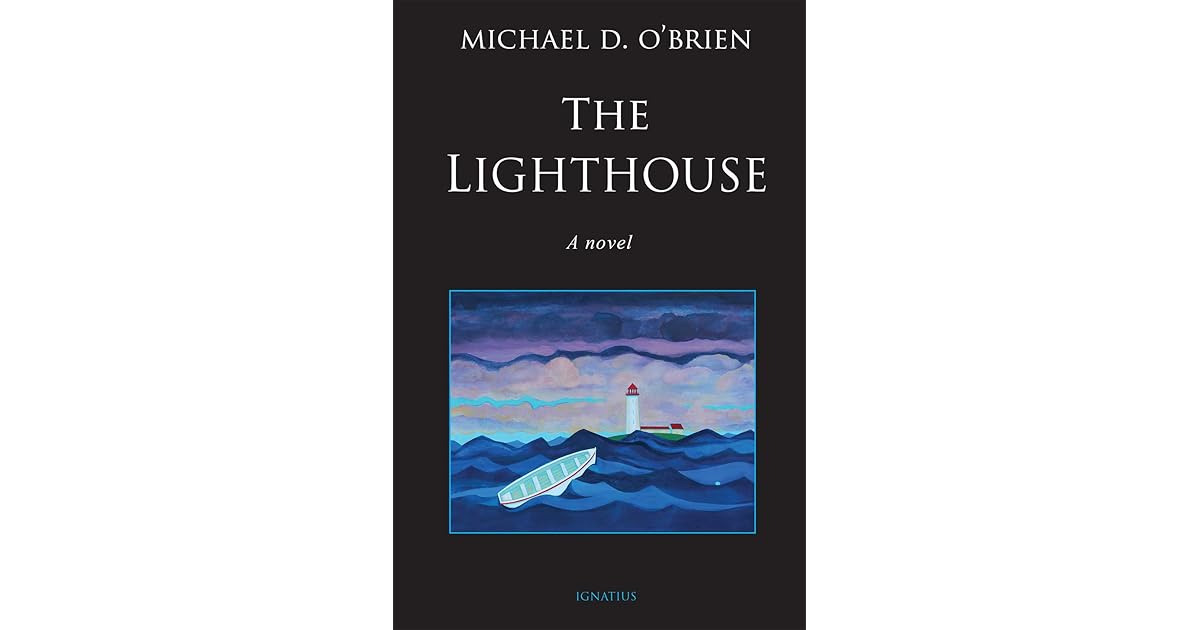
The Lighthouse: A Novel by Michael D. O’Brien, Post #3

This is the third post on Michael D. O’Brien’s novel, The Lighthouse: A Novel.

You can find Post #1 here.  

Post #2 here.  


Summary

Chapters 5 & 6

Chapter 5: Save Us from Peril

A week or two after those four intruders showed up to Ethan’s island, Ethan noticed a fifth, a boat about a quarter mile south, and when Ethan espied it through his telescope he could see a man on board wrapping metal chains around himself and uncoupling the boat’s motor.  Ethan realized the man was about to drown himself with the weight of the motor.  He stripped himself down, heroically swam to the boat, pulled himself up, and physically stopped the man from continuing.  In the struggle, the man hit his head, became unconscious, and was profusely bleeding.  Ethan slowed the bleeding down, drove the boat to town, and was then able to get the man to a hospital emergency room.  Later when the man, whose name was Esau “Skillsaw” Hurly, awoke at the hospital, he and Ethan got into a confrontation on why Esau tried to kill himself.  In the dialogue we learn that Esau was the man who had burned the church down and we also learned he had been abused as a child.  Ethan developed bronchitis from having been in the cold water and could not visit Esau again for three weeks.  In the interim, Esau died. Ethan heard Hurly’s life story from Elsie who had known Hurly as a young man.

Chapter 6: The Visitor

In July, a sixth intruder came to the lighthouse, a young marine biologist who was boating along the shore and stopped at the island to talk to Ethan.  The young man was Ross Campbell, and he was a talker.  Ross was particularly interested in puffin birds.  Ethan took him to their nests, and when the talk shifted to boats Ethan showed him the boat he had refurbished but had not yet launched.  After some resistance, Ethan agreed to let Ross help him launch it.  It would be a project of several days.  Before the final moment of dropping her into the water, Ross realized that Ethan had forgotten to rig the boat with items to dock her.  Ross volunteered to take his boat into town and buy the necessary hardware.  When he came back, they installed the equipment and dropped the boat into the water and docked her.  Still there was no motor to take the boat out.  Although Ethan was paying for one, the two decided to go into town to get an inexpensive one.  After haggling with the boat equipment supplier, Ethan and Ross took back a motor and other accessories and by that afternoon had the Puffin out on the ocean.  With a boat now, Ethan was able to get back and forth to town more easily.  He brought Elsie a gift, a small model boat Ethan sculpted that matched the Elsie’s husband’s boat.  During the autumn he made a four foot replica of an eighteenth century ship and left it anonymously at the doorstep of the newly rebuilt church.


###

Thoughts and observations on Chapter 5, “Save Us from Peril”

I thought the chapter with Skillsaw Hurly the best written in the book so far.  Skillsaw Hurly turns out to be the most three dimensional character in the book.  He is bitter and cynical, and has done a very evil act (setting fire to the church) but we get to learn of his hurt, or at least intuit it.  We suspect he’s been abused as a child, possibly by a priest, and so his core being is not simply evil.  There are causes to his persona, reasons for his alcohol addiction, and justifications for his bitterness and cynicism toward the Catholic Church.  In his bitterness and perhaps repulsion of his act, he has reached a level of despair, and so wants to commit suicide.  Wrapping the chains across his body to allow him to drown is almost a visual of a crucifixion.  His life has been a scourging at the pillar, and his recurring drinking bouts is an effort to find peace.  And finding peace is trying to find Christ.

I also thought the writing and especially the dialogue in this chapter was superior to anything we have read so far.  O’Brien created realism in this chapter, not clichéd characters and stock situations.  I’m going to give an extended quote here because I thought this was outstanding.  Ethan is visiting Skillsaw in the hospital trying to get him to reveal why he tried to kill himself.


They stared at each other until Ethan grew tired of it and said:


   “Why would you want to kill yourself?”


   “It was an accident,” the old man growled.


   “That was no accident.”


   “Who are you anyway? Police?”


   “I’m the lighthouse keeper. I found you and brought you in.”


   “Well, good for you. You’re a hero. Don’t you call the cops on me, ‘cause I ain’t gonna let nobody send me to the loony bin. And I need a drink.”


   There was nothing to say to that, so Ethan asked again:


   “Why did you do it?”


   “Ah, no reason. It was just time to check out.”


   Ethan continued to sit, staring at the man, wanting to go, though he couldn’t. And couldn’t say why he couldn’t.

Ethan looking at Hurley is suggestive of looking into a mirror.  Both men have had childhood trauma.  Ethan’s trauma could have manifested into alcoholism as well, but perhaps by the grace of God didn’t.  Technically Hurley is Ethan’s doppelganger, his literary double.  The dialogue continues.


   “You can leave now,” said Hurley. “Have a nice day.”


   “I’m not leaving.”


   “Tough guy, eh?”


   “I’m not leaving. And you’re going to tell me why you tried to kill yourself.”


   “Lots of good reasons.”


   “Give me one.”


   “None o’ your business.”


   “You made it my business. I had to swim out to your boat. It was a long way, and the water was cold. I untied you and stopped your bleeding. I got your motor hooked up again, and then I brought you here. That’s about half a day of my life. Probably a case of bronchitis too.”


   “Don’t try t’ guilt me out. It won’t work.”


   Ethan coughed. “Maybe pneumonia, if it takes hold. A little explanation would be appropriate.”


   There’s a five-dollar word. You’re a smart fellow, aren’t you?”


   “Not so smart. But I’m wondering why.”


   “Nice guy saves town drunk. Hero goes home to his happy life. Bad Boy Skillsaw goes back to the bar.”


   But even as he said it, Hurley averted his eyes and kept them averted. Beneath the bitterness, the mask of cynicism, there was a measureless grief.

“A measureless grief.”  Hurley is hurt, hurt inside, and can’t overcome it.  “Measureless” is like at the bottom of an ocean, the bottom of which he was going to drown himself.


   Ethan was not a demonstrative person, neither a toucher nor a hugger, mainly because there had never been anyone who had stayed around long enough to show him how it was done—or how to receive it. Now, tentatively, he reached out and patted Hurley on the shoulder.


   “Get yer hands off me!” the old man snarled.


   “I’m sorry.”


   “Nobody touches me. I been touched before. I know what it’s all about.”


   Tears began leaking out of one eye, then the other.


   Ethan had no idea what this might mean, so he waited. Time stretched painfully long, then it slowed, and Ethan felt the eternalness he sometimes experienced while gazing at the sea. A sort of peace, an inner stilling.

I found this interesting and yet puzzling.  Why would Skillsaw’s tears given Ethan the impression of eternity?  And why would it suggest “a sort of peace, an inner stilling”?  Perhaps there is something cathartic to Ethan to come across another person’s inner trauma.


   Hurley turned his head and met Ethan’s eyes.


   “Back then, I told myself I’m not a bad person,” he said.


   “I don’t think you’re a bad person,” mumbled Ethan.


   “You understand nothing. Let me finish my story.”


   Ethan nodded. “Please, go ahead.”


   “Gimme ten dollars, and I’ll tell you an appropriate story.”


   “I don’t have ten dollars with me.”


   “Ten dollars buys a good bottle o’ wine or a jug of bad rum, like home-still Newfy Screech. Ever drink screech?”


   Ethan shook his head.


   “Interesting. So now you know.”


   “Now I know what?”


   “My life ain’t worth ten dollars. Or maybe I’m saying it’s worth only ten dollars, but nobody’s got the cash to spare.”


   “I don’t understand, Mr. Hurley.”


   Hurley snorted. Hurley, is it? My, you’re respectful. Polite. A nice man you are, sure enough. You’re one o’ the good guys, not one o’ the bad guys, like me.”


   “Are you a bad guy? I don’t think so.”


   “Well, not in the beginning, maybe. It starts when you think you’re not the kind who does bad things. Then, little by little, so quiet, so slow you hardly notice it, like a lamprey hooking onto a salmon, sucking out its life without being noticed, you do small wrongs that get bigger and bigger, and more of them. First you’re standing on dry land watching the tide come in. You can hardly see it change. It looks harmless. Then before you know it your feet are wet, and soon your legs. And then you’re swimming for your life, because you told yourself that you couldn’t drown—not you—‘cause you’re the good guy.”


   “Mr. Hurley,” said Ethan, his voice soothing, trying to calm him, reaching out to pull the blanket up around the trembling unshaven neck. With his free hand the old man batted Ethan away.


   “Evil,” he croaked.


   “What evil?” Ethan asked.


   “You’re sinking and your head is full o’ darkness, but you keep saying to yourself, ‘This is right; this is good.’ But you know deep inside yourself that wrong isn’t right and right isn’t wrong, so you make yourself blinder, do more evil because evil was done to you and life owes you.”

The dialogue continues to where Hurley confesses to the arson and justifies it on the hypocrisy of the Church.  Hurley defines himself by his hurt, a rightful hurt, but when you define yourself by the hurt it is impossible to overcome it.  Does Ethan define himself by his hurt?  Has he overcome it?  We’ll have to see.


###

Thoughts and observations on Chapter 6, “The Visitor" 

I don’t really have a lot to say about this chapter.  Ross Campbell is a nice young man who bonds with Ethan, and though reluctant Ethan bonds with him.  In a way, Ross is Ethan without the childhood trauma.  Their relationship demonstrates Ethan’s lack of worldly experience given that a young man half of Ethan’s age seems to know the ways of the world better.  On the other hand, Ross could be Ethan’s son, and there is a sort of fatherly relationship Ethan projects.  [Edit: I did not know at the time Ross would turn out to be Ethan’s biological son.] Ross will come back in subsequent chapters, so unlike a lot of the other characters that cross Ethan’s life, Ross is structurally part of the story. 

I will say this, I don’t find Ross that interesting a character, but we don’t know much about him yet.  Perhaps O’Brien will give us more of his backstory. 

Other than Skillsaw Hurley, the novel really lacks interesting characters to hold interest.  And I’m afraid to say that goes for Ethan as a character.  We are at the 60% mark in the novel and I cannot say I am engaged with any of the characters.  The only character that was interesting was killed off in one chapter.

Let me speculate on what a different novel might have looked like.  What if O’Brien had run the narratives of Skillsaw and Ethan in parallel with intertwining connections with some climax toward the end of a major conflict between the two.  The Skillsaw part of the narrative could have started early and we could have seen the dramatization of burning the church and Ethan trying to figure out what happened and who did it.  Call me crazy, but I think that’s a more engaging story than this.


###

Ellie’s Comment:

I think the premise of this book is very good, it's just that for me, the execution lacked in many places. Like you said, Manny, there was a lack of characters that I cared for, frankly. It was a good book, just not a great one.


And honestly, this book was pretty predictable and full of schematic and kind of shallow characters that just did not do it. I wish some of the passages about building the boat would be replaced with getting deeper into Ethan's mind, because it feels like, even after finishing the book, that I don't know him at all.


I will say that I think the building and repairing of the boat stands for a sort of universal call to creating (or sub-creating, as Tolkien would say), being engaged in any creative process, trying to utilize the materials and the skills that the one Creator gave us. I found the passages about the building and repairing of the boat quite engaging, actually, but... it just lacked some spark?


I think Ross was meant to be... a vision of Ethan, like you said Manny. A vision of something he never was and could now never be, but something/somebody he could now appreciate.

Kerstin’s Comment:

The boat launching is rather tedious. I found myself skimming through the paragraphs. Do I really need to know every little step in the process? In second-rate novels minutia is often piled on as filler that adds nothing to the furthering of the plot. This is where the wheat and the chaff are separated, the good authors from the mediocre.

Am I going too far?

My Reply to Both:

I agree with both of you Ellie and Kerstin. Yes there is symbolism but symbolism in the absence of interesting characters or interesting drama doesn’t create reader engagement. No, you are not going too far. I felt the same.


I’ve read the next two chapters and will put up a summary soon, but the minutia of their work will be even more excruciating in those chapters.

My Comment:

It occurred to me after thinking about our comments on the two dimensionality of O’Brien’s characters whether it was intentional.  Before Michael O’Brien was a writer of fiction he was an artist who specialized in Byzantine icon type imagery.  Eastern Orthodox icons mandate that artistic representation be only in two dimensions.  Limiting to two dimensions, I believe, eliminates the incarnate implications and implies transcendence.  I may not understand the theology fully.  Someone help me out here if you understand the theology better than I stated.


Nonetheless, if Obrien is trying to capture an iconic effect in realistic fiction, he is writing in the wrong medium.  A novel in realism requires verisimilitude, that is the semblance of reality.  Once he established the ground rules of a “real” person in a “real” situation, then the character has to seem real, and yes one of the criteria of seeming real is three dimensional personality.  If he were writing of an elf in a fantasy world, then the ground rules might be different.  But Ethan is intended to be a real person in a fixed time and place with the ground rules of what the reader experiences of reality. 


Could O’Brien have intended Ethan and all the characters to be two dimensional?  I don’t know, but probably not.  It is a thought given O’Brien’s other artistic interests.  Since the novel does work in the medium of realism, I would assume O’Brien intended the characters to feel real. 


By the way, working in realism does not imply that O’Brien could not have incorporated metaphysical elements such as talking to his sculptures.  It comes across as creepy because of the execution not because it violated some aspect of fiction.

###

Retrospective Thoughts Post Reading of the Novel

Skillsaw remains the most interesting character in the novel, one that O’Brien should have weaved deeper into the plot.  He is Ethan’s doppelganger and we will see that Ross too becomes Ethan’s doppelganger.  In a comment later in the novel, I will surmise that the most interesting novel out of these three characters would have been the lines of the lives of Ethan, Skillsaw, and Ross in parallel and then interweaved together.  The “Save Us From Peril” chapter was the best written, the freshest dialogue, the most interesting of all the chapters in the book. 



Thursday, November 6, 2025

The Lighthouse: A Novel by Michael D. O’Brien, Post #1

We recently read Michael D. O’Brien’s The Lighthouse: A Novel as part of a group read at my Goodreads book club, Catholic Thought.  I am going to post my summaries, my detailed thoughts as we made our way through each chapter, and any pertinent discussion that was stimulated as part of my comments.  This is the first of what I think will take about five or six posts here on the blog.


This is my first Michael D. O’Brien novel read, and frankly I did not know what to expect.  I had heard of him and had wanted to read one of his novels.  Afterall he may be the most distinguished Catholic writer of fiction writing today.  But his more well known works can run anywhere from 500 to 1000 pages, and I never had the time to commit to such a long read. 

Here are some facts about O’Brien that you can easily find on the internet.  He is Canadian, born and raised, and still living there.  He was an agnostic youth but had a conversion to Catholicism when he was twenty-one years old.  He began drawing and painting as a young man but started writing fiction at the age of forty-six in 1994.  His first published novel was Father Elijah in 1996.  He writes, paints, and speaks on Catholic themes. 

###

Summary

Chapters 1 & 2

Chapter 1: The Island

We meet Ethan McQuarry, a young man in charge of taking care of a lighthouse off the coast of Cape Breton Island in Canada.  Ethan was apprenticed to an old man who used to care for the lighthouse but the old man died and Ethan was left to run it.  Ethan is a quiet man, finds solace in solitude of lighthouse life.  The lighthouse is situated on a smaller island that in low tide the water allows for a sandy connection to the mainland.  Ethan spends months isolated in the lighthouse but will go to the mainland to get supplies.  He has been on the island now for many years.  There is a deep hurt in Ethan’s past, a wound from his family that has shaped his life and personality. 

Chapter 2: The Boat

A storm had washed up a boat from the sea onto the lighthouse island, wedging it between sea rocks. It was damaged but reparable, and Ethan saw the possibility of returning it to its splendor. Little by little he got the boat free and got it into a shed beside the house. Working in his spare time, he restored the boat, bit by bit, over the course of ten years. He called the boat Puffin after the seabirds that frequented the island. Then he carved a wooden puffin as a figure piece for the boat. Throughout the chapter we get bits of exposition of his story. He had been abandoned by his father before he was born, and his mother was a dysfunctional alcoholic who also abandoned him when he had reached an age of maturity. He was short and lived in streets and woods and though of smaller size he was a feisty fighter. He met a girl and loved her, but she too left him. His solace came in books, and he read voraciously. In books he found learning and knowledge and a better way to live. 


###

My Comment:

Before I give any of my thoughts, let me just say that I come to this novel not having read anything by Michael O’Brien, and I have not read this novel before. My insights may not be as sharp or on target in some of our other fiction reads. Just a disclaimer. 😉


One thought I’ve had as I have read the first two chapters is that the situation owes a little something to Ernest Hemingway, especially his short story “A Big Two-Hearted River.” Hemingway’s story and The Lighthouse share a central character who seeks solitude after experiencing a traumatic event, and both find solace in a physical work activity within nature. In “A Big Two-Hearted River” Nick Adams has come back from WWI and I can’t remember if he was injured or shell shocked but his mental state is withdrawn into himself. The whole story is about Nick fishing by himself. Ethan too lives and works by himself. His trauma is less acute than a war experience but given the abandonment of his parents it might be deeper and more life altering. Ethan too finds solace in reading, performing the tasks of a lighthouse keeper, and rebuilding the wooden boat and crafting the wooden puffin that will be the boat’s head piece. Both characters keep down the emotions of their trauma with their isolation and the working of their hands.


You can read  “A BigTwo-Hearted River” here, though I don’t know if it has typos and mistakes not in the published story. Nick’s trauma is not mentioned in the story, but he is a character in a series of stories, so we know of his trauma elsewhere.


I found the narrative technique The Lighthouse interesting. Some people have said the story is slow. We don’t really have a story yet in two chapters. We have a character and a setting, and there is a lot of exposition but a story requires that the character overcome an obstacle or come in conflict with something or have some goal to accomplish. We don’t really have that here yet. Compare this with Lord of the Rings. Frodo has a quest to take the ring across the world to destroy it, and he comes in conflict with all sorts of obstacles and characters who wish to stop him. We don’t have that here at all, though I admit it’s just two chapters.


Still it is not pure exposition. There is a passage of time, and I’m fascinated by how O’Brien narrates that passage of time. In the first chapter, the expository focus is the island on which the lighthouse is situated, and O’Brien describes the physical characteristics of the island, the lighthouse, and the town nearby, but he also tells us how Ethan came there and became the lighthouse keeper, and by the end of the chapter O’Brien has summed up quite a number of years.


The focus of the second chapter is the boat, and O’Brien brings us back in time to tell us how a boat one day washed up on the island, and then traverses the same time as in the first chapter telling us how Ethan over ten years refurbished the boat. The years were the same for both chapters, but there was no mention of the boat in the first chapter. O’Brien has circled back to fill in what didn’t fit into the first chapter. What you have is this circling narrative that gives power to the central image of each chapter, that is the island and lighthouse in the first and the boat in the second. The images are symbolic, yes, but they also become icons.


I have more thoughts on the narrative style, but I’ll leave it here for now. I want to see if O’Brien continues in this way or whether he gives us that obstacle for Ethan to overcome.


Ellie Comment:

I am reading this book faster than I should, I hope you will forgive me for it. The story just... sucks you in and I love how meditative, slow but also fast the passage of time seems. The writing feels... simple; more simple than I'm used to, but I like it. I like that O'Brien doesn't use more words than is necessary (I know I am guilty of this when writing). I can't wait to hear others' thoughts!

Kerstin Comment:

The name ‘Ethan’ is Hebrew in origin and means firm, enduring, and long-lived, like a rocky island. And his last name, McQuarry, as in rock quarry, underscore this sense of permanence.

My Reply to Kerstin:

Oh I didn't realize that about the name Ethan. I thought it was Irish Gaelic. But you are right. 


Interesting about the rock roots in his last name. There are the sea rocks that protect the shore from the waves. The boat in chapter 2 is washed up and wedged between the sea rocks.

###

Some observations from chapter 1, “The Island”

There is a lot of symbolism in the novel.  The fact that the island is connected by a strip of land that is walkable only when the tide is low symbolizes Ethan and his isolated, though connected, state.


The island was visibly connected to the mainland only at certain ebb tides, which revealed a narrow bar of packed sand and sea-rounded stones of various colors, a natural causeway extending for just under a mile. It was wide enough for three men to walk abreast upon, and perhaps at its driest it might have supported a motor vehicle with good tires, though in its long history this had never occurred, as no man had been willing to risk it, not even in the days of horse and cart, for the ebb was short and the sands unreliable.

Is that really possible?  Even if there is a strip exposed when the tide goes down, wouldn’t the sand be so soggy it would be not be walkable?  I don’t know.  I’ve never seen such a strip of land.

Ethan has this thought when the librarian saves a book that she thought would interest him.  This comes after she strongly admonished him for bringing a book late.


This is the way people are, he thought. These are habits of speech, of manners and disposition. These are wounds and tempers. These are frail breakwaters that guard the harbor of the soul.

Is that the central theme of the novel?  It strikes me as a thematic statement.

By the way, that pdf link of the book I provided Ellie has a lot of typos in it.  I had to fill in what it left out from that quote.

There seems to be a theme of longing for the opposite sex.


In those days, too, he would glance at the young women he passed on the street, yearn for them, and then turn his gaze in another direction. He had a general sense that he was good-looking, with a nice face that drew eyes to him, and a sturdy frame, balanced and taut with muscle. But he also knew that no one would wish to live with him on the island, not even in the bond of marriage, and that love would inevitably founder on the rocks and he would be left desolate. Moreover, his deepest passion was for the lighthouse, which had become life for him. Many of the young women had thickened and greyed over the years, and though they still nodded at him in recognition, they did not initiate conversation, nor did he.


I would have loved you forever, he would think as he passed them with a lift of his cap, though we would have broken each other’s hearts.

This is quite normal for a young man, but in chapter three Ethan takes this to a very strange place.


###

Some observations on Chapter 2, “The Boat”

1. Time is amorphous in this novel.  It is awfully hard to tell, at least so far, where in time certain events occur in Ethan’s life.  In a stream of conscious, Ethan himself locates the moment the boat washed up.


How old was he then? Maybe late twenties? He looked a fair bit younger and regretted the fact, for age and experience seemed to him a more desirable state than that of youth.

In the first chapter we are told that Ethan was eighteen years old when he first came to the island.  So the boat washes ashore about ten years after he began.  We should also note that the old lighthouse keeper died in Ethan’s first year there.  He started his job at eighteen. 

2. We should note that, despite his lack of education, Ethan is a voluminous reader.  


His mind was hungry for it all. He had not persisted in high school beyond grade ten, for he had been forced by abandonment and other circumstances to take to the bush, sweating and freezing in logging camps during two long winters, feeding the pulp and paper mills of mainland Nova Scotia and New Brunswick.

He is not just a voluminous reader, but one who absorbs much and is able to quote Shakespeare from memory.  To some degree this pushes credibility for me.  I don’t think I have actually met people who dropped out of high school in their second year and had such an intellectual nature as a young man, especially since the time in between was spent on the streets and “bush.”  I know that Michael O’Brien himself did not go to college.  It seems he modeling Ethan on himself to some degree.  I wish I knew more about O’Brien’s life so that I can see what he uses from personal experience and what he doesn’t.

Throughout it all, one of the things that motivates Ethan is a drive to learn.


Now, all these years later, he continued to stock his mind with interesting tales, with practical knowledge, and with vocabulary, learning and remembering. To learn is to survive. To learn is to come closer to finding the key. To learn is to feel the immensity of life, and its sweetness, even in its awe and sadness.

Learning seems to be associated with the transcendence.

3. The refurbishing of the boat brings out the theme of craft.  Again this harkens back to Hemingway who used craft as a theme in a great deal of his works.  Ethan’s handiwork with wood echoes St. Joseph the carpenter and perhaps Jesus Himself.


Year after year, his daylight hours were preoccupied with the boat. He was in no hurry, and he wanted the job to be done right. Working in the shed that linked the tower and the cottage, its double doors open wide for light, he was restoring its former glory by degrees. During the winters he eased off, but always with the return of spring he ached to get back into the shed. One whole summer was spent steaming and bending the planks he had shipped in as replacements for the broken strakes. Another summer, he built a forward deckhouse, so small that no more than a single man, or maybe a man and a half, could fit inside it. The following year he scraped the hull and repainted it white. The next winter brought too much snow, and due to staring at white-on-white for countless hours, he had learned that a stroke of color made anything greater than the sum of its parts. So when the warm weather returned again, he painted the hull’s gunwales and the cabin’s trim a brilliant red.

One can’t help thinking that these amorphous years in Ethan’s life mirror the so called missing years of Jesus’s life when all we know is that he worked as a tektōn , which is the Greek word for artisan or craftsman.  Wikipedia has a good explanation of tektōn, especially as it pertains to Joseph and Jesus.  

4. In addition to working as a craftsman, Ethan also strives for artistry.  His slow but deliberate generation of a puffin figure piece out of wood is artistry.  He is recreating nature into a fine art piece. 


Day after day, he sat in a corner of the kitchen that he had cleared for the purpose, examining the lines and grain of the log, the log cut down to three feet high, braced temporarily by a square of timber he had bolted into its base. Tentatively at first, with uncertainty of hand, he tapped with wooden mallet and steel chisels, learning the art by trial and error. Though he suffered cuts and splinters, he saw that his droplets of blood absorbed by the wood were part of his investment in the boat, in the figurehead which represented it, for instinctively he knew that any abiding love would have a cost.


In short order there was a good smell in the room, replacing its customary atmosphere of rarely washed clothes, rarely washed man. The curl of a wood shaving doing what it should do as it parted from the main form, fulfilling hopes and estimations, gave Ethan joy—sometimes a laugh of pleasure.


Oh, now I see how you will be, what you will become. You will be beautiful, and I will love you


The shavings drifted onto the floor and were often left there for the night or a few days. Now and then he swept them up and saved them in an old burlap bag for the spring, when he would have his first bonfire of the season, and he would call to the puffins sporting in the surf and tell them about the great Puffin.


   These are its feathers. These are the losses that make it what it will become.

The “day after day” beginning of the paragraph echoes the “year after year” of the paragraph on his work refurbishing the boat.  But here it is not functionality that is Etan’s prime concern, but beauty.

5. All these elements—reading, learning, craftsmanship, artistry—seem to aim for another central theme, that of a life lived simply is a life lived well.  He refrains from joining regular society because it is too complicated. 


The traffic [on the shortwave] he listened to was mainly marine, though he also spoke with land-bound ham operators, exchanging information about the places where they lived. Now and then, one or another would call him to ask about coastal weather, usually during bad storms. The calls were never long, just checking in, distant people collecting entries for their logbooks. The simplicity of Ethan’s life and his dearth of opinions was not conducive to dialogues.

The simplicity of life is in stark contrast to the outer world.  Ethan stands apart like a lighthouse, and in his simplicity provides society a sturdy foundation from its ever evolving flotsam. 

6. At the end of the chapter, Ethan reflects he is “almost forty.”  He has given the boat ten years.  So we can now piece together that his first ten years were spent learning to be a lighthouse keeper and the second ten working on restoring the boat.

###

Kerstin Replied to My Comment:

Manny wrote: "Is that really possible? Even if there is a strip exposed when the tide goes down, wouldn’t the sand be so soggy it would be not be walkable? I don’t know. I’ve never seen such a strip of land.

It is. In the North Sea, the Channel, and other places in the North Atlantic you have plenty of islands that are connected to the main land at low tide and cut off at high tide. The sea is so shallow the distance and land exposed between low and high tides is huge. It is also quite dangerous if you’re not aware of the tide schedules should you get caught too far out from the shore.
The most famous of these islands is Mont Saint Michel in France. The causeway was raised at some point to have access at all times, though I’ve also heard they are considering reversing it. I don’t know where it stands now. We visited many years ago, but the tourist masses were so enormous we turned around and left. If you ever go, go in the off season.
Some islands in the North Sea belonging to Germany and the Netherlands have farms on them and are completely isolated during high tides.


 Mont Saint Michel at high tides


 Mont Saint Michel at low tide


Celia Comment:

Manny, I am so thankful that you described Chapters 1 and 2 so well. Through your description, I see that Chapter 1 is like an overview. We see Ethan over many years, kind of at a high level. Then we start digging into his past. First there is the boat he found and restored. It takes him 10 years. We also learn of his love of books. We learn of the people who have abandoned him. I now see Ethan as a man very glad to be alone because so many people have betrayed him. At 5 foot 4 inches, he is small of stature but feisty. But he would never use his talents to hurt any one. I was intrigued by his journal entries: Why do people hurt each other was one of his items. Very interesting and thought provoking book so far.

Kerstin Comment:

In the first chapter we get a sense how isolated Ethan sees himself from the people who live nearby on the mainland. He truly is an island to himself. He is not bothered by his isolation but rather welcomes it. He doesn’t think his life touches anyone else, so being sequestered away and manning the lighthouse is the perfect occupation for him.


The second chapter gives us insights into his broken childhood and we get a better sense why he prefers his isolation. He works on his boat for 10 years and still has to launch it. What is the purpose of this boat? In the first chapter we get the sense that given the rocky nature of the island a boat could be more of a liability than an asset.

Celia Comment:

Chapter 1 Summary: “The Island” is both a setting and a soul chapter. The island itself becomes a character, mirroring Ethan’s interior life—rugged, isolated, sometimes bleak, sometimes startlingly alive. Ethan approaches his lighthouse duties with method and reverence, every action careful and disciplined. These routines reflect both his strength and his loneliness, raising a central question: is his life one of chosen solitude, or imposed isolation? In this opening chapter, we glimpse Ethan’s whole life at a high level—like a sketch waiting to be filled in. We sense that he is a troubled man, though the reasons remain hidden. As the story unfolds, O’Brien will begin to drill down into the details of Ethan’s past—his family, his relationships, the events that shaped him.


Chapter 2 “The Boat” marks the first intrusion of the outside world into Ethan’s solitary life. Finding the boat is more than an event—it interrupts the self-contained world we saw in Chapter 1. In literature, boats often symbolize passage, transition, or messages from beyond the horizon. For Ethan, restoring the abandoned lifeboat becomes a metaphor for his own long journey of healing from childhood wounds, including abandonment by both father and mother. He invests twenty years in making the boat seaworthy, carving a puffin as its masthead and naming the vessel Puffin. He even considers buying a motor to make it easier to navigate. By the time the restoration is complete, Ethan is forty years old—a man who has poured decades of discipline and longing into transforming something broken into something capable of carrying him forward.

My Reply to Celia:

Celia wrote: "Chapter 1 Summary: “The Island” is both a setting and a soul chapter. The island itself becomes a character, mirroring Ethan’s interior life—rugged, isolated, sometimes bleak, sometimes startlingly..."

Yes, the island mirrors Ethan's interior life. I called it symbolic but I think mirroring is a better description. Your central question is interesting: "is his life one of chosen solitude, or imposed isolation?" It seems chosen to me, but who or what did you have in mind that it was imposed?


Celia wrote: "Chapter 2 “The Boat” marks the first intrusion of the outside world into Ethan’s solitary life. Finding the boat is more than an event—it interrupts the self-contained world we saw in Chapter 1. In..."

The refurbishing of the boat does seem like a process of healing from his childhood trauma. But after he finishes, I don't see any sign of being healed. The most I can see is a certain satisfaction and consolation from the work. But I think healed goes a bit too far, if I may disagree with you. How do you see any healing?

My Reply to Kerstin:

Kerstin wrote: "Manny wrote: "But he also knew that no one would wish to live with him on the island, not even in the bond of marriage, and that love would inevitably founder on the rocks and he would be left deso..."

This childhood trauma has definitely shaped his person. We will see a longing for a proper mother and family in the coming chapters, and his satisfaction with isolation comes from the trauma, perhaps escaping the trauma. Though I will say that from what is dramatized he seems to handle human relationships well. Is there a relationship he doesn't handle well? We will see him interact more in the next two chapters.

### 

Retrospective Thoughts Post Reading of the Novel

I think we all liked the setting, situation, and premise initiated in the novel.  We were intrigued by the symbolism of Ethan setting himself off either because of his childhood trauma or because he sought a simplicity of life or of both.  The two can and are probably related.  Ethan seeks the simplicity of life because of the trauma.  The lighthouse on a loosely connected island is a symbol for isolation from society but still tethered to society, and yet it is also a symbol of deliverance.  We will see the selfless act of deliverance at the climax, but if such a suggestion was in the early chapters we did not pick up on it. 

Finding the boat will have implications for the climax of the novel and of Ethan’s fate.  We can see in retrospect O’Brien setting up seeds from providence that will providentially develop to fate.