"Love follows knowledge."
"Beauty above all beauty!"
– St. Catherine of Siena

Showing posts with label Pope Benedict XVI. Show all posts

Thursday, March 28, 2024

Triduum Meditation: Holy Thursday Washing of the Feet

So we come to the Paschal Triduum—the three days that leads to the Resurrection on Easter Sunday.  I’m not going to have a meditation for every day of the Triduum in one year, but I thought I could do one of the days every year for the next three years.  I’ll do them in order, so today, this year, I will provide a meditation on Holy Thursday.

Holy Thursday—also called Maundy Thursday—commemorates the Last Supper but we celebrate it in a liturgy composed from Gospel of John’s version of the Last Supper.  More specifically we highlight Jesus’s washing of the Apostles’ feet.  The Gospel reading describes the action.


Before the feast of Passover, Jesus knew that his hour had come

to pass from this world to the Father.

He loved his own in the world and he loved them to the end.

The devil had already induced Judas, son of Simon the Iscariot, to hand him over.

So, during supper,

fully aware that the Father had put everything into his power

and that he had come from God and was returning to God,

he rose from supper and took off his outer garments.

He took a towel and tied it around his waist.

Then he poured water into a basin

and began to wash the disciples’ feet

and dry them with the towel around his waist.

He came to Simon Peter, who said to him,

“Master, are you going to wash my feet?”

Jesus answered and said to him,

“What I am doing, you do not understand now,

but you will understand later.”

Peter said to him, “You will never wash my feet.”

Jesus answered him,

“Unless I wash you, you will have no inheritance with me.”

Simon Peter said to him,

“Master, then not only my feet, but my hands and head as well.”

Jesus said to him,

“Whoever has bathed has no need except to have his feet washed,

            for he is clean all over;

so you are clean, but not all.”

For he knew who would betray him;

for this reason, he said, “Not all of you are clean.”


So when he had washed their feet

and put his garments back on and reclined at table again,

he said to them, “Do you realize what I have done for you?

You call me ‘teacher’ and ‘master,’ and rightly so, for indeed I am.

If I, therefore, the master and teacher, have washed your feet,

you ought to wash one another’s feet.

I have given you a model to follow,

so that as I have done for you, you should also do.”

~Jn 13:1-15


Fr. Geoffrey Plant explains the historical and Biblical contexts of Maundy Thursday. 


There is one interesting fact that Fr. Geoffrey cites that was startling to me.  He cites Fleming Rutledge’s observation (starting at the 27:00 min mark) that Christ washing his feet in His loin cloth is a corresponding image to Christ in His loin cloth on the cross.  This is not just a foreshadowing but an amplification of the action Christ’s self-sacrificing love teaches from the cross.  I also love the quote Fr. Geoffrey takes from Pope Benedict XVI, from I think Pope Benedict XVI’s Jesus of Nazareth: Holy Week.  Speaking of the foot washing, Pope BXVI says,


Jesus represents the whole of his saving ministry in one symbolic act.  He divests himself of his divine splendor; he, as it were, kneels down before us; he washes and dries our soiled feet, in order to make us fit at the table for God’s wedding feast.

There is one observation on the washing of feet that no one in any of the homilies I sampled across the internet makes, and so this perhaps is a peculiar observation to me.  So if I’m wrong, you can blame me.  So the connection to the washing of feet, or more specifically the lowering of a king to a servant for the sake of his subject can be found with King Rehoboam in First Kings, Chapter 12.  King Rehoboam is the son of King Solomon and the successor to the throne, but King Rehoboam faces a crises.  Jeroboam from the northern Israel is threatening to divide the kingdom by rebelling Israel against Judah.  Why, Jeroboam asks, should Israel subject herself to his authority when Rehoboam and his father have been so tyrannical over Israel?  King Rehoboam seeked advice for an answer.  Jeroboam, confronts him.


(4) “Your father put a heavy yoke on us. If you now lighten the harsh servitude and the heavy yoke your father imposed on us, we will be your servants.”

(5) He [King Rehoboam] answered them, “Come back to me in three days,” and the people went away.

(6) King Rehoboam asked advice of the elders who had been in his father Solomon’s service while he was alive, and asked, “How do you advise me to answer this people?”

(7) They replied, “If today you become the servant of this people and serve them, and give them a favorable answer, they will be your servants forever.”

(8) But he ignored the advice the elders had given him, and asked advice of the young men who had grown up with him and were in his service.

(9) He said to them, “What answer do you advise that we should give this people, who have told me, ‘Lighten the yoke your father imposed on us’?”

(10) The young men who had grown up with him replied, “This is what you must say to this people who have told you, ‘Your father made our yoke heavy; you lighten it for us.’ You must say, ‘My little finger is thicker than my father’s loins.

(11) My father put a heavy yoke on you, but I will make it heavier. My father beat you with whips, but I will beat you with scorpions.’”

(12) Jeroboam and the whole people came back to King Rehoboam on the third day, as the king had instructed them: “Come back to me in three days.”

(13) Ignoring the advice the elders had given him, the king gave the people a harsh answer.

(14) He spoke to them as the young men had advised: “My father made your yoke heavy, but I will make it heavier. My father beat you with whips, but I will beat you with scorpions.”

(15) The king did not listen to the people, for this turn of events was from the LORD: he fulfilled the word the LORD had spoken through Ahijah the Shilonite to Jeroboam, son of Nebat.

(16) When all Israel saw that the king did not listen to them, the people answered the king:

“What share have we in David?*

We have no heritage in the son of Jesse.

To your tents, Israel!

Now look to your own house, David.”


So Israel went off to their tents. (1 Kings 12:4-16)

Notice the King Rehoboam’s receives two sets of advice.  From the elders he is advised: “If today you become the servant of this people and serve them, and give them a favorable answer, they will be your servants forever” (7).  He is first advised to be a servant king.  Who today on Maundy Thursday do we celebrate in a liturgy replicating His actions as a servant King?  Jesus Christ in the washing of the feet.  Does King Rehoboam take this advice to be a servant king?  No as we see in the very next line (8).  He goes on to ask advice from his childhood buddies, and they advise him to put on an even heavier yoke than the heavy yoke his father had put on Israel (10-11).  And this is what he tells Jeroboam (14) and Jeroboam and Israel break away and divide the kingdom (16).  So King Rehoboam is an anti-archetype to King Jesus, negatively foreshadowing Christ’s foot washing.  Notice to the language of “heavy yoke” Rehoboam uses.  Notice how that contrasts with Jesus speaking about His yoke in Matthew eleven:

o

(28) “Come to me, all you who labor and are burdened,* and I will give you rest.

(29) Take my yoke upon you and learn from me, for I am meek and humble of heart; and you will find rest for yourselves.

(30) For my yoke is easy, and my burden light.” (Mt 11:28-30)


Meditation: “Do you realize what I have done for you?”


Sunday, January 29, 2023

Sunday Meditation: The Beatitudes

Today we come to Jesus’ greatest sermon.


When Jesus saw the crowds, he went up the mountain,

and after he had sat down, his disciples came to him.

He began to teach them, saying:

"Blessed are the poor in spirit,

for theirs is the kingdom of heaven.

Blessed are they who mourn,

for they will be comforted.

Blessed are the meek,

for they will inherit the land.

Blessed are they who hunger and thirst for righteousness,

for they will be satisfied.

Blessed are the merciful,

for they will be shown mercy.

Blessed are the clean of heart,

for they will see God.

Blessed are the peacemakers,

for they will be called children of God.

Blessed are they who are persecuted for the sake of righteousness,

for theirs is the kingdom of heaven.

Blessed are you when they insult you and persecute you

and utter every kind of evil against you falsely because of me.

Rejoice and be glad,

for your reward will be great in heaven."

~Mt 5:1-12

The first part of the sermon are the Beatitudes, eight keys to happiness.  Bishop Barron’s homily explains them well.


Let’s look at the first and third since they are similar but promise two very different things. 

"Blessed are the poor in spirit, for theirs is the kingdom of heaven.”

“Blessed are the meek, for they will inherit the land.”

To be poor in spirit and to be meek are nearly synonymous, are they not?  And yet one promises heaven, and the other promises land.  How are we to understand this land?  Pope Benedict XVI explains it.


“The Israelites spent forty years in the desert to arrive at the Promised Land. After they were taken captive to Babylon they waited seventy years to return to their own land. Land is always associated with right worship. Moses’ original demand of Pharaoh was to let the Israelites leave Egypt so they could worship in their own way. The Israelites were exiled to Babylon because they had abandoned right worship for idolatry. So yes, the promise of land is literal in the Old Covenant, connected with faithfulness to God’s covenant. The land is, as Benedict calls it, “a space for obedience, a realm of openness to God, that was to be freed from the abomination of idolatry.” The idea of land was gradually broadened. The Samaritan woman inquires of Jesus: “Our fathers worshipped on this mountain, but you say that in Jerusalem is the place where people ought to worship.” Jesus replies, “Woman, believe me, the hour is coming when neither on this mountain nor in Jerusalem will you worship the Father . . . . But the hour is coming and now is, when the true worshipers will worship the Father in spirit and truth.” (Jn. 4:20-22) The king who rules “from sea to sea” promises a universal place of worship and obedience to God. Thus the land is no longer a piece of earth, but the whole earth, and that is Christ’s Church. Does the beatitude then refer to the land in a physical or a spiritual sense? Again—both, the one and the other.” (Jesus of Nazareth: From Baptism in the Jordan to the Transfiguration, pp 80-81)

Of all eight beatitudes, the third is the only one that is not beyond this world.  And yet it is!

Saturday, December 31, 2022

In Memoriam: Pope Emeritus Benedict XVI

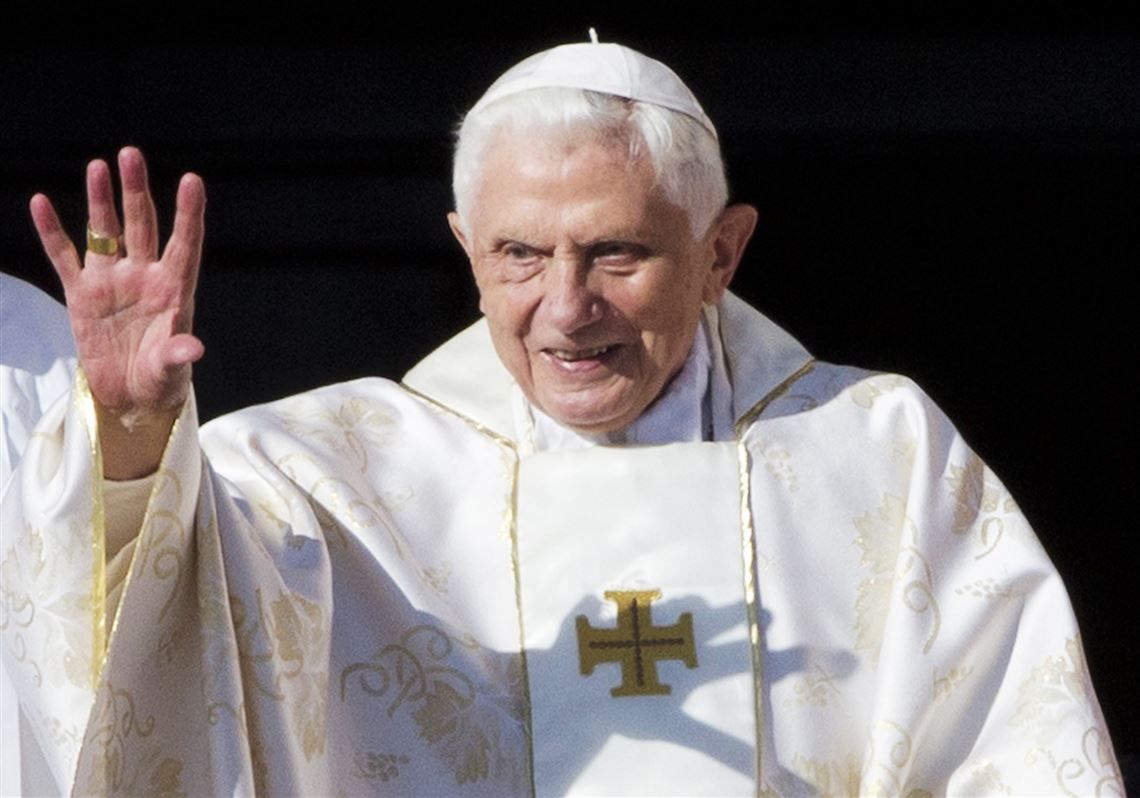
Early this morning, as many of you probably know, our beloved Pope Emeritus Benedict XVI passed away at the age of 95. Where do I even begin to summarize his epic life?  He lived through almost a hundred years of eventful history, participated in some of it directly, and wrote about the theological implications of most of it.  He wrote 66 books, three Church Encyclicals, four Apostolic Exhortations, and a number of major speeches.  His output was immense.  He was one of the key intellectuals behind the Vatican II Council, and an intellectual guide for the papacy of his predecessor, Pope John Paul II.  Through it all, and there were many who demonized him both within and outside the Church, he was a gentle man, a lover of the arts, a man of prayer and spirituality.  One aspect of his character that seems to go unnoticed was his humility.  He was an intellectual giant of the type I deeply respect and have always wanted to emulate.  In short, he was my favorite pope of my lifetime.

From what I gathered surfing around the news world, Pope BXVI (my shorthand for Pope Emeritus Benedict XVI) will be remembered for being the first pope in almost 600 years to resign the office.  I have seen criticism of it, but he was 85, frail, in not the best health, and trying to perform the duties of the modern era.  He went on to live ten years, but from accounts he did not expect to live a year. 

If you want a general perspective on his life, writings, and thoughts, this article from Aleteia, Benedict XVI,the pope of surprises” did what seems to be a thorough job.    

There are many theological ideas that Pope Benedict explored and commented on, but he had a way of bringing out their societal implications.  For instance, he first observed how the relativism of faith has had implications on our society, a concept he called “the dictatorship of relativism.” 


“Today, a particularly insidious obstacle to the task of education is the massive presence in our society and culture of that relativism which, recognizing nothing as definitive, leaves as the ultimate criterion only the self with its desires,” he said in an address in Rome in 2005. “And under the semblance of freedom it becomes a prison for each one, for it separates people from one another, locking each person into his or her own ego.”

Can you see how gay marriage and what I’ll call the relativism of gender has flowed from what contemporary society has determined to be a lack of fixed truths? 

You can easily find the highlights of his life, so I’m not going to list them.  Instead I’m going to embed a video where Bishop Robert Baron puts Pope Benedict XVI’s life and ideas into context.  It’s just over a half hour. 


Finally, BXVI was a great lover of music, and from what I understand an accomplished pianist.  Aleteia  also has an article on BXVI’s favorite musical pieces, and it’s a good deal of Mozart and Bach.  

He seemed to have a special love for Mozart.  From the article:


Pope Benedict XVI once described one of his early encounters with the music of Mozart, while attending a Mass penned by the great composer. He described Mozart’s treatment of the Mass as “music that could only come from heaven; music in which was revealed to us the jubilation of the angels over the beauty of God.” He added:


“The joy that Mozart gives us, and I feel this anew in every encounter with him, is not due to the omission of a part of reality; it is an expression of a higher perception of the whole, something I can only call inspiration out of which his compositions seem to flow naturally.”

The article also goes on to say that the first concert Joseph Ratzinger ever attended was a performance of Mozart’s Requiem Mass.  So as a fitting conclusion to this post, I want to conclude this post with three pieces from “The Requiem in D minor, K. 626.”  First the Introit and Kyrie which are here together.


The third piece will be the Domine Jesu, an appeal to Christ to save the soul of the dead.  


Here are the lyrics in English.


Lord Jesus Christ, King of glory,

deliver the souls of all the faithful departed

from the pains of hell and from the bottomless pit:

deliver them from the lion's mouth,

that hell swallow them not up,

that they fall not into darkness,

but let the standard-bearer holy Michael

lead them into that holy light:

Which Thou didst promise of old to Abraham and to his seed.

That is just so beautiful.  I am certainly saddened by the death of my beloved BXVI.  But given his age, and watching my mother struggle with old age, I can see how it is eventually a blessing.  May Pope Emeritus Benedict XVI continue to bless us from above. 


Eternal rest grant unto him,
O Lord, and let perpetual light
shine upon him.


Saturday, March 7, 2015

Word of the Day: Joy

I’ve been reading Pope Benedict’s Jesus of Nazareth: The Infancy Narratives and came across this fascinating little passage on the word rejoice.  It certainly would have been fitting if I had posted this during the Christmas season, but I read this recently and it’s fresh in my mind.  The Holy Father is discussing the Annunciation to our Blessed mother.

A striking feature of the angel’s greeting is that he does not address is that he does not address Mary with the usual Hebrew salutation shalom—peace be with you—but with the greeting formula chaîre, which we might translate with the word “Hail,” as in the Church’s Marian prayer, pieced together from the words of the annunciation narrative (cf. Lk 1:28-42).  Yet at this point it is only right to draw out the true meaning of the word chaîre: rejoice!  This exclamation from the angel—we could say—marks the true beginning of the New Testament.   (p. 26)

[Quotes are from Image edition, 2012]

So it when Gabriel comes to the Virgin, he isn’t just greeting her with “Hail Mary,” he is greeting her with “Rejoice Mary.”

The word reappears during the Holy Night on the lips of the angel who says to the shepherds: “I bring you good news of great joy” (Lk 2:10).  It appears again—in John’s Gospel—at the encounter with the risen Lord: “The disciples were glad when they saw the Lord” (20:20).  Jesus’ farewell discourses in Saint John’s Gospel present a theology of joy, which as it were illuminates the depth of the word.  “I will see you again and your hearts will rejoice, and no one will take your joy from you” (16:22). (p. 26-27)

Gladness in the John 20:20 quote is synonymous with joyous.  Here then is the conflation of several Biblical events to the word “joy.”  This observation is quite significant.

Joy appears in these texts as the particular gift of the Holy Spirit, the true gift of the Redeemer.  So a chord is sounded with the angel’s salutation which then resounds throughout the life of the Church.  Its content is also present in the fundamental word that serves to designate the entire Christian message: Gospel—good news.  (p. 27)

Pope Benedict wrote this in German, so something might not have been completely conveyed in the translation.  Gospel or “good news” is sometimes translated as “glad tidings,” which can therefore be translated as “joyous tidings.”  So then at the heart of Christian faith is joy.  This is what the Holy Father means above by “the theology of joy.”


And that is so true.  What separates my life from the moment I fell in love with my faith—not just embraced it, but fell in love with it—is the joy that I feel afterward.  I’m not even sure I know how to describe it other than to say it’s joy, but a joy beyond common joy, a supernatural joy.  I’ve tried to describe this to atheists or even just routine, non-devout Christians.  They understand it because it’s a foreign feeling to them.  It’s not like the joy that I get from following baseball.  I do get joy from that, but it’s not the same as the joy from Christ.  That’s divine joy.