"Love follows knowledge."
"Beauty above all beauty!"
– St. Catherine of Siena

Showing posts with label The Waste Land. Show all posts

Tuesday, November 29, 2022

Literature in the News: T.S. Eliot’s “The Waste Land,” the 100th Year Anniversary

It crossed my attention that the great T.S. Eliot poem, The Waste Land, had its 100th anniversary of its publication this October.  I would like to commemorate the anniversary with two posts actually.  This post, and then I want to post one of my poetry analyses of a section of the poem.  Only a section.  The poem, which is divided into five parts, contains 434 lines, and I would add densely packed lines of meaning.  That’s just too much for one poetry analysis.

So in this commemorative post, I’d just like to summarize the importance of The Waste Land.  A place to start is perhaps from the Yale university site, Modernism Lab, a site devoted to modernist literature.  From their article, “The Waste Land,” by Pericles Lewis.


The Waste Land was quickly recognized as a major statement of modernist poetics, both for its broad symbolic significance and for Eliot’s masterful use of formal techniques that earlier modernists had only begun to attempt. The critic I. A. Richards influentially praised Eliot for describing the shared post-war “sense of desolation, of uncertainty, of futility, of the groundlessness of aspirations, of the vanity of endeavour, and a thirst for a life-giving water which seems suddenly to have failed.” Eliot later complained that “approving critics” like Richards “said that I had expressed ‘the disillusionment of a generation,’ which is nonsense. I may have expressed for them their own illusion of being disillusioned, but that did not form part of my intention.” Nonetheless, it was as a representative of a postwar generation that Eliot became famous. To compare Eliot’s comments on the poem with the way it was received illustrates strikingly the fact that, as William K. Wimsatt and Monroe Beardsley put it, “The poem is not the critic’s own and not the author’s (it is detached from the author at birth and goes about the world beyond his power to intend about it or control it). The poem belongs to the public.” The Waste Land made use of allusion, quotation (in several languages), a variety of verse forms, and a collage of poetic fragments to create the sense of speaking for an entire culture in crisis; it was quickly accepted as the essential statement of that crisis and the epitome of a modernist poem.


Let me use that passage to highlight the elements and significance of the poem.  The first thing to point out is that the poem had a great influence on subsequent poetry and literature.  It is a difficult poem to read for (1) it’s fragmentary style and (2) heavy use of allusion, often obscure allusions.  I will point out in my future post why both these elements of the poem’s style are important.  On the other hand, it can be an easier poem to understand because the lines are frequently, if not mostly, prosaic.  Concentrated lines that must fit meter, line length, and rhyme scheme sometimes can be difficult to unpack.  Eliot’s individual lines are simpler.  But the frequent dislocations between parts and subparts can leave the reader bewildered.  Modernism was looking for an aesthetic to convey the particular nature of our contemporary life, and Eliot’s poem and James Joyce’s novel Ulysses, both published in 1922, are the two works cited that define Modernism.


Second, the poem captured the disillusionment of an age.  Eliot undercuts that thought in the quote inside that passage, but the central image of a waste land was perfect for capturing the post-World War I life.  It invoked the image of the trench warfare battlefield, desolated from destruction.  The war was devastating to the European nations, and it seemed like such a “waste” of a generation of men that the title rang perfectly true.  People were disillusioned in many ways, from the ideals of the war, from their governments, from life in general.  This disillusionment allowed the elements in the culture that were tearing down tradition (anti-religion, pseudo-psychology, anti-family—the same as now!) to establish themselves as normative.  The worst elements of the Enlightenment were disrupting society, and that causes disillusionment in one’s traditions.  The poem really did capture a disillusionment.  As an aside, it’s no better today, if not worse!


Third, the poem shaped literature for the next century, and still does.  There are countless references, allusions, and emulations to The Waste Land in novels, poetry, drama, and even film.  From poets.org, in their review of “What the Thunder Said: How The Waste Land Made Poetry Modern” the legacy of Eliot’s poem is summarized as such:


The Waste Land has a double legacy. It’s the milestone that vaulted its author to considerable fame and influence, culminating with the Nobel Prize in 1948. It has held a permanent place in the pantheon of modern poetry since its publication in 1922. It has been an intimidating lump in the syllabus for generations of undergraduates, and a chastening puzzle to graduate students. But The Waste Land is not only a poem; it names an event, like a tornado or an earthquake. Its publication was a watershed, marking a before and after. It was a poem unequivocal in its declaration that the ancient art of poetry had become modern.


It would be a major undertaking to detail the legacy of The Waste Land.  Novelists such as Ernest Hemingway, F. Scott Fitzgerald, Evelyn Waugh, Ford Maddox Ford, and more, would have strong allusions to the poem in their works.  Poets such as W.H. Auden, Wallace Stevens, Sylvia Plath owe much to the style and themes of The Waste Land.  Indeed, the very opening from traditional poetic forms can be traced to the poem.  In that respect, so much of the 20th century’s poetry bears a direct influence to Eliot and his poem.  And in drama, let’s not forget that Samuel Beckett’s play, Waiting for Godot owes much in theme and setting to the 1922 poem.


I should also mention that the title is The Waste Land, in two words, not “The Wasteland” as I have been historically prone to write.  Eliot himself was very specific about this.  From the website, T.S. Eliot:


The title, by the way, is not 'The Wasteland' but 'The Waste Land'. The only exact translation of the title is one which my French translator, Jean de Menasce, discovered, although alas! too late to use in his version – 'La Gaste Lande'. This is absolutely the exact equivalent as it alludes to the same mediaeval fiction.


(Eliot in a letter to Angel Flores, 22 February 1928)
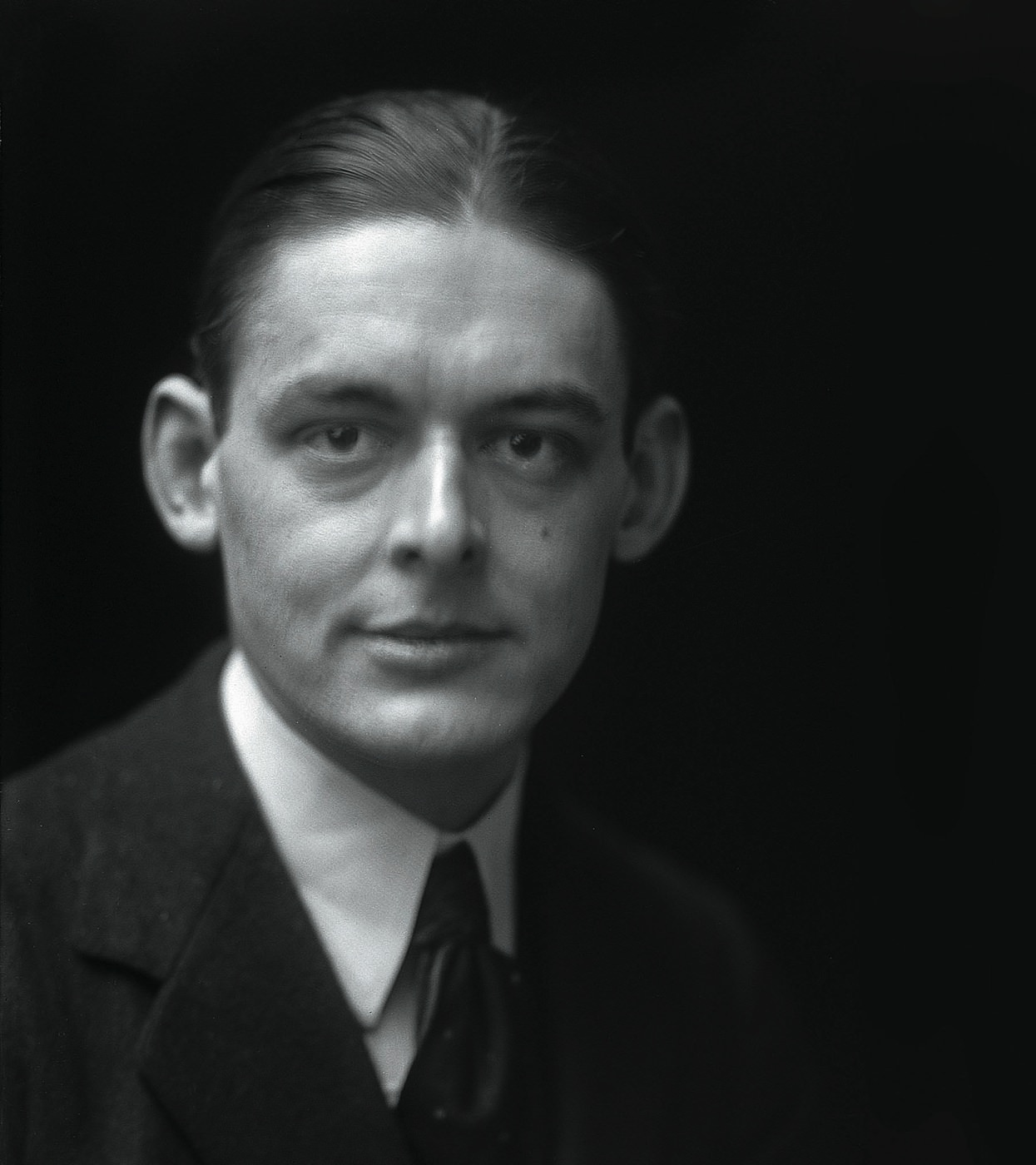


Finally, here are some of my favorite passages from the poem.


From Part I, “The Burial of the Dead”:


What are the roots that clutch, what branches grow

Out of this stony rubbish? Son of man,

You cannot say, or guess, for you know only

A heap of broken images, where the sun beats,

And the dead tree gives no shelter, the cricket no relief,

And the dry stone no sound of water. Only

There is shadow under this red rock,

(Come in under the shadow of this red rock),

And I will show you something different from either

Your shadow at morning striding behind you

Or your shadow at evening rising to meet you;

I will show you fear in a handful of dust.  (ll. 19-30)


From Part II, “A Game of Chess”:


The Chair she sat in, like a burnished throne,

Glowed on the marble, where the glass

Held up by standards wrought with fruited vines

From which a golden Cupidon peeped out

(Another hid his eyes behind his wing)

Doubled the flames of sevenbranched candelabra

Reflecting light upon the table as

The glitter of her jewels rose to meet it,

From satin cases poured in rich profusion;

In vials of ivory and coloured glass

Unstoppered, lurked her strange synthetic perfumes,

Unguent, powdered, or liquid—troubled, confused

And drowned the sense in odours; stirred by the air

That freshened from the window, these ascended

In fattening the prolonged candle-flames,

Flung their smoke into the laquearia,

Stirring the pattern on the coffered ceiling.

Huge sea-wood fed with copper

Burned green and orange, framed by the coloured stone,

In which sad light a carvéd dolphin swam. (ll. 77-96)


From Part III, “The Fire Sermon”:


At the violet hour, when the eyes and back

Turn upward from the desk, when the human engine waits

Like a taxi throbbing waiting,

I Tiresias, though blind, throbbing between two lives,

Old man with wrinkled female breasts, can see

At the violet hour, the evening hour that strives

Homeward, and brings the sailor home from sea,

The typist home at teatime, clears her breakfast, lights

Her stove, and lays out food in tins.

Out of the window perilously spread

Her drying combinations touched by the sun’s last rays,

On the divan are piled (at night her bed)

Stockings, slippers, camisoles, and stays.

I Tiresias, old man with wrinkled dugs

Perceived the scene, and foretold the rest—

I too awaited the expected guest.  (ll. 215-30)


From Part IV, “Death By Water”:


A current under sea

Picked his bones in whispers. As he rose and fell

He passed the stages of his age and youth

Entering the whirlpool.  (ll. 315-18)


From Part V, “What the Thunder Said”:


Here is no water but only rock

Rock and no water and the sandy road

The road winding above among the mountains

Which are mountains of rock without water

If there were water we should stop and drink

Amongst the rock one cannot stop or think

Sweat is dry and feet are in the sand

If there were only water amongst the rock

Dead mountain mouth of carious teeth that cannot spit

Here one can neither stand nor lie nor sit

There is not even silence in the mountains

But dry sterile thunder without rain

There is not even solitude in the mountains

But red sullen faces sneer and snarl

From doors of mudcracked houses  (ll. 331-45)


If you haven’t read it recently (or ever!) you can read it at Poetry Foundation.


After reading it, then listen to what I consider the definitive rendition by Jeremy Irons and Eileen Atkins.  Irons reads the male voices and the narrator’s voice while Atkins reads the female voices. 


Shantih, shantih, shantih. 

Wednesday, July 17, 2013

Short Story Review: Hills Like White Elephants By Ernest Hemingway


“Hills Like White Elephants” is one of the many great Hemingway short stories.  I may have said this elsewhere, but I’ll also say it here.  Hemingway was over rated as a novelist.  The Sun Also Rises I think stands as his one great novel but his other novels are either OK (such as A Farewell To Arms) or not so good.  His greatness rests with his short stories and shorter than novel length works such as The Old Man and the Sea and his memoir, A Moveable Feast.   Some of his short stories are the best ever written.  If you enjoy reading short stories, get yourself The Complete Short Stories of Ernest Hemingway: The Finca Vegia Edition, which is the most comprehensive collection.  It contains “The First Forty-Nine Stories,” which were collected during Hemingway’s life time, and I assume the stories he considered his magnum opus, but it also pulls together the other existing stories, ones that were published during his lifetime and others which have been found and published posthumously. 

I have owned “The First Forty-Nine Stories” for a long time, well before they started collating the other stories into a collection.  If by chance you come to a used book sale and you find it at a real cheap price, get it instead of The Complete Stories.  The first forty-nine are the great ones.  I’ve read two of the unpublished and they were not remarkable.  I don’t know if the ones outside the forty-nine contain any gems but they probably don’t stack up.  The last few years I’ve been reading three to five sequentially of the forty-nine every year as I make my way to reading them all.  I’m just about a little half way.


Very little that Hemingway wrote is available free on the internet.  He mostly published after the1923 cutoff for free distribution.    However for some reason “Hills Like White Elephants” is currently available online as a pdf.  It’s only four or five pages long, so if you wish to follow this analysis and you don’t have the story, you can read ithere.  It’s a quick read.

The first thing you might ask is what the heck is this story about.  The couple (the man is referred to as the American and the female as “the girl,” though the man at one point calls her Jig) talks about some sort of medical procedure he wants her to undergo.  When I first read this story as a very young man, I could never pick up what they were talking about.  I did find out later that the procedure is an abortion.  This story is essentially a discussion on whether the girl should accept having one.  You can read the story’s Wikipedia entry. 

Here’s the situation.  The couple is sitting outside at a train station bar in Spain.  They decide to have some drinks while they wait for the next train, observing the rural terrain before them and the hills in the distance.  It’s hot, they drink a few beers and in between try an anise based liquor that is advertised.  They talk about the hills, the liquor, and the sort of meaninglessness of their lives.  Then the conversation turns toward the procedure, and that makes up for the bulk of the story.  When the train’s arrival is imminent, the man moves the baggage to the other side of the station, and while inside the bar has another drink alone, and goes out to the girl.  You wouldn’t think that’s much of a story, but what makes this great is what is unsaid and the tension of the conversation.


Before I get to the analysis, there are three questions I think the reader must try to answer in order to come to a conclusion on what this story is about.  First, is the man in the story trying to manipulate the girl into having the procedure?  Second, is Hemingway sympathetic to the man or to the girl in their conflict?  Finally, is the girl more worried about the morality of the abortion or her relationship with the man?

The story’s structure divides into three parts: the part where they discuss the liquor and their wasteful lives, the part where they discuss the procedure, and the conclusion where the man steps away and has a drink inside the bar. 

The first part situates the story and identifies it with the sort of life characterized by T.S. Eliot as a waste land.  Here’s a key passage from the first part.  The man and girl are discussing the Anis del Toro drink.

“Yes,” said the girl.  “Everything tastes of licorice.  Especially all the things you’ve waited so long for, like absinthe.”

“Oh, cut it out.”

“You started it,” the girl said.  “I was being amused.  I was having a fine time.”

“Well, let’s try and have a fine time.”

“All right.  I was trying.  I said the mountains look like white elephants.  Wasn’t that bright?”

“That was bright.”

“I wanted to try a new drink.  That’s all we do, isn’t it—look at things and try new drinks?”

“I guess so.”

 
A number of reasons why their lives are associated with Eliot’s characterization of modern life.  First, they say it: all they do is look at things and drink, a soulless existence.  Second this story was written in 1927 when the influence of Eliot’s The Waste Land was most prominent in literary culture and just after Hemingway’s novel, The Sun Also Rises, of post WWI waste land life.  This story is a variation of similar characters in that novel. 

 
Another reason is the allusion to absinthe.  Characters in The Sun Also Rises drink absinthe.  It was a banned drink in many places around the world, including the United States.  You can read about it here and here, but in addition it was associated with satanic activity.  It’s an allusion to a life of the damned and with people who are heading to hell.  Another reason for the Waste Land association is the fertility motif in the description of the landscape and the fact that the girl is pregnant.  Abortion also figures in The Waste Land as I mentioned it earlier this year when I blogged on the poem.

The second part of the story features the key discussion, but what I think one needs to fully ascertain the dynamics between the couple is the tone within the dialogue.  Here’s the beginning of that section.


“It’s really an awfully simple operation, Jig,” the man said.  It’s not really an operation at all.”

The girl looked at the ground the table legs rested on.

“I know you wouldn’t mind it, Jig.  It’s really not anything.  It’s just to let the air in.”

The girl did not say anything.

“I’ll go with you and I’ll stay with you all the time.  They just let the air in and then it’s all perfectly natural.”

“Then what will we do afterward?

“We’ll be fine afterward.  Just like we were before.”

“What makes you think so?”

“That’s the only thing that bothers us.  It’s the only thing that’s made us unhappy.”

The girl looked at the bead curtain, put her hand out and took hold two of the strings of beads. 

“And you think then we’ll be all right and be happy.”

“I know we will.  You don’t have to be afraid.  I’ve known lots of people that have done it.”

“So have I,” said the girl.  “And afterward they were all so happy.”

“Well,” the man said, “if you don’t want to you don’t have to.  I wouldn’t have you do it if you didn’t want to.  But I know it’s perfectly simple.”

 
The tone of the dialogue is critical to understanding the moral implications.  It would be unclear if the girl is worried about the immorality of an abortion or having concerns for her health.  One has to read the line “And afterward they were all so happy” as dripping with sarcasm to come to the conclusion that, despite what the man thinks, the girl is not worried about her health but on something else.  It’s shortly thereafter the girl agrees to have the procedure: “Then I’ll do it.  “Because I don’t care about me.”  What is foremost on the girl’s mind is a return to what apparently once was a loving relationship.  The pregnancy has altered the couple’s romance.  The conversation continues. 
 

“You’ve got to realize,” he said, “that I don’t want you to do it if you don’t want to.  I’m perfectly willing to go through with it if it means anything to you.”

“Doesn’t it mean anything to you?  We could get along.”

“Of course it does.  But I don’t want anybody but you.  I don’t want anyone else.  And I know it’s perfectly simple.”

“Yes, you know it’s perfectly simple.”

“It’s alright for you to say that, but I do know it.”

“Would you do something for me now?”

“I’d do anything for you.”

“Would you please please please please please please please stop talking?”

 
Here you can hear the sweat talking tone of the man, and the agitation and sarcasm of the girl that tells us it’s more than the surface issues for her.  Hemingway’s skill at dialogue is on display there.  Notice too that the girl is in a position of power.  She’s the one who dictates the conversation.  The man just simply repeats.

 
The final section of the story is a bit mysterious.  The waitress (referred to as “the woman”) comes out with another order of beers and tells them the train will be arriving in five minutes.
 

“What did she say?” asked the girl.

“That the train is coming in five minutes.”

The girl smiled brightly at the woman, to thank her.

I’d better take the bags over to the other side of the station,” the man said.  She smiled at him.

“All right.  Then come back and finish the beer.”

He picked up the two heavy bags and carried them around the station to the other tracks.  He looked up the tracks but could not see the train.  Coming back, he walked through the barroom, where people waiting for the train were drinking.  He drank an Anis at the bar and looked at the people.  They were all waiting reasonably for the train.  He went out through the bead curtain.  She was sitting at the table and smiled at him.

“Do you feel better?”

“I feel fine,” she said.  There’s nothing wrong with me.  I feel fine.”

 
Why does Hemingway go through the trouble of this little drama?  He could have concluded the story without it.  He purposely gives her time to think by herself.  He had the beer waiting at the table, why have a drink at the bar?  I can’t fully answer that.  Perhaps it suggests a future separation.  And why does the girl suddenly feel fine.  Has she accepted her fate or has she made up her mind to back out?

Before I present some of my conclusions, I wanted to highlight the dualism that’s all over the story.  We have the dualism of the male and female, the dualism of the hot day and the cool drinks, the sun and the shade, the flat plain before them and the hills in the distance, inside the station and outside, the youth of the girl and the age of the woman that is the waitress, the fertility on one side of the station and the brown and dry sterility of the other side, the two sides of the river which divides into opposite banks.  Why the dualism?  Several reasons.  It subtly heightens the tension between the man and Jig.  It reduces the conflict to elements, and here it may point to an Adam and Eve elemental allegory.  It points to an elemental choice of yes or no.  It suggests a portal that one must cross through.. 

It’s because of that dualism that I believe the key symbol of the story is not the hills that look like white elephants but the curtain of beads that separates the bar from the outside.  The Wikipedia entry has it correct.  The hills form a point of discussion between the couple that distinguishes male and female perceptions.  That in turn underscores the difference in the way the man looks at the abortion (as a health issue) and the girl (as an issue regarding their relationship).  The curtain is that portal of choice that has to be crossed.  Notice how many times in the story the girl looks at or plays with the beads. 

So let’s return to the three questions. 

Is the man in the story trying to manipulate the girl into having the procedure?  I would say so.  He repeats the same “it’s perfectly simple” line.  And while he says he will honor either decision, he never paints a picture of a future with the baby.  That would have reassured her of their future.  He only walks her through the procedure.  And even that delay at the end of the story where he stops to have a drink alone while she waits for him outside is a sales tactic where the salesman has made his pitch and now leaves you to think through the decision.  If he’s made his sales pitch right, you will come to his decision. 

Is Hemingway sympathetic to the man or to the girl in their conflict?  I would say he’s sympathetic to the girl.  She has morality on her side, and the man’s motivation seems to be to keep this wastrel lifestyle going.  So many of Hemingway’s stories have a male figure as a stand in for the author.  And normally that male figure is a protagonist.  The man may still be a Hemingway stand in this story as well, but I think it’s quite clear he’s not a protagonist; he’s an antagonist.  The girl actually has the most insightful moment of anyone.  It happens in the second section, where in the middle of their dialogue the girl gets up.
 

The girl stood up and walked to the end of the station.  Across, on the other side, were fields of grain and trees along the banks of the Ebro.  Far away, beyond the river, were mountains.  The shadow of a cloud moved across the field of grain and she saw the river through the trees.

“And we could have all this,” she said.  “And we could have everything and every day we make it more impossible.”

“What did you say?”

“I said we could have everything.”

“We can have everything.”

“No, we can’t.”

“We can have the whole world.”

“No, we can’t.”

“We can go everywhere.”

“No, we can’t.  It isn’t ours any more.”

“It’s ours.”

“No, it isn’t.  And once they take it away, you never get it back.”

‘But they haven’t taken it away.”

“We’ll wait and see.”

“Come on back in the shade,” he said.  “You mustn’t feel that way.”

“I don’t feel any way,” the girl said.  “I just know things.”

 
What she sees in a transcending vision is a paradise lost.  Her insight is that there will be a loss of innocence no matter what the decision.  If she has the baby, they can’t be children any more.  If she has the abortion, she will have crossed a moral divide, and it’s not really clear that her relationship will be repaired.  Either way, innocence will have been destroyed.  The shade signals a darkness.

Is the girl more worried about the morality of the abortion or her relationship with the man?


Her agreeing to have the abortion suggests she what she really wants is the loving relationship she once had with the man to return.  She’ll do anything to get it back, but I think she realizes that no matter which choice she makes the relationship will never be the same.  Her decision to go through with it is almost exactly midway into the story.  There is more to the story than making the decision.  This is a story about a loss, almost an Edenic loss.  That allusion to paradise lost suggests a decision that is sin.  She too never paints a picture of what life will be like with the baby.  She never envisions the baby.  It remains abstract, almost as if it will never be born.  When she looks at the waitress toward the end of the story, the girl looking at the woman, I can’t help but feel that’s a suggestion that the girl will become a woman now.  That realization is why she suddenly feels fine.    


Now I could be wrong.  What do you think?

Friday, June 21, 2013

Audio: The Waste Land Read by Jeremy Irons and Eileen Atkins


I must tell the world about this recording.  It’s a BBC production of T.S. Eliot’s famous poem, The Waste Land read by Jeremy Irons and Eileen Atkins.  It is not only the best reading of The Waste Land that I have ever heard—and I’ve heard a few—but it might be the best reading of any poem of considerable length that I have ever heard.  Run, don’t walk, to this BBC site and, not just listen to, right click and save the recording to your computer.  I don’t know how long the BBC will keep this available to the general public.  Many of their recordings become CDs that you will have to purchase.  If you have an interest in literature, you will want this forever.

 First, I must give a hat tip to Joseph Susanka of the blog Summa This, Summa That for bringing itto my attention. 

Second, read along with this hyper linked with split screen notes, internet posting of The Waste Land.  One of the things that make this poem hard to understand is the many cultural and literary allusions, both explicit and furtive, that lend meaning to the line and to the larger themes.  The notes and hyper links help identify and clarify the allusions.

The Waste Land (readthe Wikipedia entry) is the single most important poem in English (possibly in the world but I can’t speak for other languages) of the 20th century.  I’m not going to expound on the poem here.  I’ll save that for next year (my readings have already been planned for this year) where I plan to post several detailed blogs that will provide my thoughts and understanding of the poem.  For now, let me say that the poem emerged from the horror that took Europe from World War I (the poem was written in 1922 but was worked on for several years prior), the culture (especially the loss of religious faith) that developed during and as a result of the war, and the fragmentation from the western historical identity.  WWI became a fracture point between modernism and a historical past.

 
The introduction provided by poets Jackie Kay, Matthew Hollis, Sean O’Brien and the former Arch Bishop of Canterbury, Rowan Williams, is interesting, though not all that penetrating.  Several points they bring up may need a little elucidation.  One is the motif of multiple voices within the poem.  The multiple voices is the key aesthetic of the poem and reflects the theme of fragmentation, the apparent lack of coherence.  When a work of art’s aesthetics are integral to the theme, that’s when greatness is achieved.  No one did it better than Dante in The Divine Comedy and why I consider that the single greatest work of literature ever produced.  But Eliot does it here too.  I would say that Eliot is the Dante Alighieri of the 20th century.

Another obscure point in the introduction is the reference to the poets Ezra Pound and William Carlos Williams in relationship to The Waste Land.  Ezra Pound, also a great and influential modernist poet, was Eliot’s friend, and he edited the original Waste Land manuscript.  He didn’t add any lines, but he did cut a lot of extraneous passages that clarified and crystallized the poem.  The original manuscript would not have been the great poem it has turned out to be, and Eliot recognized it.  The poem is dedicated to Pound: “For Ezra Pound/ il miglior fabbro” (Italian for “the better craftsman”). 


The William Carlos Williams reference is harder to explain.  He too is a great modernist poet, but he hated (and that’s not too strong a word) Eliot’s style and a lesser degree his themes.  Williams, who wrote in the Walt Whitman tradition of poetry, was a very harsh critic of Eliot.  The allusions and the heavily cultural identity of Eliot’s poetry was anathema to Williams.  By the way, the other great poet of the early modernist period, Wallace Stevens, kind of splits the difference from the Eliot (with Pound)/Williams spectrum of modernist style.  There must be a book on the relationships between Eliot, Pound, Carlos Williams, and Stevens—the four great modernist poets, all Americans by the way—but if there isn’t it would make for a great PhD thesis.  I think I would explore that myself if I were to ever go for a PhD.  [Disclosure: I do have a Master’s Degree in English Literature.]


What was remarkably missing from the BBC introduction was pointing out how central to the poem is sexuality.  The crisis of modernity, as portrayed in the poem, is the severing of sexuality with the divine.  The operative word is sterility, sexuality without love, without birth, without regeneration.  So much of the poem deals, both direct and implicit, with an unholy sexuality that has resulted from that severed relationship.  Loose sexuality, meaningless and loveless sexuality, abortion, rape all figure in the poem.  The several song allusions scattered about the poem are from songs of his day that had sexual innuendo of a vulgar nature.  Would Eliot, with today’s sexual music, today’s hookup culture, today’s millions of abortions, feel he was prescient or be further shocked?  I don’t know.  We are still in a waste land. 

Let me give a couple of my favorite passages.  This passage is a voice that I take to be that of God speaking:


What are the roots that clutch, what branches grow
Out of this stony rubbish?  Son of man, 
You cannot say, or guess, for you know only
A  heap of broken images, where the sun beats,
And the dead tree gives no shelter, the cricket no relief, 
And the dry stone no sound of water.  Only
There is shadow under this red rock,
(Come in under the shadow of this red rock),
And I will show you something different from either
Your shadow at morning striding behind you
Or your shadow at evening rising to meet you;
I will show you fear in a handful of dust.
(ll. 19-30)

 
And then towards the end, the rain over the wasteland finally comes in a redemptive baptism of water:

 
A woman drew her long black hair out tight
And fiddled whisper music on those strings
And bats with baby faces in the violet light  
Whistled, and beat their wings
And crawled head downward down a blackened wall
And upside down in air were towers
Tolling reminiscent bells, that kept the hours
And voices singing out of empty cisterns and exhausted wells.
  In this decayed hole among the mountains
In the faint moonlight, the grass is singing
Over the tumbled graves, about the chapel
There is the empty chapel, only the wind's home.
It has no windows, and the door swings,
Dry bones can harm no one.
Only a cock stood on the rooftree
Co co rico co co rico   
In a flash of lightning.  Then a damp gust
Bringing rain
(ll.  377-94)

 
Listen to Jeremy Irons and Eileen Atkins perform the poem.  I was skeptical before hearing it that two voices, a man’s and a woman’s, would sound correct.  After listening to it, I think for many reasons it’s inspired.  I can’t rave enough about it.