"Love follows knowledge."
"Beauty above all beauty!"
– St. Catherine of Siena

Showing posts with label Eugeniusz Kazimirowski. Show all posts

Friday, April 22, 2022

Faith Filled Friday: “St Thomas Didymus [the Twin]” by Denise Levertov

This coming Sunday—Second Sunday of Easter, “Divine Mercy Sunday”—the Gospel reading is from John 20: 19-31, the passage where St. Thomas the Apostle confronts the risen Jesus and puts his fingers into Jesus’ wounds.  I will probably have a Sunday Meditation post on Sunday for your contemplation.  Here I want to post a poem on the subject by Denise Levertov brought to my attention by my friend Mary Sue.  Denise Levertov was a British born and raised American immigrant who had a religious conversion late in life and ultimately became a Roman Catholic.  She was a poet from almost toddler years and as a child actually corresponded with T. S. Eliot, who had encouraged her.  After her religious experience, she wrote a number of Christian themed poems that I have always admired. 


St Thomas Didymus [the Twin]

by Denise Levertov


In the hot street at noon I saw him

a small man

gray but vivid, standing forth

beyond the crowd’s buzzing

holding in desperate grip his shaking

teethgnashing son,


and thought him my brother.


I heard him cry out, weeping and speak

those words,

Lord, I believe, help thou

mine unbelief,


and knew him

my twin:


a man whose entire being

had knotted itself

into the one tightdrawn question,

Why,

why has this child lost his childhood in suffering,

why is this child who will soon be a man

tormented, torn, twisted?

Why is he cruelly punished

who has done nothing except be born?


The twin of my birth

was not so close

as that man I heard

say what my heart

sighed with each beat, my breath silently

cried in and out,

in and out.


After the healing,

he, with his wondering

newly peaceful boy, receded;

no one

dwells on the gratitude, the astonished joy,

the swift

acceptance and forgetting.

I did not follow

to see their changed lives.

What I retained

was the flash of kinship.

Despite

all that I witnessed,

his question remained

my question, throbbed like a stealthy cancer,

known

only to doctor and patient. To others

I seemed well enough.


So it was

that after Golgotha

my spirit in secret

lurched in the same convulsed writhings

that tore that child

before he was healed.

And after the empty tomb

when they told me that He lived, had spoken to Magdalen,

told me

that though He had passed through the door like a ghost

He had breathed on them

the breath of a living man –

even then

when hope tried with a flutter of wings

to lift me –

still, alone with myself,

my heavy cry was the same: Lord

I believe,

help thou mine unbelief.


I needed

blood to tell me the truth,

the touch

of blood. Even

my sight of the dark crust of it

round the nailholes

didn’t thrust its meaning all the way through

to that manifold knot in me

that willed to possess all knowledge,

refusing to loosen

unless that insistence won

the battle I fought with life


But when my hand

led by His hand’s firm clasp

entered the unhealed wound,

my fingers encountering

rib-bone and pulsing heat,

what I felt was not

scalding pain, shame for my

obstinate need,

but light, light streaming

into me, over me, filling the room

as I had lived till then

in a cold cave, and now

coming forth for the first time,

the knot that bound me unravelling,

I witnessed

all things quicken to color, to form,

my question

not answered but given

its part

in a vast unfolding design lit

by a risen sun.


The poem recreates and marries two moments in the Gospels, the moment where a man asks Jesus to heal his convulsing son and when St. Thomas—the doubting Thomas—puts his finger into Christ’s open side but Levertov’s imaginative leap as to what he finds is wonderful.  Both scenes are from the perspective of Thomas, since as an apostle he would have been present at the curing of the possessed young boy.  When Thomas puts his finger in he feels “but light, light streaming/into me, over me, filling the room/as I had lived till then/in a cold cave.” 

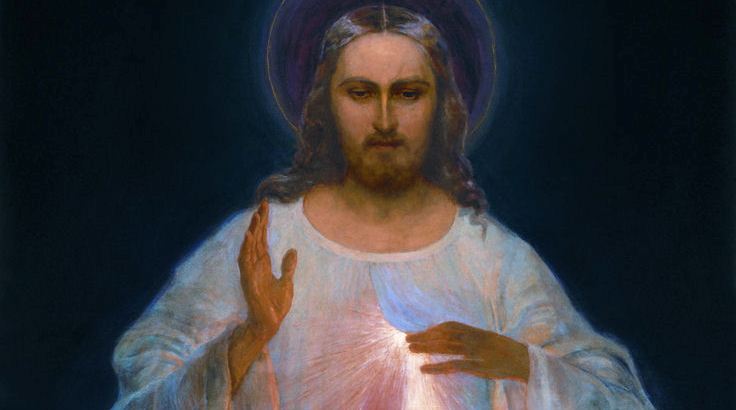
Now I don’t know how much Levertov knew of St. Faustina Kowalska and her image of Christ’s Divine Mercy, but that that light coming out of Christ’s wound has an amazing similarity to St. Faustina’s iconography.  Take a look.


 I wrote about the history of this wonderful painting St. Faustina had commissioned to capture her mystical vision, “The Divine Mercy Painting by Eugeniusz Kazimirowski” just over six years ago.  

There doesn’t seem to be a video of Levertov reading her “St. Thomas” poem, but if you like you can watch her read six poems to get a feel for her style and person.


Back to the “St. Thomas” poem.  If you’re wondering why Levertov combines the convulsing boy scene with the Doubting Thomas scene, contemplate first the struggle for the boy’s father to believe (“help my unbelief”) and what I think is the key image in the poem, the metaphorical “knot that bounds” Thomas inside his soul.  The convulsing boy, “twisted,” is a visual knot that Christ unwinds.  The boy’s father’s unbelief “knots” his insides as Thomas’s unbelief does to him.  Christ the healer “unravels” all knots.


Sunday, April 3, 2016

Art: The Divine Mercy Painting by Eugeniusz Kazimirowski [Updated]

Today is Divine Mercy Sunday, the Sunday so instituted by St. Pope John Paul II.  The idea traces back to a young Polish woman who has become one of the great saints of the 20th century, St. Maria Faustina Kowalska.  In honor of this occasion I would like to present and examine the great painting that St. Faustina commissioned to have painted based on her visions of Christ coming to her.  There are many versions which have cropped up since the original was painted back in 1934, but it is the original painting, painted by Eugeniusz Kazimirowski, that transcends. 


Last Thursday I had the great privilege to attend at my Church a private screening of a documentary on the making of the painting (“The Original Image of Divine Mercy: A Documentary”) and its convoluted history afterwards.  The death of St. Faustina in 1938, the death of the painter in 1939, the Nazi invasion, World War II, the Soviet occupation, and the communist repression of religion all caused the painting to be forgotten, abandoned, and then stored in an attic exposed to outdoor temperatures.  It is a remarkable history, which you can read here, but if you have the chance to see this wonderful documentary, do so.  Here is a movie trailer of it.


So while the original painting fell into obscurity, other painters tried their hand at St. Faustina’s description in her diary of the Christ of her visions, and their paintings took root in the culture.  That is why there are so many versions.  Of particular note is the 1943 version by Adolf Hyla, which you can see on the Wikipedia entry for the Divine Mercy image.  For me the Hyla version is most definitely inferior.  It’s less iconography and more like a cover art for a pop culture magazine.  The right hand is raised less in blessing and more in salutation; Christ’s face is Hollywoodish, the eyes don’t seem to convey mercy, and the head tilt makes Christ seem more like a buddy than God.  The more I look at the Hyla version, the more I’m turned off.

So why am I so attracted to the original Kazimirowski version? 

First, it’s restrained.  The simplicity of every element accentuates the message.  There is very little implied motion.  The right hand is fixed in position of blessing; the feet have come to a stop, though the position suggests that Christ has come forward.  The tunic hangs still, suggesting stasis.  The only motion is reserved for the left hand peeling open the lip on the tunic at the heart, letting forth divine light. 

Second, the right arm is in a position of balance and blessing.  It is directly level with the left arm, with the hand up in blessing.  Balance seems so important to the structure of the painting.  The light from the half opened lap reflects off the right hand, glowing in benediction.

Third, the dark background from which Christ comes forth is so suggestive.  One can read it as the darkness of evil and sin, or perhaps the darkness of pre-creation, or perhaps the darkness of everlasting damnation.  If the darkness contrasts behind Christ, then the bright figure of Jesus is the light of the world, the light of salvation, the light of mercy.

Fourth, the eye of the viewer is drawn in toward the light from the heart.  The lines all lead one to Christ’s heart.  The light is bright, natural, and mixed with red, suggesting the blood and water that flowed from Christ’s side.  It is not over done and completely realistic in the way it points downward as the opening from the garment flap lifts from the bottom.


Fifth, Christ’s face is perfection.  It is His face that captures me.  It is a remarkable work of realism.  The hair and the beard are so humble.  Hair can suggest ego and preening.  Not here.  The beard is scraggly, the hair thin and modestly placed.  It is a peasant’s face, not one of royalty.  The eyes are looking down.  This might be the most remarkable feature of the painting.  The eyes are not looking into the viewer’s eyes.  They are not probing you.  It is not a moment of judgement.  It is a moment of mercy, of understanding.  Here is a detail of the head to mid body. 


 The documentary said that when Kazimirowski completed the painting, St. Faustina cried, not because he had captured her vision, but because she realized it was impossible to capture it.  In a way, the painting was a collaboration between Kazimirowski, St. Faustina, and St. Faustina’s spiritual director who modeled for the Christ, Fr. Michał Sopoćko.  Every week Faustina would come to the studio and have Kazimirowski rearrange in an effort to capture her visions.  It must have been difficult for the painter to have this intense young woman stipulating her vision and forcing change upon change.  However, the final product is a masterpiece.

Jesus, I trust in you.

Update April 5th, 8:09 AM:
Great article by Paul Jaskunas in First Things Magazine on St. Faustina, the documentary, and the painting, here.