"Love follows knowledge."
"Beauty above all beauty!"
– St. Catherine of Siena

Showing posts with label Petronius. Show all posts

Friday, June 28, 2024

Quo Vadis: A Narrative of the Time of Nero by Henryk Sienkiewicz, Part 11

This is the eleventh and final post of Henryk Sienkiewicz’s historical novel, Quo Vadis.

You can find Post #1 here.  

Post #2 here. 

Post #3 here.  

Post #4 here. 

Post #5 here. 

Post #6 here.  

Post #7 here. 

Post #8 here. 

Post #9 here.  

Post #10 here.  


Chapters 72, 73, & Epilogue

Summary

Vinicius from Sicily writes a letter to Petronius.  Months have past since those climatic events in Rome.  He and Lygia are happy in their domestic life.  He writes on how his Christian religion has changed life for the better, how love as a principle transforms life.  If only Caesar and Rome could convert, the world would be so much better.  He hopes that Petronius could convert.  Petronius in the southern Italian city of Cumae, where he and the other Roman aristocracy will be departing for Greece, reads the letter knowing that his life is near its end.  He is no longer in Nero’s favor, especially since he is associated with the conspirators, and this trip to Greece is a means of isolating him for the end.  Petronius writes back expressing joy in Vinicius’s happiness, but Petronius is still philosophically a skeptic and an epicurean and so has no use for Christ.  He tells Vinicius that Tigellinus has won their struggle and he intends to die on his terms rather than allow them to take his life.  He passes on his farewell to him and to Lygia.

Petronius, still at Cumae, receives word that Nero has called for his death.  He receives the news with calm, and even sends Nero a gift.  He laughs at a plan he conceives for his final acts.  He has his servants prepare a feast at his villa and invites all the nobles.  He sits to write a letter and prepares for a banquet.  He tells Eunice that she can have his villa, and she realizes what he is going to do.  That night at the banquet, the aristocracy enjoy themselves as only at a feast that Petronius, the elegant arbiter of taste, can arrange.  Toward the end, Petronius stands, tells of his decision to end his life, and reads the letter he has composed to Nero.  In the letter he tells of Nero’s abuses, the murders, the burning of Rome, and the persecution of the innocent Christians who he used to cover his crimes.  He speaks of Nero’s terrible poetry, his horrible dancing, and atrocious singing.  He tells Nero he can no longer stand Nero’s wretched art and so he has decided to take his life.  The guests are shocked, more for their lives since associating with this letter will put them on Nero’s death list.  Petronius calls the physician over to open the vein in his arm to bleed out.  Eunice comes over and gives her arm as well to die along with her beloved.  They die together.

Nero now in Rome ignores the revolt forming against his rule.  He does not believe the rebels, led by the Gallic general Vindex, can overcome his divine authority.  He continues to sing and compose while the legions make their way toward Rome.  In his delusion he thinks he can defeat the legions with his song.  When he hears that the Spanish general Galba has joined Vindex, he goes into a rage.  He realizes the end but it is too late.  Many of his servants have abandoned him.  Several of his remaining servants push him to escape and rush him out in disguise.  Outside of Rome he hears the shouts of joy from the pretorian soldiers that Galba has been declared emperor.  He knows it is over and gives orders for his servants to kill him.  “What an artist is perishing” are his last words.  Nero tries to thrust a knife to his neck but needs help from his servant for the final thrust.


###

My Comment:

So what should we make of Petronius? His skepticism leads him to give up hope and then end his life. Obviously this is not Christian, but it's something that many non Christian views endorse. We see it today. If you're going to die, assisted suicide turns out to be an easy answer. Was he noble? I think his helping out Vinicius and Lygia was certainly noble and that was at the root of his disfavor with Nero. I assume he could have fled, but then he would no longer live as a nobleman, and Nero might have been able to track him down. As it turns out he probably could have held out until Nero was deposed, but he had no foreknowledge that would happen.


Was Petronius the central character? Look back at the first chapter. The book starts with him and ends with him. Nero's death is presented as an epilogue, so the novel proper ends with the deaths of Petronius and Eunice. If Petronius is the central character, does this make the novel a tragedy? Could the deaths of Petronius symbolize the future death of the Roman pagan world? The epilogue does end with a projected Christian triumphalism.

###

For this final excerpt I will quote the passage where Petronius reads his letter to Nero and then has his and Eunice’s veins opened.


He took from beneath the purple cushion a paper, and read as follows:—


"I know, O Cæsar, that thou art awaiting my arrival with impatience, that thy true heart of a friend is yearning day and night for me. I know that thou art ready to cover me with gifts, make me prefect of the pretorian guards, and command Tigellinus to be that which the gods made him, a mule-driver in those lands which thou didst inherit after poisoning Domitius. Pardon me, however, for I swear to thee by Hades, and by the shades of thy mother, thy wife, thy brother, and Seneca, that I cannot go to thee. Life is a great treasure. I have taken the most precious jewels from that treasure, but in life there are many things which I cannot endure any longer. Do not suppose, I pray, that I am offended because thou didst kill thy mother, thy wife, and thy brother; that thou didst burn Rome and send to Erebus all the honest men in thy dominions. No, grandson of Chronos. Death is the inheritance of man; from thee other deeds could not have been expected. But to destroy one's ear for whole years with thy poetry, to see thy belly of a Domitius on slim legs whirled about in Pyrrhic dance; to hear thy music, thy declamation, thy doggerel verses, wretched poet of the suburbs,—is a thing surpassing my power, and it has roused in me the wish to die. Rome stuffs its ears when it hears thee; the world reviles thee. I can blush for thee no longer, and I have no wish to do so. The howls of Cerberus, though resembling thy music, will be less offensive to me, for I have never been the friend of Cerberus, and I need not be ashamed of his howling. Farewell, but make no music; commit murder, but write no verses; poison people, but dance not; be an incendiary, but play not on a cithara. This is the wish and the last friendly counsel sent thee by the—Arbiter Elegantiæ."


The guests were terrified, for they knew that the loss of dominion would have been less cruel to Nero than this blow. They understood, too, that the man who had written that paper must die; and at the same time pale fear flew over them because they had heard such a paper.


But Petronius laughed with sincere and gladsome joy, as if it were a question of the most innocent joke; then he cast his eyes on all present, and said,—


"Be joyous, and drive away fear. No one need boast that he heard this letter. I will boast of it only to Charon when I am crossing in the boat with him."


He beckoned then to the Greek physician, and stretched out his arm. The skilled Greek in the twinkle of an eye opened the vein at the bend of the arm. Blood spurted on the cushion, and covered Eunice, who, supporting the head of Petronius, bent over him and said,—


"Didst thou think that I would leave thee? If the gods gave me immortality, and Cæsar gave me power over the earth, I would follow thee still."


Petronius smiled, raised himself a little, touched her lips with his, and said,—


"Come with me."


She stretched her rosy arm to the physician, and after a while her blood began to mingle and be lost in his blood.


Then he gave a signal to the leader of the music, and again the voices and cithariæ were heard. They sang "Harmodius"; next the song of Anacreon resounded,—that song in which he complained that on a time he had found Aphrodite's boy chilled and weeping under trees; that he brought him in, warmed him, dried his wings, and the ungrateful child pierced his heart with an arrow,—from that moment peace had deserted the poet.


Petronius and Eunice, resting against each other, beautiful as two divinities, listened, smiling and growing pale. At the end of the song Petronius gave directions to serve more wine and food; then he conversed with the guests sitting near him of trifling but pleasant things, such as are mentioned usually at feasts. Finally, he called to the Greek to bind his arm for a moment; for he said that sleep was tormenting him, and he wanted to yield himself to Hypnos before Thanatos put him to sleep forever.


###

My Goodreads Review

Five stars!  This is a classic, and a classic that entertains and delivers.  Published in 1895, it is a grand historical novel of the 19th century style, large, lots of characters, a complicated plot, and precise realism that captures the psychological dimensions of the major characters.  This novel captures the worldviews of the first century pagan Romans with that of the newly founded Christians.

Here are some observations about the novel with the hope I do not spoil it for others.    

The novel is observed from the point of view of the pagan Romans.  Sienkiewicz’s decision is both surprising and masterful, perhaps for several reasons.  It narrates from the inside the psychological shift of the central character starting from a pagan worldview and then evolving to a conversion.  That conversion is made much more interesting and believable than if it were told from a Christian’s perspective.  Second it builds the Roman world much more credibly if told from the inside.  Third it projects the future conversion of the Roman world from pagan to Christian.  In order to write from the Roman perspective, Sienkiewicz had to learn so many details of the Roman culture, and by my estimate he did it exceptionally well.

Another observation is how well Sienkiewicz integrated real historical people with the fictional.  Though the central Roman character, Vinicius is fictional, most of the major Roman characters are historical.  Petronius, a key character, is the author of the ancient Roman novel, Satyricon, and of course Nero is the actual emperor.  There are others.  On the Christian side, saints Peter and Paul are integrated into the novel in a major way.  Historical figures project their philosophies, and it was quite interesting to see Petronius, an exponent of Epicureanism, discuss philosophy with St. Paul and his Christianity. 

The realism of the narrative is extraordinary.  Sienkiewicz remarkably recreates first century Roman life.  You do need to look up some Latin terms of common living practices, but it made for greater precision in the depictions.  The realism of the great fire of Rome—started on the command of Nero and blamed on the Christian population—was breathtaking.  The persecutions of the Christians in the amphitheater was repulsive in its recreated narrative.  The mania of Nero was captured well.  The execution of the two apostles was done off stage I believe to give them due reverence, but the narration leading up to their executions is captured well.  As far as I can tell, all historical events are true to known history.

The mark of a good novel is that you don’t want it to end.  I did not want this to end.  I was engaged with the depictions of the various Romans, engaged with the depictions of the various Christians, engaged with the love between Vinicius and the Christian Lygia, and engaged in the subtle transformation of Vinicius’ worldview from pagan to Christian. 

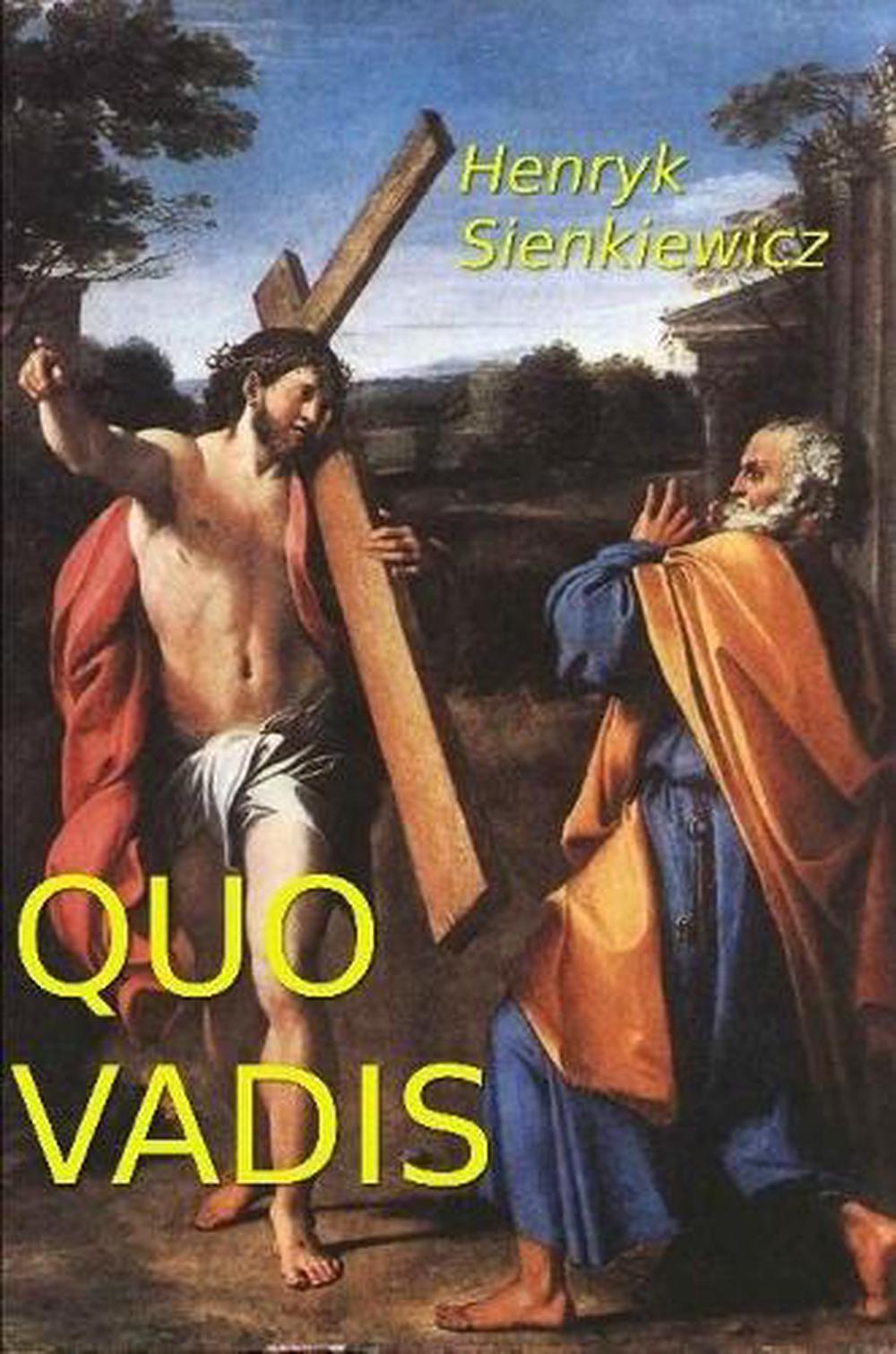
The title of the book comes from the words, "Quo vadis, Domine?" St. Peter was supposed to have said them as he was escaping Rome during the final persecutions and saw Christ going toward Rome.  It means, “Where are you going Lord?”  That scene is dramatized in the novel and brings a lump to one’s throat as St. Peter turns around and goes back to face his martyrdom. 

If you’re a Christian and you want to have insight into the early Christians, this book is a good place to go, and it will entertain you.  If you’re such a Christian and an ancient Roman history buff as well, such as I am, this novel is a must.  The novel is way better than the movies.  I highly recommend it. 


Thursday, March 21, 2024

Quo Vadis: A Narrative of the Time of Nero by Henryk Sienkiewicz, Part 6

This is sixth post of Henryk Sienkiewicz’s historical novel, Quo Vadis.

You can find Post #1 here.  

Post #2, here: 

And Post #3 here.  

And Post #4 here. 

And Post #5 here. 


Chapters 35 thru 41

Summary

On returning home, Vinicius finds Petronius sleeping in the tent of Petronius’s entourage.  Petronius tells him that Caesar and the aristocracy will be going to Antium in a couple of days.  He tells him how Nero is composing poetry and music, and how bad it is.  They go inside to have dinner and talk.  Vinicius tells Petronius that he is engaged to Lygia.  Petronius is astonished but wishes him happiness.  He warns him about Poppaea’s crush on him that could turn vindictive.  But Vinicius tells him the Apostle Peter has said not a hair on his head will be harmed.  Petroinus asks him if he’s become a Christian, and Vinicius says not yet.  He still has to undergo instruction from Paul of Tarsus.  Tired, Petronius leaves and Vinicius writes a letter to Lygia that he will have to go to Antium.

Nero’s huge entourage travels up to Antium in luxury and glittering opulence, including wild animals.  The locals look on in awe.  In the crowd was the Apostle Peter, Lygia, and Ursus who wanted a gaze at the emperor.  Nero drove up in a chariot and loved the adulation from the crowd.  Some voices in the crowd ridiculed Nero.  As Nero perused the crowd his eyes were locked with that of Peter.  At the end of the long retinue was Vinicius who seeing Peter and Lygia sprang from his chariot to greet them.  Vinicius invites them to his home and they walk through the opulence of the city.  Peter offers a humble prayer.  Lygia observing the sunset over the city, Lygia thought it seemed like the city was on fire.  Peter said the wrath of God was upon it.

Sometime later, Vinicius writes a letter to Lygia.  He tells her about Caesar and the goings on at Antium.  He writes about their future and living away on a shore.  He writes about an event on a boat where Poppaea flirted with him again but Petronius redirected the attention.  He tells her that Paul is there to instruct him in the faith.

Later, Vinicius writes another letter to Lygia.  He tells her about his lessons with Paul.  He tells her of his talks with Nero, and how Nero speaks about the burning of Troy and how a spectacle the burning of Rome would be.  He warns her to be on guard and to go stay at the house of Aulus.

With Caesar shutting himself up for days to compose songs, Vinicius makes his way down to Rome to spend time with Lygia.  Being with her on a beautiful evening, Vinicius feels total happiness.  She returns his love with complete joy.  He tells her that Paul has not finished with the lessons, and so not baptized yet, but he looks forward to it.  He reiterates the fundamental Christian teachings and finds it convicting.  In Christ’s love their love flourishes.  Vinicius relates an exchange between Paul and Petronius, both philosophers of their worldviews.  Paul points out the deficiencies of Petronius’s Epicureanism, and Petronius points out the pleasures of moderate sensuality.  Vinicius suggests once he and Lygia are married they move down to Sicily to get away from Rome’s politics.  Lygia welcomes it.  As they are about to depart, they hear a series of what appear to be thunder but then recognize it as the roar of lions who are held captive for the games.

Back in Antium, Petronius is gaining Nero’s trust more and more, especially over his aristocratic rival Tigellinus.  Petronius has the right touch of wit to praise Nero’s poetry and song without appearing obsequious.  From the flattery, Nero’s ego swells even larger than before.  Nero’s poetry tries to describe the burning of Troy, but Nero feels it falls flat because he has never seen a city burning.  Tigellinus offers to burn Antium, but Nero says Antium is too small a town to simulate a burning city.  Later, Petronius talks to Vinicius about Nero’s poetry and his growing madness.  He tells of how Paul’s philosophy would bore him.  Vinicius responds that Petronius doesn’t understand the joy that Christianity brings.  

 After singing a number of his compositions, Nero makes Petronius and Vinicius go for a walk with him.  Nero wants to talk about his talents, and Petronius continues to respond in the vein of flattery and yet not obsequious.  Nero just loves this, pointing out how different Petronius is from Tigellinus.  In trust of Petronius, Nero whispers the bizarre reason for having his mother and first wife murdered.  Petronius, feeling that he is in Nero’s total trust, suggests that Nero publically approve Vinicius’s marriage to Lygia.  Nero agrees, and going inside in front of his court with Poppaea present, asks for a valuable necklace.  He gives it to Vinicius as a wedding gift and tells him to go to Rome to Lygia.  Directly thwarted, Poppaea is angered.  Just then a servant comes in telling that Rome is ablaze in fire. 


###

My Comment:

I finally looked up Nero's Wikipedia's entry.  He only lived to thirty years old.  So he's thirty when the events of the novel occur and he has been emperor for 14 years.  So he was very young when first made emperor.  There were some accomplishments during his reign but he was not regarded as a stable man.  His mother, the wife of the Emperor Claudius was suspected of killing Claudius so that her son could become emperor, and given his youth she expected to be the real power ruling the empire.  It did work out for a time until Nero had her killed to be in complete control.  He also had his stepbrother killed and then had his first wife killed to marry Poppaea.  The Wikipedia entry summarizes what his contemporary historians thought of him:


Most Roman sources offer overwhelmingly negative assessments of his personality and reign. Most contemporary sources describe him as tyrannical, self-indulgent, and debauched. The historian Tacitus claims the Roman people thought him compulsive and corrupt. Suetonius tells that many Romans believed the Great Fire of Rome was instigated by Nero to clear land for his planned "Golden House". Tacitus claims Nero seized Christians as scapegoats for the fire and had them burned alive, seemingly motivated not by public justice, but personal cruelty. Some modern historians question the reliability of ancient sources on Nero's tyrannical acts, considering his popularity among the Roman commoners. In the eastern provinces of the Empire, a popular legend arose that Nero had not died and would return. After his death, at least three leaders of short-lived, failed rebellions presented themselves as "Nero reborn" to gain popular support.


The most shocking thing I read in his bio was that he was born on December 15th!  That's my birthday...lol.  We share a birthday.  What is shocking is that no one famous is born on that day.  I have no one to look to for a bond of a birthdate.  There isn't even a saint's feast day for me to identify with for December 15th.  There are some obscure historical people born on that day and there are some obscure saints who are given that day as a feast day, but really no one of any note.  Except now Nero!

Kerstin’s Comment:

What is also made clear now is that Petronius enjoys the daily thrills in staying on Nero's good side when he knows full well that one faux pas can mean his death. Being at this high level and in the near constant presence of the Caesar Petronius has no life of his own left. So he tries to be the best of Nero's advisers and at the same time gets his kicks for besting him on a regular basis. Converting to the Christian faith is really no option for him, for the personal demands of the faith would not allow him to operate successfully at the place where he is at. It would mean certain death. Staying a Pagan means he has a fighting chance.

My Reply:

Yes, one stumble will mean Petronius's death.


###

Some of Sienkiewicz’s best writing is of the Roman pageantry.  Here is a description of Nero’s entourage traveling up to Antium.  Excerpt from Chapter 36. 


Early on the morning of that day herdsmen from the Campania, with sunburnt faces, wearing goat-skins on their legs, drove forth five hundred she-asses through the gates, so that Poppæa on the morrow of her arrival at Antium might have her bath in their milk. The rabble gazed with delight and ridicule at the long ears swaying amid clouds of dust, and listened with pleasure to the whistling of whips and the wild shouts of the herdsmen. After the asses had gone by, crowds of youth rushed forth, swept the road carefully, and covered it with flowers and needles from pine-trees. In the crowds people whispered to each other, with a certain feeling of pride, that the whole road to Antium would be strewn in that way with flowers taken from private gardens round about, or bought at high prices from dealers at the Porta Mugionis. As the morning hours passed, the throng increased every moment. Some had brought their whole families, and, lest the time might seem tedious, they spread provisions on stones intended for the new temple of Ceres, and ate their prandium beneath the open sky. Here and there were groups, in which the lead was taken by persons who had travelled; they talked of Cæsar's present trip, of his future journeys, and journeys in general. Sailors and old soldiers narrated wonders which during distant campaigns they had heard about countries which a Roman foot had never touched. Home-stayers, who had never gone beyond the Appian Way, listened with amazement to marvellous tales of India, of Arabia, of archipelagos surrounding Britain in which, on a small island inhabited by spirits, Briareus had imprisoned the sleeping Saturn. They heard of hyperborean regions of stiffened seas, of the hisses and roars which the ocean gives forth when the sun plunges into his bath. Stories of this kind found ready credence among the rabble, stories believed by such men even as Tacitus and Pliny. They spoke also of that ship which Cæsar was to look at,—a ship which had brought wheat to last for two years, without reckoning four hundred passengers, an equal number of soldiers, and a multitude of wild beasts to be used during the summer games. This produced general good feeling toward Cæsar, who not only nourished the populace, but amused it. Hence a greeting full of enthusiasm was waiting for him.


Meanwhile came a detachment of Numidian horse, who belonged to the pretorian guard. They wore yellow uniforms, red girdles, and great earrings, which cast a golden gleam on their black faces. The points of their bamboo spears glittered like flames, in the sun. After they had passed, a procession-like movement began. The throng crowded forward to look at it more nearly; but divisions of pretorian foot were there, and, forming in line on both sides of the gate, prevented approach to the road. In advance moved wagons carrying tents, purple, red, and violet, and tents of byssus woven from threads as white as snow; and oriental carpets, and tables of citrus, and pieces of mosaic, and kitchen utensils, and cages with birds from the East, North, and West, birds whose tongues or brains were to go to Cæsar's table, and vessels with wine and baskets with fruit. But objects not to be exposed to bruising or breaking in vehicles were borne by slaves. Hence hundreds of people were seen on foot, carrying vessels, and statues of Corinthian bronze. There were companies appointed specially to Etruscan vases; others to Grecian; others to golden or silver vessels, or vessels of Alexandrian glass. These were guarded by small detachments of pretorian infantry and cavalry; over each division of slaves were taskmasters, holding whips armed at the end with lumps of lead or iron, instead of snappers. The procession, formed of men bearing with importance and attention various objects, seemed like some solemn religious procession; and the resemblance grew still more striking when the musical instruments of Cæsar and the court were borne past. There were seen harps, Grecian lutes, lutes of the Hebrews and Egyptians, lyres, formingas, citharas, flutes, long, winding buffalo horns and cymbals. While looking at that sea of instruments, gleaming beneath the sun in gold, bronze, precious stones, and pearls, it might be imagined that Apollo and Bacchus had set out on a journey through the world. After the instruments came rich chariots filled with acrobats, dancers male and female, grouped artistically, with wands in their hands. After them followed slaves intended, not for service, but excess; so there were boys and little girls, selected from all Greece and Asia Minor, with long hair, or with winding curls arranged in golden nets, children resembling Cupids, with wonderful faces, but faces covered completely with a thick coating of cosmetics, lest the wind of the Campania might tan their delicate complexions.


And again appeared a pretorian cohort of gigantic Sicambrians, blue-eyed, bearded, blond and red haired. In front of them Roman eagles were carried by banner-bearers called "imaginarii," tablets with inscriptions, statues of German and Roman gods, and finally statues and busts of Cæsar. From under the skins and armor of the soldier appeared limbs sunburnt and mighty, looking like military engines capable of wielding the heavy weapons with which guards of that kind were furnished. The earth seemed to bend beneath their measured and weighty tread. As if conscious of strength which they could use against Cæsar himself, they looked with contempt on the rabble of the street, forgetting, it was evident, that many of themselves had come to that city in manacles. But they were insignificant in numbers, for the pretorian force had remained in camp specially to guard the city and hold it within bounds. When they had marched past, Nero's chained lions and tigers were led by, so that, should the wish come to him of imitating Dionysus, he would have them to attach to his chariots. They were led in chains of steel by Arabs and Hindoos, but the chains were so entwined with garlands that the beasts seemed led with flowers. The lions and tigers, tamed by skilled trainers, looked at the crowds with green and seemingly sleepy eyes; but at moments they raised their giant heads, and breathed through wheezing nostrils the exhalations of the multitude, licking their jaws the while with spiny tongues.


Now came Cæsar's vehicles and litters, great and small, gold or purple, inlaid with ivory or pearls, or glittering with diamonds; after them came another small cohort of pretorians in Roman armor, pretorians composed of Italian volunteers only; then crowds of select slave servants, and boys; and at last came Cæsar himself, whose approach was heralded from afar by the shouts of thousands. In the crowd was the Apostle Peter, who wished to see Cæsar once in life. He was accompanied by Lygia, whose face was hidden by a thick veil, and Ursus, whose strength formed the surest defence of the young girl in the wild and boisterous crowd. The Lygian seized a stone to be used in building the temple, and brought it to the Apostle, so that by standing on it he might see better than others.


###

In almost in complete contrast to that raucous spectacle of the Romans on the trek to Antium, we have in Chapter 39 a serene moment between Vinicuis and Lygia, where they profess their love and Vinicuis expresses his desire to be a Christian.


The charm of the quiet evening mastered them completely.


"How calm it is here, and how beautiful the world is," said Vinicius, in a lowered voice. "The night is wonderfully still. I feel happier than ever in life before. Tell me, Lygia, what is this? Never have I thought that there could be such love. I thought that love was merely fire in the blood and desire; but now for the first time I see that it is possible to love with every drop of one's blood and every breath, and feel therewith such sweet and immeasurable calm as if Sleep and Death had put the soul to rest. For me this is something new. I look on this calmness of the trees, and it seems to be within me. Now I understand for the first time that there may be happiness of which people have not known thus far. Now I begin to understand why thou and Pomponia Græcina have such peace. Yes! Christ gives it."


At that moment Lygia placed her beautiful face on his shoulder and said,—"My dear Marcus—" But she was unable to continue. Joy, gratitude, and the feeling that at last she was free to love deprived her of voice, and her eyes were filled with tears of emotion.


Vinicius, embracing her slender form with his arm, drew her toward him and said,—"Lygia! May the moment be blessed in which I heard His name for the first time." "I love thee, Marcus," said she then in a low voice.


Both were silent again, unable to bring words from their overcharged breasts. The last lily reflections had died on the cypresses, and the garden began to be silver-like from the crescent of the moon. After a while Vinicius said,


"I know. Barely had I entered here, barely had I kissed thy dear hands, when I read in thy eyes the question whether I had received the divine doctrine to which thou art attached, and whether I was baptized. No, I am not baptized yet; but knowest thou, my flower, why? Paul said to me: 'I have convinced thee that God came into the world and gave Himself to be crucified for its salvation; but let Peter wash thee in the fountain of grace, he who first stretched his hands over thee and blessed thee.' And I, my dearest, wish thee to witness my baptism, and I wish Pomponia to be my godmother. This is why I am not baptized yet, though I believe in the Saviour and in his teaching. Paul has convinced me, has converted me; and could it be otherwise? How was I not to believe that Christ came into the world, since he, who was His disciple, says so, and Paul, to whom He appeared? How was I not to believe that He was God, since He rose from the dead? Others saw Him in the city and on the lake and on the mountain; people saw Him whose lips have not known a lie. I began to believe this the first time I heard Peter in Ostrianum, for I said to myself even then: In the whole world any other man might lie rather than this one who says, 'I saw.' But I feared thy religion. It seemed to me that thy religion would take thee from me. I thought that there was neither wisdom nor beauty nor happiness in it. But to-day, when I know it, what kind of man should I be were I not to wish truth to rule the world instead of falsehood, love instead of hatred, virtue instead of crime, faithfulness instead of unfaithfulness, mercy instead of vengeance? What sort of man would he be who would not choose and wish the same? But your religion teaches this. Others desire justice also; but thy religion is the only one which makes man's heart just, and besides makes it pure, like thine and Pomponia's, makes it faithful, like thine and Pomponia's. I should be blind were I not to see this. But if in addition Christ God has promised eternal life, and has promised happiness as immeasurable as the all-might of God can give, what more can one wish? Were I to ask Seneca why he enjoins virtue, if wickedness brings more happiness, he would not be able to say anything sensible. But I know now that I ought to be virtuous, because virtue and love flow from Christ, and because, when death closes my eyes, I shall find life and happiness, I shall find myself and thee. Why not love and accept a religion which both speaks the truth and destroys death? Who would not prefer good to evil? I thought thy religion opposed to happiness; meanwhile Paul has convinced me that not only does it not take away, but that it gives. All this hardly finds a place in my head; but I feel that it is true, for I have never been so happy, neither could I be, had I taken thee by force and possessed thee in my house. Just see, thou hast said a moment since, 'I love thee,' and I could not have won these words from thy lips with all the might of Rome. O Lygia! Reason declares this religion divine, and the best; the heart feels it, and who can resist two such forces?"


Lygia listened, fixing on him her blue eyes, which in the light of the moon were like mystic flowers, and bedewed like flowers.


"Yes, Marcus, that is true!" said she, nestling her head more closely to his shoulder.


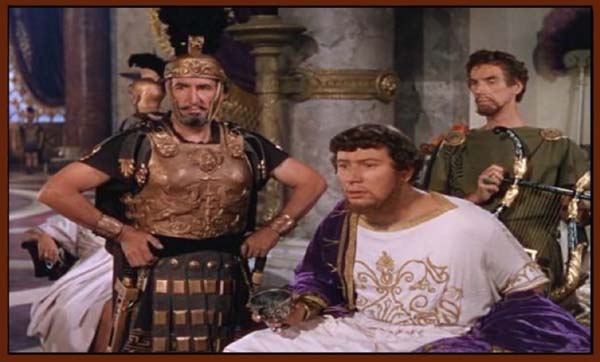
That is from the 2001 film version, I believe filmed in Polish.