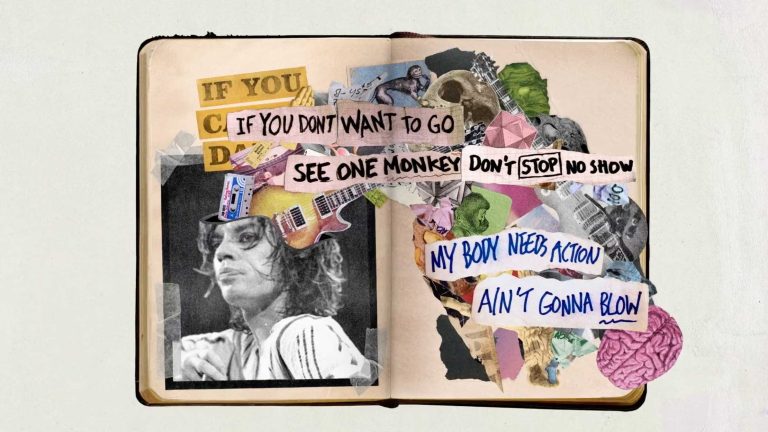
I haven’t had a “Music Tuesday’ post in quite a while. If you have followed my blog you might remember that one of my guilty pleasures is my love of the music by The Rolling Stones. Of course The Rolling Stones are not going to get an imprimatur from any Catholic bishop, and perhaps one could make an argument that some of their themes contributed to the decadence of our contemporary culture. Nonetheless as artists of rock and popular music, they are among the greatest.
On November 14th, the Stones will be releasing a remastered and expanded version of their 1976 album, Black and Blue. Remastering is an enhancement of the audio sound using more modern technology so that the track on the medium sounds closer to the studio recording. You can read about remastering here. But this new release is also an expanded version of the original album which will include six tracks that did not make the final album. The Stones like to say they have a vault full of gems that never made the final cut, and so, as with other new remastered albums, they have provided outtakes from the original recording sessions as additional material. These outtakes aren’t necessarily finished, and so sometimes they will go into the studio and “finish” the song or even add to it. But the finished song still should retain the aesthetics of that original session.
The remastered release will have six outtakes as new songs and depending on which version of the album (two disk studio songs, four disk includes live show, and five disk includes a Blu-ray video of the show) will have a recording of a live show from the 1976 tour, “Live at Earl’s Court.” Of the six new songs, the Stones have released a single, “Shame Shame Shame.” This is the song I want to share in this Music Tuesday. First the song, and then I’ll talk about it.
It’s too bad this song did not make the original album because this song is fantastic! Black and Blue was not one of the Stones’ great albums. It probably would come in low on my ranking of Stones’ albums. This is just a great cover of a song and would have most certainly improved the album. The original song was written Sylvia Robinson and originally released by Shirley & Company in 1974. The lead singer of Shirley & Company was the Shirley Goodman of the 1950s group Shirley and Lee, and who had a big hit in 1956, “Let the Good Times Roll.” Her “Shame Shame Shame” also hit number one on the charts.
Shirley Goodman’s work is mostly in
the Rhythm and Blues and Soul vein, but “Shame Shame Shame” has more of a disco
dance feel of the 1970s. It also uses a
Bo Diddley beat that has been widely used in R&B and rock and is perfect for dance
music. Shirley has a naturally high
pitched voice and in her original she does it as a duet between her falsetto
female voice complimented with the male tenor voice of Jason Alvarez. The original version uses a saxophone for the solo interlude played by Seldon
Powel. Here is the original “Shame Shame
Shame.”
It’s a dance song with the first person narrator expressing her need to go out dancing and it’s a shame if her interlocutor, who I take is a male friend, can’t dance or doesn’t want to go.
Shame
shame shame on you
If
you can't dance too
Can't
stop me now hear what I say
My
feet wanna move so get out my way
I'm
gonna have my say
I'm
going to every discotheque
I'm
gonna dance dance dance dance ooh
Till
the break of day I say
CHORUS
Shame
shame shame hey shame on you
If
you can't dance too
I
say shame shame shame
Shame
shame shame
Shame
shame on you
If
you can't dance too
Don't
stop the motion
If
you get the notion
You
can't stop the groove
'Cos
you just won't move
Got
my sun-roof down
Got
my diamonds in the back
So
put on your shaky wig baby
If
you don't I ain't comin' back
REPEAT
CHORUS
If
you don't want to go
Remember
one monkey don't stop no show
My
body needs action ain't gonna blow
Yes
I'm going out I'm going to find a dancin' man
If
you really think you're fast
Try
to catch me if you can
I
say shame shame shame yeah (aah) shame on you
If
you can't dance too
It's
a shame shame shame
Shame
shame shame
Shame
shame on you
If
you can't dance too
If
you can't dance
This is an incredibly catchy
song. There is something that
coordinates so well between the predominant lyric “Shame shame shame/Shame on
you” with the Bo Diddley beat. If you
don’t know what is referred to as a Bo Diddley beat, listen to Matt Dwyer who provides
blues guitar lessons on YouTube.
The catchy lyric has the meter of four stressed accents followed by two unstressed: / / / / u u. The four stress words (“Shame Shame Shame/Shame”) mirror the first part of the Bo Diddley beat and the two unstressed words (“on you”) mirror the last two beats. Now that you have seen the Matt Dwyer explanation and my metrical insight, go back to the Shirely version and listen to it again. I think I’m correct there.
Now go back to the Stones version. They just don’t copy the music, they enhance it. First off, the Stones version weaves multiple guitars that overlay over the Bo Diddley beat. It’s a much more complex sound. The original song is joyous but the interplay by the guitars in the Stones version make it so much more joyous. It’s as if the guitars are in a state of ecstasy.
Another difference is that the Stones version eliminates the sax and uses an electric guitar for the solo. It fits so much better with the interweaving guitars. It’s as if one of the weaving guitars stepped up and provided the solo and then steps back into the interweaving web of sound.
Another difference between the two versions is in the vocals. On the original version, Shirley is mostly the lead matched with a duet of Jason Alvarez, but they do alternate stanzas. Her high pitched voice is near falsetto and Alvarez is clearly tenor. The image is clearly of two separate people interacting. In the Stones version, Mick Jagger is singing in two voices, roughly a falsetto voice for the Shirley parts and in his natural tenor in the Alvarez parts. While the voices are two separate vocal ranges, they still have the timber of the same natural voice, and it comes across much more naturally as one person. Jagger has used the falsetto voice in quite a few songs, so this isn’t new for him. On that very Black and Blue album, arguably the best song on the album is “Fool to Cry,” which alternates between falsetto and tenor. The Shirley duet is not truly a duet. The two voices aren’t replying to each other. They are saying the same message. The lyrics of the song don’t call for two separate statements. Jagger’s one voice in two ranges makes it true to the lyrics.
Another difference is in the backup vocals. When Shirley and Alvarez come together they come to a harmony where the two voices are blended into one. In the Stones version, the backup vocals are descant (“a voice (cantus) above or removed from others”) from the lead to give it a sense of separation. Just like there is a weave of guitars there is also a weave of voices. As one listens deeper into the song there seems to be an ever so slight difference in timing (a 32nd of a note perhaps?) between the lead singer and the backup vocals. This gives the feel that the lead voice is running away, emphasizing the opening lines, “Can't stop me now hear what I say/My feet wanna move so get out my way.”
The Rolling Stones released a clip
of the song being overdubbed to the recording.
It features Mick, backup singer Chanel, and Ronnie Wood on electric
guitar.
Mick is 82 years old, and he still delivers! Amazing.
I love the Shirley & Company version of the song, but the Stones cover is an aesthetic masterpiece. On the surface it appears they are just copying the original, but, when you look closer, they have put their stamp on the song and taken it to a higher level. Too bad it didn’t make the Black and Blue album, but I can see how with the original being out just two years before it would not have given the original artist their due respect.
Finally I should mention that
Shirley & Company put out a “Disco” version of the song that doubles the
length to just over seven and half minutes.
The length is extended partly by repeating the verses but more
importantly by giving Seldon Powell a second tenor sax solo. That second solo is exquisite. I can see that Powell was a jazz saxophonist. I’m not going to embed that longer version,
but you can easily find it on YouTube.