
On the Twenty-Fourth Sunday in Ordinary Time for Year A, Jesus completes His Community Discourse with the requirement to forgive wrongs. To Peter’s well-known question as to how many times one should forgive a “brother or sister,” Jesus responds “not seven times but seventy-seven times” (or sometimes translated as “seventy times seven,” RSV, 2ndCE). This is to say infinite. Jesus then follows that up with the Parable of the Unforgiving Servant.
The infinite number of times one is to forgive, set in the context of the first reading, “Forgive your neighbor’s injustice; then when you pray, your own sins will be forgiven” (Sir 28:2) and combined with the Our Father’s “forgive us our trespasses as we forgive those who trespass against us” makes forgiveness a requirement for salvation. But it’s even more than that. In forgiving, God allows you to participate in His Divine action. You become Godlike in the act of forgiveness.
The parable is a fascinating one. It will be explicated by the homilists, but I want to touch on one element. An internet homilist, who I won’t mention by name, but I have embedded his homilies here in the past, last week made a remark about empathy which I think misses the mark. From a book he read called Suicidal Empathy he reached a conclusion that “empathy is not a supreme value” but acting in love to will the good of the other is. That’s a false dichotomy. I will get to the problem with that in a second, but to make matters worse, the homilist framed the issue in political terms: “I think it's the best exposure and take-down of the lunacy at the heart of much of the wokeist philosophy that dominates things today.” So my first reaction to that was then Jesus doesn’t have a Sacred Heart of infinite compassion? What then does the Sacred Heart of Jesus mean and what does Divine Mercy mean?
What the homilist gets wrong, in my humble opinion, and I admit I don’t have his stature or education, is that empathy starts the process, and then once connected to the other person’s heart (cor ad cor loquitur, heart speaks to heart from St. John Henry Newman) one reaches a rational plan of action that will address the good of the other. But empathy is the entrance to that love. Yes it is a supreme value.
The Parable of the Unforgiving Servant from
today's Gospel is a perfect example. The
Master empathizes with the first debtor and releases him from his debt. That was willing his good and it was a result
of his heart being moved. That debtor
then refuses to empathize with the second debtor. No connection in the heart is sparked, and so
he throws second debtor in jail, justice without any empathy. Jesus then sums it up, “So will my heavenly
Father do to you, unless each of you forgives your brother from your
heart.” "From the heart," the
center of empathy, is Jesus’s final word on the subject.

Today’s Gospel:
Peter approached Jesus and asked him,
“Lord, if my brother sins against me,
how often must I forgive?
As many as seven times?”
Jesus answered, “I say to you, not seven times but seventy-seven times.
That is why the kingdom of heaven may be likened to a king
who decided to settle accounts with his servants.
When he began the accounting,
a debtor was brought before him who owed him a huge amount.
Since he had no way of paying it back,
his master ordered him to be sold,
along with his wife, his children, and all his property,
in payment of the debt.
At that, the servant fell down, did him homage, and said,
‘Be patient with me, and I will pay you back in full.’
Moved with compassion the master of that servant
let him go and forgave him the loan.
When that servant had left, he found one of his fellow servants
who owed him a much smaller amount.
He seized him and started to choke him, demanding,
‘Pay back what you owe.’
Falling to his knees, his fellow servant begged him,
‘Be patient with me, and I will pay you back.’
But he refused.
Instead, he had the fellow servant put in prison
until he paid back the debt.
Now when his fellow servants saw what had happened,
they were deeply disturbed, and went to their master
and reported the whole affair.
His master summoned him and said to him, ‘You wicked servant!
I forgave you your entire debt because you begged me to.
Should you not have had pity on your fellow servant,
as I had pity on you?’
Then in anger his master handed him over to the torturers
until he should pay back the whole debt.
So will my heavenly Father do to you,
unless each of you forgives your brother from your heart.”
~Mt: 18:21-35
For the exegetical homily I go the USCCB’s Fr. Greg Friedman OFM. This is a short but perfectly explained
exegesis.
Fr. Greg:
Today's gospel
parable is about the servant whose massive debt had been most generously
forgiven by his master, but who in turn refuses to let a fellow servant off
forgiving a very minor debt. When the
original master hears of this cruelty, we hear the result. Jesus concludes the
parable with a harsh judgment by the master. Should you not have had pity on
your fellow servant as I had pity on you? Jesus concludes the parable by
describing how in anger his master handed him over to the torturers until he
should pay back the whole debt. After
that conclusion, Jesus adds his teaching. So will my heavenly father do to you
unless each of you forgives your brother from your heart. Like so many of Jesus
parables, the ending shocks us in more than one way. And yet the responsibility
for forgiveness is consistent with Jesus teaching earlier in the gospel in the
sermon on the mount and with the prayer Christians pray daily. The Lord's
prayer forgive us our trespasses as we forgive those who trespass against us.
The parable today is given as a response to the exchange between Jesus and Peter which precedes it in today's gospel to Peter's question about forgiveness. Lord, if my brother sins against me, how often must I forgive? As many as seven times. Jesus gives the well-known answer, I say to you, not seven times, but 77 times. The offer of forgiveness seven times seems a reasonable attitude, one I suspect most people today actually would find rather extravagant. As Father Raymond Brown notes in his observations about Peter, Father Brown suggests that most of us might forgive once or twice but let someone offend a third time and we'd probably say enough is enough. Peter, Father Brown suggests, was being very generous. And yet, the parable is about extreme forgiveness. The standard Jesus sets is also staggering in its demand. Forgive 77 times which really suggests unending forgiveness.
The parable may be extreme, but Jesus is being serious: forgive or our heavenly Father will not forgive you.
For the pastoral homily, I’m returning to Archbishop Edward J. Weisenburger who knocks it out of the park with a great example of extreme forgiveness.
Archbishop Weisenburger:
"And so it shall
be with each of you, unless you forgive
your brother from your heart." Okay,
this is serious stuff, a serious demand.
But brothers and sisters, this passage conveys an essential element of Christianity. It's not something nice, extra.
This is of the essence of our faith, and
it cannot be glossed over or denied. Moreover, I fear many of us, and I
surely include myself in that group,
many of us would rather apply this demand of Jesus to others, rather than
to ourselves. It's a reflection on that
line of the Our Father, where we pray as Jesus did, saying, "forgive us our sins, as we
forgive those who trespass against us." Yes, this teaching serves as a lasting reminder of our God's
demand that we have not simply been called to revel or glory in His mercy for us, but rather we are
to live that same kind of profoundly challenging, difficult, or daunting mercy in our own
lives.
Now, as I pondered
the parable, I was reminded of something
that happened in my senior year of seminary college. It was during Christmas
season of 1983. A photo from Rome flashed across the scene. All around the
world, it was the corner of a prison cell.
The subject of the photo: two men hunched over, sitting close together
on molded plastic chairs. One in a white cassock with white skull cap, the
other in a blue sweater, jeans, and running shoes with no laces. Time magazine
told the story accurately, and I quote, "Last week, in an extraordinary
moment of grace, the violence in St. Peter Square was transformed. In a bare, white-walled cell in Rome's
Rebibbia Prison, Pope John Paul II tenderly held the hand that held the gun
that was meant to kill him. For 21 minutes, the Pope sat with his would-be
assassin, Mehmet Ali Agca. The two talked softly. Once or twice, Agca
laughed. The Pope forgave him for the
shooting. At the end of the meeting, Agca either kissed the Pope's ring or
pressed the Holy Father's hand to his forehead in a Muslim gesture of
respect." End of quote. We're then
told later that when asked about what they had talked about, Pope John Paul II
responded, "That will have to remain a secret between him and me. I spoke to him as a brother whom I have
pardoned and who has my complete trust."
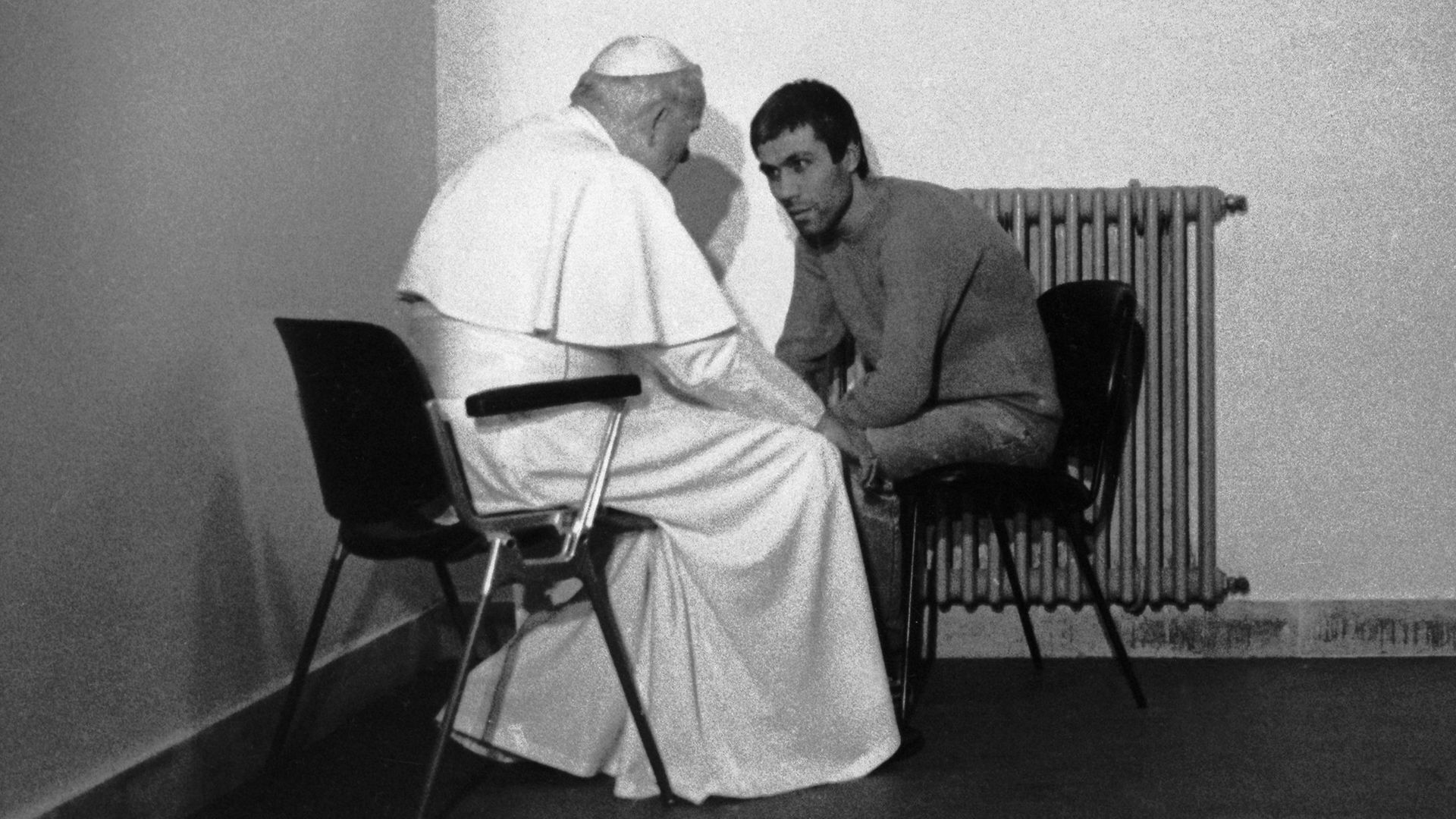
Okay, brothers and
sisters, that picture, more expressive than a thousand words. That simple phrase,
"a brother whom I have pardoned," continues to challenge us mightily
more than four decades after the event took place. It actually gives life to
the words of our Gospel today. And in doing so, it challenges us. And not
because Pope St. John Paul provides a simple solution to the world's problems
of "retaliation versus reconciliation." But quite the contrary, the
Pope's words, "I pardoned him," compels me to ask what being a Christian
demand of me today in a world that seems increasingly saturated with the
cravings of revenge.
A picture and a real life example is worth a thousand
homiletical words.
Sunday Meditation: “Should
you not have had pity on your fellow servant, as I had pity on you?"
Here is a hymn I have never heard before but so beautiful, “Give Me a
Heart of Forgiveness” credited to PureFire Worship.
Give me a heart of
forgiveness, Lord,
Soft and open, like
Yours before.
Help me to let go and
to love again,
To break these chains
and heal within.
Oh, give me a heart,
A heart of
forgiveness.
Jesus, make my heart like yours.

No comments:
Post a Comment