"Love follows knowledge."
"Beauty above all beauty!"
– St. Catherine of Siena

Showing posts with label War Poetry. Show all posts

Monday, May 27, 2024

Poetry Analysis: “Rouge Bouquet” by Joyce Kilmer

I post this poem in honor of Memorial Day.  I don’t think I have ever heard of the poet Joyce Kilmer.  But I stumbled across this poem and thought it fitting for a Memorial Day commemoration. 

According to Wikipedia, Kilmer was born in New Jersey, published several books of poetry, volunteered for World War I in the United States Army, and was killed by a sniper in France in July of 1918, some three and a half months before the war would end.  Though relatively forgotten today, he was a poet of some distinction in his day.  He wrote on his Catholic faith and was compared to his contemporary in England, G.K. Chesterton.  The one poem he is remembered for today is a poem called “Trees,” but frankly I thought “Rouge Bouquet” to be much better poem. 


Rouge Bouquet

By Joyce Kilmer


In a wood they call the Rouge Bouquet

There is a new-made grave to-day,

Build by never a spade nor pick

Yet covered with earth ten metres thick.

There lie many fighting men,

    Dead in their youthful prime,

Never to laugh nor love again

    Nor taste the Summertime.

For Death came flying through the air

And stopped his flight at the dugout stair,

Touched his prey and left them there,

    Clay to clay.

He hid their bodies stealthily

In the soil of the land they fought to free

    And fled away.

Now over the grave abrupt and clear

    Three volleys ring;

And perhaps their brave young spirits hear

    The bugle sing:

“Go to sleep!

Go to sleep!

Slumber well where the shell screamed and fell.

Let your rifles rest on the muddy floor,

You will not need them any more.

Danger’s past;

Now at last,

Go to sleep!”


There is on earth no worthier grave

To hold the bodies of the brave

Than this place of pain and pride

Where they nobly fought and nobly died.

Never fear but in the skies

Saints and angels stand

Smiling with their holy eyes

    On this new-come band.

St. Michael’s sword darts through the air

And touches the aureole on his hair

As he sees them stand saluting there,

    His stalwart sons;

And Patrick, Brigid, Columkill

Rejoice that in veins of warriors still

    The Gael’s blood runs.

And up to Heaven’s doorway floats,

    From the wood called Rouge Bouquet,

A delicate cloud of buglenotes

    That softly say:

“Farewell!

Farewell!

Comrades true, born anew, peace to you!

And your memory shine like the morning-star.

Brave and dear,

Shield us here.

Farewell!”

The poem is wonderfully set to music in this video,  I really enjoyed this, and highlights the musicality of the poem.


The poem is divided into two halves.  The first half identifies the woods called Rouge Bouquet where a number of soldiers lost their lives in a battle.  The second half commemorates their sacrifice from the viewpoint of those in heaven.  Both halves end with a stream of bugle notes, endowing the melody with song lyrics.

The meter is roughly iambic, but the length of each line varies.  It has a ballad sense, coming I think from the alternating four and three feet lines.  I suspect the poem was written while Kilmer was a soldier and perhaps published posthumously without editing.  But I’m only speculating.  The poem is fine in its improvisational style.

The central image I think is the name given to the woods, Rouge Bouquet.  Rouge alludes to the red blood that is spilled, and bouquet imagines the trees of the woods as a bouquet of flowers, a bouquet that would be placed on grave sites.  So the woods become the cemetery of which the soldiers are buried.

The bugle plays two songs, one for each half of the poem.  Both are melancholic.  The first song coaxes the dead to eternal rest.


“Go to sleep!

Go to sleep!

Slumber well where the shell screamed and fell.

Let your rifles rest on the muddy floor,

You will not need them any more.

Danger’s past;

Now at last,

Go to sleep!”

The second song bids the fallen adieu and will be honored in our collective memory.


“Farewell!

Farewell!

Comrades true, born anew, peace to you!

And your memory shine like the morning-star.

Brave and dear,

Shield us here.

Farewell!”

Kilmer in the second half has St. Michael, the archangel, a sort of military angel himself, welcome the dead souls into heaven. 

I also loved this quatrain from the first half for its elegance:


For Death came flying through the air

And stopped his flight at the dugout stair,

Touched his prey and left them there,

    Clay to clay.

That is a nice, poetic way of saying unto dust you returned, the clay of flesh to the clay of earth. 

Perhaps the poem was apocryphal.  Joyce Kilmer himself would shortly be killed and returned to clay.


May we remember all those who have died for our country.



Sunday, November 11, 2018

Poetry: “And There Was Great Calm” by Thomas Hardy

November 11th, 2018 will mark the one hundredth anniversary of the ending of the First World War, known as Armistice.  On "the eleventh hour of the eleventh day of the eleventh month" the hostilities that lasted by my count four years and 116 days and known at the time as “The Great War” came to an end.  Between all the participating countries, there were some 37,508,686 causalities, of which 8,538,315 were fatalities. Truly a tragic event in the history of mankind.  It was a war that changed the nature of western civilization, especially Europe.  Between books and poetry, I have posted often on the Great War.  If you want to scroll through those posts, you can find them here and here and here.

Today there will be lots of memorials and commemorations to this anniversary.  President Trump will attend  an event in France, and England will recreate the thousands of bells that rung on that day.  From the Guardian: 

“Inside might be a small selection of the Allies, some dark Italian officer with cameo face, a blonde English staff officer, a land girl on the bonnet, all mixed up with accretions of Australians wearing Union Jacks instead of their slouch hats, a gorgeous Indian in a turban and perhaps a bright blue Frenchman.”

The same report recorded ecstatic crowds converging on Downing Street where the prime minister, David Lloyd George, appeared and announced: “I am glad to tell you that the war will be over at 11 o’clock today.” He waved, then disappeared inside, but the crowds bayed for more until he reappeared at the first-floor window of No 10, along with Andrew Bonar Law, the chancellor, and Winston Churchill, the minister of munitions. All this, the paper said, as “the housemaids of Downing Street waved their dusters and feather mops overhead”.

This year, Armistice Day will fall on a Sunday. Thousands of local events are being coordinated by the Imperial War Museum. And again the ringing of bells will play a large part. A careful balance will be struck between the solemn sound of remembrance and peals of celebration.

Christopher O’Mahony, president of the Central Council of Church Bell Ringers, says he and others across the UK have been planning their contribution for years. “Wherever you have grown up, bells are part of the soundscape of the nation, whether it is a sound of joy as at a wedding or of sadness at a funeral,” he says.

In the early morning of 11 November more than 3,000 bell towers across England, Scotland, Wales and Northern Ireland will ring out with the sound of “half-muffled” bells, like a slow march, in solemn memory of those who lost their lives.

To commemorate this anniversary I want to post this poem about the conclusion of the war, this time not by a poet who served in the war but one who was at the home front.  Most probably know of Thomas Hardy as a great 19th century English novelist.  He was the author of Tess of the d'Urbervilles, Jude the Obscure, and others.  But at around the end of the 19th century, Hardy felt his career as a novelist had come to an end and switched over to poetry.  He lived all the way to 1928, well into the century, and wrote abundantly.  He is regarded as one of the first modernist poets and today his reputation as a poet among critics is almost as well regarded as his reputation as a novelist.

“And There Was Great Calm” was obviously written addressing the Armistice.

And There Was a Great Calm
By Thomas Hardy
 (On the Signing of the Armistice, 11 Nov. 1918)

                                       I
There had been years of Passion—scorching, cold,
And much Despair, and Anger heaving high,
Care whitely watching, Sorrows manifold,
Among the young, among the weak and old,
And the pensive Spirit of Pity whispered, “Why?”

                                       II
Men had not paused to answer. Foes distraught
Pierced the thinned peoples in a brute-like blindness,
Philosophies that sages long had taught,
And Selflessness, were as an unknown thought,
And “Hell!” and “Shell!” were yapped at Lovingkindness.

                                       III
The feeble folk at home had grown full-used
To 'dug-outs', 'snipers', 'Huns', from the war-adept
In the mornings heard, and at evetides perused;
To day-dreamt men in millions, when they mused—
To nightmare-men in millions when they slept.

                                       IV
Waking to wish existence timeless, null,
Sirius they watched above where armies fell;
He seemed to check his flapping when, in the lull
Of night a boom came thencewise, like the dull
Plunge of a stone dropped into some deep well.

                                       V
So, when old hopes that earth was bettering slowly
Were dead and damned, there sounded 'War is done!'
One morrow. Said the bereft, and meek, and lowly,
'Will men some day be given to grace? yea, wholly,
And in good sooth, as our dreams used to run?'

                                       VI
Breathless they paused. Out there men raised their glance
To where had stood those poplars lank and lopped,
As they had raised it through the four years’ dance
Of Death in the now familiar flats of France;
And murmured, 'Strange, this! How? All firing stopped?'

                                       VII
Aye; all was hushed. The about-to-fire fired not,
The aimed-at moved away in trance-lipped song.
One checkless regiment slung a clinching shot
And turned. The Spirit of Irony smirked out, 'What?
Spoil peradventures woven of Rage and Wrong?'

                                       VIII
Thenceforth no flying fires inflamed the gray,
No hurtlings shook the dewdrop from the thorn,
No moan perplexed the mute bird on the spray;
Worn horses mused: 'We are not whipped to-day;'
No weft-winged engines blurred the moon’s thin horn.

                                       IX
Calm fell. From Heaven distilled a clemency;
There was peace on earth, and silence in the sky;
Some could, some could not, shake off misery:
The Sinister Spirit sneered: 'It had to be!'
And again the Spirit of Pity whispered, 'Why?'

Hardy’s central question, put in the mouth of the “Spirit of Pity” is “Why?”  There really was no satisfactory answer.  It should be noted that the title is taken from the Gospel of Mark, when Jesus awakes with the boat tossed in the storm:  “And he arose, and rebuked the wind, and said unto the sea, Peace, be still. And the wind ceased, and there was a great calm” (Mk 4: 39).  Let us be thankful we did not live through that war.  And let us pray for all those fallen from the violence, for all who those suffered from injury and personal loss, and those that remained to deal with the problems from the turmoil.


Saturday, November 11, 2017

Poetry: “On Passing the New Menin Gate” by Siegfried Sassoon

And so “at the eleventh hour of the eleventh day of the eleventh month of 1918” an armistice went into effect bringing the cessation of hostilities to what would become known as The Great War.  It is from that event that our Veterans Day is commemorated. Today is the 99th anniversary of that armistice.

I have now completed the collection of World War I poems titled Some Desperate Glory: The First World War The Poets Knew by Max Egremont, which I have been posting on for almost two years now.  Each post on my blog highlighted a poem from one of the war years.  You can access these posts here:


As I explained in that last post, I tried to highlight a different poet for each year, but Wilfred Owen’s poetry was so superior in the last two years of the war I just had to highlight him twice.  So why am I highlighting another poem from the book?  Well, the book doesn’t stop with the end of the war (1918) but continues with one more chapter on the post war, titled, “Aftermath.”  The poets who were not killed in the war went on to write poetry on the war for their remaining years.  So intense is the war experience that one can only say the soul is forever traumatized. 

Of the eleven poets whose work are collected in the book, five survived the war.  It only occurred to me recently that Egremont’s book is a book on British poets of the First World War.  All eleven are British, and frankly I can’t think of any poets from any of the other countries that fought, even the United States, though it is incredulous to think there weren’t any poets other than British.  I’m not even sure if the eleven poets constitute all the British poets who served.  I can’t recall if Egremont ever gives his criteria for the selection.  I should also provide the list of poets Egremont selects.  Each deserves that honor. 

The six who were killed in action:


The five who survived the war:


Of the poets who survived, Siegfried Sassoon arguably went on to have the most impact as an ex-war poet.  Graves may have had a more celebrated literary career, but even he acknowledge his work after the war focused on other themes.  I’m selecting Sassoon’s “On Passing the New Menin Gate” as the highlighted poem of the war’s aftermath.


Before getting to the poem, two issues concerning Sassoon’s post war years should be considered.  First is his personal life which culminated with his conversion to Roman Catholicism and second is his refrain from and renouncing of modernist poetic form.  Egremont describes the split in the aesthetic divergence as rooted between the war poets and the younger literary generation.

A gap opened between those who’d fought and those who didn’t.  Before 1914, Britain and the new art of continental Europe had been getting closer; now, for many, the Continent meant death, obliteration and, even in peace, rumours of chaos.  Some—mostly non-combatants like [T.S.] Eliot, James Joyce, and [Ezra] Pound—still looked to modernism, to abstract art, to writing without clear narrative, whereas Sassoon and Blunden, even the more adventurous Graves, stuck to tradition, often yearning for an imagined, calm past.  They had tried to tell the war’s reality, Wilfred Owen writing that ‘every word, every figure of speech must be a matter of experience’ and ‘I don’t want to write anything to which a soldier would say No compris’.  Owen had known nothing of Eliot and Pound.  (p. 241)

Sassoon felt a particular loss from Owen’s death.  He went on to opine that if Owen “had lived, they could together have made an alternative to modernism, to Eliot’s fragmented world” (p. 256).  This decision to split with the modernist forms isolated the war poets, especially Sassoon, characterizing them as outdated. 

The second issue of Sassoon post war years was his tumultuous life.  “Propelled by his fame…Sassoon began a decade of guilt-ridden socializing and sex, briefly at Oxford before becoming editor of the Daily Herald and, billed as a hero poet…on a lecture tour of the United States” (p. 240).  The sex was filled with a series of homosexual affairs, which filled the whole decade following the war.  In 1931 he married, had a child, who he loved deeply, while he kept his homosexuality indiscreet.  He wrote throughout his life, poetry, satires, novels with mixed results.  Toward the end of his life he had a conversion experience to Roman Catholicism, which affected him greatly. 

In 1927, Siegfried Sassoon went back to Flanders.  He drove across the battlefields with Glen Byam Shaw, the young actor whom he loved, weeping at the memories.  He wrote ‘On Passing the New Menin Gate’ about the pompous memorial designed by the imperial architect Sir Reginald Bloomfield for Ypres and inscribed with the names of the dead.

Sassoon had tried politics and lecture tours; he discovered sex, fooling himself that he could reform his decadent lovers, all the time feeling a bit lost.  Thomas Hardy became an idol and Edmund Blunden an essential friend; to see the two together at Max Gate, Hardy’s home at Dorset, allowed Sassoon to imagine a world that might respond to his increasingly traditionalist style.  When, in 1924, Blunden went to teach in Japan, Sassoon missed him badly; and nostalgia became more intense as he became less inspired by the present.  ‘On Passing the New Menin Gate’ evoked the bitterness and anger of the war.  (p. 250).

Later, through the turmoil of the Second World War, Egremont tells us Sassoon “longed for a more purposeful and ordered life, for spiritual rest.  In 1957, [he] converted to Roman Catholicism, welcoming its clear answers and its discipline” (p. 256).  He would live for another ten years and apparently his new found faith was the only thing that could put his war-torn, dislocated soul at rest.

As mentioned in the quote above, New Menin Gate was a war memorial at Ypres, Belgium dedicated to the British and Commonwealth dead who’s grave went unidentified.  Apparently Sassoon was not pleased with it.  Here is the poem he wrote. 

On Passing the New Menin Gate
By Siegfried Sassoon

Who will remember, passing through this Gate,
the unheroic dead who fed the guns?
Who shall absolve the foulness of their fate,-
Those doomed, conscripted, unvictorious ones?

    Crudely renewed, the Salient holds its own.
    Paid are its dim defenders by this pomp;
    Paid, with a pile of peace-complacent stone,
    The armies who endured that sullen swamp.

Here was the world's worst wound. And here with pride
'Their name liveth for ever', the Gateway claims.
Was ever an immolation so belied
as these intolerably nameless names?
Well might the Dead who struggled in the slime
Rise and deride this sepulchre of crime.


There’s not much to analyze, a rather straightforward poem.  In the first stanza, the speaker is passing this new memorial at Ypres, questioning whether this self-conscious monument actually addresses those who it’s supposed to memorialize.  The second stanza shifts the focus to those who are supposed to be memorialized, and the third ridicules the monument for not displaying the reality of war’s struggle and death.  “Here was the world's worst wound” is truly a great and memorable line.  You can hear the entire poem read here.


With the conclusion of these war poets, I want to announce that in 2018 I will be continuing with Sassoon by reading a play by Joseph Pierce on Owen and Sassoon, Pierce using the two poet’s own words to form the drama.  I will also be going through T. S. Eliot’s post WWI poem, “The Wasteland,” and so we can compare the modernist and the traditionalist’s styles.  Stay tuned for that.


Finally, for Veteran’s Day, say a prayer for those that fought in wars.  As you can see with Sassoon, the experience of war is not pleasant and life-long traumatizing. 


Thursday, October 19, 2017

Poetry: “Dulce et Decorum est” by Wilfred Owen

Continuing the ongoing series of World War I poems from the collection titled, Some Desparate Glory: The First World Warthe Poets Knew edited by Max Egremont, I want to post what I consider the finest poem to come out of the First World War.  Before I get to the poem, let me provide links to the previous poems of the series.  Since Egremont organizes his book by year during the war, I have been posting on what I consider the most interesting poem of that year.  Here are the poems and the links.


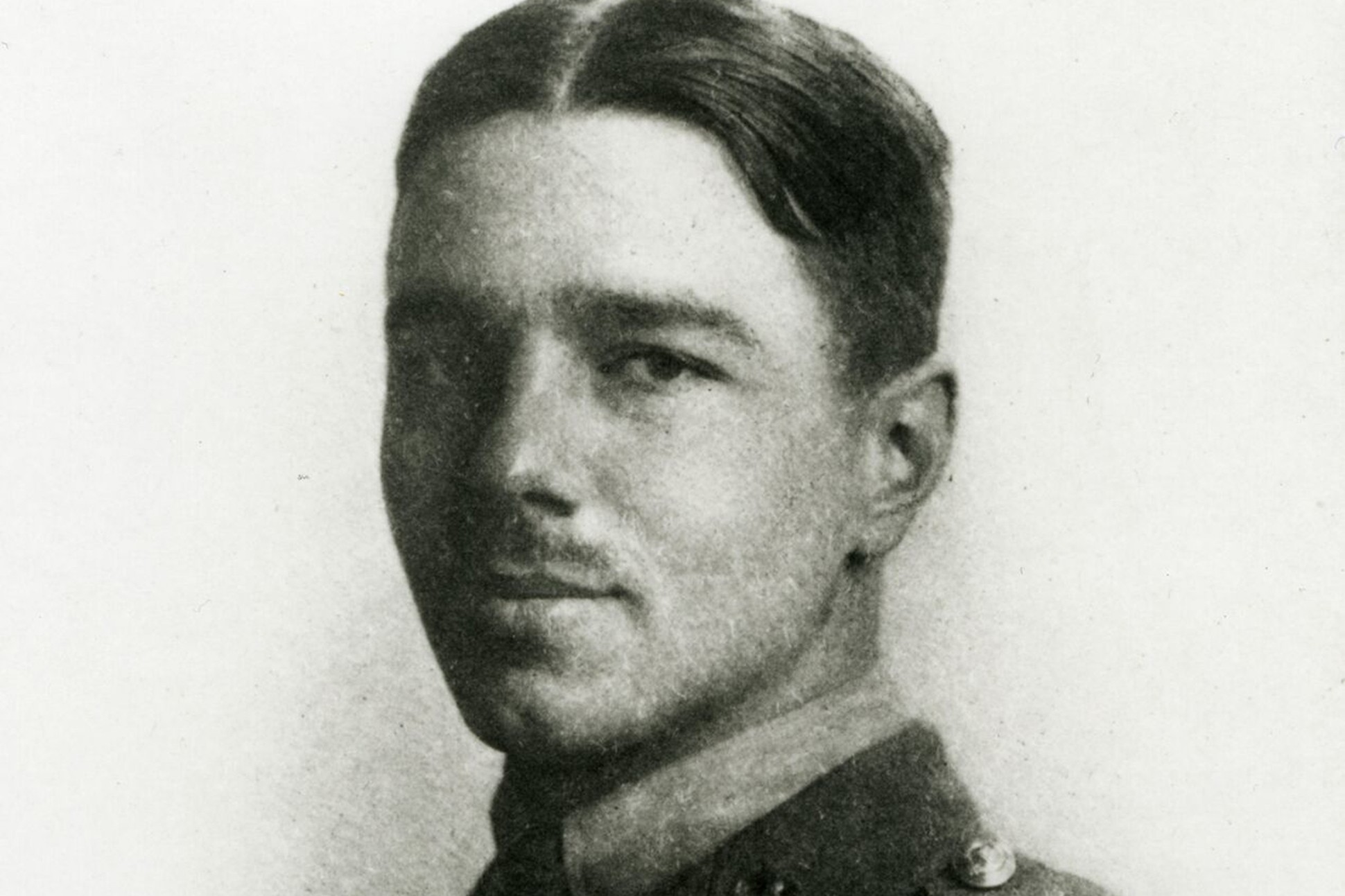
Now I had intended to only post one poem per poet so we could get a broad diversity of voices, but, since Wilfred Owen in both 1917 and 1918 stands head and shoulders above the other poems written, I really have no choice but to repeat one of his poems.  As I mentioned before, Egremont provides a summary of biographical events for each poet during each year of the war.  In the 1917 post on Wilfred Owen I had mentioned how he had been injured and spent almost a year in hospital at Craiglockhart, where he met Siegfried Sassoon, built up a friendship, and influenced each other’s poetry.  But by the end of August in 1918, Owen was recovered and on his way back to the front.  Ergremont elaborates:

The way to the front went through Etaples, then to Amiens to join his battalion and from Amiens to Vendelles before preparations for an attack.  In France Owen completed “The Sentry”, “Exposure” and “Spring Offensive”.  Of the fighting, he told his mother, “I lost all my earthly faculties, and fought like an angel.”  Doubts about his courage vanished when, with a corporal, he captured a German machine-gun post, writing that “I only shot one man with my revolver (at about 30 yards!).  The rest I took with a smile.”  Wilfred Owen won a Military Cross.

He knew he had a mission now, to care for and to record what his men endured, how “every word, every figure of speech must be matter of experience”, must be conveyed so that any soldier could understand.  “I came out in order to help these boys,” he told his mother, “directly by leading them as well as any officer can; indirectly by watching their sufferings that I might speak of them as a pleader can.  I have done the first.”  What he wrote would fulfill the second.

The end came on 4 November, during an attack across the Sambre-Oise canal when three Victoria Crosses were won.  Owen was last seen trying to cross the canal on a raft under heavy enemy fire.  The engagement was his unit’s last time in action, the heroism perhaps encouraged by a sense that victory was near.  Showing the static nature of the western front, the 2nd Manchesters found themselves on Armistice Day—11 November 1918—in billets to the south of Landrecies, where they’d been on 18 August 1914, on their way to Mons.

The confirmation of Owen’s Military Cross occurred some four days after he had been killed.  One of the myths of the armistice is of the bells of Shrewsbury ringing out in celebration as the telegram boy knocked on the door of the Owen home with the news of Wilfred’s death.  It’s ironic that the last letter to his mother from a poet whose work shows should say, “It is a great life…Of this I am certain, you could not be visited by a band of friends so fine as surround me here.”

That Wilfred Owen died one week prior to the cessation of hostilities is one of the great tragedies of the war.  Of course there were countless tragedies within the 1,568 days (4 years, 3 months, 15 days) the war spanned.  As far as literature was concerned, Owen's death seems to represent the great human, and creative loss brought forth by the war.

Now to the poem. 

Dulce et Decorum Est
By Wilfred Owen

Bent double, like old beggars under sacks,
Knock-kneed, coughing like hags, we cursed through sludge,
Till on the haunting flares we turned our backs
And towards our distant rest began to trudge.
Men marched asleep. Many had lost their boots
But limped on, blood-shod. All went lame; all blind;
Drunk with fatigue; deaf even to the hoots
Of tired, outstripped Five-Nines that dropped behind.

Gas! Gas! Quick, boys!—An ecstasy of fumbling,
Fitting the clumsy helmets just in time;
But someone still was yelling out and stumbling
And flound’ring like a man in fire or lime...
Dim, through the misty panes and thick green light,
As under a green sea, I saw him drowning.

In all my dreams, before my helpless sight,
He plunges at me, guttering, choking, drowning.

If in some smothering dreams you too could pace
Behind the wagon that we flung him in,
And watch the white eyes writhing in his face,
His hanging face, like a devil’s sick of sin;
If you could hear, at every jolt, the blood
Come gargling from the froth-corrupted lungs,
Obscene as cancer, bitter as the cud
Of vile, incurable sores on innocent tongues,—
My friend, you would not tell with such high zest
To children ardent for some desperate glory,
The old Lie: Dulce et decorum est
Pro patria mori.

As the Wikipedia entry states, the title and the subsequent quote that ends the poem comes from a famous poem by the Roman poet, Horace, “Dulce et decorum est pro patria mori,”  (“How sweet and glorious it is to die for one’s country.”)  The Wikipedia entry states that the poem combines two sonnets, which is not true.  A sonnet does have fourteen lines and this poem is twenty-lines long, which would be two sonnets, but neither of the two halves of fourteen lines have any type of sonnet rhyme scheme.  Wikipedia also says that the form is “similar to a French Ballade,” and claims that through the allusion to a French Ballade and through breaking form, Owen is making a modernist statement of disorder, if I may paraphrase.  I’m not familiar with the ballade form to fully understand variation to it, but Owen’s poem doesn’t incorporate a refrain, which I would think is defining to a ballade, nor does it incorporate an interlocking rhyme scheme.   The only similarity to a ballade is that it has roughly eight line stanzas with a quatrain rhyme scheme. 

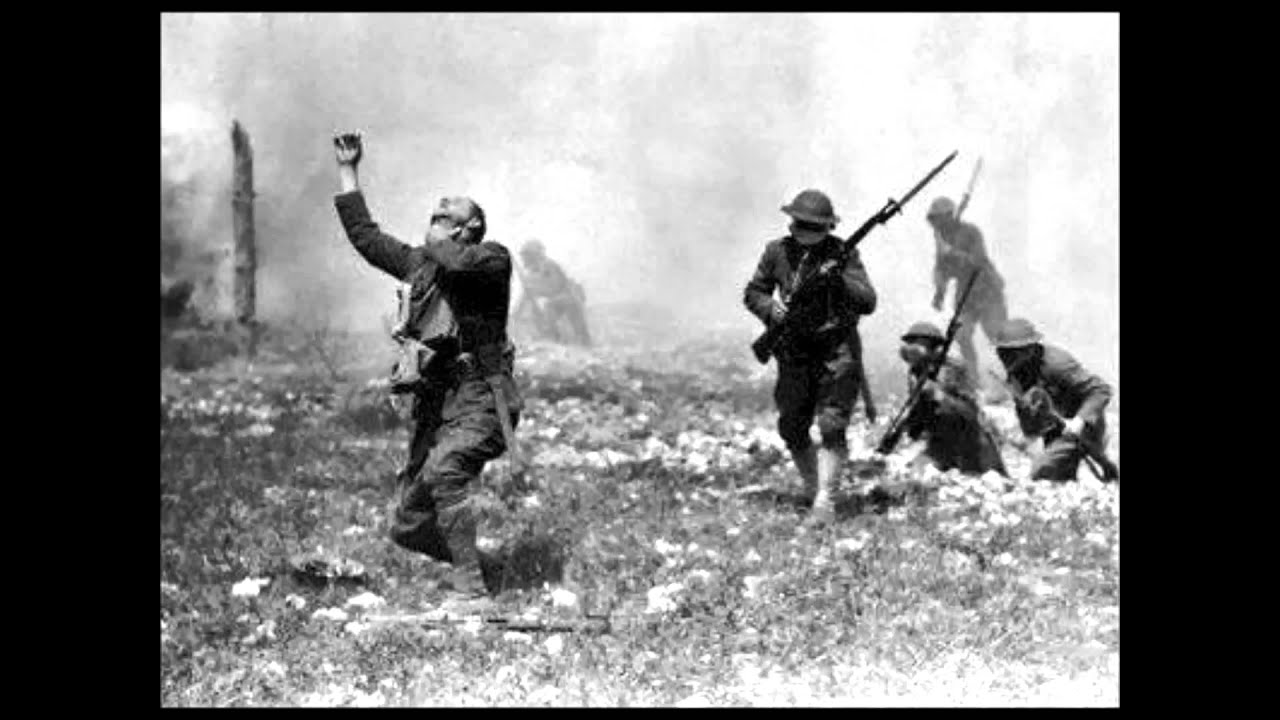
The poem’s structure follows a progression of thought, and here the rhyme scheme of progressing, alternating rhymes (ABABCDCD and so on) accentuates the forward thrust toward the poem’s conclusion.  The poem is divided into four sections; I’ll call them stanzas.  The first is an eight line stanza of which could be thought of as two quatrains.  It sets the scene of a marching troop, all suffering through the hardships of soldiers on maneuver.  The second stanza is of six lines, and taken with the eight can be seen as a second half of an Italian sonnet as Wikipedia see it.  It is a volta, meaning a turn of thought from the initial motif.  Here the turn is the introduction of a new crises, the realization that the Five-Nines (mortar or artillery shells) contained poison gas, and so the soldiers need to immediately put on their gas masks. 

Both the first and second stanzas are in the past tense, and so this is set in the past.  But notice how the second stanza has a stream of gerunds: “fumbling,” “fitting,” “stumbling,” “flound’ring,” “drowning.”  Though not associated with time, gerunds have a wonderful immediacy that makes the language feel as if it’s present time.  The “I saw him drowning” main clause clearly though situates it in the past. 

The third stanza is only two lines, but it clearly pushes us into the present tense—a simple present tense of general time, “in all my dreams.”  The poor dying man “plunges at [him]” in repeated dreams, again characterized by the immediacy of gerunds: “guttering, choking, drowning.”  “Drowning” gains a tremendous power by being repeated with the repetition falling on a rhymed word slot. 
The last stanza is made up of twelve lines with a strong break between the first eight and the last four. The tense shifts again here, this time into a conditional “if-then” construction.  Suddenly there is a person being addressed, “you” and later “my friend.”  Each quatrain of the eight lines has its own “if” construction.  The first “if” puts the person being addressed into the situation watching the dying man, and the second “if” allows the addressee hear the suffering man.  The “then” is a reproach to the addressee for promoting what Owen calls the “old lie,” the quote from Horace promoting a romanticized version of war.  Shortening that last line to three feet makes the ending that much more powerful.  Everything in the poem refutes the claim that there is anything sweet and glorious about war or dying in war for one’s country.  The Wikipedia entry identifies who Owen is addressing in that last stanza, a Jesse Pope who apparently was a propagandist poet for the war.  


There is more one can point out in the poem, such as the alliteration, the diction that accentuates the drudgery and the chaos, and the allusions to Dante’s hell.  Listen for it as you hear the poem being read here overlaid with some WWI video.   


So many great lines and phrases in the poem: “Bent double, like old beggars under sacks,” “deaf even to the hoots/Of tired, outstripped Five-Nines that dropped behind,” “Gas! Gas! Quick, boys!” “As under a green sea, I saw him drowning,” and finally “you would not tell with such high zest/To children ardent for some desperate glory,/The old Lie.”  Egremont titles his book from that line, “some desperate glory.”


Not only the finest poem of the First World War, but truly one of the great poems of the ages.