"Love follows knowledge."
"Beauty above all beauty!"
– St. Catherine of Siena

Showing posts with label Robert Hugh Benson. Show all posts

Tuesday, January 10, 2023

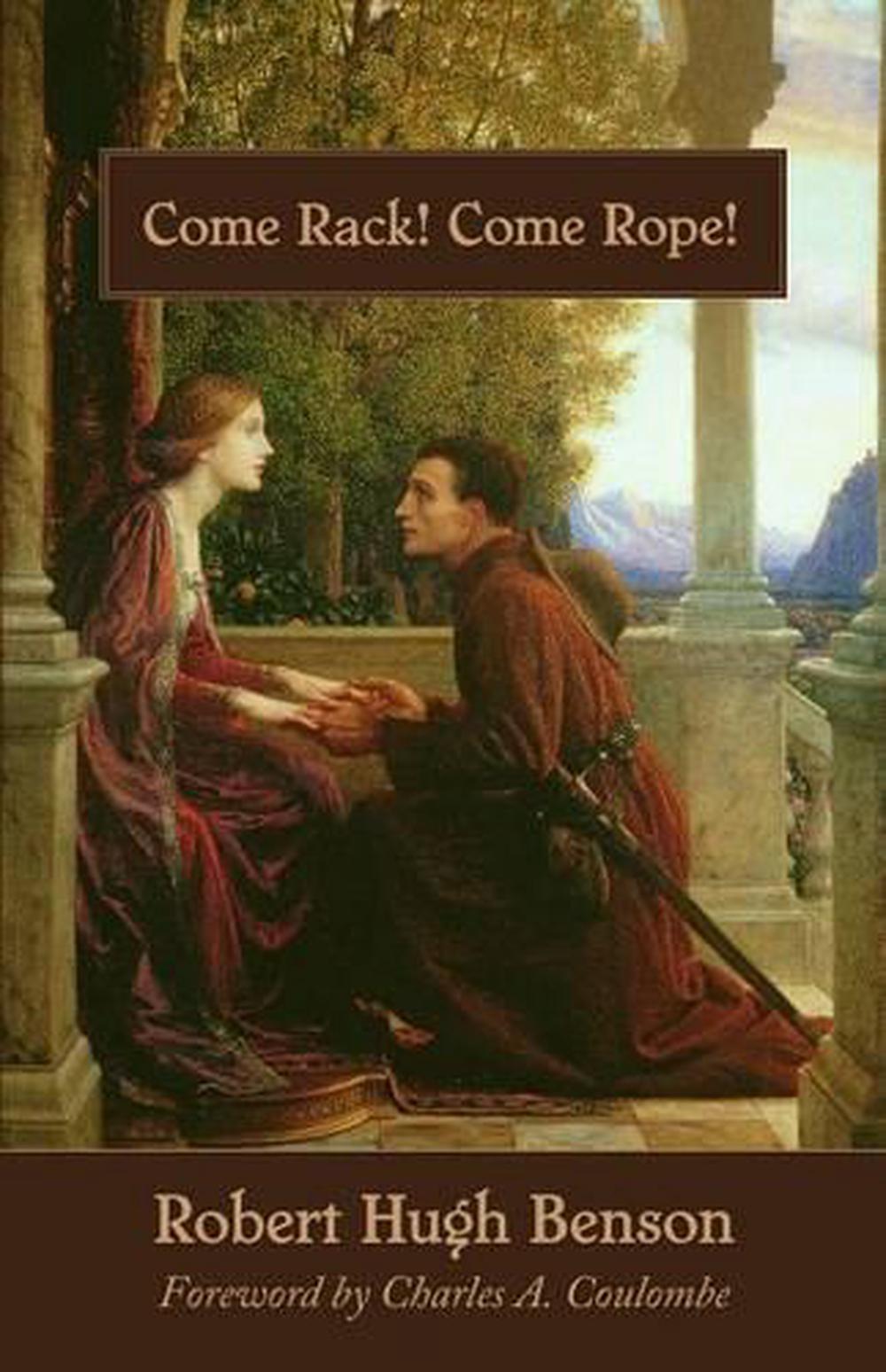
Come Rack! Come Rope! By Robert Hugh Benson, Post #5

This is fifth and final post of a series on the historical novel Come Rack! Come Rope! by Robert Hugh Benson. 

You can find Post #1 here.  

Post #2 here.  

Post #3 here.  

Post #4 here.  


Part IV, Chapters 4 thru 9 

Summary  

Marjorie hears about the two priests being taken at FitzHerbert’s.  Robin makes his way back to her home.  She arranges for him to hide out at a shepherd’s hut a couple of hours away.  He hears about the executions of those captured at FitzHerbert’s.  

He is called back to Marjorie’s but has a feeling of being followed.  He hears of the news the Spanish Armada has been destroyed by the English fleet.  At Marjorie’s a posse is heard approaching the house, and they rush Robin into the priest hole upstairs.  Leading the posse is Mr. Audrey, Robin’s father, who has no idea who the priest is hiding in the house.  Nonetheless he is reluctant to damage Marjorie’s house since he is on good terms with her.  She is shocked that the magistrate is Mr. Audrey and that he will be apprehending his own son.  She wants to warn him in some fashion but is powerless to do so.  Just as they are about to give up, one of the men from the posse strikes the wall of the priest hole, opening it, and finding Robin.  

Robin is taken to a jail in Derby.  He is hopeful they will not prove he is a priest.  He resolves to admit nothing.  The country people are exuberant from the news of the defeat of the Armada. 

Marjorie and Mr. Bidell try to formulate a defense for Robin.  Lord Shrewsbury and now Topcliffe, who has come to Derby for this, form the prosecuting opposition.  Marjorie realizes how events are conspiring against Robin.  What would be a first offense not punishable by death is being conflated with the Babington plot against the Queen’s life and the treason of coordinating with Spain.  

 Under Topcliffe’s interrogation, Robin is put on the rack and water tortured.  The pain is excruciating and the sense of drowning pushes Robin in and out of consciousness.  Still Robin refuses to admit anything, and he certainly denies involvement with the plot.  The torture goes on for three days and completely breaks Robin bodily.  

 Still Robin is condemned to being hung, drawn, and quartered.  His disfigured body can barely cooperate with the events, but he does not resist in any way.  Dragged by horses, his aching body reaches another level of pain.  Finally he is brought up to the gallows platform, not resisting but unable to climb up under his own power.  At the gallows he is allowed to make a last statement.  He freely and proudly admits he is a priest and that he dies for the Catholic faith, prays for England to return to the faith and for the Queen.  He leads the observing Catholics into an Our Father.  His last act was to forgive and absolve all those who are in attendance.  He is hung, goes out of consciousness, and for a moment awakes to realize the dismemberment before his death. 

###

I'm late in posting this. I have to admit the sadness of the story had me delay completing it. I knew round about how it would end. I thought by spacing the chapters out it might not effect me as much. Still it did. To some degree it reminded me of the Endo novel Silence and even Orwell's Nineteen Eighty-Four, though Winnie from 1984 survives but broken and mind-altered. Actually even Rodrigues from Silence survives but is emotionally broken from his apostasy. Nonetheless both novels share some heritage to Come Rack! Come Rope! I wonder if either Endo and Orwell had read it.

This was the tragedy of the Protestant Reformation.


Kerstin Commented:

This last part is hard to get through. Fr. Benson writes beautiful prose, but the ugliness of the subject matter is hard to stomach.

Casey Commented:

I happen to have just picked up Brave New World. You may recall a scene where Bernard and Lenina visit New Mexico and witness a young Indian boy being whipped as part of a rain ceremony. They meet another young boy who brags he could've done better etc. and Lenina says "Do you mean to say you wanted to be hit with that whip?"


There's part of me that feels the way the young man does about Robin's plight. Of course, one doesn't actually want to be tortured but there's such a paradoxical nobility in it that is admirably appealing. Oh, that I could give my all for Christ... but then I'll mindlessly forget to attend mass on a holy day or something.


What is the all that I can give? What is my limit? Everything, like Robin? Everything, like Marjorie? Everything?


Most probably I'm closer to Lenina that I'd like to admit.

Kerstin Commented:

In the second week of this reading I posted a comment on the meanings of the names Robin and Marjorie. Now that we’ve finished reading the book I want to go back and explore how this is significant. Both Robin and Marjorie are representations of Jesus and Mary; this is why they have a deep love for one another but can’t be married. As the novel moves past the opening chapters their initial romantic love, eros, is elevated by the extraordinary historical circumstances to self-sacrificing agape.

To recapture, the name Robin means “fame” and “bright”, and after he is ordained he takes on the last name of Alban. “Albus” is Latin for “white”. Robin, the Christ figure, is transformed by his ordination into a spotless sacrificial lamb. There are several parallels to the life of Jesus. Robin travels through the land with no place to put his head. And like John the Baptist paving the way for Jesus, the execution of Queen Mary of Scotts is pointing towards Robin's own martyrdom. On the scaffold Robin absolves his own father, an echo of the Good Thief.

Now let’s move on to Marjorie. I’ll repeat what I wrote before:


Marjorie is a version of Margaret, and it is the Greek word for pearl.

Pearls are formed in various species of shells and have always been very precious, as they are very rare in nature. For pearls to form they need the shell, no shells, no pearls.

The shell is a symbol of the Virgin Mary because she carried Jesus, the precious pearl, in her womb. So Jesus is identified with the pearl. The shell also became a symbol of Christ’s sepulcher and of the Resurrection in the Middle Ages. In art when Jesus gets baptized the water is often poured from a shell. Many priests use shells during baptisms. Baptismal fonts are often shaped in the form of a shell or have them as ornamentation.


Marjorie’s life parallels that of the Virgin Mary, and the intertwined imagery of the pearl - a hidden treasure - and the shell - shelter - are indirectly repeated throughout the novel in various ways.

When Marjorie as a seventeen-year-old senses that Robin is destined to become a priest she has to come to grips with that. She paces in the garden praying the rosary. She has to give her fiat first that when the time comes she can release him to be about his Father’s business. Her parents, like Anne and Joachim, are at this point only background figures, she steps out of their shadow. Later, when her mother dies, there is no priest. Just like there was no priest for Anne. All we know of her life was before Christ and the Church.

Marjorie, the Mary figure, becomes the mother of all the travelling priests and many of the recusants alike. The priests are her sons and she takes care of them. Her estate is a shelter for all of them, and for the longest time it isn’t even on the radar of the priest hunters. It is hiding in plain sight. Only when the one and truly special one, Robin, is hunted does her stronghold get breached. Mary can shelter Christ, but she cannot contain him. Hidden are also the myriad of communications she is engaging in to keep the priests safe and keeping the flame of faith alive. Robin rightly advises Marjorie not to hide herself away at a nunnery, she is needed exactly where she is at. Where is the pearl to hide if there is no shell? At Robin's martyrdom, ever faithful, Marjorie is present.
Even though the book ends, we know the Faith did survive the persecutions. It wouldn't have happened without Marjorie.

My Reply to Kerstin:

Kerstin this is excellent. I had forgotten you had mentioned the names. I picked up that Robin was a Christ figure, but I didn't think about Marjorie as the Blessed Mother. Yes, it fits very well. Very insightful comment.

###

One could have many highlights from this concluding section, especially Robin’s capture, torture, and execution.  But I particularly like the letter Marjorie sends Robin while he is hiding in the shepherd’s hut.  The letter informs him of the three more priests who were executed.  It foreshadows Robin’s future and presents to Robin the ramifications for his holding to his conscience.


“Three more have glorified God to-day by a good confession—Mr. Garlick, Mr. Ludlam and Mr. Simpson. That is the summary. The tale in detail hath been brought to me to-day by an eye-witness.


“The trial went as all thought it would. There was never the least question of it; for not only were the two priests taken with signs of their calling upon them, but both of them had been in the hands of the magistrates before. There was no shrinking nor fear showed of any kind. But the chief marvel was that these two priests met with Mr. Simpson in the gaol; they put them together in one room, I think, hoping that Mr. Simpson would prevail upon them to do as he had promised to do; but, by the grace of God, it was all the other way, and it was they who prevailed upon Mr. Simpson to confess himself again openly as a Catholic. This greatly enraged my lord Shrewsbury and the rest; so that there was less hope than ever of any respite, and sentence was passed upon them all together, Mr. Simpson showing, at the reading of it, as much courage as any. This was all done two days ago at the Assizes; and it was to-day that the sentence was carried out.


“They were all three drawn on hurdles together to the open space by St. Mary’s Bridge, where all was prepared, with gallows and cauldron and butchering block; and a great company went after them. I have not heard that they spoke much, on the way, except that a friend of Mr. Garlick’s cried out to him to remember that they had often shot off together on the moors; to which Mr. Garlick made answer merrily that it was true; but that ‘I am now to shoot off such a shot as I never shot in all my life.’ He was merry at the trial, too, I hear; and said that ‘he was not come to seduce men, but rather to induce them to the Catholic religion, that to this end he had come to the country, and for this that he would work so long as he lived.’ And this he did on the scaffold, speaking to the crowd about him of the salvation of their souls, and casting papers, which he had written in prison, in proof of the Catholic faith.


“Mr. Garlick went up the ladder first, kissing and embracing it as the instrument of his death, and to encourage Mr. Simpson, as it was thought, since some said he showed signs of timorousness again when he came to the place. But he showed none when his turn came, but rather exhibited the same courage as them both. Mr. Ludlam stood by smiling while all was done; and smiling still when his turn came. His last words were, ‘Venite benedicti Dei’; and this he said, seeming to see a vision of angels come to bear his soul away.


“They were cut down, all three of them, before they were dead; and the butchery done on them according to sentence; yet none of them cried out or made the least sound; and their heads and quarters were set up immediately afterwards on poles in divers places of Derby; some of them above the house that stands on the bridge and others on the bridge itself. But these, I hear, will not be there long.


“So these three have kept the faith and finished their course with joy. Laus Deo. Mr. John is in ward, for harbouring of the priests; but nothing hath been done to him yet.


“As for your reverence, I am of opinion that you had best wait another week where you are. There has been a man or two seen hereabouts whom none knew, as well as at Padley. It hath been certified, too, that Mr. Thomas was at the root of it all, that he gave the information that Mr. John and at least a priest or two would be at Padley at that time, though no man knows how he knew it, unless through servants’ talk; and since Mr. Thomas knows your reverence, it will be better to be hid for a little longer. So, if you will, in a week from now, I will send Dick once, again to tell you if all be well. I look for no letter back for this since you have nothing to write with in the hut, as I know; but Dick will tell me how you do; as well as anything you may choose to say to him.


“I ask your reverence’s blessing again. I do not forget your reverence in my poor prayers.”


And so it ended, without signature—for safety’s sake.

(pp. 284-286).

There is no question then that Robin knows exactly what fate awaits him.  He will heroically keep to his conscience.


###

My Goodreads Review:

This a very good novel.  Four and a half stars to be precise but I rounded down.  Why round down?  It didn’t reach the sense of a classic for me.  I had the same Four and a half rating for Benson’s great novel, Lord of the World, but with that I rounded up.  I would say Lord of the World is an unheralded classic.  I think the difference is that Come Rack! Come Rope! is a historical novel, and so is fixed to historical events while Lord of the World was an imaginative creation and so requires a bit more artifice.  But if you love historical novels Come Rack! Come Rope! is definitely for you. 

Benson puts you right into the Catholic subculture of Elizabethan England and using an actual historical event: the Babington Plot to kill Queen Elizabeth and install the Catholic Mary Queen of Scots. Benson develops a suspenseful tale of Catholic characters unconnected to the plot striving to exercise their faith but yet caught in the tragedy of their times.

The novel is set in the 1580’s in the English Midlands, the heart of the Catholic resistance to the Protestant wave.  Though he is not mentioned in the novel, the period and region overlaps with William Shakespeare’s life and hometown, which was also part of the English Midlands, though Stratford-Upon-Avon is a little further south than the Derbyshire of the novel.  Still it gives support to the theory that Shakespeare was a recusant Catholic.  The region was populated with Catholics.

The novel centers on two fictional characters, Robin Audrey and Marjorie Manners.  The two intend to marry but events compel Robin to become a priest so that the recusant Catholics can secretly celebrate Mass and receive the sacraments.  In and about their lives is Anthony Babington, the real life person who plotted the assassination of Queen Elizabeth.  The novel mixes fictionalized characters and real life characters seamlessly. 

One thing you will not regret is reading Robert Hugh Benson’s prose.  He is such a wonderful stylist.  Let me provide an example.  Here is a scene where Robin, the central character of the novel and now secretly a Catholic priest, stands in front of the castle where Mary, Queen of Scots is held prisoner and expected to be executed.


Overhead lay the heavy sky of night-clouds like a curved sheet of dark steel, glimmering far away to the left with gashes of pale light. In front towered the twin gateway, seeming in the gloom to lean forward to its fall. Lights shone here and there in the windows, vanished and appeared again, flashing themselves back from the invisible water beneath. About, behind and on either side, there swayed and murmured this huge crowd—invisible in the darkness—peasants, gentlemen, clerks, grooms—all on an equality at last, awed by a common tragedy into silence, except for words exchanged here and there in an undertone, or whispered and left unanswered, or sudden murmured prayers to a God who hid Himself indeed. Now and again, from beyond the veiling walls came the tramp of men; once, three or four brisk notes blown on a horn; once, the sudden rumble of a drum; and once, when the silence grew profound, three or four blows of iron on wood. But at that the murmur rose into a groan and drowned it again….

The dark steel of the sky foreshadows the blade that will behead the queen with the “gashes of pale light” suggesting the bloody nape of the severed head.  Benson puts the reader right into the spectacle, full of medieval horns and rustic peasantry.  Here is the climax of the scene later in the chapter.


Then suddenly the heads grew still; a wave of motionlessness passed over them, as if some strange sympathy were communicated from within those tall windows. The moments passed and passed. It was impossible to hear those murmurs, through the blare of the instruments; there was one sound only that could penetrate them; and this, rising from what seemed at first the wailing of a child, grew and grew into the shrill cries of a dog in agony. At the noise once more a roar of low questioning surged up and fell. Simultaneously the music came to an abrupt close; and, as if at a signal, there sounded a great roar of voices, all shouting together within the hall. It rose yet louder, broke out of doors, and was taken up by those outside. The court was now one sea of tossing heads and open mouths shouting—as if in exultation or in anger. Robin fought for his place on the projecting stones, clung to the rough wall, gripped a window-bar and drew himself yet higher.


Then, as he clenched himself tight and stared out again towards the tall windows that shone in bloody flakes of fire from the roaring logs within; a sudden and profound silence fell once more before being shattered again by a thousand roaring throats….


For there, in full view beyond the clear glass stood a tall, black figure, masked to the mouth, who held in his out-stretched hands a wide silver dish, in which lay something white and round and slashed with crimson….

The blare of music, the intervals of quiet hush and roar of the crowd, and the dramatic display of the Queen’s head, not even distinct, makes for such a dramatic scene.

His prose is exquisite, but I also find Benson to be masterly at plotting and pacing, masterly at descriptions, masterly at heightening suspense, and masterly at bringing abstract ideas into conflict in a narrative.  His one limitation as a novelist I think is character psychological depth.  His characters can be flat at times.  But don’t get me wrong; I still think this is a fine novel.

Finally, the subject matter is heartbreaking.  Family members in opposition with each other, even father against son.  Courtship is aborted with lovers separated.  Hopes are raised, but then shattered.  Traditions are uprooted.  An old way of life is persecuted and supplanted.  Those who want to hold on to their deeply held beliefs and stay true to their conscience are tortured and killed.  Say what you will about the Protestant Reformation, the human results were tragic.  Benson captures this all.


Tuesday, December 6, 2022

Come Rack! Come Rope! By Robert Hugh Benson, Post #4

This is fourth post of a series on the historical novel Come Rack! Come Rope! by Robert Hugh Benson. 

You can find Post #1 here.  

Post #2 here.  

Post #3 here.  


Part 3, Chapters 1 thru 5


Summary


Robin arrives in London several years later under the name of Robin Alban.  He is now a priest and meeting him at an inn is Anthony Babington, where the old friends catch up on what has been happening.  He hears of more priests being discovered and either exiled or executed.  Babington confesses he is involved in a plot to kill Queen Elizabeth and have Queen Mary of Scots assume the throne.  Robin offers no consolation to the evil scheme and advices against it.  Babington insists that Mary supports such a plot.


After strolling through London, Robin is handed a package of letters by the innkeeper.  Inside his bolted room, he reads that the covert Catholic company in London has been betrayed and are on the run.  Another letter from Babington speaks of a trap for Mary Queen of Scots.  Ten days later, the innkeeper tells Robin his friends have dispersed and left a luggage.  He is warned it is unsafe to stay in London, and with his aid, Mr. Arnold, abscond as quickly as possible.  In leaving, he sees a posse corner a group of men, who turn out to be his friends.


On the way to Derby is Chartley Castle where Queen Mary is imprisoned.  Robin decides to risk getting to the queen by posing as an apothecary with the ruse to provide the ailing queen with some healing herbs.  Despite some difficulties he does meet with the queen in private, reveals he is a priest, hears her confession, and provides her with Holy Communion.  She is clearly devout and believes will not survive long.  She tells him she is innocent of this plot to kill Elizabeth.  With the Queen in apparent better health after his visit, he tells the jailer he may come back again.


From Chartley he reaches Derby and arrives at Marjorie’s where he learns Babington has been executed.  He learns of the Thomas FitzHerbert apostacy and other local news he has missed.  The good Catholics gather at Marjorie’s and Robin hears confessions and celebrates Mass.  He asks about his father, but no one seems to know much.  When all are gone, he tells Marjorie about what happened at Chartely, and that if called upon he will go back.


###


Peej Commented:

These chapters portrayed Mary, Queen of Scots as a pseudo-transcendental figure. I wonder if this is how she was perceived by English Catholics of the time, as a political savior.


We obviously know this isn’t true. She’s never been beatified. While she was the rightful heir and held the true religion, Babington and others may have slid into politico-theological heresy by elevating her. I really don’t know more than what I read in the novel. Does anybody else?


Frances Replied:

Not very much, Peej. Her son, James VI of Scotland, became James I of England, unifying the two thrones as the first Stuart king. And then, there is some ambiguity regarding the role -- very likely passive -- that he played in his mother's execution under Elizabeth I.


My Reply:

Benson is quite clear in portraying Mary Queen of Scotts as a sort of martyr and innocent of the charges. I don't know the history well enough to say one way or the other. It's probably within the span of the unknown and possible. What I see at this point in England's history, is that the Catholics have become a minority under a government where there are no minority rights, and where the majority has a vested interest in destroying the minority. And the minority made it worse with attempts to overthrow the majority. So even those in the majority sympathetic found it tough to defend the minority. It's all just a shame and tragic, put in motion by Henry VIII, a despicable and selfish man.


###


The highlight of these chapters is Robin’s meeting of Mary Queen of Scots, held prisoner at Chartley Castle.  First let’s start with this description of Mary.


Mary was past her prime long ago; she was worn with sorrow and slanders and miseries; yet she appeared to the priest’s eyes, even then, like a figure of a dream. It was partly, no doubt, the faintness of the light that came in through the half-shrouded windows that obliterated the lines and fallen patches that her face was beginning to bear; and she lay, too, with her back even to such light as there was. Yet for all that, and even if he had not known who she was, Robin could not have taken his eyes from her face. She lay there like a fallen flower, pale as a lily, beaten down at last by the waves and storms that had gone over her; and she was more beautiful in her downfall and disgrace, a thousand times, than when she had come first to Holyrood, or danced in the Courts of France.


Now it is not in the features one by one that beauty lies but rather in the coincidence of them all. Her face was almost waxen now, blue shadowed beneath the two waves of pale hair; she had a small mouth, a delicate nose, and large, searching hazel eyes. Her head-dress was of white, with silver pins in it; a light white shawl was clasped cross-wise over her shoulders; and she wore a loose brocaded dressing-gown beneath it. Her hands, clasped as if in prayer, emerged out of deep lace-fringed sleeves, and were covered with rings. But it was the air of almost superhuman delicacy that breathed from her most forcibly; and, when she spoke, a ring of assured decision revealed her quiet consciousness of royalty. It was an extraordinary mingling of fragility and power, of which this feminine and royal room was the proper frame.

 (p. 215, Aeterna Press. Kindle Edition)


Finally when the guard is out of the room and the Queen and her attendants are left with Robin, they all move quickly to get the Queen her sacraments.


The Queen opened her eyes, waited for one tense instant till the door closed; then she slipped swiftly off the couch.


“The door!” she whispered.


The woman was across the room in an instant, on tip-toe, and drew the single slender bolt. The Queen made a sharp gesture; the woman fled back again on one side, and out through the further door, and the old man hobbled after her. It was as if every detail had been rehearsed. The door closed noiselessly.


Then the Queen rose up, as Robin, understanding, began to fumble with his breast. And, as he drew out the pyx, and placed it on the handkerchief (in reality a corporal), apparently so carelessly laid by the crucifix, Mary sank down in adoration of her Lord.


“Now, mon père,” she whispered, still kneeling, but lifting her star-bright eyes. And the priest went across to the couch where the Queen had lain, and sat down on it.


In nomine Patris et Filii et Spiritus Sancti—” began Mary.


When the confession was finished, Robin went across, at the Queen’s order, and tapped with his finger-nail upon the door, while she herself remained on her knees. The door opened instantly, and the two came in, the woman first, bearing two lighted tapers. She set these down one on either side of the crucifix, and herself knelt with the old physician.


… Then Robin gave holy communion to the Queen of the Scots….

(p. 217)


Finally they restore the room to its previous state, and the Queen gives a commendation.


She was back again on her couch now, once more as drowsy-looking as ever. The candlesticks were gone again; the handkerchief still in its place, and the woman back again behind the couch. The two men kneeled close beside her, near enough to hear every whisper.


“Listen, gentlemen,” she said softly, “I cannot tell you what you have done for my soul to-day—both of you, since I could never have had the priest without my friend…. I cannot reward you, but our Lord will do so abundantly…. Listen, I know that I am going to my death, and I thank God that I have made my peace with Him. I do not know if they will allow me to see a priest again. But I wish to say this to both of you—as I said just now in my confession, to you, mon père—that I am wholly and utterly guiltless of the plot laid to my charge; that I had neither part nor wish nor consent in it. I desired only to escape from my captivity…. I would have made war, if I could, yes, but as for accomplishing or assisting in her Grace’s death, the thought was never near me. Those whom I thought my friends have entrapped me, and have given colour to the tale. I pray our Saviour to forgive them as I do; and with that Saviour now in my breast I tell you—and you may tell all the world if you will—that I am guiltless of what they impute to me. I shall die for my Religion, and nothing but that. And I thank you again, mon père, et vous, mon ami, que vous avez….


Her voice died away in inaudible French, and her eyes closed.


Robin’s eyes were raining tears, but he leaned forward and kissed her hand as it lay on the edge of the couch. He felt himself touched on the shoulder, and he stood up. The old man’s eyes, too, were brimming with tears.

 (pp. 217-218)


A touching scene, full of pathos. 


###


Part 3, Chapters 6 thru 8, Part 4, Chapters 1 thru 3


Summary


Robin spends his time in his old grounds with his Catholic friends.  They hear that Mary Queen of Scots has been relocated in Farthingay, which is still within two day’s reach from Derby.  Marjorie receives a letter that it is expected that Mary will be executed and there will be a need for a priest.  She is reluctant to tell Robin, but in the end she does.  Robin decides to risk his life and travel to Farthingay.


When Robin arrives at Farthingay, he cannot find the means to visit the Queen.  He tries to make contact with those inside but they put him off.  Everyone anticipates her execution but none is scheduled.  Even on the night before her execution, they will not allow a priest for her last rites.  But suddenly folks that night gathered beneath the Castle’s tower.  As Robin tries to get to the front of the mob that morning, suddenly with fanfare instruments and a roar from the crowd, in an open window a man presents to the crowd on a platter the severed head of the Queen.


A year later, the Catholics still continue to have their Masses and sacraments in secret through the ingenuity of Marjorie Manners.  However, news of priests being captured continues to filter in.  Slowly more Catholics, such as Mr. Simpson, are beginning to give in to the authorities.  The Protestant Lord Shrewsbury has it seems taken a more aggressive role in rooting out the Catholics in the Derby region.  More and more searches are repressing the Catholics. 


Attacks on Catholic homes are now more frequent, and more lay Catholics are being jailed as well.  The area is down to three priests: Garlick, Ludlam, and Robin.  The three priests one day meet at the house of old Mr. FitzHerbert, and the four have a wonderful, peaceful dinner.  The next morning, the three priests all celebrate a Mass each.  Upon finishing the last, they hear a loud ruckus outside of a posse coming from Lord Shrewsbury.  They have been found out, and Garlick and Ludlam hide inside a two man priest hole on the ground floor while Robin hides in the one man priest hole on the floor above.


The Shrewsbury posse crash the house and break walls searching for the hiding priests.  Robin can hear as they tap and puncture the walls.  He hears the shuffling movements, the sounds, and the talk of Garlick and Ludlam being discovered and restrained.  They come close to breaking the wall at Robin’s hole as well but by fortunate the posse stops short.  The posse leaves eventually and Robin stays many hours to ensure that all have left.  Finally he crawls out to only find a weeping maid servant. 


###


Joseph Commented:

Robin is almost like the English Reformation Forrest Gump. He's in the middle of all of it, but it also makes very real just how bad things were in the 1580s.


###


Two points strike me as I read this last section. 


First, the allusions to Spain in these chapters are significant.  The Babington Plot included the addition of the Spanish army invading England once Elizabeth I had been assassinated and replaced by Mary Queen of Scots.  Even after Mary was executed Catholics hoped on Spain to overthrow the Protestant government.   Indeed the Spanish Armada had plans of invading England, but the English Navy defeated them in 1588. That is the year after Mary was beheaded, so the threat from Spain was co-terminus with the events of the novel.  English fear of Spain was at a high, and so the persecution of the Catholics became more intense.  The novel captures this perfectly.


Second, the intensity of the persecution is very intense, especially when you consider these are fellow countrymen who are torturing and killing their fellow townsmen.  When a country or people turn against Catholicism, it is with savage intensity.  Recall the Roman persecution of the first three centuries of the Common Era.  Think ahead then in the Enlightenment persecution of Revolutionary France, or the Japanese persecutions in Medieval Japan, the Bolshevik Revolution, Mexican persecutions, or the Spanish Civil War.  Catholicism’s refusal to give the state the primary role in their lives sets off fury in those who oppose it. 


###


The highlight of these chapters is that of the execution of Mary, Queen of Scots.  But the chapter is filled with more than just her execution.  Let’s start at the beginning of Part 3, Chapter VIII.  Part I of the chapter is so superbly written than it should be quoted in its entirety.


Overhead lay the heavy sky of night-clouds like a curved sheet of dark steel, glimmering far away to the left with gashes of pale light. In front towered the twin gateway, seeming in the gloom to lean forward to its fall. Lights shone here and there in the windows, vanished and appeared again, flashing themselves back from the invisible water beneath. About, behind and on either side, there swayed and murmured this huge crowd—invisible in the darkness—peasants, gentlemen, clerks, grooms—all on an equality at last, awed by a common tragedy into silence, except for words exchanged here and there in an undertone, or whispered and left unanswered, or sudden murmured prayers to a God who hid Himself indeed. Now and again, from beyond the veiling walls came the tramp of men; once, three or four brisk notes blown on a horn; once, the sudden rumble of a drum; and once, when the silence grew profound, three or four blows of iron on wood. But at that the murmur rose into a groan and drowned it again….


So the minutes passed…. Since soon after midnight the folks had been gathering here. Many had not slept all night, ever since the report had run like fire through the little town last evening, that the sentence had been delivered to the prisoner. From that time onwards the road that led down past the Castle had never been empty. It was now moving on to dawn, the late dawn of February; and every instant the scene grew more distinct. It was possible for those pushed against the wall, or against the chains of the bridge that had been let down an hour ago, to look down into the chilly water of the moat; to see not the silhouette only of the huge fortress, but the battlements of the wall, and now and again a steel cap and a pike-point pass beyond it as the sentry went to and fro. Noises within the Castle grew more frequent. The voice of an officer was heard half a dozen times; the rattle of pike-butts, the clash of steel. The melancholy bray of the horn-blower ran up a minor scale and down again; the dub-dub of a drum rang out, and was thrown back in throbs by the encircling walls. The galloping of horses was heard three or four times as a late-comer tore up the village street and was forced to halt far away on the outskirts of the crowd—some country squire, maybe, to whom the amazing news had come an hour ago. Still there was no movement of the great doors across the bridge. The men on guard there shifted their positions; nodded a word or two across to one another; changed their pikes from one hand to the other. It seemed as if day would come and find the affair no further advanced….


Then, without warning (for so do great climaxes always come), the doors wheeled back on their hinges, disclosing a line of pikemen drawn up under the vaulted entrance; a sharp command was uttered by an officer at their head, causing the two sentries to advance across the bridge; a great roaring howl rose from the surging crowd; and in an instant the whole lane was in confusion. Robin felt himself pushed this way and that; he struggled violently, driving his elbows right and left; was lifted for a moment clean from his feet by the pressure about him; slipped down again; gained a yard or two; lost them; gained three or four in a sudden swirl; and immediately found his feet on wood instead of earth; and himself racing desperately as a loose group of runners, across the bridge; and beneath the arch of the castle-gate.

 (pp. 246-247).


Notice Benson describes the dark clouds in the first sentence as “night-clouds like a curved sheet of dark steel.”  That alludes to the dark steel of the blade that will behead the Queen.  And the “gashes of pale light” is an image foreshadowing the violence of the act.  The scene is so beautifully drawn: the gathering crowd, the rush, the energy.  It’s interesting how an execution gathers so many people.  It would not be something that would draw me, but then this execution is a political gathering too.  So there is a mixture of political interest with the spectacle of a death in front of one’s eyes.  Later, Robin’s contemplation on the Queen’s execution has intertextual significance.


And now that the priest was in his place, he began again to think over that answer of the Queen. The very words of it, indeed, he did not know for a month or two later, when Mr. Bourgoign wrote to him at length; but this, at least, he knew, that her Grace had said (and no man contradicted her at that time) that she would shed her blood to-morrow with all the happiness in the world, since it was for the cause of the Catholic and Roman Church that she died. It was not for any plot that she was to die: she professed again, kissing her Bible as she did so, that she was utterly guiltless of any plot against her sister. She died because she was of that Faith in which she had been born, and which Elizabeth had repudiated. As for death, she did not fear it; she had looked for it during all the eighteen years of her imprisonment.


It was at a martyrdom, then, that he was to assist…. He had known that, without a doubt, ever since the day that Mary had declared her innocence at Chartley. There had been no possibility of thinking otherwise; and, as he reflected on this, he remembered that he, too, was guilty of the same crime;… and he wondered whether he, too, would die as manfully, if the need for it ever came.


Then, in an instant, he was called back, by the sudden crash of horns and drums playing all together. He saw again the ranks of heads before him: the great arched windows of the hall on the other side of the court, the grim dominating keep, and the merciless February morning sky over all.


It was impossible to tell what was going on.

(pp. 249-250)


Robin wonders if he will face the same martyrdom manfully.  This is another foreshadow.  We know he will.  Finally the simple pathos of the Queen’s beheading.


Then suddenly the heads grew still; a wave of motionlessness passed over them, as if some strange sympathy were communicated from within those tall windows. The moments passed and passed. It was impossible to hear those murmurs, through the blare of the instruments; there was one sound only that could penetrate them; and this, rising from what seemed at first the wailing of a child, grew and grew into the shrill cries of a dog in agony. At the noise once more a roar of low questioning surged up and fell. Simultaneously the music came to an abrupt close; and, as if at a signal, there sounded a great roar of voices, all shouting together within the hall. It rose yet louder, broke out of doors, and was taken up by those outside. The court was now one sea of tossing heads and open mouths shouting—as if in exultation or in anger. Robin fought for his place on the projecting stones, clung to the rough wall, gripped a window-bar and drew himself yet higher.


Then, as he clenched himself tight and stared out again towards the tall windows that shone in bloody flakes of fire from the roaring logs within; a sudden and profound silence fell once more before being shattered again by a thousand roaring throats….


For there, in full view beyond the clear glass stood a tall, black figure, masked to the mouth, who held in his out-stretched hands a wide silver dish, in which lay something white and round and slashed with crimson….

(pp. 250-251)


The blare of music, the intervals of quiet hush of the crowd with the roar of the crowd, and the dramatic display of the Queen’s head, not even distinct, makes for such a dramatic scene.