
Today, Year A’s Nineteenth Sunday in Ordinary Time, we continue following Jesus and the apostles after the Feeding of the Five Thousand. Jesus disperses the crowd and sends the apostles off on their boat while he goes up the hillside to pray alone. The boat encounters a storm, and Jesus heads out to the apostles, walking on the water. You know the passage. Peter asks if he could be allowed to walk on the water, and after Jesus acknowledges and Peter does take a few steps, he loses faith and starts to sink. Jesus then saves him.
There are a couple of mysterious details in this passage. Let me bring them out in the form of questions and try to answer them, but rest assured I’m not all that confident in my answers.
Why does Jesus send them off alone to the
boat while He goes away from them?
Prayer is certainly important to Jesus, but the fact He “made them get into a boat” suggests He has orchestrated all the subsequent events. All details should be filtered with this detail.
Why does He walk on water to go out to
them? Couldn’t He calm the sea and wait
for the boat to dock?
Jesus walking on water is a theophany, a manifestation of His divinity. He intended to manifest to the apostles. This appears to be the reason to send them off while He stays back.
Why is the boat on the sea on the fourth
watch, which is supposed to be between 3 and 6 AM? That’s not a particularly safe time to be on
water in ancient times.
It’s obviously overcast and the surroundings would be totally dark. A natural impulse would be to head back to shore but Jesus wanted them out and so they were obedient. As Dr. Pitre will explain below, they were fishermen, and so used to going on the sea at night. Perhaps the bad weather caught them by surprise.
Why did Peter want to walk on the water?
It’s not exactly a natural inclination. He sees Jesus walking on water, did Peter want to emulate Him? Was he just looking for a thrill? Was he trying to show off? I guess we will never know.
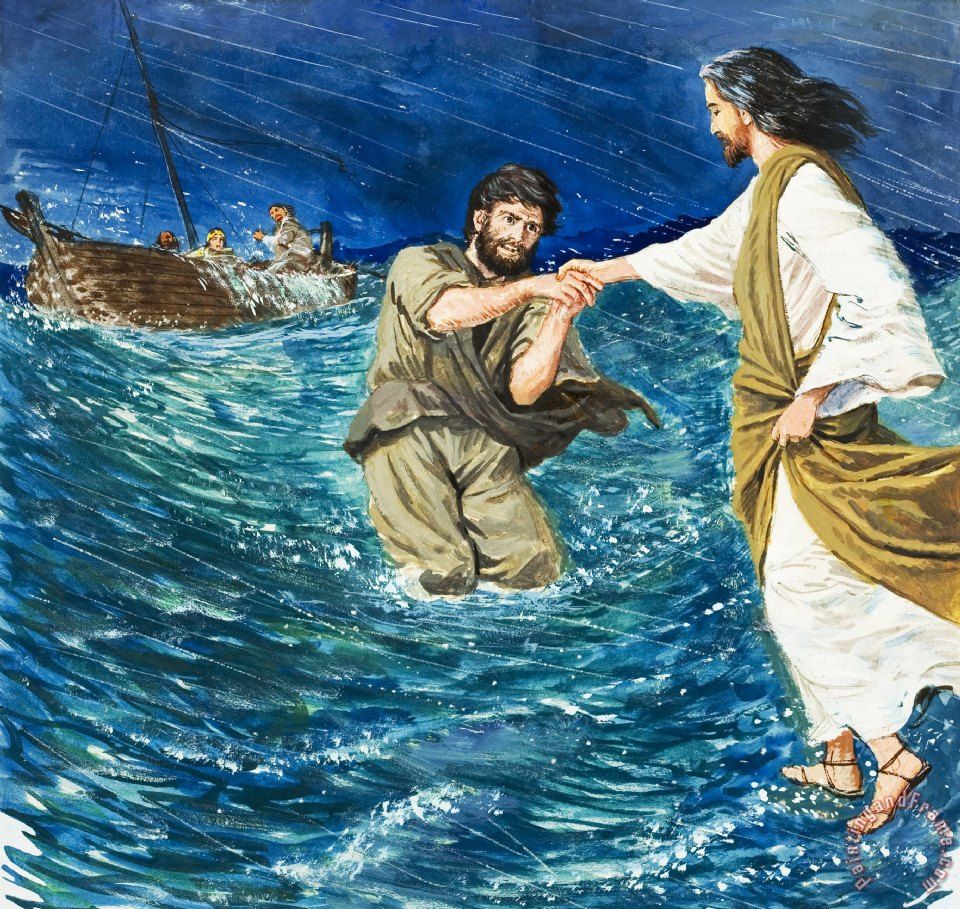
Today’s Gospel:
After he had fed the people, Jesus made the disciples get into a boat
and precede him to the other side,
while he dismissed the crowds.
After doing so, he went up on the mountain by himself to pray.
When it was evening he was there alone.
Meanwhile the boat, already a few miles offshore,
was being tossed about by the waves, for the wind was against it.
During the fourth watch of the night,
he came toward them walking on the sea.
When the disciples saw him walking on the sea they were terrified.
“It is a ghost,” they said, and they cried out in fear.
At once Jesus spoke to them, “Take courage, it is I; do not be afraid.”
Peter said to him in reply,
“Lord, if it is you, command me to come to you on the water.”
He said, “Come.”
Peter got out of the boat and began to walk on the water toward Jesus.
But when he saw how strong the wind was he became frightened;
and, beginning to sink, he cried out, “Lord, save me!”
Immediately Jesus stretched out his hand and caught Peter,
and said to him, “O you of little faith, why did you doubt?”
After they got into the boat, the wind died down.
Those who were in the boat did him homage, saying,
“Truly, you are the Son of God.”
~Mt: 14:22-33
Our old friend, Dr. Brant Pitre, brings out the exegetical main points.
Dr. Pitre:
It's important to
recall the setting of this miracle. It
takes place after the famous feeding of the 5,000 in the Gospel of Matthew. So one of the reasons this is important to
highlight is because the same sequence occur in all the Gospels so for example
in Matthew and Mark and in John all of those Gospels—three of the four actually—three
of the four Gospels have accounts of the walking of Jesus on the water and in
all three that that account immediately follows the feeding of the 5,000, so
it's like a pair of miracles: Jesus feeds the 5,000 and then he walks on the
water, so it's in the wake of him having performing this amazing miracle
feeding 5,000 people from five loaves and two fish that Jesus then withdraws
and he goes up the mountain to pray right. So it gets late and then while he is up in the
mountain praying the disciples set off across the Sea of Galilee in the boat. Now a couple elements about the context: where
exactly does this take place on the Sea of Galilee? Well we don't the exact location but we do
know the Sea of Galilee to this day is not a very…small lake it's about seven
miles wide at its widest point and it was the kind of beating heart of Galilee,
and is the place of fishing and industry and disciples knew it well and when
they're in their boat [it] is important the first thing you notice is they're
not right next to shore; it says there are many furlongs distant from the land
now in John's account of this miracle he actually says they're about four miles
from the shore.
Also notice the time
it's the fourth watch of the night, so this is in the middle of the night
sometime between three o'clock and six o'clock in the morning now most of us
wouldn't get on a boat and be out in the middle of the night between 3 and 6
a.m. But for the Apostles they were
pretty used to this because as fishermen it was actually customary to fish at
night we'll see that in a gospel John that they spend all night fishing and
they don't catch anything so they are traveling in the middle of the night and something
they're pretty used to. What they're not
used to however is being on the water in the middle of the night in the middle
of the lake and seeing a man coming to them walking on the waves of the sea,
and that's what Jesus does here in this account, he comes to them walking on
the sea. Now when they experience this
their first reaction is fear right and they assume that he's a ghost pretty
interesting a point there because it shows us that apparently at least some of
the disciples believed in ghosts.
Jesus says something
very interesting, he says take heart don't be afraid. I'll pause there for a second; this is a clue
to us that we should characterize this account Jesus walking on the water as a
theophany. A theophany as I've mentioned
in other videos is an appearance of God. It's where God reveals his power and his glory
and its presence to his people on earth, and one of the things you'll see over
and over again in accounts of theophanies in the Bible is that people are
always afraid, like when they see God they're afraid, and God's response to their
fear is often to quell it. Right to say
be calm don't be afraid and then to speak to them to give them some message, so
in this case Jesus says take heart have no fear and then he says it is I. Now the Greek, the literal Greek behind that
expression which most Bibles render—“it is I”—is “egō eimi,” which
literally in Greek means take heart, “I am so,” that's quite the same thing as
it is me. [It] literally just says take
heart I now. On the one hand the expression I am, egō eimi,
can be used to identify someone right so if I ask you a question is that you
and you say I am it could respond by saying yes it's me. Right so that can be the sense or the meaning
of it, but the literal meaning of the word in context is more than that Jesus
isn't just identifying himself; he's also taking the divine name of God.
From the Old Testament and using it as his own, so in other words he's alluding to the most famous theophany in the Bible, the theophany of the appearance of God to Moses on Mount Sinai in the book of Exodus chapter 3. So in that theophany God comes to Moses and he calls Moses to go to the people of Israel who were slaves in Egypt and to set them free and to bring a message of deliverance, and Moses says well if I go to them whose name shall I give them, what name will I tell them is the name of the God who sent me? And the Lord says to Moses, “I am Who I am, tell them I am has sent you to them.” Right this is my name for all generations God goes on to say, so the name that the expression, “I am,” is more than just an identification; it's the divine name, so when you take Jesus's use of the term, “I am,” you couple it with the fact that he is walking on water and that he's saying don't be afraid which is standard theophany language from the Old Testament, [all] three things together show to us that Jesus is revealing his divinity.
That’s a pretty clear exegesis. For the pastoral homily, I’m going to knock you out of your socks with this from Pope Leo XIV.
Pope Leo XIV:
Dear brothers and sisters, happy Sunday. Today's gospel speaks of Jesus approaching his disciples by walking on the waters of the Sea of Galilee in the midst of a storm. Following the miracle of the loaves and fish, the master urges his disciples to get into the boat and set out while he withdraws to the mountain to pray by himself. Once away from the shore, the disciples find themselves at the mercy of the wind and struggle to make headway. After a successful experience in which they had been the protagonists of a miraculous sign, they now find themselves helpless and frightened in the face of the threat of the waves and the headwind. As the night was drawing to a close, Jesus came towards them across the choppy waters, and terrified, they mistook him for a ghost. But he said to them, "Take heart. It is I. Do not be afraid.” The Lord's presence changes everything. Peter even manages to take a few steps across the waves towards him. But then losing his nerve, he begins to sink and Jesus saves him. When the master then steps into the boat, the storm subsides and a profession of faith spontaneously springs out of the disciples hearts. Truly, you are the son of God. To realize this point, it was not enough for them simply to have witnessed a miracle nor to have succeeded in the eyes of the people. Instead, they had to experience their own weakness and within it recognize God's presence. Only this experience could open their eyes and hearts to his closeness, finding peace even in the midst of the storm.
Notice the point. It’s not just witnessing the miracle that changes the apostle’s hearts. It’s the fear and anxiety they experience that changes them. They had to experience the terror for their souls to find peace.
Pope Leo XIV:
Sometime later, Jesus would say to them, "If you have faith and do not doubt, if you say to this mountain, be lifted up and thrown into the sea, it will be done." This is similar to what they experienced on the lake. The peace of Christ who had been on the mountain praying reached them in the midst of the raging waters. This miracle then teaches us something important. First, not to get carried away by success and never to be presumptuous. At the same time, not to despair even in moments of darkness when we feel powerless in the face of problems. And despite our efforts, it seems as though we are going backwards rather than forwards. Whatever the circumstances, Jesus does not abandon us. And if we humbly welcome him into the boat of our lives through prayer, the sacraments, and listening to his word, in him we will find peace, light, and strength for our journey. May who is proclaimed blessed for her faith, help us to live in a trusting surrender to God.
Ultimately what I think Pope Leo is getting at is that there
is a relationship between faith and hope.
The apostles had a momentary shaking of faith; Peter walking on the
water loses faith and begins to drown. What
does he do? He calls out to Jesus. The calling is an act of hope. The apostles did not despair. One may have a shaking of one’s faith from
the tumultuous events in our lives—and that is natural—but keeping hope in
Jesus is the key to salvation.
Sunday Meditation: But
when he saw how strong the wind was he became frightened; and, beginning to
sink, he cried out, “Lord, save me!”
What hymn could be better for this reading than “Take My Hand, Precious
Lord,” Words: Thomas A. Dorsey, 1932. I played this three years ago for this reading, and I will never miss an opportunity to play my most beloved hymn. And I absolutely love this version by a not
so well known jazz singer named Jimmy Scott.
Precious Lord, take
my hand,
Lead me on, let me
stand,
I am tired, I am
weak, I am worn;
Through the storm,
through the night,
Lead me on to the
light:
Refrain
Take my hand,
precious Lord,
Lead me home.
When my way grows
drear,
Precious Lord, linger
near,
When my life is
almost gone,
Hear my cry, hear my
call,
Hold my hand lest I
fall:
Refrain
When the darkness
appears
And the night draws
near,
And the day is past
and gone,
At the river I stand,
Guide my feet, hold
my hand:
Refrain
I want this song and
this version played at my funeral. I
said this on YouTube comments for this song: “I think Jimmy Scott's rendition
of this beautiful hymn is my all time favorite.
There is such suffering in his voice.
It feels so honest.”

Deus caritas est!
ReplyDelete