One
last entry on Mother Teresa’s Heart of
Joy. The thesis of this little
passage has probably been said, but I wanted to highlight this because I think
it's the best written passage in the entire book. It has me wondering if
she wrote it herself or if someone edited it for her. The balanced
sentence and the parallel structure is absolutely exquisite. Great
writing sparks me as much as what's being said. This passage is a
rhetorical joy!
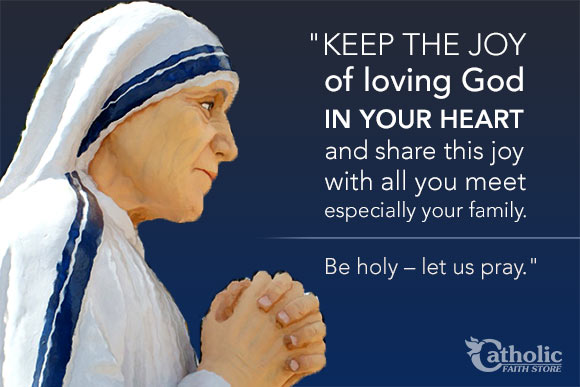
The Vine and the Branches

Let us be like a genuine
and fruitful branch of the vine, which is Christ, accepting him in our lives
the way he gives himself to us: as truth, which must be spoken; as life, which
must be lived; as light, which must shine out; as love, which must be loved; as
a way, which must be trodden; as joy, which must be communicated; as peace,
which must be radiated; as sacrifice, which must be offered to our families, to
our closest neighbors, and to those who live far away.
I
haven't done this yet, but I think a good spiritual exercise would be take each
clause in the parallelisms and meditate over them individually.
There
was one anecdote that I thought was hilarious which seemed someout of place.
But it's worth the smile to quote it here.
Unexpected Details
Jesus has unexpected
details sometimes.
Once, in London, I
received a telephone call from the police: "Mother Teresa, there is a
woman in the street, reeking of alcohol, who is asking for you." We
went to pick her up.
As we were coming back
she said, "Mother Teresa, Christ changes water into wine in order to give
us to drink." She was, indeed, very drunk.
That
was it! I guess it was an unexpected detail from Jesus. I bet
Mother was a very funny lady.
Finally
I might as well provide my book review I posted at Goodreads.
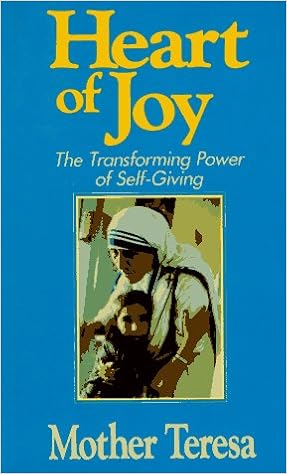
Heart
of Joy is a collection of Mother Teresa’s speeches, talks to
her religious sisters, and one published article all taken from the mid 1970s.
The fact that most of the speeches are so close together in time creates some
repetition. I doubt Mother Teresa had a book in mind when she made the
speeches, but nonetheless this is an engaging read, a spiritually satisfying
read, and an insightful read.
One of the more interesting themes of the book is how the future saint expands the definition of poverty. As people know, Mother was famous and won the Nobel Peace Prize for her care and attention to “the poorest of the poor.” Now the poorest of the poor in 1970’s India must be way beyond my experience of poverty, where mass numbers of people are homeless, starving, and deathly ill, all abandoned to the gutters. Her efforts which are linked to her seeing the Christ in all individuals are inspiring, but her expanded notion of poverty is striking to the core because it addresses the poverty that is not linked to material possessions. The poverty she identifies is a poverty of values in well off nations. Neglect of the elderly, the decision to abort a child, the abandonment of family, the insensitivity to others, these are a poverty just as debilitating as a poverty of material.
Most of the speeches appear to be extemporaneous and reflect that Mother Teresa is more of a doer than a systematic thinker. The sections where she address her sisters seem to collect aphorisms, precepts, and axioms from the future saint, presented in random order which has the effect of a collage. While no single piece of a collage creates a portrait, the sum total of the collage draws a portrait of the future saint through her thoughts and values. We see what makes her tick: her devotion to the poor, her tireless and ceaseless work, her merging with Christ and seeing Christ in the suffering. We see how she puts her faith into action. The central point of her message, if I may draw that conclusion, is by this quote: “Do not turn your back on the poor because the poor are Christ,” and as I’ve said the poor are more than those that lack means.
I enjoyed this book. The sections with anecdotes and aphorisms serve as good devotional reading. I gave the rating a three because the book is kind of slim and at times repetitive. But if you want a short read on understanding what motivates Mother Teresa and an unfiltered portrait through her own words and thoughts, this is a fine book.
One of the more interesting themes of the book is how the future saint expands the definition of poverty. As people know, Mother was famous and won the Nobel Peace Prize for her care and attention to “the poorest of the poor.” Now the poorest of the poor in 1970’s India must be way beyond my experience of poverty, where mass numbers of people are homeless, starving, and deathly ill, all abandoned to the gutters. Her efforts which are linked to her seeing the Christ in all individuals are inspiring, but her expanded notion of poverty is striking to the core because it addresses the poverty that is not linked to material possessions. The poverty she identifies is a poverty of values in well off nations. Neglect of the elderly, the decision to abort a child, the abandonment of family, the insensitivity to others, these are a poverty just as debilitating as a poverty of material.
Most of the speeches appear to be extemporaneous and reflect that Mother Teresa is more of a doer than a systematic thinker. The sections where she address her sisters seem to collect aphorisms, precepts, and axioms from the future saint, presented in random order which has the effect of a collage. While no single piece of a collage creates a portrait, the sum total of the collage draws a portrait of the future saint through her thoughts and values. We see what makes her tick: her devotion to the poor, her tireless and ceaseless work, her merging with Christ and seeing Christ in the suffering. We see how she puts her faith into action. The central point of her message, if I may draw that conclusion, is by this quote: “Do not turn your back on the poor because the poor are Christ,” and as I’ve said the poor are more than those that lack means.
I enjoyed this book. The sections with anecdotes and aphorisms serve as good devotional reading. I gave the rating a three because the book is kind of slim and at times repetitive. But if you want a short read on understanding what motivates Mother Teresa and an unfiltered portrait through her own words and thoughts, this is a fine book.
With
that ends Heart of Joy and next up
for the Catholic Thought book club is Confessions
by St. Augustine of Hippo. If you’ve
ever want to read that, come and join the book club.