
And this morning I noticed in the papers that this
was the 450th anniversary of his birth. I noticed there were several commemorations. I sort of kicked myself for not pulling
together a blog last night to also commemorate such an anniversary, and then I said,
well, I’ll just have to remember for his really big one, his five hundredth. And then I realized I’ll be a 102 then, and
if I’m still alive, I’ll be damned if I’m still writing this blog at 102. ;)
 So I put a commemorative post together late on the
23rd even though most people will probably see it the next day. What else can I do for the greatest writer in
the English language, and arguably in the top three greatest writers of all
languages. To date I’ve read 26 of the
36 acknowledged solely written plays.
There are two plays in which he collaborated, Henry VIII and Two Noble Kinsman. Henry
VIII is usually accredited as mostly written by Shakespeare while Two Noble Kinsman as not. I have not read either of them. There are also other plays where it’s thought
he may have contributed. Here is a listing of all the plays he may have had a hand in.
So I put a commemorative post together late on the
23rd even though most people will probably see it the next day. What else can I do for the greatest writer in
the English language, and arguably in the top three greatest writers of all
languages. To date I’ve read 26 of the
36 acknowledged solely written plays.
There are two plays in which he collaborated, Henry VIII and Two Noble Kinsman. Henry
VIII is usually accredited as mostly written by Shakespeare while Two Noble Kinsman as not. I have not read either of them. There are also other plays where it’s thought
he may have contributed. Here is a listing of all the plays he may have had a hand in.
Three controversial points about Shakespeare’s life
that I’ll give you my opinion on.
First, Shakespeare’ religion. It has been long time rumored, going back to
the seventeenth century, that Shakespeare was actually a Roman Catholic in an
age of Catholic persecution in England.
In recent years the entire body of evidence on his religion has been put
together and I think it is indisputable that Shakespeare was most certainly
Roman Catholic, and possibly even a supporter of the underground subversive movements attempting to
undermine the Protestant government. I
don’t come to such a conclusion lightly.
I had known of the lurking Catholicism both in his plays and the rumors,
but I had been skeptical. When the
totality of the evidence was put together by Joseph Pierce in his biography,
The Quest for Shakespeare, I was completely convinced. One of these days I will have to put together
a post summarizing the evidence. But I
have never seen anything remotely rebutting the evidence.
Second, Shakespeare’s sexuality. It has been claimed that Shakespeare was
either homosexual or bi-sexual. The
claims are based on what amounts to a couple of lines from a few sonnets that
perhaps can be construed as professing love for a man, his patron that
supported his writing. well, the man
supported his writing, so yes Shakespeare’s profession of love for the man
might appear to go overboard. Given the thousands
of other lines and drama he wrote that have no suggestion whatsoever, and given
he was a married man with children, I find that claim of his other than
heterosexuality to be insubstantial.
Third, that Shakespeare didn’t write the plays. You will see all sorts of theories that
either some other Elizabethan man wrote the plays or they were a mix of people
or even that Shakespeare didn’t exist.
Well, all the semi-credible theories (frankly there are no credible
theories) have been taken apart by Shakespeare biographers and scholars and the
conclusive evidence is that a William Shakespeare existed and wrote his 36
plays by himself. This claim has become
one of those ridiculous conspiracy theories that just never seem to die.
So let’s start with a summary of the global
celebrations that are going on. Fox News
summarizes it here, but of particular note is Shakespeare’s hometown
celebration:
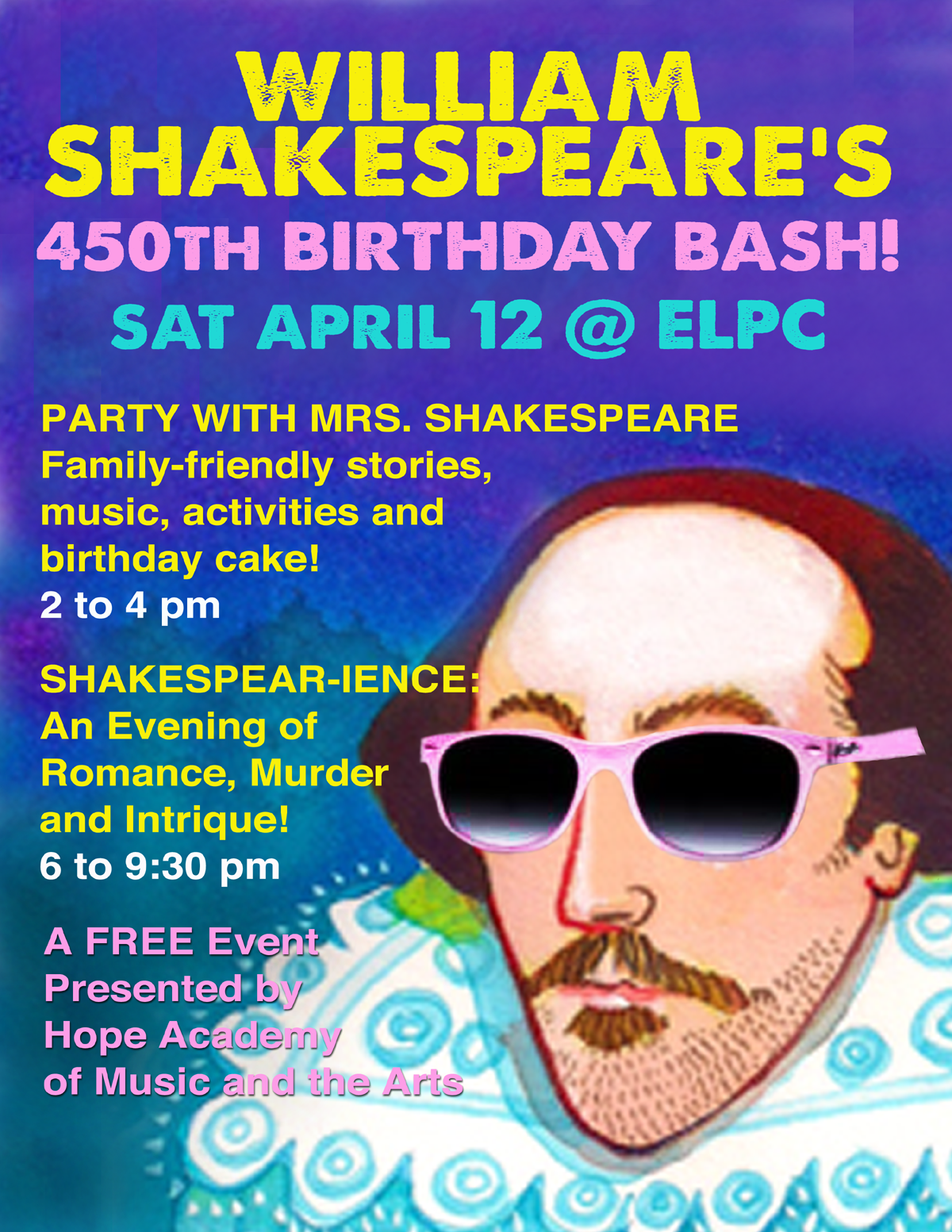 Of course, you would
expect Shakespeare’s birthplace, Stratford-Upon-Avon, to do it up right in
honoring the day of his birth. To start, they’ll be creating a giant model cake
that will require the power of a horse-drawn carriage to pull it along during
an annual birthday procession. Led by actors, diplomats and local dignitaries,
the parade to the playwright’s grave at Holy Trinity Church has taken place for
150 years.
Of course, you would
expect Shakespeare’s birthplace, Stratford-Upon-Avon, to do it up right in
honoring the day of his birth. To start, they’ll be creating a giant model cake
that will require the power of a horse-drawn carriage to pull it along during
an annual birthday procession. Led by actors, diplomats and local dignitaries,
the parade to the playwright’s grave at Holy Trinity Church has taken place for
150 years.
This year’s birthday
celebrations will be held the weekend after the Bard's birthday on April 26 and
27. Afterward, the tens of thousands in attendance can delve into a “real”
birthday cake and enjoy street entertainers, music, sonnet readings, theatre
workshops, tours of his houses and even try to spot some famous actors in town
for the event.
Of
course you can take Victoria McNally’s advice at Geekosystem (not sure if that’s
a blog) by taking up these ill advised suggestions to celebrate from Shakespeare’s
plays. She provides 25 suggestions, but here are a
few:
1. Convince a friend
that his wife is cheating on him through the clever placement of handkerchiefs.
 2. Trick your
significant other into developing feelings for an ass. No, like, a literal ass.
2. Trick your
significant other into developing feelings for an ass. No, like, a literal ass.
3. Get a group of your
buddies together and dress up as trees.
4. Blackmail nuns into
having sex with you. (Alternately, demand that people you’ve had sex with
become nuns.)
5. Bake a pie. (Do not
tell anyone what you’ve made the pie from. Laugh maniacally.)
I’m
going by memory here but I believe No. 1 is from Othello, No. 2 from A Mid
Summer Night’s Dream, No. 3 from Macbeth,
No. 4 from Measure for Measure, and
No. 5 from Titus Andronicus.
The
aforementioned Joseph Pierce has a piece in The
Imaginative Conservative outlining why Shakespeare is timeless, titled “TheEternal Shakespeare.” Here is an excerpt.
The reason that
Shakespeare is not of an age but for all time is that he serves the Heilige
Geist and not the zeitgeist. The truths that inspire his Muse and the truths
that emerge in the fruits of his Muse (his plays and poems) are the truths of
the Holy Spirit. Such truths do not merely stand the test of time they are the
very truths by which time itself is tested. This timeless aspect of truth is very
important for us to understand but perhaps a little difficult to grasp. It
might, therefore, be useful to employ a famous philosophical riddle: If a tree
falls in a forest and there’s nobody there to hear it fall does it make a
sound? The answer is that of course it makes a sound because the sound of the
tree falling is not dependent on anyone hearing it. We might rephrase the
riddle thus: If Shakespeare’s works are neglected so that they are no longer
performed or read, will Shakespeare and his works cease to be relevant? The
answer is that of course they are still relevant because the goodness, truth
and beauty of the works are not dependent on our ability to see or understand
them. Indeed, it could and should be argued that a culture that could no longer
read Shakespeare because of its illiteracy and barbarism was suffering the
woeful consequence of neglecting the truths that Shakespeare’s plays reveal!
It’s
worth reading the entire piece. Finally,
today’s Wall Street Journal had a hilarious piece in their Op-Ed where Kim
Askew in the persona of a Hollywood movie producer tells “Bill” how to improve his
plays for the movie industry.
Dear Bill,
Thanks for the
screenplay pitches—you're certainly a prolific guy! We're confident that some
of the ideas, with a few tweaks, would have real blockbuster potential. I'm
happy to pass along this feedback from the studio creative team…
And
here are a couple of the suggestions that come back from the creative team.
King Lear : Retooled as
an action flick, this could be a great starring vehicle for a geriatric hunk
like Liam Neeson. How about a rewrite where Lear, a retired CIA operative, has
to rescue his daughter Cordelia from an undercover crime syndicate? (Love the
cliff dive, by the way . . . can totally see this filmed like a Bond sequence.)
Titus Andronicus : This
slasher flick is solid in terms of blood, guts and body count but would
doubtless land us in NC-17 ratings territory. Just riffing here, but what if we
lose the rape, cannibalism and beheadings and re-imagine it as dark animated
tale for kids? "Game of Thrones" meets "Frozen."
Othello: We like this
one, except (stay with me here) we want you to rethink the location. And time
period. Let's set it in the distant future on another planet (maybe Venus
stedda Venice?) with the Moor being either an alien or cyborg. If we lose the
murder-suicide ending and the Moor lives to fight another day, this could pop
as a trilogy.
Too
funny. Read the rest for a few more
suggestions.
And
now for a confession. My poor wife has had
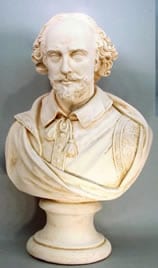
to put up with my love of Shakespeare by me insisting that we keep a bust (shown just below) of
the man prominently placed on a pedestal in the corner of our dining. The bust is staring at me as I write.
I have always said that if there is a single
person I would love to hang out with in heaven, it is William Shakespeare. Happy birthday Billy!

