"Love follows knowledge."
"Beauty above all beauty!"
– St. Catherine of Siena

Showing posts with label Go to Dark Gethsemane. Show all posts

Friday, April 3, 2026

Triduum Meditation: The Silence of Holy Saturday

Two years ago I initiated a meditation for the holy three days before Easter Sunday referred to as the Pascal Tridium.  Each year I would highlight one of the three days.  I started with Holy Thursday, and last year was Good Friday.  This year I will offer a meditation on Holy Saturday.

There is no Mass celebrated on Holy Saturday, nor as in Good Friday an opportunity for a recital of the Passion and Adoration of the Wood of the Cross.  There are no readings nor homilies.

Perhaps the best place to start for Holy Saturday is at the thirteenth and fourteenth stations of the Stations of the Cross: Jesus taken down from the cross and placed in a tomb. 
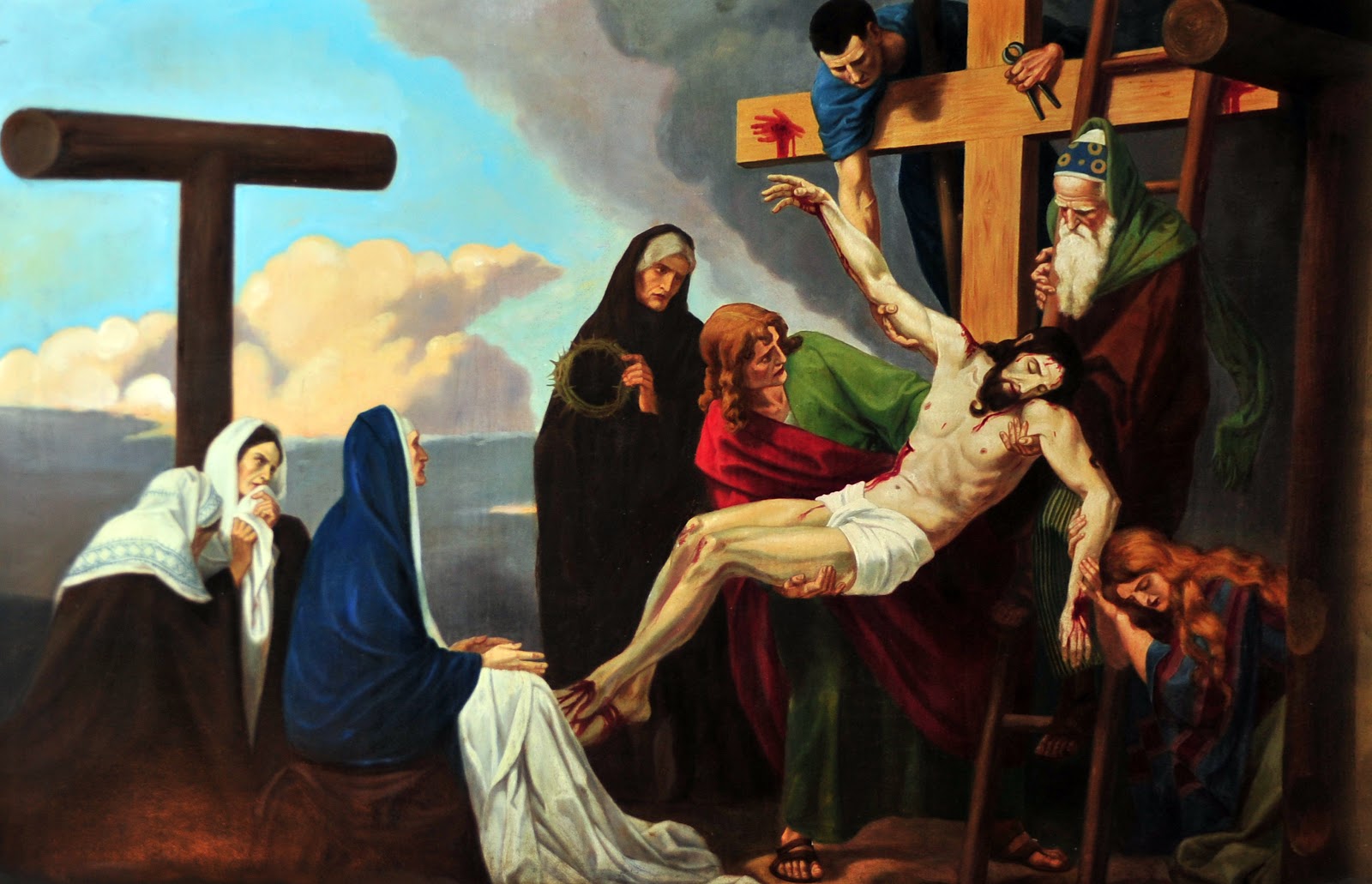


This comes from the last paragraph of the nineteenth chapter of John’s Gospel.


After this, Joseph of Arimathea,

secretly a disciple of Jesus for fear of the Jews,

asked Pilate if he could remove the body of Jesus.

And Pilate permitted it.

So he came and took his body.

Nicodemus, the one who had first come to him at night,

also came bringing a mixture of myrrh and aloes

weighing about one hundred pounds.

They took the body of Jesus

and bound it with burial cloths along with the spices,

according to the Jewish burial custom.

Now in the place where he had been crucified there was a garden, and in the garden a new tomb, in which no one had yet been buried.  So they laid Jesus there because of the Jewish preparation day; for the tomb was close by.

~Jn 19:38-42


We adore you, O Christ, and we praise you, because by your Holy Cross you have redeemed the world.


The distinguishing feature of Holy Saturday is silence and waiting.  There is no liturgy, no celebration, no homilies, no Eucharist.  Jesus’s body is motionless, indeed, lifeless in tomb while His soul travels down to the abode of the dead to raise up all the righteous dead. 


Dominican Fr. Jonah Teller O.P. reflects on the wait.


Fr. Teller:

God sleeps the sleep of death but only for a time.  Hope in him, hope in Christ. So what do we do on this day, this strange day when the stone is still rolled in front of the tomb and we can't see Jesus? What do we do?  I think we just wait.  We just wait there close to Jesus. He's still there. And we hope. And hope is for what you can't see.  But the one who has promised is trustworthy and he will do it. And so whatever it is that we're waiting for, whatever it is we're hoping for, whatever it is we're suffering, any stone rolled in front of any tomb in our lives, any death that we fear, any suffering we experience, we can know confidently that Jesus Christ has already stepped into the middle of it, taken it upon himself, and conquered it. And we can hope that he will share the victory over it with us.  All we have to do is wait.
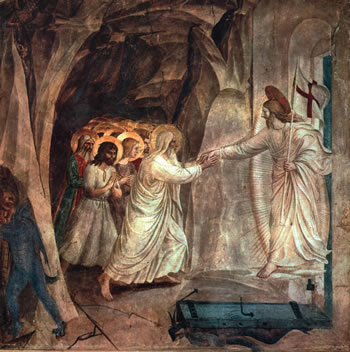


Fra Angelico's The Harrowing of Hell

The Office of Readings of the Liturgy of the Hours has a reading attributed to an ancient unknown writer but sometimes, though questionably, attributed to St. Melito of Sardis.  It is sometimes referred to as “An Ancient Homily on Holy Saturday.”  Whoever wrote it, it was probably written during the second century.

Something strange is happening—there is a great silence on earth today, a great silence and stillness. The whole earth keeps silence because the King is asleep. The earth trembled and is still because God has fallen asleep in the flesh and he has raised up all who have slept ever since the world began. God has died in the flesh and hell trembles with fear.

He has gone to search for our first parent, as for a lost sheep. Greatly desiring to visit those who live in darkness and in the shadow of death, he has gone to free from sorrow the captives Adam and Eve, he who is both God and the son of Eve. The Lord approached them bearing the cross, the weapon that had won him the victory. At the sight of him Adam, the first man he had created, struck his breast in terror and cried out to everyone: “My Lord be with you all.” Christ answered him: “And with your spirit.” He took him by the hand and raised him up, saying: “Awake, O sleeper, and rise from the dead, and Christ will give you light.”

I am your God, who for your sake have become your son. Out of love for you and for your descendants I now by my own authority command all who are held in bondage to come forth, all who are in darkness to be enlightened, all who are sleeping to arise. I order you, O sleeper, to awake. I did not create you to be held a prisoner in hell. Rise from the dead, for I am the life of the dead. Rise up, work of my hands, you who were created in my image. Rise, let us leave this place, for you are in me and I am in you; together we form only one person and we cannot be separated.

For your sake I, your God, became your son; I, the Lord, took the form of a slave; I, whose home is above the heavens, descended to the earth and beneath the earth. For your sake, for the sake of man, I became like a man without help, free among the dead. For the sake of you, who left a garden, I was betrayed to the Jews in a garden, and I was crucified in a garden.

See on my face the spittle I received in order to restore to you the life I once breathed into you. See there the marks of the blows I received in order to refashion your warped nature in my image. On my back see the marks of the scourging I endured to remove the burden of sin that weighs upon your back. See my hands, nailed firmly to a tree, for you who once wickedly stretched out your hand to a tree.

I slept on the cross and a sword pierced my side for you who slept in paradise and brought forth Eve from your side. My side has healed the pain in yours. My sleep will rouse you from your sleep in hell. The sword that pierced me has sheathed the sword that was turned against you.

Rise, let us leave this place. The enemy led you out of the earthly paradise. I will not restore you to that paradise, but I will enthrone you in heaven. I forbade you the tree that was only a symbol of life, but see, I who am life itself am now one with you. I appointed cherubim to guard you as slaves are guarded, but now I make them worship you as God. The throne formed by cherubim awaits you, its bearers swift and eager. The bridal chamber is adorned, the banquet is ready, the eternal dwelling places are prepared, the treasure houses of all good things lie open. The kingdom of heaven has been prepared for you from all eternity.

“I order you, O sleeper, to awake.”  “My side has healed the pain in yours.”  I find that beautiful.  You can hear it being read along with some gorgeous imagery from this video produced by St. Catherine Labouré Church in Wheaton, Maryland.


Sunday Meditation: "They took the body of Jesus and bound it with burial cloths along with the spices, according to the Jewish burial custom.  Now in the place where he had been crucified there was a garden, and in the garden a new tomb…"


Any hymn on such a solemn day must be acapella.  Appropriate I think would be “Go to Dark Gethsemane” here performed by the Lux Choral Society.


Go to dark Gethsemane,

Ye who feel the tempter's pow'r;

Your Redeemer's conflict see;

Watch with Him one bitter hour;

Turn not from His griefs away;

Learn of Jesus Christ to pray.


Follow to the judgment hall;

View the Lord of life arraigned;

O the worm-wood and the gall!

O the pangs His soul sustained!

Shun not suff'ring, shame, or loss;

Learn of Him to bear the cross.


Calv'ry's mournful mountain climb;

There, adoring at His feet,

Mark the miracle of time,

God's own sacrifice complete:

""It is finished!"" Hear Him cry;

Learn of Jesus Christ to die;


Blessed Savior, now in love

Send thy Spirit from above;

Come and dwell with us, we pray;

Amen.

Wednesday, December 21, 2022

Notable Quote: To Master Life’s Gloominess by Fr. Alfred Delp, SJ

The character of life is to keep going, to keep a lookout, and to endure until the vigilant heart of man and the heart of God who meets us come together: presently in the true interior meeting of the sacraments, and later in the final homecoming.  God enters only his own rooms, where someone is always keeping watch for him…This is the deeper sense of Advent: that we scrutinize this center, little by little, and set up lights of recognition in our lives, and from the center master life’s gloominess.  There is no absolute darkness…Those who really wait on the Lord God will not be disappointed.


This is a quote in reference to Advent—the season on waiting for the Lord to come.  You will need some background.  Father Alfred Delp was a German priest with the Jesuit order who was arrested by the Nazis for conspiring to kill Adolph Hitler, and though found not guilty of participating in the conspiracy was executed nonetheless for his association with the conspirators.  While in jail he wrote some remarkable meditations, especially since it was Advent season and his coming meeting with God. 

Before I get to the quote, here is how Regis Martin summarized in the National Catholic Register earlier this month Delp’s arrest.  


When Gestapo agents arrived on the morning of July 28, 1944, slipping into the back of the quaint little country church outside Munich where its pastor, Father Alfred Delp, was saying Mass, they waited until he’d finished before arresting him on a charge of treason. It hardly mattered that he had committed no treason — they were determined to destroy him anyway. His record of resistance to Nazi tyranny was sufficiently known already among members of the Reich, and the time had now come to silence him for good. So, they hauled him off to prison where he was tortured, tried and sentenced to be hanged, which took place on Feb. 2, 1945, the Feast of the Purification of Mary.

But Fr. Delp’s antagonism with the Nazis went deep in his formation.  It seemed his whole adult life was in some way a reaction to this ideology that had taken over Germany.  From Delp’s Wikiwand entry: 


Following philosophy studies at Pullach, he worked for 3 years as a prefect and sports teacher at Stella Matutina Kolleg in Feldkirch, Austria, where in 1933, he first experienced the Nazi regime, which forced an exodus of virtually all German students from Austria and thus the Stella Matutina by means of a punitive 1000 Mark fine to be paid by anyone entering Austria. With his Director, Fr Otto Faller and Professor Alois Grimm, he was among the first to arrive in the Black Forest, where the Jesuits opened Kolleg St. Blasien for some 300 students forced out of Austria. After St. Blasien, he completed his theology studies in Valkenburg, The Netherlands (1934–1936), and in Frankfurt (1936–1937). 


Upon being ordained it seemed Delp increased his resistance to the Rech, both rhetorically and in deed.


In 1937, Delp was ordained a Catholic priest in Munich. Delp had wanted to study for a doctorate in philosophy at the University of Munich, but he was refused admission to the university for political reasons. From 1939 on, he worked on the editorial staff of the Jesuit journal Stimmen der Zeit ("Voices of the Times"), until the Nazis suppressed it in April 1941. He was then assigned as rector of St. Georg Church, part of Heilig-Blut Parish in the Munich neighbourhood Bogenhausen. He preached both at Heilig-Blut and St. Georg, and also secretly helped Jews who were escaping to Switzerland through the underground.

But it was in joining a group called the Kreisau Circle that got him marked.


The Jesuit provincial, Augustin Rösch, Delp's superior in Munich, became active in the underground resistance to Hitler…Rösch introduced Delp to the Kreisau Circle. As of 1942, Delp met regularly with the clandestine group around Helmuth James Graf von Moltke to develop a model for a new social order after the Third Reich came to an end.

This finally came to a head with the July 20th plot to assassinate Adolph Hitler.


After the 20 July plot to assassinate Hitler failed, a special Gestapo commission arrested and interrogated all known members of the Resistance. Delp was arrested in Munich on 28 July 1944 (eight days after Claus von Stauffenberg's attempt on Hitler's life), although he was not directly involved in the plot. He was transferred to Tegel Prison in Berlin. While in prison, he secretly began to say Mass and wrote letters, reflections on Advent, on Christmas, and other spiritual subjects, which were smuggled out of the prison before his trial.

So, the context of the quote is that Fr. Delp, consigned to prison and waiting his hanging, was able to secretly write meditations on life and the transcendental.  It recalls the fifth century Roman philosopher, Boethius, who wrote his famous On the Consolation of Philosophy while awaiting his execution.  But Delp languishes in prison in the late fall while awaiting Christmas, and so many of his meditations are on the importance of Advent, the coming of the Lord.  But this is of double significance for Delp.  Not only will he be meeting the incarnation at Christmas,; he, fully aware, will be meeting the Lord face to face upon his execution.

Each day during Advent, the days grow shorter and darker, until the beautiful light of Christmas morn.  Each day in prison, as one faces one’s execution, the days grow shorter and darker.  And so, Delp says he will endure, as we all must in our lives, “until the heart of man meets the heart of God.”  If we are prudent, through our faith and spirituality, we set up lights in our hearts to “master the gloominess.”  With God, there is no absolute darkness.


Friday, April 19, 2019

Faith Filled Friday: The Way of the Cross over the Brooklyn Bridge

Today, arguably the holiest day of the year, as my custom now for the last five years, I participated in the annual Way of the Cross over the Brooklyn Bridge. It’s a sort of mini Stations of the Cross procession, we only do five stations, but the distanced walked is about two and three quarter miles.  It starts in Brooklyn at the St. James Cathedral-Basilica, and then the pilgrimage ensues by crossing over the Brooklyn Bridge, stops at Manhattan’s City Hall, stops at the World Trade Center, and concludes at lower Manhattan’s St. Peter’s Church.  It’s organized by local chapter of the Communion and Liberation Movement, which is a Catholic religious organization of religious and lay members.  Fr. Richard Veras seems to be the primary coordinator, though I don’t know if that is his role.  Fr. Veras was the pastor at my parish, St. Rita’s on Staten Island, for a number of years but has moved on.  He has published a number of books and is a monthly contributor to Magnificat magazine.

The form of the events has not changed in the five years.  I detailed them in my 2014 entry, which you can read here.    


I didn’t take a lot of pictures this year.  It was overcast.  But here’s one picture of the procession ahead of me on the Brooklyn Bridge. 


You can see how far long pilgrimage of people ahead of me, and I was toward the front.  The local news lists us in the hundreds, but it seems more to my non-expert eye.

I was able to film one of the pieces sung by the wonderful—and I do mean wonderful with no exaggeration—Communion and Liberation choir.  At the St. James Cathedral, they sing “Go to Dark Gethsemane.”  Let me preface, for some reason my camera just would not focus on the choir.  The video is blurred but I did capture the singing.


We passed a little garden as you come off the Brooklyn Bridge on the Manhattan side and the tulips were in bloom. 


And of course we passed the new Liberty Tower at the World Trade Center.  I don’t know what that weird sculpture is out in front, but who understands modern art?


Finally we made the news.  Here’s a video clip.


I hope you had a blessed Good Friday.