"Love follows knowledge."
"Beauty above all beauty!"
– St. Catherine of Siena

Showing posts with label Victimae paschali laudes. Show all posts

Sunday, April 20, 2025

Sunday Meditation: Easter Sunday, The Women at the Tomb

The day of Resurrection is here!  Blessed be God, He has risen!
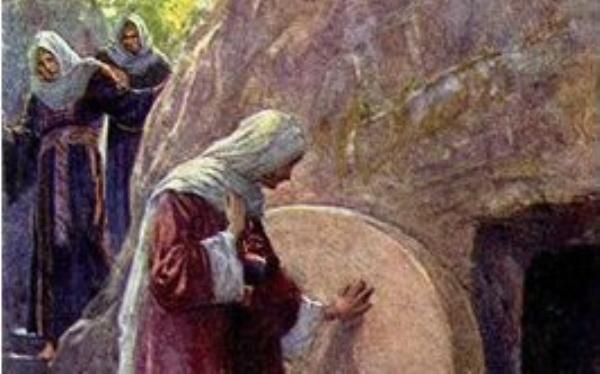


I will post on the Gospel reading for the Easter Vigil Mass. The Gospel is always the same for each of the three years, the discovery of the empty tomb from St. John’s Gospel.  Easter Vigil Mass follows the Lectionary cycle, which for Year C is the empty tomb passage of Luke.


At daybreak on the first day of the week

the women who had come from Galilee with Jesus

took the spices they had prepared

and went to the tomb.

They found the stone rolled away from the tomb;

but when they entered,

they did not find the body of the Lord Jesus.

While they were puzzling over this, behold,

two men in dazzling garments appeared to them.

They were terrified and bowed their faces to the ground.

They said to them,

"Why do you seek the living one among the dead?

He is not here, but he has been raised.

Remember what he said to you while he was still in Galilee,

that the Son of Man must be handed over to sinners

and be crucified, and rise on the third day."

And they remembered his words.

Then they returned from the tomb

and announced all these things to the eleven

and to all the others.


The women were Mary Magdalene, Joanna, and Mary the mother of James;

the others who accompanied them also told this to the apostles,

but their story seemed like nonsense

and they did not believe them.

But Peter got up and ran to the tomb,

bent down, and saw the burial cloths alone;

then he went home amazed at what had happened.

~Lk 24:1-12


Fr. Sam French offers us a homily in which faith and reason work toward understanding the resurrection.


The changes and persistence in the apostles and disciples after the Resurrection that something as earth shaking as Jesus rising from the dead is what really convinces me. 

Fr. Timothy Dore OFM Cap of the Companions of St. Anthony provides a pastoral homily.


Alleluia, He is risen!


Sunday Meditation: "Why do you seek the living one among the dead?  He is not here, but he has been raised."


Let us rejoice with the Victimae paschali laudes, which you should have heard on Easter Sunday.  I really like this simple rendition in English by Corpus Christi Watershed.


The choir at our Mass performed it in Latin.  I have posted on it in Latin and analyzed its beauty.  I’m going to capture this English translation attributed in the video to a Father Fortescue.


Sing to Christ your paschal victim

Christians sing your Easter hymn

The sinless Lord for sinners

Christ God's son for creatures died

The sheep who stray the Lamb of God redeemed

Then death and life their battle

Wonderfully fought and now

The King of life once dead forever lives

Tell us Mary we pray

What you saw on Easter day

Empty was the grave and looking

I saw there the glory of his rising

The angel witnesses I saw and folded linen

Christ my hope is risen truly in Galilee

He goes before you

We know he rose from death indeed

And so to him we pray

Great king and Lord of life

Bless us this day

Amen

Hallelujah


Have a blessed Easter!


Wednesday, April 12, 2017

Music Tuesday: Victimae paschali laudes

We are now in the holiest week of the year.  Sunday was Palm Sunday, and we head into the Easter Tridium.  I wanted to offer this beautiful Easter chant, Victimae paschali laudes, for your listening pleasure and hopefully inspire you to strive for greater holiness this coming weekend.

Of course I’ll have to provide some background.  Victimae paschali laudes, literally “Praise to the Paschal Victim,” is sung in chant—monophonic and unaccompanied—with an evolving melody.  It was written in the eleventh century and its authorship is in dispute, attributed to at least four people.  Technically the chant is a sequence, which means it’s set as part of a liturgical celebration, in this case for Easter Sunday celebration.  Apparently even some Protestant denominations, such as Lutherans, preserved it for their celebrations as well.


First listen to the hymn and I’ll go through the melody after.


Here are the lyrics, copied from Wikipedia.

(1) Victimae paschali laudes   [8 syllables]
immolent Christiani.                [7]

(2) Agnus redemit oves:          [7]
Christus innocens Patri           [7]
reconciliavit                             [6]
peccatores.                              [4]

(3) Mors et vita duello            [7]
conflixere mirando:                 [7]
dux vitae mortuus,                  [6]
regnat vivus.                            [4]

(4) Dic nobis Maria,                [6+1]
quid vidisti in via?                  [7]
Sepulcrum Christi viventis,     [8]
et gloriam vidi resurgentis:      [10]

(5) Angelicos testes,                [6+1]
sudarium, et vestes.                 [7]
Surrexit Christus spes mea:     [8]
praecedet suos in Galilaeam.  [10]

(6) [Credendum est magis soli            [8]
Mariae veraci                                       [6]
Quam Judaeorum Turbae fallaci.]       [10]

(7) Scimus Christum surrexisse           [8]
a mortuis vere:                                     [6]
tu nobis, victor Rex, miserere. [10]

[Amen.] [Alleluia.]                              [6]

Let’s look at the construction of the hymn.  This appears to be some dispute on how you arrange the stanzas when you look across the internet for the lyrics.  I would arrange it as above into seven stanzas.  First note that stanza six is in brackets because it is often eliminated from a performance.  Also the “Amen” and “Alleluia” were added to the hymn later as part of its use in liturgy. 

Each line of a stanza has four, six, seven, eight, or ten syllables.  I’ve listed the number of syllables off to the right of each line.  Setting aside the initial stanza for now, you can see that the stanzas two and three are a matching set, four and five match, and six and seven match.  The two concluding lines of stanzas two and three both contain six and four syllables, which add up to ten, which matches the concluding lines of stanzas four, five, six. and seven.  This means that all stanzas except the first end with ten syllables, whether from a single line or the sum of the last two.  Stanzas two through five all have their first two lines with seven syllables.  Four and five actually contain six syllables in their first lines but the melody adds an extra syllable by repeating the last in the line.  All of this has the effect of creating unity, despite what appears to be several melodies throughout.  More on the melodies further down.

The rhyme scheme is also interesting.  Here’s how I map the ending rhymes, with the stanza number following in parentheses:

AB (Stanza 1), ABBA (2),  CCDD (3), EEFF (4), AAGG (5), HHH (6), JJJ (7).

So stanzas two through five are quatrains, while the two concluding stanzas are triplets.  If you take stanzas one and two together you have an interlocking rhyme scheme of As and Bs.  Stanzas three, four, and five are quatrains of couplets, with the fifth stanza bringing back the A rhyme (“es”) from the beginning.  So stanzas one through five also project a sense of interlocking.  The final two stanzas of triplets provide a wonderful sense of conclusion.

So what does this mean to the musical melody?  I hear the hymn as having three melodies, each varying on its predecessor, concluding in the climaxing triplets.  First stanza serves as an introduction which leads into the first melody in stanzas two and three.  Notice how the penultimate syllable is of a longer note in the lines of those stanzas.   Stanzas four and five have a similar melody but subtly different because I think the lines are of different length.  The third melody are formed from the triplets again being of different length.  But are they of different length?  The first line of eight syllables borrows one from the second line, so in effect they could be seen as two lines of seven syllables.  And the last line of ten could be broken up into two lines of four and six, thereby matching stanzas two through five.  It’s only because of the rhyme scheme that causes us to envision those stanzas as triplets. 

All this creates a marvelous interconnecting sounds and line lengths to form a harmonious whole.  My concluding thought is that the absence of accompaniment forces the composer to craft in such an elaborate fashion.  I don’t think you see this very often in modern song writing. 

It’s extraordinarily beautiful.