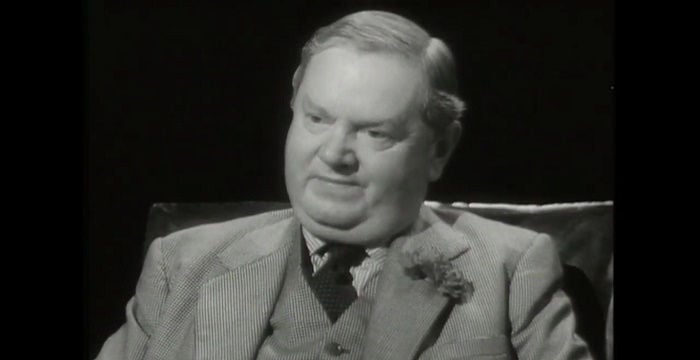
This is just an amazing quote by Evelyn Waugh on James
Joyce.You have to know a little bit of
literature.You have to know that Evelyn
Waugh, author of Brideshead Revisited,
which I’ve posted on here, was a curmudgeon of the highest order.You have to know that James Joyceis the great modernist writer of Dubliners,A Portrait of the Artist as a Young Man, and,
relevant to the subject here, Ulysses.I don’t know if it’s probably not accurate to
say that Joyce was the founder of modernist literature, but he certainly is its
greatest devotee.And in modernism we
find that the stream of consciousness narrative is its most difficult to device for the reader to grasp.James Joyce is “the major pioneer of stream
of consciousness” as the Wikipedia entry says.
So now the quote: Waugh is asked about James Joyce’s
influence on Waugh as a young man.He
replies with this.
“A poor, dotty Irishman called James Joyce—if you’ve heard about
him—he was thought to be a great influence in my youth. . . . and he wrote
absolute rot, you know. He began writing quite well and you can see him going
mad as he wrote, and his last books—only fit to be set for examinations at
Cambridge.”
At this Waugh was asked: “He didn’t always write gibberish, did
he?”
His response: “No, you could
watch him going mad sentence by sentence. If you read Ulysses, it’s perfectly
sane for a little bit, and then it goes madder and madder.”
I’m
torn between four and a half and five stars.I rounded to five.Waugh’s
gorgeous prose is the deciding factor.
What
is this novel about?I can’t help
feeling that the central, controlling concept of the novel is
displacement.There is in the novel the
displacement of Edwardian England by the force of the First World War.We see this through the lives of Lord and
Lady Marchmain, Charles’ father, and the deaths of Lady Marchmain’s
brothers.There is the displacement of
inter war England by the Second World War.Lives are displaced, Charles enters the army, and Brideshead castle is damaged
and the furniture is packed away upstairs.There is the displacement of the upper classes as middle and lower
classes gain in status.We see this in
Hooper and Mottram.And there is the
displacement of something in each of the main characters which fractures their
sense of being.
For
Sebastian, the displacement seems to have occurred in childhood. At first I seemed to be drawn to some sort of
causal link between some event in his childhood that could be at the root of
his unhappiness and alcoholism.Waugh
even gives us possible suggestions for that causal link: a father who abandoned
his family when Sebastian was a child, an overbearing mother, a Catholicism
that constricts his freedom, fear of responsibility, which is akin to fear of
growing up, and perhaps, as many dramatizations of this novel seem to imply, an
unfulfilled homosexual desire.Now it
may be all of these things or it may be none.The novel is not intended to be that kind of psychological
examination.The mystery of Sabastian’s
nature leads the reader to try to solve the mystery, but Waugh makes sure it’s
unsolvable.What the reader is left with
is the fact of displacement from a happy, Edenic time to a fallen state.This is still psychology—all studies of human
nature must involve psychology (there was psychology as early as in the writing
of Homer’s Iliad; there’s psychology
in Adam and Eve)—but not as we think of psychology in the 20th
century sense.Call this displacement,
Catholic psychology.
For
Charles his Edenic moment is in that summer with Sebastian at Brideshead.It is at this time he feels the near freedom
of adulthood but still the wonder of a boy.He explores a beautiful world, lives an epicurean life-style, and shares
Sebastian’s friendship, a friendship based on mutual love.Though they are a bit older than just mere
boys, I’m convinced their friendship and love is boyish and platonic.It would have to be for the novel to make
sense.Though not everything they do is
holy, such friendship is ultimately holy, a grace that works in their hearts.
And
then a displacement comes.Sebastian
sinks into alcoholism.He cannot bear to
live with his family.Perhaps boyhood
ends.Perhaps pubescent longings mature
into sex drives.Perhaps the
responsibility of adulthood—the responsibility that led Lady Marchmain’s
brothers to die in WWI—pulls Sebastian and Charles away from that love.But a displacement occurs.Sebastian leaves England altogether and
Charles becomes a semi-famous though mediocre painter.
Such
displacement leaves a hole in their being.They try to fill it.Sebastian
with alcohol and a needy lover.Charles
with his work, lovers, a wife, and an affair. Displacement incurs a longing to return.His affair with Julia, who happens to look
very much like Sebastian, is an attempt to return to that holy love of that
first Brideshead summer.Sebastian was
“the first” not because there was sex involved but because with Sebastian
Charles had found holy love.Julia too
has her own displacement.She finds
grace in her young womanhood.She wants
to marry Catholic, but the events of life just displace her away from
that.In the midst of their affair,
Julia asks Charles if he had forgotten Sebastian and Charles tells her, “He was
a forerunner.”And then Charles thinks
about that, contemplates it deeply.
“Perhaps,” I thought,
while her words still hung in the air between us like a wisp of tobacco smoke—a
thought to fade and vanish like smoke without a trace—“perhaps all our loves
are merely hints and symbols; vagabond-language scrawled on gate-posts and
paving-stones along the weary road that others have tramped before us; perhaps
you and I are types and this sadness which sometimes falls between us springs
from disappointment in our search, each straining through and beyond the other,
snatching a glimpse now and then of the shadow which turns the corner always a
pace or two ahead of us.” I had not forgotten Sebastian. He was with me daily
in Julia; or rather it was Julia I had known in him, in those distant Arcadian
days.(p. 349)
That
thought is at the heart of the narrative.Let me complete his thought in this way: “Perhaps all our loves are
merely hints and symbols” of a greater
love of a distant home where we were as full of our being as God created us to
be.That's what I think he means in
direct prose.Call that place heaven,
our true home, and call our journey in this life a striving to return, a journey
to return to heaven, to return to our full being, a return to our true home.The name of the novel even provides an
association of it: Brideshead > Bridegroom > Christ > Heaven.Revisited > Return > Home.The novel is a return to Brideshead, which is
a return to home, a home with all the pregnant meaning that Waugh has put into
it.This is why nostalgia figures so in
the novel.It is a longing to go home.
It
is no coincidence, then, that the novel’s climax is with Lord Marchmain’s
return to Brideshead.Having been
displaced by the First World War, and subsequently self-displaced from his
family and ancestral home, in the end he returns home.In one sense it completes the circle of his
life, and, then having reconciled with God and his Catholic faith, he goes on
to his eternal home.When he makes the
sign of the cross, he fully returns home and the displacement of
twenty-something years has been righted.
This
longing to return home is the grace that works on all the characters.Allow me to paraphrase one of Jesus’s
sayings:“If you make my word your home,
you will know the truth, and the truth will make you free” (John 8:31-32).Displacement is the first experience when we
are born.It is beyond our memory, but
the sense of that memory remains.It is
a memory of being loved, the mystery of being loved, which leads us to home in
all its metaphorical senses.Remembering
this sense of home leads us to a deeper longing, the longing to be
complete.The sense of nostalgia is an
inkling to a greater desire, the desire to be free and to reach our eternal
home.This is what I think this novel is
about.
###
Some
really fine excerpts to highlight Evelyn Waugh’s beautiful prose.
Form
the Prologue, the opening paragraphs:
When I reached “C”
Company lines, which were at the top of the hill, I paused and looked back at
the camp, just coming into full view below me through the gray mist of early
morning. We were leaving that day. When we marched in, three months before, the
place was under snow; now the first leaves of spring were unfolding. I had
reflected then that, whatever scenes of desolation lay ahead of us, I never
feared one more brutal than this, and I reflected now that it had no single
happy memory for me.
Here love had died
between me and the Army.
Here the tram lines
ended, so that men returning fuddled from Glasgow could doze in their seats
until roused by their journey’s end. There was some way to go from the
tram-stop to the camp gates; quarter of a mile in which they could button their
blouses and straighten their caps before passing the guard-room, quarter of a
mile in which concrete gave place to grass at the road’s edge. This was the
extreme limit of the city. Here the close, homogeneous territory of housing
estates and cinemas ended and the hinterland began.(p. 2-3)
From
Book 1, Chapter 1, Chares and Sebastian drive out to the country.
At Swindon we turned off
the main road and, as the sun mounted high, we were among dry-stone walls and
ashlar houses. It was about eleven when Sebastian, without warning, turned the
car into a cart track and stopped. It was hot enough now to make us seek the
shade. On a sheep-cropped knoll under a clump of elms we ate the strawberries
and drank the wine—as Sebastian promised, they were delicious together—and we
lit fat, Turkish cigarettes and lay on our backs, Sebastian’s eyes on the
leaves above him, mine on his profile, while the blue-gray smoke rose, untroubled
by any wind, to the blue-green shadows of foliage, and the sweet scent of the
tobacco merged with the sweet summer scents around us and the fumes of the
sweet, golden wine seemed to lift us a finger’s breadth above the turf and hold
us suspended.
“Just the place to bury a
crock of gold,” said Sebastian. “I should like to bury something precious in
every place where I’ve been happy and then, when I was old and ugly and
miserable, I could come back and dig it up and remember.” (p. 24-25)
From
Book 1, Chapter 2, Charles looking back at his first year at Oxford.
In the event, that Easter
vacation formed a short stretch of level road in the precipitous descent of
which Jasper warned me. Descent or ascent? It seems to me that I grew younger
daily with each adult habit that I acquired. I had lived a lonely childhood and
a boyhood straitened by war and overshadowed by bereavement; to the hard
bachelordom of English adolescence, the premature dignity and authority of the
school system, I had added a sad and grim strain of my own. Now, that summer
term with Sebastian, it seemed as though I was being given a brief spell of
what I had never known, a happy childhood, and though its toys were silk shirts
and liqueurs and cigars and its naughtiness high in the catalogue of grave
sins, there was something of nursery freshness about us that fell little short
of the joy of innocence. At the end of the term I took my first schools; it was
necessary to pass, if I was to remain at Oxford, and pass I did, after a week
in which I forbade Sebastian my rooms and sat up to a late hour, with iced
black coffee and charcoal biscuits, cramming myself with the neglected texts. I
remember no syllable of them now, but the other, more ancient lore which I
acquired that term will be with me in one shape or another to my last hour. “I like
this bad set and I like getting drunk at luncheon”; that was enough then. Is
more needed now?(p. 47-48)
From
Book 1, Chapter 4, Charles reflecting on his summer with Sebastian.
The languor of Youth—how
unique and quintessential it is! How quickly, how irrecoverably, lost! The
zest, the generous affections, the illusions, the despair, all the traditional
attributes of Youth—all save this—come and go with us through life. These
things are a part of life itself; but languor—the relaxation of yet unwearied
sinews, the mind sequestered and self-regarding—that belongs to Youth alone and
dies with it. Perhaps in the mansions of Limbo the heroes enjoy some such
compensation for their loss of the Beatific Vision; perhaps the Beatific Vision
itself has some remote kinship with this lowly experience; I, at any rate,
believed myself very near heaven, during those languid days at Brideshead. (p.
87)
From
Book 2, Chapter 2, Charles becomes infatuated with Julia.
That night and the night
after and the night after, wherever she went, always in her own little circle
of intimates, she brought a moment of joy, such as strikes deep to the heart on
the river’s bank when the kingfisher suddenly flares across the water.
This was the creature,
neither child nor woman, that drove me through the dusk that summer evening,
untroubled by love, taken aback by the power of her own beauty, hesitating on
the cool edge of life; one who had suddenly found herself armed, unawares; the
heroine of a fairy story turning over in her hands the magic ring; she had only
to stroke it with her fingertips and whisper the charmed word, for the earth to
open at her feet and belch forth her titanic servant, the fawning monster who
would bring her whatever she asked, but bring it, perhaps, in unwelcome shape.
She had no interest in me
that evening; the jinn rumbled below us uncalled; she lived apart in a little
world, within a little world, the innermost of a system of concentric spheres,
like the ivory balls laboriously carved in China; a little problem troubling
her mind—little, as she saw it, in abstract terms and symbols. She was wondering,
dispassionately and leagues distant from reality, whom she should marry. Thus
strategists hesitate over the map, the few pins and lines of colored chalk,
contemplating a change in the pins and lines, a matter of inches, which outside
the room, out of sight of the studious officers, may engulf past, present, and
future in ruin or life. She was a symbol to herself then, lacking the life of
both child and woman; victory and defeat were changes of pin and line; she knew
nothing of war. (p. 207-208)
From
Book 3, Chapter 1, Charles reflects on his ten years since last at Brideshead.
My theme is memory, that
winged host that soared about me one gray morning of war-time.
These memories, which are
my life—for we possess nothing certainly except the past—were always with me.
Like the pigeons of St. Mark’s, they were everywhere, under my feet, singly, in
pairs, in little honey-voiced congregations, nodding, strutting, winking,
rolling the tender feathers of their necks, perching sometimes, if I stood
still, on my shoulder; until, suddenly, the noon gun boomed and in a moment,
with a flutter and sweep of wings, the pavement was bare and the whole sky
above dark with a tumult of fowl. Thus it was that morning of war-time.
For nearly ten dead years
after that evening with Cordelia I was borne along a road outwardly full of
change and incident, but never during that time, except sometimes in my
painting—and that at longer and longer intervals—did I come alive as I had been
during the time of my friendship with Sebastian. I took it to be youth, not
life, that I was losing. My work upheld me, for I had chosen to do what I could
do well, did better daily, and liked doing; incidentally it was something which
no one else at that time was attempting to do. I became an architectural
painter.(p. 260-261)
From
Book 3, Chapter 3, Charles reflects on his two year relationship with Julia.
It had been an afternoon
of low cloud and summer squalls, so overcast that at times I had stopped work
and roused Julia from the light trance in which she sat—she had sat so often; I
never tired of painting her, forever finding in her new wealth and delicacy—until
at length we had gone early to our baths and, on coming down, dressed for
dinner, in the last half-hour of the day, we found the world transformed; the
sun had emerged; the wind had fallen to a soft breeze which gently stirred the
blossom in the limes and carried its fragrance, fresh from the late rains, to
merge with the sweet breath of box and the drying stone. The shadow of the
obelisk spanned the terrace.
I had carried two garden
cushions from the shelter of the colonnade and put them on the rim of the
fountain. There Julia sat, in a tight little gold tunic and a white gown, one
hand in the water idly turning an emerald ring to catch the fire of the sunset;
the carved animals mounted over her dark head in a cumulus of green moss and
glowing stone and dense shadow, and the waters round them flashed and bubbled
and broke into scattered flames.(p.
318-319)
From
Book 3, Chapter 5, Lord Marchmain returns to Brideshead.
Julia gave a little sigh
of surprise and touched my hand. We had seen him nine months ago at Monte
Carlo, when he had been an upright and stately figure, little changed from when
I first met him in Venice. Now he was an old man. Plender had told us his
master had been unwell lately: he had not prepared us for this.
Lord Marchmain stood
bowed and shrunken, weighed down by his great-coat, a white muffler fluttering
untidily at his throat, a cloth cap pulled low on his forehead, his face white
and lined, his nose colored by the cold; the tears which gathered in his eyes
came not from emotion but from the east wind; he breathed heavily. Cara tucked
in the end of his muffler and whispered something to him. He raised a gloved
hand—a schoolboy’s glove of gray wool—and made a small, weary gesture of
greeting to the group at the door; then, very slowly, with his eyes on the
ground before him, he made his way into the house.
They took off his coat
and cap and muffler and the kind of leather jerkin which he wore under them;
thus stripped he seemed more than ever wasted but more elegant; he had cast the
shabbiness of extreme fatigue. Cara straightened his tie; he wiped his eyes
with a bandanna handkerchief and shuffled with his stick to the hall fire.
There was a little
heraldic chair by the chimney-piece, one of a set which stood against the
walls, a little, inhospitable, flat-seated thing, a mere excuse for the
elaborate armorial painting on its back, on which, perhaps, no one, not even a
weary footman, had ever sat since it was made; there Lord Marchmain sat and
wiped his eyes.(p. 364-365)
From
the Epilogue, Charles goes to the chapel to pray, the final lines of the novel.
There was one part of the
house I had not yet visited, and I went there now. The chapel showed no
ill-effects of its long neglect; the art-nouveau paint was as fresh and bright
as ever; the art-nouveau lamp burned once more before the altar. I said a
prayer, an ancient, newly-learned form of words, and left, turning towards the
camp; and as I walked back, and the cook-house bugle sounded ahead of me, I
thought:
“The builders did not
know the uses to which their work would descend; they made a new house with the
stones of the old castle; year by year, generation after generation, they
enriched and extended it; year by year the great harvest of timber in the park
grew to ripeness; until, in sudden frost, came the age of Hooper; the place was
desolate and the work all brought to nothing; Quomodo sedet sola civitas.
Vanity of vanities, all is vanity.
“And yet,” I thought,
stepping out more briskly towards the camp, where the bugles after a pause had
taken up the second call and were sounding “Pick-em-up, pick-em-up, hot
potatoes,” “and yet that is not the last word; it is not even an apt word; it
is a dead word from ten years back.
“Something quite remote
from anything the builders intended, has come out of their work, and out of the
fierce little human tragedy in which I played; something none of us thought
about at the time; a small red flame—a beaten-copper lamp of deplorable design
relit before the beaten-copper doors of a tabernacle; the flame which the old
knights saw from their tombs, which they saw put out; that flame burns again
for other soldiers, far from home, farther, in heart, than Acre or Jerusalem.
It could not have been lit but for the builders and the tragedians, and there I
found it this morning, burning anew among the old stones.”
I quickened my pace and
reached the hut which served us for our ante-room.
“You’re looking unusually
cheerful today,” said the second-in-command.(p. 408-410)
Charles
has his gallery exhibition in London.Meanwhile he furtively conducts an affair with Julia.Anthony Blanche shows up at the exhibition,
and he and Charles go out to a gay bar for lunch where Anthony is completely
honest and tells Charles his paintings are charming but completely
uninspired.Meanwhile the international
crises which will culminate into WWII occur in the background, involving
Rex.Charles and Julia are deeply in
love.
Book
3, Chapter 3
It
is two years later, and Charles and Julia have continued their affair, are very
much in love, and it has become common knowledge, even to their respective
spouses, that the two are a committed couple.At dinner with Bridey one evening, Bridey tells them he is engaged to be
married to a middle-aged woman, a widow and devout Catholic with three
children.He also tells Julia that he
cannot bring Beryl to meet them at Brideshead because of the adulterous affair
that is manifest to all between Charles and Julia.Julia breaks into a fit of tearful hysteria,
not over Bridey’s rudeness, but over its truth of her living in sin.
Book
3, Chapter 4
The
two divorces are in process without the two opposite spouses offering much
resistance.Julia meets Beryl and finds
her a bit different than Bridey described.All the while the political and international events are coagulating
into what will become the Second World War.In November Cordelia returns home from serving as a nurse in the Spanish
Civil War and its aftermath.We learn
that she had tried and left a convent, and has now dedicated her life to
service.While in Spain she heard that
Sebastian was ill, and so took a trip over to Tunis where Sebastian resides at
a monastery.She nursed him and learned
of his life: seven years with Kurt, mostly together in Greece and then Germany,
where Kurt was arrested and ultimately killed himself.Sebastian went back to Morocco and then to
Tunis at the monastery where the monks reluctantly took in the alcoholic.There he lives a holy life despite the
alcohol.Cordelia speculates that he
will eventually die there because of his deteriorating health.
###
Book
3, Chapter 5
As
the two divorces make their way through the courts, as the international
situation continues to reach a crises, Lord Marchmain returns to Brideshead in
January of 1939 for what is surely his final months of life.He is ready to hand over the property to his
eldest son, but upon meeting Bridey’s new wife he is so revolted that he
changes his will and leaves it to Julia.By Easter Lord Marchmain’s health has significantly deteriorated, and
the three children against protestation from Charles bring in a priest, Fr.
Mackay, to give Marchmain last rites.To
everyone’s embarrassment, Marchmain dismisses the priest summarily.By mid-July Marchmain is near death.Julia brings back Fr. Mackay, who asks for a
sign of repentance from Marchmain, and with his last strength makes the sign of
the cross.A few hours later, Marchmain
dies.Through the giving of last rites,
Charles has suddenly become a believer.Julia too has experienced grace of returning to faith, and tells Charles
that, despite her deep love for him, she cannot marry him.
Epilogue
Charles
returns to the scene of the Prologue as soldier entering Brisdeshead as a place
to quarter his company.As Charles
surveys the house, he notices the damages done by soldiers of other companies
quartered there, including damage to his artwork, all of which culminates to a
shameful disrespect for the estimable manor.Nanny Hawkins still is upstairs, and Charles sits and has tea with her,
talking of what’s become of the Brideshead family.Bridey, Julia, and Cordelia have all ended up
in Palestine.Finally Charles enters the
chapel, which has been restored, the red sanctuary lamp now lit, kneels, and
prays.
###
I
can’t help feeling that the central, controlling concept of the novel is
displacement.There is in the novel the
displacement of Edwardian England by the force of the First World War.We see this through the lives of Lord and
Lady Marchmain, Charles’ father, and the deaths of Lady Marchmain’s
brothers.There is the displacement of
inter war England by the Second World War.Lives are displaced, Charles enters the army, and Brideshead castle is damaged
and the furniture is packed away upstairs.There is the displacement of the upper classes as middle and lower
classes gain in status.We see this in
Hooper and Mottram.And there is the
displacement of something in each of the main characters which fractures their
sense of being.
For
Sebastian, the displacement seems to have occurred in childhood.Earlier in this discussion I gave it a sort
of “psychological” connotation.What
drives Sebastian is still psychological but not in the sense I meant it
earlier.Earlier I seemed to be drawn to
some sort of causal link between some event in his childhood that could be at
the root of his unhappiness and alcoholism.Waugh even gives us possible suggestions for that causal link: a father
who abandoned his family when Sebastian was a child, an overbearing mother, a
Catholicism that constricts his freedom, fear of responsibility, which is akin
to fear of growing up, and perhaps unfulfilled homosexual desire.Now it may be all of these things or it may
be none.The novel is not intended to be
that kind of psychological examination.The mystery of Sabastian’s nature leads the reader to try to solve the
mystery, but Waugh makes sure it’s unsolvable.What the reader is left with is the fact of displacement from a happy,
Edenic time to a fallen state.This is
still psychology—all studies of human nature must involve psychology (there was
psychology as early as in the writing of Homer’s Iliad; there’s psychology in Adam and Eve)—but not as we think of
psychology in the 20th century sense.Call this displacement, Catholic psychology.
For
Charles his Edenic moment is in that summer with Sebastian at Brideshead.It is at this moment he feels the near
freedom of adulthood but still the wonder of a boy.He explores a beautiful world, lives an
epicurean life-style, and shares Sebastian’s friendship, a friendship based on
mutual love.Though they are a bit older
than just mere boys, I’m convinced their friendship and love is boyish and platonic.It would have to be for the novel to make
sense.Though not everything they do is
holy, such friendship is ultimately holy, a grace that works in their hearts.
And
then a displacement comes.Sebastian
sinks into alcoholism.He cannot bear to
live with his family.Perhaps boyhood
ends.Perhaps pubescent longings mature
into sex drives.Perhaps the
responsibility of adulthood—the responsibility that led Lady Marchmain’s
brothers to die in WWI—pulls Sebastian and Charles away from that love.But a displacement occurs.Sebastian leaves England altogether and
Charles becomes a semi-famous though mediocre painter.
Such
displacement leaves a hole in their being.They try to fill it.Sebastian
with alcohol and a needy lover.Charles
with his work, lovers, a wife, and an affair. Displacement incurs a longing to return.His affair with Julia, who happens to look
very much like Sebastian, is an attempt to return to that holy love of that
first Brideshead summer.Sebastian was
“the first” not because there was sex involved but because with Sebastian
Charles had found holy love.Julia too
has her own displacement.She finds
grace in her young womanhood.She wants
to marry Catholic, but the events of life just displace her away from
that.In the midst of their affair,
Julia asks Charles if he had forgotten Sebastian and Charles tells her, “He was
a forerunner.”And then Charles thinks
about that, contemplates it deeply.
“Perhaps,” I thought,
while her words still hung in the air between us like a wisp of tobacco smoke—a
thought to fade and vanish like smoke without a trace—“perhaps all our loves
are merely hints and symbols; vagabond-language scrawled on gate-posts and
paving-stones along the weary road that others have tramped before us; perhaps
you and I are types and this sadness which sometimes falls between us springs
from disappointment in our search, each straining through and beyond the other,
snatching a glimpse now and then of the shadow which turns the corner always a
pace or two ahead of us.” I had not forgotten Sebastian. He was with me daily
in Julia; or rather it was Julia I had known in him, in those distant Arcadian
days.(p. 349)
That
thought is at the heart of the narrative.Let me complete his thought in this way: “Perhaps all our loves are
merely hints and symbols” of a greater
love of a distant home where we were as full of our being as God created us to
be.That's what I think he means in
direct prose.Call that place heaven,
our true home, and call our journey in this life a striving to return, a journey
to return to heaven, to return to our full being, a return to our true home.The name of the novel even provides an
association of it: Brideshead > Bridegroom > Christ > Heaven.Revisited > Return > Home.The novel is a return to Brideshead, which is
a return to home, a home with all the pregnant meaning that Waugh has put into
it.This is why nostalgia figures so in
the novel.It is a longing to go home.
It
is no coincidence, then, that the novel’s climax is with Lord Marchmain’s
return to Brideshead.Having been
displaced by the First World War, and subsequently self-displaced from his
family and ancestral home, in the end he returns home.In one sense it completes the circle of his
life, and, then having reconciled with God and his Catholic faith, he goes on
to his eternal home.When he makes the
sign of the cross, he fully returns home and the displacement of
twenty-something years has been righted.
This
longing to return home is the grace that works on all the characters.Allow me to paraphrase one of Jesus’s
sayings:“If you make my word your home,
you will know the truth, and the truth will make you free” (John 8:31-32).Displacement is the first experience when we
are born.It is beyond our memory, but
the sense of that memory remains.It is
a memory of being loved, the mystery of being loved, which leads us to home in
all its metaphorical senses.Remembering
this sense of home leads us to a deeper longing, the longing to be
complete.The sense of nostalgia is an
inkling to a greater desire, the desire to be free and to reach our eternal
home.This is what I think this novel is
about.
###
My
Reply to Kerstin:
Kerstin
wrote: "Has Charles found peace in the end or a place for a new beginning?
He goes off to war and that's not very reassuring."
Well, he's certainly
depressed but I have a hope that when it's all said and done, he and Julia will
marry. From what I can tell I think annulments are valid for both their
marriages. Now will Julia feel it is proper, I don't know. Maybe not. But
Charles is Catholic now. Julia has returned to the faith. Sebastian has found
holiness. Cordelia will be holy. Lord Marchmain is redeemed. Lady Marchmain is
in heaven and hopefully reconciled with Sebastian and her husband. In time
everyone's soul projects to be in heaven, though life on earth will entail
suffering. It projects to be a happy ending.
My
Reply to Mark:
Mark
wrote: "Manny wrote: "he and Julia will marry."
Oh,
no, certainly not that. Apart from the fact that if it is not on the page it did
not happen, Julia refusing Charles is her choosing which world she is
t..."
Oh I realize it's not on
the page and it's all pure speculation, and really any version of speculation
goes against the author's wishes.
He ended the novel at a
point and that is that.
But to speculate, and
it's not from some romantic conviction I may have. Waugh invested about half
the novel in their relationship and then it falls apart in a dozen pages, maybe
less, from against the desires of both. It's not too far a leap to project and
speculate that the obstacles that prevent their union might be overcome.
Charles has become Catholic - which he wasn't when they split - and the war
will be over and Brideshead will return to normal and annulments are very
possible. After all the word "annulment" came up earlier in the
novel. It's planted there. It's not even a question of happiness. It's a
question of settling the chaos. Bringing order to an unsettled situation.
Revisited in the title is a return. Will the return end where the author leaves
it or is it not likely a return again will occur ahead in time?
After all the parallels
suggest it. Lord Marchmain dies in the faith. Sebastian finds his holy
sanctuary. Bridey his Catholic wife and family, Cordelia her charitable works.
Order has settled on each of their situations. It's not that big a leap to
project the same for Charles and Julia.
My
Reply to Mark:
Mark
wrote: "Waugh does not, like some earnestly evangelical Christian authors,
try to present the Catholic world as a place of good happy contented people
making good life decisions and saying their prayers. Rather, the Catholic world
is one of enchantment, one in which there is more to the world that what the
five senses can perceive."
I certainly agree with
that. The only quibble I have is your word "enchantment." Is it
enchantment or supernaturally charged? Your use of the word enchantment
suggests that it is wonderful and heavenly and conducive to happiness. I think
you brought up Tolkein as an allusion for Waugh's Catholic world view, and with
that I can understand your use of the word enchantment. But I don't think
Tolkein is Waugh's model for his Catholic world view. I think it's T.S. Eliot.
In T. S. Eliot's Catholicism (yes, I know, Anglo-Catholicism) the world is
supernaturally charged and that supernatural affects our psyche in a way that's
just not there in Tolkein. At least from my reading of him. I think your use of
"enchantment" leads you to minimize the psychology that is going on
in the novel. I think T.S. Eliot's Catholicism fits better with the unhappiness
of following one's Catholic faith fully. It's Tolkein who presents some happy
shire and a Utopian existence.
My
Reply to Mark:
Mark
wrote: "If Waugh's vision here is open to criticism, I think it would be
that he bundled a set of specific aesthetics and social structures into his
vision of the Catholic world as if they were a necessary part of it. I think
there is some merit in that criticism, but at the same time, one could argue
that part of seeing the world whole is going to be the opportunity for a more
profound aesthetic experience. "
Yes it is open to
criticism. Part of Waugh's vision of Catholicism it seems is inextricably
linked to some medieval social structure of aristocrats and lower classes. You
could say that comes from TS Eliot too. I assume the implication being the
aristocracy have some sort of divine right to their place. Yes, there is a
division in worldviews, but I would characterize it more as a feudal worldview
(which to Waugh seems to be the Catholic worldview) in conflict with the
capitalist/modern worldview of the rising middle classes which we see in Hooper
and Mottram. No, I will have to disagree. I think displacement is a very apt
term for the novel. The grace overcomes the displacements. The grace is
operating to overcome displacement. That doesn't contradict Waugh
My
Comment:
One other thing I will
criticize Waugh for. After thinking about this for a while now, I think Waugh
believes alcoholic drinking is actually a grace. Remember I said his values on
drinking are not in line even with the society of his day, not to mention ours.
As I've thought about this, I think he really thinks the drinking is part of
the graces that flow from God. Perhaps he may even think of the drinking as a
sacramental. Just look over the novel and see how many times drinking an
alcoholic beverage is mentioned, and one has to be drunk from all the drinking
they do on those occasions. It's a lot of alcohol. Charles and Julia are
drinking champagne while the ship is pitching all over and everyone is seasick.
I think every chapter has alcohol in it. I think there is more to it than just
the surface drinking. I think Waugh intends drinking to be loaded with symbolic
meaning. Waugh was known to being a drinker and maybe an alcoholic too. I do
not think the Catholic Church sees drinking to the level of being drunk as a
grace.
My
Reply to Mark:
Mark
wrote: "This is a pattern that is repeated for many characters, and Waugh
announces the theme very explicitly when he has Lady Machmain read Chesterton's
Father Brown story with the line about a twitch upon the thread."
I see nothing of what I
speculated that would violate anything in that explanation of a "a twitch
upon the thread." You seem to forget or not address that Charles is now
Catholic. If Julia returned and got annulments - of which, again, was planted
earlier in the novel - then their marriage would be a Catholic marriage. The
twitch to return to Catholicism is not violated.
If Waugh intended to make
the point that Julia and Charles must go on for the rest of their earthly lives
carrying this cross (and he may well have intended that) then he should have shut the lid on all
possibilities. But as I have pointed out, he left the possibilities open. His
dramatic structure calls for the possibility and it would have been very easy
for him to end the novel with the situation categorically closed. If it was
important to him to make that point it would have been incumbent on him to do
so.
Was this a failure on
Waugh's part? Few novels are perfect. I don't see Waugh as James Joyce or
William Faulkner. He did not create perfection here. I tend to start with a
work as perfect to the author's intent. But to paraphrase DH Lawrence, once a
novel has left an author's hands, he no longer has a say. It's the novel itself
that speaks. It's all speculation on what happens after, but the lid is not
shut closed on a Charles and Julia uniting in a Catholic marriage.
My
Reply to Mark:
Mark
wrote: "This is a highly dissonant note. We instinctively want to think --
and so much inferior Christian literature is devoted to promoting the thought
-- that being in harmony with God means being in harmony with the world in this
life; that becoming Catholic will make you happy in this world. This is the
prosperity gospel, in short, and it is heretical. "Think not that I am
come to send peace on earth: I came not to send peace, but a sword."
"Take up your cross and follow me.""
I said no such thing. I
despise prosperity gospel. You keep thinking that is my point, and it is not.
My
Comment:
As it happened, yesterday
[September 13th] was the feast day of St. John Chrysostom and as I
was reading about him I found this perfectly suited quote:
“Let there be no
drunkenness; for wine is the work of God, but drunkenness is the work of the
devil. Wine makes not drunkenness; but intemperance produces it. Do not accuse
that which is the workmanship of God, but accuse the madness of a fellow mortal
… For what is more wretched than drunkenness! The drunken man is a living
corpse. Drunkenness is a demon self-chosen … ”
Waugh's later self
criticism on this was warranted. And yes, I do enjoy a good drink myself. I am
not a teetotaler
My
Reply to Mark:
Mark
wrote: ""Thus I come to the broken sentences which were the last
words spoken between Julia and me..."
Charles
never speaks to Julia again, therefore he certainly does not marry he."
It's first person
narration where Charles is speaking in 1943. We are speculating beyond the
ending of the narration. That is the current status as of 1943. It could not
imply a future status because Charles is not a soothsayer.
Well, we've both made our
points. I am not convinced by your reading and you are not convince by mine. We
actually agree more than you think. So be it. There's no point in pursuing this
further.
Part
1: Charles returns to London to join an anti-communist defense group to resist
striking unionists.In London he goes to
a party where an American jazz band is playing and he meets up with Boy
Mulcaster and Anthony Blanch.Mulcaster
is an exuberant member of the defense group, and Blanche inform him of what has
happened to Sebastian.Sebastian has
become a complete “sot” and found his way to Fez, Morocco and taken up with a
German who has intentionally shot his foot to get out of the French Foreign
Legion.Julia having heard Charles is in
London summons him to ask him if he can go convince Sebastian to return to see
Lady Marcmain before she dies.Charles
agrees.
Part
2: Charles flies out to Casablanca and takes a bus to Fez and makes his way to
Sebastian’s house.There he finds Kurt,
Sebastian’s German friend, incapacitated because of his foot that won’t heal,
who tells him Sebastian is sick in the hospital.While attending to Sebastian at the hospital,
they receive word that Lady Marchmain has died.Charles sees Sebastian out of the hospital and back to his home to Kurt
where Sebastian is quite satisfied spending his life taking care of Kurt.Before Chales leaves he arranges Sebastian’s
finances.
Part
3: Back at Brideshead Charles tells Bridey of Sebastian.Charles is informed that Marchmain House is
to be destroyed and is given the commission to paint it, his first commission
as an architectural painter.Cordelia
comes by to watch him and they spend dinner together, and Cordelia tells him
she hopes she has the vocation to become a nun.
Book
3 Chapter 1
Part
1: Charles brings us ten years ahead and relates the events of those ten
years.He has become a celebrated
architectural painter, published several books, becoming world famous.He has just come back from a two year trip to
Mexico and Central America to be re-inspired.He has come to New York City where his wife, Celia, has come to meet him
for the leg back to England.Charles
learns he has had a daughter in his absence, supposedly attributed to him
before he departed, and we learn Celia has cheated on him before and after he
left for Mexico.The marriage is still strained,
though Celia tries to restart their life together.
Part
2: On board the ship happens to be Julia, who we later learn has come to New
York for her own extramarital affair which has not ended well.As the ship travels, a storm and incredibly
rough ocean hits and nearly everyone on board is isolated in their cabins with
seasickness.Charles and Julia are two
of the few passengers who do not get seasick, and over the course of three days
of the ship pitching and rolling meet, discuss their sad marriages, and fall in
love, culminating with a night sleeping together.When the seas finally return to normal,
Charles promises to meet Julia in London.
###
So
what are we to make of Sebastian and Kurt?I assume this proves Sebastian’s homosexuality.If so, does that then mean that Charles and
Sebastian in those Oxford years were homosexual lovers?I think it puts my earlier thought that they
were friends innocent of sexuality in doubt.
However,
it’s not conclusive either way.It’s not
even conclusive that Sebastian and Kurt are physical lovers.Kurt has an infected foot that won’t heal and
is in constant pain.I would imagine
that could make sexual activity difficult.Still Sebastian’s attraction to men and lack of attraction to women
confirms his homosexuality.
Why
is Evelyn Waugh so reticent about the homosexuality?Does he feel that in 1946 he can’t write
openly about it?And yet he is quite
clear about Anthony Blanche’s homosexuality.Why is he not constrained there?
Though
I am not as confident about it anymore, I still maintain that Sebastian and
Charles’ relationship in the Oxford years is innocent and boyish.
My
Reply to Frances on Anthony Blanche’s sexual orientation.
You think that makes a
difference as to how open Waugh would be about Sebastian and Charles'
relationship? He doesn't have to be vividly explicit, but he has to make it
clear, especially given that this is in first person narration. Otherwise I do
think this is a failing on the novel. If it were third person, I might be a
little more forgiving. But Charles is quite clear about his adultery. He has to
be as clear on this too, though he doesn't have to be as explicit.
Cara, Lord Marchmain's
mistress calls the Sebastian/Charles relationship innocent, even though she
thinks there was a physical relationship. I have to stand by my comment 30 in
the thread of Book 1, Chpaters 4 & 5. It is "a friendship that innocently
extends to some sort of physical caress but short of cognizant sex." I
have nothing else to go by. What choice do I have as a reader if Waugh doesn't
make it clear? The novel would be flawed otherwise. I would rather think the
novel is not flawed.
Irene
Commented on the subject:
I am not trying to be
provocative, but I am wondering why the question about any sexual interaction
between Charles and Sebastian is important. We know that all these characters
are flawed. We know that Sebastian has caused his family great pain by his
abuse of alcohol. We know that Charles is not chased. We certainly do not know
all the sins of every character. Charles does not narrate every event of his
life, only those that will advance the story. So, how would knowing that
Sebastian and Charles did or did not engage in some physical sexual behavior
change the story? Would knowing that Sebastian was or was not homosexual alter
our understanding of him as a character or our understanding of the novel?
My
Reply to Irene:
You're not being
provocative at all Irene. Those are very good questions. Here's my attempt at
it on what I can think of now.
(1) From an aesthetic
point of view, if a first person narrator is not being forthright, then there
are implications. A first person novel is a creation of a world inside the
narrator's head. Unless the author has an artistic reason for being
disingenuous (I'm thinking of Ford Madox Ford's The Good Soldier) then the
creation of that world is suspect, the artistry marred, and the reader left
with a sense of being cheated. It would be an artistic failing.
(2) The arc of the novel
moves from a sense of innocence and joy to worldliness, malignancy, and
squalor. Remember how Julia's plans for a wonderful wedding degenerates into
what she calls "squalid." Every major character except Cordelia goes
from joyous and happy to squalid as the novel progresses. Happy drink turns to
alcoholism, happy marriages go to adulterous affairs and still born children,
and so on. It is important to understand the theme to understand the nature of
that innocence. We have to understand "the before" as well as
"the after."
(3) So much of the novel
depends on what is the root cause of Sebastian's unhappiness, or at least his
need to be drunk.
Sebastian serves as the
model of humanity which is reflected in the other characters. He is the mystery
of which Waugh's understanding of human nature rests and is reflected in the
other characters. If we knew that Sebastian was an alcoholic because of his
homosexual urges in conflict with Catholicism, then our understanding of the
novel is altered. Given that Catholicism is of such importance to the novel,
this would have to be known. Does he drink because he's Catholic and
homosexual? People could draw that conclusion.
Irene
Replied:
Are we sure that Waugh is
writing a psychological character study and not a spiritual study? In other
words, are we sure that Waugh wants the reader to focus on the psychological
cause of Sebastian's alcoholism, of julia's failed romances, of Charles's
discontent? Or does Waugh want the reader to focus on gracious moments in the
lives of these undeserving characters? Does it matter if Sebastian abuses
alcohol because he has failed to reconcile his sexuality with his moral
upbringing, or because he has unresolved animosity toward a father that
abandoned the family or a mother who he can't please, or because his brain
chemistry makes him susceptible to addictive patterns or....? Or is it enough
to see a young man who, despite so many advantages, spiraled down to squallor,
but can still care for an ailing friend, can still be drawn to the spiritual in
a monastery, can still encounter God and point others to God despite himself
because God is so incredibly greater than the wounds we carry or inflict, is
present even in the greatest depths of our despair, brokenness, sin?
My
Reply to Irene:
You know Irene, I think
that's right. I'm so conditioned for novels to develop psychological insights
to the characters that it was blinding me to the larger theme. Perhaps that's
what Mark in earlier comments was trying to say. I was slowly getting there
with the unsolved mystery of Sebastian's personality.
You also said:
"Does it matter if
Sebastian abuses alcohol because he has failed to reconcile his sexuality with
his moral upbringing, or because he has unresolved animosity toward a father
that abandoned the family or a mother who he can't please, or because his brain
chemistry makes him susceptible to addictive patterns or....? Or is it enough
to see a young man who, despite so many advantages, spiraled down to squallor,
but can still care for an ailling friend, can still be drawn to the spiritual
in a monastery, can still encounter God and point others to God despite himself
because God is so incredibly greater than the wounds we carry or inflict, is present
even in the greatest depths of our despair, brokeness,sin?"
Excellent! I think that
is the theme to the novel.
This does bring up an
interesting question on the artistry of novels. Can a novel bring up the
psychological dysfunctions of a major character, beg the reader to try to
understand the character, and leave them unexplained? I guess it can. Waugh
seems to have here.
OK, you have answered the
psychology part of the novel. But what about that state of innocence? Is Waugh
including sexual activity (homosexual or not) as part of that state of
innocence? One still needs to know.
And what about the
reliability of Charles as a narrator? That too would be an open question.
My
Reply to a lot of comments:
There's a lot here to
respond. First off, if you do a search homosexuality and alcoholism, you will
find homosexuals do have a higher rate of alcoholism and other addictions as
well as a higher suicide rate. That's a reality. But I'm not talking about the
reality. The psychology in a novel does not have to be clinically true. It has
to have the sense of verisimilitude. The question is, what does Waugh intend.
It is credible for a character in a novel to have a dysfunction due to a root
cause. Is the tension between Sebastian's Catholicism and his homosexuality the
root cause of his inability to cope? Is that why he takes flight (pun on his
name intended) away from his family? I don't know. Waugh lays out other
credible root causes. I think I listed five last week in an earlier comment. Is
Waugh's intent to show that all of those potential causes are the reason, or to
show that none of them, and that the problem is spiritual as Irene insightfully
said above?
But then that raises
another question. What is his spiritual problem? Obviously we are given a very
dysfunctional person. As I see it, either we the reader are called to figure it
out like a mystery or we are called to accept the unfathomable nature of
another human being.
My
Reply to Frances
Frances
wrote: "Joseph Pearce in his excellent Literature: What Every Catholic
Should Know, says: “It is evident that there is much of Waugh’s own
pre-conversion self in the characterization of Charles Ryder . . . It is hard
to see Ryder without seeing a shadow of Waugh, musing on his own loss of faith
as a youth and his years as a hedonistic agnostic at Oxford . . . Ryder’s
account of undergraduate decadence and debauchery reflects Waugh’s own riotous
hedonism at Oxford . . . “
(Joseph
Pearce, Literature, page 172).."
Yes, that is right. You
cannot avoid connecting Ryder with Waugh, and as I pointed out last week (I
think it was) it is well known and documented that Waugh had homosexual affairs
when in Oxford. The person Sebastian is to have been modeled on was homosexual.
Perhaps Pierce doesn't want to glamorize homosexuality in a Catholic book, but
the homosexuality is there. The question is whether it's in Sebastian and
Charles' relationship, of which I'm skeptical but it's possible. I also don't
think there is any question that once we get to the Sebastian and Kurt
relationship, that Sebastian is homosexual.
My
Comment:
Of those who say
Sebastian's sexuality doesn't matter, then does the adultery in the novel not
matter? The novel is set in a Catholic worldview. Of course it matters. Every
character (except Cordelia) has a moral failing.
When Julia rejects
divorce as we will see (sorry for the spoiler) does not her Catholic worldview
play into her decision? When Lord Marchmain returns to the Church, has he not
rejected his life of living in sin? If Sebastian turns away from his
homosexuality - I don't know if he does, I'm guessing here since I haven't
finished the novel - will that be a return to grace?
If Catholicism is the
novel's worldview, then the underpinnings of Catholicism control the novel's
morality. And how could homosexuality not be important in a Catholic worldview,
especially in the mid 20th century?
My
Reply to Kerstin:
Kerstin
wrote: "To me the larger issue here is immaturity vs. maturity. Sexuality
is only a symptom. Lets look at infidelity and promiscuity in the upper
classes. Marriages are often entered into not because of mutual affection but
material security. The emotional needs of the spouses are secondary so they
escape into extra-marital affairs and other pleasures. Being emotionally
distant even to your family members is often the norm. This sort of thing seems
to be taken very much for granted, and is ultimately very immature. The
emotional investment and the recognition that your spouse, children, and other
family members are human beings made in the image of God asks of us to make
sacrifices for the good of the other. Only then can mature relationships develop.
Who in this novel is making actual sacrifices for the good of others safe for
Lady Marchmain and Cordelia? Even Charles is inconsistent. Yet all of them
display some recognition that something very fundamental is missing.."
Yes, I agree Kerstin.
This is akin to when I said that that Sebastian's problem is his inability to
be responsible, to grow up. Sebastian is unfavorably compared to Lady
Marchmain's brother Ned, who sacrificed his life in WWI by being responsible.
And now we see that all the major characters are in some way irresponsible, or
as you say immature.
Your last sentence is I
think very important: "Yet all of them display some recognition that
something very fundamental is missing." Now recall what Julia says about
Rex.
He simply wasn’t all
there. He wasn’t a complete human being at all. He was a tiny bit of one,
unnaturally developed; something in a bottle, an organ kept alive in a
laboratory. I thought he was a sort of primitive savage, but he was something
absolutely modern and up-to-date that only this ghastly age could produce. A
tiny bit of a man pretending he was the whole. (p. 231)
A man who is not whole.
Perhaps Rex is the most distinct of the characters to show his fragmentation,
but couldn't we say that about all the characters (except Codelia)? Isn't
Sebastian not a whole man? Isn't Julia herself not a whole woman? Isn't Ryder
not a whole man? He says so himself about himself, just after spending two
years in Central America:
But despite this
isolation and this long sojourn in a strange world, I remained unchanged, still
a small part of myself pretending to be whole. (p. 262)
The modern world has
created fragments of our humanity. That is one of the novel's central themes.
This is at the heart of modernist literature, the fragmentation of man. This is
right out of TS Eliot's poetry. Here is the first stanza of Eliot's "The
Hollow Men."
We are the hollow men
We are the stuffed men
Leaning together
Headpiece filled with
straw. Alas!
Our dried voices, when
We whisper together
Are quiet and meaningless
As wind in dry grass
Or rats' feet over broken
glass
In our dry cellar
Shape without form, shade
without colour,
Paralysed force, gesture
without motion;
Those who have crossed
With direct eyes, to
death's other Kingdom
Remember us-if at all-not
as lost
Violent souls, but only
As the hollow men
The stuffed men.
So much of Eliot's poetry
echoes in this novel. You can read that entire poem here:
Only by rejecting the
outside world and accepting God's grace can we achieve wholeness. Only in
Christ can we be whole because He is the only man that is completely whole.
My
Reply to Irene:
Irene
wrote: "I think it is fascinating how each of us are approaching this same
novel from a slightly different angle and therefore asking different questions
of the text. I love to listen to the conversation b..."
I don't think we're
seeing it all that different. Yes, the grace is key but you can't just
disregard or minimize everything else. Waugh brings us through a process of
each character's brokenness. That's the bulk of the novel actually. You can't
just discard it (I'm exaggerating) and just focus on the grace. There are
reasons for the brokenness and that too is central. Now I agree I don't think
the homosexuality is a big part of the novel even though Anthony Blanche does
keep popping up. I didn't bring it up until mid way in our read. I don't even
think it's there in Book 1, except perhaps in some germ which will flower
later. Once you see Sebastian settled in a relationship with Kurt, however, it
cannot be ignored.
My
Reply to Christine
Christine
in BoMass, USA wrote: "I think that Charles and Sebastian were 'in love'.
As I indicated before, young adults can fall in love with each other with no
sexuality being involved at any level.
To
your question Irene, I wonder if their 'love' only added to Sebastian's hurt. I
do not think that Charles was gay. They might have participated in some 'if you
show me yours, I will show you mine', however not much else. I wonder, because
it did not blossom into a full blown love affair, that added to Charles' hurt.
He did warn Charles that he would leave him for his family.
This
would be the only reason I can see why the terms relationship has any real
bearing on the story."
I do see the relationship
between Charles and Sebastian in the same way. It's a platonic friendship of
close boys. I don't know about the 'if you show me yours, I will show you mine'
(LOL, what?), they are 20 years old after all; they are not little boys. But as
I pointed out in an earlier comment, Cara says that this happens late with the
English.
As I finished the novel,
I realize that there is an underlying thread of sexuality throughout the novel.
I'm reminded of when Charles first meets Julia and Waugh gives us that great
line about Charles hearing "a thin bat’s squeak of sexuality" in
Julia's voice. After Book 1, which I've said is the idyllic Eden, the narrative
turns to finding spouses and soul mates as a key narrative drive. It turns to
sex.
I have to believe the
Sebastian/Kurt relationship is homosexual. Just as Charles matures to a
heterosexual, the implication from the parallel construction is that Sebastian
matures to being gay. His soul mate becomes Kurt. I don't find any idyllic or
sense of innocence in this relationship.
I'm not sure I understand
your last sentence. Are you unsure why Sebastian and Charles relationship has
any bearing on the story?
My
Reply to Christine:
Christine
in BoMass, USA wrote: "Where is the grace? I do not see any grace? I must
be blind as a few people have mentioned it already.
Grace
would be if Sebastian finds some solace and re-establishes some relationship
with his family.
Grace
would be if Charles and Juila stay connected in a meaningful way.
I
do see Grace in Julia returning to the Church.
Looking
forward to being enlightened to the grace."
Certainly this is the
central theme of the novel and requires some thought. Let me attempt to give a
quick explanation using Sebastian's life to outline it.
Sebastian is an
alcoholic. Being drunk is actually a sin. That is not a grace. But God can take
that sin and bring graces from it. The alcohol brings Charles and Sebastian
together. The friendship manifested in love that comes from it is a grace. Sebastian
has some sort of psychological problem, which is not a grace. But the
psychological problem contributes Sebastian's sense of charm, which brings
friends together and spreads a certain love. This is a grace. He meets Kurt and
the two bond in a homosexual bonding. Homosexuality is a sin, and that is not a
grace, but the love that comes from it is a grace. It manifests itself into
Sebastian's sacrificial love for Kurt. When Kurt dies and Sebastian is left
alone, his alcoholism and his psychological problems (again not graces) lead
him to a monastery, and the monks take him in. God turns the evil (Sebastian is
not evil but the demons within are evil) into graces of love. The monks love
him and care for him, and he now absent of the homosexuality and in full
communion with the church can die in a state of grace. Much like his father
returns to a state of grace before he dies, so too we are to assume happens to
Sebastian. There are a lot of parallel constructions going on. We can probably
dissect the other character's lives to find the graces that act upon them.
At least this is how I
see it. Love to hear other's thoughts on this.