
In the Twenty-Seventh Sunday in Ordinary Time of Year A, Jesus comes to what amounts to a final confrontation with the temple elders. He has entered Jerusalem as a messiah, He has taught as a prophet, He has violently cleansed the Temple with one of authority, He has made claims of hypocrisy against the elders, He has told them a parable of their disobedience, and now He will tell them a parable of their wickedness and God’s condemnation. This will be the final straw for the religious hierarchy.
The Parable of the Wicked Tenants is not opaque. The reference to Isaiah would have been widely known, especially to religious authorities. The allegorical identifications are obvious. The vineyard stands for Israel, the tenants in the parable stand for the religious leaders, the servants who are sent before the son are the ancient prophets, and the son who will be killed is the Son of God. The parable becomes a clear indictment of the religious leaders. Three years ago I embedded Dr. Brant Pitre’s explanation of the parable and it’s still worth going back to.
Above I referred to this as Jesus’s final confrontation with the religious leaders, but perhaps the best characterization would be as “a decisive confrontation. When asked by Jesus what the owner of the vineyard will do, one (or several) of the religious leaders heedlessly says the owner will put the tenants “to a wretched death.” At that point Jesus has raised the stakes to an existential level, and the only way for the elders to win would be to put Jesus to death. Or so they think. Jesus concludes His exchange with “the kingdom of God will be taken away from you.” Though it’s not in today’s lectionary passage, Matthew includes this coda to this section:
When the chief priests and the Pharisees heard his parables, they knew that he was speaking about them. And although they were attempting to arrest him, they feared the crowds, for they regarded him as a prophet (45-46).
That is the exegesis of this Gospel
reading. I’ve noticed in my survey of homilies
on this passage, the homilists may explain the rudiments of the exegesis, but
the better homilies will tend toward the pastoral application for the
congregation. Are you like the religious
leaders not bearing fruit? Will you be
put to a wretched end after your time has run out?
Today’s Gospel:
Jesus said to the chief priests and the elders of the people:
"Hear another parable.
There was a landowner who planted a vineyard,
put a hedge around it, dug a wine press in it, and built a tower.
Then he leased it to tenants and went on a journey.
When vintage time drew near,
he sent his servants to the tenants to obtain his produce.
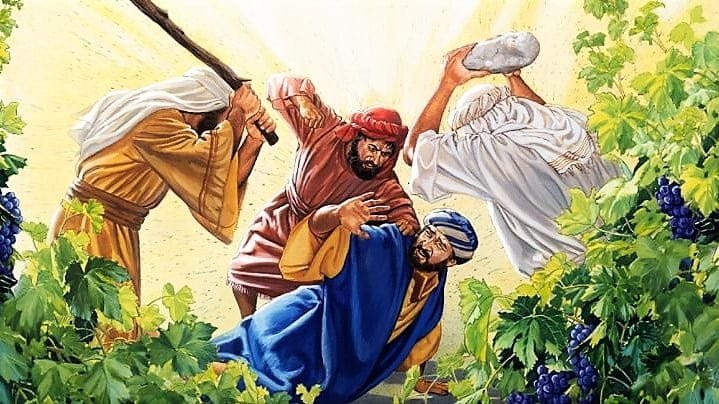
But the tenants seized the servants and one they beat,
another they killed, and a third they stoned.
Again he sent other servants, more numerous than the first ones,
but they treated them in the same way.
Finally, he sent his son to them, thinking,
'They will respect my son.'
But when the tenants saw the son, they said to one another,
'This is the heir.
Come, let us kill him and acquire his inheritance.'
They seized him, threw him out of the vineyard, and killed him.
What will the owner of the vineyard do to those tenants when he
comes?"
They answered him,
"He will put those wretched men to a wretched death
and lease his vineyard to other tenants
who will give him the produce at the proper times."
Jesus said to them, "Did you never read in the Scriptures:
The stone that the builders rejected
has become the cornerstone;
by the Lord has this been done,
and it is wonderful in our eyes?
Therefore, I say to you,
the kingdom of God will be taken away from you
and given to a people that will produce its fruit."
~Mt: 21:33-43
Dr. Matthew Patrick Barber, a Catholic theologian with the Augustine
Institute who I have heard speak elsewhere but only now discovered has a
YouTube channel, finds a theological wrinkle that I did not hear elsewhere.
Dr. Barber:
And let's talk about
the end of the parable. We read, "The kingdom of God will be taken away
from you and given to a people that will produce its fruit." Now, this has
often been read in terms of what is called replacement theology, and that is
the idea that God is rejecting the Jewish people and now replacing Israel with
a gentile church. There are lots of
problems with that reading. For one thing, it imagines that the early believers
in Jesus, the early followers of Jesus, stopped seeing themselves as
Israelites, as Jewish. That's incorrect.
When you read the New Testament, you see Paul, for example, is emphatic on this
point. And in the Gospel according to Matthew, Jesus speaks of how the
disciples will be punished in the synagogues. This is really important. For
example, in Matthew 23, Jesus is condemning Pharisees for various things. And
he says that he will send prophets and wise men and scribes. And says,
"And some of them you will flog in your synagogues." That's Matthew
23:34. Now, some will seize on the
language there of their synagogues as evidence that the readers of the Gospel
of Matthew no longer see themselves as Jewish. These approaches take their
synagogues to imply the Jewish synagogues, right?
So what does it mean
then when Jesus says the kingdom of God will be taken away from you and given
to others? Who is the you Jesus is speaking to there? Well, it's important.
Matthew makes it clear at the end of the scene, the end of the
Chapter 4: Leadership replacement story. Jesus tells the parable. We read, "Now the chief priests and the Pharisees heard this parable and they knew that he was speaking about them." So the point is not that the kingdom is being taken away from the Jews in general and given to non-Jewish people. The point is that the leaders are being replaced and they know the story is being told about them. So the question is who are the new leaders? And I think it's clear the new leaders are the apostles. This is already suggested by a close reading of the gospel Matthew and other places. In Matthew 19 Jesus says that the 12 the 12 apostles will sit on 12 thrones and judge the 12 tribes. They are the eschatological judges, the eschatological leaders of Israel. Moreover, there are some fascinating parallels. I don't have time to get into all of this, but in Matthew 16, Jesus is talking to Peter and in Matthew 23, Jesus condemns the the Pharisees. There's some interesting connections here. Jesus gives to Peter the keys of the kingdom. In Matthew 16, and Matthew 23, we read that the Pharisees literally key shut the kingdom. They lock people out of the kingdom. In Matthew uh 16, Jesus gives to Peter the authority to bind and loose. And in Matthew 23, the Pharisees bind heavy burdens. So there's a parallel there between Matthew 16, Matthew 23, I think the larger point is that the kingdom is being taken away from these leaders and given to new leaders that Jesus has appointed.
I have to admit, I was under the impression it was replacement theology. That is brilliant.
For the pastoral homily I’m going to turn to a Franciscan given that
today happens to also be the Feast of St. Francis of Assisi on the 800th
anniversary of his passing. Let’s turn
to Fr. Jonathon St. André, TOR of Franciscan University, who combines this
homily with St. Francis.
Fr. Jonathon:
So I think I hit the
jackpot today. I get to share reflection with you not only on the 27th Sunday
in ordinary time but also on October 4th which is the feast of our holy father
St. Francis of Assisi in the Jubilee year of St. Francis. Last night in many places throughout the
world was celebrated the transitus a beautiful prayer service where we commemorate
Francis's death and passing into eternal life. And this is not just a
celebration for Franciscan friars or sisters, but it's for everyone for the
gift of St. Francis to the church and the gift of the gospel. And the gospel today
for the 27th Sunday in ordinary time is the parable of the landowner. And we hear about this land owner and he has
builds a vineyard, puts a hedge around it, uh builds a well within it, then
goes away on a journey and as it says he leased it to tenants and went on a
journey. Then he sends his servants as
we know in the parable to come back and to reclaim the produce from the
tenants. And of course the story goes that the tenants reject the servants who
come and reject the overtures of the master to claim what is rightly his own. There's a lot of ways we could go into this
parable, but one of them that really strikes me today is to recognize that we
are tenants of the Lord's vineyard. That we everything we have been given is
from the Lord. Our bodies, our minds, our souls, it is all his. It belongs to
him. In fact, St. Francis himself would say, "You only possess one thing,
your sins. That's the only thing that's
our own. Everything else is God's."
And so, it makes sense that everything we do in our life would return, give an
abundant return to the Lord…
Interestingly one of the main themes of the life of St. Francis was living penance. And we hear that word penance and sometimes we can think of that as what we say or do after our confession or we can think of it as a penitential practice in our life or what the attitude we should have during Lent and all those are true but a deeper fuller scriptural sense of penance means a love of God and a love of neighbor. It means an openness to conversion from our sins. It means a closeness to the Eucharist. And interestingly St. Francis says penance is about producing fruits. So it matches the parable here. What are the fruits? The fruits of the Holy Spirit. The fruits of the Holy Spirit should be visible in our life. Love, joy, peace, patience, kindness, gentleness, self-control. That people should see that we are living our lives in such a way that the kingdom of God is bearing fruit in us, that we the tenants of the vineyard are helping and cultivating the vines so that the new wine of the Holy Spirit is pouring out of us is pouring out upon people is pouring out upon the church. So on this feast of St. Francis of Assisi. And at this occasion when we hear the parable of the landowner and in this time when we're called to recognize how am I a good tenant of what the Lord has given me in my life, we should ask ourself, how am I showing forth the fruits of the Holy Spirit?
That is excellent.
I hope to have a blog post during the week on the 800th anniversary
of St. Francis’ passing into new life.
Sunday Meditation: “Therefore,
I say to you, the kingdom of God will be taken away from you and given to a
people that will produce its fruit."
For the hymn, how could we not have the “Prayer of St. Francis”?
Make me a channel of
Your peace
Where there is
hatred, let me bring Your love
Where there is
injury, Your pardon Lord
And where there's
doubt, true faith in You
Make me a channel of
Your peace
Where there's despair
in life, let me bring hope
Where there is
darkness, only light
And where there's
sadness, ever joy
Oh Master, grant that
I may never seek
So much to be
consoled as to console
To be understood as
to understand
To be loved as to
love with all my soul
Make me a channel of
Your peace
It is pardoning that
we are pardoned
In giving to all men
that we receive
And in dying that
we're born to eternal life
And in dying we are
born to eternal life
Eternal life
I love this hymn, and St. Francis of Assisi is one of the greatest
saints ever.
