"Love follows knowledge."
"Beauty above all beauty!"
– St. Catherine of Siena

Showing posts with label Early Christians. Show all posts

Friday, June 28, 2024

Quo Vadis: A Narrative of the Time of Nero by Henryk Sienkiewicz, Part 11

This is the eleventh and final post of Henryk Sienkiewicz’s historical novel, Quo Vadis.

You can find Post #1 here.  

Post #2 here

Post #3 here.  

Post #4 here

Post #5 here. 

Post #6 here.  

Post #7 here

Post #8 here

Post #9 here.  

Post #10 here.  


Chapters 72, 73, & Epilogue

Summary

Vinicius from Sicily writes a letter to Petronius.  Months have past since those climatic events in Rome.  He and Lygia are happy in their domestic life.  He writes on how his Christian religion has changed life for the better, how love as a principle transforms life.  If only Caesar and Rome could convert, the world would be so much better.  He hopes that Petronius could convert.  Petronius in the southern Italian city of Cumae, where he and the other Roman aristocracy will be departing for Greece, reads the letter knowing that his life is near its end.  He is no longer in Nero’s favor, especially since he is associated with the conspirators, and this trip to Greece is a means of isolating him for the end.  Petronius writes back expressing joy in Vinicius’s happiness, but Petronius is still philosophically a skeptic and an epicurean and so has no use for Christ.  He tells Vinicius that Tigellinus has won their struggle and he intends to die on his terms rather than allow them to take his life.  He passes on his farewell to him and to Lygia.

Petronius, still at Cumae, receives word that Nero has called for his death.  He receives the news with calm, and even sends Nero a gift.  He laughs at a plan he conceives for his final acts.  He has his servants prepare a feast at his villa and invites all the nobles.  He sits to write a letter and prepares for a banquet.  He tells Eunice that she can have his villa, and she realizes what he is going to do.  That night at the banquet, the aristocracy enjoy themselves as only at a feast that Petronius, the elegant arbiter of taste, can arrange.  Toward the end, Petronius stands, tells of his decision to end his life, and reads the letter he has composed to Nero.  In the letter he tells of Nero’s abuses, the murders, the burning of Rome, and the persecution of the innocent Christians who he used to cover his crimes.  He speaks of Nero’s terrible poetry, his horrible dancing, and atrocious singing.  He tells Nero he can no longer stand Nero’s wretched art and so he has decided to take his life.  The guests are shocked, more for their lives since associating with this letter will put them on Nero’s death list.  Petronius calls the physician over to open the vein in his arm to bleed out.  Eunice comes over and gives her arm as well to die along with her beloved.  They die together.

Nero now in Rome ignores the revolt forming against his rule.  He does not believe the rebels, led by the Gallic general Vindex, can overcome his divine authority.  He continues to sing and compose while the legions make their way toward Rome.  In his delusion he thinks he can defeat the legions with his song.  When he hears that the Spanish general Galba has joined Vindex, he goes into a rage.  He realizes the end but it is too late.  Many of his servants have abandoned him.  Several of his remaining servants push him to escape and rush him out in disguise.  Outside of Rome he hears the shouts of joy from the pretorian soldiers that Galba has been declared emperor.  He knows it is over and gives orders for his servants to kill him.  “What an artist is perishing” are his last words.  Nero tries to thrust a knife to his neck but needs help from his servant for the final thrust.


###

My Comment:

So what should we make of Petronius? His skepticism leads him to give up hope and then end his life. Obviously this is not Christian, but it's something that many non Christian views endorse. We see it today. If you're going to die, assisted suicide turns out to be an easy answer. Was he noble? I think his helping out Vinicius and Lygia was certainly noble and that was at the root of his disfavor with Nero. I assume he could have fled, but then he would no longer live as a nobleman, and Nero might have been able to track him down. As it turns out he probably could have held out until Nero was deposed, but he had no foreknowledge that would happen.


Was Petronius the central character? Look back at the first chapter. The book starts with him and ends with him. Nero's death is presented as an epilogue, so the novel proper ends with the deaths of Petronius and Eunice. If Petronius is the central character, does this make the novel a tragedy? Could the deaths of Petronius symbolize the future death of the Roman pagan world? The epilogue does end with a projected Christian triumphalism.

###

For this final excerpt I will quote the passage where Petronius reads his letter to Nero and then has his and Eunice’s veins opened.


He took from beneath the purple cushion a paper, and read as follows:—


"I know, O Cæsar, that thou art awaiting my arrival with impatience, that thy true heart of a friend is yearning day and night for me. I know that thou art ready to cover me with gifts, make me prefect of the pretorian guards, and command Tigellinus to be that which the gods made him, a mule-driver in those lands which thou didst inherit after poisoning Domitius. Pardon me, however, for I swear to thee by Hades, and by the shades of thy mother, thy wife, thy brother, and Seneca, that I cannot go to thee. Life is a great treasure. I have taken the most precious jewels from that treasure, but in life there are many things which I cannot endure any longer. Do not suppose, I pray, that I am offended because thou didst kill thy mother, thy wife, and thy brother; that thou didst burn Rome and send to Erebus all the honest men in thy dominions. No, grandson of Chronos. Death is the inheritance of man; from thee other deeds could not have been expected. But to destroy one's ear for whole years with thy poetry, to see thy belly of a Domitius on slim legs whirled about in Pyrrhic dance; to hear thy music, thy declamation, thy doggerel verses, wretched poet of the suburbs,—is a thing surpassing my power, and it has roused in me the wish to die. Rome stuffs its ears when it hears thee; the world reviles thee. I can blush for thee no longer, and I have no wish to do so. The howls of Cerberus, though resembling thy music, will be less offensive to me, for I have never been the friend of Cerberus, and I need not be ashamed of his howling. Farewell, but make no music; commit murder, but write no verses; poison people, but dance not; be an incendiary, but play not on a cithara. This is the wish and the last friendly counsel sent thee by the—Arbiter Elegantiæ."


The guests were terrified, for they knew that the loss of dominion would have been less cruel to Nero than this blow. They understood, too, that the man who had written that paper must die; and at the same time pale fear flew over them because they had heard such a paper.


But Petronius laughed with sincere and gladsome joy, as if it were a question of the most innocent joke; then he cast his eyes on all present, and said,—


"Be joyous, and drive away fear. No one need boast that he heard this letter. I will boast of it only to Charon when I am crossing in the boat with him."


He beckoned then to the Greek physician, and stretched out his arm. The skilled Greek in the twinkle of an eye opened the vein at the bend of the arm. Blood spurted on the cushion, and covered Eunice, who, supporting the head of Petronius, bent over him and said,—


"Didst thou think that I would leave thee? If the gods gave me immortality, and Cæsar gave me power over the earth, I would follow thee still."


Petronius smiled, raised himself a little, touched her lips with his, and said,—


"Come with me."


She stretched her rosy arm to the physician, and after a while her blood began to mingle and be lost in his blood.


Then he gave a signal to the leader of the music, and again the voices and cithariæ were heard. They sang "Harmodius"; next the song of Anacreon resounded,—that song in which he complained that on a time he had found Aphrodite's boy chilled and weeping under trees; that he brought him in, warmed him, dried his wings, and the ungrateful child pierced his heart with an arrow,—from that moment peace had deserted the poet.


Petronius and Eunice, resting against each other, beautiful as two divinities, listened, smiling and growing pale. At the end of the song Petronius gave directions to serve more wine and food; then he conversed with the guests sitting near him of trifling but pleasant things, such as are mentioned usually at feasts. Finally, he called to the Greek to bind his arm for a moment; for he said that sleep was tormenting him, and he wanted to yield himself to Hypnos before Thanatos put him to sleep forever.


###

My Goodreads Review

Five stars!  This is a classic, and a classic that entertains and delivers.  Published in 1895, it is a grand historical novel of the 19th century style, large, lots of characters, a complicated plot, and precise realism that captures the psychological dimensions of the major characters.  This novel captures the worldviews of the first century pagan Romans with that of the newly founded Christians.

Here are some observations about the novel with the hope I do not spoil it for others.    

The novel is observed from the point of view of the pagan Romans.  Sienkiewicz’s decision is both surprising and masterful, perhaps for several reasons.  It narrates from the inside the psychological shift of the central character starting from a pagan worldview and then evolving to a conversion.  That conversion is made much more interesting and believable than if it were told from a Christian’s perspective.  Second it builds the Roman world much more credibly if told from the inside.  Third it projects the future conversion of the Roman world from pagan to Christian.  In order to write from the Roman perspective, Sienkiewicz had to learn so many details of the Roman culture, and by my estimate he did it exceptionally well.

Another observation is how well Sienkiewicz integrated real historical people with the fictional.  Though the central Roman character, Vinicius is fictional, most of the major Roman characters are historical.  Petronius, a key character, is the author of the ancient Roman novel, Satyricon, and of course Nero is the actual emperor.  There are others.  On the Christian side, saints Peter and Paul are integrated into the novel in a major way.  Historical figures project their philosophies, and it was quite interesting to see Petronius, an exponent of Epicureanism, discuss philosophy with St. Paul and his Christianity. 

The realism of the narrative is extraordinary.  Sienkiewicz remarkably recreates first century Roman life.  You do need to look up some Latin terms of common living practices, but it made for greater precision in the depictions.  The realism of the great fire of Rome—started on the command of Nero and blamed on the Christian population—was breathtaking.  The persecutions of the Christians in the amphitheater was repulsive in its recreated narrative.  The mania of Nero was captured well.  The execution of the two apostles was done off stage I believe to give them due reverence, but the narration leading up to their executions is captured well.  As far as I can tell, all historical events are true to known history.

The mark of a good novel is that you don’t want it to end.  I did not want this to end.  I was engaged with the depictions of the various Romans, engaged with the depictions of the various Christians, engaged with the love between Vinicius and the Christian Lygia, and engaged in the subtle transformation of Vinicius’ worldview from pagan to Christian. 

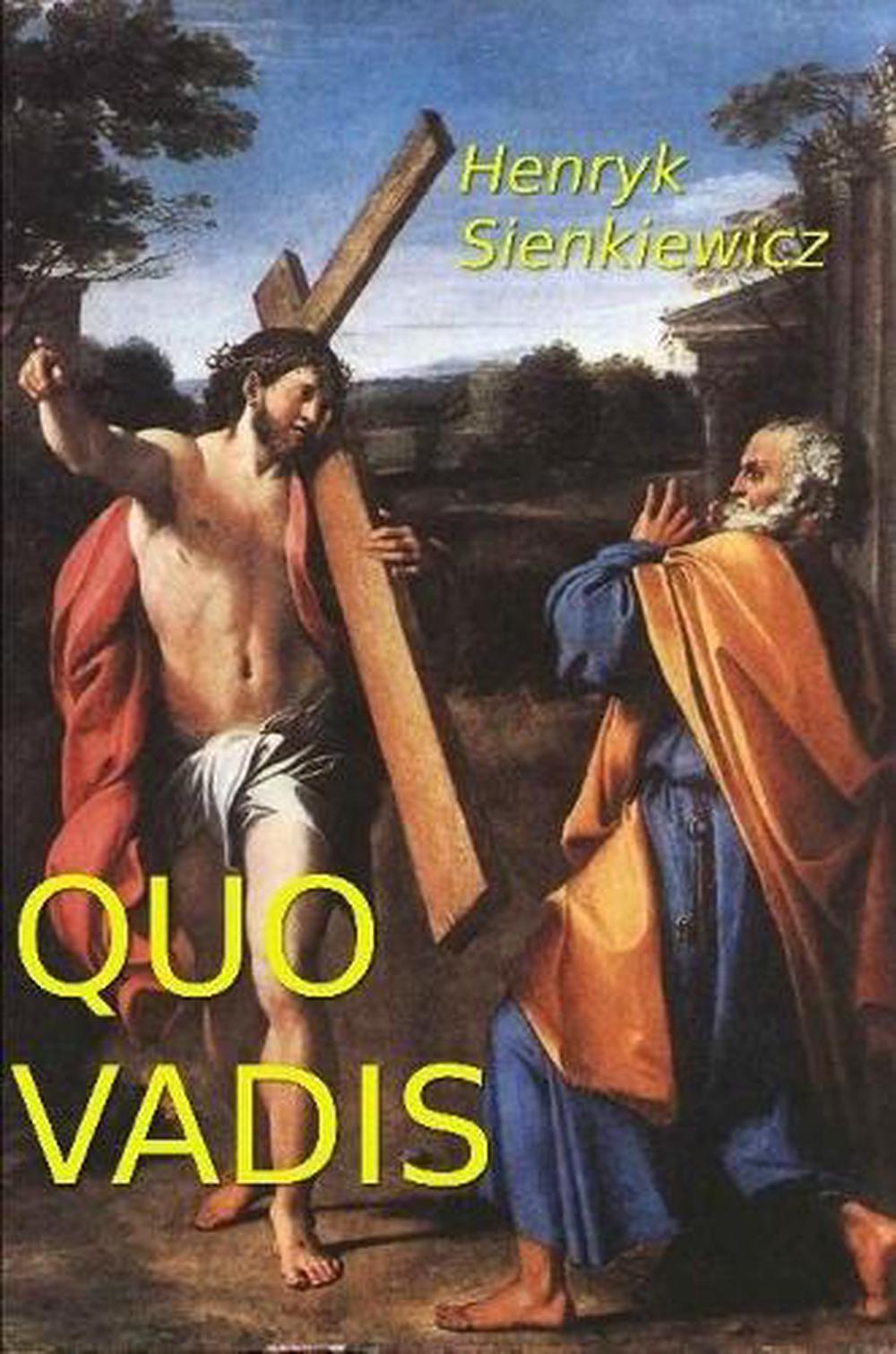
The title of the book comes from the words, "Quo vadis, Domine?" St. Peter was supposed to have said them as he was escaping Rome during the final persecutions and saw Christ going toward Rome.  It means, “Where are you going Lord?”  That scene is dramatized in the novel and brings a lump to one’s throat as St. Peter turns around and goes back to face his martyrdom. 

If you’re a Christian and you want to have insight into the early Christians, this book is a good place to go, and it will entertain you.  If you’re such a Christian and an ancient Roman history buff as well, such as I am, this novel is a must.  The novel is way better than the movies.  I highly recommend it. 


Wednesday, May 29, 2024

Quo Vadis: A Narrative of the Time of Nero by Henryk Sienkiewicz, Part 10

This is the tenth post of Henryk Sienkiewicz’s historical novel, Quo Vadis.

You can find Post #1 here.  

Post #2 here

Post #3 here.  

Post #4 here

Post #5 here. 

Post #6 here.  

Post #7 here

Post #8 here

Post #9 here.   


Chapters 64 thru 71

Summary

One evening a Senator, Scevinus, visits Petronius and openly talks of the dissatisfaction in the Roman people over Nero, and of the potential of overthrowing the emperor.  Petronius warns him about such talk.  Scevinus tells him that the next day will be the last of the Christians to be slaughtered in the games.  Petronius realizes this could be the end of Lygia and decides to make one last effort on Nero.  That night at Nero’s feast, Petronius tells Nero that he will celebrate a wedding feast, the wedding of Lygia and Vinicius which the emperor himself had given permission.  Nero is a little surprised at this, but Tigellinus tells Nero she is still in prison on Nero’s command.  Nero plays along and says they will celebrate the wedding after the last of the games.

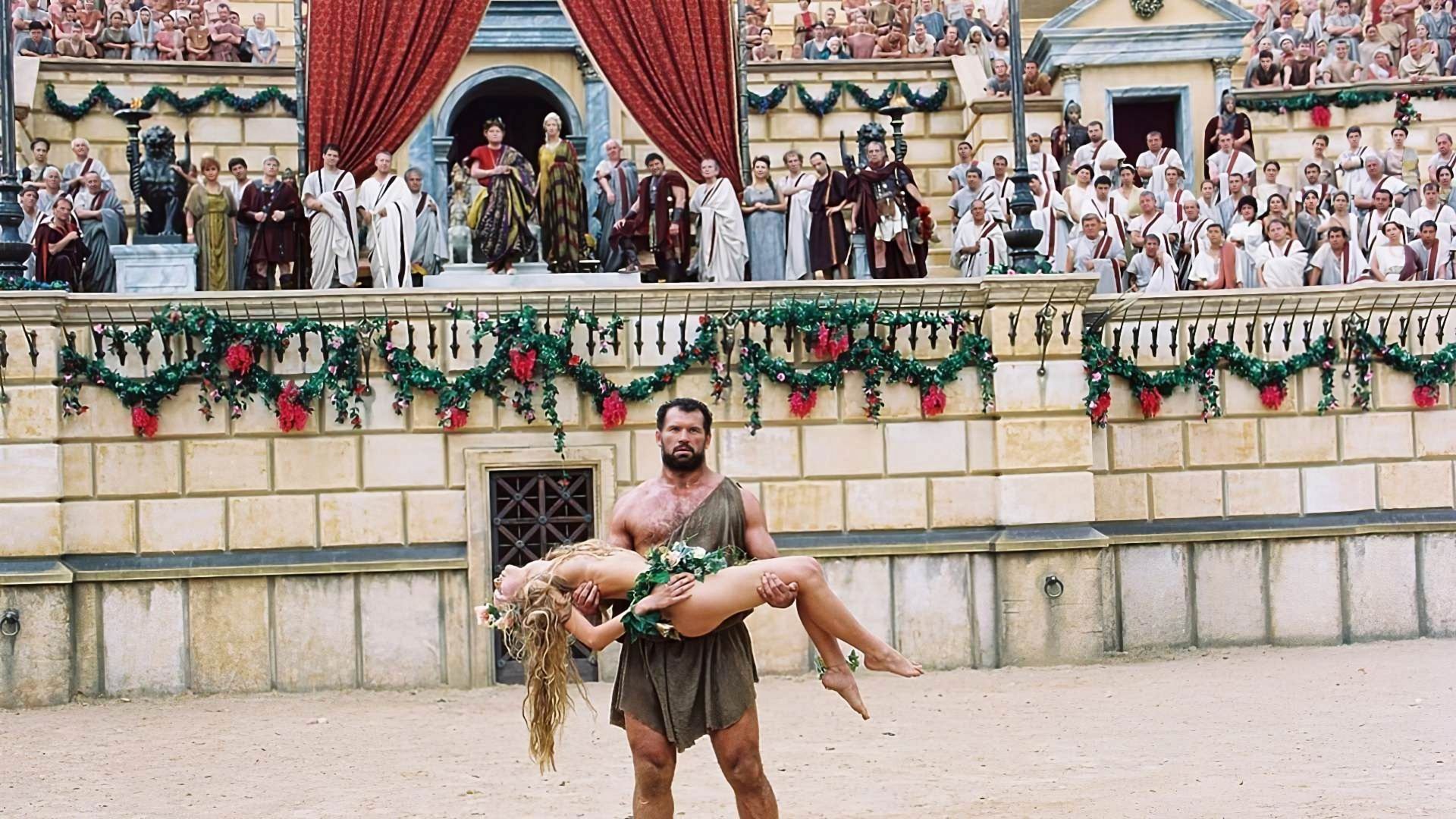
The Roman people, tired of the blood sport, still populate the theater knowing they will be coming to an end.  Everyone expects the death of the beautiful Lygia, but they do not know how she would be slaughtered.  Vinicuis, reconciled to her death, comes to perhaps see her one last time, but in his soul he rages for revenge against Nero and hopes for a miracle.  The spectacle begins with Ursus entering into the arena, and everyone marvels at the giant they had heard about.  Hoping to be crucified, Ursus stands in the middle of the arena looking at the crowd, then dropping to his knees to pray.  The crowd howls with disappointment.  The want to see him fight.  Then the trumpets blast and a bull is let into the arena with the unconscious body of Lygia strapped to the bull’s horns.  The crowd gasps, and Ursus in a rush runs to the bull and grabs him by the horns. The bull and the giant lock in a battle of strength, the bull trying to gore Ursus, Ursus trying to twist the bull’s neck.  The amphitheater is in an amazed silence as they watch the deadlock between the man and the beast, neither of the two pushing the other back, both straining to the limit of their strength.  When Ursus’s muscles are ready to yield, the bull’s neck slowly twists until his neck breaks and he dies.  The amphitheater is finally able to breath and then goes wild.  Ursus unties Lygia and carrying her still unconscious body to the podium in front of Nero begs mercy for her.  The crowd, clearly endeared to Ursus, roars and gives the sign for mercy.  Vinicius jumps into the arena and goes beside Ursus and Lygia and shows the scars on his body fighting for Roman wars.  Tigellinus tells Nero to have them slain.  Nero wants to have them slaughtered but becomes afraid of the vociferous crowd, and relents.

Lygia, still unconscious, is taken to Petronius’s house with Vinicius praising God the whole way.  A physician who was dispatched declares that once the fever passes, Lygia should recover.  That night Lygia’s consciousness returns for a moment and then falls back into a sleep.  Vinicius kneels by her all night long in prayer.

Petronius, wanting to find out if there were any further schemes from the palace, goes to visit Nero.  Nero, angry at how the events had turned, does not wish to speak to Petronius, but Petronius tells him to write a poem on the magnanimity of the emperor toward a young maiden.  Nero is pleased with the suggestion and plans to use the subject to glorify himself.  Still when he returns home advises Vinbicius to take Lygia to Sicily.  Vinicius agrees but plans to take her to Pomponia as she recovers.  Vinicius feels an immense happiness.

Christians from across the Rome visit Lygia at Petronius’s home.  The apostle Peter stops by one night.  Vinicius thanks him for all the prayers which led to Lygia’s being saved.  Peter tells him that he expects to be a victim of Nero’s continuing persecutions.  Vinicius implores him to leave Rome and save himself.  But Peter tells Vinicius how the Lord had predicted one day he would be crucified.  Days later, Petronius informs Vinicius that letters of Peter and Paul are found on a Christian soldier, and Tigellinus has set up a search to nab them.  Ursus and Vinicius rush to see Peter and tell him of a means to escape Rome.  Peter, unafraid, is undecided.  He wants to stay in Rome, but his followers have mostly been killed.  After days and nights in uncertainty Peter listens to Linus to leave and convert more followers elsewhere. 

The next day at dawn, two people are walking away from Rome.  One is Peter, who was persuaded to leave Rome, the other is Nazarius.   Peter sees a vague figure in the sunlight up ahead.  Nazarius sees nothing.  Suddenly Peter is astonished to recognize the vague figure as Christ and falls to the ground.  Peter in tears mutters the words, “Quo vadis, Domine?” which means, “where are you going, Lord?”  The answer which only Peter could hear is “If you desert my people, I am going to Rome to be crucified a second time.”  And Peter straightway turns around to return to Rome.  He tells the others that he has seen the Lord.  From then on he goes to the Christian cemetery to preach daily.

Two groups of soldiers are dispensed.  One group arrest Peter and the other Paul.  Even in prison, Peter converts two guards.  On the day before his crucifixion, Peter is flogged.  On the next day he was led to Vatican Hill.  He is too old to be made to carry a cross, but he walks with dignity and majesty.  Satisfied with his life’s work, Peter walks with joy.  As he walks, he envisions the future city that will be the center of the Christian world.  At last he reaches the destination and he prays and blesses the city and the world.  That evening another detachment of soldiers lead Paul outside the city.  He will have more respect since he is a Roman citizen.  He too walks with peace and tranquility.  He thinks back over his life as he walks.  When he reaches the destination of his execution, he places a veil around his head to cover his eyes.

With the Christians finally dispatched, the aristocrats of Rome hatch a plot to assassinate Nero, but Nero is ahead of them and has many of the highest nobles of Rome killed as well as their families.  Even Poppaea is killed.  The Senate trembles in fear.


###

Michelle Comment:

And Nero lost his city to St. Peter!


My Reply to Michelle:

Yes. I loved it!


Frances Comment:

Those with Bishop Robert Barron’s Word On Fire ministry will be aware that the Institute publishes a journal four times a year. The latest issue, titled ‘’Conversion,” contains a two-page article by essayist Joseph Susanka on Quo Vadis. Here are some lines which I think fit in well with our reading:


‘’The years Sienkiewicz spent researching the demise of the Julio-Claudian dynasty and his attentiveness to its chaotic detail give the book both focus and narrative precision. There is a power in the historical particulars that serve as the perfect backdrop to his characters’ lives. . .


‘’While the story of Marcus Vinicius’ journey toward the Catholic faith gives the work its narrative thrust, the most powerful image of conversion for me is that of Peter turning back toward Rome, both literally and figuratively. Petrus, the Rock, the leader of Christ’s earthly Church, must be reminded to abandon himself to divine providence, to turn back, to suffer and die, and to be transformed.


‘’Returning to Sienkiewicz’s work after years away, that is the most striking message the book offers me. If even St. Peter had strayed far enough from the path of truth to necessitate his Savior’s gentle chiding, how much more so must we answer Christ’s call to be renewed and transformed, again and again, day by day, until we come at last to our final home.


‘’Quo Vadis? Where are you going?’’


‘’Simon Peter answered him, ‘Lord, to whom can we go? You have the words of eternal life.’ ‘’


— Evangelization Culture, Issue No. 18, ‘’Conversion,’’ Winter, 2023, pages 21-23.

Michelle’s  Reply to Frances:

Thank you for posting this excerpt, Frances. That image from the book has really stayed with me.

My Reply to Frances:

Wonderful, Frances. I think I'm finally going to commit and subscribe to Bishop Barron's journal. I find him the most solid of the Catholic voices speaking out there, neither part of the hermeneutic of rupture of the liberals nor the hermeneutic of suspicion of the reactionary conservatives. He is what Catholicism should be.

Frances’s Reply to Me:

Well said, Manny. I agree. Candidly, I don’t know how Bishop Barron produces all that he does, and all of high quality. For those interested in joining the Word On Fire Institute, dues are $27 a month. But there are many low cost items available, too. Right now his Lenten booklet is being offered free of charge, with only a shipping fee.

My Comment:

I had no clue how the climatic scene of Lygia and Ursus in the arena would happen.  Normally I try to look ahead of a book and know the rough outline so that I can understand the writer as the scenes develop.  For this book, I’ve known nothing nor tried to read a summary somewhere.  The Ursus and Lygia scene in the arena with the bull was breathtaking.  I had no idea that was to develop, and I had no idea how it would resolve as I read.  In that moment of Ursus and the bull locked in a death struggle I was in stunned anticipation.  I could see it going in many directions.  When Ursus won and brought Lygia’s unconscious body to the emperor’s podium and begged for her mercy—not even his—I was literally in tears.  I had joined the Roman spectators in the amphitheater, totally rooting for Ursus.  What masterful writing! 


I have not finished the novel, but it seems to me the Ursus struggle with the bull scene was the climax of the story, and from there on a denouement to tidy up loose ends.  Peter and Paul’s executions are part of that “tidying up.” 


On the other hand, Peter seeing the Lord who speaks the words that would become the novel's title seems significant enough to be a climax.  But ultimately I would argue that it's not the climax.  The novel starts with Vinicius, Petronius, Lygia, and Ursus.  Peter is really a supporting role.


On that note, I was surprised that neither Peter’s nor Paul’s execution was narrated.  Sienkiewicz narrated all the way to the executions but he does not show them.  They were sort of off-stage.  Was that out of respect for the great apostles?  He narrated lots of other deaths and gore.  He wasn’t shy about it before this.  I was a little surprised actually.


The movies take great liberties with the novel, but I include video clips despite they are not truly reflective of how they are rendered.

###

The first excerpt is from that climatic scene where Ursus is pushed into the amphitheater and Lygia is let in unconscious strapped to a bull.  I cannot excerpt the entire scene since it is too long, but the beginning is so well written that I’ll start there and let you read how it concludes on your own.


Vinicius shook his head. He might die in that amphitheatre, but he could not go out of it. Moreover the spectacle might begin any moment.


In fact, at that very instant almost, the prefect of the city waved a red handkerchief, the hinges opposite Cæsar's podium creaked, and out of the dark gully came Ursus into the brightly lighted arena.


The giant blinked, dazed evidently by the glitter of the arena; then he pushed into the centre, gazing around as if to see what he had to meet. It was known to all the Augustians and to most of the spectators that he was the man who had stifled Croton; hence at sight of him a murmur passed along every bench. In Rome there was no lack of gladiators larger by far than the common measure of man, but Roman eyes had never seen the like of Ursus. Cassius, standing in Cæsar's podium, seemed puny compared with that Lygian. Senators, vestals, Cæsar, the Augustians, and the people gazed with the delight of experts at his mighty limbs as large as tree-trunks, at his breast as large as two shields joined together, and his arms of a Hercules. The murmur rose every instant. For those multitudes there could be no higher pleasure than to look at those muscles in play in the exertion of a struggle. The murmur rose to shouts, and eager questions were put: "Where do the people live who can produce such a giant?" He stood there, in the middle of the amphitheatre, naked, more like a stone colossus than a man, with a collected expression, and at the same time the sad look of a barbarian; and while surveying the empty arena, he gazed wonderingly with his blue childlike eyes, now at the spectators, now at Cæsar, now at the grating of the cunicula, whence, as he thought, his executioners would come.


At the moment when he stepped into the arena his simple heart was beating for the last time with the hope that perhaps a cross was waiting for him; but when he saw neither the cross nor the hole in which it might be put, he thought that he was unworthy of such favor,—that he would find death in another way, and surely from wild beasts. He was unarmed, and had determined to die as became a confessor of the "Lamb," peacefully and patiently. Meanwhile he wished to pray once more to the Saviour; so he knelt on the arena, joined his hands, and raised his eyes toward the stars which were glittering in the lofty opening of the amphitheatre.


That act displeased the crowds. They had had enough of those Christians who died like sheep. They understood that if the giant would not defend himself the spectacle would be a failure. Here and there hisses were heard. Some began to cry for scourgers, whose office it was to lash combatants unwilling to fight. But soon all had grown silent, for no one knew what was waiting for the giant, nor whether he would not be ready to struggle when he met death eye to eye.


In fact, they had not long to wait. Suddenly the shrill sound of brazen trumpets was heard, and at that signal a grating opposite Cæsar's podium was opened, and into the arena rushed, amid shouts of beast-keepers, an enormous German aurochs, bearing on his head the naked body of a woman.


"Lygia! Lygia!" cried Vinicius.


Then he seized his hair near the temples, squirmed like a man who feels a sharp dart in his body, and began to repeat in hoarse accents,—


"I believe! I believe! O Christ, a miracle!"


And he did not even feel that Petronius covered his head that moment with the toga. It seemed to him that death or pain had closed his eyes. He did not look, he did not see. The feeling of some awful emptiness possessed him. In his head there remained not a thought; his lips merely repeated, as if in madness,—


"I believe! I believe! I believe!"


This time the amphitheatre was silent. The Augustians rose in their places, as one man, for in the arena something uncommon had happened. That Lygian, obedient and ready to die, when he saw his queen on the horns of the wild beast, sprang up, as if touched by living fire, and bending forward he ran at the raging animal.


From all breasts a sudden cry of amazement was heard, after which came deep silence.


The Lygian fell on the raging bull in a twinkle, and seized him by the horns.


"Look!" cried Petronius, snatching the toga from the head of Vinicius. The latter rose and bent back his head; his face was as pale as linen, and he looked into the arena with a glassy, vacant stare.


All breasts ceased to breathe. In the amphitheatre a fly might be heard on the wing. People could not believe their own eyes. Since Rome was Rome, no one had seen such a spectacle.


The Lygian held the wild beast by the horns. The man's feet sank in the sand to his ankles, his back was bent like a drawn bow, his head was hidden between his shoulders, on his arms the muscles came out so that the skin almost burst from their pressure; but he had stopped the bull in his tracks. And the man and the beast remained so still that the spectators thought themselves looking at a picture showing a deed of Hercules or Theseus, or a group hewn from stone. But in that apparent repose there was a tremendous exertion of two struggling forces. The bull sank his feet as well as did the man in the sand, and his dark, shaggy body was curved so that it seemed a gigantic ball. Which of the two would fail first, which would fall first,—that was the question for those spectators enamoured of such struggles; a question which at that moment meant more for them than their own fate, than all Rome and its lordship over the world. That Lygian was in their eyes then a demigod worthy of honor and statues. Cæsar himself stood up as well as others. He and Tigellinus, hearing of the man's strength, had arranged this spectacle purposely, and said to each other with a jeer, "Let that slayer of Croton kill the bull which we choose for him"; so they looked now with amazement at that picture, as if not believing that it could be real.


###

For the second excerpt, I’m going to post the moment where Peter, trying to escape Rome, encounters Christ who asks him where he is going?  It is where the title of the novel comes.  Peter in remorse turns around and goes back to Rome to be with the remaining Christians and, of course, face martyrdom.  The short, staccato, mostly one sentence paragraphs in this scene hits the reader in the gut.   It’s a most moving scene.


About dawn of the following day two dark figures were moving along the Appian Way toward the Campania.


One of them was Nazarius; the other the Apostle Peter, who was leaving Rome and his martyred co-religionists.


The sky in the east was assuming a light tinge of green, bordered gradually and more distinctly on the lower edge with saffron color. Silver-leafed trees, the white marble of villas, and the arches of aqueducts, stretching through the plain toward the city, were emerging from shade. The greenness of the sky was clearing gradually, and becoming permeated with gold. Then the east began to grow rosy and illuminate the Alban Hills, which seemed marvellously beautiful, lily-colored, as if formed of rays of light alone.


The light was reflected in trembling leaves of trees, in the dew-drops. The haze grew thinner, opening wider and wider views on the plain, on the houses dotting it, on the cemeteries, on the towns, and on groups of trees, among which stood white columns of temples.


The road was empty. The villagers who took vegetables to the city had not succeeded yet, evidently, in harnessing beasts to their vehicles. From the stone blocks with which the road was paved as far as the mountains, there came a low sound from the bark shoes on the feet of the two travellers.


Then the sun appeared over the line of hills; but at once a wonderful vision struck the Apostle's eyes. It seemed to him that the golden circle, instead of rising in the sky, moved down from the heights and was advancing on the road. Peter stopped, and asked,—


"Seest thou that brightness approaching us?"


"I see nothing," replied Nazarius.


But Peter shaded his eyes with his hand, and said after a while,


"Some figure is coming in the gleam of the sun." But not the slightest sound of steps reached their ears. It was perfectly still all around. Nazarius saw only that the trees were quivering in the distance, as if some one were shaking them, and the light was spreading more broadly over the plain. He looked with wonder at the Apostle.


"Rabbi! what ails thee?" cried he, with alarm.


The pilgrim's staff fell from Peter's hands to the earth; his eyes were looking forward, motionless; his mouth was open; on his face were depicted astonishment, delight, rapture.


Then he threw himself on his knees, his arms stretched forward; and this cry left his lips,—


"O Christ! O Christ!"


He fell with his face to the earth, as if kissing some one's feet.


The silence continued long; then were heard the words of the aged man, broken by sobs,—


"Quo vadis, Domine?"


Nazarius did not hear the answer; but to Peter's ears came a sad and sweet voice, which said,—


"If thou desert my people, I am going to Rome to be crucified a second time."


The Apostle lay on the ground, his face in the dust, without motion or speech. It seemed to Nazarius that he had fainted or was dead; but he rose at last, seized the staff with trembling hands, and turned without a word toward the seven hills of the city.


The boy, seeing this, repeated as an echo,—


"Quo vadis, Domine?"


"To Rome," said the Apostle, in a low voice.


And he returned.


###

I wish I could excerpt the executions of Saints Peter and Paul, but that would be too long.  You will just have to read the novel on your own then.


Friday, May 3, 2024

Quo Vadis: A Narrative of the Time of Nero by Henryk Sienkiewicz, Part 9

This is the ninth post of Henryk Sienkiewicz’s historical novel, Quo Vadis.

You can find Post #1 here.  

Post #2 here

Post #3 here.  

Post #4 here

Post #5 here. 

Post #6 here.  

Post #7 here

Post #8 here


Chapters 57 thru 63

Summary

The games are interrupted by three days of rain and hail.  Once they resume, Nero wants to arm Christians to fight each other to the death in the arena.  The Christians refuse, throw their weapons to the ground, and kneel in prayer.  Nero is forced to put an end to them by having real gladiators come in and slaughter the Christians as they passively kneel.  Then Nero, inspired to exceed all past games, creates enactments of mythic and historic stories where the Christians will be raped and killed per the legends.  Another spectacle put on in the arena is real crucifixions, and so Christians are nailed to crosses and lifted up, the arena filled with so many crosses it looks like a forest with the audience enjoying the slow deaths of the crucified.  One such Christian is the old man Crispus, preaching the wrath of God as he is nailed and dies on the cross.  The cross on which Crispus is nailed stood opposite the emperor’s podium, and Crispus and Nero faces look on each other.  Crispus in his dying breath denounces Nero.

Chilo, trying to leave the games, tries to persuade Nero to leave for Greece, but Nero says not until after the games are over.  Chilo insists he will no longer attend the games, but Nero stipulates that he be forced to sit next to him.  Chilo feels that death is coming for him through the vengeance of the Christian God.  Petronius says that the Christians in their passive deaths are actually arming and with patience will bring down Rome.  Tigellinus says that this is insane.

Petronius believes that Vinicius is devising a new plan to free Lygia, but Vinicuis has lost hope.  Still Vinicius decides to try to enter the new prison, just to see Lygia.  Dressed as a slave the guards do not recognize him and he goes in.  The prison is vast and he hears the groans of all those infected with fever.  Deep in the dungeons he finally finds Lygia and Ursus.  Lygia, asleep on the floor, is emaciated.  He kneels by her and she awakes.  She is weak but grateful to see her beloved.  He tells her Christ will save them, but she believes she will die, either in the arena or in prison. 

For three nights Vinicius similarly comes to the prison to be with Lygia.  They talk about how they will love and live with each other beyond the grave.  Petronius is astonished that Vinicius is at peace with the situation.  Petronius informs him that the Christians will be human torches for Nero’s garden the next day.  Vinicius again dresses as a slave and heads over to the prison.  He gets there in time to see Christians being led out to go to Nero’s garden.  Scanning their faces he does not find Lygia or Ursus, but he does notice Glaucus. 

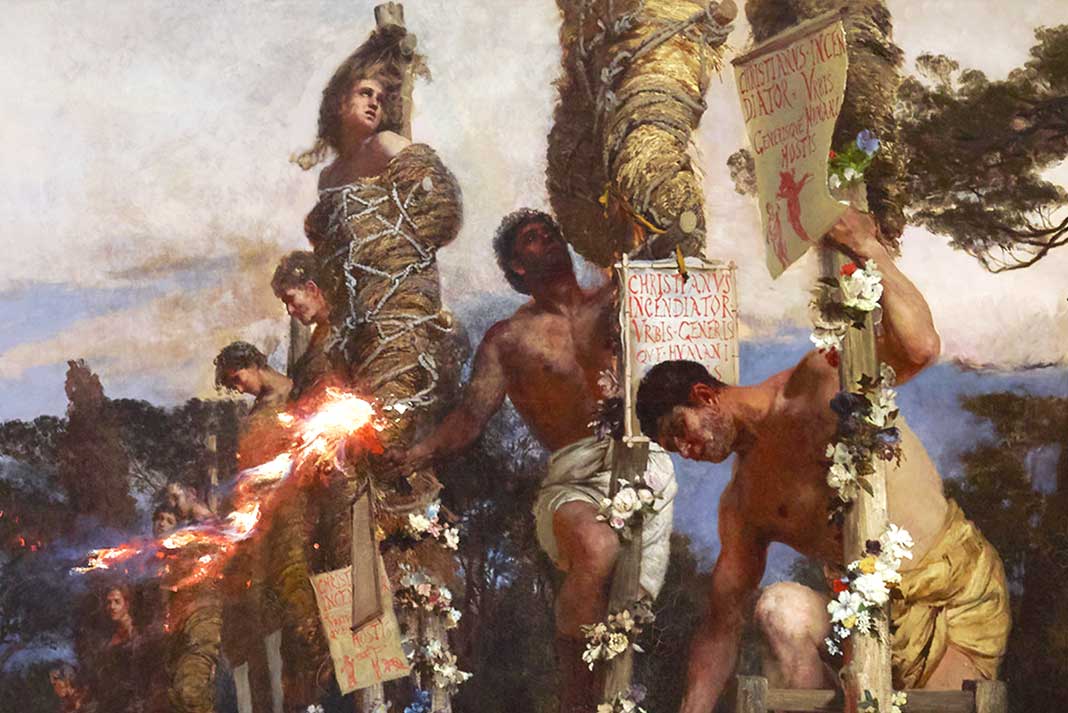
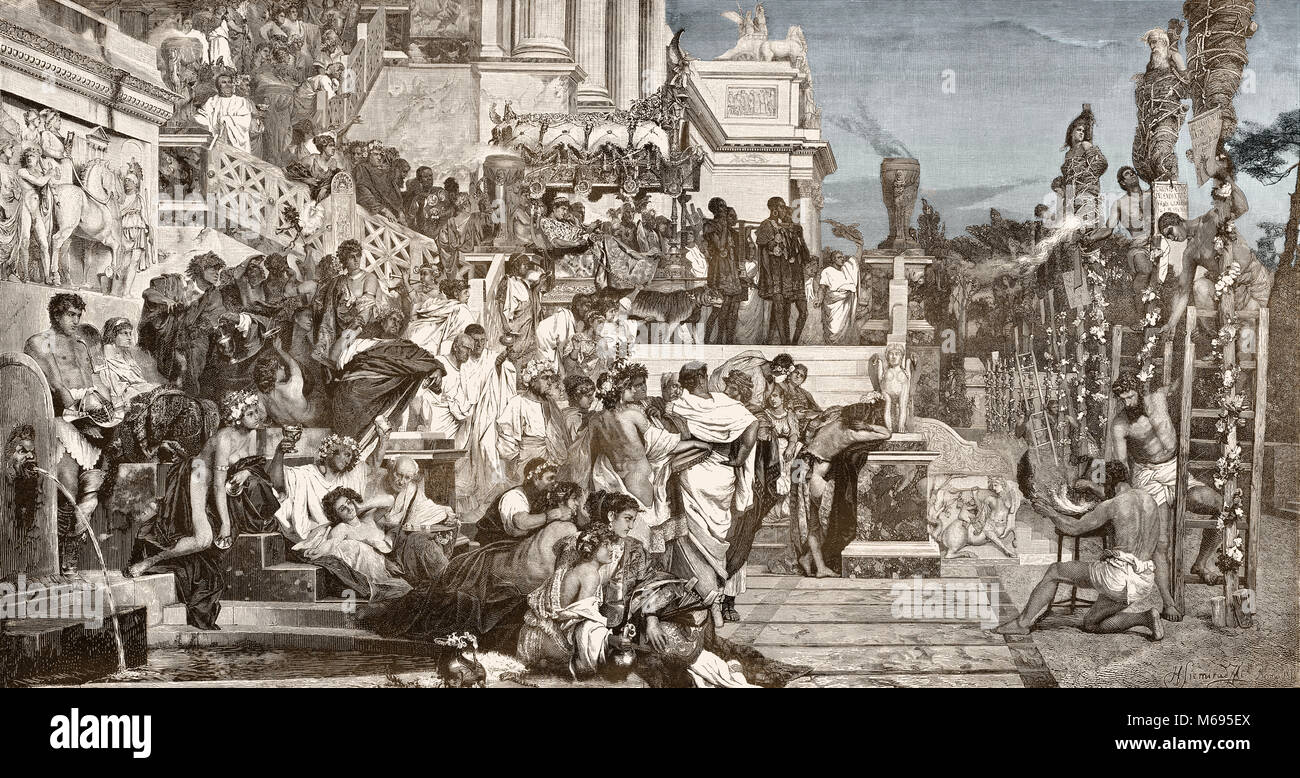
The Roman people have grown tired of the games, and Nero and Tigellinus are hoping with the last of the Christians to bring the spectacle to an end.   In Nero’s garden, Christians are tied to poles and plastered with pitch.  At a given command, a slave beneath each pole sets fire to a pile of straw.  The fire climbs the pole and ignites the pitch.  As the fire climbs the poles and up the bodies of the Christians, screams can be heard, smell of burnt flesh can be smelled, and the garden is as bright as day.  Chilo is forced to attend with Caesar, and is horrified at the distorted burning bodies, some still in agony, some frozen in a death gaze.  As Nero’s entourage stroll through the garden they come to the pole where Glaucus is strapped.  Chilo lets out a cry upon recognizing him.  Nero laughs at the shock he sees in Chilo’s face.  Chilo begs Glaucus to forgive him, and Glaucus does before he dies.  Chilo drops to the ground in tears and the Romans wonder what is happening to him.  Chilo gets up and pointing a finger at Nero and in a loud voice screams that Nero had been responsible for the fire.  The Roman people within earshot believe him and question why the need for the murderous games.  In the chaos, Chilo wanders away and comes across Paul the Apostle.  Chilo makes a confession and Paul baptizes him into Christianity.  Tigellinus finds Chilo, and Chilo announces that he has become a Christian too.  Tigellinus has guards apprehend Chilo who torture him to retract what he said about Nero.  Chilo refuses, and Tigellinus has his tongue pulled out.

Tigellinus comes up with a new idea for a spectacle.  He will have a Christian hang on a cross while devoured by a real life bear.  The Roman audience has begun to believe the Christian divinity will conquer Rome.  When it is time for the bear scene, to the audience’s surprise two guards drag out Chilo, naked and decrepit from his broken bones.  He lay calm, awaiting his fate with peace.  They nail him to a low cross so a bear can reach up to him.  The bear is curious but does not attack Chilo, as if in pity for the man.  As Chilo looks up, he smiles as if in a vision of wonder, and then dies.  A voice from the top of the amphitheater yells out, “Peace to the martyrs,” silencing the audience.

After the burning of the Christians as torches in Nero’s garden, there are not many Christians left.  The Roman population is convinced the Christian God will take revenge.  The rumors that Nero and Tigellinus are the real culprits of the fire spread through the city.  To calm the populace more free food is provided.  Vinicius is reassured that when Lygia dies he will be given her remains.  He too has become emaciated from his stress.  The thought of reuniting with her in the afterlife consoles him.  Ursus too is consoled in the thought of serving Lygia in the afterlife.  The prison guards admire the mild good temper of the gentle giant. 


###

My Comment:

Good Lord, the degradation on the Christians sinks lower and lower. The crowd is bored with the slaughter, so the powers have to devise more disgusting spectacles to hold the audience's interest. The slaughter of the Christians is a holocaust, which reminded me of Nazi Germany. The book, however, was published in 1896, well before WWII.

Michelle’s Reply:

This was so very hard to read about! It's hard to fathom how people could watch the Christians brutalized in the "games" and see them as entertainment. It's very disturbing.


On a lighter note, the reconciliation between Chilo and Glaucus was unexpected but touching, wasn't it? I was really glad that it happened.

My Reply to Michelle:

It was very hard to read Michelle. The blackness of the Roman people’s hearts to watch and be entertained by this is chilling. I don’t believe the author is exaggerating. I do think the Roman people were numb to cruelty.


Chilo surprised me at every turn. I did not expect him to betray the Christians nor convert to Christianity nor stand up for Christianity and accept martyrdom. He was a weak man who was strengthened by the grace of God and did the right thing in the end

Frances’s Comment:

Over the weekend my husband and I watched the movie “Gladiator,” which as many of you who saw it when it first came out about 20 years may remember well. It takes place during the reign of the Emperor Commodus (177-192 A.D.), while the events in Quo Vadis occurred during the reign of Nero, around 54-68 A.D. (Christians were persecuted, tortured and martyred during the first through fourth centuries, as you doubtless know.)


Two observations: 1). After seeing the film, I looked up reviews of it.

I was not that surprised to read in one review that all mention of Jesus and Christianity were deliberately left out. The hero, played by the actor Russell Crowe, dies a martyr’s death; the afterlife he goes to resembles the Elysian Fields of ancient mythology. Above, Manny referred to the blackness of the Roman people’s hearts, to watch such cruelty as entertainment. This is not apparent in “Gladiator.” Spectators are watching “the games.” We can deduce their attitudes, but they aren’t highlighted by the filmmaker.


2) Now go to Tom Holland’s brilliant book, Dominion. In it Holland stresses he was surprised to learn what a savage and alien place the ancient world was. And he discovered there was a certain innocence about the citizens’ callousness: they lived with it, not aware of their attitudes toward savagery and slavery. Caring, sensitivity, respect for human rights: these were the gifts of Christianity. Our culture at large doesn’t recognize that the values of Western civilization trace their roots to early Christianity, but they do. I find it particularly sad that the makers of the movie “Gladiator” chose to ignore this. Quo Vadis did not.

My Reply to Frances:

Oh I love the movie Gladiator and caught a scene that same day you were watching Frances. My wife was watching it. Unfortunately I had to go out.


I think the Roman people were probably mixed on the gladiatorial games. But the fact that they were a big source of entertainment suggests that most supported them. As with anything, repetition without challenge will normalize all sorts of hideous behavior. There are many things in society today that is accepted as normal that would have been disgraceful 100 years ago. You can probably make a list resulting from the sexual revolution.

Kerstin’s Comment:

I found these scenes very disturbing too. I actually skipped much of it, it was too much.

From the beginning Sienkiewicz has been very consistent in depicting the Romans as people without the gentling influences of Christianity. It exposes the inner tension that must exist in a person who will love those close to him and not care one whit about anyone else.

###


The first excerpt I’ll post is from Chapter LXI; Nero, Tigillianus, and Chilo are walking through Nero’s garden with the Christians hung on poles as human torches.


Darkness had not come when the first waves of people began to flow into Cæsar's gardens. The crowds, in holiday costume, crowned with flowers, joyous, singing, and some of them drunk, were going to look at the new, magnificent spectacle. Shouts of "Semaxii! Sarmentitii!" were heard on the Via Tecta, on the bridge of Æmilius, and from the other side of the Tiber, on the Triumphal Way, around the Circus of Nero, and off towards the Vatican Hill. In Rome people had been seen burnt on pillars before, but never had any one seen such a number of victims.


Cæsar and Tigellinus, wishing to finish at once with the Christians and also to avoid infection, which from the prisons was spreading more and more through the city, had given command to empty all dungeons, so that there remained in them barely a few tens of people intended for the close of the spectacles. So, when the crowds had passed the gates, they were dumb with amazement. All the main and side alleys, which lay through dense groves and along lawns, thickets, ponds, fields, and squares filled with flowers, were packed with pillars smeared with pitch, to which Christians were fastened. In higher places, where the view was not hindered by trees, one could see whole rows of pillars and bodies decked with flowers, myrtle, and ivy, extending into the distance on high and low places, so far that, though the nearest were like masts of ships, the farthest seemed colored darts, or staffs thrust into the earth. The number of them surpassed the expectation of the multitude. One might suppose that a whole nation had been lashed to pillars for Rome's amusement and for Cæsar's. The throng of spectators stopped before single masts when their curiosity was roused by the form or the sex of the victim; they looked at the faces, the crowns, the garlands of ivy; then they went farther and farther, asking themselves with amazement, "Could there have been so many criminals, or how could children barely able to walk have set fire to Rome?" and astonishment passed by degrees into fear.


Meanwhile darkness came, and the first stars twinkled in the sky. Near each condemned person a slave took his place, torch in hand; when the sound of trumpets was heard in various parts of the gardens, in sign that the spectacle was to begin, each slave put his torch to the foot of a pillar. The straw, hidden under the flowers and steeped in pitch, burned at once with a bright flame which, increasing every instant, withered the ivy, and rising embraced the feet of the victims. The people were silent; the gardens resounded with one immense groan and with cries of pain. Some victims, however, raising their faces toward the starry sky, began to sing, praising Christ. The people listened. But the hardest hearts were filled with terror when, on smaller pillars, children cried with shrill voices, "Mamma! Mamma!" A shiver ran through even spectators who were drunk when they saw little heads and innocent faces distorted with pain, or children fainting in the smoke which began to stifle them. But the flames rose, and seized new crowns of roses and ivy every instant. The main and side alleys were illuminated; the groups of trees, the lawns, and the flowery squares were illuminated; the water in pools and ponds was gleaming, the trembling leaves on the trees had grown rose-colored, and all was as visible as in daylight. When the odor of burnt bodies filled the gardens, slaves sprinkled between the pillars myrrh and aloes prepared purposely. In the crowds were heard here and there shouts,—whether of sympathy or delight and joy, it was unknown; and they increased every moment with the fire, which embraced the pillars, climbed to the breasts of the victims, shrivelled with burning breath the hair on their heads, threw veils over their blackened faces, and then shot up higher, as if showing the victory and triumph of that power which had given command to rouse it.


At the very beginning of the spectacle Cæsar had appeared among the people in a magnificent quadriga of the Circus, drawn by four white steeds. He was dressed as a charioteer in the color of the Greens,—the court party and his. After him followed other chariots filled with courtiers in brilliant array, senators, priests, bacchantes, naked and crowned, holding pitchers of wine, and partly drunk, uttering wild shouts. At the side of these were musicians dressed as fauns and satyrs, who played on citharas, formingas, flutes, and horns. In other chariots advanced matrons and maidens of Rome, drunk also and half naked. Around the quadriga ran men who shook thyrses ornamented with ribbons; others beat drums; others scattered flowers.


All that brilliant throng moved forward, shouting, "Evoe!" on the widest road of the garden, amidst smoke and processions of people. Cæsar, keeping near him Tigellinus and also Chilo, in whose terror he sought to find amusement, drove the steeds himself, and, advancing at a walk, looked at the burning bodies, and heard the shouts of the multitude. Standing on the lofty gilded chariot, surrounded by a sea of people who bent to his feet, in the glitter of the fire, in the golden crown of a circus-victor, he was a head above the courtiers and the crowd. He seemed a giant. His immense arms, stretched forward to hold the reins, seemed to bless the multitude. There was a smile on his face and in his blinking eyes; he shone above the throng as a sun or a deity, terrible but commanding and mighty.


At times he stopped to look with more care at some maiden whose bosom had begun to shrink in the flames, or at the face of a child distorted by convulsions; and again he drove on, leading behind him a wild, excited retinue. At times he bowed to the people, then again he bent backward, drew in the golden reins, and spoke to Tigellinus. At last, when he had reached the great fountain in the middle of two crossing streets, he stepped from the quadriga, and, nodding to his attendants, mingled with the throng.


He was greeted with shouts and plaudits. The bacchantes, the nymphs, the senators and Augustians, the priests, the fauns, satyrs, and soldiers surrounded him at once in an excited circle; but he, with Tigellinus on one side and Chilo on the other, walked around the fountain, about which were burning some tens of torches; stopping before each one, he made remarks on the victims, or jeered at the old Greek, on whose face boundless despair was depicted.


At last he stood before a lofty mast decked with myrtle and ivy. The red tongues of fire had risen only to the knees of the victim; but it was impossible to see his face, for the green burning twigs had covered it with smoke. After a while, however, the light breeze of night turned away the smoke and uncovered the head of a man with gray beard falling on his breast.


###

The second excerpt is from Chilo’s crucifixion and death in Chapter LXII.


But others spoke of Chilo.


"What has happened to him?" asked Eprius Marcellus. "He delivered them himself into the hands of Tigellinus; from a beggar he became rich; it was possible for him to live out his days in peace, have a splendid funeral, and a tomb: but, no! All at once he preferred to lose everything and destroy himself; he must, in truth, be a maniac."


"Not a maniac, but he has become a Christian," said Tigellinus.


"Impossible!" said Vitelius.


"Have I not said," put in Vestinius, "'Kill Christians if ye like; but believe me ye cannot war with their divinity. With it there is no jesting'? See what is taking place. I have not burned Rome; but if Cæsar permitted I would give a hecatomb at once to their divinity. And all should do the same, for I repeat: With it there is no jesting! Remember my words to you."


"And I said something else," added Petronius. "Tigellinus laughed when I said that they were arming, but I say more,—they are conquering."


"How is that? how is that?" inquired a number of voices.


"By Pollux, they are! For if such a man as Chilo could not resist them, who can? If ye think that after every spectacle the Christians do not increase, become coppersmiths, or go to shaving beards, for then ye will know better what people think, and what is happening in the city."


"He speaks pure truth, by the sacred peplus of Diana," cried Vestinius.


But Barcus turned to Petronius.


"What is thy conclusion?"


"I conclude where ye began,—there has been enough of bloodshed."


Tigellinus looked at him jeeringly,—"Ei!—a little more!"


"If thy head is not sufficient, thou hast another on thy cane," said Petronius.


Further conversation was interrupted by the coming of Cæsar, who occupied his place in company with Pythagoras. Immediately after began the representation of "Aureolus," to which not much attention was paid, for the minds of the audience were fixed on Chilo. The spectators, familiar with blood and torture, were bored; they hissed, gave out shouts uncomplimentary to the court, and demanded the bear scene, which for them was the only thing of interest. Had it not been for gifts and the hope of seeing Chilo, the spectacle would not have held the audience.


At last the looked-for moment came. Servants of the Circus brought in first a wooden cross, so low that a bear standing on his hind feet might reach the martyr's breast; then two men brought, or rather dragged in, Chilo, for as the bones in his legs were broken, he was unable to walk alone. They laid him down and nailed him to the wood so quickly that the curious Augustians had not even a good look at him, and only after the cross had been fixed in the place prepared for it did all eyes turn to the victim. But it was a rare person who could recognize in that naked man the former Chilo. After the tortures which Tigellinus had commanded, there was not one drop of blood in his face, and only on his white beard was evident a red trace left by blood after they had torn his tongue out. Through the transparent skin it was quite possible to see his bones. He seemed far older also, almost decrepit. Formerly his eyes cast glances ever filled with disquiet and ill-will, his watchful face reflected constant alarm and uncertainty; now his face had an expression of pain, but it was as mild and calm as faces of the sleeping or the dead. Perhaps remembrance of that thief on the cross whom Christ had forgiven lent him confidence; perhaps, also, he said in his soul to the merciful God,


"O Lord, I bit like a venomous worm; but all my life I was unfortunate. I was famishing from hunger, people trampled on me, beat me, jeered at me. I was poor and very unhappy, and now they put me to torture and nail me to a cross; but Thou, O Merciful, wilt not reject me in this hour!" Peace descended evidently into his crushed heart. No one laughed, for there was in that crucified man something so calm, he seemed so old, so defenceless, so weak, calling so much for pity with his lowliness, that each one asked himself unconsciously how it was possible to torture and nail to crosses men who would die soon in any case. The crowd was silent. Among the Augustians Vestinius, bending to right and left, whispered in a terrified voice, "See how they die!"  Others were looking for the bear, wishing the spectacle to end at the earliest.


The bear came into the arena at last, and, swaying from side to side a head which hung low, he looked around from beneath his forehead, as if thinking of something or seeking something. At last he saw the cross and the naked body. He approached it, and stood on his hind legs; but after a moment he dropped again on his fore-paws, and sitting under the cross began to growl, as if in his heart of a beast pity for that remnant of a man had made itself heard.


Cries were heard from Circus slaves urging on the bear, but the people were silent.


Meanwhile Chilo raised his head with slow motion, and for a time moved his eyes over the audience. At last his glance rested somewhere on the highest rows of the amphitheatre; his breast moved with more life, and something happened which caused wonder and astonishment. That face became bright with a smile; a ray of light, as it were, encircled that forehead; his eyes were uplifted before death, and after a while two great tears which had risen between the lids flowed slowly down his face.


And he died.


At that same moment a resonant manly voice high up under the velarium exclaimed,—


"Peace to the martyrs!" Deep silence reigned in the amphitheatre.


This video clip is not from any of the movies but a historical retelling of the events. 


As you can see, the novel follows the historical events very closely.