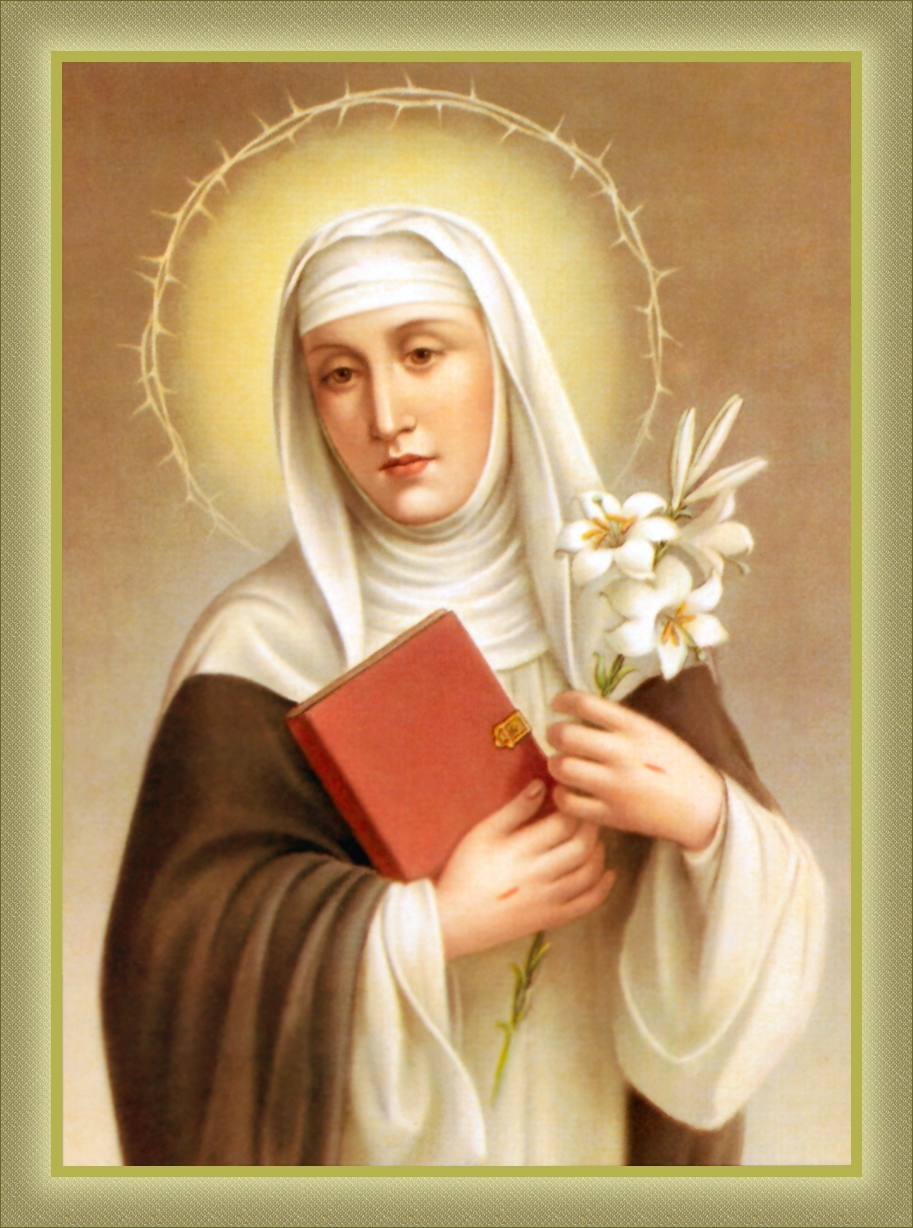
"Love follows knowledge."
"Beauty above all beauty!"
– St. Catherine of Siena

Showing posts with label Found Poetry. Show all posts

Friday, November 14, 2025

Faith Filled Friday: The Nature of Christ’s Peace

I came across this striking quote in the October 2025 issue of Magnificat (Vol. 27, No.8) in one of the meditations (p. 280-1) by the Mexican mystic and spiritual writer Blessed Concepción Cabrera de Armida who is sometimes referred to as Blessed Conchita.  According to her Wikipedia entry, she was a prolific writer.  This quote comes from a book she wrote on meditating on the nature of Jesus, both on His human and divine natures, What Jesus is Like.  I’ve put that book in my cart for a future purchase.  Looks like a great advent read.


Fr. Mark Goring tells us a little about Blessed Conchita as he describes another of her books.


Here is this most notable quote.


Peace is not something negative: a lack of conflict.  It is rather something positive: a glimpse of heaven, a beam of tranquility, a ray of God’s own happiness.  The calm that comes from peace is not transitory, but something that is permanent and immortal, like a day when the sun does not set…. The person who is at peace is like a lake that is perfectly serene.  A lake in which God is reflected, in which Jesus the God-Man is imaged.  To achieve that peace, that serenity, one needs a profound humility, a great purity of heart, a tranquil conscience, and a trusting love…. Suffering which we willingly accept brings us peace.  It makes us like him.

            -Blessed Concepción Cabrera de Armida 

First, the notion that peace is a positive value rather than a negative runs counter to our temporal minds.  We envision peace coming after conflict and turmoil, such as after war or some great disturbance.  But I think she’s got that right.  War and turmoil take peace away.

Second, she tries to describe what that peace is: “a glimpse of heaven, a beam of tranquility, a ray of God’s own happiness.”.  It is not transitory but everlasting, “like a day when the sun does not set.”  It comes from God and is God. 

Third, she describes attributes of a person who has this peace: a perfectly serene lake which reflects Jesus.  Jesus is peace and we achieve peace by becoming Him.  One needs humility, purity, conscience (which can be seen as righteousness), and love.  This comes right out of the Beatitudes (Mt 5:3-12).  To be blessed is to achieve the beatitudes and perhaps make them manifest in the world.  “Blessed are the peacemakers, for they will be called the children of God.”  When I read that verse, I imagine “peacemakers” as those who resolve conflicts and wars.  But that might be too narrow a definition.  Peacemakers are those bring tranquility to a moment.  “Lord make me an instrument of your peace” St. Francis of Assisi is said to have prayed.  Bringing such peace is bringing Christ to the moment.

Fourth, to arrive at those attributes, we have to become Christ, especially through the willing acceptance of suffering.  Jesus gives this advice to Martha in Luke 10:41-42 when Jesus says to the hyperactive Martha in response to Martha’s sister Mary: “Martha, Martha, you are anxious and worried about many things.  There is need of only one thing. Mary has chosen the better part and it will not be taken from her.”  Mary has achieved peace in Christ.

I must say that arriving at such peace is very hard to do.  To willingly go through Christ’s passion and crucifixion is not easy in this temporal world.  After all, on this side of heaven, the sunset does give way to nightfall.

Conchita’s passage is so wonderful, I consider it Found Poetry.  Found poetry are passages that were not meant as a poem but a reader sees poetry in it.  With all due respect to Conchita, let me take the parts of her passage and arrange it as a poem.  Remember, this is Conchita’s work, not mine.


Peace


A sudden glimpse, a beam of tranquility,

The ray of God’s own blessedness from His eternal face,

We sit below a sunset that never ends,

Nightfall is extinguished, and with that

The anxiety that is not of the better part.


Peace came dropping slow.

The drops now pooled into a smooth lake.

What is that reflection staring back?  God’s face!

We see Jesus in the circles of a tarn.

We sit at His feet reflecting light.


The kingdom is for the meek and merciful,

The purity of one’s heart shows us God.

We remember the trials of persecution and of turmoil;

We now have comfort and are satisfied.

We are planted at our seats as the children of God.


Haha, that was fun composing it.  Let me know if my poem is any good.

Tuesday, April 29, 2014

Poetry: My Nature is Fire by St. Catherine of Siena

Today, April 29th is the feast day of what has become my personal patron saint, St. Catherine of Siena.  I read a biography of her life written by the Nobel Prize winning author, Sigrid Undset last year, and I blogged four posts on the work, and you can access them all here.  The biography was consequential for me.  Now I admire many saints, possibly all of them, but for several reasons. Catherine is the first saint that strikes me as a kindred spirit.  And I have to say that when I can I promote her importance.    

Well, I keep going deeper and deeper in learning about St. Catherine.  Everyone seems to know her biography, especially that she was able to convince the Pope at the time to return to Rome after the Papacy had been displaced to Avignon for sixty-five years.   

But personally I think her greatest achievement is her immense writing in so short a life time, especially when you consider she had no formal education.  In 1970, along with St. Theresa of Avila, St. Catherine became the women to be recognized as Doctors of the Church.  This is a title not given lightly.  One has to have expanded the church’s understanding of its theological doctrine.  When at a time it was rare for women to know how to read and write, let alone write books and letters, Catherine either taught herself to read, or, as her hagiography goes, was given the gift by God as an adult.   

And what writing.  I’m not qualified to speak to the theology and the Church doctrine, but I can speak to her writing skills.  Her output is her treatise The Dialogue, 385 letters (collected to be four volumes) to Popes, leaders across Europe, and religious and lay people, and a collection of prayers, which amounts to a complete book.  All in a short life of thirty-three years.  I can’t speak to the quality of her Italian, which is considered by experts to be among the best of her day, but what stands out for me in the translations is her ability to generate sparkling imagery and metaphor.  She was a natural poet. 

Last year Judy Keane at Catholic Exchange had this piece on the newly translated letters that encapsulates her accomplishments, her personality, and why the letters should be read:     

Each letter Catherine wrote gives us a greater understanding of her personality, humor, charm and deep spiritual wisdom.  Miracle worker, mystic, contemplative, stigmatic, humanitarian, Doctor of the Church, activist, and counselor – this is a woman whose letters you want to spend some time with!  Why? Because they are letters that allow us to peer deeply inside the soul of a celebrated saint.  They are a gift from her to us from across the centuries – filled with spiritual and practical advice – from her troubled times to ours.  Ultimately, they contain the simple gift of being able to learn from a saint and in doing so, hopefully, become saints ourselves. 

I haven’t read them yet, but in time.  I have spent a little time with her collected prayers.  What I’ve done below is taken one of her prayers, posted at the marvelous St. Catherine of Siena website, Drawn by Love, and shaped it into the form of a free verse poem.  Other than the shaping the line lengths and organizing the strophes (irregular stanzas) I have not changed a single word except for one.  In the very first line, the actual word provided is “Godhead” but I simplified it to God.  I don’t have access to the Italian, so I don’t know exactly what word Catherine used for the translator to come up with “Godhead” but there is no distinction between the nouns “God” and “Godhead,” and I have never been fond of the term “Godhead.”  


My Nature is Fire
Prayer 12 (XXII)*

by St. Catherine of Siena 
 

In your nature, eternal God,
I shall come to know my nature. 

And what is my nature, boundless love?
It is fire, because you are nothing but a fire of love. 

And you have given humankind a share in this nature,
for by the fire of love you created us. 

And so with all other people and every created thing;
you made them out of love. 

O ungrateful people!
What nature has your God given you?
His very own nature! 

Are you not ashamed to cut yourself off
from such a noble thing through the guilt of deadly sin? 

O eternal Trinity, my sweet love! 

You, light, give us light.
You, wisdom, give us wisdom.
You, supreme strength, strengthen us. 

Today, eternal God, let our cloud be dissipated
so that we may perfectly know and follow your Truth
in truth, with a free and simple heart. 

God, come to our assistance!
Lord, make haste to help us! 

Amen.
 

*Taken from The Prayers of Catherine of Siena. 2nd edition. Suzanne Noffke, OP, translator and editor.
(San Jose.: Authors Choice Press, 2001) (Roman numerals indicate the number of the prayer in
the critical edition of G. Cavallini).
 

Excerpted from Drawn by Love.   

By the way, arrangement of a passage of words into a poem is called FoundPoetry.    
 

The central image that controls the poem and I think bends theology is that God is a fire, that He created through medium of fire, and that His love itself manifests itself through fire.  Now fire can be a destructive element; it can be a purgative element; it can be a punitive element.  But a creative, generative element is a new one for me.  My first impulse is to say it’s not biblical, so one has to consider it metaphorical.  But God does manifest Himself as a fire in the burning bush.  He is a pillar of fire leading the Israelites out of Egypt.  There are the tongues of fire at Pentecost.  In classical learning, fire was considered one of the primary four elements, so perhaps there is a leap from there to being a creative element.   

To visualize God and His love as a fire is actually an image that symbolizes unity, which I think is outside all the examples I just listed.  Fire consumes and swallows.  It merges and becomes one.  We are part of God in His essence and we dissipate (line 18) into the greater whole.  

I hope this has inspired you to search out more by this saint.