
A note. This was last Sunday’s Gospel reading. I’m still a week behind but I should have this Sunday’s shortly.
A talent had a different meaning in the first century Mediterranean world than it does today, but in my research I learned that today’s use was derived from the ancient meaning. From the online Etymology Dictionary:
“An ancient denomination of weight, originally Babylonian (though the
name is Greek), and varying widely in value among different peoples and at
different times.” [Century Dictionary]
According to Liddell & Scott, as a monetary sum it was considered
to consist of 6,000 drachmae, or, in Attica, 57.75 lbs. of silver. Also
borrowed in other Germanic languages and Celtic. It is attested in Old English
(talente) in the sense of "ancient unit of weight or monetary sum."
The Medieval Latin and common Romanic "will, inclination, desire"
sense developed from figurative use of the word in the sense of "money,
wealth, riches."
The meaning "gift committed to one for use and improvement"
developed by mid-15c., probably mostly from the parable of the talents in
Matthew xxv.14-30. The notion is of something God has granted to one and for
which one will render account at the Last Judgment. It may be also in part from
or encouraged by the figurative sense of "wealth, treasures, riches."
The general sense of "special natural ability or aptitude" is by c. 1600. The meaning "persons of ability collectively" is attested from 1856. Talent scout is attested by 1936; talent agency is by 1956.
One talent in first century I believe was worth some 20 years of salary, so even the servant receiving one talent was put in the responsibility of a fortune.
But the parable says each servant was given based on his ability. The question of the difference in amount is not actually the point of the parable. The point is what you did with what you were given. You can see then how the word talent can evolve to the natural gifts given by God.
The other key word of the parable is “fear.” Biblical scholar Nancy Haught inAmerica Media’s Scriptural Reflection puts in this way:
Fear overcame the faith of the third servant. It happens to all of us as well. Ordinary fears—whether they are reasonable or not—may keep us from acting on our faith so that it diminishes our good works and hinders our relationship with Jesus so that it does not grow or deepen. Jesus’ parable encourages putting God’s investments in us to the best use we can, even if we fear failing. We can continue to look for work, advocate on behalf of the climate or immigrants, attend to our health or work for peace. If we can overcome our ordinary fears, we can aim to fear God in the broader biblical sense, with reverence, awe and the earnest desire to be worthy followers. Let us not bury our faith.
That’s a fairly generous reading of the parable rather than the more hardline readings you will see. But Jesus is being pretty hardline with His conclusion, “throw this useless servant into the darkness outside, where there will be wailing and grinding of teeth.” But remember, this hardline conclusion is the parable’s twist that transcends logic. A sin of omission could be grave enough to send one to hell, but it would depend. For instance a doctor has a person collapse in front of them outside of work. If the doctor decides to not get involved and the person dies and he could have saved him, then I could see that as a grave offense of hiding your talent. I would think most mundane occurrences might not reach that level of gravity.
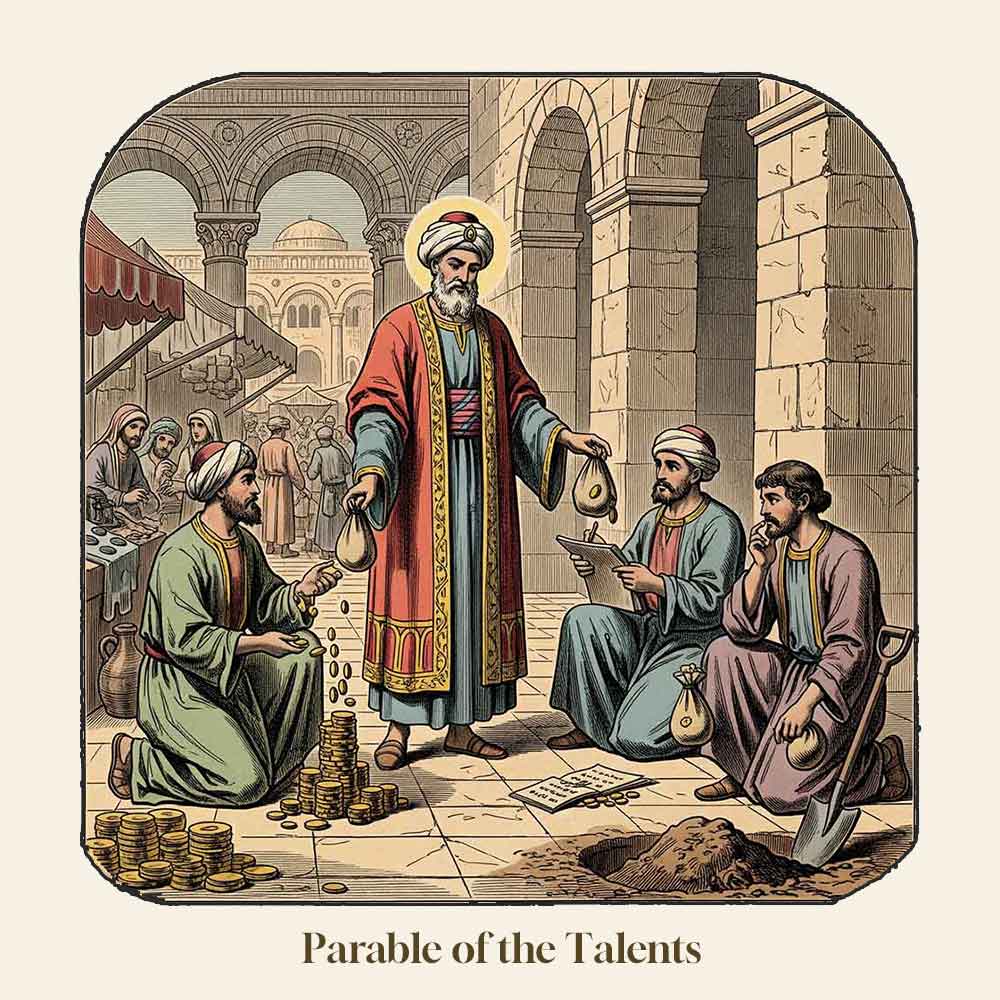
Today’s Gospel:
Jesus told his disciples this
parable:
"A man going on a journey
called in his servants and entrusted
his possessions to them.
To one he gave five talents; to
another, two; to a third, one--
to each according to his ability.
Then he went away.
Immediately the one who received five talents went and traded with them,
and made another five.
Likewise, the one who received two
made another two.
But the man who received one went off and dug a hole in the ground
and buried his master's money.
"After a long time
the master of those servants came
back
and settled accounts with them.
The one who had received five
talents came forward
bringing the additional five.
He said, 'Master, you gave me five
talents.
See, I have made five more.'
His master said to him, 'Well done,
my good and faithful servant.
Since you were faithful in small
matters,
I will give you great
responsibilities.
Come, share your master's joy.'
Then the one who had received two talents also came forward and said,
'Master, you gave me two talents.
See, I have made two more.'
His master said to him, 'Well done,
my good and faithful servant.
Since you were faithful in small
matters,
I will give you great
responsibilities.
Come, share your master's joy.'
Then the one who had received the one talent came forward and said,
'Master, I knew you were a demanding
person,
harvesting where you did not plant
and gathering where you did not
scatter;
so out of fear I went off and buried
your talent in the ground.
Here it is back.'
His master said to him in reply,
'You wicked, lazy servant!
So you knew that I harvest where I
did not plant
and gather where I did not scatter?
Should you not then have put my
money in the bank
so that I could have got it back
with interest on my return?
Now then! Take the talent from him and give it to the one with ten.
For to everyone who has,
more will be given and he will grow
rich;
but from the one who has not,
even what he has will be taken away.
And throw this useless servant into
the darkness outside,
where there will be wailing and
grinding of teeth.'"
~Mt: 25:14-30
For the exegetical reading I will once again go to the seminary
professor, Dr. Nina Heereman.
Dr. Nina:
If you go to chapter
26, you will see that it says, "After Jesus had finished saying all these
words." Then he goes off to accomplish our salvation in laying down his
life for us. He dies son the cross and he rises on the third day, and he goes
to the Father. He returns to the Father and sends the Holy Spirit. That is the
journey he goes on. He goes to the Father, he sends the Holy Spirit, and this
is the next part of the allegory. He's
going on a journey. He called his servants and entrusted his possessions to
them. What happens on Pentecost? Christ sends his Holy Spirit and everything
that he has won on the cross is given to
the church. To one he gave five talents, to another two, to a third one, each
according to his ability. Now, it's very important to properly understand what
is meant with talents because we use that term in our day-to-day language
nowadays, right? And if we speak about talents, we mean someone who is super
talented to play the piano. Another one
is super talented to play soccer or baseball or football or whatever. The third
one is super talented in managing people's money and earns millions of dollars
just by being doing capital investment, etc., etc. So, these are all natural
talents in our language. What Jesus is talking about here is not the natural
talents. The natural talents are found in the word according to his ability.
The man going on the journey, Jesus Christ, gives talents according to our abilities.
So, what are the talents? The talents are a metaphor for the gifts of the Holy
Spirit, which we receive in baptism and then very in a more pronounced and
clear fashion in confirmation, which is our personal Pentecost. St. Thomas has a
beautiful comparison. He says, "In In baptism, we receive the grace we
need for our salvation. Sons and
daughters of God and we receive that saving grace. But in confirmation, our
baptismal grace is sealed, the baptismal covenant is sealed, and we receive
strength and the gifts of the Holy Spirit to serve the church, defend the
faith, defend Christ and the church, and build up the church. So, those are the
talents. Each and every confirmed person
in the church has received talents from the Holy Spirit with which he is now to
live his faith as an adult and defend the church, build up the church. Paul speaks
about this very same thing in in a little bit of a different language, but it's
helpful to understand the mystery. Because Paul says in Ephesians chapter 4,
there is one body, which is the body of Christ, of which we are all members.
There's one spirit, just as we are called to one hope that belongs to your
call, one Lord, one faith, one baptism, one God and Father of us all, who is
above all and through all and in all.
Now, we come to the talents. But, grace was given to each of us
according to the measure of Christ's gift. So, gift is another term for the
talents.
He takes us out of
death, takes us with us to the Father as Colossians says in chapter 3,"Your life is already
hidden with Christ in God. "And
then he gives gifts to men. This is what
happens at Pentecost. He pours out his Holy Spirit. Everything he has conquered
he gives in the power of his spirit to us men. And then Paul says in verse
10,"He who descended in his incarnation is also he who ascended far above all
the heavens that he might fill all things.
"So, Christ has inaugurated his kingdom. He fills all things and
now Paul numbers the gifts. And he gave some He made them apostles, some
prophets, some evangelists, some pastors, some teachers to equip the saints.
So, the saints are all who belong to the church, who equip the saints for the
work of ministry, service in the church for the building up of the body of
Christ until we all attain to the unity of faith and of the knowledge of the
Son of God to mature manhood, to the measure of the stature of the fullness of
Christ. This is what the talents are all
about. Paul uses the slightly different metaphor, but he speaks about exactly
the same reality also in Romans chapter
12. And in Corinthians chapter 14.
So Dr. Nina projects this parable into what Christ does at
Pentecost. That is incredibly insightful. I have not found anyone else to see this
nuance. She continues.
With that, we can
skip forward. One gets five, one gets two, one gets one. The Lord returns, the one
with the five has earned another five because he's made his life fruitful. Same
with the guy who earns another two. And when the Lord comes back, he says,
"Well done, my good and faithful servant.
Since you were very faithful in small matters, I will give you great
responsibilities. "This is very
mysterious cuz it shows that in the life to come, we will continue our
ministries with greater responsibility. We will see what that is. "Come and share in your master's
joy." And then to the one who had received the one talent came forward and
he said, "Master, I knew you were
a demanding person, harvesting where you did not plant and gathering
where you did not scatter. So, out of fear, I went off and buried your talent
in the ground. Here it is back." His master said to him in reply, "You
wicked and lazy servant. So, you knew that I harvest where I did not plant and
gather where I did not scatter. Should you not then have put my money in the
bank so that I could have got it back with interest in my return? Now then,
take the talent from him and give it to the one with 10. For to everyone who
has, more will be given and he will grow rich. But from the one who has not,
even what he has will be taken away. And
throw this useless servant into the darkness outside, where there will be
wailing and grinding of teeth." The darkness outside, the wailing and grinding
of teeth is a scriptural image for eternal perdition in hell. This is something
we don't like to speak about and we don't like to hear about, but the Lord is
very clear that this possibility exists and he warns us that we do not fall into this most horrible outcome of our
life. So, how do we end up there? Very
simply, by living as if the Lord did not exist.
There are ramifications to not using our talents, those gifts from God.
I’m going to again turn to someone new for the pastoral sermon, from a YouTube channel called Sacred Heart Precious Blood, and their owner named Aaron. I particularly enjoyed this video in that it combined the moral of the Sunday reading with the saint’s feast day of that day, November 15th, St. Albert the Great.
Aaron:
Then the master
returns and settles accounts, the first servant steps forward: "Master,
you gave me five talents. See, I have made five more." And the master says those words we all hope
to hear someday: "Well done, my good and faithful servant. Since you were
faithful in small matters, I will give you great responsibilities. Come, share
your master's joy." The second servant, the one who started with two,
hears the exact same thing. Not a lesser
version, not a scaled-down compliment. The very same words. Then the third servant comes forward, and
this is where the whole parable turns: "Master, I knew you were a
demanding person, harvesting where you did not plant and gathering where you
did not scatter; so out of fear I went off and buried your talent in the
ground. Here it is back." Out of fear; That is what stopped him. Not laziness in the way we usually think of
it, not rebellion, just fear. He looked
at what he had been given and decided the safest move was to not move at all. And maybe that is the part of this parable
that sits with us the longest on a Sunday morning. Because most of us are not out here throwing
away what God has given us on something reckless. Most of the time we are just holding back. Keeping whatever gifts or quiet callings we
have received tucked safely away where they cannot fail, because if they cannot
fail, then we cannot be judged for how they turned out.
There is probably
something in your life right now that fits this, I know there is in mine. You have been feeling pulled to reach out to
someone at the parish, or to finally have that honest conversation with someone
you love about something really important.
And a voice in you keeps saying, "I am not the right person for
that. Someone else could do it
better." That voice can sound responsible, almost humble. But if we sit with it honestly, it is the
same voice that third servant listened to.
It is fear wearing the clothes of caution. What really stands out here is that the
master never compared the first two servants to each other. The one who started with five and the one who
started with two heard the exact same praise, word for word. God is not measuring what we produce against
what the person next to us produces. He
is asking whether we trusted Him enough to take what He placed in our hands and
do something with it, whatever that looked like for us. The invitation this morning is to dig out
what we have been sitting on. That small
gift, that quiet prompting, that conversation we keep putting off. To take it out of the ground and offer it
back, even imperfectly, even with shaky hands, and trust that He is not the
harsh master the third servant imagined Him to be.
“But if we sit with it honestly, it is the same voice
that third servant listened to.” How
many times do we bury an act that could direct someone toward the good out of
hesitation?
Now let's turn to
today's Saint of the Day. Saint Albert the Great was the eldest son of a
powerful German military lord, born in 1206 in Lauingen, in what is now
southern Germany. By every expectation
of his time, his path was already set. The
family name, the wealth, the military standing, all of it was supposed to pass
to him. But Albert wanted none of it.
Despite fierce opposition from his family, he entered the Dominican novitiate, choosing
poverty and preaching over everything his father had built. That single decision set the course for one
of the most remarkable minds the Church has ever known. Educated in the liberal arts from an early
age, Albert's curiosity only grew once he entered religious life, and it didn't
narrow so much as explode. Check out
this list; botany, biology, astronomy, mathematics, logic, rhetoric, ethics,
economics, politics, and metaphysics. He
wrote and illustrated guides based on his own careful observations of the
natural world, and over time his knowledge grew so vast that people placed him
on the same level as Aristotle. What set
Albert apart was not just the breadth of his mind but the courage of it. At a time when the Church approached Greek
and Arabic philosophy with real caution, Albert dove straight into it. He studied Aristotle's writings carefully and
honestly, and he brought that learning into direct conversation with the
Christian faith. "Our
intention," he once said, "is to make all the aforesaid parts of
knowledge intelligible to the Latins."
Two very different stories met this morning around the same quiet question, which is what we do with the gifts God has placed in our hands. The servants were asked to trust enough to put theirs to work, and Albert spent a whole lifetime doing exactly that, letting a curious mind carry him closer to God instead of away from Him. The difference was never how much anyone started with, only whether fear kept the gift buried or trust brought it back out into the open. So whatever has been sitting untouched in your own hands, maybe this is the morning to lift it out of the ground and offer it back, shaky, imperfect and real.
St. Albert, a Dominican icon to me, is the perfect
example of one who never hid his talents.
This good and faithful servant returned more than five talents to the
Master.
Sunday Meditation: “Therefore,
stay awake, for you know neither the day nor the hour."
We haven’t had a John Michael song in a while, and I have posted this
before, but it’s very applicable to today’s reading: “I Surrender It All.”
Take all my freedom
My liberty, my will
All that I have
You've given to me
So I offer it up to
You
I surrender it all to
Jesus
I surrender it all to
God's will
I surrender it all
for the kingdom of God
I surrender my life,
my all
Your grace and Your
love
Are wealth enough for
me
Grant me these Lord
Jesus
And I'll ask for
nothing more
I surrender it all to
Jesus
I surrender it all to
God's will
I surrender it all
for the kingdom of God
I surrender my life,
my all
I surrender my life,
my all
“All that I have/You've given to me/So I offer it up to You!”
