
Are the readings longer during Lent? Today, Year A of the Fourth Sunday in Lent, must be the longest reading of the entire three-year lectionary. Today we read the entire ninth chapter of John’s Gospel. But it is a fantastic read, one that could classify as a short story. Jesus comes across a man who is blind from birth and cures him. But the story only starts there. The city folk and especially the Pharisees who witness the miracle then try to figure out how and why the man was cured, and who the miracle worker was. I’ll let the homilists I selected below explain most of it to you. But I did want to focus on a particular word the blind man uses when asked to explain how he got his vision. He says, “The man called Jesus made clay and anointed my eyes and told me, ‘Go to Siloam and wash.’” He says his eyes were “anointed.” I had puzzled over what the connections were between the first reading, the selection of David for king, and this reading. Then I realized both the boy and the blind man were anointed.
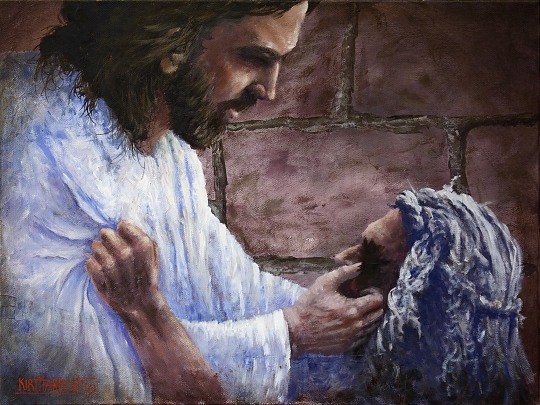
Here is today’s Gospel reading.
As Jesus passed by he saw a man
blind from birth.
His disciples asked him,
“Rabbi, who sinned, this man or his
parents,
that he was born blind?”
Jesus answered,
“Neither he nor his parents sinned; it is so that the works of God might
be made visible through him.
We have to do the works of the one
who sent me while it is day.
Night is coming when no one can
work.
While I am in the world, I am the
light of the world.”
When he had said this, he spat on
the ground
and made clay with the saliva,
and smeared the clay on his eyes,
and said to him,
“Go wash in the Pool of Siloam”
—which means Sent—.
So he went and washed, and came back
able to see.
His neighbors and those who had seen him earlier as a beggar said,
“Isn’t this the one who used to sit
and beg?”
Some said, “It is, “
but others said, “No, he just looks
like him.”
He said, “I am.”
So they said to him, “How were your
eyes opened?”
He replied,
“The man called Jesus made clay and
anointed my eyes
and told me, ‘Go to Siloam and
wash.’
So I went there and washed and was
able to see.”
And they said to him, “Where is he?”
He said, “I don’t know.”
They brought the one who was once
blind to the Pharisees.
Now Jesus had made clay and opened
his eyes on a sabbath.
So then the Pharisees also asked him
how he was able to see.
He said to them,
“He put clay on my eyes, and I
washed, and now I can see.”
So some of the Pharisees said,
“This man is not from God,
because he does not keep the
sabbath.”
But others said,
“How can a sinful man do such
signs?”
And there was a division among them.
So they said to the blind man again,
“What do you have to say about him,
since he opened your eyes?”
He said, “He is a prophet.”
Now the Jews did not believe
that he had been blind and gained
his sight
until they summoned the parents of the one who had gained his sight.
They asked them,
“Is this your son, who you say was
born blind?
How does he now see?”
His parents answered and said,
“We know that this is our son and
that he was born blind.
We do not know how he sees now,
nor do we know who opened his eyes.
Ask him, he is of age;
he can speak for himself.”
His parents said this because they
were afraid
of the Jews, for the Jews had
already agreed
that if anyone acknowledged him as
the Christ,
he would be expelled from the
synagogue.
For this reason his parents said,
“He is of age; question him.”
So a second time they called the man
who had been blind
and said to him, “Give God the
praise!
We know that this man is a sinner.”
He replied,
“If he is a sinner, I do not know.
One thing I do know is that I was
blind and now I see.”
So they said to him,
“What did he do to you?
How did he open your eyes?”
He answered them,
“I told you already and you did not
listen.
Why do you want to hear it again?
Do you want to become his disciples,
too?”
They ridiculed him and said,
“You are that man’s disciple;
we are disciples of Moses!
We know that God spoke to Moses,
but we do not know where this one is
from.”
The man answered and said to them,
“This is what is so amazing,
that you do not know where he is
from, yet he opened my eyes.
We know that God does not listen to
sinners,
but if one is devout and does his
will, he listens to him.
It is unheard of that anyone ever opened the eyes of a person born blind.
If this man were not from God,
he would not be able to do
anything.”
They answered and said to him,
“You were born totally in sin,
and are you trying to teach us?”
Then they threw him out.
When Jesus heard that they had
thrown him out,
he found him and said, Do you
believe in the Son of Man?”
He answered and said,
“Who is he, sir, that I may believe
in him?”
Jesus said to him,
“You have seen him,
the one speaking with you is he.”
He said,
“I do believe, Lord,” and he
worshiped him.
Then Jesus said,
“I came into this world for
judgment,
so that those who do not see might
see,
and those who do see might become
blind.”
Some of the Pharisees who were with
him heard this
and said to him, “Surely we are not
also blind, are we?”
Jesus said to them,
“If you were blind, you would have
no sin;
but now you are saying, ‘We see,’ so
your sin remains.
~Jn:9:1-41
I was absolutely glued to Bishop Robert Barron’s homily on this passage this
Sunday.
Bishop Barron:
Right at the
beginning, it says Jesus passed by. He saw a man blind from birth. So his
disciples asked him, "Rabbi, who sinned, this man or his parents?"
Listen now to the answer of Jesus. Neither he nor his parents sinned. It is so
that the works of God might be made visible through him. Let me just say
something brief about this. I think it's
so important. Not many days ago, I was watching a replay of the movie Jackie,
which is about Jackie Kennedy in the wake of the assassination of her husband.
And it's a good kind of heart aching movie, but she's in dialogue in the course
of movie with an elderly priest played by the great John Hurt, the English
actor. And she's suffering, of course.
Why did this happen? How could God have possibly allowed this horrible thing to
happen to my husband, to me, to our family? And the parole priest says,
"Let me let me share a parable with you." And he tells this story and
he gives that answer of Jesus. It's not because of his sin or anyone's sin. It's that the works of God might be made
visible through him. You know, we all suffer [to] different degrees. I get it. But we all suffer and we're always looking
for the answer. Why? Why? Why? Why is
God allowing this? Let this answer, everybody, sink in. Let it sink in. That
when you're going through some terrible suffering, that the works of God might
be made visible in you. Somehow God is
using this struggle, this difficulty, this pain for his purposes.
Oh that is profound. God allows tragedy for us to bring about the Kingdom of God on earth. There is so much more that Bishop Barron brings out of this passage: the dirt and spittle as elements for the sacraments, the dual nature of the incarnation, and the salve as the healing mixture for salvation. “We are healed by our contact with Him.” What a great homily.
For the pastoral homily, I present the homily from another bishop, Bishop
John E. Keehner of Sioux City, Iowa.
Bishop Keehner:
But isn't there a bit of blindness in each of us which prevents us from seeing our own faults? Preventing us from understanding our own place in the world and our relationships with others? Don't we all have a blind spot which periodically gets us into trouble when we fail to notice those things we so easily take for granted? Don't we all occasionally fail to see the truth of our prejudice which prevent us from seeing in those around us the image and the likeness of God? Don't we all occasionally fail to see the truth of our relationships, even our relationship with God, so that we assume that there will always be the time we need to do whatever it is we need and want to do in life. There will always be another day for us to mend a broken relationship or to heal the wounds we have inflicted on others because of our selfishness. The season of Lent is passing quickly away. Have we taken time this season to examine our hearts so that we might recognize that we are in fact blind?
Mea culpa, mea culpa, mea culpa. Routinely I am proven to have been blind to some issue or some insight to another’s life. Perhaps it would be wise to take a moment before criticizing someone to realize that you are blind to their life unless—to mix metaphors—you stand in their shoes.
Sunday Meditation: “Neither he nor his parents sinned; it is so that the works of God might be made visible through him.”
Oh I love this hymn, “Christ Be Our Light.” It was written by Bernadette Farrell,
who I learned from her Wikipedia entry is from England.
Christ, be our light!
Shine in our hearts
Shine through the
darkness
Christ, be our light!
Shine in your church gathered today
Performed by the Frank Brownstead Choir.

God bless you and yours.
ReplyDelete