"Love follows knowledge."
"Beauty above all beauty!"
– St. Catherine of Siena

Sunday, March 26, 2023

Sunday Meditation: The Raising of Lazarus

This is one of the most iconic of Gospel scenes.  Lazarus lays dead, bound head and foot, in a burial cave, and Jesus raises him from the dead.


Now a man was ill, Lazarus from Bethany,

the village of Mary and her sister Martha.

Mary was the one who had anointed the Lord with perfumed oil

and dried his feet with her hair;

it was her brother Lazarus who was ill.

So the sisters sent word to him saying,

“Master, the one you love is ill.”

When Jesus heard this he said,

“This illness is not to end in death,

but is for the glory of God,

that the Son of God may be glorified through it.”

Now Jesus loved Martha and her sister and Lazarus.

So when he heard that he was ill,

he remained for two days in the place where he was.

Then after this he said to his disciples,

“Let us go back to Judea.”

The disciples said to him,

“Rabbi, the Jews were just trying to stone you,

and you want to go back there?”

Jesus answered,

“Are there not twelve hours in a day?

If one walks during the day, he does not stumble,

because he sees the light of this world.

But if one walks at night, he stumbles,

because the light is not in him.”

He said this, and then told them,

“Our friend Lazarus is asleep,

but I am going to awaken him.”

So the disciples said to him,

“Master, if he is asleep, he will be saved.”

But Jesus was talking about his death,

while they thought that he meant ordinary sleep.

So then Jesus said to them clearly,

“Lazarus has died.

And I am glad for you that I was not there,

that you may believe.

Let us go to him.”

So Thomas, called Didymus, said to his fellow disciples,

“Let us also go to die with him.”


When Jesus arrived, he found that Lazarus

had already been in the tomb for four days.

Now Bethany was near Jerusalem, only about two miles away.

And many of the Jews had come to Martha and Mary

to comfort them about their brother.

When Martha heard that Jesus was coming,

she went to meet him;

but Mary sat at home.

Martha said to Jesus,

“Lord, if you had been here,

my brother would not have died.

But even now I know that whatever you ask of God,

God will give you.”

Jesus said to her,

“Your brother will rise.”

Martha said to him,

“I know he will rise,

in the resurrection on the last day.”

Jesus told her,

“I am the resurrection and the life;

whoever believes in me, even if he dies, will live,

and everyone who lives and believes in me will never die.

Do you believe this?”

She said to him, “Yes, Lord.

I have come to believe that you are the Christ, the Son of God,

the one who is coming into the world.”


When she had said this,

she went and called her sister Mary secretly, saying,

“The teacher is here and is asking for you.”

As soon as she heard this,

she rose quickly and went to him.

For Jesus had not yet come into the village,

but was still where Martha had met him.

So when the Jews who were with her in the house comforting her

saw Mary get up quickly and go out,

they followed her,

presuming that she was going to the tomb to weep there.

When Mary came to where Jesus was and saw him,

she fell at his feet and said to him,

“Lord, if you had been here,

my brother would not have died.”

When Jesus saw her weeping and the Jews who had come with her weeping,

he became perturbed and deeply troubled, and said,

“Where have you laid him?”

They said to him, “Sir, come and see.”

And Jesus wept.

So the Jews said, “See how he loved him.”

But some of them said,

“Could not the one who opened the eyes of the blind man

have done something so that this man would not have died?”


So Jesus, perturbed again, came to the tomb.

It was a cave, and a stone lay across it.

Jesus said, “Take away the stone.”

Martha, the dead man’s sister, said to him,

“Lord, by now there will be a stench;

he has been dead for four days.”

Jesus said to her,

“Did I not tell you that if you believe

you will see the glory of God?”

So they took away the stone.

And Jesus raised his eyes and said,

“Father, I thank you for hearing me.

I know that you always hear me;

but because of the crowd here I have said this,

that they may believe that you sent me.”

And when he had said this,

He cried out in a loud voice,

“Lazarus, come out!”

The dead man came out,

tied hand and foot with burial bands,

and his face was wrapped in a cloth.

So Jesus said to them,

“Untie him and let him go.”


Now many of the Jews who had come to Mary

and seen what he had done began to believe in him..

        -Jn11:1-45


First let’s watch a dramatization.


Bishop Barron gives a wonderful homily of this passage. 


I love Martha out of the three siblings.  What she says to Jesus here is as great as what Peter says to Jesus in the Gospel of Matthew (16:16):


[Martha] said to him, “Yes, Lord.

I have come to believe that you are the Christ, the Son of God,

the one who is coming into the world.”

Death is not the end for those with Christ.

Friday, March 24, 2023

Faith Filled Friday: From Blessed Pier Giorgio Frassati

This is a wonderful meditation as a Lenten meditation.  It comes from a letter by Blessed Pier Giorgio Frassati on what makes a truly profitable life.  I quote it from the February 2023 edition of Magnificat.

If you have not heard of Blessed Pier Giorgio Frassati, his life is a must to learn.  He came from a rich, well-connected Italian family who secretly helped the poor with his time and money from a young age.  Whatever money he was given, he gave it away.  He was a mountain climber, a student of engineering, a Third Order Dominican, a passionate Catholic, a lover of the Eucharist, a lover of Christ, and he did all this before contracting a form of polio which killed him at the age of twenty-four.  He perhaps lived out the beatitudes as well as any young man could do.  Wherever he went, his joyful smile made friends.  I think of his as the saint of friendship.

I don’t know who he wrote this letter to, but it encapsulates the essence of his Catholic point of view.


May peace be in your soul….Every other gift which one possesses in this life is vanity.  It is wonderful to be alive inasmuch as our true life is the life beyond; otherwise who could bear the burden of this life if there weren’t a prize for suffering, an eternal joy; how could one explain the admirable resignation of so many poor creatures who struggle with life and often die in the breach if it weren’t for the certainty of God’s justice?  In the world which has distanced itself from God, there is a lack of peace, but there is also a lack of charity that is true and perfect love.  Maybe if all of us listened more to Saint Paul, human miseries would be slightly diminished….


My life is monotonous, but every day I understand better what a grace it is to be Catholic.  Poor unlucky those who don’t have faith: to live without a faith, without a patrimony to defend, without a steady struggle for the truth, is not living but existing.  We must never exist but live, because even through every disappointment we should remember that we are the only ones who possess the truth, we have a faith to sustain, a hope to attain: our homeland.  And therefore let us banish all melancholy that can only exist when the faith is lost.  Human sorrows touch us, but if they are viewed in the light of religion, and thus of self-surrender, they are not harmful but helpful, because they purify the soul of the little and inevitable stains by which we men, due to our wicked nature, dirty ourselves many times.  In this holy Lent, let us lift up our hearts and always go forward for the triumph of the reign of Christ in Society.


Cordial greetings in Jesus Christ.


            -Blessed Pier Giorgio Frassati


From Magnificat February 2023


From Letters to His Friends and Family, Father Timothy E. Deeter, Tr., 2009, St Pauls Alba House, Staten Island, NY.


For a young man, he knew the range of human experience: “Human sorrows touch us, but if they are viewed in the light of religion, and thus of self-surrender, they are not harmful but helpful, because they purify the soul of the little and inevitable stains by which we men, due to our wicked nature, dirty ourselves many times.”  I don’t know how old he was when he wrote that, but there is no way I could have envisioned that in my twenties. 

Let me close with his ending exhortation: “In this holy Lent, let us lift up our hearts and always go forward for the triumph of the reign of Christ in Society.”

Here is a little film clip of his life.


I hope he is finally canonized in my lifetime.  He is someone I really admire.


Tuesday, March 21, 2023

Music Tuesday: The Veed Video

OK, so VEED is not really a musical piece.  If you noticed my post, “Matthew Monday: Sleeping Lotus,” the link to Matthew’s performance of the piano piece, “Sleeping Lotus,” was not working.  Matthew’s teacher had recorded his performance with phone audio, which was in MP3 format.  Actually it was recorded with M4a, whatever that is, and I was able to convert that to MP3.  But neither MP3 nor M4a would embed in Google Blogger, nor would it upload to YouTube.  I thought I figured out some way to convert it into MP4, but that also didn’t upload to YouTube.  But I thought it embedded into Blogger, and so I posted it.  But after an initial embed, somehow it got disabled, and so there was no audio performance.

But then I came across VEED, a website that converts audio and video into all sorts of formats, and you can modify and add to those videos.  It’s really cool.  Now you have to pay for VEED but they allow you free trials.  If I start needing it much, I will pay for it, but for now free suits my needs.  Not only that, there was a video that showed you the steps to do it.  It was easy enough, here.


So I converted my MP3 to MP4 through VEED, uploaded it into my YouTube page and embedded it to the blog post, “Matthew Monday: Sleeping Lotus.”  Now you can go back and hear it, if you tried last week.  But I’ll make it easy.  Here is Matthew’s piano performance of “Sleeping Lotus” once again but you will need to go back to the original post to get the details of the musical piece.


Isn’t that beautiful.  I’m so proud of him.

Sunday, March 19, 2023

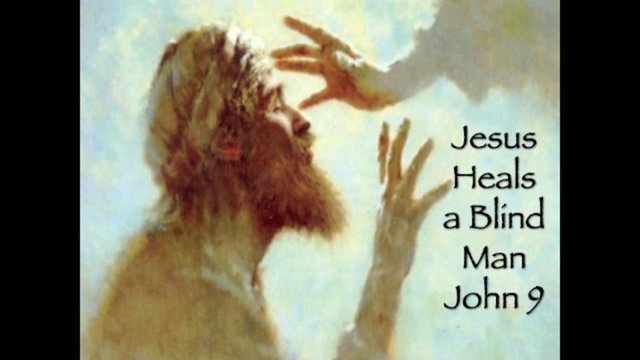
Sunday Meditation: The Healing of the Blind Man

Today Jesus performs another of His miracles, which in the Gospel of John are referred to as “signs.”  The first half of John’s Gospel is actually referred to as “The Book of Signs.”  The seven signs of the Gospel of John are the following:

    1.      Changing water into wine at Cana in John 2:1–11 – "the first of the signs"

    2.      Healing the royal official's son in Capernaum in John 4:46–54

    3.      Healing the paralytic at Bethesda in John 5:1–15

    4.      Feeding the 5000 in John 6:5–14

    5.      Jesus walking on water in John 6:16–24

    6.      Healing the man blind from birth in John 9:1–7

    7.      The raising of Lazarus in John 11:1–45 


    Today’s Gospel reading is of the sixth sign, healing the man born blind.


    As Jesus passed by he saw a man blind from birth.

    His disciples asked him,

    "Rabbi, who sinned, this man or his parents,

    that he was born blind?"

    Jesus answered,

    "Neither he nor his parents sinned;

    it is so that the works of God might be made visible through him.

    We have to do the works of the one who sent me while it is day.

    Night is coming when no one can work.

    While I am in the world, I am the light of the world."

    When he had said this, he spat on the ground

    and made clay with the saliva,

    and smeared the clay on his eyes,

    and said to him,

    "Go wash in the Pool of Siloam" —which means Sent—.

    So he went and washed, and came back able to see.


    His neighbors and those who had seen him earlier as a beggar said,

    "Isn't this the one who used to sit and beg?"

    Some said, "It is, "

    but others said, "No, he just looks like him."

    He said, "I am."

    So they said to him, "How were your eyes opened?"

    He replied,

    "The man called Jesus made clay and anointed my eyes

    and told me, 'Go to Siloam and wash.'

    So I went there and washed and was able to see."

    And they said to him, "Where is he?"

    He said, "I don't know."


    They brought the one who was once blind to the Pharisees.

    Now Jesus had made clay and opened his eyes on a sabbath.

    So then the Pharisees also asked him how he was able to see.

    He said to them,

    "He put clay on my eyes, and I washed, and now I can see."

    So some of the Pharisees said,

    "This man is not from God,

    because he does not keep the sabbath."

    But others said,

    "How can a sinful man do such signs?"

    And there was a division among them.

    So they said to the blind man again,

    "What do you have to say about him,

    since he opened your eyes?"

    He said, "He is a prophet."


    Now the Jews did not believe

    that he had been blind and gained his sight

    until they summoned the parents of the one who had gained his sight.

    They asked them,

    "Is this your son, who you say was born blind?

    How does he now see?"

    His parents answered and said,

    "We know that this is our son and that he was born blind.

    We do not know how he sees now,

    nor do we know who opened his eyes.

    Ask him, he is of age;

    he can speak for himself."

    His parents said this because they were afraid of the Jews,

    for the Jews had already agreed

    that if anyone acknowledged him as the Christ,

    he would be expelled from the synagogue.

    For this reason his parents said,

    "He is of age; question him."


    So a second time they called the man who had been blind

    and said to him, "Give God the praise!

    We know that this man is a sinner."

    He replied,

    "If he is a sinner, I do not know.

    One thing I do know is that I was blind and now I see."

    So they said to him,

    "What did he do to you?

    How did he open your eyes?"

    He answered them,

    "I told you already and you did not listen.

    Why do you want to hear it again?

    Do you want to become his disciples, too?"

    They ridiculed him and said,

    "You are that man's disciple;

    we are disciples of Moses!

    We know that God spoke to Moses,

    but we do not know where this one is from."

    The man answered and said to them,

    "This is what is so amazing,

    that you do not know where he is from, yet he opened my eyes.

    We know that God does not listen to sinners,

    but if one is devout and does his will, he listens to him.

    It is unheard of that anyone ever opened the eyes of a person born blind.

    If this man were not from God,

    he would not be able to do anything."

    They answered and said to him,

    "You were born totally in sin,

    and are you trying to teach us?"

    Then they threw him out.


    When Jesus heard that they had thrown him out,

    he found him and said, "Do you believe in the Son of Man?"

    He answered and said,

    "Who is he, sir, that I may believe in him?"

    Jesus said to him,

    "You have seen him,

    the one speaking with you is he."

    He said,

    "I do believe, Lord," and he worshiped him.

    Then Jesus said,

    "I came into this world for judgment,

    so that those who do not see might see,

    and those who do see might become blind."


    Some of the Pharisees who were with him heard this

    and said to him, "Surely we are not also blind, are we?"

    Jesus said to them,

    "If you were blind, you would have no sin;

    but now you are saying, 'We see,' so your sin remains.

            -Jn 9:1, 6-9, 13-17, 34-38 

    Dr. Brant Pitre gives a wonderful exegesis of this passage. 


    Pitre explains a lot.  I don’t know if I ever had heard that when John in his Gospel refers to “the Jews,” he is referring to the Judeans as opposed to those from other parts of Israel.  That is something I should try to retain.

    But the one point most worth meditating on is the blind man’s transition to the fullness of faith: prophet to man sent from God to Lord.


    Friday, March 17, 2023

    St. Patrick’s Day 2023

    I’m ethnically Italian but I have a devotion to St. Patrick, the real St. Patrick, not the distorted silly festival St. Patrick that is dressed in what is supposed to pass as green bishop garb.  Why is it that festivals left to secular devices almost all lead to bacchanals?  I remember as a college kid meeting up with other students in Manhattan for the St. Patrick’s Day parade, drinking green beer, and then sitting at an Irish pub named Molly Bloom—named after a character in James Joyce’s novel Ulysses—and talking Irish literature.  I can still quote a few of Yeats’ poems!  [“Turning and turning in the widening gyre/The falcon cannot hear the falconer…”]

    And I remember in the years after college meeting up with some of my boyhood friends—none of which were actually Irish—every St. Patrick’s Day at a local Brooklyn tavern named Pippin’s Pub, where on St. Patrick’s Day they would give out free corned beef sandwiches all night.  We’d drink Guinness—our tastes had developed beyond green beer—and later in the night swing down Irish whiskies and listen to Steely Dan on the jukebox.  [“They got a name for the winners in the world/I want a name when I lose/They call Alabama the Crimson Tide/Call me Deacon Blues”] I’m not sure why Steely Dan felt appropriate for March 17th, but it was hip, and I think Irish was hip back then in New York City, at least on St. Patrick’s Day.  There was certainly Irish music played on the juke, but I remember Steely Dan.  I can tell you the hangovers weren’t hip.

    But such is New York City’s version of St. Patrick’s Day. 

    By the way, I discovered a wonderful podcast from Ireland called The Brendan Option, hosted by Fr. Brendan Kilcoyne who from a Catholic perspective gives his opinions on the new Ireland, and they are not very positive.  Here he laments at what has happened to the St. Patrick’s Day parades in Ireland where he wants to cancel the parade altogether.


    Besides agreeing with his many opinions, I just love his gift of gab that apparently so many Irish have.  And I love his accent.  If you don’t watch it, here’s a little quote from the episode he put on the description pages:


    I want this vulgar, drink-sodden, bullsh!t that is commonly called St. Patrick's Day to stop so that the celebration of a major Catholic figure in the Irish Catholic experience is not ruined.

    Since those days attending Irish pubs I got married and became religious.  Not that marriage and developing faith necessarily follow or are connected, but I will attest that in marriage God does actually call you, and whether you listen or not is up to the individual.  Be that as it may, I discovered my Catholic faith, assessed it against other faiths and other versions of Christianity, and came down solidly on Catholicism. 

    One of the many blessings of Catholicism are the lives of the saints.  They are our models and our heroes.   Reading about saint’s lives can be a real pleasure to faithful Catholics, and I encourage it.  Yes, some of the hagiography can be hard to believe, but the moral instruction is the critical element, and moral instruction is missing from much of our contemporary literature.  Or perhaps to say it in another way, much of the moral instruction we get from contemporary literature is frankly immoral.  Flannery O’Connor, the Catholic American writer, has a great quote that shows Catholic’s admiration of saint’s lives where she says this about a character: “She could never be a saint, but she thought she could be a martyr if they killed her quick.”  I forget which novel or story that came from but it shows that even in a satirical line that Catholic’s measure their lives against those of saints. 

    Which brings me to St. Patrick, the real St. Patrick.  I don’t go to the St. Patrick’s Day Parade in Manhattan any more, but one of the pleasures of this day is to read the story of St. Patrick.  And every year I seem to discover something new about him.  We know more of his life than people probably realize.  I’m sure most have heard how as a teenager he was kidnapped from what is now England or Wales and brought to Ireland as a slave, and in time e escaped and after six years made his way back home.  You probably also know he had a calling to evangelize the very people who enslaved him, and so with great risk went back to Ireland and in time converted the island to Christianity. 

    That’s the short version, but there is a lot in-between that has been glossed over, and it’s not just the hagiographic Patrick driving the snakes out of Ireland.  I particularly enjoyed reading Catholic League’s Bill Donohue’s post on St. Patrick’s life.  The calling to go back to Ireland came in Patrick’s sleep, and while still a young man realized he needed to be a priest to fully answer the call, and so went to France and was tutored under monks at a monastery, and after two decades was made a bishop of the diocese of Ireland.  His dream of finally answering the call was realized.  This probably put him in his forties, but he went on to live into his seventies or eighties (the actual length disputed) which would have given him a good thirty to forty years evangelizing in Ireland.

    How do we know so much of St. Patrick’s life?  Beside he being included in historical annals, two documents have been preserved which he wrote.  His autobiography, Confessio, and a letter to a Roman war lord (or nobleman) named Coroticus and apparently a Christian denouncing his enslavement of Irish in Britain.  The letter is referred to as the Letter to the soldiers of Coroticus.  This is how the letter opens.


    I declare that I, Patrick, – an unlearned sinner indeed – have been established a bishop in Ireland. I hold quite certainly that what I am, I have accepted from God.  I live as an alien among non-Roman peoples, an exile on account of the love of God – he is my witness that this is so. It is not that I would choose to let anything so blunt and harsh come from my mouth, but I am driven by the zeal for God. And the truth of Christ stimulates me, for love of neighbours and children: for these, I have given up my homeland and my parents, and my very life to death, if I am worthy of that. I live for my God, to teach these peoples, even if I am despised by some.

    Donohue points out that no public person in history had ever publically denounced slavery.  Patrick was the first.  Coroticus had apparently raided, plundered, killed and enslaved, and Patrick was furious.  Paragraph 15


    I do not know what to say, or how I can say any more, about the children of God who are dead, whom the sword has touched so cruelly. All I can do is what is written: ‘Weep with those who weep’; and again: ‘If one member suffers pain, let all the members suffer the pain with it’. This is why the church mourns and weeps for its sons and daughters whom the sword has not yet slain, but who were taken away and exported to far distant lands, where grave sin openly flourishes without shame, where freeborn people have been sold off, Christians reduced to slavery: slaves particularly of the lowest and worst of the apostate Picts.

    Donohue also points out that Patrick particularly identified the crime of enslaving women: “So where will Coroticus and his villainous rebels against Christ find themselves – those who divide out defenceless baptised women as prizes, all for the sake of a miserable temporal kingdom, which will pass away in a moment of time” (par. 19).  Donohue identifies Patrick as being ahead of his time when it came to human rights.


    What makes this all the more dramatic is the way the pagan world thought about women: the idea that women were equal to men was totally foreign to them. But the women understood what Patrick was saying, and gravitated to him in large numbers. The Christian tenet that all humans possess equal dignity had taken root.

    And so, when Fr. Brandan denounces the drunken debauchery that has become the St. Patrick’s Day festivities, he is upset at the besmirching of a great man and holy saint.  

    Saint Patrick pray for us.


    Monday, March 13, 2023

    Matthew Monday: Sleeping Lotus

    In the past I’ve posted on Matthew’s learning to play the piano.  He was so cute at his first recital when he was six years old.  And then when he was learning on his own I posted his playing of Für Elise.  Since the summer however he has been taking lessons and has gotten good. 

    His piano teacher recorded him playing this piece, “Sleeping Louts” by a Dutch composer, Joep Beving.   Here is Matthew playing, but you will catch his piano teacher’s voice at the beginning and end.


    Not bad!  The piece has such a contemplative feel to it.  Matthew selected it himself to learn.  He seems drawn to contemplative music.  This is going to count as both a Matthew Monday and a Music Tuesday entry!