"Love follows knowledge."
"Beauty above all beauty!"
– St. Catherine of Siena

Friday, May 8, 2020

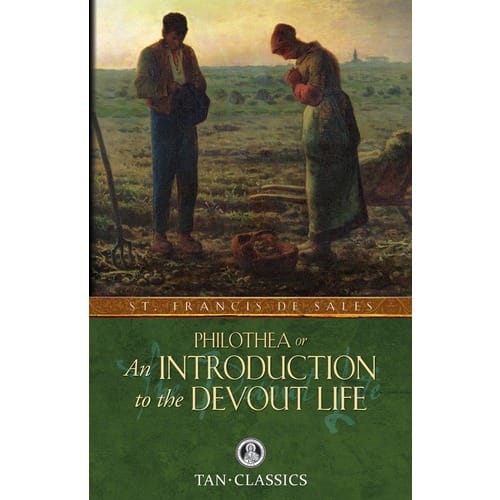
Introduction to the Devout Life, Part 2


This is part of a series on St. Francis de Sales’ Introduction to the Devout Life.  You can read Part 1 here.  

Part II: “Prayer and the Sacraments”

1. The Necessity of Prayer
2. A Short Method of Meditation, and first, the Presence of God, the First Point of Preparation
3. Invocation, the Second Point of Preparation
4. The Third Point of Preparation, Representing the Mystery to be Meditated to Your   
     Imagination
5. Considerations, the Second Part of Meditation
6. The Third Part of Meditation, Affections and Resolutions
7. The Conclusion and Spiritual Bouquet
8. Some Useful Hints as to Meditation
9. Concerning Dryness in Meditation
10. Morning Prayer
11. Evening Prayer and Examination of Conscience
12. Spiritual Retirement
13. Aspirations, Ejaculatory Prayer, and Holy Thoughts
14. Holy Communion, and How to Join in It
15. The Other Public Offices of the Church
16. How the Saints are United to Us
17. How to Hear and Read God's Word
18. How to Receive Inspirations
19. Confession
20. Frequent Communion
21. How to Communicate

Part II takes the reader through the finer points of meditation, establishing a prayer life, integrating with church life, connecting with saints, the use of frequent confession, mass, and partaking of the Eucharist. 

###

Some notable quotes from Part II.

From Chapter 1:
But especially I commend earnest mental prayer to you, more particularly such as bears upon the Life and Passion of our Lord. If you contemplate Him frequently in meditation, your whole soul will be filled with Him, you will grow in His Likeness, and your actions will be moulded on His. He is the Light of the world; therefore in Him, by Him, and for Him we shall be enlightened and illuminated; He is the Tree of Life, beneath the shadow of which we must find rest;--He is the Living Fountain of Jacob's well, wherein we may wash away every stain.

From Chapter 6:
Meditation excites good desires in the will, or sensitive part of the soul,--such as love of God and of our neighbour, a craving for the glory of Paradise, zeal for the salvation of others, imitation of our Lord's Example, compassion, thanksgiving, fear of God's wrath and of judgment, hatred of sin, trust in God's Goodness and Mercy, shame for our past life; and in all such affections you should pour out your soul as much as possible. If you want help in this, turn to some simple book of devotions, the Imitation of Christ, the Spiritual Combat, or whatever you find most helpful to your individual wants.

From Chapter 12:
There are few social duties of sufficient importance to prevent an occasional retirement of the heart into this sacred solitude. When Saint Catherine of Sienna was deprived by her parents of any place or time for prayer and meditation, Our Lord inspired her with the thought of making a little interior oratory in her mind, into which she could retire in heart, and so enjoy a holy solitude amid her outward duties. And henceforward, when the world assaulted her, she was able to be indifferent, because, so she said, she could retire within her secret oratory, and find comfort with her Heavenly Bridegroom. So she counselled her spiritual daughters to make a retirement within their heart, in which to dwell.

From Chapter 13:
We retire with God, because we aspire to Him, and we aspire in order to retire with Him; so that aspiration after God and spiritual retreat excite one another, while both spring from the one Source of all holy thoughts. Do you then, my child, aspire continually to God, by brief, ardent upliftings of heart; praise His Excellence, invoke His Aid, cast yourself in spirit at the Foot of His Cross, adore His Goodness, offer your whole soul a thousand times a day to Him, fix your inward gaze upon Him, stretch out your hands to be led by Him, as a little child to its father, clasp Him to your breast as a fragrant nosegay, upraise Him in your soul as a standard. In short, kindle by every possible act your love for God, your tender, passionate desire for the Heavenly Bridegroom of souls.

From Chapter 18:
Let me make use of an illustration of my meaning. In contracting a marriage, the bride must be a party to three separate acts: first, the bridegroom is proposed to her; secondly, she entertains the proposal; and thirdly, she gives her consent. Just so when God intends to perform some act of love in us, by us, and with us; He first suggests it by His inspiration; secondly, we receive that inspiration; and thirdly, we consent to it: for, like as we fall into sin by three steps, temptation, delectation, and consent, so there are three steps whereby we ascend to virtue; inspiration, as opposed to temptation; delectation in God's inspiration, as opposed to that of temptation; and consent to the one instead of to the other.

He mentions St. Catherine of Siena in that quote from chapter 12.  He seems to mention her frequently.  I'm not the only person, I guess, who adores that little lady.


Tuesday, May 5, 2020

Introduction to the Devout Life, Part 1


Born in France in 1567, St. Francis de Sales became a Bishop of Geneva in 1602 and therefore was at the epicenter of Catholic/Protestant conflicts over theology.  As a young man he considered himself brash, but in time was able to discipline himself to have the temperament of Christ, and his patience, knowledge, and communication skills enabled him to bring back many to the Church.  Francis died in 1622 and was beatified in 1665.  Among other patronages, he is regarded as the patron saint of writers.

His Introduction to the Devout Life, published in 1609, is regarded as one of the best spiritual guides.  He states the need for the book in the first chapter:

You aim at a devout life, dear child, because as a Christian you know that such devotion is most acceptable to God's Divine Majesty. But seeing that the small errors people are wont to commit in the beginning of any under taking are apt to wax greater as they advance, and to become irreparable at last, it is most important that you should thoroughly understand wherein lies the grace of true devotion;--and that because while there undoubtedly is such a true devotion, there are also many spurious and idle semblances thereof; and unless you know which is real, you may mistake, and waste your energy in pursuing an empty, profitless shadow.

The book aims to show how true devotion can be best obtained.  You can find the book online in English, here.    


###

Part I: Attaining a Firm Resolution to the Devout Life

The best way to give a summary for each part of the book is to list the chapters.  There are twenty-four chapters in Part 1.

Part I: Attaining a Firm Resolution to the Devout Life
1. What True Devotion Is
2. The Nature and Excellence of Devotion
3. Devotion is Suitable to Every Vocation and Profession
4. The Need of a Guide for Those Who Would Enter Upon and Advance in the Devout Life
5. The First Step Must be Purifying the Soul
6. The First Purification, Namely, From Mortal Sin
7. The Second Purification, From All Sinful Affections
8. How to Effect This Second Purification
9. First Meditation - On Creation
10. Second Meditation - On the End for Which We Were Created
11. Third Meditation - On the Gifts of God
12. Fourth Meditation - On Sin
13. Fifth Meditation - On Death
14. Sixth Meditation - On Judgment
15. Seventh Meditation - On Hell
16. Eighth Meditation - On Paradise
17. Ninth Meditation - On the Choice Open to You Between Heaven and Hell
18. Tenth Meditation - On How the Soul Chooses the Devout Life
19. How to Make a General Confession
20. A Hearty Protest Made with the Object of Confirming the Soul's Resolution to Serve God, as     
      a Conclusion to its Acts of Penitence
21. Conclusion of This First Purification
22. The Necessity of Purging Away All Tendency to Venial Sins
23. It is Needful to Put Away All Inclination for Useless and Dangerous Things
24. All Evil Inclinations Must be Purged Away

The first four chapters are in essence an introduction to the book.  It speaks to what is devotion and why we need devotion.  Chapters five through eight gives us instruction on purifying the soul.  Chapters nine through eighteen provide ten meditative exercises to strengthen yourself for purifying oneself.  Chapters nineteen twenty-one provide the culmination of Part 1, what each chapter has been building to, that is the act of penitence as the means of purging mortal sins.  Chapters twenty-two through twenty-four provide reason to do away with either venial sins and harmful inclinations. 

In short, Part 1 provides the instruction for the first step to a devout life, the cleansing of one’s soul.

###

It never occurred to me to specifically define devotion.  It seems like it would have been a rather  obvious word not requiring definition.  But as a superb writer of non-fiction, de Sales defines the key word in the very first chapter on which his book hinges.
…all true and living devotion presupposes the love of God;--and indeed it is neither more nor less than a very real love of God, though not always of the same kind; for that Love one while shining on the soul we call grace, which makes us acceptable to His Divine Majesty;--when it strengthens us to do well, it is called Charity;--but when it attains its fullest perfection, in which it not only leads us to do well, but to act carefully, diligently, and promptly, then it is called Devotion…. In short, devotion is simply a spiritual activity and liveliness by means of which Divine Love works in us, and causes us to work briskly and lovingly; and just as charity leads us to a general practice of all God's Commandments, so devotion leads us to practise them readily and diligently. And therefore we cannot call him who neglects to observe all God's Commandments either good or devout, because in order to be good, a man must be filled with love, and to be devout, he must further be very ready and apt to perform the deeds of love.

There’s a lot to unpack in that partial paragraph.  (1) Devotion is a reflection from the love of God that we shine back to Him.  (2) It stems from the grace that God sends out to us.  (3) Devotion is a spiritual activity of the Divine Love working in us. (4) And it makes us “ready and apt” to perform the works of love. 

In essence, he goes on to say, love and devotion are inextricably linked. 

The difference between love and devotion is just that which exists between fire and flame;--love being a spiritual fire which becomes devotion when it is fanned into a flame;--and what devotion adds to the fire of love is that flame which makes it eager, energetic and diligent, not merely in obeying God's Commandments, but in fulfilling His Divine Counsels and inspirations.

How does one conceptualize fire and flame?  Isn’t fire composed of flames?  Aren’t flames fire?  So love and devotion are to de Sales the same as fire and flame.  What a brilliant rhetorical flourish. 

###

I have to say Chapter 23 struck a dagger into my heart.  Here’s how he starts it:

SPORTS, balls, plays, festivities, pomps, are not in themselves evil, but rather indifferent matters, capable of being used for good or ill; but nevertheless they are dangerous, and it is still more dangerous to take great delight in them.  Therefore, my daughter, I say that although it is lawful to amuse yourself, to dance, dress, feast, and see seemly plays,—at the same time, if you are much addicted to these things, they will hinder your devotion, and become extremely hurtful and dangerous to you.

Gee, there is so many interests I have that are not religiously oriented.  I love sports.  I love literature.  I love festivities.  There is no way I can give up my beloved baseball.  He goes on to say:

The harm lies, not in doing them, but in the degree to which you care for them. It is a pity to sow the seed of vain and foolish tastes in the soil of your heart, taking up the place of better things, and hindering the soul from cultivating good dispositions.

This is my biggest fear of actually getting a spiritual director.  The degree of commitment could wipe away all your other interests.

Some notable quotes from Part I.

From Chapter 1:
But, in fact, all true and living devotion presupposes the love of God;--and indeed it is neither more nor less than a very real love of God, though not always of the same kind; for that Love one while shining on the soul we call grace, which makes us acceptable to His Divine Majesty;--when it strengthens us to do well, it is called Charity;--but when it attains its fullest perfection, in which it not only leads us to do well, but to act carefully, diligently, and promptly, then it is called Devotion…The difference between love and devotion is just that which exists between fire and flame;--love being a spiritual fire which becomes devotion when it is fanned into a flame;--and what devotion adds to the fire of love is that flame which makes it eager, energetic and diligent, not merely in obeying God's Commandments, but in fulfilling His Divine Counsels and inspirations.

From Chapter 2:
Ponder Jacob's ladder:--it is a true picture of the devout life; the two poles which support the steps are types of prayer which seeks the love of God, and the Sacraments which confer that love; while the steps themselves are simply the degrees of love by which we go on from virtue to virtue, either descending by good deeds on behalf of our neighbour or ascending by contemplation to a loving union with God. Consider, too, who they are who trod this ladder; men with angels' hearts, or angels with human forms. They are not youthful, but they seem to be so by reason of their vigour and spiritual activity. They have wings wherewith to fly, and attain to God in holy prayer, but they have likewise feet wherewith to tread in human paths by a holy gracious intercourse with men; their faces are bright and beautiful, inasmuch as they accept all things gently and sweetly; their heads and limbs are uncovered, because their thoughts, affections and actions have no motive or object save that of pleasing God; the rest of their bodies is covered with a light shining garment, because while they use the world and the things of this life, they use all such purely and honestly, and no further than is needful for their condition --such are the truly devout. Believe me, dear child, devotion is the sweetest of sweets, the queen of virtues, the perfection of love. If love is the milk of life, devotion is the cream thereof; if it is a fruitful plant, devotion is the blossom; if it is a precious stone, devotion is its brightness; if it is a precious balm, devotion is its perfume, even that sweet odour which delights men and causes the angels to rejoice.

From Chapter 5:
The very first step towards spiritual health is to be purged from our sinful humours. Saint Paul received perfect purification instantaneously, and the like grace was conferred on Saint Magdalene, Saint Catherine of Genoa, Saint Pelagia, and some others, but this kind of purgation is as miraculous and extraordinary in grace as the resurrection of the dead in nature, nor dare we venture to aspire to it. The ordinary purification, whether of body or soul, is only accomplished by slow degrees, step by step, gradually and painfully.

From Chapter 7:
Be sure, my child, that if you seek to lead a devout life, you must not merely forsake sin; but you must further cleanse your heart from all affections pertaining to sin; for, to say nothing of the danger of a relapse, these wretched affections will perpetually enfeeble your mind, and clog it, so that you will be unable to be diligent, ready and frequent in good works, wherein nevertheless lies the very essence of all true devotion.

Chapter 19:
When you come to your spiritual father, imagine yourself to be on Mount Calvary, at the Feet of the Crucified Saviour, Whose Precious Blood is dropping freely to cleanse you from all your sin. Though it is not his actual Blood, yet it is the merit of that outpoured Blood which is sprinkled over His penitents as they kneel in Confession. Be sure then that you open your heart fully, and put away your sins by confessing them, for in proportion as they are put out, so will the Precious Merits of the Passion of Christ come in and fill you with blessings.


Friday, May 1, 2020

Faith Filled Friday: This is the Pascha of Our Salvation


This poem by St. Melito of Sardis was published in the April 2020 edition of Magnificat.  It’s absolutely beautiful.  St. Melito of Sardis was a second century bishop in what is now Turkey.  He apparently was a very learned man and a great apologist of Christianity.  I don’t know if this piece was intended to be a poem or was shaped into found poetry by arranging the lines by subsequent editors.  It really works well as a poem.


This Is the Pascha of Our Salvation
by St. Melito of Sardis

This is the Pascha of our salvation:
this is the one who in many people endured many things.
This is the one who is murdered in Abel,
tied up in Isaac,
exiled in Jacob,
sold in Joseph,
exposed in Moses,
slaughtered in the lamb,
hunted down in David,
dishonored in the prophets.

This is the one made flesh in a Virgin,
who was hanged on a tree,
who was buried in the earth,
who was raised from the dead,
who was exalted to the heights of heaven.

This is the lamb slain,
this is the speechless lamb,
this is the one born of Mary the fair ewe,
this is the one taken from the flock,
and led to slaughter.
Who was sacrificed in the evening,
and buried at night;
who was not broken on the tree,
who was not undone in the earth,
who rose from the dead and resurrected humankind
from the grave below.

I love the transition to the negative (“not broken,” “not undone”) victory toward the end of the last stanza.  It emphasizes that all those efforts to defeat Christ were not successful. 


Wednesday, April 29, 2020

Letters of St. Catherine of Siena: Catherine Extols Mary Magdalene


I recently acquired new three of the four volumes of Suzanne Nofke’s wonderfully edited The Letters of Catherine of Siena at the ridiculously low price of $10 each.  These are each 600 hundred page scholarly, hardcovers for research libraries.  They should easily go ten or twelve times that each.  I have Volumes I, III, and IV.  I am missing Volume II.  Oh I would love to complete the set.  Right now Amazon lists available one used copy of Volume II for $250, and it is only in an “acceptable” condition.  I’m holding out for something more affordable, or at least in better condition.  You can read about Sr. Susan Nofke O.P. and her translation of the letters here.  

In honor of today, St. Catherine of Siena’s feast day—and bear in mind, she’s my patron saint—I want to post something from them.  Here’s is a paragraph from the very first letter, identified as “Letter T61/G183/DT2,” dated “Before May 1374” but one scholar dates this as early as 1365 or 1366.  That would make Catherine eighteen or nineteen years old. 

Some context to the letter.  The letter is addressed to Mona Agnesa Malavolti, a widow and a member of one of the leading families of Siena.  She is also a Montellate, which was a group of Dominican tertiaries which Catherine herself was a member.  The letter’s intent is to bring her order into unison with St. Mary Magdalene, who, as one of the first Resurrection preachers of Christ, holds a special place in the Dominican Order. 

Catherine in her letters has a habit of breaking into dialogue with a saint or God, and so the italicized sections of this paragraph are actually addressing the Blessed Virgin or Magdalene herself.

Oh sweet virgin, how well you imitated that devoted disciple Magdalen.  See, dearest daughters, how Magdalen knew herself, and humbled herself.  With what great love she sat at our gentle Savior’s feet.  And speaking of showing him love, we surely see it at the holy cross.  She wasn’t afraid of the Jews, nor did she fear for herself.  No, like a passionate lover she ran and embraced the cross.  Indeed, in order to see her Master she was bathed in blood.  Surely you were drunk with love, oh Magdalen!  As a sign that she was drunk with love for her Master, she showed it in her actions toward his creatures, when after his holy resurrection she preached in the city of Marseille.  And, I tell you, she had the virtue of perseverance.  You showed this, dearest Magdalen, when you were seeking your beloved Master after not finding him in the place where you had laid him.  So, oh Magdalen, love, you were beside yourself; you had no heart, since it was buried with your dearest Master and our dear Savior.  But you took it upon yourself to find your dear Jesus.  You didn’t give up; you didn’t stop grieving.  How commendably you acted!  For you found out by your persevering you were able to find your Master.

Legend has it that Mary Magdalene, after the Gospel accounts, traveled to southern France (Marseille) to preach and convert.  That’s part of why the Dominican order hold her as one of their patronesses. 

In many ways Magdalene is almost a stand in for Catherine herself here.  She seems to be projecting herself into Magdalene’s situation.  It’s Catherine who is always embracing Christ crucified and his blood.  I am also amazed that a eighteen or nineteen year old girl speaks in this manner to someone above her in experience and station.  My dear Catarina was not shy.

Today, April 29th, is the feast day of St. Catherine of Siena, my patroness.  Pray for us St. Catherine of Siena.

Monday, April 27, 2020

Literature in the News: Why Read?


There is a fascinating article in Dominicana, which is a student publication of one of the Dominican provinces; actually the one in the Northeast of the US, the St. Joseph Province.  The article should be of interest to we lovers of reading.  The article is called "Why Read?" by Br. Simon Teller, O.P.  You can read it here.

The article addresses the new nature of reading that the internet has created and then reflects on the implications of reading sacred scripture.  Brother Teller first brings up a quote from a Rhodes Scholar that characterizes this new reading culture:  "I don't read books ... I go to Google, and I can absorb relevant information quickly,” as quoted in The Shallows.

First in good Dominican fashion (per St. Thomas Aquinas), Br. Teller provides substance to the opposing argument:

To our Rhodes Scholar's point: power-reading has its advantages. Why waste time reading a book cover-to-cover, when the same information can be found by a few deft Google Books Searches? Does it really matter how we read, as long as we are coming away with the same information?

But to the good Brother of the Order of Preachers it does matter when it comes to reading sacred scripture.  Here he presents the counter argument, which is the thesis of his argument:

TO THE CONTRARY, "In the sacred books, the Father who is in heaven comes lovingly to meet his children, and talks with them" (Dei Verbum, 21).

The way we relate to words matters, because God has chosen to reveal himself in writing. In a sense, God is "incarnate" in the words of Scripture.

I'm not going to quote the entire article, but I think Brother Teller's main thrust is this:

But God's revelation of himself through the Scriptures can't be reduced to the mere communication of data. Revelation doesn't just mean that God has told us about himself, but that God is inviting us into a personal relationship with him. When you read the inspired words with faith, you step into an ongoing dialogue. For God speaks to each of us personally through the Scriptures.

I completely agree with Brother Teller.  There is very little argument against his point when it pertains to sacred scripture.  I think we could all agree with that.  But frankly I think that Rhodes Scholar's point is preposterous.  To say one gets the same knowledge from a three page Wikipedia entry that one gets from a three hundred page book is obviously fallacious.  Just consider the context of the subject that isn't developed, the counter-arguments, secondary sources, and so on.  Because I read a Wikipedia entry (and I do rely on them and love them) does not mean I understand the full issue.  I've absorbed nuggets and nuggets without full context are like nuggets that are too small and will wash away through a sieve.  Yes, you may get some information, but it is not knowledge.  If this is what scholarship has evolved to, I'm flabbergasted. 


Kerstin on Goodreads Commented:
I don't think this Rhodes "Scholar" is much of a scholar. It looks like someone who has perfected the way of cutting corners. As you say, data collection doesn't equal knowledge. But this is how in a reductionist and materialist world our young people are taught to think. It is all part of simply consuming what others have written or presented without critically diving into the subject matter yourself. Being stuffed to the brim with only facts makes for a sorry human being when knowledge, wisdom, virtue and morals are missing.

My Reply to Kerstin:
I know. He isn't much of a scholar. I wonder how wide spread that is. I could see myself in college doing it too, but I wouldn't be bragging about it.
After I posted my original comment, I thought of a perfect example. Remember when we did the Divine Comedy last year? Now how could anyone get the same understanding of the work by just reading the Wikipedia entry? Yes, the internet summaries might help to enlighten on something that just didn't sink in, but you would never pass on the actual text and claim you read it and understood it

Tuesday, April 21, 2020

Music Tuesday: Lee Konitz, RIP


One of the tragedies of the Coronavirus is the death of Lee Konitz who passed away from the contagion last week on April 15th.  He was 92.  Konitz was a jazz legend, one of the remaining artists from the bebop and cool jazz styles of the forties, fifties, and sixties.  The NY Times had a wonderful obituary.  Let me pull a few quotes.  First the facts:

Lee Konitz, a prolific and idiosyncratic saxophonist who was one of the earliest and most admired exponents of the style known as cool jazz, died on Wednesday in Manhattan. He was 92.

Next, what made him great:

Mr. Konitz initially attracted attention as much for the way he didn’t play as for the way he did. Like most of his jazz contemporaries, he adopted the expanded harmonic vocabulary of his fellow alto saxophonist Charlie Parker, the leading figure in modern jazz. But his approach departed from Parker’s in significant ways, and he quickly emerged as a role model for musicians seeking an alternative to Parker’s pervasive influence.

Where modern jazz in the Parker mold, better known as bebop, tended to be passionate and virtuosic, Mr. Konitz’s improvisations were measured and understated, more thoughtful than heated.

“I knew and loved Charlie Parker and copied his bebop solos like everyone else,” Mr. Konitz told The Wall Street Journal in 2013. “But I didn’t want to sound like him. So I used almost no vibrato and played mostly in the higher register. That’s the heart of my sound.”

Although some musicians and critics dismissed Mr. Konitz’s style as overly cerebral and lacking in emotion, it proved influential in the development of the so-called cool school. But while cool jazz, essentially a less heated variation on bebop, was popular for several years — and some of its exponents, notably the baritone saxophonist Gerry Mulligan and the trumpeter and singer Chet Baker, both of whom he sometimes worked with, became stars — Mr. Konitz for most of his career was a musician’s musician, admired by his peers and jazz aficionados but little known to the general public.


At his best, Lee Konitz seems to put out a dream like melody and rhythm.  As I’ve grown older, I appreciate it more so that the hard bebop sounds where you sometimes can’t pick out the melody.  Let’s start with this lovely tune, “When You’re Smiling.”
Personnel: Lee Kontiz- Alto Sax, Billy Bauer- Guitar, Henry Grimes- Bass, Dave Bailey-Drums.


Here in “Topsy” he joins Warne Marsh who is on tenor sax.  The subtle distinction between the two saxes, which at times are interweaving, is what makes this so interesting.  The contrast is subtle.  Personnel: Lee Konitz (alto sax), Warne Marsh (tenor sax), Billy Bauer (guitar), Oscar Pettiford (bass), Kenny Clarke (drums)


Konitz doesn’t hit you over the head with style.  He’s so subdued.  Here is a live piece, “Just Friends,” with Knonitz coming in at the 1:50 mark.  Personnel: Lee Konitz (alto sax), Art Farmer (fluegelhorn), Ake Persson (trombone), Pim Jacobs (Piano), Stu Martin (drums).


Here in an interview, Lee articulates what makes beautiful music for him.


Finally a lovely ballad, “Lover Man,” with Lee on alto sax and Paul Bley on piano. 


That might be the quintessential Lee Konitz piece.  Beautiful music, indeed.  Eternal rest in peace, Mr. Konitz.


Friday, April 17, 2020

Notable Quote: Jerusalem Laments, From the Book of Baruch


Background:

The Book of Baruch was written by the scribe of the prophet Jerimiah after the Israelites were enslaved during the Babylonian captivity.  I will only speak of the first five chapters.  The sixth chapter is apparently an addition which calls itself “A Letter from Jerimiah” and appeals to the Israelites to not succumb to the idolatry of their Babylonian masters.  As the Introduction to the NAB edition states at the USCCB website http://usccb.org/bible/scripture.cfm?bk=Baruch&ch= the Book attempts to encode the captivity in “Deuteronomic cycle: sin (of Israel), punishment, repentance, and return (cf. Jgs 2; also Dt 28–33).”  The Book uses two voices throughout, that of the scribe and that of a personified Jerusalem.  The Book speaks in prayer, in poetry, in appeal, and in lamentation.  It is quite beautiful in places.  I’m going to quote a section where the author speaks in the voice of Jerusalem addressing the subjugated and captive Israelites.

Jerusalem Addresses Diaspora

17 What can I do to help you?
18     The one who has brought this evil upon you
    must himself deliver you from your enemies’ hands.
19 Farewell, my children, farewell;
    I am left desolate.
20 I have taken off the garment of peace,
    have put on sackcloth for my prayer of supplication;
    while I live I will cry out to the Eternal One.
21 “Take courage, my children; call upon God;
    he will deliver you from oppression, from enemy hands.
22 I have put my hope for your deliverance in the Eternal One,
    and joy has come to me from the Holy One
Because of the mercy that will swiftly reach you
    from your eternal Savior.
23 With mourning and lament I sent you away,
    but God will give you back to me
    with gladness and joy forever.
24 As Zion’s neighbors lately saw you taken captive,
    so shall they soon see God’s salvation come to you,
    with great glory and the splendor of the Eternal One.

-Jerusalem Addresses the Diaspora Baruch 4:19-22, NABRE

In the language, one gets echoes of the coming Savior.

You can read more on the Book of Baruch at these websites:
From New Advent
From Wikipedia