"Love follows knowledge."
"Beauty above all beauty!"
– St. Catherine of Siena

Saturday, May 15, 2021

Dark Night of the Soul by St. John of the Cross, Post 3

This is the third post in a series on St. John of the Cross’ Dark Night of the Soul. 

Post #1 can be found here.  

Post #2 here. 


Summary

Part 1

Chapter 10: One should conduct themselves with patience, perseverance, and contemplation during a dark night.

Chapter 11: Exposition of lines two, three, and four of the poem’s first stanza.

Chapter 12: On the benefits that the dark night causes on the soul.

Chapter 13: More benefits the soul experiences from the dark night.

Chapter 14: Exposition of the last line of the poem’s first stanza.

Part 2

Chapter 1: Explains the dark night of the spirit.

Chapter 2: Describes the two imperfections of those undergoing the dark night of the spirit.

Chapter 3: Expounds on the need to purge the imperfections.

Chapter 4: An interpretation of the poem’s first stanza as it reflects the dark night of the spirit.

Chapter 5: Expounds on the first two purgations of the dark night of the spirit.

Chapter 6: Expounds on the third and fourth purgation of the dark night of the spirit.

### 

My Comment:

I'm now finished with Book 1, which I guess is about 40% of the book, but what I find stunning is that Christ has to my awareness not been mentioned once! Can you have a Christian classic without Jesus Christ? ;)

My Comment:

I'm having a hard time in those early chapters of Book 2. Has it suddenly gotten more difficult? He talks so indirectly I'm having a hard time following. Purging, dark night, path. It can be so abstract. Are others finding Book 2 more difficult as well?

Casey Replied:

Book 2, Ch 5 is a key chapter. the fulcrum. Spend some time there.


I'm trying to think of an analogy that might help some folks.... here's a gardening analogy:


Let's say you are planting your tomato or pepper seeds right now. That seed sits in your house in artificial heat and sprouts. It spreads its roots looking for the water you give it and it stretches out for the light of a lamp or window. In doing so it gets all leggy and spindly. As the weather warms the plant needs to be hardened off for outside conditions. So you take it out a little at a time. The sun burns the leaves, the wind and rain bash it about, and then you bring it back in. Then a little longer tomorrow. The little thing was doing just fine and now its getting all burned and beat up. Then it gets planted in unfamiliar soil. But as the weeks pass the plant settles in and discovers that the rain and the wind and the sun that consistently wash down upon it are making it stronger. It grows and grows without reaching and stretching. It has everything it needs to bear great fruit.


The hardening off period is "the dark night." The beginner period isn't a worse period than the others. The seedling is being what it ought to be at its time. It is a necessary period before the next and the next. We need to sprout and reach and stretch first so that we present ourselves to God. But there's this transition period where we learn to relax our will (because it is insufficient) and let God's will take over.


Does that help at all?

My Reply:

Yes, that makes sense Casey. My trouble is distinguishing a difference between a purgation of sense and a purgation of spirit.

Casey’s Reply:

OK, so like we initially desire the pleasures of the sense instead of God Himself, we now desire God's love instead of God Himself. I'm thinking something like a child learning to ride a bike to impress mom rather than riding a bike for riding a bike's sake.

Irene’s Reply:

Manny, Here is how I understand the difference, but I could be wrong.


The purgation of the sense is usually taken on by the individual deliberately to detach from bodily pleasures or psychological pleasures that we might desire sufficiently that they distract us from God. Food and alcohol, TV or other entertainment, social status or wealth accumulation, the pursuit of learning or excitement, sex or the affirmation of friends, etc., we let go of anything so we can approach God with open hands. It is not that any of these things are necessarily bad, but, like Job, if they were stripped from us, would they lessen our peace in God? People relinquish various attachments so that their truest love is God and God alone. Of course, sometimes these things are stripped from a person by illness or misfortune or war or whatever. But even in these situations, the individual can rage against or mourn the loss or willingly relinquish what is stripped away.


The purgation of the spirit is largely done by God as God withdraws the pleasurable experiences associated with initial religious fervor. Early in the spiritual life, most people experience peace or a sense of intimacy with God or joy or something else with their turning to God in prayer. If they did not, they would quickly lose interest, doubt that God was anything more than a figment of other people's psyche. But the joy, the peace, the sense of well-being, none of this is God. These sweetnesses might entice a spiritual novice to continue, but they are not God. So, when the soul is ready, God begins to remove these things so that the soul comes to desire and love God, not the promises of God or the sweetness God has bestowed.


For me, it is like a marriage. Early in the dating, the person needs something to validate the relationship. Some of this might be the physical attraction to the other person, the affirmation of peers that you make a great couple, and it is also the sweetness’s done, the thrill of the special Friday night dates, the gifts, the constant compliments and terms of endearment. But, over time, much of this will fade. Looks don't last, friends stop remarking on your relationship, Friday night dates turn into dirty diapers and broken water pipes and bills that can't be paid, compliments are replaced by pet peeves. If it is not love, the marriage often does not last, or if it does, it lasts under duress. If you loved the endearments more than the person, what will happen when the partner goes through a prolonged depression and can't offer them? If you loved the fun things you did together more than the person, what happens when the partner is felled by a stroke? None of us wants to think that the only reason our partner married us was because of our salary or our figure. We want to be loved because of who we are. In the same way, God asks that we do not love God because of the physical blessings God bestows, the pleasures we enjoy or because of the spiritual sweetness’s we have in prayer. God asks that we love God because God is God, the only true center of our life.

Casey’s Reply to Irene:

Irene wrote: "Manny, Here is how I understand the difference, but I could be wrong.

The purgation of the sense is usually taken on by the individual deliberately to detach from bodily pleasures or psychological..."


Actually, it is God who detaches us in both cases. What is being purged is not those things that distract us from God but those pleasures that we confuse for God.

So in our secular culture we may hear how science shows us that prayer is good for our emotional well-being. But praying for our well-being is the wrong aim for prayer.

God removes the emotional benefit and it seems to us that something is wrong but he's revealing something greater. And we now experience God's great love and we are spurred on.

But praying to receive God's love is not exactly right either. It is God Himself at which we ought to aim. This is the realm of the Saints.


Here's an article (“Musings On The Dark Night Of The Soul: Insights From St. John Of The Cross On A Developmental Spirituality”) I found that is a great and thorough explanation.  

My Reply to Irene & Casey:

In theory I understand the difference between the purgation of the senses and the purgation of the spiritual, but what I took from your comment and left above is also confusing me. I said I understand in theory, but someone has to give me examples. St. John never provides examples of anything, and such amorphous concepts require tangible examples. What is a tangible example of purging of the spiritual? Is he saying we shouldn't be praying? Or going to Mass? Or receiving communion? I doubt he's saying any of that. So what is he saying? In practice I have no idea.

Casey’s Reply:

The ultimate tangible example of the "final stage" (so to speak) would be the Blessed Virgin Mary. She did not have to go through these dark nights as we do but rather she was gifted with a simplicity of heart that allowed her to fully and totally cooperate with the will of God. There is no ego or desire or rebellion or pride etc in her. It is perfect cooperation.


Examples of the passage through the dark nights would be St. Paul in a linear sense or St. Peter in a seasonal sense. (linear and seasonal idea in the linked article.)


Thomas Merton's Seven Story Mountain is a tale about this very journey.


In a Lenten context, think of it this way. Say you gave up beer for Lent. On Ash Wednesday you are feeling very good about that. 10 days in you've not touched a drop and are thinking this isn't as hard as you thought. 10 days after that, still a perfect record, and you start thinking about how great it will be to sip that cold beer with Easter dinner. You see, you've given up the thing and you are doing good but you haven't given up the desire of the thing. By the end of Lent, you hope to have purged that desire for the thing such that you have a right relationship with it. You have that relationship with the beer that God himself has with the beer. You approach that beer the way Mary would approach it.


Maybe think of it like, in the dark night of the sense God is dealing with our sin. In the spirit, he is dealing with our original sin.

My Reply to Casey:

Casey that's brilliant. I think I get it now. It also shows how hopeless I'll be. I can't imagine ever giving up the desire for a good glass of wine. Thanks. It definitely helps.

Casey’s Reply:

"Create in me a clean heart, O God, and put a new and right spirit within me." Psalm 51:10


Imagine a young man in his 20s who it taken with strong drink. In his 30s he moves away from the drink and by 40 drinks no more. In his 40s, however, he longs for the days of his youth and wishes he could have those wild nights again. You see, he's no longer drinking but he still has the longing for drink. That root is still alive in his heart. This is what need to be purged in the second night.


Here is another article I found that might work better. Haven't read all of this one either but it seems good:  “Chapter Four—A Third Conversion—ThePassive Night of the Spirit.”    

My Reply to Casey:

Casey, you've saved the book for me! I don't think I would have gotten this without your help. And that website really helps too. I can identify with that young man. Perhaps as we read on it will say, but how does one purge that past out of the heart?

Casey’s Reply:

Great, I'm glad. This has really struck a chord with me. I had never even heard of it before. It's been amazing.


I think the idea is that God purges the roots of desire from our hearts with his blinding love. We cannot will ourselves to deserve it. We can only learn to cooperate with His will.

My Comment:

I know Casey, its taking me a while to get through it. Half the time it feels like he’s repeating himself with an ever so subtle a nuance that I can’t make a distinction from one chapter to another or even one paragraph to another.

Casey’s Reply:

Regarding the seeming repetitiveness:


"For the most important part of my task, and the part which chiefly led me to undertake it, was the explanation of this night to many souls who pass through it and yet know nothing about it," (XXII 2.)


I think it's something like painting the same bowl of fruit from different angles through time. From the north angle we see more grapes and less banana and from the south more banana and now an orange etc. So there's a repetitiveness in that it is always the same bowl of fruit. But when you get to a depiction of your particular angle, then you say "A-Ha! That's it!"


And then through time meaning like an artist's eye continually improves. You see more than bananas and grapes. You see shadow and texture etc.


So I do think that one individual reader is likely to "get" the book up to that point where one is in their journey. A saint would get the whole book and the beginner would see this as entirely intangible. To a newly excited convert, the idea of aridity and a coming dark night would be like the idea of desert air to a fish.

My Reply to Casey:

Casey wrote: "I have a question regarding the terms "soul" and "spirit." An example here from Book 2, Chapter 2:

"Are those terms theologically distinct or is soul being used like we might say "the poor soul" and spirit like the soul soul?"


I don't know Casey. I have been reading it as if they are synonymous. I don't see a distinction but I'm not confident I've been understanding him throughout the book.

Casey’s Reply:

Regarding soul and spirit - here's a clue:


"For, when there is a naked contact of spirit with spirit, the horror is intolerable which the evil spirit causes in the good spirit (I mean, in the soul), when its tumult reaches it." (XXIII - 5.)


Friday, May 14, 2021

Faith Filled Friday: The Ascension and a Prayer

Yesterday was Solemnity of the Ascension of Our Lord, otherwise known as Ascension Thursday.  I want to offer a prayer and an image for the occasion.  . 

This came out of last month’s Magnificat: “A Prayer for Eternal Life” by St. Anselm, who lived from 1033 to 1109.  He lived quite a life.  Born in Italy, became a Benedictine monk in France, and an archbishop in Canterbury England.  He was a theologian and philosopher and involved in some of the political disputes of the day.  He wrote this really beautiful prayer.


A Prayer for Eternal Life


My Lord and my God, my joy and the hope of my heart, tell my soul if this is that joy which you spoke to us about through your Son: Ask and you will receive that your joy may be full.  For I have found a fullness of joy that fills the whole heart, mind, and soul, indeed it fills the whole of a man, and yet joy beyond measure still remains.  The whole of that joy cannot enter into those who rejoice, but those who rejoice can enter wholly into that joy.


Speak, Lord, to your servant, in the depths of his heart, tell him if this is that joy that your servants enter into when they enter into the joy of their Lord?  But, of course, that joy in which your chosen ones will rejoice, neither has eye seen, nor ear heard, nor has it entered into the heart of man.


So as yet, Lord, I have not spoken about or understood how greatly your blessed ones rejoice.  They will rejoice as much as they love, and they will love as much as they know.  How much will they know you, Lord, how much will they love you?  Truly in this life, neither has eye seen, nor ear heard, nor has it entered into the heart of man, how much they will know and love you in that life.


The painting is by Benvenuto Tisi, a sixteenth century Italian painter.  The Ascension of Christ from 1520.


The Ascension is what led to our eternal life!


Saturday, May 8, 2021

Dante’s Inferno, Canto VIII

A friend of mine, Mary Sue, is doing a term paper using Dante’s Canto VIII from his Inferno as part of a larger main point which ties into T.S. Eliot’s great poem, Ash Wednesday. So Mary Sue intrigued me enough to go back and read Canto VIII, which then planted a seed of interest in me that compelled me to think about it for days.  I realize this can happen on any one of Dante’s one hundred cantos from his Commedia.  So let me provide the fruits of my thoughts and perhaps it may help my friend.

When I posted on the entire Divine Comedy back in 2018 to 2019, other than summarizing that canto, I did not find the time to write on it.  (You can find links to all my Dante blog posts above in the Header Bar with the hyperlink, “Dante Links.”)  I had wished I could comment on every canto, but that was impossible at the time.  Perhaps slowly in time as a need arises I can fill in the cantos that I missed.

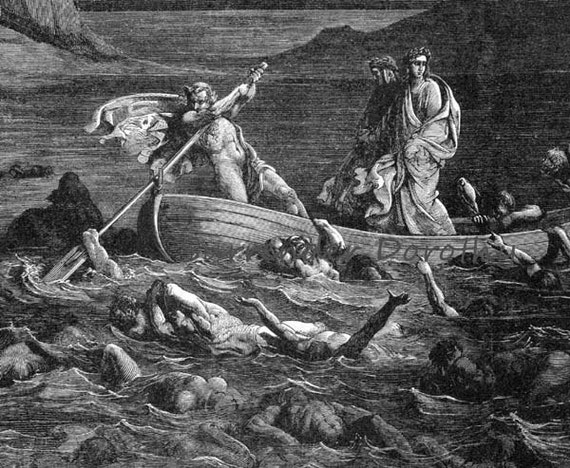
So in Canto VII, to back up a little, Dante and Virgil are walking through the fifth circle of hell, that of anger and sullenness, down the bank to the river Styx.  At the river there is a bog in which the souls of the fifth circle wade in the mud and filthy water.  Here the wrathful fight and tear at each other in everlasting anger.

Which brings us to Canto VIII.  At the bank Virgil and Dante observe a tower at the other side of the river flashing two lights of fire and further back another flashing light responded in a returning signal.  This causes Dante to ask Virgil for its meaning.


And turning to that sea of wisdom, I asked:

'What does this mean? And that other fire,

what does it answer? And who are they who made it?'


And he to me: 'Over the filthy waves

you may already glimpse what is to come,

if the marsh-fumes do not hide it from you.' (7-12)

I am using the wonderful Robert and Jean Hollander (husband and wife team) translation.  As I’ve said before in my Dante posts, this is my preferred translation.

So Dante asks some rather obvious questions, and Virgil doesn’t really answer them, only perhaps to imply he will find out shortly.  What captures my curiosity is the epithet Dante uses for Virgil in verse seven: “the sea of wisdom.”  (The use of an epithet for a proper in name in rhetoric is called antonomasia.)  Here Virgil is associated with wisdom but couched in a metaphor of the sea.  The metaphor is not a function of the translation.  It’s there in the Italian: “al mar di tutto 'l senno.”

Anthony Esolen in his translation annotates that Virgil is punning with mar on Virgil’s last name of “Maro.”  That is possible but I do think it goes beyond that.  Certainly Virgil is associated with wisdom, but “sea” brings in the naval term that runs throughout the Divine Comedy.  In fact we will see a boat speed to them in the very next set of triplets from where I quoted.  In addition to the naval metaphor, I think the “sea of wisdom” is a contrasting epithet to the Ulysses character we will see in Canto XXVI.  There we will hear of Ulysses’ tale of taking his crew on a voyage of exploration that leads to their destruction.  He who had the reputation of wisdom—Ulysses—was unwise in his pride.    

What comes next is the arrival of the bark that will take them across the river, but Dante (the author—I will need to distinguish between Dante the author and Dante the character) frames it in a fascinating simile.


Never did a bowstring loose an arrow

that whipped away more swiftly through the air

than, even as I watched, a skiff came skimming


straight toward us on the water,

under the guidance of a single helmsman,

crying: 'Now you are caught, damned spirit!'  (13-18)

The boat, racing in, is compared to a flying arrow.  One envisions a speed boat here, and I find that remarkable in itself given there is no such speed boat or any speedy vehicle in Dante’s time.  That’s a remarkable image when you realize that it would be outside of Dante’s experience to envision such speed.  That conceit to archery will appear repeatedly in the Divine Comedy (see Inf XII, XXXI, Pur XXV, XXXI, Par I, VII and elsewhere).  Ships and boats also appear often throughout the Commedia.  They emphasize the pilgrimage as the central objective of our lives, the pilgrimage to God.  Charon’s ferry in Inferno Canto III is one example.  The speed of Phlegyas’ boat in VIII recalls the swift speed of the ship in Purgatorio Canto II that ferries the souls to the Purgatory island.  Even the opening lines of Purgatorio are framed in a ferry conceit: “To run its course through smoother water/the small bark of my wit now hoists its sail,/leaving that cruel sea behind” (Pur I, 1-3).  Both naval and archery imagery are part of the overall web of imagery that underlies the themes of La Commedia.

So Phlegyas thinks he has caught two escaping souls as he comes upon Dante and Virgil, but Virgil sets him straight.


Phlegyas, Phlegyas, this time you shout in vain,'

replied my lord. 'You'll not have us any longer

than it takes to cross this bog.'


Like one who learns of a deceitful plot

that has been hatched against him and begins to fret,

such was Phlegyas in his stifled wrath. (19-24)

Phlegyas is frustrated in his expecting thrill, but I find the metaphor describing his reaction with deeper resonance.  Phlegyas is in wrath as one who learns of a deceit against him.  Well, Dante and Virgil are leaving the circle of anger and crossing over to the city of Dis, where all the various sins of deceit are placed.  Phlegyas in anger is echoing his surroundings, and his “fretting” foreshadows Dante’s fretting when he and Virgil later in the canto are locked out from entering the gates of Dis once they are ferried across.   


The two get in the boat, encounter the soul of Felippo Argenti in the mire of the river, who tries to grasp Dante but is pushed into the filthy water by Virgil, and subsequently torn and beaten by the other damned in the river.  Dante in fighting off the soul of Argenti, curses him.  Virgil for this praises Dante.


Then my master put his arms around my neck,

kissed my face and said: 'Indignant soul,

blessed is she that bore you in her womb! (43-45)

Why does Virgil praise Dante (the character) so here?  Most annotations will explain that Dante (the author) sees it as proper to take satisfaction in the justice done to damned souls—and being in hell the characters know that the soul is truly damned while we on earth can never know for certain.  But I find it fascinating that Virgil quotes Luke 11:27, “Blessed is the womb that bore you” as a woman cries out to Christ in praise.  I haven’t found any good annotation as to why Dante (the author) uses that quote here.  Certainly Dante (the character) is not deserving of the Christ allusion.  The only speculation I could propose—and this is me speculating, I have not found this commentary elsewhere—is that in referencing Mary’s womb, Dante (the author) is alluding to the ark of the covenant, furthering the naval imagery.  Certainly Dante (the character) is in a sort of ark on board Phlegyas’ boat. 

I have mentioned elsewhere how Dante usually structures his cantos in the Divine Comedy in three parts.  He does so here in Canto VII.  The first part (l. 1-27) is the opening scene leading to getting on board Phlegyas’ boat; the second (l. 28-63) is the scene with Filippo Argenti; the third (l. 64-130) is the landing on Dis and being locked out.

The city of Dis is of iron walls, separated by a moat, and heavily guarded by thousands of demons, suggesting an iron and a closed off heart.  It is the contrasting image of the “New Jerusalem,” from the Books of Ezekiel (OT) and Revelation (NT). The towers inside the ramparts appear to Dante (the pilgrim) as “mosques,” which Esolen points out are probably minarets, and glow red from an “eternal fire.”  Where Dante (the author) would have seen mosques and minarets is a mystery to me.  As far as I know his travels were limited to Italy and France. 

Upon being kicked out of the boat by Phlegyas (no one is kind in hell), a small drama ensues.  The angry demons refuse to let a living being into the city.  Virgil signals for Dante to hold back so he can arbitrate the situation, but the demons are immovable.  They will allow Virgil to pass, but they will not yield concerning Dante.


Then they reined in their great disdain

enough to say: 'You come -- alone. Let him be gone,

who has so boldly made his way into this kingdom.


'Let him retrace his reckless path alone --

let him see if he can, for you shall stay,

you who have led him through this gloomy realm.' (88-93)

This is where Dante frets and momentarily loses hope.  He begs Virgil to not leave him, and Virgil reassures him.


But the mentor who had brought me there replied:

'Have no fear. None can prevent our passage,

so great a power granted it to us.


'Wait for me here. Comfort your weary spirit

and feed it with good hope.

I will not forsake you in the nether world.' (103-108)

Two important points can be gleaned from Virgil’s response.  First, God has granted Dante’s passage, so the will of God cannot be resisted.  Second, Dante should not lose hope.  Hope is one of the theological virtues, and a virtue requires strengthening, almost like an exercise.  We see Dante (the character) here in these early cantos as spiritually immature.  He has not built up his virtue.

Finally Virgil leaves Dante while he walks over to the demons to mull the issue.  Dante sees them speaking but is out of hearing distance.  Suddenly the demons slam the gates shut against Virgil, who sullenly returns to Dante.  The remainder of the canto is worth quoting in its entirety.


He had his eyes upon the ground, his brows

shorn of all confidence. Sighing, he muttered:

'Who dares deny me access to the realm of pain?'


To me he said: 'Be not dismayed

at my vexation. In this contest I'll prevail,

whatever they contrive to keep us out.


'This insolence of theirs is nothing new:

they showed it once before, at another gate.

It still stands open without lock or bolt.


'Over it you saw the deadly writing.

Even now, making his unescorted way

down through the circles, one descends

by whom the city shall be opened.' (118-130)

We see Virgil’s virtue in contrast to Dante.  While he assesses the situation as serious, he does not give up hope.  He has hope in divine intervention.

We see the demons then are just being spiteful.  There is no reason why Dante cannot pass.  Their “insolence” is merely a resistance to the Divine Will.  If the Divine Will did not want Dante to enter, the demons would have lured him in.  Anything to be adversarial to God.

We will see in the next canto how a divinely sent angel arrives and with a touch of a wand, the gates opened up.  The Divine Will cannot be overcome.

What are we to make of Canto VIII?  We see the pilgrimage progress, the development of the naval and archery imagery, the justice of hell, the contrast of wrath with reason, the iron heart of Dis, and the testing of the theological virtue of hope.  Canto VIII is rich, but one can say that about all the cantos.

So how does Canto VIII relate to Eliot’s Ash Wednesday?  Well, the opening stanzas of Eliot’s poem are these:


Because I do not hope to turn again

Because I do not hope

Because I do not hope to turn

Desiring this man's gift and that man's scope

I no longer strive to strive towards such things

(Why should the agèd eagle stretch its wings?)

Why should I mourn

The vanished power of the usual reign?


Because I do not hope to know

The infirm glory of the positive hour

Because I do not think

Because I know I shall not know

The one veritable transitory power

Because I cannot drink

There, where trees flower, and springs flow, for there is nothing again  (1-15)

And further down we get these closing stanzas of the poem’s part 1:


Because these wings are no longer wings to fly

But merely vans to beat the air

The air which is now thoroughly small and dry

Smaller and dryer than the will

Teach us to care and not to care Teach us to sit still.


Pray for us sinners now and at the hour of our death

Pray for us now and at the hour of our death.  (34-40)

Wings that are “merely vans to beat the air”—ha!  That’s a reference Inferno’s Canto XXXIV where satan is a winged creature half stuck in ice beating his wings hopelessly in trying to fly.  How did I miss that in the past?  Ash Wednesday is about hope and hopelessness.  I’ve completely misread this poem.  I used to think Eliot was referring to Purgatorio.  The allusion is to Inferno.  Mary Sue is onto something!  I can’t wait to see what she writes.  ;)


Monday, May 3, 2021

Matthew Monday: His Heart of Gold

I must relate something wonderful Matthew did last week.

It was my wife’s birthday and unfortunately I had to take an all-day business trip down to Maryland.  Three hours down, three hours back, and most of the day there.  It made for a long day away. 

The night before I told Matthew to wish his mother a happy birthday in the morning, and he nodded as he climbed into bed.  I would be gone before he got up, and I wondered if he would even remember the next day.

When I got home that night I found an ice cream cake in the freezer, partially eaten, but you could see “Happy Birthday” written on it.  I thought my wife bought for herself—possibly in a tiff since I didn’t do anything special for her.  But the next day she told me what exactly happened.

After school, Matthew made her take him for a ride to the ice cream parlor.  He had her wait in the car while he went inside all alone.  He selected an ice cream cake, had them write “Happy Birthday” on it, and paid for it with his own money.  Mind you, he’s been saving to buy a bicycle, and I only give him a few dollars each week when he helps me with some chores.  The cake came to over $26 after taxes, a few weeks of allowance for him.  He carried the cake out to the car and surprised her.

He made his mother feel so proud. 


I was looking for a picture of him to put here and found he took a picture of himself with my camera.  He never allows me to take his picture any more, but he’ll do this.  Go figure.

Saturday, May 1, 2021

2021 Reads, Update #1

You can find my plans for the year here.  


Here’s my first update of the year.  I finished off Prince Caspian as a read started last year, read five short stories, a novel, In This House of Brede, and a work of spirituality, Dark Night of the Soul.   Caroline Gordon’s short story, “The Presence,” is deceptively deep and I hope to try to write up a post on it. 

I’m currently reading the retired Archbishop Charles Chaput’s new book, Things Worth Dying For, at the Catholic Thought Book Club at Goodreads.  There’s an interesting story with this read.  A month ago I received a private message on Goodreads from the publisher of the book, Henry Holt.  This was shortly before the book was to come out to the public.  Because we're a Catholic book club she offered our book club free copies of the book (I assume so we could write good reviews on it), and I responded if she did we would read it next.  Well she did.  She sent out some two dozen copies to us and we're reading it and discussing it.  I sent the discussion links to the publisher and she passed it onto the Bishop.  Then I got a note from someone on the Bishop's staff that he would love to monitor our discussion.  How cool is that!  If you want to check in on our discussion, you can find the various discussion links at Goodreads here.  Eventually I will post on the book on this blog.

I also started Alice McDermott’s novel Charming Billy, and I’m trying to finish Acts of the Apostles and a couple of other books that have gone unfinished for over a year.  And of course I read the monthly devotional, Magnificat.  As usual, I’m behind in my reading.


Completed First Quarter:

Prince Caspian, a novel from the Chronicles of Narnia series by C. S. Lewis.

Magnificat, January 2021, a monthly Catholic devotional.

“Baptism,” a (Don Camillio) short story by Giovanni Guareschi, translated by Adam Elgar.

Magnificat, February 2021, a monthly Catholic devotional.

In This House of Brede, a novel by Rumer Goddard.

“The Coffee-House of Surat,” a short story by Leo Tolstoy.

“The Presence,” a short story by Caroline Gordon.

Dark Night of the Soul, a non-fiction work of spirituality by St. John of the Cross.

Magnificat, March 2021, a monthly Catholic devotional.

“Nimram,” a short story by John Gardner.

“Screwball,” a short story by William Baer.

Magnificat, April 2021, a monthly Catholic devotional.


Currently Reading:

Things Worth Dying For: Thoughts on a Life Worth Living, a non-fiction work by Charles J. Chaput.

Dominican Life: A Commentary on the Rule of St. Augustine, a non-fiction work by Walter Wagner, O.P.

Catholicism: A Journey to the Heart of the Faith, a non-fiction work by Robert Barron.

Acts of the Apostles, a book of the New Testament, RSV translation.

Charming Billy, a novel by Alice McDermott.


Thursday, April 29, 2021

St. Catherine of Siena, Being One with God’s Will

Today, April 29th is St. Catherine of Siena’s feast day.  She is the patron saint of this blog and one of my personal patron saints.  I try to honor this day every year.

Last year on this date I mentioned acquiring three of the four volumes of her annotated Letters.  Just as last year I want to highlight a particular letter in honor of this day.

Letter T41/G105/DT3, from The Letters of Catherine of Siena, Volume 1, Translated and Annotated by Suzanne Noffke, O.P., Arizona Center for Medieval and Renaissance Studies, Tempe, Arizona, 2000.

To Frate Tommaso dalla Fonte, in San Quirico.  Noffke dates this letter as before 1374 but possibly 1368, making her 21 years old, and a year after she famously exited her self-imposed cell.  Tommaso is her cousin who as a child came to live at Catherine’s household, and so they grew up as siblings.  Tammaso has become a Dominican friar and priest at the time of this letter, and is living away from Siena in San Quirico.  I’m going to take one key paragraph from this letter which is thick with Catherine’s theology.


Dearest Father, I beg you to fulfill my longing to see you united with and transformed in God.  But this is impossible unless we are one with his will.  Oh sweet eternal will, to have taught us how to discover your holy will!  If we were to ask that gentlest most loving young man and most merciful father, this is how he would answer us: “Dearest children, if you wish to discover and experience the effects of my will, dwell within the cell of your soul.”  This cell is a well in which there is earth as well as water.  In the earth we recognize our own poverty: we see that we are not.  For we are not.  We see that our being is from God.  Oh ineffable blazing charity!  I see next as we discover the earth we get to the living water, the very core of the knowledge of God’s true and gentle will which desires nothing else but that we be made holy.  So let us enter into the depths of that well.  For if we dwell there, we will necessarily come to know both ourselves and God’s goodness.  In recognizing that we are nothing we humble ourselves.  And in humbling ourselves we enter that flaming, consumed heart, opened up like a window without shutters, never to be closed.  As we focus there the eye of the free will God has given us, we see and know that his will has become nothing other than our sanctification.

I am always amazed at how a young uneducated girl could reach such heights of theological reasoning.  I am also amazed at how she as a twenty-one year old has the chutzpah to instruct an educated priest.  First she implores the friar to holiness by uniting his will with that of God.  And then she has a rhetorical flourish by switching perspective and offering advice on how to do so by speaking through the voice of God: “Dearest children, if you wish to discover and experience the effects of my will, dwell within the cell of your soul.”  Here she speaks of her concept of the soul as a “cell” from which you can reach God.  Then she uses the metaphor of a well to explain the cell.  It contains earth, which is our poor humanity, but deeper one reaches a spring of water, where we reach God.  Of course there is the Biblical allusion there of the woman at the well in John’s Gospel. 


There are a couple of other concepts in that short paragraph.  She says in recognizing our poverty in the earth that “we see that we are not.”  Noffke annotates this as an early expression of Catherine’s future, more developed thought that “God is, and we are not.”  It is the realization that God creates us and maintains our existence through His will, and that our will has nothing to do with our existence. 

In realizing this poverty of humanity, we humble ourselves before God.  And in this humility we are able to enter into Christ: “we enter that flaming, consumed heart, opened up like a window without shutters, never to be closed.”  Noffke’s note here is that Catherine is alluding to Christ as the door, taken from a Sermon from St. Augustine of Hippo, “the entrance opened for you when his side was pierced with a lance” (Sermones CCCXI, Chapter III).  Catherine could be alluding to St. Augustine, but I find it hard to believe she read it.  The open hole in Christ’s side is an image she could have picked up anywhere.  Nonetheless, this is a remarkable passage of profound theological insight.

So go deep into the well of your soul and find God’s will.  St. Catherine of Siena, pray for us.