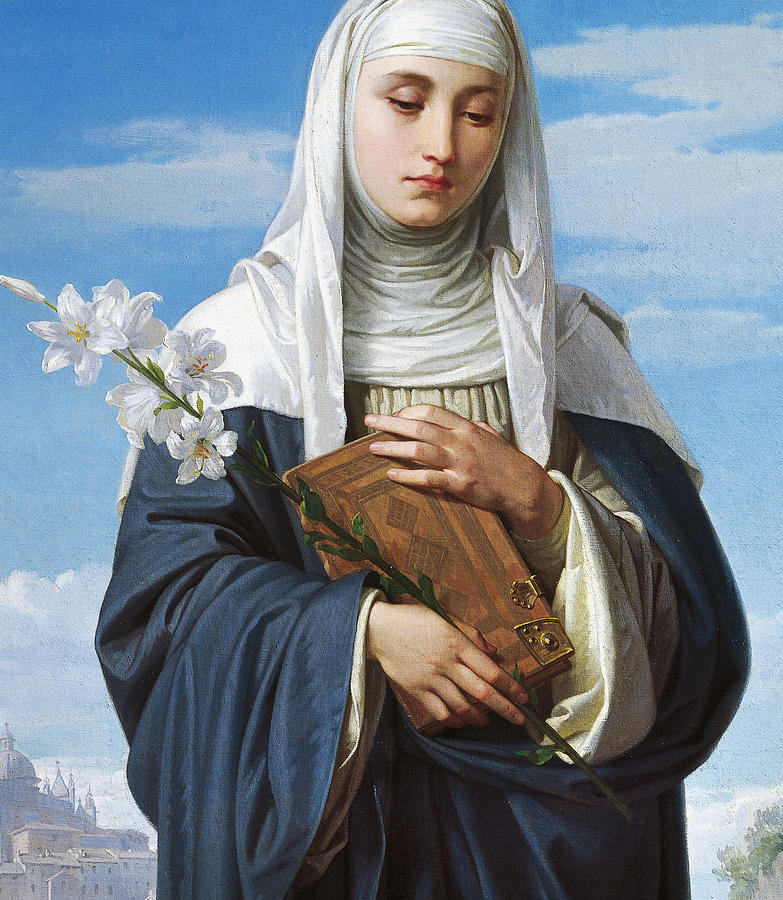
"Love follows knowledge."
"Beauty above all beauty!"
– St. Catherine of Siena

Tuesday, May 7, 2019

Comments to Dante’s Paradiso, Cantos XIX thru XXII

Here are some random thoughts and observations on the Jupiter cantos.

Going back to Canto XVIII, the way the lights scroll across the sky, forming letters which spell words, suddenly coalesce, and then forming shapes is, if you think on it, an incredible feat of imagination for someone in Dante’s time.  This is like a video game playing itself out on a “screen” in front of Dante.  We can easily conceptualize it today, but how could someone in the Middle Ages conceptualize such visuals is stunning.  And then Dante (the author) takes it a step further in the visual “technology.”  A full bodied bird image forms then morphs into a fleur de lily, and then morphs again into the head of the eagle.  Dante is actually visualizing the morphing of shapes.  Amazing!

The eagle, if you missed it, is symbolic for the Roman Empire, and represents human justice.  When the eagle speaks, it is each individual light speaking in unison, and this has particular significance when considering the notion of justice.  What is justice but the application of a society’s values, and each individual member of that society contributes his input to establishing justice.  Think of it as a jury of twelve coming to a single verdict.  The verdict is the single, unified voice of the jury group, each member having contributed to that voice.

Notice the wonderful imagery Dante (the author) uses to describe that amalgamation of voices into one.

Just as from many coals we feel a single heat,
so from that image there came forth
the undivided sound of many loves. (XIX.19-21)

Each single coal individually provides heat, but the amalgamation of each coal’s contribution is felt as a single heat source.  And then in the following tercet, Dante addresses the eagle as an amalgamation of a variety of scents:

And I then answered: 'O everlasting blossoms
of eternal bliss, you make all odors
blend into what seems a single fragrance…(22-24)

In some of the other instances when a holy soul or Beatrice reads Dante’s mind about a question, they articulate the question and then answer it.  In this section, when Dante (the character) has his mind read on the doubt that has formulated, unlike the previous instances the eagle starts answering the question before it is articulated.  I think this might confuse some readers.  In Canto XIX, from lines 22 through 33, Dante (the character) tells the eagle he has something on his mind.  From lines 40 through 69 the eagle starts answering the question which has not been articulated.  In essence what the eagle is saying is that Dante cannot see, does not have the vision to see, the entire creation.  Finally from lines 70 to 78 the eagle articulates the hypothetical about a man born in India who can never know the faith.  Where is the justice in not having the means to salvation?

It is fitting that in the sphere of Jupiter, that of just rulers, the eagle turns judgement back at Dante (the character).  When Dante questions the justice of a pagan incapable of achieving salvation, the eagle says:

            'Now, who are you to sit upon the bench,
             judging from a thousand miles away
             with eyesight that is shorter than a span? (XIX.79-81)

To paraphrase, “Who are you with your limited eyesight to judge God?”  It’s not just questioning God; it’s judging God.

Dante (the author) seems to associate proper justice with eyesight.  Here he contextualizes Dante (the character)’s incorrect judgement of God with limited sight, but when in Canto XX the eagle catalogues six great rulers who were just, their points of light were the ones that made up the eagle’s eye.  Indeed, the eagle was known in the middle ages as the creature with the sharpest eyesight.

How ingenious of Dante to formulate an acrostic (a series of lines or verses in which the first, last, or other particular letters when taken in order spell out a word, phrase, etc.) when cataloguing the bad twelve kings that are living in Dante’s time.  The acrostic spells lue, which means plague.  These kings are a plague. 

Again Dante (the author) shows his contempt for his contemporary world by locating the good kings in the distant past and the bad ones in the present.  When you look over the geographic span of the bad rulers—from England to Spain to France to Italy to Germany to eastern Europe, he’s identifying a good three quarters, if not more) of his known world as ruled by bad kings.  You can’t have more of a condemnation of his existing world than this.

Dante (the character) is taken aback when he hears Trajan and Ripheus are saved.  He had just been told that only baptized Christians and Old Testament worthies can be saved.  How could this be?  The eagle answers:

'For from Hell, where no one may return
to righteous will, the one came back into his bones --
this his reward for living hope,

'the living hope that furnished power to the prayers
addressed to God to raise him from the dead
so that his will might find its moving force. (XX.106-111)

First the eagle alludes to hell where if you recall there was a sign “Abandon hope all who enter here.”  Second the eagle says that through the “living hope” of prayer—and notice “living hope is repeated twice—God’s will can find a way to save all righteous people.  They still must be baptized—God’s word cannot be a lie—but our limited sight cannot envision every formulation of God’s workings.  So never give up hope and never stop praying for anyone you love.

So why Trajan?  Trajan was mentioned in Purgatorio as an example of humility.  It alludes to the story of Trajan and the widow.  Trajan has gathered an army of a million men and are about to set off on campaign when a widow stops the column and asks for justice for her murdered son.  Trajan wants to ignore her but the widow is persistent, and Trajan with pity gets off his horse and stops the march until he can assess justice.  He brings justice to a sorrowful woman, a mater delorosa, over her murdered son.  Well I think you can see the allusion now. 

So why Ripheus?  Who is Ripheus?  Ripheus is a less than minor character from Vergil’s Aeneid, who is briefly mentioned as a righteous king who dies during the sack of Troy.  He is less than obscure.  So who can be saved?  Everyone from Trajan, the greatest emperor of the greatest empire, to an obscure, inconsequential name from a thousand years before the birth of Christ.  Who can be saved?  Everyone within the scope of God’s expansive arms.


###

Some thoughts on the Saturn cantos. 

Saturn is the final planet in the spheres.  After Saturn will come the sphere of the fixed stars, followed by Prima Mobile, the sphere from which God controls the universe, and finally the heart of heaven, the Empyrean. 

Saturn contains those who excelled at mystical contemplation.  But didn’t we encounter a group of souls who were mystics in the second garland under the sphere of the sun?  Yes, led by St. Bonaventure, but the distinction is that those at the sun were intellectual mystics.  The mystics at Saturn were those who lived their lives under total mystical immersion into God.  The distinction is a subtle one perhaps.  The souls at Saturn tend to be monastics, not friars.

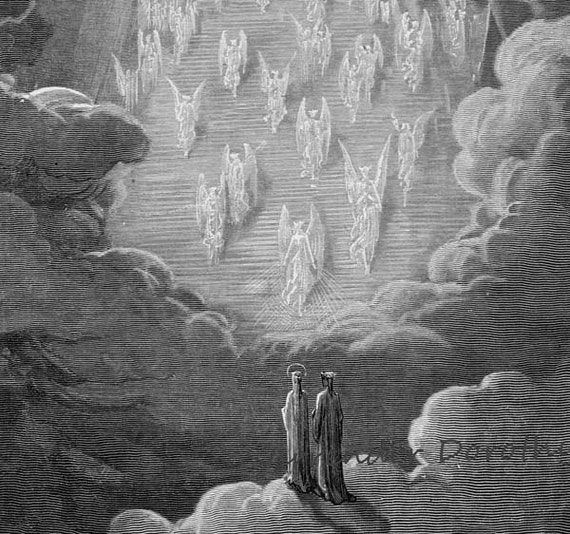
The central image in the realm of Saturn is a ladder stretching all the way up to the Empyrean (if I read correctly) with souls streaming up and down the ladder.  It’s a fantastic image and worthy of quoting the entire passage. 

Within the crystal, circling our earth,
that bears the name of the world's belovèd king,
under whose rule all wickedness lay dead,

the color of gold in a ray of sunlight,
I saw a ladder, rising to so great a height
my eyesight could not rise along with it.

I also saw, descending on its rungs,
so many splendors that I thought that every light
shining in the heavens was pouring down.

And as, following their native instinct,
rooks rise up together at the break of day,
warming their feathers, stiffened by the cold,

and some of them fly off, not to return,
while some turn back to where they had set out,
and some keep wheeling overhead,

just such varied motions did I observe
within that sparkling throng, which came as one,
as soon as it had reached a certain rung. (XXI.25-42)

The image of the ladder comes from Genesis—Jacob’s ladder—where in a dream Jacob sees angels ascending and descending between heaven and earth.  Here Dante (the author) has souls instead of angels traversing up and down, and, since they are already in heaven, Dante has the ladder stretch from Saturn up beyond eyesight toward the end of heaven, possibly to the Empyrean where God and all souls in heaven reside.  The ladder is described as the color of gold and either emits or reflects sunlight.  The souls going up and down also shine bright, so it makes for a stunning image.

The ladder is a perfect image for those immersed in mystic contemplation.  What does a contemplative do but rise up to heaven when in mystical exaltation and return back to earth to share the fruits of his contemplation?  Here at the planet closest to God, we find souls who minimize rational thought and enjoy God’s intense grace.

We see this ever increasing grace through Beatrice’s increasing beauty.  If you’ve notice, at each station Beatrice appears more intensely beautiful, and that’s because the closer the pilgrim’s travel toward God, the more intense the light that shines, which is allegorical for increasing grace.  Beatrice’s “cup” filled with grace, is getting filled higher, which was the image I provided in my comments back in Canto IV to describe a soul’s capacity to receive grace. 

So, to answer that question I had back in Canto IV, a soul may not be able to enlarge his cup, but it can get more filled. 

Two saints are featured at Saturn.  First is Peter Damian, a monastic, who was known for his asceticism and self-mortification.  Perhaps an implication can be drawn that through the self-denial and extreme penance, one climbs the ladder toward heaven.  It’s interesting he doesn’t come to greet Dante out of willingness but because ultimately he serves the Lord.

'I have come down the sacred ladder's rungs this far
only to bid you welcome with my words
and with the light that wraps me in its glow.

'It was not greater love that made me come more swiftly,
for as much and more love burns above,
as that flaming luminescence shows,

'but the profound affection prompting us
to serve the Wisdom governing the world
has brought about the outcome you perceive.' (XXI.64-72)

The mystical ecstasy he feels in God’s bosom overrides his love of neighbor, but he obeys the Will that moves the world.  That’s a pretty amazing statement, and if you think about it, monastics is doing just that—separating themselves from society for love of God.  But just as in his real life where Damian was compelled to leave the monastery to become a bishop for society, here too he leaves the Empyrean to greet the travelers.

The other featured saint is St. Benedict of Nursia, the founder of the Benedictine Order, the first major monastic order in the west, and creator of  rule that balanced work and prayer.  At a time of collapsing civilization the Benedictines preserved civilization through their monasteries and through copying of ancient texts.  It is the fruits of contemplation that Dante wishes to emphasize with Benedict.

'I am he who first brought up the slope
the name of Him who carried down to earth
the truth that so exalts us to the heights.

'And such abundant grace shone down on me
I led the neighboring towns away
from impious worship that misled the world.

'All these other flames spent their lives in contemplation,
kindled by that warmth which brings
both holy flowers and holy fruits to birth. (XXII. 40-48)

He was first to bring Christ up the slope of Monte Cassino and provided the truth to the neighboring towns for their conversion.  His fellow contemplatives brought down both flowers and fruits from up above.  So Peter Damian emphasizes the trip up the ladder to spiritual ecstasy, St. Benedict emphasizes the trip down the ladder to bring graces to earth.

Finally something should be said of the remarkable image of Beatrice and Dante looking down from high above and first seeing the entire solar system below them and then finally the little planet earth.  This is akin to the images of space probes we send out to the far reaches of the solar system to take pictures.  Indeed, the image of the planet earth is equivalent to the famous photos taken by early space missions where for the first time we had a picture of the earth from the outside.  Dante (the author) was over six hundred and fifty years ahead of that.


Sunday, May 5, 2019

Dante's Paradiso Cantos XIX - XXII, Summary

Canto XIX

At Jupiter, the lights that formed the eagle burn bright in front of Dante.  The individual lights speak in unison, so that a voice appears to come as one from the eagle’s beak.  Dante expresses that he has a doubt formulated in his mind of which the eagle must realize.  The eagle articulates Dante’s question: where is the justice of a person in not having the ability to be saved only because he did not have the advantage of being born knowing of Christianity?  The eagle answers using the same line of argument of God to Job: who are you with your limited vision of the totality to judge God’s ways.  God’s will always leads to justice.  The eagle further argues that just because one believes in Christ it does not guarantee salvation.  Indeed, the worst fates are reserved for those that knew Christ but failed to adhere to His teachings.  The eagle then confirms Church teaching that only those baptized in Christ can ultimately be saved.  He goes on to identify twelve kings contemporary to Dante that are judged to be plagues to the world: Emperor Albert, Phillip the Fair, Edward I, Ferdinand IV of Castile, Wenceslaus IV, Charles II, Frederick II, James of Aragon, James II of Aragon, Dionysius, Haakon IV, and Stephan II.  The eagle also identifies two kingdoms run well (Hungary and Novarre) and one poorly, Cyprus.

Canto XX

Still on Jupiter, when the eagle stops speaking, the individual lights stand out as individual points.  In the silence, the murmuring of what appears to be a stream is heard, sounding as if it is a musical instrument projecting from the eagle’s throat.  The murmuring is actually individual voices not speaking in unison, and, when they finally go back to speaking in unison, the eagle describes the single points of light that make up his eye.  Six bright souls, all former kings, form this eye: King David from the Old Testament, Trajan the Roman Emperor, Hezekiah from the Old Testament, the Emperor Constantine, William the Good of Sicily, and Ripheus the Trojan.  These six good kings contrast with the twelve bad ones from the previous canto.  At this, Dante (the character) expresses surprise.  Two of the good kings in heaven are pagans, Trajan and Ripheus.  He had just been told that only baptized Christians (and Old Testament worthies) could be saved.  The eagle goes on to explain that God had found a way to baptize those souls into Christianity, which ultimately came from the power of prayer.  Trajan was baptized through the prayer of Pope Gregory and Ripheus through the prayer of the three ladies of the Christian virtues.  The eagle concludes that only God can know the fates of souls.

Canto XXI

Abruptly the pilgrims are rising toward the next sphere, Saturn, and Dante (the character) turns to look at Beatrice, who is even more beautiful but now not smiling.  She tells him that if he smiled now, he would be burnt to ashes.  Into the crystal planet of Saturn he sees a ladder of great height with many shining lights of souls coming down and still others flying off.  One light of a soul is close by, and his brightness intensifies as Dante gives him attention.  Beatrice encourages a hesitant Dante to ask what is on his mind.  Dante asks two questions.  What has caused the spirit to approach them and why has heaven here at Saturn gone silent?  He answers that he has come down the ladder to bid Dante welcome.  He explains that heaven has not gone silent but that Dante’s mortal ears could withstand the beauty of the music, much like Dante would burn to ash if Beatrice smiled.  Dante then asks a third question, why the spirit was charged to welcome the pilgrims.  In joy to the question, the light spins like a wheel and says that an answer to that question is impossible for anyone but God to reveal.  Dante then withdraws the question and simply asks who the soul is.  The soul says he is Peter Damien, cloistered monk and had lived a life of mystical immersion—Saturn being the sphere of mystical contemplation—until, that is, he was compelled to become a bishop.  Damien then denounces the luxuries of Dante’s contemporary bishops, so bloated, he says, that their horses sag under their weight.  Suddenly a loud cry is heard that freezes Dante in fear.

Canto XXII


Still on Saturn, Dante in fear from the shout turns to Beatrice for guidance.  She comforts him and reminds him he is in heaven where everything is holy.  She explains that the shouts are prayers which his mortal ears cannot comprehend or process, just as her smile cannot be seen or it will turn him into ash.  She then directs his gaze to where one hundred glittering lights are now near them.  The largest of these lights speaks up in response to Dante’s thought on who it might be.  The splendor narrates the key details of his life from which we can deduce—it is never actually said—he is St. Benedict, the founder of the Benedictine Order.  Benedict explains that these flames on Saturn once lived lives of contemplation.  He names a couple of these souls.  Dante asks him if he may see his face unveiled, and Benedict promises him he will when he reaches the highest sphere.  He explains that the ladder on Saturn is a bridge to that highest sphere and goes on say that now on earth his famous rule is but a waste of paper since so few now have the discipline to keep it.  Finally Benedict and the other souls disappear up the ladder.  Dante and Beatrice then ascend to the next sphere, which is not a planet, but rows of fixed stars.  From that height, Beatrice has Dante look back down and see the smallness of the planet Earth.


Thursday, May 2, 2019

2019 Reads, Update #1

My first quarter update is running a month behind, which is not unusual.  I was waiting to complete the major read of this quarter, Dante Alighieri’s Paradiso, the third canticle from his epic Divine Comedy before I posted this.  I just finished it.  You can probably see I’m still posting my summaries and comments.  I’m spreading them out, so they’ll be coming out for the next few weeks.  I’ve actually read Paradiso twice in that I’m reading two translations in parallel, which has been my method for the other canticles.  I’ve been reading the outstanding Hollander and Hollander translation and the equally good Anthony Esolen translation.  The way I would compare the translations is in this way: the Hollander and Hollander has outstanding commentary and bibliography, so that’s more geared for graduate students.  The Esolen is just a fine, clean translation with less commentary, so that’s more geared for undergraduate students. 

I’ve also read seven short stories and two essays.  “Mother” by Sherwood Anderson is an excellent story and well worth reading.  You can find it for free on the internet.  “The Background” (Saki) and “Poldi” (McCullers), “A Sin Confessed” (Guareschi), and "Why Bugsy Siegel Was a Friend of Mine” (Burke) were good stories, and I’d recommend them.  The others were not worth it.  The two essays, one on how to mark up a book you are reading by the great academic, Mortimer J. Adler, and the other by Joshua Wren (published in Dappled Things, Vol 13, Issue 4) on the French Catholic writer Léon Bloy and his contribution to the Catholic literary tradition are both excellent reads.  The Adler essay you can find for free on-line.

I’m also reading the Old Testament’s Book of Jeremiah.  I finished the modern English translation and about half way through the King James Version.

I have to say I am reader who juggles many books at the same time.  For our parish Bible class, we are reading Mike Aquilina’s The Fathers of the Church, and we’re about thirty pages from the end.  I’m about forty pages from the end of The Life of Saint Dominic.  I’m reading the Narnia series with my son, and we are a third of the way into The Horse and His Boy, which I think is excellent.  And our Catholic Thought Book Club at Goodreads has just started reading Thomas à Kempis’ The Imitation of Christ.  We just started the first week of a planned five week read.  You can still join us, and you can find the work for free on-line.  Here’s one site.  

So here’s a listing of the first quarter activity. 


Completed First Quarter:

“The Background,” a short story by Saki (H. H. Munro).
“How to Mark a Book,” an essay by Mortimer J. Adler.
“In the Snow,” a short story by Stefan Zweig, translated by Anathea Bell.
“Poldi,” a short story by Carson McCullers.
“Mother,” a short story by Sherwood Anderson. 
“A Sin Confessed,” a short story by Giovanni Guareschi, translated by Adam Elgar.
“A Fire-Stained Cathedral Gargoyle: Léon Bloy and the Catholic Literary Tradition,” an essay by Joshua Wren.
“Gibberish,” a short story by Thomas Berger. 
Book of Jeremiah, a book of the Old Testament, NIV Translation.
"Why Bugsy Siegel Was a Friend of Mine," a short story by James Lee Burke.
Paradisio, 3rd part of the epic poem, The Divine Comedy by Dante Alighieri, translated and annotated by Robert and Jean Hollander.
Paradisio, 3rd part of the epic poem, The Divine Comedy by Dante Alighieri, translated and annotated by Anthony Esolen.


Currently Reading:
The Fathers of the Church: An Introduction to the First Christian Teachers, 3rd Edition, a non-fiction work by Mike Aquilina.
The Life of Saint Dominic, a biography by Augusta Theodosia Drane.
Book of Jeremiah, a book of the Old Testament, KJV Translation.
The Horse and His Boy, a novel from the The Chronicles of Narnia series by C. S. Lewis.
The Imitation of Christ, a non-fiction devotional by Thomas à Kempis.


Upcoming Plans:
“The Light of the World,” a short story by Ernest Hemingway.
“God Rest You Merry Gentleman,” a short story by Ernest Hemingway.
“The Sea Change,” a short story by Ernest Hemingway.
“A Matter of Chance,” a short story by Vladimir Nabokov.
 “The Manager of ‘The Kremlin,’” a short story by Evelyn Waugh.


I has been a very busy quarter.

Monday, April 29, 2019

Notable Quote: Blood and Fire by St. Catherine of Siena

Today, April 29th is the feast day of St. Catherine of Siena, the patron saint of this blog.  I take this quote from today’s “Meditation of the Day” in Magnificat.  It is put along side the passage John 3:18, where Christ tell Nicodemus that he must be born again by water and spirit.
 
I remember what Jesus once said to one of his servants.  She asked, “Once you were dead, why did you want your side to be opened and to pour out such a torrent of blood?”  And he said, “There are many reasons, but I will tell you two important ones.  First of all, I wanted this because by having my side opened I showed you the secret of my heart.  For my heart held more love for humankind than any external physical act could show.  The other reason was the baptism that was given to the human race because of the merits of my blood.”  You know that he poured out blood and water.  The water was Christian baptism, which gives us the life and form of grace, and which divine eternal Goodness provided through the merits of the blood of the Lamb as a remedy for our poverty and ignorance.
 
And for those who might not be able to have baptism by water, he instituted the baptism of blood and fire.  Their blood would be their baptism, as it was for the holy innocents.  It would have for them because of the blood of God’s Son; I mean the martyr’s blood had and still has worth because of his blood.
 
There is more, but I’ll only quote the first two paragraphs. She is such a brilliant woman, self-educated, self-motivated. I have no idea who she is referring to that's Jesus' servant who asks him the question, or where she gets Christ's response. Magnificat cites from The Letters of Catherine of Siena, Vol 1, Suzanne Noftke, O.P. translator.


Friday, April 26, 2019

Faith Filled Friday: The Exultet

As a short read at the Catholic Thought Book Club, we read “The Exultet,” the long Eucharistic Prayer and Blessing of the Paschal Candle that is prayed at the Easter Vigil Mass.  Here it is in its entirety:

Exult, let them exult, the hosts of heaven,
exult, let Angel ministers of God exult,
let the trumpet of salvation
sound aloud our mighty King's triumph!
Be glad, let earth be glad, as glory floods her,
ablaze with light from her eternal King,
let all corners of the earth be glad,
knowing an end to gloom and darkness.
Rejoice, let Mother Church also rejoice,
arrayed with the lightning of his glory,                 (10)
let this holy building shake with joy,
filled with the mighty voices of the peoples.
(Therefore, dearest friends,
standing in the awesome glory of this holy light,
invoke with me, I ask you,
the mercy of God almighty,
that he, who has been pleased to number me,
though unworthy, among the Levites,
may pour into me his light unshadowed,
that I may sing this candle's perfect praises.)             (20)
(V. The Lord be with you.
R. And with your spirit.)
V. Lift up your hearts.
R. We lift them up to the Lord.
V. Let us give thanks to the Lord our God.
R. It is right and just.
It is truly right and just, with ardent love of mind and heart
and with devoted service of our voice,
to acclaim our God invisible, the almighty Father,
and Jesus Christ, our Lord, his Son, his Only Begotten.  (30)
Who for our sake paid Adam's debt to the eternal Father,
and, pouring out his own dear Blood,
wiped clean the record of our ancient sinfulness.
These, then, are the feasts of Passover,
in which is slain the Lamb, the one true Lamb,
whose Blood anoints the doorposts of believers.
This is the night,
when once you led our forebears, Israel's children,
from slavery in Egypt
and made them pass dry-shod through the Red Sea.  (40)
This is the night
that with a pillar of fire
banished the darkness of sin.
This is the night
that even now, throughout the world,
sets Christian believers apart from worldly vices
and from the gloom of sin,
leading them to grace
and joining them to his holy ones.
This is the night,                                                          (50)
when Christ broke the prison-bars of death
and rose victorious from the underworld.
Our birth would have been no gain,
had we not been redeemed.
O wonder of your humble care for us!
O love, O charity beyond all telling,
to ransom a slave you gave away your Son!
O truly necessary sin of Adam,
destroyed completely by the Death of Christ!
O happy fault                                                            (60)
that earned so great, so glorious a Redeemer!
O truly blessed night,
worthy alone to know the time and hour
when Christ rose from the underworld!
This is the night
of which it is written:
The night shall be as bright as day,
dazzling is the night for me,
and full of gladness.
The sanctifying power of this night                          (70)
dispels wickedness, washes faults away,
restores innocence to the fallen, and joy to mourners,
drives out hatred, fosters concord, and brings down the mighty.
On this, your night of grace, O holy Father,
accept this candle, a solemn offering,
the work of bees and of your servants’ hands,
an evening sacrifice of praise,
this gift from your most holy Church.
But now we know the praises of this pillar,
which glowing fire ignites for God's honor,                (80)
a fire into many flames divided,
yet never dimmed by sharing of its light,
for it is fed by melting wax,
drawn out by mother bees
to build a torch so precious.
O truly blessed night,
when things of heaven are wed to those of earth,
and divine to the human.
Therefore, O Lord,
we pray you that this candle,                                 (90)
hallowed to the honor of your name,
may persevere undimmed,
to overcome the darkness of this night.
Receive it as a pleasing fragrance,
and let it mingle with the lights of heaven.
May this flame be found still burning
by the Morning Star:
the one Morning Star who never sets,
Christ your Son,
who, coming back from death's domain,             (100)
has shed his peaceful light on humanity,
and lives and reigns for ever and ever.
R. Amen.

First, to learn about the Exultet, you can get the history here at New Advent,  and learn its significance from Fr. Michael J. Flynn at the USCCB site, here.   

Allow me to provide a short analysis of the beautiful prayer.  Fr. Flynn speaks about the first section.  Let’s look at all the sections.  I divide the major sections into six. 

The first section is the rejoicing, comprising up through the first twelve lines.  We are here to exult, to “shout aloud” our “mighty King’s triumph” over death, over “gloom and darkness.”   

The next section, lines twelve through twenty I take to be the central theme of the prayer.  We are here to invoke God in His mercy to “pour into me [the deacon or priest performing the ceremony] his light unshadowed” so that he can sing of the “candle’s perfect praises.”  It’s quite interesting that what I take to be the central theme is in parentheses. 

The third section, by far the longest, stretches from line 21 “(V. The Lord be with you.” through line 54, “had we but been redeemed.”  I call this section the Acclamation of Redemption both through the Passover and the Crucifixion.  This section is characterized by the rhetorical repetition called anaphora of “This is the night.”  This is the night when we mystically link back to the Passover, where God’s children were freed from bondage, and back to the Crucifixion, where humanity was freed from the debt of sin, otherwise known as the Redemption. 

The fourth section, from line 55, “O wonder of your humble care for us!” through 73, “drives out hatred, fosters concord, and brings down the mighty” explains what the sanctifying power of redemption has done, that is, “destroyed completely” Adam’s sin “by the death of Christ.”

The fifth section, from line 74, “On this, your night of grace, O holy Father” through line 88, “and divine to the human” is the gift offering of the candle to God on this night “when things of heaven are wed to those of earth.”  How beautiful.

And finally the last section from line 89, “Therefore, O Lord” through the end is the consecration of the candle, so that as Christ has overcome death, the candle’s light will overcome darkness.  The prayer asks to mingle the candle’s light with the lights of heaven. 

Finally, here is the Exultet sung. 


Amen.