"Love follows knowledge."
"Beauty above all beauty!"
– St. Catherine of Siena

Friday, August 15, 2014

Faith Filled Friday: The Feast of the Assumption of the Blessed Virgin Mary

From the Book of Revelations (12:1-6):

1 A great sign appeared in the sky, a woman clothed with the sun, with the moon under her feet, and on her head a crown of twelve stars. 

2 She was with child and wailed aloud in pain as she labored to give birth.   
3 Then another sign appeared in the sky; it was a huge red dragon, with seven heads and ten horns, and on its heads were seven diadems.   

4 Its tail swept away a third of the stars in the sky and hurled them down to the earth. Then the dragon stood before the woman about to give birth, to devour her child when she gave birth. 

5 She gave birth to a son, a male child, destined to rule all the nations with an iron rod. Her child was caught up to God and his throne. 

6 The woman herself fled into the desert where she had a place prepared by God, that there she might be taken care of for twelve hundred and sixty days.

This is the day we celebrate the bodily assumption into heaven of our Blessed Mother.  If you want to read a good piece on why the day is so important, read here from the Catholic news site, aleteia.  

The dignity of the Immaculate Conception is uniquely Mary’s; but the dignity of living body and soul with God, which the Assumption foreshadows, that can be ours. That is, in fact, the great promise Christ offers us; and Mary shows the fulfillment of this promise to us in her Assumption.

And I was directed to this blog, The Jagged Word, of a group of Lutheran pastors, where one of them, Graham Glover, wrote this post, “Protestantism’s Greatest Heresy – Ignoring the Blessed Mother.”  Glover laments the diminution of the Blessed Virgin in Protestant worship. 

Rather, we lump her together with the other saints of the New Testament. But the Blessed Mother is nothing of the sort. She is no ordinary saint. She is the saint of saints. She is the Theotokos – the Mother of God, a title given her at the Council of Ephesus in 431 and echoed in the Lutheran Book of Concord. The Blessed Mother is the example that all Christians should emulate. Her “Yes” to the angel Gabriel is an act of faith that sets the standard for all of the Church to follow.

And he concludes with one of the best homage to our lady that I have come across:

To ignore the Blessed Virgin Mary makes no sense. Without her our Christology is shot. Without her our hermeneutics are insignificant. Without her our understanding of sin and grace is incomplete. Without her we cannot call ourselves part of the Body of Christ. This woman is our Mother, commended to the Church by our Lord Himself. And to ignore her is something no Christian should ever do.

Ave Maria, gratia plena, Dominus tecum!

Hail Mary, full of grace, the Lord is with Thee;
Blessed art thou among women,

And blessed is the fruit of thy womb, Jesus.


Wednesday, August 13, 2014

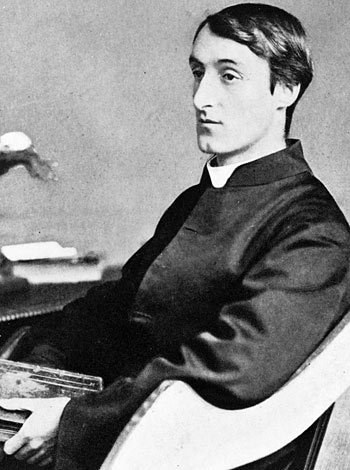
Notable Quote: On Poetic Language

The poetical language of an age should be the current language heightened.
     ~Gerard Manley Hopkins

That’s a great quote.  That’s what I believe poetic language is all about.  Now it could be arguable that Hopkins practiced it himself.  Certainly his language is heightened, but does he actually employ the current language of his day?  His language in many of his poems, though not all, is so heightened that it could be said that he crossed over into a language of another age, of either a passed age or of an age he created.


Monday, August 11, 2014

Matthew Monday: At Myrtle Beach

I mentioned the other day we are having major work done at our house.  It’s been going on five weeks now, and we are seeing progress.  The living and dining rooms are done, except for a few minor things.  We’ve got a working television finally.  The kitchen has progressed but still behind.  There’s a few floor tile that still needs to be mortared in.  They had miscalculated the quantity and fell short.  So that will be put in when the backsplash behind the countertop is mortared on.  The cabinets are all in and the counter top is on.  We have electric power and ceiling spot lights in, and the microwave is operational.  But still need the plumbing completed and the gas line hooked to the oven.

I also mentioned I took the family away for nearly a week to get away from this.  We drove down to Myrtle Beach in South Carolina.  It’s a ten hour drive, but we broke the trip into two five hour legs in both directions. 

I don’t know what’s so special about Myrtle Beach.   It was a nice beach.  It was not as nice as our trip to Ft. Walton Beach Florida earlier in the year.  That was the purest beach I had ever seen.  I would say Myrtle Beach was as nice as the New Jersey Beaches, which are also very nice, but I could have gone to the Jersey Shore with just a couple of hours driving.  I guess what makes Myrtle Beach renown is their golf courses.  I don’t golf, so I guess that allure was wasted on us.  Still we had a nice time.  The first day we got there the weather was brutal, something like 95F (35C) and 100% humidity.  But it rained at night and the weather was more pleasant, though still hot, the remaining three days. 

Here are some pictures of Matthew at the beach.


With his Batman Beach towel;


No we didn’t dig this hole.  We found it and took it over.


The water was so warm.  I would love to live near an ocean beach with water that warm.


And Matthew just loved the water, though he was afraid to go above his belly.


Saturday, August 9, 2014

The Art of the Essay: An Ode to the Greatest Cat

I had to come up with a new category for this: an essay by someone I came across that I thought was noteworthy.  Since this is the first of the category, I ought to define what an essay is.  Its etymology derives from the French “assay,” a word with multiple meanings. But of the ones relevant to this topic, consider “to examine or analyze” and perhaps more importantly, “to attempt.”  It is interesting that the French cognate is a verb while the English is a noun, though its use as a verb is in the dictionary, but I can’t say I have ever come across it personally.  When I do think of an essay, I do think of the original French use of an attempt.  It is an attempt to communicate.  I think of it as a reaching out to a reader, an attempt to bridge the gap between writer and whoever wishes to read.

 But an attempt to communicate what?  It’s no coincidence that when we think of essay we think of a school writing assignment.  The primary English definition of the noun is “a short literary composition on a particular theme or subject, usually in prose and generally analytic, speculative, or interpretative.”  Most of people’s contact with the essay is in high school English composition class.  We are taught to formulate a thesis, provide supporting argument, and finally a coalescing conclusion.  Wikipedia provides a fuller definition:  

Essays are generally scholarly pieces of writing written from an author's personal point of view, but the definition is vague, overlapping with those of an article, a pamphlet and a short story.

Essays can consist of a number of elements, including: literary criticism, political manifestos, learned arguments, observations of daily life, recollections, and reflections of the author. Almost all modern essays are written in prose, but works in verse have been dubbed essays (e.g. Alexander Pope's An Essay on Criticism and An Essay on Man). While brevity usually defines an essay, voluminous works like John Locke's An Essay Concerning Human Understanding and Thomas Malthus's An Essay on the Principle of Population are counterexamples. In some countries (e.g., the United States and Canada), essays have become a major part of formal education. Secondary students are taught structured essay formats to improve their writing skills, and admission essays are often used by universities in selecting applicants and, in the humanities and social sciences, as a way of assessing the performance of students during final exams.

Through the use of literary criticism and learned arguments (i.e., term papers) is where most students perfect their skills of writing.  By the latter part of my graduate school, I started incorporating creative elements into my literary essays.  The essay has an incredible flexibility to it, as long as one keeps focused on the thesis argument, and in my latter essays in Grad School I let go of scholarly inhibition and heightened my papers with all sorts of rhetorical twists.  One of my favorite writers, the one whose work I ultimately wrote my Master’s Thesis, D. H. Lawrence, was a brilliant essayist, and at my best writing I felt I was channeling his creative flares. 

Now if the scholarly essay is what we normally encounter in school, what we enjoy to read when out of school is a subset of the essay, known as the personal essay.  In the personal essay we encounter life, as experienced by the author by means of drawing the reader into the experience, much in the way of fiction author, but with the criteria that this experience actually happened.  In the introduction to The Art of the Personal Essay: An Anthology from the Classical Era to the Present (a must have book for lovers of literature, by the way), editor Phillip Lopate attempts to reach a definition:  

The hallmark of the personal essay is its intimacy.  The writer seems to be speaking directly into your ear, confiding everything from gossip to wisdom.  Through sharing thoughts, memories, desires, complaints, and whimsies, the personal essayist sets up a relationship with the reader, a dialogue—a friendship, if you will, based on identification, understanding, testiness, and companionship.
                        (p. xxiii, Anchor Books/Doubleday, New York, 1994)

Now that I have introduced you to what a personal essay is, here is a wonderful example I just came across that makes for a touching read: “An Ode to Sophie,the World’s Greatest Tabster,” by Lee Cheeks from The Imaginative Conservative.  I’ll just provide the central paragraph:

Guided by the inspiration of Grandpa Cheek and Russell Amos Kirk, even though closed to the prospect of having a feline in our house, some openness emerged after making a professional transition to Lee University in Cleveland, Tennessee, an exemplary liberal arts college. My wife, Kathy, convinced me that we needed a cat. I was adamantly opposed to the prospect initially, but my life experiences allowed me to consider the possibility. In August of 2000, I walked gently into a pet store on Keith Street in Cleveland, Tennessee, and a beautiful tab cat kitten with white paws ran up to me without provocation; her paws glistened in the bright lights of the store, suggesting she had chosen me as her new factotum. Little did I know that this kitten would change my life. In a day or so we brought Sophie to our Georgia Bell Circle home. Sophie was an adorable kitten, not in the typical sense that all kittens are adorable; she seemed to be able to discern your attitude and you intentions, and responded in due course. At the beginning of her first night with us, we placed her in the kitchen, and between the kitchen and the dining room we placed an inflatable bed (vertically) so as to block exit from the kitchen. Sophie cried and obviously wanted to spend the evening with us, but she eventually settled down and we went to sleep. Much to our surprise and excitement, in middle of the night, she was able to make her way into our bedroom, overcoming the “great wall” we had placed in her way! We quickly discerned that Sophie was unstoppable and unflappable, even in the midst of difficult situations. As she overcame her inflatable bed as barricade, she would overcome many challenges during her twelve years on this earth.


All pet lovers will instantly connect, and though I’m a dog person, I have to say this made me want to go out and bring home a cat.  The essay strikes me as a classical example of the personal essay form: an introduction that provides the context and initial conflict, a personal narrative that draws the reader into the experience, a climatic conclusion, and an epilogue that frames the experience into some sort of insight.  Like all personal essays done well, it was a joy to read.

Thursday, August 7, 2014

Personal Note: Crazy Around the House

I have to admit, it’s been slow blogging for me lately.  And slow reading as well.  I mentioned somewhere we are remodeling a good portion of the house. The kitchen was gutted and the living and dining rooms were to get new floors.  Plus we updated all the electric in those three rooms, and of course paint.  The kitchen was gutted the first day, so we've been without a kitchen now for over a month.  Then the floors were pulled up and all the living and dining room furniture had to be squeezed into the kitchen.  All the stuff we had in the kitchen cabinets, the china cabinet, the living room curio cabinets (what’s another word for cabinet?) and television case are all in boxes upstairs in our bedrooms.  So the whole house is in turmoil.  Upstairs is a cluttered mess, downstairs is unlivable, and there is dust and fumes everywhere.  We've been living on garbage food and dining out.  Our routines are disordered, and our nerves have been on edge with some of the problems the workmen have created.


It’s been about five weeks now and hopefully next week the light will be visible at the end of the tunnel.  I took the family on a little driving vacation to get away from this.  It helped.  I had a week’s travel in there for work as well, which made it even harder on my wife.  All this has caused me to slow down my reading and posting.  I’ve put out a few short posts but I owe a number of them.  I owe a concluding post on Dante’s Purgatorio, a second post on Hopkins’ poem “The Windhover,” at least a post on Stephan King’s The Shining, and a few others on what I’ve been reading.  What can I say, it’s what I can do.   It will get done when it gets done.  I’m not even sure where the books are stored.  It’s chaos here.  I just hope when this is all said and done, it will look good.  It better.


Tuesday, August 5, 2014

Music Tuesday: Fanfare for the Common Man by Aaron Copland

The other day I came across this post in American Thinker , “Why Criminals are Afraid of Classical Music.”   I had never heard this, but the author, Enza Ferreri seems to think it’s common knowledge.

Many young people, especially the anti-social, dislike classical music so much that it can be played to discourage them from intimidating, harassing and robbing.

This experiment has been successful over many years in countless locations.

The earliest occurrence was in the mid-1980s, when Canadian outlets of 7-Eleven played easy listening and classical music to disperse teenagers loitering outside. After that, companies from McDonald's to Co-op, transport authorities, housing estates and shopping malls around the world have employed this method.

She goes on to list various places across the globe that have used this concept to discourage bad behavior.  Then she tries to draw some reasons:

The evidence seems plentiful. Why, then?

The simplest explanations, in the time-honored scientific tradition of Occam's razor, should be considered first.

Teenagers, especially those with uneducated ears, don't like classical music, and they think it's not "cool" to be seen by their peers listening to it.

Still other explanations are in the nature of classical music itself. Much of it conveys a sense of order, symmetry and beauty, that conflicts with the disorder and ugliness in the minds of hooligans.

Musicologist Giovanni Bietti explains that Beethoven -- who was convinced that music could make a great social contribution -- Mozart and Haydn had a rational image of music, which is why in their works the initial contrasts are always resolved through the rules of composition, giving order to thoughts. This discourages those who don’t accept the rules.

It’s like the link between criminal behavior and rap, through the rap lyrics and the "music" -- or rather cacophony -- itself.

I don’t know if I’m completely convinced, but nonetheless it’s very interesting.  So in an effort to keep the hooligans away from my blog, here’s one of my favorite classical pieces, a well known 20th century work by the American composer Aaron Copland, "Fanfare for the Common Man."


A thought just occurred to me.  My ear is so attuned to German and Italian classical composers, that it is striking when you hear an American composer.  The “language” of the music seems very American to me.


Saturday, August 2, 2014

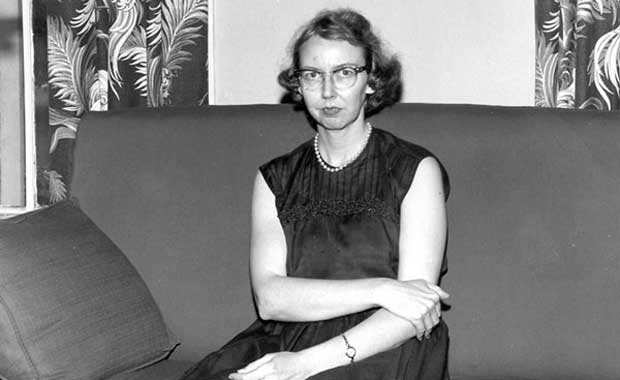
Literature in the News: The Fifty Year Anniversary of Flannery O’Connor’s Passing

This Sunday, August 3rd will be the 50th anniversary of the passing of the great, prematurely taken Flannery O’Connor.  She only lived to thirty-nine years, but she wrote two novels—of which I’ve never read, so I can’t assess their stature—but she left a body of short stories, thirty-one in total, that rivals the best short stories writers ever.

CrisesMagazine has a wonder feature on her life and work by Regis Martin.  

Her life bore such eloquence of pain that when she left it—August 3, 1964—her friend Thomas Merton could recall no other writer of the last century to compare her with. Rather, he said, she summoned the voice of Sophocles: an artist whose vision had likewise reached into the dark places of the human heart, there to reveal with “all the truth and all the craft…man’s fall and his dishonor.”

Flannery O’Connor has been dead a half-century now, and the weight of her reputation remains as fixed as Faulkner’s. A remarkable achievement for someone whose actual published work amounted to a couple of novels and a handful of short stories. But altogether astonishing in light of her last years, the fourteen or so she spent literally dying of lupus. A rare and terrible disease, its cumulative debilities failed utterly to diminish the grace of her spirit. “All my life,” she would say, “death and suffering have been brothers to my imagination.”

Acceptance of her end would appear to have come fairly early. It could hardly have come easy. For all the brave talk of brotherhood, is any bond ever possible with enemies as fearsome as these? Amid the ruinous terms of this world, death remains the ultimate evil, and in every brush with suffering, be it ever so brief, there is always some foreshadowing, some showing of the skull beneath the skin. Yet she steeled herself to submit to both suffering and death, cheerfully acquiescing to whatever losses each in turn would exact. Always she sought passive diminishment, that condition of suffering whose meaning she’d first learned from Teilhard de Chardin, which taught her to endure every affliction she hadn’t the capacity to escape. All this she set about doing because, not unlike the sufferings of Christ, the terrible diminishment of his cross, such sufferings bring to those who have borne them well a triumph and consummation equal to his own. It is nothing less than the Christian life itself, pressed to the point of sheer anagogical extremity, without, however, any correlative loss of freedom or hope. Instead, there accrues such enlargement of soul that grace alone may account for it. Of which the outpouring exists in complete, scandalous disproportion to the data of one’s own crushing debility.

It is a wonderful article and if you have any interest or curiosity in her work you should read it.  The article summarizes her vision:

How does one disabuse the godless? By telling tales that render most truthfully the consequences of their belief that he is. Here she would flesh out what clearly must be among the more ludicrous aspects of our fall from grace, to wit, our persisting and sentimental refusal ever to acknowledge that we had.

How incisive she was in cutting through the sentimental syrup, straight to the bone and marrow of real meaning. “The stories are hard,” she would allow, “but they are hard because there is nothing harder or less sentimental than Christian realism. I believe that there are many rough beasts now slouching toward Bethlehem to be born and that I have reported the progress of a few of them.”

It is a superb gloss on the stories, the Yeatsian echo of which intimating all that is most deeply abiding in her work. In short, to see all that was there, her faith the pure light by which she was enabled to see. “The Catholic novel,” she wrote, “is not necessarily about a Christianized or Catholicized world, but one in which the truth as Christians know it has been used as a light to see the world by.”

I want to provide a short excerpt of what might be my favorite O’Connor short story, “Parker’s Back.”  O.E. Parker is a sailor with a penchant for tattoos, and he has gotten a preacher’s daughter, Sarah Ruth, pregnant, and has married her.  Sarah Ruth turns out to be a hard woman, difficult to satisfy, petulant, indignant, and even nasty.  Parker wants to do something that will shake her up, something that will both startle her and get her to admire him.  He wants her to love him, despite being anti Christian and she being a religious woman, of the sort of hard southern Baptist type.  It is not a smooth marriage to say the least.  What Parker decides to do is fill in the only place on his body not covered in ink, his back, and he chooses an image of a Byzantine Christ, one whose eyes penetrate his very soul.  He thinks it will penetrate her soul too.  He returns home in the wee hours of the morning after not returning home for several days, sobering from a night of drinking.  He knocks on the door and she has locked him out.  One of the keys to the scene here is that he has been embarrassed to say what his initials stand for.

A sharp voice next to the door said, “Who’s there?”

“Me,” Parker said, “O.E.”

He waited a moment.

“Me,” he said impatiently, “O.E.”

Still no sound from inside.

He tried once more.  “O.E.,” he said, bamming the door two or three more times.  “O.E. Parker.  You know me.”

There was a silence.  Then the voice said slowly, “I don’t know no O.E.”

“Quit fooling,” Parker pleaded.  “You ain’t got any business doing me this way.  It’s me, old O.E., I’m back.  You ain’t afraid of me.” 

“Who’s there?” the same unfeeling voice said.

Parker turned his head as if he expected someone behind him to give him the answer.  The sky had lighted slightly and there were two or three streaks of yellow floating above the horizon.  Then as he stood there, a tree of light burst over the skyline.

Parker fell against the door as if he had been pinned there by a lance.

“Who’s there?” the voice from inside said and there was a quality about it now that seemed final.  The knob rattled and the voice said peremptorily, “Who’s there, I ast you?”

Parker bent down and put his mouth near the stuffed keyhole.  “Obadiah,” he whispered and all at once he felt the light pouring through him, turning his spider web soul into a perfect arabesque of colors, a garden of trees and birds and beasts.

“Obadiah Elihue!” he whispered. 

The door opened and he stumbled in.  Sarah Ruth loomed there, hands on her hips.  She began at once, “That was no hefty blonde woman you was working for and you’ll have to pay her every penny on her tractor you busted up.  She don’t keep insurance on it.  She came here and her and me had us a long talk and I…”

Trembling, Parker set about lighting the kerosene lamp.

“What’s the matter with you, wasting that kerosene this near daylight?” she demanded.  “I ain’t got to look at you.”

A yellow glow enveloped them.  Parker put the match down and began to unbutton his shirt.

“And you ain’t going to have none of me this near morning,” she said.

“Shut your mouth,” he said quietly.  “Look at this and then I don’t want to hear no more out of you.”  He removed the shirt and turned his back to her.

“Another picture,” Sarah Ruth growled.  “I might have known you was off after putting some more trash on yourself.”

Parker’s knees went hollow under him.  He wheeled around and cried, “Look at it!  Don’t just say that!  Look at it!”

“I done looked,” she said.

“Don’t you know who it is?” he cried in anguish.

“No, who is it?” Sarah Ruth said.  “It ain’t anybody I know.”

“It’s him,” Parker said.

“Him who?”

“God!” Parker cried.

“God?  God don’t look like that!”

“What do you know how he looks?” Parker moaned.  “You ain’t seen him.”

“He don’t look,” Sarah Ruth said.  “He’s a spirit.  No man shall see his face.”

“Aw listen,” Parker groaned, “this is just a picture of him.”

“Idolatry!”  Sarah Ruth screamed.  “Idolatry!  Enflaming yourself with idols under every green tree!  I can put up with lies and vanity but I don’t want no idolator in this house!” and she grabbed up the broom and began to thrash him across the shoulders with it.

Parker was too stunned to resist.  He sat there and let her beat him until she had nearly knocked him senseless and large welts had formed on the face of the tattooed Christ.  Then he staggered up and made for the door.

She stamped the broom two or three times on the floor and went to the window and shook it out to get the taint of him off it.  Still gripping it, she looked toward the pecan tree and her eyes hardened still more.  There he was—who called himself Obadiah Elihue—leaning against the tree, crying like a baby.


It’s a great story by a great writer.  We lost so many more great stories by her early death.  May she be smiling down at us.

By the way, I've promised to read and post on O'Connor's story, "Greenleaf."  I should get to that in a few weeks to a month or so.  So stay tuned.