Yes,
I know.It’s supposed to be Music
Tuesday, but today is Ash Wednesday, the beginning of Lent, and I wanted to
commemorate it with a perfect music piece for the day.It’s Gregorio Allegri’s Miserere mei, Deus, a polyphonic choral piece composed around
1638.Wikipedia explains it better than
I can.
Miserere (full title: Miserere mei, Deus,
Latin for "Have mercy on me, O God") is a setting of Psalm 51 by
Italian composer Gregorio Allegri. It was composed during the reign of Pope
Urban VIII, probably during the 1630s, for the exclusive use of the Sistine
Chapel during the Tenebrae services of Holy Week, and its mystique was
increased by unwritten performance traditions and ornamentation. It is written
for two choirs, of five and four voices respectively, singing alternately and
joining to sing the ending in 9-part polyphony.
You
can read the history of the piece in that Wikipedia entry.It’s interesting.
So
this is the penitential 51st psalm set to song, and one that should
be prayed repeatedly during Lent.This
rendition, conducted and arranged by Edward Higginbottom is just stunningly
beautiful.
The
lyrics are listed but I’ll present them here.First in Latin.
Miserere mei, Deus:
secundum magnam misericordiam tuam.
Et secundum multitudinem
miserationum tuarum, dele iniquitatem meam.
Amplius lava me ab
iniquitate mea: et a peccato meo munda me.
Quoniam iniquitatem meam
ego cognosco: et peccatum meum contra me est semper.
Tibi soli peccavi, et
malum coram te feci: ut justificeris in sermonibus tuis, et vincas cum
judicaris.
Ecce enim in
iniquitatibus conceptus sum: et in peccatis concepit me mater mea.
Ecce enim veritatem
dilexisti: incerta et occulta sapientiae tuae manifestasti mihi.
Asperges me hysopo, et
mundabor: lavabis me, et super nivem dealbabor.
Auditui meo dabis gaudium
et laetitiam: et exsultabunt ossa humiliata.
Averte faciem tuam a
peccatis meis: et omnes iniquitates meas dele.
Cor mundum crea in me,
Deus: et spiritum rectum innova in visceribus meis.
Ne proiicias me a facie
tua: et spiritum sanctum tuum ne auferas a me.
Redde mihi laetitiam
salutaris tui: et spiritu principali confirma me.
Docebo iniquos vias tuas:
et impii ad te convertentur.
Libera me de sanguinibus,
Deus, Deus salutis meae: et exsultabit lingua mea justitiam tuam.
Domine, labia mea
aperies: et os meum annuntiabit laudem tuam.
Quoniam si voluisses
sacrificium, dedissem utique: holocaustis non delectaberis.
Sacrificium Deo spiritus
contribulatus: cor contritum, et humiliatum, Deus, non despicies.
Benigne fac, Domine, in
bona voluntate tua Sion: ut aedificentur muri Ierusalem.
Tunc acceptabis
sacrificium justitiae, oblationes, et holocausta: tunc imponent super altare
tuum vitulos.
English translation
(Douay Rheims)
Have mercy on me, O God,
according to thy great mercy.
And according to the
multitude of thy tender mercies blot out my iniquity.
Wash me yet more from my
iniquity, and cleanse me from my sin.
For I know my iniquity,
and my sin is always before me.
To thee only have I
sinned, and have done evil before thee: that thou mayst be justified in thy
words and mayst overcome when thou art judged.
For behold I was
conceived in iniquities; and in sins did my mother conceive me.
For behold thou hast
loved truth: the uncertain and hidden things of thy wisdom thou hast made
manifest to me.
Thou shalt sprinkle me
with hyssop, and I shall be cleansed: thou shalt wash me, and I shall be made
whiter than snow.
To my hearing thou shalt
give joy and gladness: and the bones that have been humbled shall rejoice.
Turn away thy face from
my sins, and blot out all my iniquities.
Create a clean heart in
me, O God: and renew a right spirit within my bowels.
Cast me not away from thy
face; and take not thy holy spirit from me.
Restore unto me the joy
of thy salvation, and strengthen me with a perfect spirit.
I will teach the unjust
thy ways: and the wicked shall be converted to thee.
Deliver me from blood, O
God, thou God of my salvation: and my tongue shall extol thy justice.
O Lord, thou wilt open my
lips: and my mouth shall declare thy praise.
For if thou hadst desired
sacrifice, I would indeed have given it: with burnt offerings thou wilt not be
delighted.
A sacrifice to God is an
afflicted spirit: a contrite and humbled heart, O God, thou wilt not despise.
Deal favourably, O Lord,
in thy good will with Sion; that the walls of Jerusalem may be built up.
Then shalt thou accept
the sacrifice of justice, oblations and whole burnt offerings: then shall they
lay calves upon thy altar.
Perhaps
you can visit this choral several times during Lent.The lyrics are part of the video.You can pray it as you listen.
It’s
well into 2021 and it’s about time I posted on my annual plans.Since I am locked into my Catholic Thought Book Club at Goodreads, I’m limited in what I can choose to read.We nominate and vote on books, so I can’t predict what will be
selected.On a fair amount of
selections, I have to flow with the spirit.
Here’s
what I do know.We are currently reading
Acts of the Apostles from the New
Testament, and at some point later this year we will pick up on the second part
of St. Augustine’s City of God.We are currently in the process of selecting
our next read, and I’m hoping that Dark
Night of the Soul (both the poem and his commentary) by St. John of the
Cross gets selected.A number of people
have expressed interest in reading it too, so I am hopeful enough to put it in
my plans here.
I
am also currently reading Rumer Godden’s In
This House of Brede, a novel about a middle-aged, career woman who quits
her job and joins a Benedictine monastery.Godden was a Catholic convert.This is one of her best known novels.
Now
that I am finished with Victor Hugo’s Les
Misérables, I can continue to read more novels from the French.I have long wanted to read Stendhal’s The Red and the Black.And so I will begin at some point this year.
As to non-fiction, I really want to read Conservatism: An Introduction to the Great
Tradition by the recently deceased Roger Scruton.I would also love to read the confessional autobiography
and conversion story, From Fire By Water:
My Journey to the Catholic Faith by Sohrab Ahmari.And also my book short reading list is the
recently republished How to Read a Novel
by Caroline Gordon.Another non-fiction book
that caught my eye was Skunk Works: A
Personal Memoir of My Years of Lockheed by Ben R. Rich.It’s another personal memoir which mostly
details his project of the development of the stealth fighter.I am still an engineer with engineering
interests.
The
Biblical texts are nicely laid out for me.I need to wrap up the Old Testament with the late prophets: Hosea, Joel,
Amos, Obadiah, Jonah, Micah, Nahum, Habakkuk, Zephaniah, Haggai, Zechariah, and
Malachi.They will be read both in KJV
and RSV translation.With that I will
have completed the entire Bible.Along
with Acts as I mentioned above, I
will be reading Revelation again, and
this time along with Peter S. Williamson’s Revelation:
Catholic Commentary on Sacred Scripture.I read the Biblical text last year and meant to read Williamson’s
commentary but I didn’t get the chance.
There
are still the unfinished reads from last year.Dominican Life: A Commentary on
the Rule of St. Augustine, by Walter Wagner, O.P., Catholicism: A Journey to the Heart of the Faith, by Robert Barron,
Prince Caspian, from the Chronicles
of Narnia series by C. S. Lewis.I have
one more chapter to go with Prince
Caspian and then I’ll push onto the next in the series, The Voyage of the Dawn Treader.
Of
course I’ll read as many short stories as I can, and try to reach that goal of
twenty-four short stories for the year.And I’ll continue to read the monthly devotional, Magnificat.
And
let’s see what Providence also throws in my way to read.
Catherine
continuous her furious letter writing, this time to everyone and for all
occasions, some to her personal friends and some for the cause of Pope Urban
VI.In one letter to Raimondo she
chastises him for being afraid of being killed on the road of a mission he
backed out, and then in another letter she forgives him for his weakness.Her mother Lapa also joins Catherine in Rome.
Chapter
25
Undset
narrates how the schism caused deep factions in Europe, where leaders and
religious took sides.Eventually the
schism turned violent as the King of France sent a military expedition to
Italy, attacking some of the Italian cities and finally Rome.But the Pope’s army with its paid mercenaries
overturned the French force, many thanking Catherine for the victory.Her letter writing continued strongly, even
writing to Queen Joanna again, and this time it may have appeared Joanna
changed her side to Urban, though she probably did it for Machiavellian reasons
rather than what was right.
Chapter
26
As
the year turned 1380, Catherine began to weaken as the Romans began to rebel
against Pope Urban.By now she had
become emaciated.Devils began to attack
her both physically and spiritually.At
times she could not walk; other times she struggled to walk to Mass and the
Vatican.Sensing her life was waning,
she wrote a letter to the Holy Father advising him how to comport himself in
this struggle of the schism.She wrote a
last letter to Raimondo telling him of her final spiritual struggles, and to
take charge of her writings, and finally offering her life for the Church and
glory of God.
Chapter
27
By
the middle of Lent in 1380, Catherine was unable to leave her bed.By the Holy week her old confessor, Fra
Bartolommeo Dominici, came to Rome and spent time with her.She made her confession and he celebrated
Mass in her room.By April, Catherine
had made her spiritual last will and testament, gathered all her sons and
daughters, including her mother, and individually blessed them and gave them
each final advice.She made a final open
confession to them all, received absolution again, and on April 29th
passed away while in prayer.
Chapter
28
At
the hour of Catherine’s death, Raimondo recalls how he, leagues away in Genoa
and not knowing she had passed, hearing her voice assuring his protection from
heaven.Undset also delineates how a
Roman woman, Semia on the day of Catherine’s death had a dream of Catherine
being led into heaven by angels, and how Semia found out about Catherine’s body
lying in protection at the basilica of Santa Maria sopra Minerva and paid her
respects.Catherine was initially buried
at the Basilica.
Chapter
29
Undset
narrates how Catherine’s body was initially buried at the churchyard at Santa
Maria sopra Minerva, then brought into the church itself where her head was
cutoff and sent to Siena in a reliquary with her body entombed in the church
and ultimately moved under the high altar.Undset briefly describes the fates of her closest sons and daughters.We learn of Catherine’s beatification and
then canonization in 1461 by Pope Pius II.
###
My
Reply to Gerri:
Gerri wrote: "The
fasting and staying up all night? Checkmark for a manic state. The sense of
being tormented by demons/the devil - which Catherine regularly said she
suffered? Checkmark for the 13th century, when bipolar disorder was unknown and
a suffering person was believed to be possessed by the devil. And Catherine's
recurring illnesses that sent her to her bed - checkmark for the depressive
side of the illness.."
Very interesting Gerri. I could see some sort of compulsive disorder. Actually
it's likely, but she was never really depressed to be bi-polar. If you remember
she was always a happy upbeat person. But I do see some sort of high compulsive
inner drive that just won't stop. The exhaustion was because she just pushed
her self beyond her breaking point. Plus, she didn't eat. I would imagine there
was no fuel in the tank.
My
Reply to Gerri:
Gerri wrote: "Three
more things. You can tell I've become a Caterinati!"
Welcome to the club! Now you see how this book really alterted me. Because of
having read this book and falling in love with Catherine I ultimately became a
Lay Dominican, And if you're interested, my chosen religious name is Br. John
Catherine of Siena.
###
There
is an interesting passage in chapter 26 of St. Catherine and the ship that is
the church.
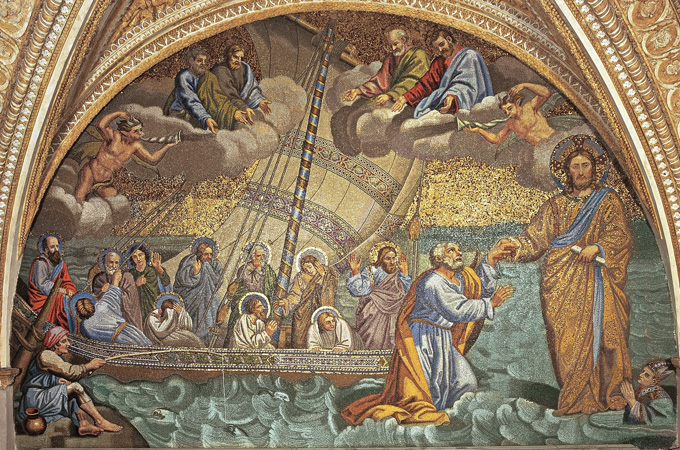
In the entrance to the
old basilica of St. Petyer’s, there was a mosaic of Giotto’s called
“Navicella”—St. Peter’s ship.Catherine
must have seen it hundreds of times, sometimes with deep thoughts, sometimes
without noticing it.But when she
received the vision which assured her that her heavenly Bridegroom had accepted
her prayer to sacrifice her life, the impression of this mosaic may have helped
to decide the pictorial form of her vision.
Sexagesima Sunday fell on
January 29.Catherine was on her knees
in St. Peter’s, where she had remained motionless for hours.But suddenly at vespers her friends saw that
she collapsed, as though an overwhelming burden had been laid on her shoulders
and crushed her body with its weight.When they tried to help her to her feet she was so weak that she could
not stand.Supported by two of her sons
she was more carried than led home.When
they lifted her onto her bed it looked as though she were dying.
Tommaso Caffarini’s
description is repeated by William Flete:As Catherine knelt at the tomb of St. Peter that Sunday at vespers,
while the winter evening began to creep in over the city, she felt how Jesus
Christ laid the whole weight of His Church, la
Navicella, on the thin shoulders of His faithful bride.
And the crushing pain was
sweet too—indescribably sweet.It meant
that He had accepted the sacrifice she had offered Him in love and desire.It meant too that He would soon come and lead
her from “this dark world” to the land of her desire and eternal union with
Him.(304-5)
I’m
struck with how many contemporaneous writings about her took place and have
survived.Raimondo, Fra Dominici,
Cafferini come to mind.It helps that
she was associated with Dominicans since they were the most educated
order.I also want to point out that
image of Giotto’s “Navicella.”It is an
exquisite work of art.You can read about it here and if you click the picture you will get it in full screen and
fully appreciate it.
More
importantly, Catherine takes the image and interprets it as her burden.The crushing weight of the ship—which stands
for the church herself—becomes the means of her martyrdom.Undset goes on to describe Catherine’ last
letter to Pope Urban, written just after this incident, even quoting
extensively from it. I went and looked
up that actual letter and found that Undset did not quote this particular
sentence: “Comfort you, and do not fear on account of any bad reply which this
rebel against your Holiness may have made or may make, for God will care for
this and for everything else, as Ruler and Helper of the ship of Holy Church,
and of your Holiness.”[Saint of Siena
Catherine. Letters of Catherine Benincasa (Kindle Locations 3921-3923).]Notice she calls him “Ruler and Helper of the
ship of Holy Church.”The ship is
clearly on her mind.I also want to
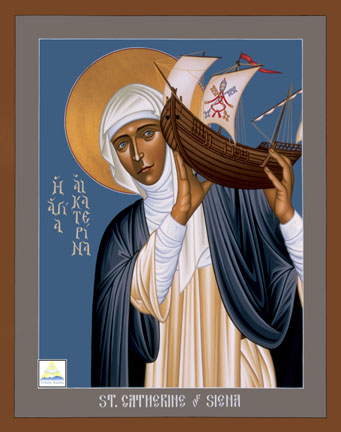
point out that sometimes you may see an image or icon of St. Catherine holding
a ship.This is what the image is
referring to, Catherine holding up the bark of Peter.Here is an example.
###
Some
of Catherine’s last words are interesting.For instance, toward the end when her children are gathered round her
bed in sorrow, she says:
“And I promise you that I
shall be with you always, and be of much more use to you on the other side than
I ever could be here on earth, for then I shall have left the darkness behind
me and move in the eternal light.”(p.
317)
The
first part of that—“I shall be with you always”—is a quote right out of the
Gospel of Matthew, the very last lines in fact.Jesus’ parting words are “And behold, I am with you always, until the
end of the age” (Mat 28:20).So there
she is quoting Jesus.
The
next part is also a famous quote, that is, famous to the Order of
Preachers.Catherine says “[I will] be
of much more use to you on the other side than I ever could be here on earth.”Those words are very similar to that of St.
Dominic himself, the founder of the order.On his death bed, he too had his close friars beside him in
morning.The situation is exactly
parallel to that of Catherine in this scene.St. Dominic’s words are, “Do not weep, my children; I shall be more useful
to you where I am now going, than I have ever been in this life” (p. 225 from The Life of Saint Dominic, Augusta
Theodosia Drane, 1988 by TAN Books, Charlotte, North Carolina, first published
in 1857, London).Every Dominican knows
those words of St. Dominic. It must have
been on Catherine’s mind.
And
the last part, “for then I shall have left the darkness behind me and move in
the eternal light,” that movement from darkness to light is all over the Bible,
but Catherine’s words seem to echo Jesus as He quotes Isaiah, “Land of Zebulun
and land of Naphtali, the
way to the sea, beyond the Jordan, Galilee of the Gentiles, the people who sit
in darkness have seen a great light, on those dwelling in a land overshadowed
by death light has arisen” (Mat 4:15-6).When you live in the words of God, you repeat the words of God,
consciously or unconsciously.
Let’s
closely look at her moment of death as Undset depicts it.
Catherine continued to
pray till the last moment, for the Church, forPope Urban, for her children. She prayed with such intense love that her
disciples thought that not only their hearts, but the very stones must
break.“Beloved, You call me, I come.Not through any service of mine, but through
Your mercy and the power of Your blood…”She made the sign of the cross and cried, “Blood, blood…”Then she bowed her head.“Father, into Your hands I commit my
spirit.”And as she said it, she gave up
the spirit.Her face had become as
beautiful as an angel’s, radiant with tenderness and happiness.
It was about the hour of
terce on April 29, 1380. (320)
Terce,
the Third Hour, is about 9 AM.Her last
words of “Father, into Your hands I commit my spirit” is a little too
neat.I personally don’t believe it.I’ve been reading I Am Going: Reflections on the Last Words of Saints by Mary
Katherine Glavich, SND, and she lists “Blood, blood…” as Catherine’s last
words.Her lifelong obsession with
Christ’s blood makes that perfectly reasonable and fitting to be her last
words.Those are the last words I consider
she said.
###
I
was moved by Undset’s final words on Catherine.
It is certain that
Catherine voluntarily—and few women have ever had such an inflexible will—chose
to suffer ceaselessly for all she believed in, loved and desired: unity with
God, the glory and honor of His name, His kingdom on earth, the eternal
happiness of all mankind, and the re-birth of Christ’s Church to the beauty
which it possesses when the radiance of its soul shines freely through its
outward form—that form which was then stained and spoilt by its own
degenerative servants and rebellious children.As Catherine expressed it: the strength and beauty of its mystical body
can never diminish, for it is God; but the jewels with which its mystical body
are adorned are the good accomplished by its sincere and faithful
children.
Wow,
what beautifully constructed sentences.And the imagery is wonderful too: the good works we do in our love of
God are jewels that adorn His mystical body.Is the imagery Undset’s or is she paraphrasing it from Catherine?It sounds like one of those visual images St.
Catherine would come up with.
###
My Goodreads Review:
This is probably the best biography of a saint I have
ever read, and no wonder.It’s written
by Sigrid Undset, Nobel Prize winning author.Undset was a convert to Catholicism, and even became a Lay Dominican.Many of Undset’s novels are set in the Middle
Ages, so it’s no surprise then she would write a biography of the most
important Lay Dominican to have ever lived and one of the most influential
women of the fourteenth century, St. Catherine of Siena.What is amazing about this biography is that
though it has elements of a hagiography, it is detailed and reads like a work
of realism.I’m even more impressed on
my second read than after the first.
Why is the life of St. Catherine so engaging?St. Catherine of Siena incorporates into her
being every element of sainthood possible.She lived a life of uncompromising holiness.You may be surprised to learn she was not a
consecrated religious, but a Third Order Dominican.Prayer was the foundation of her life, which
then led to an active ministry of taking care of the sick and the poor.She was a mystic who had who supernatural
experiences on an almost daily basis but was involved in the issues and
politics of her day.Though uneducated,
she learned Catholic theology so well she was correcting theologians, and she
went on to write—at some point she learned to read and write either mystically
or through perseverance—one of the great Catholic theological classics, her Dialogue.I marvel at her writings—mostly her
letters—for her intense prose and wonderful imagery.She was a natural poet.She was a little woman from a
non-aristocratic family who became so influential she was offering advice to
kings and queens, and her greatest accomplishment was in persuading Pope
Gregory XI to return the papacy to Rome after almost a century in Avignon.Her greatest disappointment was in not being
able to resolve the Papal Schism of 1378, and here too she offered her life up
in ascetic martyrdom in the hopes of a resolution.Because of her brilliance in articulating the
faith, in 1970, along with St. Teresa of Avila, she was recognized as a Doctor
of the Church, the first women.And
though her asceticism was severe, she was never dour.On the contrary she one of the most affable
and gregarious women of her time.She
attracted a large following known as the Caterinati.Read this bio and perhaps you will be a Caterinati too!
I
wonder if this could count as a miracle.It’s certainly wondrous and remarkable.Every so often I enjoy surfing through the St. Dominic Store. To quote their website it’s a “religious
goods online store associated with the Lay Provincial Council of the Lay
Fraternities of St. Dominic of the Holy Name of Jesus (Western) Province of the
Order of Preachers (Dominicans); and, St. Dominic's Store is affiliated with
the Third Order of St. Dominic.”Simply put it’s a gift shop of the Lay Dominicans
of the western province of the United States.A little over a week ago I came across a twelve inch high statue of St.
Catherine of Siena.My heart leaped, and
it was only $37 dollars!
It
was beautiful, made in Italy of paste marble (whatever that is) and hand
painted.Everyone here knows my love for
everything Santa Catarina.I’ve always
wanted such a statue and never found one to my liking.This looked perfect.Of course I ordered it, along with a couple
of small items, just to make the order worth it.But the statue was the key.
In
the week that it took to get to me, I got antsy and wanted to see the statue
again.I returned to the website.I couldn’t find it.I went through every category, “Statues,” “St.
Catherine,” “Dominican Items,” nothing, not there.Huh?Where did it go?Did I buy the
last one?If so it would say sold out or
something like that.If anyone can find
it there, please send me the link.
So
this got me motivated to look for this statue elsewhere.Did it really exist?I checked Amazon.No not there.I did a search under religious statues, and I could not find it.Finally I did find the very statue at a
website for the gift shop at the Basilica Caterina in Siena, Italy. It was the very one: “STATUE OF SAINT
CATHERINE. CROWN OF THORNS SIZE 41”They
sold it for 58 Euros.I quickly looked
up the conversion of Euros to dollars, and it translates to about $70.So I got it for half the price and didn’t
need to pay shipping costs from Italy.Wow!
This
is all very strange and certainly divinely sent.Thank you God. Thank you St. Catherine.
So
once it arrived I took some pictures to show you.First the entire length.
Next, mid body up.
The
book she is holding indicates she is a Doctor of the Church and the lilies that
she was a life-long virgin.
The
base says “Santa Caterina.”Of course
you realize that’s Italian for “St. Catherine.”
From
the back.
The
halo has a crown of thorns around it.Finally some close ups of her face.
Isn’t
she beautiful?What a wonderful
sacramental this will make.I still can’t
find it on the St. Dominic Store website.This was heaven sent.
I
loved the front page headline from today’s (2/2/21) New York Post: Stuck
at home, locked down—it’s not COVID-19, it’s SNOVID’21.
I
guess you may have heard we had a Nor’easter.New York City was supposed to get 18 to 24 inches.Parts of the city may have gotten that.North of New York City I heard they got anywhere
from 30 to 36 inches.Yikes!Three feet.Here on Staten Island we may have gotten 18 inches but to my eye it
looks a little short of that.We’re on
the southern end of the city.The more
north you were, the more snow you got.I
just love that NY Post headline.They
have the best headlines.
Some
pictures.From my front slider.
From
my back deck.
Also
from my back deck looking out into the convent with the statue of the Blessed
Mother and Child.
Did
I ever mention behind my house is a convent?Unfortunately they have sold the property and will be moving out, but I have
been blessed all these years.
Finally
my car on the street if you can make it out.
The
car is still buried.My back is
hurting.I need a day of rest.
Summaries
for chapters 19 through 23 were written by Gerri Bauer for our Goodreads,
Catholic Thought book club.(I didn’t
have the time to keep up and Gerri did me a favor.Thank you Gerri.)
Chapter
19
Catherine
is called mediate a feud between two branches of the Salimbeni family. While at
their fortress, a possessed women is brought to Catherine for healing - causing
Catherine to cry out because she suffers so much from attacks by demons. But
she is the victor in the struggle for the woman. Also, while at the fortress, Catherine
discovers she can write. She says this occurred while she was in ecstasy. She
also survives an attack by a monk who was in despair and tries to kill her.
Chapter
20
Catherine
heads to Florence as the Pope's ambassador, without any priests accompanying
her because the town is under an interdict. Catherine's friends and enemies
agree that she is well versed in everything concerning the Church, is very
learned, and has a brilliant intuitive understanding of things. A peace
conference starts at the beginning of 1378 but Pope Gregory XI dies on March 27
before peace is secured. A fierce civil war breaks out in Florence. Catherine
faces down a mob that comes to murder her in Soderini's garden. She offers her
life but begs them to spare her companions. The mob leaves but the war
continues. At one point, Catherine flees to nearby woods but soon returns to
town. While in Florence, she writes her first letter to Pope Urban VI, urging
mercy as well as reform of the Church. She also again calls for a crusade after
peace is established in Florence. Peace finally comes in July and Catherine
returns to Siena.
Chapter
21
When
Pope Gregory XI died, Rome was in chaos. Romans formed mobs and stormed the
Vatican, screaming that a Roman must be elected or the cardinals would be
murdered. Terrified cardinals rushed through the election and chose the
Archbishop of Bari, Bartolommeo Prignano, who became Urban VI. As soon as the
crowds were told there was a new Pope, the mob broke down the doors and forced
their way in, again repeating the threat. (A Roman noble, Cardinal Tebaldeschi,
was presented to the mob as the new Pope.) The cardinals in Avignon, supported
by Provencal colleagues, refused to accept any declarations sent out in Urban's
name. On Sept. 20, a schismatic Pope was elected. Catherine, meanwhile, is back
in Siena and dictates so many letters she keeps three secretaries busy. She
writes numerous letters supporting Urban as the lawful Pope. Undset says she
had foreseen the schism.
Chapter
22
Catherine
removes herself to a solitary dwelling outside the gates of Siena and dictates
the book that becomes known as the "Dialogue." She asks her
secretaries to listen when she is in ecstasy and write down all she says.
Catherine calls the manuscript "the book" or "my book."
Undset says a belief in God's mercy is the undercurrent of the conversations
between the Eternal Father and His dear daughter, a much loved child. In the
Dialogue, the Lord repeats for Catherine all he has taught her. The contents
are revealed to Catherine during a series of visions that take place over four
or five days. This Chapter goes into depth about the Dialogue.
Channel
23
Catherine
starts on a journey to Rome and arrives Nov. 28 to find the town under arms.
The Pope can't move into the Vatican and is staying at Santa Maria in
Trastevere. He asks Catherine to make a speech to the cardinals about the
schism. She urges them to show courage. Pope Urban also asks Catherine and
another virgin named Katherine to go as his ambassadors to Queen Joanna of Naples,
who supports the schismatics. Katherine refuses for personal reasons, so
neither woman goes. But Catherine had already written to Joanna from Siena,
with a plea for the lawful Pope. She writes again, but Joanna ignores the
pleas. Catherine and her companions settle in a house near Santa Maria sopra
Minerva. Christmas is approaching, and it will be the first Catherine
celebrates in Rome.
###
My
Comment to Gerri:
Gerri! Thank you so much
for summarizing these chapters. I am behind. Besides what seems a busier than
usual week, the election and the results has had me distracted.
"Distracted from
distraction by distraction," one of my favorite quotes from TS Eliot.
Now let me get to reading
these chapters and I will comment. Bless you.
My
Comment:
Gerri, I just finished
chapter 22 which was on the Dialogue. Undset only gives us a smattering from
the book. I too want to read it, but I'm told is a little chaotic. Remember it
was dictated while Catherine was in ecstasy and so I'm told it can be hard to absorb.
I've read that Catherine intended to edit it but she couldn't bring herself to
do it because she felt it came from the mouth of God. The Dialogue is a
conversation between her and God.
There is a condensed version that cuts the repetitions and makes things flow
logically. Little Talks With God. Perhaps that's a better choice for the book club to
start if we can get it voted in as a read.
My Comment:
On page 285 I was struck
with Undset saying that Catherine "was such a good cook." I've never
seen that anywhere else. She made the candied oranges for the pope. If she
cooked then she had to to taste, no? And if she tasted, she had to have had
some nutrition.
But I'm startled to see
she was a good cook. That is surprising to me.
My
Comment:
On page 282 she chastises
two hermits for not getting personally involved in healing the schism, one of
the two being William Fleete. She says about him, "I sigh from the bottom
of my heart over his stupidity, for he does not seek the glory of God and the
good of his neighbor with noticeable zeal." Apparently she didn't think
his being a hermit was an excuse. She being a Dominican I can see why she would
have a hard time with it. She tells him later, "The glow of your faith
cannot be very ardent if you risk losing it by changing your dwelling. It seems
as though God cares about places, and is only to be found in solitude and no
other place in the day of need."
Now think back when she
was in her cell of self-knowledge and did not want to come out. She only came
out on Christ's insistence. I think she was eighteen at the time. Now, here,
she is around thirty or thirty-one. She has grown much over that time.
Gerri
Replied:
She called things as she
saw them. It's one reason why, after reading this book, I consider her
fearless. She was disappointed when she perceived Raimondo to be shying away
from potential martyrdom, and she told him so. I marvel at her boldness in
expressing strong opinions and in getting away with doing so.
I agree with you about
the Dialogue. Your suggested book is a good one to put up for a future read
vote.
My
Reply to Gerri:
Oh she was so courageous.
And just think about her travels. A woman just didn't do that back then.
###
I
was taken a little by surprised in chapter 23 by how much Catherine was
involved in solving the great schism.We
frequently hear of Catherine’s having convinced Pope Gregory XI to return the papacy
back to Rome, and perhaps rightly so since that was a great achievement, but
her efforts to heal the schism is also a great effort, even though she was not
successful.I didn’t realize (actually I
must have forgotten since I have read this before) how much Pope Urban VI relied
on her to help support the legitimacy of his papacy.I thought she just came to Rome and prayed to
end the schism, but we see a lot more than that in chapter 23, but it hardly
gets mentioned in the Catholic world of today.I guess an achievement is always more historically lasting in people’s
memory than a failed effort, but this effort should be documented.Allow me to pull some short excerpts from the
chapter to highlight and in my small little way hopefully disseminate knowledge
of Catherine’s great participation to end the schism.
Let
me start with Catherine being received by Pope Urban VI in Rome.
Catherine was immediately
received by the Pope, who was overwhelmed with joy at meeting her again.He asked her to make a speech to the
assembled cardinals, first and foremost about the schism, which had now become
a fact.She did so in such a way that
everyone was greatly moved.She
encouraged them to show courage and determination, and brought forward many reasons
for this.She explained how God’s
providence watched over each individual in such a way in these times which
brought great suffering on Holy Church.Therefore, she said finally, they should not let themselves be
frightened by the schism, but persevere and work for God without fear of me.When she finished her talk the Pope seemed
extremely happy.He summed up what she
had said and added to the cardinals: “See, brothers, how guilty we must appear
to God because we are without courage.This little woman puts us to shame.And when I call her a little woman [piccola
donzella] I do not do so out of scorn, but because her sex is by nature
fearful; but see how we tremble while she is strong and calm, and see how
consoles us with her words.(p. 274)
There
is that courage of hers highlighted again; everyone sees it.Can you imagine in the 14th
century a woman being asked to speak in front of an assembly of cardinals, and
then delivering a motivating speech, probably off the cuff?She is amazing.
Pope
Urban had plans to use her across Italy.
A day or two later Urban
suggested that Catherine and another virgin, also called Katherine, should go
as his ambassadors to Queen Joanna of Naples, who now openly supported the
schismatics.This other Katherine was
the daughter of St. Birgitta and had come to Rome to arrange several matters
connected with the convent in Vadstena which her mother had founded.But St. Karin of Vadstena, as the Swedes
called her, blankly refused to visit Queen Joanna…Karin Ulfsdotter was now a
woman of about forty, but she was obviously convinced that there was no misdeed
so terrible that Queen Joanna would not commit it.If she and Catherine of Siena went to Naples
they risked being taken in ambushed on the way and killed.Raimondo agreed with Karin; he considered
Queen Joanna an utterly depraved woman, and was stubbornly set against his
“mamma” meeting her.Only Catherine
scorned her friends’ lack of courage….But Urban thought over what Karin said
and let the idea drop.(275-6)
Still
to be considered for such a diplomatic mission is extraordinary and speaks of
her reputation.It also shows how
dangerous it was for Catherine to do all the travels across Italy and France
that she did.Catherine had already
implored Queen Joanna concerning the schism prior to this and would do so
again.
While she was still in
Siena Catherine had written to Queen Joanna—a passionate plea for the lawful
Pope, Urban, to whom all Christian princes owed their loyalty.From Rome she sent the Queen a letter which
was even more outspoken.She addresses
the letter to her “dear mother in Christ.”(Joanna was by then a woman of fifty-one and married for the fourth
time.)Catherine now writes to this
woman on her favorite theme, self-love opposed to the love for God as He has
revealed Himself in Christ Crucified.“Oh, dear mother, you must love the Truth, you must submit yourself to
the Holy Church—for otherwise I will never again call you mother or turn
towards you with respect.From being a
queen you have been made a servant and the slave of something which is
nothing…”(277)
I
would have loved to have been privy to Queen Joanna’s thoughts as she read from
some commoner woman asking to consider herself a servant and slave.I have not read much other writing from the
time but I can’t imagine anyone else writing such as this.Undset continues on Catherine’s letter.
Catherine begs Joanna at
least to remain neutral until she has discovered the truth.“Oh, I say to you in the deepest sorrow, for
I wish with my whole soul that you may be saved, that if you do not change, and
turn from this error and all others, the Highest Judge will punish you in such
a way that it will fill all who think of rebelling against the Church with
terror, do not wait for Him to strike, for it is hard to withstand God’s
justice.You must die, and you do not
know when.”…Joanna paid no attention to Catherine’s warnings, not to those of
the Pope.(277-8)
Joanna
would ultimately be killed about four years later by the relations of her first
husband, who it was said she had killed.One could read about her in the Wikipedia entry.She probably deserves a little more sympathy
than suggested here when one takes the totality of her life in
perspective.She was living in a world
of dangerous Italian politics and she was a woman, perhaps vulnerable to some
degree.
I
can’t say I have fully grasped the subtleties of the schism.Supporting Pope Urban we have the Dominican
St. Catherine of Siena, and yet across Europe we have another Dominican who
would become a saint, St. Vincent Ferrerwho supported the antipope (that is actually the title) Clement VII.It shows you that elections are very
dangerous if people don’t trust the process.That should be a lesson to us today and the need to show the public that
irregularities are addressed.
Catherine
also wrote a letter to three cardinals who apparently betrayed Urban and join
the antipope.
It is possible that a
letter from Catherine to the three Italian [cardinals] caused them to
hesitate.She begins by telling them
that if they come out of the darkness in which they live she will call them her
fathers, but not if they do not change their opinions.The Sister of Penitence speaks sharply and to
the point to the cardinals, as one who has authority.Even her favorite theme of two kinds of love,
the one life-giving, the other bringing death, is turned into a violent attack
against these men who have been invested with the greatest responsibility and
the highest dignities in the Church, but have become traitors through love of
temporal things.(280)
One
should be respectful of our bishops and even our Pope, but one should also take
Catherine’s example and speak truth to power.She is amazing.She even offers
the pontiff advice.
Catherine had advised
Pope Urban most urgently to collect around himself a lifeguard of the most
worthy, righteous and pure of God’s servants—the same advice she had given his
predecessor.The Pope listened to her
advice, or perhaps he had himself the same idea.Now he wrote to the prior of the Carthusians
at Gorgona and asked him to arrange for Masses to be said and prayers offered
in all the monasteries in Tuscany for the Pope’s cause.He commanded the prior moreover to appear in
Rome before the end of the month, for the Pope wished to consult with him and
other holy and pious monks regarding the problems of the times.Catherine sent her own letters with the
Pope’s bull’s: she wrote to most of her old friends in the various monasteries,
and also to the prior of Gorgona.(282)
This
is not mere tangential praying for the Pope’s cause.It seems like she is working hand in hand
with the Holy Father.Undset in this
narrative clearly delineates the relationship in this way.She continues.
Urban was always loyal to
Catherine.He always thought seriously
over what she suggested and advised, and he did not turn against her or become
sulky, as Gregory XI had dine at times when it seemed as though he had got
himself into a difficult position through following her advice.The obstinate and headstrong old man never
seems to have been offended at anything she wrote to him; he obviously felt
real fatherly love for “this little woman” whom he allowed to lead him, and
honored her as the chosen spokesman of his Lord and Master…Catherine and Urban
looked exactly the same way at the most important questions of their time—the
cleansing of the Church and the re-awakening of faith among all Christian
peoples.(283)
This
is beyond any imagining of Catherine’s involvement in solving the schism.She wasn’t exactly the Pope’s “chief of
staff” but perhaps we can think of her as even more elevated than that.She was almost an equal political figure,
Urban at the head of the earthly faction, Catherine at the head of the
spiritual faction.Unfortunately
Catherine died in 1380, and one wonders that had she lived a normal life span,
she may have helped resolve this crises.Urban the VI would live another ten years after Catherine’s death, and
the schism still fully entrenched.The
schism would last until 1417 and include three more legitimate popes and four
antipopes, and at one time three men claiming to be pope at the same time.In all it was thirty-nine years of
turmoil.Clearly Catherine’s two or
three years involvement were not superficial, and history really should reflect
more of her efforts.