Today Jesus reveals His divine nature again,
only this time to the outside world.Who
is the recipient of such a blessing?A
woman, no less, and a Samaritan, the religious adversaries of the Jews.
Jesus
came to a town of Samaria called Sychar,
near
the plot of land that Jacob had given to his son Joseph.
Jacob’s
well was there.
Jesus,
tired from his journey, sat down there at the well.
It
was about noon.
A
woman of Samaria came to draw water.
Jesus
said to her,
“Give
me a drink.”
His
disciples had gone into the town to buy food.
The
Samaritan woman said to him,
“How
can you, a Jew, ask me, a Samaritan woman, for a drink?”
—For
Jews use nothing in common with Samaritans.—
Jesus
answered and said to her,
“If
you knew the gift of God
and
who is saying to you, ‘Give me a drink, ‘
you
would have asked him
and
he would have given you living water.”
The
woman said to him,
“Sir,
you do not even have a bucket and the cistern is deep;
where
then can you get this living water?
Are
you greater than our father Jacob,
who
gave us this cistern and drank from it himself
with
his children and his flocks?”
Jesus
answered and said to her,
“Everyone
who drinks this water will be thirsty again;
but
whoever drinks the water I shall give will never thirst;
the
water I shall give will become in him
a
spring of water welling up to eternal life.”
The
woman said to him,
“Sir,
give me this water, so that I may not be thirsty
or
have to keep coming here to draw water.”
Jesus
said to her,
“Go
call your husband and come back.”
The
woman answered and said to him,
“I do
not have a husband.”
Jesus
answered her,
“You
are right in saying, ‘I do not have a husband.’
For
you have had five husbands,
and
the one you have now is not your husband.
What
you have said is true.”
The
woman said to him,
“Sir,
I can see that you are a prophet.
Our
ancestors worshiped on this mountain;
but
you people say that the place to worship is in Jerusalem.”
Jesus
said to her,
“Believe
me, woman, the hour is coming
when
you will worship the Father
neither
on this mountain nor in Jerusalem.
You
people worship what you do not understand;
we
worship what we understand,
because
salvation is from the Jews.
But
the hour is coming, and is now here,
when
true worshipers will worship the Father in Spirit and truth;
and
indeed the Father seeks such people to worship him.
God
is Spirit, and those who worship him
must
worship in Spirit and truth.”
The
woman said to him,
“I
know that the Messiah is coming, the one called the Christ;
when
he comes, he will tell us everything.”
Jesus
said to her,
“I am
he, the one speaking with you.”
At
that moment his disciples returned,
and
were amazed that he was talking with a woman,
but
still no one said, “What are you looking for?”
or
“Why are you talking with her?”
The
woman left her water jar
and
went into the town and said to the people,
“Come
see a man who told me everything I have done.
Could
he possibly be the Christ?”
They
went out of the town and came to him.
Meanwhile,
the disciples urged him, “Rabbi, eat.”
But
he said to them,
“I
have food to eat of which you do not know.”
So
the disciples said to one another,
“Could
someone have brought him something to eat?”
Jesus
said to them,
“My
food is to do the will of the one who sent me
and
to finish his work.
Do
you not say, ‘In four months the harvest will be here’?
I
tell you, look up and see the fields ripe for the harvest.
The
reaper is already receiving payment
and
gathering crops for eternal life,
so
that the sower and reaper can rejoice together.
For
here the saying is verified that ‘One sows and another reaps.’
I
sent you to reap what you have not worked for;
others
have done the work,
and
you are sharing the fruits of their work.”
Many
of the Samaritans of that town began to believe in him
because
of the word of the woman who testified,
“He
told me everything I have done.”
When
the Samaritans came to him,
they
invited him to stay with them;
and
he stayed there two days.
Many
more began to believe in him because of his word,
and
they said to the woman,
“We
no longer believe because of your word;
for
we have heard for ourselves,
and
we know that this is truly the savior of the world.”
~Jn
5:4-52
Here is a wonderful dramatization from the
series The Chosen.
Here is an explanation from the producers of The Chosen.
This is one of my favorite stories too.Let us drink the Living Water in Spirit and
Truth!
This
is the second post of George MacDonald’s collect of Christmas poems and short
stories under the book title, My Little
King.
You
can read Post #1, on the poem, “A Christmas Carol,” here.
This
post will focus on the short story, “The Gifts of the Child Christ.”You can read the story online at The Literature Network, here.Or you can hear it being read through Librovox.
The
following summary was put together in collaboration with my co-moderator at the
Catholic Thought Book Club, Kerstin.
Summary
Mr. Greatorex is a
widower of about 30 and remarried. The couple is unhappy. He has a daughter
from his previous marriage, Sophy, who is neglected by the couple and most of
the household. Even her nurse, Alice, is pre-occupied with the prospect of
inheriting a large sum of money.
Sophy is a pious child.
Their preacher has a recurring theme in his Sunday sermons, “the chastening of
the Lord”, which makes a deep impression on her innocent mind. She wishes that
the Lord would chasten her.
Mrs. Greatorex is
pregnant and on Christmas night she gives birth to a stillborn boy. Early in
the morning the household finds Sophy with her lifeless brother on her lap in a
Pietà–like position.
In a parallel sub-plot, Alice,
the Greatorex’s servant, anticipates a
large inheritance from her uncle and leaves the service of the Greatorexes. Her
new found wealth creates a change in her that now she feels above her fiance
John and breaks up with him. In a twist of the plot, her “inheritance” turns
out to be a ruse, and now 'chastened', returns to John and her employers. She
will be at the Greatorex’s home when the stillborn child is found.
###
Celia
Commented:
This story, though sad,
does end up on a positive note. Especially noteworthy is Sophy's attitude about
Christmas: she is looking for the Christ Child, not presents. A very wise 9
year old.
My
Reply to Celia:
I thought Sophy was five
years old. Where did you see nine?
Celia’s
Reply:
I looked again and she is
7.How did I get Sophy's age? From this
excerpt.
"Some six years
before, he had married to please his parents; and a year before, he had married
to please himself."
I assume Sophy is 7,
maybe 6.
Kerstin
Commented:
Now we have to tie in how
the "chastening of the Lord" fits in.
Sophy, who is the most
innocent of all and desires this correction - even though she may not even
understand what is meant here - really has no need of it. It is the family
around her who have fallen into dysfunctional behavior patterns.
Mr. and Mrs. Greatorex
live parallel lives, they are absorbed and closed off to each other with their
own selfishness. It is not a relationship of mutual giving. The repercussions
of this self-isolation is spilling over in how they neglect Sophy.
Alice is so self-absorbed
and blinded by the promise of monetary riches and social status that she no
longer recognizes the intangible riches of marrying a good man.
It is a household barren
of love. Letty's child dies because there is no love, the self-giving necessary
to nurture life. It is fitting that all this happens during Christmas night,
for during this night Love is born. The coming of the Savior marks a
demarcation line of what was before and what comes after. Only now can Love
break in and heal this family from their self-destruction. But there is a real
cost too. The sins of this previous life truly happened, and the pain and
suffering they brought need to be transformed and redeemed. Sophy's Pietà–like
posture points to this.
###
My
Comment:
I think everyone has
mentioned all the bright spots of the story. Let me mention a couple of
negatives.
(1) The baby was
relatively a surprise. You have to search to find that Letty might even be
pregnant. There is no detail of of Letty's pregnancy. The most I could find is
that she wanted to give her husband a son.
(2) Where is any detail
of the birth? If the baby was still born, who cleaned it up? Where were the
post birth fluids? Was the baby still born or just died in infancy? I cannot
tell. At first I thought Sophy had smothered it by accident. But that couldn't
be it.
(3) Once the dead baby
has been found, where is the horror and shock? For a moment Alice runs to her
boyfriend crying, but once the baby is taken away, they have a conversation
about her inheritance as if nothing has happened. There was a dead baby in the
room moments before and they are talking about inheritance?
(4) Where is Letty's
reaction to the dead baby? She's in her room crying and when her husband comes
in and sooths her, it's all alright, just like that? It's all ok after an hour
or two?
I found the ending of the
story bizarre and lacking and really unclear in detail.
My
Comment:
This is not a criticism,
but something I can't understand how it fits. The name "Greatorex" is
unusual, definitely not an English/Scottish name, and almost certainly
contrived to have some significance. But what? "Rex" is Latin for
king. So "Great king"? Why? Ironic? Alluding to the king who will be
born at Christmas?
Kerstin
Replied:
I was wondering about
this too. If it is a play on words, were they making themselves greater than
God?
Keith
Replied:
Hello everyone. Just
joining in this read. I wonder if the almost casual nature of the response to
the baby’s death reflects how much more common it was in the 19th century for
babies to die at birth or to be born dead.
And perhaps the reticence
about Letty’s pregnancy and the specifics of the birth reflects how one did not
speak of such things in those days. I wonder how MacDonald speaks of pregnancy
in his other works? This is the first I’ve read of his.
My
Reply to Keith:
Well, that could be about
infant mortality being more common then. It's still rather bizarre to me. I
thought about the reticence of bodily things in Victorian times, but still
there has to be some detail, even if it's oblique or a euphemism. I didn't see any.
Kerstin
Replied:
George MacDonald was a
protestant minister. Six of his eleven children died before he did, five in
infancy. Looking at the passage more closely, I think we find that the tragedy
that has befallen the Greatorex household is felt very keenly.
Her mistress was again
taken ill. Doctor and nurse were sent for in hot haste; hansom cabs came and
went throughout the night, like noisy moths to the one lighted house in the
street; there were soft steps within, and doors were gently opened and shut.
The waters of Mara had risen and filled the house.
Towards morning they were
ebbing slowly away. Letty did not know that her husband was watching by her
bedside. The street was quiet now. So was the house. Most of its people had
been up throughout the night, but now they had all gone to bed except the
strange nurse and Mr. Greatorex.
The “waters of Mara” are
out of Exodus 15:22 – 27. Israel had just crossed the Red Sea and they couldn’t
find any fresh water for three days. Then at Marah the water they found was
bitter. Moses threw a piece of wood into the water and it was made fresh. This
reference not only points at the Passion, but is also about suffering at its
most dire, the lack of life-giving water.
My
Reply to Kerstin:
Yes, I remember reading
that. Did anyone realize she was pregnant then? I think she was ill frequently
in the story but it went unexplained.
That's an interesting
detail from MacDonald's bio. Yes, I can see how he might be projecting into the
scene.
By criticizing the
casualness of the baby's death in the story, I don't mean to imply that MacDonald
was not compassionate to babies dying. I'm criticizing the way he rushed to
conclude his story. It felt he was just trying to bring it to a close and
provided a simplified wrapping up of the story.
Kerstin
Replied:
I had a hunch Liddy was
pregnant, though it wasn't confirmed until Sophy finds the baby. Her not
feeling well again - for a young married woman that usually means morning
sickness - and then the activity going on in the house during the night, made
me wonder.
###
My
Comment:
So here’s an interesting
question.The story is titled “The Gifts
of the Christ Child.”Now who is the
“Christ child”?Is it simply the Christ
whose birth they are celebrating?Is it
Sophy?Is it the dead baby?
Certainly it’s Christmas
Day, so baby Jesus does enter the scene metaphysically.But I think you could make the case that both
Sophy and the dead baby are Christ figure types.
The dead baby is probably
most obvious.Sophy’s discovery of the
child is worth quoting.
The room next the foot of
the stair, and opposite her step-mother's, was the spare room, with which she
associated ideas of state and grandeur: where better could she begin than at
the guest-chamber?—There!—Could it be? Yes!—Through the chink of the
scarce-closed door she saw light. Either he was already there or there they
were expecting him. From that moment she felt as if lifted out of the body. Far
exalted above all dread, she peeped modestly in, and then entered. Beyond the
foot of the bed, a candle stood on a little low table, but nobody was to be
seen. There was a stool near the table: she would sit on it by the candle, and
wait for him. But ere she reached it, she caught sight of something upon the
bed that drew her thither. She stood entranced.—Could it be?—It might be.
Perhaps he had left it there while he went into her mamma's room with something
for her.—The loveliest of dolls ever imagined! She drew nearer. The light was
low, and the shadows were many: she could not be sure what it was. But when she
had gone close up to it, she concluded with certainty that it was in very truth
a doll—perhaps intended for her—but beyond doubt the most exquisite of dolls.
She dragged a chair to the bed, got, up, pushed her little arms softly under
it, and drawing it gently to her, slid down with it. When she felt her feet
firm on the floor, filled with the solemn composure of holy awe she carried the
gift of the child Jesus to the candle, that she might the better admire its
beauty and know its preciousness. But the light had no sooner fallen upon it
than a strange undefinable doubt awoke within her. Whatever it was, it was the
very essence of loveliness—the tiny darling with its alabaster face, and its
delicately modelled hands and fingers! A long night-gown covered all the
rest.—Was it possible?—Could it be?—Yes, indeed! it must be—it could be nothing
else than a real baby! What a goose she had been! Of course it was baby Jesus
himself!—for was not this his very own Christmas Day on which he was always
born?—If she had felt awe of his gift before, what a grandeur of adoring love,
what a divine dignity possessed her, holding in her arms the very child
himself! One shudder of bliss passed through her, and in an agony of possession
she clasped the baby to her great heart—then at once became still with the
satisfaction of eternity, with the peace of God. She sat down on the stool,
near the little table, with her back to the candle, that its rays should not
fall on the eyes of the sleeping Jesus and wake him: there she sat, lost in the
very majesty of bliss, at once the mother and the slave of the Lord Jesus.
That is perhaps the best
written passage in the entire story.The
baby is described in Christ allusions: “Through the chink of the scarce-closed
door she saw light.”“…she concluded
with certainty that it was in very truth a doll…”“…filled with the solemn composure of holy
awe she carried the gift of the child Jesus to the candle…”“Of course it was baby Jesus himself!—for was
not this his very own Christmas Day on which he was always born?”“If she had felt awe of his gift before, what
a grandeur of adoring love, what a divine dignity possessed her…”“then at once became still with the
satisfaction of eternity, with the peace of God…” and finally, “there she sat,
lost in the very majesty of bliss, at once the mother and the slave of the Lord
Jesus.”
And then when Sophy
awakes to realize the dead baby, she proclaims Christ’s death.
“Jesus is dead,” she
said, slowly and sadly, but with perfect calmness. “He is dead,” she repeated. “He
came too early, and there was no one up to take care of him, and he’s
dead—dead—dead!”
The thrice pronouncement
of “dead—dead—dead” echoes the thrice incantation of the Agnus Dei.It’s a reference to Christ’s sacrifice and
the redemption of the world.Through the
baby’s death, all the characters are redeemed.
So how is Sophy a Christ
figure?
But she did not read far:
her thoughts went back to a phrase which had haunted her ever since first she
went to church: "Whom the Lord loveth, he chasteneth."
Later she thinks, “I wish
he would chasten me.”To chasten is “to
correct by punishment or suffering.”(Webster’s Dictionary) with the connotation of purifying.And frequently she says, "If the Lord
would but chasten me!"The
frequency of Sophy’s wish to be chastened is a leitmotif, a recurring phrase
that accompanies her and characterizes her.When Alice is struggling because of her humiliation, Sophy turns to her:
"Is the Lord chastening Alice? I wish he would chasten Phosy."Sophy becomes the “suffering servant,” taking
on the sins of the world, or at least those around her.And so when she sits with the lifeless baby
she associates with being chastened:
She sat for a time still as marble waiting for
marble to awake, heedful as tenderest woman not to rouse him before his time,
though her heart was swelling with the eager petition that he would ask his
Father to be as good as chasten her. And as she sat, she began, after her wont,
to model her face to the likeness of his, that she might understand his
stillness—the absolute peace that dwelt on his countenance.
She for a moment becomes
Jesus.Indeed through Sophy her father
is transformed.
And every day, as he
looked in her face and talked to her, it was with more and more respect for
what he found in her, with growing tenderness for her predilections, and
reverence for the divine idea enclosed in her ignorance, for her childish
wisdom, and her calm seeking—until at length he would have been horrified at
the thought of training her up in his way: had she not a way of her own to
go—following—not the dead Jesus, but Him who liveth for evermore?
Her childish wisdom is
divine wisdom.She too is a childChrist.
Today Jesus reveals His divine nature.We have one of the most iconic moments of the
New Testament, the Transfiguration.All
three Synoptic Gospels tell of this moment.In Year A of the lectionary, we have Matthew’s version.
Jesus
took Peter, James, and John his brother,
and
led them up a high mountain by themselves.
And
he was transfigured before them;
his
face shone like the sun
and
his clothes became white as light.
And
behold, Moses and Elijah appeared to them,
conversing
with him.
Then
Peter said to Jesus in reply,
"Lord,
it is good that we are here.
If you
wish, I will make three tents here,
one
for you, one for Moses, and one for Elijah."
While
he was still speaking, behold,
a
bright cloud cast a shadow over them,
then
from the cloud came a voice that said,
"This
is my beloved Son, with whom I am well pleased;
listen
to him."
When
the disciples heard this, they fell prostrate
and
were very much afraid.
But
Jesus came and touched them, saying,
"Rise,
and do not be afraid."
And
when the disciples raised their eyes,
they
saw no one else but Jesus alone.
As
they were coming down from the mountain,
Jesus
charged them,
"Do
not tell the vision to anyone
until
the Son of Man has been raised from the dead."
~Mt
17:1-9
Last year, I posted Dr. Brant Pitre
explaining the transfiguration as told in Luke’s Gospel.Here he is again explaining it as told in
Matthew’s Gospel.
There is a lot there to really sink your teeth
into.But I want to end this with one of
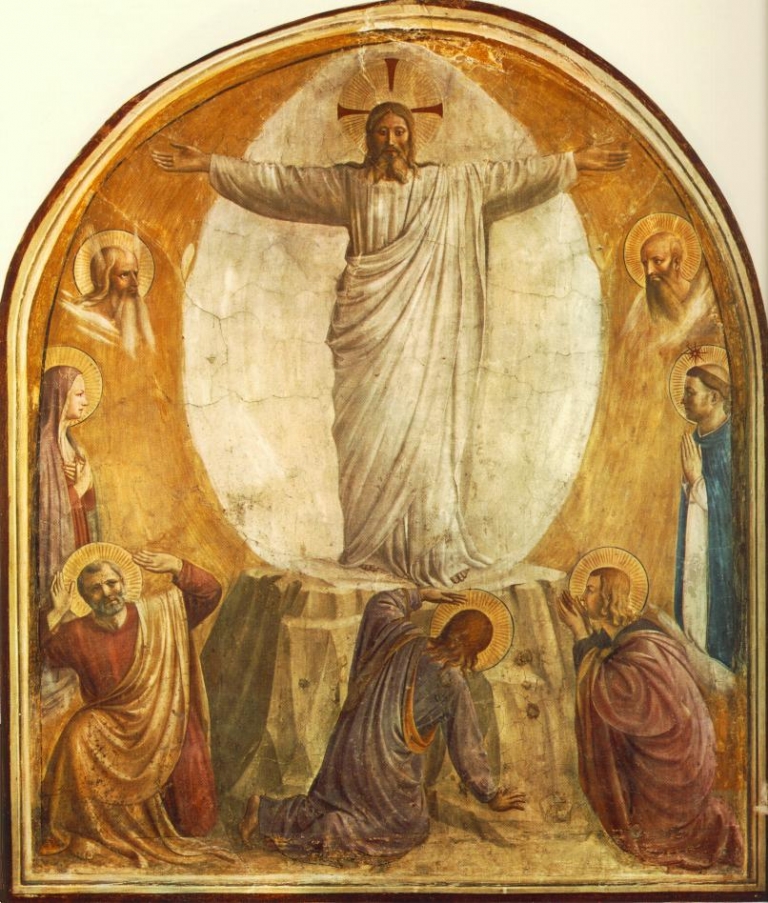
the great representations of the event, Fra Angelico’s The Transfiguration.
Notice how Christ is delineated at about
twice the size of the three apostles fallen to the ground.And the blazing white of Christ’s figure is
almost blinding.Christ’s arms are
spread out projecting the crucifixion and we see the heads of Moses and Elijah
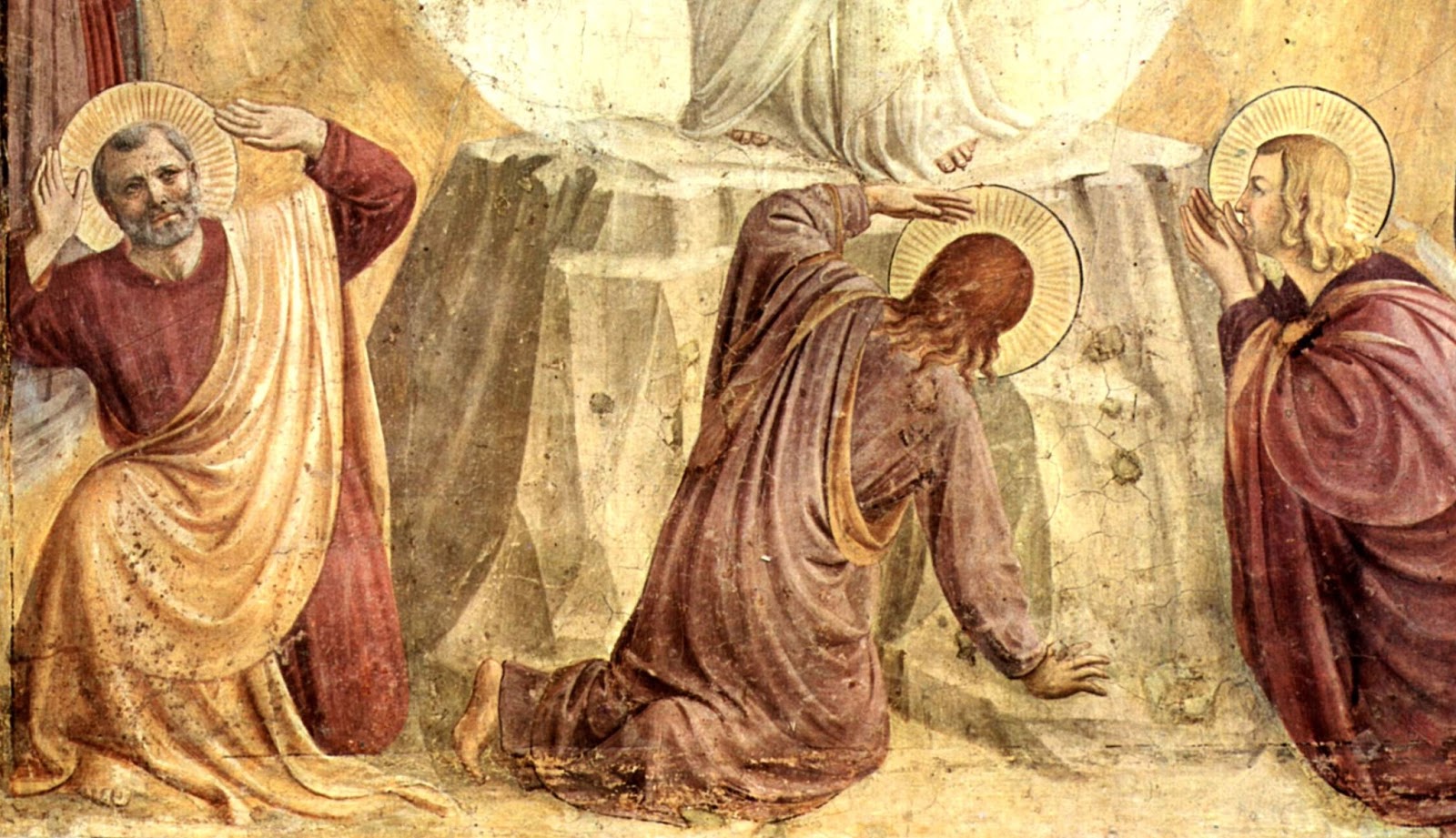
on each side.I love the delineation of
Christ’s face as you can see in this detail.
His expression is emotionless and He is
thickly bearded, depicted I think as one who has taken “the vow of a Nazirite”
(see Numbers, chapter 6).And consider
the detail of the apostles at Jesus’ feet.
The one facing the viewer would have to be
Peter with the sash I think signifying authority.He is turned away from Christ, projecting Peter’s
denial of Jesus.The apostles are not
clothed in white garments.That is
reserved for Jesus, and I would guess that the apostle with the blondish hair
is John since the hair makes him look youngish.
Who are those two figures on the sides
looking in at Jesus?On the right is St.
Dominic.Fra Angelico was a Dominican
friar.On the left is said to be the
Virgin Mary.
Perhaps
you’ve heard of the religious spiritual phenomena—or should I call it a
religious experience?—that occurred at Asbury University from February 8th
to the 21st just a few weeks ago, referred to as the Asbury Revival .You can read about it here. I’m not sure what to make of it.Let me
say up front that I tend to be skeptical of even Catholic supernatural
events.(I’m sorry, but I find it
impossible to believe that Padre Pio bi-located.)Did the Holy Spirit come to the Protestant
college to bring about this awakening?I’m
not going to say no, but my natural skepticism doesn’t let me dive right into
this belief.
It
should be noted that Asbury University is associated with the Methodist and Wesleyan-Holiness
tradition, which believes in personal holiness and sanctification.Wesleyan Protestantism was in many ways antithetical
to the Lutheran and Calvinist notions against works for salvation.John Wesley agreed with Protestant Arminianism,
which denounced the predestination of the Calvinists.On this theological issue Jacobus Arminius
and John Wesley were heading back toward a Catholic notion of sanctification
and salvation.So if these students at
Asbury University were practicing spiritual holiness, I could see how they may
have tapped into something mystical.
Still
I don’t know how much is this self-induced spirituality, which is what I see in
Pentecostal experiences, both Protestant and Catholic Pentecostalism.I’m not saying anyone at these Pentecostal (again
both Protestant and Catholic, and I’ve been to at least one Catholic Pentecostal
Mass with follow-on healing service) events are faking their experiences.I just think there is a psychological state
these people put themselves in that feels like they are receiving direct interaction
with the Holy Spirit.And to clarify, I’m also not saying they aren’t receiving any graces from the Lord in that state.They may well be.The evidence of grace will be the fruits of
their lives.But are they really
responding to the Holy Spirit?
Now
here’s an interesting little detail from the Wikipedia entry on 2023 Asbury Revival.When you look into the background of Asbury
University and revivals, the “University has a history of revivals, dating back
in 1905, 1908, 1921, 1950, 1958, 1970, 1992, and 2006.”What?This is the ninth revival in 120 years at the same college?Is the Holy Spirit then singling out Asbury
University or is the college campus subculture one where there is a
predisposition for revivals from identity to its heritage?Now this doesn’t mean the phenomena is not
legit.The Holy Spirit is more likely going
to come to those who ask, but it does raise questions.
Enough
of my skepticism.There is a Catholic
response to the Revival and it’s not skepticism.I’ve seen positive comments across the
Catholic world, and I can’t say I’ve seen any skeptical.Apparently even a Catholic priest or two partly
participated during the thirteen days it went on.Here is the EWTN news show, In Depth, reporting and interviewing on
the phenomena.Only the first fifteen
minutes concern the Revival.
And
then I found a “Catholic Response” to the Asbury Revival, specifically from Fr.
Ignatius Schweitzer, O.P..Let me say I
happen to tangentially (I haven’t met him in person yet, only through Zoom) know
Fr. Ignatius.He is the Provincial Priest
of the Province of my Lay Dominican chapter.Now in my opinion he strikes me
as a bit different than your typical contemporary Dominican priest.He is much more into the mystical tradition
than the stereotypical Dominican philosopher.The Dominicans do have a mystical tradition, but it mostly goes back to
the 14th and 15th centuries (St. Catherine of Siena,
Meister Eckhart, Henry Susso, and others).If you search on YouTube for Fr. Ignatius, a number of videos will come
up put out by the Dominican House of Prayer with Fr. Ignatius explaining the mystics
and their works.So this spiritual
phenomena is part of his expertise.Here
is Fr. Ignatius’ Catholic Response to the Asbury Revival.
He
reminds me more of a Carmelite than a Dominican, and he brings up Carmelite
saints often.Let me also add, if you
wondered, that he is definitely orthodox and not one of the liberals trying to
change the faith.I was also surprised
to find him interviewed on Edify today.Coincidences again!Edify is a conservative
Catholic podcast associated with Catholic Vote, with a focus on news and cultural
issues.Today’s episode, “Revival
through the Eucharist,” host Mary FioRito interviews Fr. Ignatius.
Now,
I’ve given you my more skeptical view of the Asbury Revival, and I’ve given you
the more endorsing view by Fr. Ignatius.What do you make of it?Any
thoughts?