"Love follows knowledge."
"Beauty above all beauty!"
– St. Catherine of Siena

Wednesday, July 28, 2021

Candor Lucis Aeternae by Pope Francis, Post 2

This is the second of two posts on the Apostolic Letter commemorating the 700th anniversary of Dante’s passing.  You can find Post #1 here.  
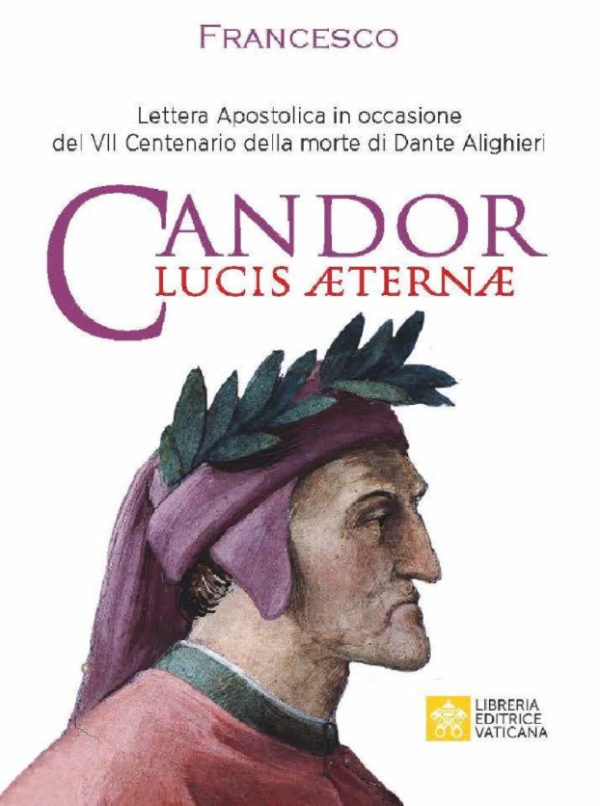
Refresher: After an introduction, the letter divides into nine sections:


1) The Popes of the last century and Dante Alighieri

2) The life of Dante Alighieri: a paradigm of the human condition

3) The poet's mission as a prophet of hope

4) Dante as the poet of human desire

5) The poet of God's mercy and human freedom

6) The image of man in the vision of God

7) The three women of the Comedy: Mary, Beatrice, and Lucy

8) Francis, the spouse of Lady Poverty

9) Accepting the testimony of Dante Alighieri


Under the fourth part, “Dante as the poet of human desire,” Pope Francis quotes Dante from one of his other works, the Convivio.  


“The ultimate desire of every being, and the first bestowed by nature, is the desire to return to its first cause. And since God is the first cause of our souls… the soul desires first and foremost to return to him. Like a pilgrim who travels an unknown road and believes every house he sees is the hostel, and upon finding that it is not, transfers this belief to the next house he sees, and the next, and the next, until at last he arrives at the hostel, so it is with our souls. As soon as it sets out on the new and untravelled road of this life, the soul incessantly seeks its supreme good; consequently, whenever it sees something apparently good, it considers that the supreme good” (IV, XII, 14-15).

Pope Francis expands on this: “Starting from his own personal situation, Dante becomes the interpreter of the universal human desire to follow the journey of life to its ultimate destination, when the fullness of truth and the answers to life’s meaning will be revealed and, in the words of Saint Augustine, our hearts find their rest and peace in God.”  Yes, this is at the heart of the Commedia, at the heart of Dante’s personal life, and, indeed, at the heart of all our lives as Christians as we make our way to our eternal home. 

###

Under “poet of God’s mercy and human freedom,” the Holy Father cites two examples from the Commedia.  First is the good Roman Emperor Trajan, who as a pagan had no knowledge of Christ, and yet is the only pagan in heaven.  It is a reminder that with God, all things are possible.  The second is the King Manfred, who was a horrible human being certainly bound for hell, but in battle after receiving a deadly blow to his skull dies with contrition and the Blessed Mother on his lips.  We find King Manfred in Purgatorio.  God’s mercy can be obtained at the last seconds of breath.

The immense number of characters within the Divine Comedy, each with their lives and decisions laid before the reader, does in itself compile an insight into the human heart.  Pope Francis sees this as portraying humanity in its dignity and showcasing their human freedom.


Dante champions the dignity and freedom of each human being as the basis for decisions in life and for faith itself. Our eternal destiny – so Dante suggests by recounting the stories of so many individuals great and small – depends on our free decisions. Even our ordinary and apparently insignificant actions have a meaning that transcends time: they possess an eternal dimension. The greatest of God’s gifts is the freedom that enables us to reach our ultimate goal, as Beatrice tells us:


“The greatest gift that in his largess God

Creating made, and unto his own goodness

Nearest conformed, and that which he doth prize

Most highly, is the freedom of the will” (Par. V, 19-22).

I should add here that in the English translation of the Apostolic Letter, the quotes from the Divine Comedy are taken from the Longfellow translation.  It is not one of my favorite translations, even though it was the translation of the first time I read it.  It is definitely outdated in language, and frankly I find stilted.  They probably used it for copy write issues.   

###

Pope Francis points out in the section of the three ladies how central the Blessed Mother is to La Commedia. 


In celebrating the mystery of the incarnation, the source of salvation and joy for all humanity, Dante cannot but sing the praises of Mary, the Virgin Mother who, by her fiat, her full and total acceptance of God’s plan, enabled the Word to become flesh. In Dante’s work, we find a splendid treatise of Mariology. With sublime lyricism, particularly in the prayer of Saint Bernard, the poet synthesizes theology’s reflection on the figure of Mary and her participation in the mystery of God.

The Holy Father goes on to note several of the passages where the Blessed Virgin is directly or indirectly essential either narratively or thematically to the work.  It’s a fairly standard reading of Dante’s work, so I won’t quote any more.  I will agree that the prayer by St. Bernard in the final canto is sublime, among the best poetic lines ever written. 

###

Under “Francis, the spouse of Lady Poverty,” Pope Francis makes a rather audacious claim.


Saint Francis and Dante had much in common. Francis, with his followers, left the cloister and went out among the people, in small towns and the streets of the cities, preaching to them and visiting their homes. Dante made the choice, unusual for that age, to compose his great poem on the afterlife in the vernacular, and to populate his tale with characters both famous and obscure, yet equal in dignity to the rulers of this world. Another feature common to the two was their sensitivity to the beauty and worth of creation as the reflection and imprint of its Creator. We can hardly fail to hear in Dante’s paraphrase of the Our Father an echo of Saint Francis’s Canticle of the Sun.

At first I was hesitant to accept the claim, but in time I think he may be right.  While it seems a stretch to say Dante was in love with Lady Poverty—he wasn’t a poor man and though he had his wealth taken from him he didn’t give it up voluntarily from what I know—he did compose the Divine Comedy in the vernacular as St. Francis composed his Canticle of the Sun.  Now you could say this is just one allusion among many allusions to many other writers in the great poem, but it seems to resonate.  I was surprised to learn in my last reading of the Divine Comedy that Dante was a Franciscan Penitent, which was what they called a lay order branch of the Franciscans back then.  And I think the spirit of the poem does exude a Franciscan spirituality, a sort of embracing of creation and making the Gospel come alive.  Of course there is the learned and systemic approach of the Dominicans throughout the poem as well, and one recalls Cantos XI and XII in Paradiso where Dante has a Dominican praise St. Francis and Franciscan praise St. Dominic.  Dante is certainly a bit of both spiritualties, but I now accept he may have been more Franciscan.

###

Finally Pope Francis concludes the Letter by first acknowledging the incredible scope of the Divine Comedy. 


At the conclusion of this brief glance at Dante Alighieri’s work, an almost inexhaustible mine of knowledge, experience and thought in every field of human research, we are invited to reflect on its significance. The wealth of characters, stories, symbols and evocative images that the poet sets before us certainly awakens our admiration, wonder and gratitude. In Dante we can almost glimpse a forerunner of our multimedia culture, in which word and image, symbol and sound, poetry and dance converge to convey a single message.

A great epic has to encompass a great scope of knowledge and vision, and of all the great epics, The Iliad, The Odyssey, The Aeneid, War and Peace, Moby Dick, none I think has as great a scope as the Divine Comedy.  The Holy Father also touches on the Commedia’s ability to transform lives.


If Dante tells his tale admirably, using the language of the people yet elevating it to a universal language, it is because he has an important message to convey, one meant to touch our hearts and minds, to transform and change us even now, in this present life.

Yes, I can attest to that.  The Divine Comedy was one of the means by which my conversion back to the faith occurred.  Christ came to me when I was ready, but Dante’s work was in my heart for Christ and the Church to find form.

Pope Francis ends with an exhortation to use this 700th year of Dante’s passing to disseminate Dante’s work.


It is fitting, then, that the present anniversary serve as an incentive to make Dante’s work better known and appreciated, accessible and attractive, not only to students and scholars but to all those who seek answers to their deepest questions and wish to live their lives to the full, purposefully undertaking their own journey of life and faith, with gratitude for the gift and responsibility of freedom.

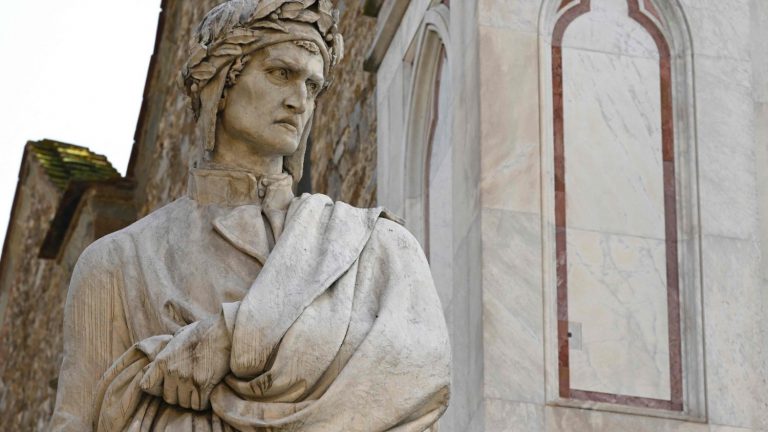
Do yourself a favor, if you haven’t read the Divine Comedy, take this year to read it.  If you’ve read it and don’t have the time to re-read it, take a canto from any of the three canticas, or better yet, take a canto from each of the three canticas, and read that.  Try it in both the Italian and the English.  Learn the nuances of that one canto, and tell people about it.  Spread the word.  The Divine Comedy is the greatest literary work ever composed.  It is the height of human achievement.
###

My Goodreads Review:  

In commemoration of the 700th anniversary of Dante’s death, Pope Francis published this Apostolic Letter highlighting some of the recent history of papal documents on Dante, probing the life of Dante, and journeying through Dante’s great work the Divine Comedy. This was a pleasant read, and while it certainly not ground breaking in any literary way—who would expect that from the Pope?—it really is educational for those with only a passing knowledge of Dante and his work.  If you’re a lover of the Divine Comedy, you will enjoy reading the Holy father’s Letter.  If you’re new to the work, let this be an inspiration to delve into it.

Indeed, Pope Francis ends with an exhortation to use this 700th year of Dante’s passing to make Dante’s work better known.  Do yourself a favor, if you haven’t read the Divine Comedy, take this year to read it.  If you’ve read it and don’t have the time to re-read it, take a canto from any of the three canticas, or better yet, take a canto from each of the three canticas, and read that.  Try it in both the Italian and the English.  Learn the nuances of that one canto, and tell people about it.  Spread the word.  The Divine Comedy is the greatest literary work ever composed.  It is the height of human achievement.


Monday, July 26, 2021

Candor Lucis Aeternae by Pope Francis, Post 1

This is the first of two posts on the Apostolic Letter commemorating the 700th anniversary of Dante’s passing.


The full title of this work is ”Apostolic Letter CANDOR LUCIS AETERNAE of the Holy Father FRANCIS on the Seventh Centenary of the Death of Dante Alighieri.”  Popes have various genres of writing forms they use to communicate with their faithful and with the world at large: encyclicals, motu proprio or rescripts, constitutions, bulls, exhortations, apostolic letters, and more.  Apostolic Letters are not quite as long as an encyclical, but they are not a brief note either.  I posted back in March that Pope Francis had just released an Apostolic Letter on the seventh hundredth anniversary of Dante’s death.  I read it and I want to post my thoughts on it.  Candor Lucis Aeternae is about 18 pages long, about that of a short story, and you can read the letter on line here.   

Candor Lucis Aeternae translates into “Splendor of Light Eternal,” and refers to the day the letter was published, March 25th, the Feast of the Annunciation.  Here is the opening paragraph:


SPLENDOUR OF LIGHT ETERNAL, the Word of God became flesh from the Virgin Mary when, to the message of the angel, she responded: “Behold the handmaid of the Lord” (cf. Lk 1:38). The liturgical feast that celebrates this ineffable mystery held a special place in the life and work of the supreme poet Dante Alighieri, a prophet of hope and a witness to the innate yearning for the infinite present in the human heart. On this Solemnity of the Annunciation of the Lord, I readily add my voice to the great chorus of those who honour his memory in the year marking the seventh centenary of his death.

Is there a particular reason why it’s connected to the Feast of the Annunciation?  Pope Francis identifies “the light of the Word made flesh” is part of “the loving plan that is the heart and inspiration of Dante’s most famous work.”  OK, but one could have easily picked Holy Thursday or any day of the Triduum and it could have been as fitting.  The Divine Comedy is set from Holy Thursday to Wednesday after Easter. 

After an introduction, the letter divides into nine sections:


1) The Popes of the last century and Dante Alighieri

2) The life of Dante Alighieri: a paradigm of the human condition

3) The poet's mission as a prophet of hope

4) Dante as the poet of human desire

5) The poet of God's mercy and human freedom

6) The image of man in the vision of God

7) The three women of the Comedy: Mary, Beatrice, and Lucy

8) Francis, the spouse of Lady Poverty

9) Accepting the testimony of Dante Alighieri

Pope Francis starts by summing up what the various Popes going back a century—to the sixth century of the poet’s death—have had to say about Dante and his great work, then showing how Dante’s life reflects the human condition.  He then provides several sections on the themes within The Divine Comedy, showing hope, human desire and freedom, and God’s mercy, and how the images of God reflect in man.  Pope Francis then highlights the three central women of the work, and Dante’s relationship with St. Francis of Assisi.  He concludes with final reasons why today people should read and appreciate Dante’s great work.

Some interesting highlights from past popes.  I found interesting Pope Benedict XV’s claim in his encyclical (In Praeclara Summorum, 30 April 1921) that Dante can only have come from Catholicism.


The fact that Alighieri is our own… Indeed, who can deny that our Dante nurtured and fanned the flame of his genius and poetic gifts by drawing inspiration from the Catholic faith, to such an extent that he celebrated the sublime mysteries of religion in a poem almost divine?”

That was written obviously in a time when ecumenicalism was not a priority.  But it is true.  Dante could only have written his work through his Catholic worldview.  It is a deeply Catholic work.  Still to claim Dante as “our own” may have dissuaded others from seeing the great beauty and universal themes in his poem.  This is exactly the point Pope Saint Paul VI makes in his Apostolic Letter of 1965, Altissimi Cantus.


“Dante is ours, we may well insist, but we say this not to treat him as a trophy for our own glorification, but to be reminded of our duty, in honouring him, to explore the inestimable treasures of Christian thought and sentiment present in his work. For we are convinced that only by better appreciating the religious spirit of the sovereign poet can we come to understand and savour more fully its marvellous spiritual riches”.

He goes on to say, “Dante’s poem is universal: in its immense scope, it embraces heaven and earth, eternity and time, divine mysteries and human events, sacred doctrine and teachings drawn from the light of reason, the fruits of personal experience and the annals of history”.  Pope Francis captures the full scope of Dante’s genius from another quote from Paul VI’s Letter:


“In Dante all human values – intellectual, moral, emotional, cultural and civic – are acknowledged and exalted. It should be noted, however, that this appreciation and esteem were the fruit of his deepening experience of the divine, as his contemplation was gradually purified of earthly elements”.

Yes, this is what makes Dante’s Commedia the single greatest work in all of literature: it captures all elements of humanity, captures all elements of divinity, expresses it beautifully in craft that can only be described as sublime, and creates an aesthetic structure that reflects all those elements artistically. 

###

Perhaps the most original thought—at least one I had not come across before—in Candor Lucis Aeternae is the relationship Pope Francis draws from Dante’s life exile to the human condition and how it shaped his great work.


Dante, pondering his life of exile, radical uncertainty, fragility, and constant moving from place to place, sublimated and transformed his personal experience, making it a paradigm of the human condition, viewed as a journey – spiritual and physical – that continues until it reaches its goal. Here two fundamental themes of Dante’s entire work come to the fore, namely, that every existential journey begins with an innate desire in the human heart and that this desire attains fulfilment in the happiness bestowed by the vision of the Love who is God.


For all the tragic, sorrowful and distressing events he experienced, the great poet never surrendered or succumbed. He refused to repress his heart’s yearning for fulfilment and happiness or to resign himself to injustice, hypocrisy, the arrogance of the powerful or the selfishness that turns our world into “the threshing-floor that maketh us so proud” (Par. XXII, 151).

So the constant moving from city to city after his exile becomes sublimated into the journey of toward the beatific vision.  From his personal struggles to earn a living and find a stable home, Pope Francis identifies what caused Dante to create his poem:


Reviewing the events of his life above all in the light of faith, Dante discovered his personal vocation and mission. From this, paradoxically, he emerged no longer an apparent failure, a sinner, disillusioned and demoralized, but a prophet of hope. In the Letter to Cangrande della Scala, he described with remarkable clarity the aim of his life’s work, no longer pursued through political or military activity, but by poetry, the art of the word which, by speaking to all, has the power to change the life of each. “We must say briefly that the purpose of our whole work and its individual parts is to remove from their state of misery those who live this life and to lead them to a state of happiness” (XIII, 39 [15]). In this sense, it was meant to inspire a journey of liberation from every form of misery and human depravity (the “forest dark”), while at the same time pointing toward the ultimate goal of that journey: happiness, understood both as the fullness of life in time and history, and as eternal beatitude in God.

Just as the Resurrection is a sign of hope for our eternal life, so too does the Holy Father see the movement from dark forest to the beatific vision as an expression of hope that permeates the Divine Comedy.  I think “prophet of hope” is a fair moniker for Dante.


Saturday, July 24, 2021

Catholics: A Novel by Brian Moore, Post #1

This is the first in a series of posts on the Brian Moore novel, Catholics: A Novel. 


Brian Moore was an Irish born novelist and movie script writer, but after serving in WWII as a young man emigrated to Canada where he established himself as a novelist.  Later he moved to the United States where he wrote for film as well.  He tends to be thought of as a Ca
nadian writer.  He was short listed for the British Booker Prize three times, so he is a writer of some reputation.  Catholics: A Novel was not one short listed.  As you will see, especially in my later posts on this novel, I do not think highly of this work, and of course I don’t recommend it.  I don’t know what his good novels are like, but this novel makes me skeptical about the value of the others.  However, his three short listed novels came after Catholics.

Catholics:A Novel was published in 1972, well beyond his developmental years.  What is important to know about Moore’s biography is that he grew up Catholic in Northern Ireland, and by the time he was an adult he had pretty much lost his faith and considered himself an atheist.  Still, a good deal of the subject matter of his life’s work dealt with Catholicism, as does this novel of course.  This novel was written shortly after the Vatican II Church Council, and it takes the changes of the Council to an absurd level.  The premise is that after a “Vatican IV” Council, almost all the traditions of the Church have been obliterated and those rules are enforced by a militarized church.  So Moore is writing a dystopia set in the future.  One of the changes to the traditions is to the Mass, the Latin Mass now forbidden, and the novel hinges on the changes to the Mass, as well as the loss of the belief that the true Presence of Christ is in the Eucharist. 

We read this novel for the Goodreads Catholic Book club, and it was coincidental (or perhaps providential) that as soon as we completed the read, Pope Francis issued is moto propio, Traditionis Custodes, severely limiting the use of the old Latin Mass.  It was amazing how contemporaneous to real life activity this read became.  And if I may editorialize, Pope Francis’ moto propio was just as dictatorial in tone as the militarized future church in Moore’s dystopia.  Our discussion did not take the moto propio into account because that was published one week after we had moved on from the book. 

###

Summary:

Part One

The novel is set in the future after Vatican IV has removed all mysteries associated with the faith, all rituals now to be regarded as symbols.  Father James Kinsella is sent by Rome to Muck Abbey, a monastery off the west coast of Ireland where a religious order (the fictional Albanesian Order) still practice the Latin Mass as it has been done for centuries. 

The weather has made it impossible for any sea craft to get to the island, so Fr. Kinsella stays on the mainland encountering the people who attend the old Latin Mass and traditional private confessions.  He learns that the Abbot of Muck, which dates back to 1216, is a sixty-nine year old Tomás O’Malley and the Abbey contains thirty monks who live off their fishing and growing of kelp.  No one on the mainland identifies Fr. Kinsella as a Catholic priest because in the new mode, priestly dress is à la secular. 

###

This captures the devotion of the locals who attend the traditional Mass.


The pilgrims rose early on Sunday, went in buses and cars to the foot of Mount Coom, five miles from the village. There, they ascended the mountain, on foot, to kneel on muddied grassy slopes, or on shelves of rock, often in the unyielding Irish rain. Most could see the Mass rock and the priest only from a distance, but all heard the Latin, thundering from loudspeakers rigged up by the townsfolk. Latin. The communion bell. Monks as altar boys saying the Latin responses. Incense. The old way.

And this exchange with the hotelkeeper shows the emotional reaction of learning the locals are not following Rome’s directives.  Fr. Kinsella first asks about confessions:


“But why do the confessions take so long?”


“We still have private confessions. One person at a time in the box.”


Private confessions. This was not known in Rome. “What about public confessions?”


“Public confessions, Father?”


“Where the whole congregation stands before Mass and says an act of contrition?”


“Ah, that never took here.”


Anger, sudden and cold, made Kinsella say: “It took everywhere else!” Ashamed, he saw the hotelkeeper bob his head, obedient, rebuked, but unconvinced.

Fr. Kinsella is angry over this.  “It took everywhere else.”  Why hasn’t it taken here in this remote part of Ireland?

It may have taken everywhere else, but perhaps parishoners were forced to, or did it out of obedience.  Kinsella then recalls a conversation he had with his friend who had done some sort of study on this.


His friend Visher, a behaviorist, had made a study of current Catholic attitudes toward their clergy. “People are sheep,” Visher said. “They haven’t changed. They want those old parish priests and those old family doctors. Sheep need authoritarian sheepdogs nipping at their heels from birth to funeral. People don’t want truth or social justice, they don’t want this ecumenical tolerance. They want certainties. The old parish priest promised that. You can’t, Jim.”

This novel was first published in 1972.  It certainly speaks to us today.  We have been going through changes since Vatican II, and they are still current today.  I’m not against ecumenical tolerance or social justice, but when it becomes the primary focus of the faith there is something wrong.

###

Joseph Commented:

It is certainly fascinating that a 49 year old novel is still current events. I offered Mass for our local Latin Mass Community yesterday and celebrating both forms of the Roman Rite pretty much back to back makes the issues they're talking about even more poignant. I wouldn't say that I noticed a difference in attitude on the part of the people, but the ritual patterns of worship and having to switch between them makes me appreciate more just how jarring things must've been when the Novus Ordo was first promulgated and why there are people who will literally drive hours to find a TLM.

My Reply to Joseph:

That’s pretty cool Joseph. I’ve only been to one Latin Mass in my life, and I have to admit it wasn’t the spiritual experience some claim it to be. I found the language did not resonate with me. Even when I knew the Latin referred to a known segment of the Mass, say the Agnus Dei, my mind transliterated the words in block rather than knowing each word as one would in their vernacular. I think the vernacular makes the words more intimate. I feel I absorb the “spiritual nutrients” better from the vernacular than from the Latin. Of course if I went to Latin Mass routinely that might change. But it occurred to me now, since I’ve been writing on Dante the last few days, that Dante consciously chose the vernacular for his great religious poem and rejected writing in Latin. Now I understand the theological value of having the Mass in a universal language—it’s small “c” catholic!—the very opposite of the Tower of Babel, but yet there is a lot of value with the language of prayer being intimate with the parishioner.


As to facing ad orientem, I can’t make up my mind. It’s not as warm as facing the congregation, but I think it is proper and the Church should experiment with using it with the vernacular. Perhaps there is an optimum mix of when during the Liturgy of the Eucharist the priest should face Christ and when he should face the congregation. Perhaps East during the Eucharistic prayer and the congregation when we re-kneel for the presentation of the Lamb of God? After all it is an exchange of our man-made gifts for His flesh and blood.

My Reply to Catherine:

Catherine wrote: " Imagine describing a form of liturgy or prayer as nostalgic! These are worship and prayer that go back to Jesus. Maybe not the rosary directly but the prayers and the mysteries are Scriptural based."

The Latin Mass used to be universal. It's now nostalgic.

Catherine wrote: His description of confession was equally horrifying. An act of contrition before the congregation and that's it??? I have to wonder if this was the author's hope for where the Church was going. "

When I got married back in 1991 and I went to confession, the priest just had me think my sins to myself without saying them to him. Then when I was done he gave me absolution. Some really funky things were happening back post Vatican II. [Actually I kind of prefer confession like that, but it's not real confession.]

Good insight on his outfit resembling Maoist.

My Comment:

This is the second novel we've recently read where the author presents the collapse of Catholicism from the de-sacralization of the rites over the emphasis to social justice. Lord of the World had a similar argument.

Joseph Commented on the Latin Mass:

Manny I think your experience with the Latin Mass points to what I was getting at, and I think what Moore is getting at as well. It's something so alien to our everyday experience that if you just drop someone into it they're completely lost. I had the same experience my first time going, and that was after 6 years of studying Latin. The tension that Moore is pointing out between these two understandings of liturgy is very much present and the debates about how to do whatever thing best haven't ended either.

My Reply to Joseph:

Joseph and others, why do you think Pope Francis is anti Latin Mass? I'm struck by his outright hostility toward it. As I said above, the Latin Mass is not something that moves me spiritually, but I know it does many Catholics, and I see no harm in keeping it as an alternative for those who prefer it. But Pope Francis has spoken against it and there are rumors he may actually put a stop to its use. I can't understand why. I think that discussion is worthy here. I would like to do it without bringing up Church politics, but it does dovetail with the central dystopia being presented in the novel.

Joseph’s Reply:

I don't think it's so much that he's against it as he's worried about a division within the Church along liturgical lines. I generally find that reporting about stuff that comes out of the Vatican is woefully inaccurate and misrepresents what's actually going on. That being said, I think that whatever updated Latin Mass guidelines come out are going to be emphasizing that it's currently considered the Extraordinary Form of the Roman Rite and that it shouldn't push the Ordinary Form to the side in any given parish.

Kerstin Replied:

The most recent episode of the Burrowshire Podcast delves into this issue and sheds light on the different versions of the Latin Mass, whether it is a Novus Ordo Mass said in Latin or the Extraordinary Form. I was very much surprised how many historical details there are I wasn't aware of at all.

My Reply to Kerstin:

I listened to that Kerstin. I thought it was excellent, though they seemed to get off topic toward the end. Actually what they said is what I support. If done reverently the Novus Ordo is a richer Mass, bringing in more rites than are in the Tridentine Mass. What people call the Latin Mass was established at the Counsel of Trent, and therefore a reaction to Protestants. It was not the original Mass. If it feels that there are more parts to the Novus Ordo, it's because there are more parts. The Church brought them back from prior to the Counsel of Trent. I maintain the Novus Ordo is a richer Mass if done properly.

My Reply to Irene:

Irene wrote: "The abbey seems to represent the opposite temptation. It has so withdrawn from the world that people only can hear the liturgy over a megaphone, kneeling at a distance. I think that Moore describes the mood of the worshipers as nostalgic because he wants the reader to understand that this is not a deep encounter with Christ, but a clinging to some external for its own sake. It may be engaged in lovely liturgical rituals, but, in the words of St. Basil, whose feet are they washing? ."

That is interesting Irene. I had not picked up on that. You seem to be reading this as a balanced tension between the past and the future, while I'm seeing this as a dystopia. At least the Introduction in my edition by Robert Ellsberg presents it as a dystopia. Even on the surface it strikes me as unbalanced between the two sides: little obscure, powerless monastery in the middle of nowhere versus the big, bad institution of the Church who exerts its will through power. I haven't finished but haven't been seeing it that way. Perhaps I have to look a little closer with this in mind, but the surface details do not paint Fr. Kinsella as having any positive attributes that would engender sympathy.

Irene Replied:

No, I am not reading this as a balanced tension between past and future. I am reading this as two temptations against what it means to be church. Both have existed in the past. Both can exist in the future. One builds walls to keep out the world; the other knocks down walls to let the world in. One finds certitude in clinging to a particular historical moment; one denies all certitude and with it all truth. But God can't be walled in or pinned to a historical moment. Nor can we claim to be Church just because we claim institutional titles or authority.

My Reply to Irene:

Two temptations still implies some sort of equal weight. Nonetheless, I don't see the Abbey as building walls. If anything they are reaching out to the mainland as far as their limited reach can go. In Part One at least there is nothing to suggest they are ignoring the social justice needs of the people around them at the expense of their liturgy. Who is being shown as deprived? If you're reading was accurate, there should be some sort of social deficiency dramatized or suggested.

My Comment:

There was a really good article in The Catholic World Report as a memorial to a nun who was influential in the author's (who happens to be a priest) life, "Requiem for a Holy Nun". The article's intent is to highlight the nun who was the author's teacher and who had predicted he would one day be a priest. The nun lived to 108, so he got to know her as an adult as well. It was quite touching and I would recommend that article for that alone. Here is the article:


But I post this in the context of this read and discussion. The author mentions how the nun refused to no longer wear her religious clothing after Vatican II, while apparently all the other sisters of her chapter followed the directive. Here is that paragraph:


We moved out of the city after fifth grade, but Sister and I kept in touch. She was thrilled when I entered the seminary in 1968, making me truly one of “her boys” (an affectionate term nuns often used for their students who became priests). That year – that annus horribilis – was also the year of her community’s general chapter when they doffed their habits, moved into apartments, and abandoned our schools in droves. Sister stayed the course. When she refused to take off her veil, she was sent for psychological counseling and was also told there was no position open for her in the community.


Can you imagine? Sent for psychological counseling because she refused to change to secular clothing? That is just so Marxist. So one can see where Brian Moore is coming from when he created this dystopia.

My Comment:

I should also make it clear, Brian Moore is not ridiculing the Novus Ordo. He is ridiculing the fictional "Mass" that came out of the fictional "Vatican IV."


Thursday, July 22, 2021

Things Worth Dying For by Archbishop Charles J. Chaput, Post 5

This is the fifth and final post on Things Worth Dying by Archbishop Chaput. 

You can find post #1 here: 

Post #2 here.  

Post #3 here.  

Post #4 here.  


Here’s how I breakdown chapter nine.

(1) Imagine Your Funeral—Candor—The Four Last Things—Royal Road—Quo Vadis—Pilgrim’s Progress—End of the Journey—Death.

(2) Only God Knows Another Person’s Soul—Being Judged After Death—Particular Judgement—Divine Judgement—Purgation—Purgatory—Justice Demands Resolution.

(3) Doctor Faustus—Hell—Scientism Leads to Delusion—Satan—The Reality of Hell—Building Hell on Earth—God Does Not Abandon Us.

(4) Heaven—Love—Vladimir Solovyov—Learning to Love God More than Our Appetites—Jesus is the Face of God—Beauty Projects to the Divine—Love That Moves the Sun—The Hound of Heaven—Heaven is Real.

Next a summing statement of each of the sections.

(1) “The sheer honesty of pondering one’s death forces a person to consider what matters, to choose a path, to focus on the direction and meaning of his or her life, and to treat others accordingly” (p. 203).

(2) The thought of being judged by a just God who knows us better than ourselves is or should be terrifying.

(3) “We become what we choose and do” (p. 216).  God gives us the freedom to choose the hell we want to live in, and justice demands it.

(4) Heaven is the fulfillment of love, “the home of love,” and the desire of God of our end.

To summarize the chapter then we could articulate it as thus.  The Catholic tradition teaches us that the four last things cannot be avoided and must be contemplated to complete a successful journey to our everlasting home.

###

My Comment:

That was a great explanation of the four last things. I enjoyed this chapter very much. 

### 

Here is a breakdown of the Afterword.  

(1) Journey’s End—Relationship Between Faith, Hope, and Charity—Friendship—Philia vs. Agape—Candor in Friendship.

(2) Friend—Old Testament Friendships—New Testament Friendships—To Lay Down One’s Life for One’s Friends.

(3) Memory—Memory as a Burden—The Future—Henri de Lubac—Love is Stronger than Death—My Job is to Save My Soul—The Good We Do In Life is Not Wasted—Our Lives Matter.

Only three sections in the Afterword.  Here’s how I summarize each section.

(1) “The true and highest form of friendship, for Aristotle, is that of good persons who resemble and reinforce each other in virtue” (p. 229).

(2) Friendship is the highest form of love and is ultimately derived from God, especially through Jesus Christ.

(3) Our lives matter when we give of ourselves and our love.

Finally the summing of the Afterword can be articulated by this quote.

“The crowning achievement of the Christian life is a community animated and ruled by agape (unselfish love) because of the free and generous philia (friendship-love) of its members” (p. 234).

My Comment:

I really found this little digression in the Afterword to be hilarious and from my point of view spot on.  Abp Chaput is speaking on the friendship of the Inklings: Tolkien, Lewis, and Hugo Dyson.  Chaput tells us how Tolkien “dominated some meetings” by reading from his drafts of Lord of the Rings:


Thus it was an exasperated Hugo Dyson, the Tolkien friend, committed Christian, and distinguished Shakespeare scholar, who finally, and famously, blurted out, Oh no, not another [expletive] elf!”


Hahaha, that’s exactly how I feel about Lord of the Rings.  The elves and dwarfs and hobbits and wizards and orcs and all others fantastical creatures all seem silly after a while.  I know many of you are Lord of the Rings fans, and I did enjoy the book, but it’s a bit much.

###

So what are we to make of this book?  It seems to have covered a lot of ground, and frankly on the surface one chapter sometimes seems disconnected from either the whole or its predecessor.  Chaput starts with memory and within the body of the book we hear of the movie Casablanca, we hear of Cistercian monks dying, of scientism, the bureaucratic nation state, the French Revolution, the decline of the modern family, a survey of what people think of the Church, the four last things, and the nature of friendship, all of which is supposed to wrap up into “things worth dying for.”  The Archbishop states that the book is “less a methodical argument or work of scholarship, more a collection of thoughts on a theme that seems to grow in importance along with the years” (p. 8-9).  Does this book hold together or is it just a rambling of sorts of things the Archbishop wants to get off his chest before he passes?  Let me try to find the central thesis.  Let me take the main theme of each chapter and lay them side by side and see if I can discern the development of thought.  Here are how I had summed up the central point of each chapter.

(1) Having established the link of memory of the past with that of the integrity of being, having suggested that the modern world has weakened the bonds to our memory, the Archbishop asks the question of whether we modern Catholics are able to suffer and even accept martyrdom for that integrity of being.

(2) “How a culture deals with death, reveals how it thinks about the meaning of life and the nature of the human person,” and the Cistercian monks deal with it best.

(3) Sarcasm and scientism, has led to a cultural nihilism that has deprived society of its moral coherence and deprived of what truly matters in life.

(4) Though God has revealed Himself, modern man in rejecting God has replaced Him with idols. 

(5) The modern nation state, with its administrative bureaucracy, does not inspire the love and sacrifice for one’s nation as in previous generations.

(6) Since the French Revolution to the present, ideologies have rested on the notion of perfecting human society and has had catastrophic consequences.  All these ideologies fail because they either fail to take the love that stems from God as its operating mode or reject that love outright. 

(7) The modern family is in decline because of four main factors, and we need to repair the family by putting into proper perspective human sexuality and marriage.

(8) Most laity, priests, and the Archbishop himself love the Catholic Church and want to make it holier.

(9) The Catholic tradition teaches us that the four last things cannot be avoided and must be contemplated to complete a successful journey to our everlasting home.

(A) “The crowning achievement of the Christian life is a community animated and ruled by agape (unselfish love) because of the free and generous philia (friendship-love) of its members”

What I find is a subtle pattern of a journey, sometimes with diversions, but mostly with a focused trajectory.  It starts from a question—are modern Catholics able to suffer and even accept martyrdom for their integrity of being?  Chaput then shows us first what constitutes proper acceptance of such willingness as seen in the ancestral values of the Cistercian monks.  From there he then identifies the root illness of modernity, culminating in the decline of the modern family. He then takes some sort of assessment of the current state of the Church, which, of course, is the home and guide of Catholics.  And finally the Archbishop ends with the four last things and the nature of Christian friendship.  It strikes me that the Archbishop never actually answers his question: Are contemporary Catholics willing to suffer and die for what they believe?  Unless I missed it, I think it’s left as an open question. 

But I do think in the two last movements of the book, one individualistic and one communal, Chaput provides his accumulated wisdom as to how to build this internal integrity.  The first of these movements—meditating on the four last things—is an act that builds internal strength, that integrity of being he is questioning.  Every individual is faced with death, judgement, and the fate of his soul in either hell or heaven.  It is an individual destiny which comes from individual choices along one’s journey to the end.  The Archbishop seems to be saying, focus on these four last things and you will build that integrity of being that will give you the fortitude to be a martyr if that choice comes upon you.

The second of the last movements is friendship, a communal act that in effect builds the integrity of the Catholic community.  Through friendship we build a community, a society, a nation, and a universal Church.  Through friendship we build a tradition, a culture, a city, a nation, a history, a memory, and that Holy Land we hold dear in our hearts.  Through friendship we build what we are willing to suffer and die for.  I don’t know if the Archbishop is optimistic—sometimes he seems exasperated with the current state of things—but he is pouring out his heart as to how to right the ship of society. 

If the Archbishop is not optimistic for this generation, his optimism for the future and for God’s people is unquestioned.  After his exhortation to build friendships and “to make the world a better place in the light of the Gospel,” he concludes with this vision.


We rarely see the full effects of the good we do in this life.  So much of what we do seems a tangle of frustrations and failures.  We don’t see—on this side of the tapestry—the pattern of meaning that our faith weaves.  But one day we’ll stand on the other side.  And on that day, we’ll see the beauty that God has allowed us to add to the great story of creation, the richness we’ve added to the lives of our family and friends, the mark for the better we’ve left the world, and the revelation of his love that goes from age to age no matter how good or bad the times.  We are each an unrepeatable, infinitely treasured part of the story.  (p. 239-40)

Perhaps one would have wanted a wrap up at the end to pull all the threads together.  Chaput doesn’t give it to us at the end, but it’s there in the beginning.  Once you are done with the book, re-read the first chapter.  It pulls it all together.  Perhaps this little paragraph sums up everything:


Love is demanding.  It draws us outside ourselves.  The more we love, the greater our willingness to sacrifice.  When we know, honestly, what we’re willing to sacrifice for, even to die for, we can see the true nature of our loves.  And that tells us who we really are.  (p. 9)

 This is a fine and sober book that comes from a loving heart. 

###

My Goodreads Review:

So what are we to make of this book?  It seems to have covered a lot of ground, and frankly on the surface one chapter sometimes seems disconnected from either the whole or its predecessor.  Chaput starts with memory and within the body of the book we hear of the movie Casablanca, we hear of Cistercian monks dying, of scientism, the bureaucratic nation state, the French Revolution, the decline of the modern family, a survey of what people think of the Church, the four last things, and the nature of friendship, all of which is supposed to wrap up into “things worth dying for.”  The Archbishop states that the book is “less a methodical argument or work of scholarship, more a collection of thoughts on a theme that seems to grow in importance along with the years” (p. 8-9).  Does this book hold together or is it just a rambling of sorts of things the Archbishop wants to get off his chest before he passes? 

What I find is a subtle pattern of a journey, sometimes with diversions, but mostly with a focused trajectory.  It starts from a question—are modern Catholics able to suffer and even accept martyrdom for their integrity of being?  Chaput then shows us first what constitutes proper acceptance of such willingness as seen in the ancestral values of the Cistercian monks.  From there he then identifies the root illness of modernity, culminating in the decline of the modern family. He then takes some sort of assessment of the current state of the Church, which, of course, is the home and guide of Catholics.  And finally the Archbishop ends with the four last things and the nature of Christian friendship.  It strikes me that the Archbishop never actually answers his question: Are contemporary Catholics willing to suffer and die for what they believe?  Unless I missed it, I think it’s left as an open question. 

But I do think in the two last movements of the book, one individualistic and one communal, Chaput provides his accumulated wisdom as to how to build this internal integrity.  The first of these movements—meditating on the four last things—is an act that builds internal strength, that integrity of being he is questioning.  Every individual is faced with death, judgement, and the fate of his soul in either hell or heaven.  It is an individual destiny which comes from individual choices along one’s journey to the end.  The Archbishop seems to be saying, focus on these four last things and you will build that integrity of being that will give you the fortitude to be a martyr if that choice comes upon you.

The second of the last movements is friendship, a communal act that in effect builds the integrity of the Catholic community.  Through friendship we build a community, a society, a nation, and a universal Church.  Through friendship we build a tradition, a culture, a city, a nation, a history, a memory, and that Holy Land we hold dear in our hearts.  Through friendship we build what we are willing to suffer and die for.  I don’t know if the Archbishop is optimistic—sometimes he seems exasperated with the current state of things—but he is pouring out his heart as to how to right the ship of society.

This is a fine and sober book that comes from a loving heart.  Four and a half stars, and I rounded up to five.


Sunday, July 18, 2021

Sunday Meditation: Collecting the Sheep

Without Jesus, we are just scattered sheep.


“So they went off in the boat by themselves to a deserted place.

People saw them leaving and many came to know about it.

They hastened there on foot from all the towns

and arrived at the place before them.


When he disembarked and saw the vast crowd,

his heart was moved with pity for them,

for they were like sheep without a shepherd;

and he began to teach them many things.”

       -Mark 6:32-34

 Collect us O Lord and show us the way to the pasture.