"Love follows knowledge."
"Beauty above all beauty!"
– St. Catherine of Siena

Friday, May 3, 2013

Faith Filled Friday: The Rosary For The Unborn

St. Michael the Archangel Organization is coordinating this weekend (May 3rd through May 5th) to gather one million people praying the rosary for the unborn.  This is a worldwide event.  You can read about it here.


You will need to register so they can tally your prayers. You can do that here.

Here is their poster.


Now I have to admit I'm not great at the rosary.  So for all those novices like me, here is a little video to refresh your memory on how to do it.  It's not hard.  Let's pray for those unborn children.


Tuesday, April 30, 2013

Music Tuesday: "White Lightning" By George Jones

Country music star George Jones passed away last week.  That he lived to 81 is astonishing to me.  He lived a self destructive life of alcoholism and drug abuse.  From the Associated Press Obituary:


When it comes to country music, George Jones was The Voice.

Other great singers have come and gone, but this fact remained inviolate until Jones passed away Friday at 81 in a Nashville hospital after a year of ill health.

“Today someone else has become the greatest living singer of traditional country music, but there will never be another George Jones,” said Bobby Braddock, the Country Music Hall of Fame songwriter who provided Jones with 29 songs over the decades. “No one in country music has influenced so many other artists.”

He did it with that voice. Rich and deep, strong enough to crack like a whip, but supple enough to bring tears. It was so powerful, it made Jones the first thoroughly modern country superstar, complete with the substance abuse problems and rich-and-famous celebrity lifestyle that included mansions, multiple divorces and — to hear one fellow performer tell it — fistfuls of cocaine.


He lived a hard life, and if you look at his features over the years, they must have taken a physical toll on him.  But he was probably the preeminent singer of country music.  Here's one of his early songs I really dig.

 
Well in North Carolina, way back in the hills
Me and my old pappy had a hand in a still
We brewed white lightnin' 'til the sun went down
Then he'd fill him a jug and he'd pass it around
Mighty, mighty pleasin, pappy's corn squeezin'
Whshhhoooh . . . white lightnin'

Chorus:
Well the "G" men, "T" men, revenuers, too
Searchin' for the place where he made his brew
They were looking, tryin to book him,
But my pappy kept a-cookin'
Whshhhoooh . . . white lightnin'
 
You can read the rest of the lyrics here.  One of his daughters, Georgette Jones, through his marriage with Tammy Wynette, is also a country music singer.  I absolutely love this song they did together.  I don't know if there's any biographical family history in the lyrics, but it sounds like there might be.  It's called "You and Me and Time."


Sunday, April 28, 2013

Book Excerpt: Catherine of Siena by Sigrid Undset, Part 4

You can find part 1 of my blogs on this biography here, part 2 here, and part 3 here. 
 
One last excerpt from the biography, this time with the focus on the author.  I’ve mentioned that Sigrid Undset went from an agnostic at best to a Roman Catholic convert in mid life.  She experienced the full catastrophe of the Second World War, losing her home and her son’s life.  There are a number of places in her biography of this saint from the middle ages she personally speaks from a perspective of one who has lived through the first half of the twentieth century, suggesting that we here in the modern world have much to learn from Catherine.  I found those passages interesting and worth noting.

Here is a most moving passage where Undset, starting from Catherine’s vision of drinking blood from the actual side of Christ, contemplates the remedy Catherine would proscribe to horrific life of the modern condition. 

In our own lifetime we have learned to know the smell of rotting corpses on battlefields and in bombed towns; we know of the stinking sores and boils of prisoners from concentration camps, where dead and dying were made to lie on beds as wretched as the one Catherine had chosen for herself.  We have poured out oceans of blood and tears, both of the guilty and the guiltless, while we hoped against hope that this blood and these tears could help to save a world reeling under the weight of its miseries.  And how little have we achieved of the great things we dreamed!  Yet we ascribe it to the confused ideas of the time she lived in and her own dark vision of Christianity, when Catherine intoxicated herself on the blood of Christ—that blood which would put an end to human bloodshed, if only we could agree to receive it as redemption from our bloodthirsty passions, our insatiable lust for imagined gain for ourselves projected onto other nations or classes.  Indeed, many Catholics think in this way.  The strong-willed, brave and strangely optimistic girl who handled the powerful men of her time so masterfully, who had an unusual understanding of the characters of the men and women among who she lived, who succeeded in making peace between many of her unruly townsmen, who in fact on one or two occasions prevented war, and on many put an end to bloody feuds—she would answer us as she answered her contemporaries in her letters and conversations and in the Dialogue: that the blood of Christ was the only source of her own courage and strength and wisdom, of her amazing and indomitable joy of living.  She would say to us, Drink of it with the lips of your souls, as the saints in their visions seemed to drink it with their lips of flesh; assuage your thirst in the love which streams from God’s holy Heart—then there will be an end to the vain shedding of man’s blood by the hand of man.  In her visions Catherine saw God’s fire fall from heaven, like a rain of blazing light and burning warmth: can we really understand anything of her experience, we who have seen the fire of hate falling from the clouds, who fear in our hearts for the day when an even more destructive fire, invented by an even more bitter hatred and more violent passions, shall rain down over us and our children?  For us, Catherine would have only the same message which she brought to her contemporaries, she would know only of the same remedy for our misery—the blood of Christ, the fire of God’s love, which burns up self-love and self-will, and lets the soul appear, beautiful and full of grace, as it was meant to be when God created it.   [p.83-5]

For Undset, the remedy that Catherine would offer is the remedy that all the saints taken in their comprehensive whole offer this age.  It is in our bond of a common humanity that they serve as guide posts for us.  The wars and devastation of our age have shown us that suffering is part of our condition.  It is in our response to suffering that distinguishes people, but our Catholic faith tells us that suffering is not to be shunned.

The fact that the saints have been so willing to suffer, that they often in fact seemed to be in love with suffering and chose it as their inheritance on earth, is often looked upon by non-Catholics—that is to say non-Catholic Christians—as incomprehensible, and, in the eyes of many, extremely unsavory.  If God is goodness, if Christ died on the cross to save us from our sins, why should Christians have to suffer—and suffer not only merely ordinary opposition, which may have an educational value for the sufferer, but, though innocent, suffer for other’s sins?  One thing is certain, that all the saints have maintained that they suffer for their own sins, although we cannot see it otherwise than that they suffered for the sins of others.  It is only among the saints that we find any who have the right to say, “Nothing human is foreign to me.”  Nevertheless, we may all, at any given moment, find that we have to suffer for what in our eyes are exclusively the sins of others.  Two world wars, and their aftermath, spread over almost the whole of the world, should have made this truth understandable—emphatically understandable—even for the simplest and most self-satisfied of souls.  [p.331]

What the saints show us is that through suffering and a holy life we can achieve wholeness, “unity with the Origin of life.”  Suffering is not wasted; a holy life will find its reward.

The saints have always known the power of good is something quite incalculable.  When they renounce even pure and harmless happiness on earth, that they might have none of the hindrances interposed by care for their own or another’s material needs, in their struggle to achieve unity with the Origin of life, they knew if He filled them with His grace and mercy, His superfluous gifts—gifts bringing health and life—would overflow into the lives of other men—even to people outside the range of their knowledge, beyond their sight and the field of their activity.  St. Catherine must have felt discouraged when she saw no concrete results of her efforts for certain individuals, both men and women, through prayer and attempts at persuasion.  But she never wavered; she gave of herself until her physical life was used up, in a fight whose final results she was as sure of, as she was sure that she would not see many victories on the battlefield of this world.  But in fact Our Lord has never made any promises regarding the triumph of Christianity on earth—on the contrary.  If we expect to see His triumph here, His own words should warn us: “The Son of Man, when He cometh, shall he find, think you faith on earth?”  He did not tell us the answer.  [p. 334]

Finally what the saints and Catherine offer us is wisdom, a wisdom achieved by seeing beyond the material, beyond human constructions, beyond the human ego. 

It is not given to us to know what Christendom’s final fate on earth will be.  The gates of hell shall not overpower His Church, but those who wish to break out of it have full freedom to do so.  The real question is: when the conditional reality which we call the material world withers away, who will have won real life in all eternity in the land of the living?  Even the people of our times, who have magnified mankind’s ineradicable trust in the things which we can see, touch, and enjoy with our senses, and made their articles of faith out of materialism, self-aggrandizing humanism, collectivism, or whatever one likes to call it—even they have caught a glimpse of how utterly worthless all material things are.  In light of the split atoms, solid objects become as it were transparent, evanescent.  But who can say how mankind will react to the new discoveries it makes?  We sorely need the wisdom of the saints.

Has the world changed much since Undset wrote that in the late 1940’s, post World War II and at the onset of the Cold War?  Those wars of devastation have passed, and perhaps we can breathe a sigh of relief.  But the culture, if anything has deteriorated even further.  Nihilism has taken root; self-doubt in our heritage, in the existence of God, in noble values, in the dignity of the human person has only expanded.  Nazi and Soviet holocausts may be over but in our very democracies that stand on the ideal of human rights the slaughter of the unborn go on at holocaust proportions.  Undset showed us how Catherine of Siena emptied her ego into that of Christ crucified.  That forgoing of one’s ego is what is sorely lacking today.  I don’t know if Undset would be surprised (probably not) but I’m sure she would have been saddened.


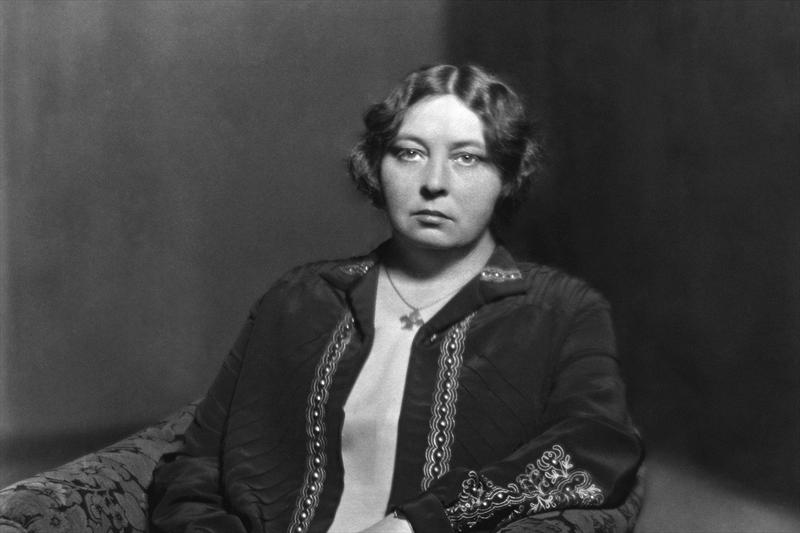
Not sure how old Undset was here, but it’s obviously in middle age.  I particularly like this photo since it shows her proudly displaying her cross pendent.  She was a lovely woman.

 
If you wish to find more on St. Catherine of Siena, these links are most interesting:

I’ve mentioned this all encompassing St. Catherine of Siena site, Drawn By Love.

Here is an article from Crises Magazine proclaiming Catherine “The First Catholic Feminist?” by Christopher Check:

And one of my favorite Catholic bloggers, Jimmy Akin, has just put out a piece, “8 Things to Know About St. Catherine of Siena” just in time for her feast day:

 
Tomorrow, April 29th is St. Catherine’s feast day.  Let us appeal to her for her prayers.


Tuesday, April 23, 2013

Music Tuesday: "The Way You Look Tonite" By Frank Sinatra

I was at a wedding this weekend, and as in most weddings quite a few of Frank Sinatra's music is played.  I love Franky.  He's my all time favorite singer in any music genre, truly the finest American singer that I can think of.  I can listen to Sinatra all night long.  So here's one.


Some day, when I'm awfully low,
When the world is cold,
I will feel a glow just thinking of you...
And the way you look tonight.

Yes you're lovely, with your smile so warm
And your cheeks so soft,
There is nothing for me but to love you,
And the way you look tonight.

With each word your tenderness grows,
Tearing my fear apart...
And that laugh that wrinkles your nose,
It touches my foolish heart.

Lovely ... Never, ever change.
Keep that breathless charm.
Won't you please arrange it ?
'Cause I love you ... Just the way you look tonight.

Mm, Mm, Mm, Mm,
Just the way you look to-night.


Monday, April 22, 2013

Matthew Monday: Matthew Proposes Marriage

We had to go to a wedding in Pittsburgh, and we spent the weekend there.  Wed had two double beds in the room for the three of us, and we expected Matthew and his mother to sleep in one and I would get the other.  After all my wife makes a snide comment to Matthew that he wouldn't be able to sleep with Daddy's snoring.  Nonetheless Matthew chose to sleep with me.  After the lights were out and I had turned over with my back to him, Matthew pulls me over and whispers, "Daddy I want to tell you a secret."  I kind of half turn back and said, "What?"

He climbed over my shoulder to face me.  "I want to tell you that we're friends," he whispered.

"Oh, thank you.  Why did you tell me?"

"Because we're going to have adventures together." 

"OK," I whispered back.  I thought that was a neat male bonding moment.

Next day when he kind of understood what marriage means, he tells his mother rather dramatically that he's "going to marry" her.  "You are?" his mother asks.  "Then you better go out and buy me a ring as soon as you can." 

Pulling out a quarter, Matthew says, "OK.  Is this enough?"


Later that night, the night of the wedding we were there to attend, the baby sitter we arranged to take care of Matthew showed up.  She was a sweet young lady who was a friend of the bride's family, and she apparently had a nice way with children.  Matthew took to her immediately.  She baby sat from four-thirty to ten-thirty at the hotel room.  When we got back to the room, Matthew had gotten Ellen (her name) to sit with him in his "man-cave."  He had taken one of the decorative spreads from the bed and placed it over a table so that it formed a sort of cave (he's done this at home) and placed his stuffed animals in there and invited her in...lol.  They had read nursery rhymes and stories and played with alphabet cards.  He also made her race back and forth up the length of the room with him.  What a little lady's man.  When we asked him if he had a good time, he said, "I'm going to marry Ellen." 

So there you go.  From male bonding to marrying his mother to dumping his parents for a cute chick all within 24 hours.

Friday, April 19, 2013

Faith Filled Friday: Thanksgiving Prayer

Well, my mother had her operation on her finger Wednesday.  You can read about the need here.  All went well.  The only hangup was trying to get one of her earrings off.  She was to take all jewelery off, but no matter how we tried we couldn't unclasp the right one.  The nurse put tape over it, something about it getting too hot during the operation and burning her.  I can't say I understand.  It had no bearing on the operation.

The operation took under an hour.  She went in at 12:25, and I went out to get lunch.  I also took a little walk since it was such a beautiful spring day here.  I got back to the waiting room at 1:20 and the doctor had gone.  He had stuck his head out to look for me and I wasn't there.  Mama was in a recovery bay sipping a cup of coffee and looking like she had slept pleasantly.  I had them call the doctor for me and he said it all went well.  The tendon/ligament (not sure if that's the same thing) had torn and was in need of reconstruction.  I think he used that word, but I'm not sure.  Then he put pins in to hold it together for the next ten days when he will see her again.  We were home an hour later.

Thank you for all those who prayed for her.  The finger will be the finger, but my biggest concern was her going under sedation.  One never knows with that. 

And finally I thank the Lord for this little blessing.  His blessings are too numerous to count.  Special devotion to the Holy Family on this instance.  I'll end with this Thanksgiving Prayer.


Blessed are You, loving Father,
For all your gifts to us.
Blessed are You for giving us family and friends
To be with us in times of joy and sorrow,
To help us in days of need,
And to rejoice with us in moments of celebration..

Father,
We praise You for Your Son Jesus,
Who knew the happiness of family and friends,
And in the love of Your Holy Spirit.
Blessed are you for ever and ever.

Amen.

Prayer source from here.


Wednesday, April 17, 2013

Notable Quote: Walt Whitman

Well, Walt Whitman has been on my mind this week.  He was such a good soul.  He never had an unkind word for people, even those he opposed.  He embraced all people, even those from the South, though he was staunchly against slavery and supported the Union as a nurse to the wounded during the Civil War.  Last year I completely read his Death-Bed edition of Leaves of Grass, all 500 plus pages.  Leaves of Grass, first published in 1855, was his great work that he kept republishing with additional poems.  I think there were up to nine editions of publications, with the concluding edition dubbed "The Death-Bed" edition because it went into publication just prior to Whitman's death.  With each addition Whitman added and revised the poems, but unfortunately not all the revisions were improvements.  Sometimes the original poem is superior.  What I really like about Whitman was how he embraced humanity.  He loved everyone.


The proof of a poet is that his country absorbs him as affectionately as he has absorbed it.


In his life time he was not appreciated.  That really disappointed him.  He loved the United States, and you can see that in many of his poems.  He was consciously the poet of America, embracing the land, the people, the life-style of his day, and most importantly the particular English language we call the American language.  He did for the American language what Shakespeare did for British English and Dante did for Italian.  He became our national poet.  It took a while, but after his death the country did embrace him as he embraced the country.


By the way, he was frequently photographed in his lifetime.  There are lots of great photos of him.  It was hard to pick one.