Memorial Day (last Monday in May) is the day we honor
fallen troops, and Fleet Week is the week the Navy brings in some ship into New
York City for civilian visitation. They
coincide. I took Matthew in Manhattan to
look at some ships. We had a nice
time. Took the Staten Island Ferry over,
passing the Statue of Liberty. We
stopped in down town and took some pictures of the World Trade Liberty Tower,
and then went up to the piers to look at some Navy vessels. Here are a couple of pictures.
Home
"Love follows knowledge."
"Beauty above all beauty!"
– St. Catherine of Siena
Monday, June 3, 2019
Friday, May 31, 2019
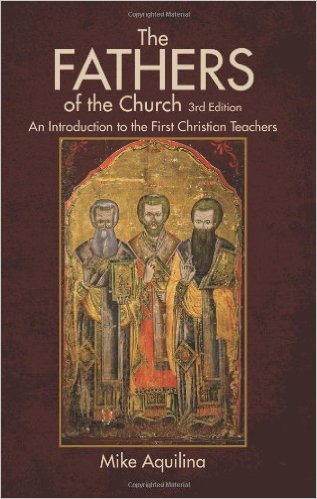
The Fathers of the Church by Mike Aquilina
We
read The Fathers of the Church: An Introduction to the First Christian Teachers by
Mike Aquilina at our parish Bible class this past year.
This was my first year with the Bible group, and to my surprise they don’t
just read the Bible. What the group
typically does is read a book and meet once a week to discuss it. The read seems to run about nine months. The summer is off.
You
have probably seen Mike Aqulina on EWTN, and his expertise is the
patristics. The following is my review
of the book at Goodreads.
This is a solid book that
surveys the Church Fathers (and a few Mothers too) from the very early days -
shortly after the New Testament documents were written (first century) to the
eighth century. It spans St. Clement of
Rome, who was probably a disciple of St. Peter, to St. John of Damascus, who
was part of the refutation of the iconoclastic heresies in the eighth
century. There are fifty-four different
Church Fathers represented, and what is particularly excellent is the
background information. Where the Acts
of the Apostles leaves off, the Church Fathers pick up to provide the history,
theology, and apologetics of Christian thinking. Aquilina states:
"As heirs to the
Apostles, the leaders and teachers of the early Church - the Fathers of the
Church - were intensely concerned with preserving the unity and integrity of
the "company of those who believed," even as that company grew from a
small band of several hundred to encompass millions of people speaking dozens
of languages and dispersed throughout the Roman Empire."
Aquilina discusses each
of the Fathers and provides excerpts of key texts and important biographical
information. Take for instance the first
paragraph on St. Polycarp of Smyrna:
"St. Polycarp (c.
69-155) could be called the most well-connected man in the ancient Church. At one end of his long life, he was a young
disciple of St. John the Apostle. At
middle age, he was a bishop-colleague of St. Ignatius of Antioch. As an old man, he was master to the young boy
who would grow up to be St. Irenaeus of Lyons.
By his longevity, St. Polycarp was able to teach many how to live as the
Apostles had taught him to live. By his
death as a martyr, at age eighty-six, he taught generations of persecuted
Christians after him how to die."
Aquilina concisely
explains the shifting political situations as the centuries roll by and the key
arguments and heresies of the times. He
provides a handy list of the councils and the evolution of the creeds. Mostly Aqulina lets the Fathers speak in
their own voice. All the well-known
fathers are represented: St. Ignatius of Antioch, St. Justin Martyr, St.
Irenaeus of Lyons, Origen, St. Anthanasius, St. Basil, St. Gregory of Nazianus,
St. Gregory of Nyssa, and so on. I can't
name them all, but it includes both east and west traditions. It also includes many that are less well
known, ones I never heard of: Hermas, Lactantius, St. Pacian of Barcelona, St.
Ramanus the Singer, Theodore of Mopsuestia.
What kind of works are
represented? We see in the writings all
the Church doctrines we have now. We
have an excerpt of St. Aristedes of Athens' apologetic letter to the
Greco-Roman pagan (actually addressed to the Emperor Hadrian) world explaining
the nature of the Christian deity. Then
in a different era with Christianity now the prominent religion, we have St.
Ambrose's letter to his emperor explaining how it was out of place for him, a
secular leader, to intrude on Christian doctrine. We have a nativity hymn composed by St.
Ephrem of Syria in the middle of the fourth century and a Christmas carol from
Prudentius composed a century later. We
have from St. Irenaeus in the second century a discourse on Mary as the new Eve
and from St. Jerome in the fourth or early fifth centuries on Mary's perpetual
virginity. We have from St. Basil
"On the Holy Spirit" and from St. Augustine "On the
Trinity." We have recounts of
martyrdoms from an anonymous letter recounting the martyrdom of St. Polycarp,
from St. Perpeuta herself leading up to her martyrdom, and the heroic martyrdoms
witnessed by St. Dionysius the Great. We
have refutations of heresies from St. Ignatius of Antioch, St. Irenaeus, St.
Clement of Alexandria, and others. We
have pastoral texts on how to live the Christian life, how to understand the
Church and the sacraments, and how to read and understand sacred
scripture. What we have in these
excerpts is the complete faith in microcosm.
This is a handy reference
for one's bookshelf. If not this book,
you should have one just like it.
I gave the book four stars I think. I
enjoyed the read and the discussions at the Bible class. I’m looking forward to next year’s read.
Friday, May 24, 2019
Comments to Dante’s Paradiso, Cantos XXIII thru XXVI
Canto
XXIII may be the most beautiful canto in the entire Commedia, and that’s saying a lot.
It’s worth looking at it in a close reading. It’s a canto known for its seven similes, two
simple comparisons, and I’ve noticed a metaphor or two as well. First let me highlight a few of the narrative
details and then I’ll look at each of the seven similes.
We
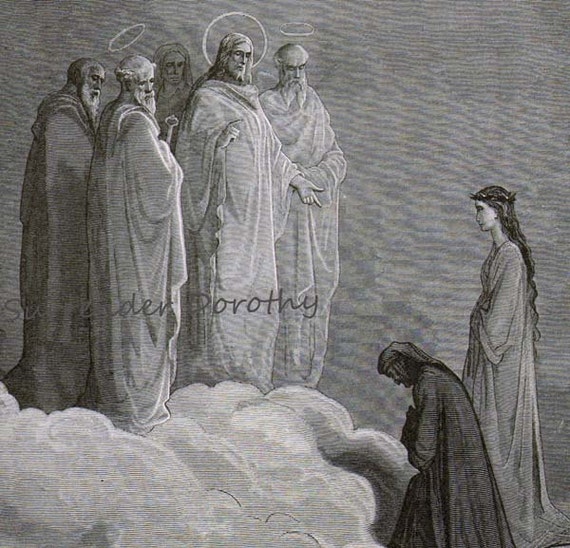
start the canto with Beatrice suspended in the sky and looking heavenward. She points to Christ above who is in a
triumph. A triumph is a specific ancient
Roman victory celebration where the victorious general is given a public
commemoration. As part of the ceremony,
the man of honor was given a laurel for his head, and, dressed in a golden toga,
took a victory lap in a chariot. That is
how to picture Christ’s triumph. It is a
triumphant ride across the sky, and it also represents the Church
Triumphant. This is one of the three
Church aspects, Militant (in its role to combat sin and heresy), Penitent (in
its role to forgive sins), and Triumphant (in its role to celebrate
salvation). Both Church Militant and
Penitent are roles the Church has on earth; Triumphant is a role in
heaven. The closing quatrain of the
canto summarizes this.
Beneath the exalted Son
of God and Mary,
up there he triumphs in
his victory,
with souls of the
covenants old and new,
the one who holds the
keys to such great glory.
(XXIII.136-139)
Christ,
in the triumph, is portrayed as bright as the sun. Dante (the character) looking at the intense
brightness goes momentarily blind. This
is the first of the several instances of Dante going blind in this group of
cantos. I’ll have more to say on the
various times he goes blind when I comment on the other cantos, but here the
intensity of Christ’s light is emphasized.
It is notable that it is Christ’s light that illuminates the other
souls, just as the sun illuminates the world.
Beatrice
implores Dante to open his eyes and see her fully. “The things that you have witnessed,” she
says, “have given you strength to bear my smile!” So since he couldn’t see her smile a few
cantos back or he would burnt up, here Dante has graduated to a greater ability
to withstand God’s intensity. He too has
been increasing in grace.
Beatrice
then points to a rose in the heavens, which is the Blessed Virgin. Associated with the rose because of the
flower’s beauty and complexity, the Holy Queen is sometimes called the Mystic
Rose. When the archangel Gabriel comes
down as a lit torch and circles the head of the Blessed Mother, we have the
enactment of her coronation. Is this a
dramatization for Dante’s sake or is this a constant, eternal drama? It doesn’t say, but now every time I get to
the fifth mystery of the Glorious Mysteries of the rosary, I will forever have
this image in mind.
The
drama in this canto is stunning, but let’s look at the poetry through the seven
similes. The first is right at the
opening of the canto describing Beatrice staring at the sky.
As the bird among the
leafy branches that she loves,
perched on the nest with
her sweet brood
all through the night,
which keeps things veiled from us,
who in her longing to
look upon their eyes and beaks
and to find the food to
nourish them --
a task, though difficult,
that gives her joy –
now, on an open bough,
anticipates that time
and, in her ardent
expectation of the sun,
watches intently for the
dawn to break,
so was my lady, erect and
vigilant,
seeking out the region of
the sky
in which the sun reveals
less haste. (1-12)
Now
that is a Homeric type of simile, one sentence of one hundred words (in
English) spanning four tercets. Dante
does not typically write long sentences.
Here we have the bird imagery, which has been a frequent motif throughout
the Commedia, with Beatrice compared
to a mother bird—perhaps foreshadowing the Blessed Mother who will shortly
appear—looking for the sun, which becomes associated with Christ. The mother bird is looking to nourish her
chicks, and Dante is her chick that needs spiritual nourishment.
The
second simile describes how Christ brightens all around him.
As, on clear nights when
the moon is full,
Trivia smiles among the
eternal nymphs
that deck the sky through
all its depths,
I saw, above the many
thousand lamps,
a Sun that kindled each
and every one
as ours lights up the
sights we see above us,
and through that living
light poured down
a shining substance. (25-32)
In
what should be dark night, the sun reflects across to the moon and lights her
up, so Christ lights up all that is around him.
Trivia is an ancient Roman goddess, but I have to admit I don’t get the
allusion and Hollander doesn’t explain it.
The
third simile compares a thought in his mind to a flash of lightning (lines
40-45). The fourth simile compares
Dante’s inability to fully poetically represent Paradise and so requiring a
leap like man walking and needing to leap over an obstruction (61-63). The fifth simile describes how the throng of
souls are lit up like the sun lights up a field of flowers (79-84).
The
sixth simile describes the transcendent beauty of the heavenly music. During the Coronation, heavenly music is
heard and Dante (the author) describes it in an inverse way.
The sweetest melody,
heard here below,
that most attracts our
souls,
would seem a burst of
cloud-torn thunder
compared with the
reverberation of that lyre
with which the lovely
sapphire that so ensapphires
the brightest heaven was
encrowned. (97-102)
So
the sweetest melody heard on earth would sound like a thunder clap compared to
the beauty of the Paradisic melody.
Notice Dante also adds a metaphor as an extension to the simile. That heavenly hymn is a sapphire which
encrowns heaven. The hymn which is a
sapphire which is a crown connects with the crown which circles the Blessed
Mother.
Finally
the seventh simile describes the apostles reaching out to Mother Mary as
infants reaching for their mother.
And, like a baby reaching
out its arms
to mamma after it has
drunk her milk,
its inner impulse kindled
into outward flame,
all these white splendors
were reaching upward
with their fiery tips, so
that their deep affection
for Mary was made clear
to me. (121-126)
The
fiery tips of the splendors, which are souls, are like the arms of a babe
reaching for its mother. Dante brings
mother down to the colloquial, “mamma.”
And what began the canto as a mother bird awaiting to nourish her brood,
it ends with a mother having nourished her babe.
Truly,
what beauty.
###
Here
are some thoughts and comments on the cantos concerning the Starry Sphere.
The
oral examination under which Dante (the character) is subjected is a brilliant
narrative innovation. I can't recall any
other writer writing before Dante to have used it. First off, it captures the university
experience of the medieval world. Next,
it captures the flow of St. Thomas Aquinas' Summa
Theolgiae in which the Commedia owes much philosophically. Here it reproduces it narratively. Also think of the far reaching influence of
this narrative technique. We see such
interrogative dramatizations all the time, most noticeably in crime dramas and
legal suspense stories.
The
oral examination captures the mediaeval university experience so well that it
makes me wonder if Dante (the author) actually attended a university. No such event is recorded. Presumably then Dante had access to many university
texts, especially that of Thomas Aquinas.
The
oral exam also brings one of the ongoing motifs to a conclusion. Throughout the Commedia, Dante (the character) has been learning. He is on a journey to acquire knowledge, and
before he can complete the journey we see what he has learned put to the
test. When lost in the woods of life as
seen way back before he entered the underworld, Dante (the character) was in a
spiritual crises, and what we have seen is that despite having gain great
knowledge of all sorts of things, when Beatrice died he lost his understanding
of the Christian virtues of faith, hope, and charity. Through his journey he has seen what the
three virtues mean, either because they are absent in some (Inferno), struggling to regain in others
(Purgatorio), or celebrated in still
others (Paradiso).
The
spirits that test Dante are the three apostles of Christ's inner circle, saints
Peter, James, and John. Dante
appropriately picks the apostle who in some way was associated with the virtue
they question Dante on. Peter, who
famously denied Christ but had faith enough to walk on water, at least
momentarily, wrote a magnificent letter (First Epistle) on the perseverance of
faith under suffering. St. James, on
whose burial place in Compostella pilgrims go to pray with petitions, examines
Dante on hope, which is what prayer expresses.
And St. John the Evangelist wrote several letters on the virtue of love.
It
is interesting how Beatrice interacts within all three of Dante’s examinations. In her exchange with Peter, she acknowledges
that Peter already knows Dante’s knowledge on faith, hope, and love, but he
should be made to articulate it for God’s glory:
And she: 'O everlasting
light of that great man
with whom our Lord did
leave the keys,
which He brought down
from this astounding joy,
'test this man as you see
fit on points,
both minor and essential,
about the faith
by which you walked upon
the sea.
'Whether his love is
just, and just his hope and faith,
is not concealed from you
because your sight
can reach the place where
all things are revealed.
'But since this realm
elects its citizens
by measure of true faith,
it surely is his lot
to speak of it, that he
may praise its glory.' (XXIV.34-45)
Peter’s
questioning is capped off with a mini credo at the end of the canto
(XXIV.130-147), but the last two tercets capture Dante’s exam answers in two
wonderful metaphors.
The profound truth of
God's own state of which I speak
is many times imprinted
in my mind
by the true instructions
of the Gospel.
'This is the beginning,
this the living spark
that swells into a living
flame
and shines within me like
a star in heaven.' (142-147)
God
is imprinted in his mind through the Gospels, and from that little spark his
faith grows into a flame which shines within him like a star in heaven. Beautiful.
The
canto where Dante (the character) is quizzed on hope, Dante (the author),
intruding into the narrative, begins with an earthly hope.
Should it ever come to
pass that this sacred poem,
to which both Heaven and
earth have set their hand
so that it has made me
lean for many years,
should overcome the
cruelty that locks me out
of the fair sheepfold
where I slept as a lamb,
foe of the wolves at war
with it,
with another voice then,
with another fleece,
shall I return a poet
and, at the font
where I was baptized,
take the laurel crown. (XXV.1-9)
He
hopes that the beauty of this poem, the Divine
Comedy, will someday allow Florence to renounce his exile and allow him
back to receive a laurel crown as poet.
This can be seen in at least two ways.
First, it foreshadows and echoes the canto’s theme of things hoped for,
but it also contrasts his earthly hope with the spiritual hope of
salvation. In fact, it makes the earthly
hope appear so much less in comparison.
When Dante is writing these lines, it is well into his exile and toward
the end of his life. He probably
realized that such a hope would never materialize, and so in a way he is
belittling his pride that he would have such a hope when the hope of eternal
salvation is at hand. Heavenly glory is
by far more important than this earthly glory.
St.
James quizzes Dante on hope. The New
Testament identifies three men as James.
There is James Zebedee, the brother of John, there is another apostle
with the name James, and he is usually referred to as James the Lesser. And in Acts
there is James the head of the church in Jerusalem, who is referred to as James
the Brother of Jesus. James the Lesser
and James the Brother of Jesus are to some considered the same person. But nonetheless this James is not the brother
of John. The James here in the canto is
identified as the one whose bones are in Compostella (18), which indicates that
he is James Zebedee. But when Beatrice
addresses him, as the one “who wrote/of the abundant gifts of our heavenly
court” (29-30), which indicates this is the James who wrote the New Testament
Epistle under his name. But the epistle
was written by the other James if you count two or the Brother of Jesus if you
count three. So Dante is either ignorant
of the distinction or has something in mind by conflating the two. I fail to see any reason for the conflation,
so I lean to a mistake.
Before
Dante provides an answer on what rests his hope, Beatrice interjects that she
knows no other person so filled with hope as Dante (52-54). On what basis does she make this
assertion? Well, think about it. Dante first fell in love with Beatrice when
he was nine years old. He has been
hoping for the fulfillment of this love for many years and across earthly life
and the afterlife. Yes, he has certainly
demonstrated such hope.
Throughout
the questioning from St. John on love, Dante is unable to see. This is the culmination of several instances
of loss of sight while in the Starry Sphere.
The closer Dante journeys to God, the more intense the light. Each time he loses his sight, when he regains
it his eyes are stronger for the next vision.
Each instance is a strengthening, like an exercise.
The
first time he loses his sight in the Starry Sphere is in Canto XXIII when he
looks up to see a vision of Christ triumphant.
When he regains that sight, his eyes are now strong enough to see
Beatrice’s smile. The second time is in
Canto XXV when saints Peter and James stand together and their collective light
overwhelms Dante. James tells Dante to
look up and take hope, and that restores his sight. The third loss of sight in Starry Sphere is
when John approaches and Dante tries to discern if John is in the glory of a
body. The blindness begins at the end of
Canto XXV and stretches all the way through the middle of Canto XXVI when Dante
completes his exam on love without being able to see. It is through the power of Beatrice’s voice
that Dante then regains his sight.
As soon as I was silent,
the sweetest song
resounded through that
heaven, and my lady
chanted with the others:
'Holy, holy, holy!'
As sleep is broken by a
piercing light
when the spirit of sight
runs to meet the brightness
that passes through its
filmy membranes,
and the awakened man
recoils from what he sees,
his senses stunned in
that abrupt awakening
until his judgment rushes
to his aid –
exactly thus did Beatrice
drive away each mote
from my eyes with the
radiance of her own,
which could be seen a
thousand miles away,
so that I then saw better
than I had before. (XXVI.67-79)
Upon
completing his answer, the heavens sound with the Sanctus hymn, and Beatrice’s voice singing along stimulates his
vision like a person being awakened. The
scene alludes to Saul’s transformation to Paul. Just as Ananias of Damascus was
used to restore Saul’s sight (Acts 9:10-18), Beatrice is used to restore
Dante’s sight, whereby now he can see “better” than ever.
The
first thing he sees when he regains his sight is another spirit approaching, this
time Adam. It’s not clear why
narratively Adam approaches now. He
seems out of place with the three apostles, but Dante makes thematic use of it. The first thing Dante sees is the first human
being, and so Dante (the author) gives us a breadth of scope from the beginning
of all time to the present, from the first man to the current. Now only is the timeline linear, but also
circular. Dante’s questions of Adam’s
time seem to emphasize this.
Dante’s
question on the original language is certainly one that would concern a poet,
especially a poet who is writing in the vernacular. Apparently Dante had once believed that
Hebrew was the original language spoken by Adam and Eve, but here we are now
told differently. That original language
has gone extinct, and as Adam implies so does language. This connects with Dante’s vernacular Italian
being the outgrowth of its Latin roots.
Just as Adam is Dante’s “father” here, Adam’s language is ultimately
progenitor to the contemporary languages.
Finally,
Dante’s question of why Adam was expelled from heaven seems curious, since the
Biblical story is well known, but Adam’s answer is even more peculiar. Adam doesn’t say he was expelled for
disobeying God or for eating the apple, which is what we would expect. He says he was expelled for “trespassing”
(XXVI.117). In effect he trespassed on
God’s prerogative. This echoes back to Inferno where Ulysses sails beyond human
boundaries to God’s ire. Adam also
refers to his time away from heaven as an “exile” (116). This connects the two men in their dislocated
histories.
Monday, May 20, 2019
Matthew Monday: School Concert and Lip Synch Show
Matthew’s
school put on their annual show for the school families. It’s a combination orchestral performances
and lip synch dancing. Matthew
participated in both this year.
I
got there late, so I didn’t get a very good seat. I’m in the back and the pictures didn’t come
ut the best. Here’s a picture of violin
orchestra. Matthew is there on the left
in the front.
Now
here is a clip I was able to video. It’s
called Allegro from some composer named Suzuki.
That will be their music teacher who will lead the class, and at about
the 59 second mark she will point to Matthew for a solo. The solo is only about five seconds long and
then she’ll point to a couple of others.
So
cute.
As
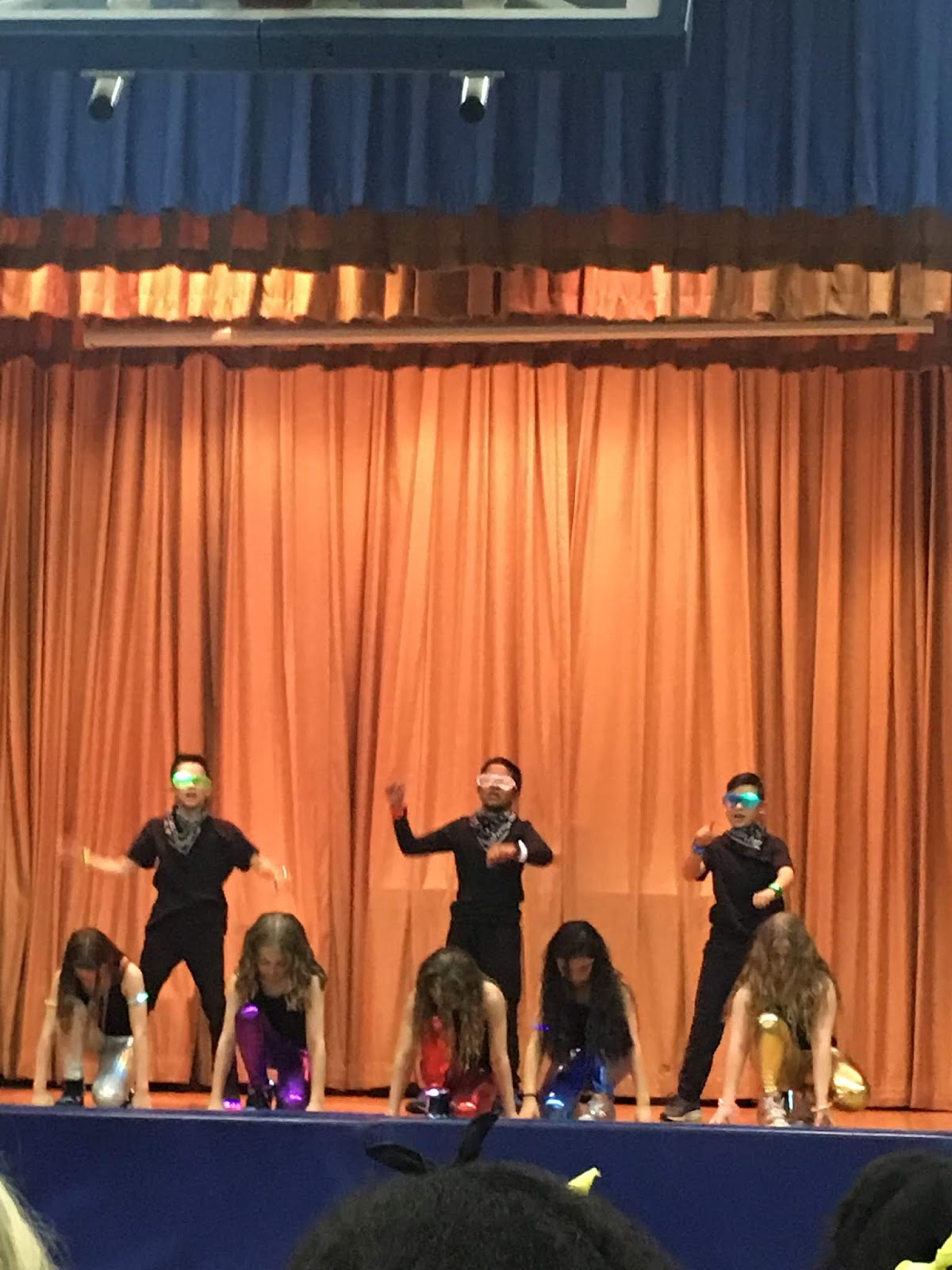
to the lip synch, I have no clue what song they were performing. I lost the program. I didn’t get any video but here are a few
pictures. Matthew is the boy on the
right.
Personally
I didn’t care for any of the lip synch performances but the kids had fun. Isn’t he cute? My little boy is growing too fast!
Saturday, May 18, 2019
Dante's Paradiso Cantos XXIII - XXVI, Summary
Canto
XXIII
In
the Starry Sphere, Dante (the character) is overwhelmed with Beatrice’s
beauty. As she stares at the heavens, he
compares her to a mother bird awaiting the sun to rise. Suddenly she directs Dante to the sky for him
to see Christ passing in a triumph. He
notices that Beatrice’s face is aflame from the brightness that is blazing that
is Christ. The brightness is so intense
that Dante cannot endure it. Beatrice
explains that this light is that which redeemed mankind. She then instructs him to open his eyes, and
now not only can he see, but he can withstand to see her smile. Dante is so overcome that he cannot find the
words to represent the immensity of it all.
Beatrice then points to Virgin Mary, also in the sky, described as a
rose, and around her the apostles that are described as lilies. Again, Dante has to close his eyes from the
intensity. When he opens he sees a star
circling around the head of the Blessed Mother, making it appear that a crown
was about her head. The light is the angel
Gabriel, and he and all the other lights sing in homage to her. Mary and the triumph march higher, rising up
beyond Dante’s sight into the next sphere, the Primum Mobile, the final
sphere. As Mary disappears, the lights
that were the apostles sing Regina Celi
in praise. Dante too offers praise to
Christ and Mary. St. Peter, then, comes
before him.
Canto
XXIV
Still
at the Starry Sphere, Beatrice addresses the spinning lights that are the
apostles. These lights dance about full
of joy. One light circles Beatrice three
times, and Dante is again lost for words to describe it. The light addresses Beatrice since it is her
love that has drawn him close. She asks
him, who though unnamed we know is St. Peter, to test Dante on his faith. So just as a college student standing before
professors, Dante must undergo an oral examination for him to pass
through. The first question that St.
Peter asks Dante is, what is faith?
Dante responds that it is the substance of things hoped for. Second question: from where did you get your
faith? Answer: the Holy Spirit provided
it from reading the Old and New Testaments.
Third question: why do you believe what they say? Answer: Because of the miracles that
substantiate the claims. Fourth
question: what makes you believe in those miracles? Answer; because the world turned to Christ in
subsequent generations. Fifth question:
what exactly is it you have faith in?
Answer: The creed, I believe in one God who moves the universe through
His love, who through His prophets revealed, who through His incarnation
redeemed and further revealed the Trinity within His single Essence. St. Peter satisfied blesses Dante, circling
him three times.
Canto
XXV
Dante
(the author) opens with contemplation that one day this poem may allow him back
to the city of his birth where he will receive the laurel crown. Still in Starry Sphere, another light
approaches them. Beatrice identifies him
as St. James as St. Peter greets the new light warmly. Beatrice, as she did previously with St.
Peter, asks St. James to test Dante, this time on the virtue of hope. St. James then asks Dante, what is hope, how
does it grow in your mind, and from where did it come from? Before Dante can answer, it is Beatrice that
testifies for him, that she knows of no other person with greater hope than
Dante. Dante then answers that hope is
the expectation of heavenly glory and that it comes from heavenly grace. In approval, St. James flashes brightly
several times like lightning. He then
asks, what promises does hope hold for you?
Dante replies that his hope is in the promise of the resurrection and of
the glorified body that is to come. Upon
that a hymn of hope is heard from above and an even brighter light moves toward
the group. Beatrice explains that this
is St. John. The brightness of St. John
completely overwhelms Dante’s eyes, and he goes momentarily blind. He had tried to see if St. John was before
him bodily as a legend had suggested, but St. John’s first words were of
chastisement. Only Christ and His
Blessed Mother have their bodies in heaven.
Dante, troubled, looks back for Beatrice, but he still cannot see.
Canto
XXVI
Still
in the Starry Sphere and still unable to see, Dante hears the voice of St.
John, who now takes his turn to interrogate him, his exam on the virtue of
love. His first question, what is the
goal of your soul? Dante answers that
the goal of his soul is to satisfy itself in the love that comes from God. Second question, what made your soul reach
for that goal? Dante replies,
philosophic reasoning that love moves all and from the prophets in the Old and
New Testaments. Third question, what is
it exactly that moves you to love? Dante
answers that there is a divine imprint on the soul which moves us to love and
that all beauty gifted from above elicits that love to come out. He adds that the creation, the Redemption,
and the hope of future glory arouses that love.
Upon his final words, he hears all souls including Beatrice chanting
“Holy, holy, holy.” Through Beatrice he
is now able to see again, and see sharper and further than he ever did
before. He now sees a fourth light
shining in their company and Beatrice explains that this is Adam, the first human
being, Dante overcome with emotion finally implores Adam to speak to him, and
that Adam knows the questions he wishes to ask.
Four questions are in Dante’s mind, how long has passed since Adam was
in Eden, how long has he been there now, what caused God’s anger to expel him,
and what language did he speak then?
Adam answers that God exiled him for trespassing a boundary, that he
lived on earth 950 years, that there was another 4302 years before he was
returned to heaven, and the language that he spoke has long been extinct. Nothing of human construction lasts forever.
Wednesday, May 15, 2019
The Life of Saint Dominic by Augusta Theodosia Drane
I
completed reading The Life of Saint
Dominic by Augusta Theodosia Drane, and thoroughly enjoyed it.
This
is an excellent biography of the famous saint which includes many of the events
that led to the institution of the Order of Preachers, otherwise unofficially
known as the Dominican Order, and the early members that shaped what is
probably the most intellectual of all the religious orders. The book has a nice
mix of solid historical facts and what I would say are hagiographic facts
(super natural miracles), which I guess you can believe or not. Augusta
Theodosia Drane’s prose is quite good though at times reflects the Victorian
style – originally published in 1857 – of her day. What she captures most is
the humility of the saint – he refused to have the order named after himself –
and the sort of magnetic attraction his followers had for him. It is sometimes
said St. Dominic “befriended” an order rather than found it. The explosion of
Dominican friars after the 1216 founding is remarkable and can be attributed to
St. Dominic himself on the strength of his humble charisma. And St. Dominic
understood the dire need for a religious order that would engage the general
population, preach the Word, and evangelize the fallen away. We are in such a
need today. Not as much is known of St. Dominic as for instance his
contemporary and counterpart, St. Francis of Assisi, but what is known Drane
skillfully weaves into a narrative.
One
of the hallmarks of the Order of Preachers is that they are a mendicant order,
but yet Dominic, who insisted on committed poverty, came from a noble and
well-to-do family. Here’s how Drane
opens the biography with his family background.
It was in the year 1170,
during the pontificate of Alexander III, that Dominic Guzman, the founder of
the order of Friars Preachers, was born at his father’s castle of Calaroga, in
old Castile. The history of a genealogy,
however illustrious, seems scarcely to find its place in the biography of a
saint; though indeed few families can boast of one more honorable than that of
the Castilia Guzmans. But if their long
line of chivalrous ancestors, and the royal privileges granted to them by the
kings of Spain, have no claim to be noticed here, the immediate ancestors of
St. Dominic possessed at least one distinction which had a more powerful
influence on his life. They were a
family of saints.
Indeed,
his mother, Joana de Aza, and one of his brothers are both beatified. His mother experienced a vision while
pregnant with him that would follow him through his life and all the way to
today.
The future greatness of
her younger son was announced to Joanna even before his birth. The mysterious vision of a dog, bearing in
his mouth a lighted torch which would set fire to the world, appeared to
indicate the power of that doctrine which should kindle and illuminate men’s
hearts through the ministry of his words.
That
dog carrying a torch in its mouth is one of the icons that is associated with
the Dominican order. In fact, if one
breaks “Dominican” into fragments of Latin, it translates into “Hounds of the
Lord.” There is another story of his
infancy, one pertaining to his baptism.
The noble lady who held
him at the font saw, as the water was poured on his head, a brilliant star
shinning on the infant’s forehead; and this circumstance, which is mentioned in
the earliest life which we have of the saint (that of Blessed Jordan), bears a
singular connection with the beautiful description of his appearance in
after-life, left by his spiritual daughter, the Blessed Cecelia; in which she
says, among other things, that “from his forehead, and between his brows, there
shone forth a kind of radiant light, which filled men with respect and love.”
Those
are two icons associated with St. Dominic, the dog carrying a torch in its
mouth and a bright star shinning from his forehead. From these images are what his followers are
committed to do, brighten the world with the torch of truth and shine forth
with a loving light.
Apparently
he was a young genius, so much so that he was sent to the University of Polencia
at the age of fourteen. One of the
characteristics that would serve him so well was his lack of attachment to
worldly things. The world of study was
precious to him, but not precious enough allow suffering. At the university there was a famine in the
region. He sold all he had to give to
the poor but there was one thing left.
His dear and precious
books were all that remained to give; and even those he parted with that their
rice might be distributed to the starving multitudes. To estimate the cost of such an act, we must
remember the rarity and costliness of manuscripts in those days, many having
probably been laboriously copied out of his own hands. Yet when one of his companions expressed
astonishment that he should deprive himself of the means of pursuing his
studies, he replied in words preserved by Theodoric of Apoldia and treasured by
after-writers as the first which have come down to posterity, “Would you have
me study off those dead parchments when there are men dying of hunger?”
There
are many other events that can be highlighted.
His ability to speak to people and convert them. His conversion among the Albigenses. Setting up of convents for the women
converts. Receiving the rosary from our
Blessed Mother. Instituting the Order of
Preachers with its study and preach.
Transforming his order into a western world wide group. Attracting through the power of his
personality and sacrifice wonderful men that rivaled the Franciscans as an
order.
Though
Dominic would probably deny it, I think it cannot be emphasized enough that the
his persona was initially at the heart of what made him successful in
converting souls and attracting dedicated followers. And that persona was formed and grounded
through his life of prayer. Here is how
Drane describes it.
St. Dominic was
pre-eminently a man of prayer; it is the feature above all others which we find
traced upon his life. By night or by day,
whether alone or with others, silent in contemplation, or surrounded by the
distractions of an active apostolic vocation, his heart never stirred from the
true and steady center it had so early found in God; and in this one fact lay
the secret of all the graces which adorned his most beautiful soul. It was the source of that interior
tranquility which fitted him to be called “the rose of patience,” as well as of
the exterior and gracious sweetness to which all have borne testimony, and
which with him was nothing else than the fragrant odor preceding from the
abiding presence of God.
Some
other quotes from the book that provide insight in the character of this noble
saint.
"Dominic was anxious
to provide for the preservation of another essential of his institute, the pursuit
of sacred learning." p. 194
“Gathered from all states
of life--knights, courtiers, professors, men of the world, penitents, and
saints--the novices of Dominic, as soon as his spirit has breathed over them,
display to our gaze and many varieties, one trait of which has the
indescribable peculiarity of a family likeness: Sweetness" (p.184)
“The holy joy which shone
in him had something singular about it, which drew all men's affections to him
so soon as they had looked upon his face. He embraced all in great charity, and
so was loved by all; and his rule was to rejoice them that rejoiced, and to
weep with them that wept." (p. 143)
“He devoted himself
entirely to the salvation of souls by the ministry of preaching, and he bore
with a great heart a multitude of affronts, ignominies, and sufferings for the
name of Jesus Christ.” (p. 26)
“But if ever a man
possessed the art of persuasion it was the blessed Dominic, whom, as it was
said, ‘none ever resist;’ or rather persuasion with him was not art, but
nature. It was the effect of that
admirable union of patience, prudence, and firmness, tempered with the charm of
a sweet and tranquil gaiety, which gave so wonderful a magic to his
intercourse.” (p. 112)
“Dominic’s idea included
a much wider field than any of the more modern founders had attempted. He had designed an order for preaching and
teaching; which for that purpose should apply itself to the study of sacred
letters, with the express object of the salvation of souls.” (p. 61)
So
far this might be the best biography of this wonderful saint I've seen. Don't
forget St. Dominic's feast day is August 8th.
St.
Dominic de Guzman, pray for us.
Tuesday, May 7, 2019
Comments to Dante’s Paradiso, Cantos XIX thru XXII
Here
are some random thoughts and observations on the Jupiter cantos.
Going
back to Canto XVIII, the way the lights scroll across the sky, forming letters
which spell words, suddenly coalesce, and then forming shapes is, if you think
on it, an incredible feat of imagination for someone in Dante’s time. This is like a video game playing itself out
on a “screen” in front of Dante. We can
easily conceptualize it today, but how could someone in the Middle Ages
conceptualize such visuals is stunning.
And then Dante (the author) takes it a step further in the visual
“technology.” A full bodied bird image
forms then morphs into a fleur de lily, and then morphs again into the head of
the eagle. Dante is actually visualizing
the morphing of shapes. Amazing!
The
eagle, if you missed it, is symbolic for the Roman Empire, and represents human
justice. When the eagle speaks, it is each
individual light speaking in unison, and this has particular significance when
considering the notion of justice. What
is justice but the application of a society’s values, and each individual
member of that society contributes his input to establishing justice. Think of it as a jury of twelve coming to a
single verdict. The verdict is the
single, unified voice of the jury group, each member having contributed to that
voice.
Notice
the wonderful imagery Dante (the author) uses to describe that amalgamation of
voices into one.
Just as from many coals
we feel a single heat,
so from that image there
came forth
the undivided sound of
many loves. (XIX.19-21)
Each
single coal individually provides heat, but the amalgamation of each coal’s
contribution is felt as a single heat source.
And then in the following tercet, Dante addresses the eagle as an
amalgamation of a variety of scents:
And I then answered: 'O
everlasting blossoms
of eternal bliss, you
make all odors
blend into what seems a
single fragrance…(22-24)
In
some of the other instances when a holy soul or Beatrice reads Dante’s mind
about a question, they articulate the question and then answer it. In this section, when Dante (the character)
has his mind read on the doubt that has formulated, unlike the previous
instances the eagle starts answering the question before it is
articulated. I think this might confuse
some readers. In Canto XIX, from lines
22 through 33, Dante (the character) tells the eagle he has something on his
mind. From lines 40 through 69 the eagle
starts answering the question which has not been articulated. In essence what the eagle is saying is that
Dante cannot see, does not have the vision to see, the entire creation. Finally from lines 70 to 78 the eagle
articulates the hypothetical about a man born in India who can never know the
faith. Where is the justice in not
having the means to salvation?
It
is fitting that in the sphere of Jupiter, that of just rulers, the eagle turns
judgement back at Dante (the character).
When Dante questions the justice of a pagan incapable of achieving
salvation, the eagle says:
'Now, who are you to sit upon the
bench,
judging from a thousand miles away
with eyesight that is shorter than a span?
(XIX.79-81)
To
paraphrase, “Who are you with your limited eyesight to judge God?” It’s not just questioning God; it’s judging
God.
Dante
(the author) seems to associate proper justice with eyesight. Here he contextualizes Dante (the
character)’s incorrect judgement of God with limited sight, but when in Canto
XX the eagle catalogues six great rulers who were just, their points of light
were the ones that made up the eagle’s eye.
Indeed, the eagle was known in the middle ages as the creature with the
sharpest eyesight.
How
ingenious of Dante to formulate an acrostic (a series of lines or verses in
which the first, last, or other particular letters when taken in order spell
out a word, phrase, etc.) when cataloguing the bad twelve kings that are living
in Dante’s time. The acrostic spells lue, which means plague. These kings are a plague.
Again
Dante (the author) shows his contempt for his contemporary world by locating
the good kings in the distant past and the bad ones in the present. When you look over the geographic span of the
bad rulers—from England to Spain to France to Italy to Germany to eastern
Europe, he’s identifying a good three quarters, if not more) of his known world
as ruled by bad kings. You can’t have
more of a condemnation of his existing world than this.
Dante
(the character) is taken aback when he hears Trajan and Ripheus are saved. He had just been told that only baptized
Christians and Old Testament worthies can be saved. How could this be? The eagle answers:
'For from Hell, where no
one may return
to righteous will, the
one came back into his bones --
this his reward for
living hope,
'the living hope that
furnished power to the prayers
addressed to God to raise
him from the dead
so that his will might
find its moving force. (XX.106-111)
First
the eagle alludes to hell where if you recall there was a sign “Abandon hope
all who enter here.” Second the eagle
says that through the “living hope” of prayer—and notice “living hope is
repeated twice—God’s will can find a way to save all righteous people. They still must be baptized—God’s word cannot
be a lie—but our limited sight cannot envision every formulation of God’s
workings. So never give up hope and
never stop praying for anyone you love.
So
why Trajan? Trajan was mentioned in Purgatorio as an example of
humility. It alludes to the story of
Trajan and the widow. Trajan has
gathered an army of a million men and are about to set off on campaign when a
widow stops the column and asks for justice for her murdered son. Trajan wants to ignore her but the widow is
persistent, and Trajan with pity gets off his horse and stops the march until
he can assess justice. He brings justice
to a sorrowful woman, a mater delorosa,
over her murdered son. Well I think you
can see the allusion now.
So
why Ripheus? Who is Ripheus? Ripheus is a less than minor character from
Vergil’s Aeneid, who is briefly
mentioned as a righteous king who dies during the sack of Troy. He is less than obscure. So who can be saved? Everyone from Trajan, the greatest emperor of
the greatest empire, to an obscure, inconsequential name from a thousand years
before the birth of Christ. Who can be
saved? Everyone within the scope of
God’s expansive arms.
###
Some
thoughts on the Saturn cantos.
Saturn
is the final planet in the spheres.
After Saturn will come the sphere of the fixed stars, followed by Prima Mobile, the sphere from which God
controls the universe, and finally the heart of heaven, the Empyrean.
Saturn
contains those who excelled at mystical contemplation. But didn’t we encounter a group of souls who
were mystics in the second garland under the sphere of the sun? Yes, led by St. Bonaventure, but the
distinction is that those at the sun were intellectual mystics. The mystics at Saturn were those who lived
their lives under total mystical immersion into God. The distinction is a subtle one perhaps. The souls at Saturn tend to be monastics, not
friars.
The
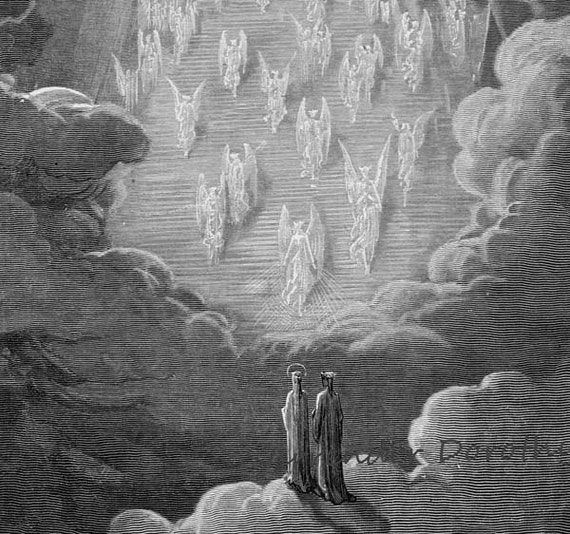
central image in the realm of Saturn is a ladder stretching all the way up to
the Empyrean (if I read correctly) with souls streaming up and down the
ladder. It’s a fantastic image and
worthy of quoting the entire passage.
Within the crystal,
circling our earth,
that bears the name of
the world's belovèd king,
under whose rule all
wickedness lay dead,
the color of gold in a
ray of sunlight,
I saw a ladder, rising to
so great a height
my eyesight could not
rise along with it.
I also saw, descending on
its rungs,
so many splendors that I
thought that every light
shining in the heavens
was pouring down.
And as, following their
native instinct,
rooks rise up together at
the break of day,
warming their feathers,
stiffened by the cold,
and some of them fly off,
not to return,
while some turn back to
where they had set out,
and some keep wheeling
overhead,
just such varied motions
did I observe
within that sparkling
throng, which came as one,
as soon as it had reached
a certain rung. (XXI.25-42)
The
image of the ladder comes from Genesis—Jacob’s ladder—where in a dream Jacob
sees angels ascending and descending between heaven and earth. Here Dante (the author) has souls instead of
angels traversing up and down, and, since they are already in heaven, Dante has
the ladder stretch from Saturn up beyond eyesight toward the end of heaven,
possibly to the Empyrean where God and all souls in heaven reside. The ladder is described as the color of gold
and either emits or reflects sunlight.
The souls going up and down also shine bright, so it makes for a
stunning image.
The
ladder is a perfect image for those immersed in mystic contemplation. What does a contemplative do but rise up to
heaven when in mystical exaltation and return back to earth to share the fruits
of his contemplation? Here at the planet
closest to God, we find souls who minimize rational thought and enjoy God’s
intense grace.
We
see this ever increasing grace through Beatrice’s increasing beauty. If you’ve notice, at each station Beatrice
appears more intensely beautiful, and that’s because the closer the pilgrim’s
travel toward God, the more intense the light that shines, which is allegorical
for increasing grace. Beatrice’s “cup”
filled with grace, is getting filled higher, which was the image I provided in
my comments back in Canto IV to describe a soul’s capacity to receive
grace.
So,
to answer that question I had back in Canto IV, a soul may not be able to
enlarge his cup, but it can get more filled.
Two
saints are featured at Saturn. First is
Peter Damian, a monastic, who was known for his asceticism and
self-mortification. Perhaps an implication
can be drawn that through the self-denial and extreme penance, one climbs the
ladder toward heaven. It’s interesting
he doesn’t come to greet Dante out of willingness but because ultimately he
serves the Lord.
'I have come down the
sacred ladder's rungs this far
only to bid you welcome
with my words
and with the light that
wraps me in its glow.
'It was not greater love
that made me come more swiftly,
for as much and more love
burns above,
as that flaming
luminescence shows,
'but the profound
affection prompting us
to serve the Wisdom
governing the world
has brought about the
outcome you perceive.' (XXI.64-72)
The
mystical ecstasy he feels in God’s bosom overrides his love of neighbor, but he
obeys the Will that moves the world.
That’s a pretty amazing statement, and if you think about it, monastics
is doing just that—separating themselves from society for love of God. But just as in his real life where Damian was
compelled to leave the monastery to become a bishop for society, here too he leaves
the Empyrean to greet the travelers.
The
other featured saint is St. Benedict of Nursia, the founder of the Benedictine
Order, the first major monastic order in the west, and creator of rule that balanced work and prayer. At a time of collapsing civilization the
Benedictines preserved civilization through their monasteries and through
copying of ancient texts. It is the
fruits of contemplation that Dante wishes to emphasize with Benedict.
'I am he who first
brought up the slope
the name of Him who
carried down to earth
the truth that so exalts
us to the heights.
'And such abundant grace
shone down on me
I led the neighboring
towns away
from impious worship that
misled the world.
'All these other flames
spent their lives in contemplation,
kindled by that warmth
which brings
both holy flowers and
holy fruits to birth. (XXII. 40-48)
He
was first to bring Christ up the slope of Monte Cassino and provided the truth
to the neighboring towns for their conversion.
His fellow contemplatives brought down both flowers and fruits from up above. So Peter Damian emphasizes the trip up the
ladder to spiritual ecstasy, St. Benedict emphasizes the trip down the ladder
to bring graces to earth.
Finally
something should be said of the remarkable image of Beatrice and Dante looking
down from high above and first seeing the entire solar system below them and
then finally the little planet earth. This
is akin to the images of space probes we send out to the far reaches of the
solar system to take pictures. Indeed,
the image of the planet earth is equivalent to the famous photos taken by early
space missions where for the first time we had a picture of the earth from the
outside. Dante (the author) was over six
hundred and fifty years ahead of that.
Subscribe to:
Posts (Atom)