"Love follows knowledge."
"Beauty above all beauty!"
– St. Catherine of Siena

Monday, January 22, 2018

Comments, Inferno, Cantos I thru V

These are my comments from the Good reads discussion on Inferno.  All quotes come from the Hollander and Hollander translation, unless otherwise noted.

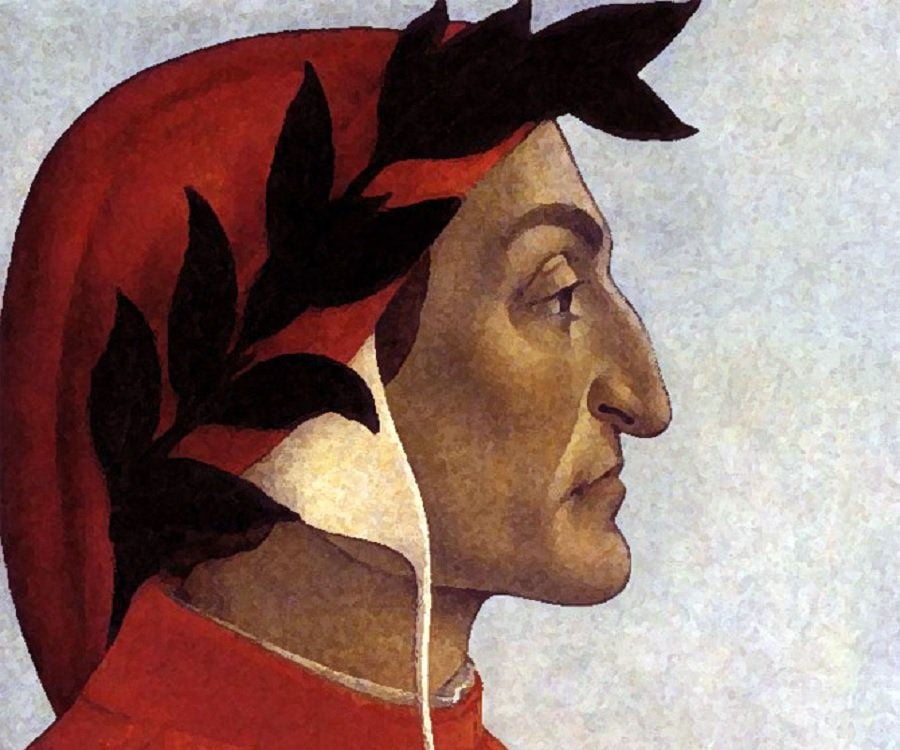
I’m not sure where to start with comments. I could write an essay on something in all those Cantos.  My first thought is to try to minimize, if not dispel the notion that much in the Comedia works as allegory.  Allegory is a device where a character or event stands for an abstract notion.  Dante can be said to stand for “everyman,” Virgil for wisdom, and say Beatrice for virtue.  This was common practice in many medieval works and even going into the Renaissance.  Edmund Spencer’s The Fairy Queen is a late example where an epic work actually carried this one for one allegory.  But other than at the beginning of The Divine Comedy, this sort of simple allegory falls apart in Dante’s work.  The characters are three dimensional.  Dante isn’t an “everyman” but a specific man, a poet, a Florentine who has been exiled, someone in love with a specific woman.  Same thing with Virgil.  He may be wise but he’s not an abstract “wisdom.”  He’s the ancient Roman poet from the city of Mantua who died before Christ and so was a pagan.  Despite the fantastical premise of passing through the world of the hereafter, Dante’s work is a highly crafted realism, way ahead of its time.

Take the three beasts in the first Canto, the leopard, the lion, and the she-wolf.  Unless your notes went into a lot of detail, it probably listed a simple allegory of the leopard standing for lust, the lion for pride, and the she-wolf for greed.  Hollander goes through the history of varying opinions.  At times the leopard was believed to stand for envy instead of lust; other times, incontinence.  The lion has been thought as standing for violence or even malice.  The she-wolf for mad brutishness or fraud.  Then there are those that have read the three beasts as representing Dante’s human enemies: the leopard for the Florentines who exiled him, the lion for the royal house of France, and the she-wolf for the papacy.  All possible.

So what do they stand for?  In my opinion those beasts stand for all those things, envy, lust, avarice, brutishness.  Why would a leopard be less brutish than a she-wolf, or a she-wolf less violent than a lion?  Notice in Canto II there are three ladies that come to Dante’s aid: the Blessed Mother, St. Lucy, and Beatrice.  The three ladies directly correspond to the three beasts, and yet we don’t look for some sort of abstract meaning behind those three ladies.  It’s the three ladies whose virtue is there to counteract the appetite of the three beasts.

Hollander in his introduction has an interesting section of allegory, and without quoting him I think supports what I say above.  He goes on, however, to distinguish that simple allegory I described above with what he calls theological allegory.  I had never heard the term before, but apparently it traces back to Thomas Aquinas.  Theological allegory is where a figure in one part of the bible runs parallel to another.  Christ for instance can be thought of as the new Adam, or the new Moses; Mary as the new Eve, and so on.  I always called that typology, and I guess it does have a certain allegorical connection.  Hollander doesn’t explain in the introduction how Dante uses theological allegory; perhaps that will come later.  Now let me speculate on the first two cantos: could the three blessed ladies be typologies for the three beasts in the first canto?  That might be so.

But what I do what to emphasize again how The Divine Comedy is a work of great realism, way ahead of its time.  Hollander also points out the skilled use of point of view.  Notice how complex it is.  We have the point of view of Dante the writer, who stands back knowing all that has transpired; we have the point of view of Dante the character who is undergoing the journey for the first time and is almost completely ignorant; we have the point of view of the person who comments on the situations – the guides – in this case Virgil who understands partially but is not in on everything, and we have the point of view of the souls encountered, many of which have a different point of view than their reality, the unreliable narrator, if you will.  All oif this happening simultaneously.  Modern fiction has nothing on Dante.

----------------------------------------------------------------------------------------------------------

One of the most interesting set of lines are those inscribed above the gate of hell. 

1          THROUGH ME THE WAY TO THE CITY OF WOE,
2          THROUGH ME THE WAY TO EVERLASTING PAIN,
3          THROUGH ME THE WAY AMONG THE LOST.
4          JUSTICE MOVED MY MAKER ON HIGH.
5          DIVINE POWER MADE ME,
6          WISDOM SUPREME, AND PRIMAL LOVE.
7          BEFORE ME NOTHING WAS BUT THINGS ETERNAL,
 8         AND ETERNAL I ENDURE.
9          ABANDON ALL HOPE, YOU WHO ENTER HERE. (III. l. 1-9)

The first three lines beginning with “Through me…” are what the dead soul expects to find when entering.  The seventh and eighth lines speak to its eternalness, and the last line is a command to the entering soul that his time for change is over.  But the middle three lines (4-6) are possibly the most intellectually rich:  “Justice moved my maker on high/Divine Power made me/Wisdom supreme and primal love.”  Line four is a statement of why God created hell – for justice.  Line five is a statement of who made hell, and line six is a modifying phrase to why He made it.  If you were to write the sentence out it would look like this, “Divine Power made me, wisdom supreme and primal love.”  If you were to replace the comma and use a prepositional phrase, it would go like this: “Divine Power made me through wisdom and primal love.”  So there are three abstract qualities that caused God to create hell: justice, wisdom, and love. 

Now that’s how I read it, but Hollander in his notes seems to read the fifth and sixth lines differently.  He doesn’t read “wisdom supreme and primal love” are not modifying the predicate but the subject.  If he were to write it in a prose sentence it might be, “Divine Power, wisdom, and love made me."  Under Hollander’s logic then the three attributes of God are power, wisdom, and love and justice is the means of which things were created.  He supports his argument by citing St. Augustine as attributing those three to the Trinity. 

Now I don’t think that’s how it should be read.  I’m not saying that St. Augustine is wrong, but I think Dante is creating his own Trinitarian attributes of justice, wisdom, and love.  Power it seems to me is the acting force that creates as a result of the attributes.  But take my brain noodling here with a grain of salt.  Hollander is a PhD with a expertise in Dante with scores of experience. 

Now I bring this up because embedded in those words are the themes that apply to all of The Divine Comedy.  Everything in the poem works in concordance with justice, wisdom, and love.  Now come down a few lines from the words on the gate to where Virgil is explaining to Dante what they are about to get into.  He says, “We have come to where I said/you would see the miserable sinners/who have lost the good of the intellect” (16-18).  Those in hell are there because they have misused their intellect in their application of justice, wisdom, and love.  But this will also go beyond hell.  It can be said that those in purgatory are there to repair (or perhaps relearn may be more accurate) their use of intellect, and those in heaven are there because they properly used their intellect.

It’s all very highly condensed, but the themes of the entire Comedia are there in the first eighteen lines of the third Canto.

Amanda Commented:
I wonder if this comes down to a matter of translation. Longfellow and Musa both use "Omnipotence" instead of "power."

From Longfellow, the lines read" Justice incited my sublime Creator; Created me divine Omnipotence, The highest Wisdom and primal Love." So for me, that translation indicates the creation of hell by the Trinity.

But your argument for justice, wisdom and love is also interesting. It seems (to me at least) that you can argue that God the Father represents justice based off the old Testament. From there, it would be the Trinity working together in Divine Power to create Hell.

My Reply:
Hi Amanda, thanks for commenting. I think what you present there was one of the variations Hollander listed that at one time or another was brought up. I find the allegory concerning the three ladies that Musa and Grandgent advance as even less satisfying. Can't Mary be Illuminating Grace or Revelation? Can't Beatrice be Divine Mercy or Illuminating Grace? Yes, I know Lucia means "light" but then why is it illuminating grace and not illuminating wisdom? It all seems so arbitrary.

I am definitely sold on Hollander's "Biblical allegory," which I consider typology, rather than simple (literary?) allegory. The difference between Dante's The divine Comedy and Spencer's The Fairy Queen is immense. You can pin down the allegory in Spencer; you can't pin down the allegory in Dante.

Dante's technique of these triple analogues that run throughout the work is incredibly rich. It almost replicates the mystery of the Trinity! I may say this a dozen times before we finish the read, this is the greatest work of literature.

Longfellow:
"Justice incited my sublime Creator; Created me divine Omnipotence, The highest Wisdom and primal Love."

Hollander:
“Justice moved my maker on high/Divine Power made me/Wisdom supreme and primal love.”

Look at the difference! If you have an ear for poetry, the Longfellow is stilted. All I can say is "yuck." The Hollander just rolls so fluidly, and it never sacrifices accuracy. Notice the alliteration with the "m" words. I make it a habit to compare translations, and I have not found anything better than the Hollander duo. God bless Jean Hollander, she was the poet of the two.

Yes, power or omnipotence is an ability; justice, wisdom, and love are qualities. Even in college I was not afraid to disagree with PhD's. ;)

------------------------------------------------------------------------------------------------------------

One other thing I wanted to examine was this fainting that Dante has at the closing of two out of the last three cantos.  Twice in the very first five cantos.  For those reading this for the first time, I hope you don't think this is going to be a regular routine, that this is some melodrama.  I don't remember if it happens again.  I have an inkling that it happens one more time, but I'm not sure.  Let's take a look at the two occurrences in some detail.

In Canto III, Dante the character has been led into the underworld, read the sign which warned his to "abandon all hope" for those that enter, come through the pre-circle of the Neutrals where for the first time he is seeing mass numbers of dead souls walking about, even recognizing some, realizing now that "death had undone so many."  Here's what he actually reports:

Now sighs, loud wailing, lamentation
resounded through the starless air,
so that I too began to weep.
Unfamiliar tongues, horrendous accents,
words of suffering, cries of rage, voices
loud and faint, the sound of slapping hands --
all these made a tumult, always whirling
in that black and timeless air,
as sand is swirled in a whirlwind.  (III. l. 22-30)

That's pretty horrific and oppressive to the senses.  I'm sure we would all be rattled, even if it were not in the world of the dead.  But then Dante comes up on the demon ferry driver Acheron who tells him and the souls around him "to give up all hope of ever seeing heaven."  Despite that he's reassured by Virgil, board the boat along with all the dead, and before landing on the other side thunder claps.

When he [Virgil] had ended [speaking], the gloomy plain shook
with such force, the memory of my terror
makes me again break out in sweat.
From the weeping ground there sprang a wind,
flaming with vermilion light,
which overmastered all my senses,
and I dropped like a man pulled down by sleep. (III. l. 130-36)

It seems that thunder is so loud that the concussion causes him to drop, or perhaps it's the terror which rises to a crescendo and overcomes him.  Either way, his sense, which have been on edge, have been overwhelmed.

Now let's look at the faint in Canto V.  The pilgrims (Virgil and Dante) are in the first circle where the sinners of lust reside.  This is one of the great and memorable scenes in Inferno.  Dante, after seeing some famous souls in literature and being moved to "pity" so that he almost loses his "senses," comes across the souls of Francesca and her lover Paolo, and asks to hear their tale.  Francesca is more than willing to tell her story.  (By the way, that's a common attribute of most of the souls in hell; they want to tell their story and spin it to how they were either wronged or were trapped into it.)  So Francesca says,

'Love, quick to kindle in the gentle heart,
seized this man with the fair form taken from me.
The way of it afflicts me still.
'Love, which absolves no one beloved from loving,
seized me so strongly with his charm that,
as you see, it has not left me yet.
'Love brought us to one death. (V. l. 100-106)

Notice how she offloads responsibility from herself.  Nixon spoke of Watergate as "mistakes were made," as if he had nothing to do with it.  It's "love" that "seized this man," and "love" that seized her, love that "absolves no one beloved from loving."   Did love make them take off their clothes and do what they did?  How different is the love that Francesca talks about than the love that moved the three ladies in Canto II to come to Dante’s aid.  That chain sequence of love really does show how love moves the universe, but that is true love, caritas, not lust. 

But why does Dante the character faint?  Francesca goes on to explain further.   

'One day, to pass the time in pleasure,
we read of Lancelot, how love enthralled him.
We were alone, without the least misgiving.
'More than once that reading made our eyes meet
and drained the color from our faces.
Still, it was a single instant overcame us:
'When we read how the longed-for smile
was kissed by so renowned a lover, this man,
who never shall be parted from me,
'all trembling, kissed me on my mouth.
A Galeotto was the book and he that wrote it.
That day we read in it no further.'  (V. l. 127-38)

The book made them do it.  The “book and he that wrote it” was a “Galeotto,” who was the knight go-between in the adultery between Lancelot and Guenivere.  The book and the author were in essence pimps.  And what is Dante?  Among other things, an author of love poetry, a pimp himself.  Dante realizes he has been responsible for bringing people to sin.  What he must have thought as innocent youthful expression has brought people down the very real hell that he is passing through.  And so, this realization shocks him, and he faints from the horror.


Notice also this comes right after Canto IV where he has been immortalized with five of the greatest poets who ever lived.  That was a moment of high honor – some variation of the word “honor” was used seven times in 28 lines.  And now in Canto V, all that honor has been reduced to the disgrace of a pimp.  It’s as if Dante the author needs to bring humility to Dante the character.  

Sunday, January 21, 2018

Dante's Inferno, Cantos I thru V, Summary

I'm going to provide the summaries and my part of the discussion on our Goodreads Catholic Book Club read of Dante Alighieri's The Divine Comedy.  Here is a summary of the first five Cantos.

We meet Dante lost in a wood, distraught. and suffering a midlife crises.  To make matters worse, he comes across three beasts, a leopard, a lion, and a she-wolf that threatens his life.  While fleeing, he comes across the spirit of Virgil, the Roman poet, who promises to lead him to safety, but he must follow through the parts of hereafter.  Dante, desperate, agrees.  (Canto I)

Having followed Virgil, Dante now stops to question him and doubt his worthiness to make such a journey.  Virgil reassures him by telling Dante how he was summoned for this mission.  It was three ladies in heaven who organized Dante’s salvation.  It started with the Blessed Mother moved to pity for Dante that she summoned St. Lucy, who in turn beseeched Beatrice to take some action.  Beatrice knowing of Dante’s love for the poet Virgil, begged him to lead Dante through this journey.  Dante now reassured agrees and follows Virgil on.  (Canto II)

They stop before the Gate of Hell and absorb its hard message.  They enter and find what some have called the pre-circle (hell proper will be made up of narrowing, descending circles) where the souls who never took a moral stand, either for good or evil, reside.  Their eternity will be spent in mindless activity with no hope of ending and forever envious of those who did.  They move on to the first river in hell, Acheron, where they will be ferried across to hell proper by Charon, who is taken aback by a living man.  Virgil explains, and they are ferried across.  When Dante steps foot in hell, the sounds, the darkness and atmosphere sends terror into him and he suddenly drops to the ground having fainted.  (Canto III)

Thunder awakes Dante from his faint, and the two proceed into the first circle of hell, Limbo, the place where those not baptized and pre-Christians, yet morally good, reside.  This is the place where Virgil normally resides and he tells Dante of one time when Christ came and lifted out the Jewish saints who had resided there.  They walk further and come to the only place in hell where there is natural light and it is the place of the great pre-Christian poets.  A group of four poets invite Dante and Virgil into their group and they discuss poetry.  And they move on to a castle and in the inner meadow and meet great pre-Christians statesmen (active life) and philosophers (contemplative life).  (Canto IV)


The two descend into the second circle – the first circle where everlasting punishment is doled out.  They meet Minos, the King who became a judge in the underworld in Greek mythology.  He is the one who assigns which circle the soul will forever reside in.  He too questions whether a living being can enter, but Virgil explains it as well.  They have come to the circle of lust, where the souls that reside will be forever blown about by swirling, fierce winds, as birds are blown out in a storm.  Dante meets the souls Francesca and Paolo, who committed adultery and then slain together by Francesca’s husband, who was also Paolo’s brother.  Francesca explains the circumstances of how they fell into sin, all stemming from having read of a adulterous love affair in a book.  Upon hearing this, Dante faints for the second time in three cantos.  (Canto V)


Wednesday, January 10, 2018

Blog Note: The Divine Comedy

I have not posted yet on my reading plans for the year, but we do know that at my Goodreads Catholic Though book club we are reading Dante Alighieri’s The Divine Comedy.  If you’ve ever wanted to read it, either make plans to read it along with me or come and join our book club here.  It doesn’t cost anything.

Now The Divine Comedy will be read as a recurring read.  A long, recurring read is one that is too long for the group to read in one straight effort, so it gets broken up into segments. After completing a segment, we move on to other reads, and then return to the next segment, and so on until completed. Since The Divine Comedy naturally breaks up into three segments called canticas, Inferno, Purgatorio, and Paradisio, I plan on a cantica for each segment. So then we will start with Inferno.

In the meantime, obtaining a book will require a decision on which translation to select. Before I get to translations, let me give you forewarning that more than likely you will have to get a separate book for each of the canticas. Most editions come with notes and facing original Italian, and so that usually means that the entire Comedia does not fit into a single binding. For the immediate future, Inferno is what you need to obtain.

So which translation? This Wikipedia page lists all the English translations that have ever been published. Good translations try to balance capturing the aesthetic of the author’s writing with precision of translation. This makes it doubly difficult for the Comedia because it is a poetic work, and the poetry is of the most sublime possible, and it incorporates a rhyme scheme that is near impossible in English for a poem of this length (longer than most novels), the terza rima. You can go with a prose translation but that would strip the sublimity out of the poem. You can go with an English attempt at the rhyme scheme or any rhyme scheme, but that would undoubtedly sacrifice precision of translation as a translator has to make many compromises to force a rhyme. What you want is a poetic translation that doesn’t care about the rhyme.

Since I’ve either partly read or completely read a few of these translations, here’s what I recommend in: (1) The Robert and Jean Hollander, (2) Anthony Esolen, or (3) Mark Musa in that order. Both the Hollander and the Esolen translations combine precision with the sublimity of the poetry. I lean toward the Hollander because it provides extensive notes, much more so than Esolen. Think of it this way: the Esolen is more for undergraduates while the Hollander might be more for graduate students. The Musa is also a fine translation, but it doesn’t capture the poeticism as well as the other two. It also has a great section of notes. You can’t go wrong with any of the three but there is an added reason to go with the Hollander. The Hollander and Hollander (husband and wife team) is also online at the Dante Project from Princeton University, here. That Princeton and the Hollanders would put up this great translation free for people to use is a real blessing, and we should provide a prayer of thanks.

More recently the Mandelbaum translation has been popular. I have not read it extensively, so I can’t speak from personal experience. My side by side quick and simple comparison with the Hollander left it lacking for me. But it has become popular.

As to a more detailed reading plan for the Inferno, let me propose the following. First some background terminology as it pertains to the work. As I mentioned above, the whole Divine Comedy – Dante only named it La comedia, the “divinia” part was added later – is divided into three sections, Inferno, Prugatorio, and Paradisio, each referred to as a “cantica.” Each cantica is divided into 33 cantos, which you can think of as chapters. The premise of the Comedia is that Dante is forced to journey through the sections of the afterlife, hell (Inferno), purgqtory (Purgatorio), and heaven (Paradisio). So Dante becomes a character in his own work of fiction, so you will need to keep straight Dante the writer and Dante the character. (Who says that metafiction started in the 20th century?) Dante the writer is writing from having completed the journey and gained wisdom, while we see Dante the character stumble and learn.

The one exception to the 33 cantos per cantica is Inferno, which has an additional one, an introductory canto. So 1 + 33 + 33 + 33 equals 100 Cantos. Numerology is particularly important to the construction of the Comedia, but you don’t need to pick up on the numerology to understand the work. I think of the number links as a pulling together the work into a harmony. 100 is a perfect number and 33 is the age of Christ at His death. Each canto probably averages about 150 lines, which amounts to three or four pages. Each canto is not long but it’s incredibly compact, and you will probably want to peruse the four or five pages of notes that go with each canto.

So for Inferno, we have 34 cantos and if we go with the six week maximum preference for a Catholic Thought read, that divides to six cantos per week for four weeks and five cantos per week for two weeks. So here’s what I’m proposing. This week is set aside to obtain the book. And the following will be reading schedules.

Wk 1: Jan 7 – 13, Cantos 1 thru 5
Wk 2: Jan 14 – 20, Cantos 6 thru 11
Wk 3: Jan 21 – 27, Cantos 12 thru 17
Wk 4: Jan 28 – Feb 3, Cantos 18 thru 23
Wk 5: Feb 4 – 10, Cantos 24 thru 29
Wk 6: Feb 11 – 17, Cantos 30 thru 34

This way we’ll have five cantos to read on the first and last weeks, and six for each of the four weeks in between. I’ll provide a new folder for each of the weekly group with a little summary.


This will be a great read!


Saturday, January 6, 2018

Rock Crystal by Adalbert Stifter, Part 2

I provided a reading of the expository background in “Part 1,” hereNow I’ll go through the story proper and how it all relates to the themes and instabilities brought out in the exposition.

The narrative begins in my edition (Mayer and Moore translation, New York Review Books Classics) thirty pages into a 75 page story, nearly 40% in:

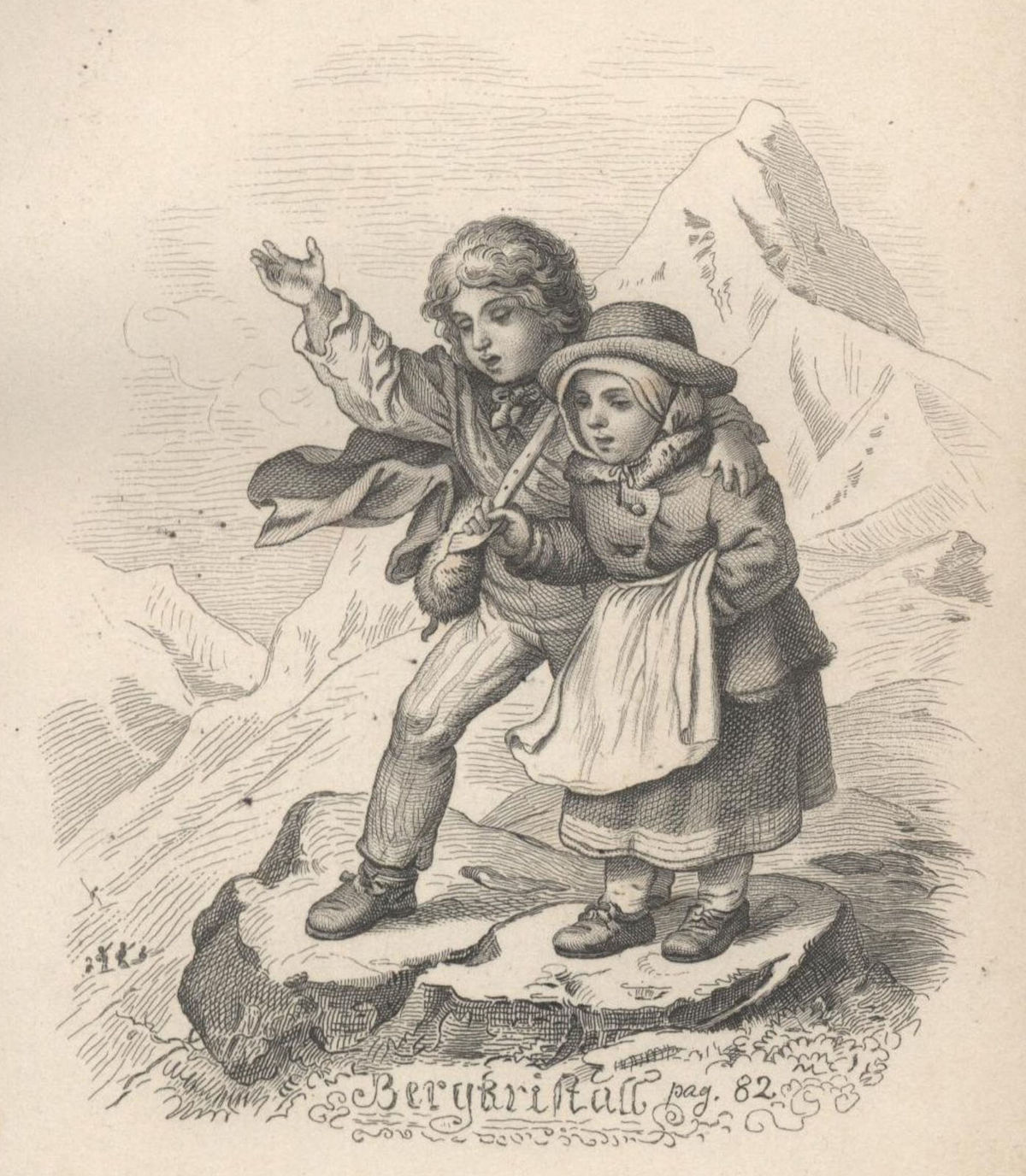
One winter, the day before Christmas, when in the valley of Gschaid early dawn had broadened into day, a faint clear-weather haze overspread the sky, so that the sun creeping up in the south-east could be seen only as an indistinct reddish ball; furthermore, the air was mild, almost warm in the valley and even in the upper reaches of the sky as indicated by the unchanging forms of the motionless clouds. So the shoemaker’s wife said to the children: “Since it is such a fine day and since it has not rained for a long time and the roads are hard, and since yesterday your father gave you permission, provided it was the right kind of day, you may go over to Millsdorf to see your grandmother; but first you must ask your father again.”
 
Perhaps one should say something about waiting so long for the narrative to begin.  This was much more prevalent in the 19th century, and actually opposed to the classical notion of storytelling by in medias res, which means to begin in the middle of things.  That means to start the story at a critical point in the narrative, or at least at the beginning of the action, and backfill the exposition.  Homer, Virgil, Dante, Shakespeare, and others do it regularly, but for some reason the 19th century authors weren’t fond f it.  As great a story teller as Dickens was, I don’t recall a work of his where he starts in the middle.  Certainly narrative thrusted at the beginning grabs the reader’s attention, and I would say most times that not it is the best approach to storytelling.  However, here because the themes are more of a hook than the story itself, I think Stifter does well with this extended opening exposition.

 There are two elements to the story that I want to highlight.  After getting their father’s permission to go off to their grandparents, the last thing the mother does is give them a blessing:

The lad slung a calfskin pouch over his shoulder by a strap—a perquisite deftly sewn by his father—and the children went into the next room to bid him farewell. They were soon back, and after their mother had made the sign of the cross over them in blessing, they skipped merrily off down the street.  (p.32)

Secularists might think of the blessing as superstitious, but Stifter doesn’t, as we see with so many of the providential events that lead to the children’s survival.  In a Catholic worldview a blessing endows a physical, spiritual, or supernatural gift upon a person, and while it does not guarantee an outcome (that would be superstition) it links the giver of the blessing and the receiver with the divine.  A blessing is also a sacramental, a sacramental being a sacred sign either abstract like a blessing or physical like holy water that brings us in contact with God.  (Don’t confuse a sacramental with a sacrament, which is a sacred sign implemented by Christ that confers a physical change to the soul.) Sacramentals are not just holy items, but things that are done with God’s love.  That calfskin pouch that Conrad uses is a sacramental since it was put together and given in love.  The mother bundling the children to protect them against the cold is another, and of course the blessing.  The Catholic worldview holds that there is a continuum between the spiritual and the physical, and so we see it in the story.  Notice the sacramentals later when the grandmother provides all sorts of gifts to the children.

Then she [the grandmother] bustled about here and there, packing to overflowing the lad’s calfskin pouch, besides stuffing things into his pockets. She also put divers things into Sanna’s little pockets, gave them each a piece of bread to eat on the way, and in the bag, she told them, were two rolls in case they became very hungry.

“For your mother,” she said, “I am giving you some well-roasted coffee-beans, and in the very tightly wrapped bottle with the stopper is some black coffee extract better than your mother herself usually makes; she can taste some just as it is; it is a veritable tonic, so strong the merest sip warms the stomach so that you cannot feel chilled even on the coldest of winter days. The other things in the bag, in the cardboard box wrapped with paper, you are to take home without opening.”  (p.36)

All these things aid the children in their survival.  All that food was not needed for a normal three hour hike, but it came in handy when they were lost.  Nor would they have received all that food if Conrad didn’t have the bag.  And that coffee allowed them to stay awake and not freeze to death during the overnight rest.  Providence uses the sacramentals to ensure survival.  And let’s not forget the father is a shoemaker who specialized in mountain shoes.  I don’t remember if it was mentioned in the story, but those mountain shoes the children were wearing had to be critical on the climbs and descent on the glacier.  By coordinating the sacramentals for a fortunate outcome, Stifter is presenting a world integrated with the divine.  When the children eat that bread the grandmother puts into Conrad’s bag, it’s most certainly suggestive of the Eucharist, and therefore God’s presence.  In town the priest had postponed high Mass (p. 72) because of the missing children, but the children eat the bread (p. 54) in a thanksgiving, and this happens just when children back in town are supposed to be receiving Christmas gifts (p. 56). 

Another part of the story we need to consider is the landscape and environment.  We see the harshness of nature; we see the spot the baker died and realize the danger is real.  One should begin to think, is this story an allegory?  And if so, what does it mean for the children to pass through a snowstorm unable to cognitively process the signs that would lead home, and all on Christmas Eve, for that matter?  Here is the moment they begin to realize they are lost.

“Will we be at the post soon?” asked Sanna. “I don’t know,” answered her brother. “This time, I can’t make out the trees, or the road because it is so white. We may not see the post at all, because there is so much snow it will be covered up, and hardly a grass-blade or arm of the cross will stick out. But that’s nothing. We’ll just keep straight on; the road leads through the trees and when it gets to the place where the post is, then it will start downhill and we keep right on it and when it comes out of the woods we are in Gschaid meadows; then comes the footbridge, and we’re not far from home.” (p.41)

But obviously they have drifted and are not on the way home. 

However, as they went, they could not tell whether they were going down the mountain or not. They had soon turned downhill to the right but then came to elevations leading up. Often they encountered sheer rises they had to avoid; and a hollow in which they were walking led them around in a curve. They climbed hummocks that became steeper under their feet than they expected; and what they had deemed a descent was level ground or a depression, or went on as an even stretch.

“But where are we, Conrad?” asked the child.

“I don’t know,” he answered. “If only my eyes could make out something and I could get my bearings.”

But on every side was nothing but a blinding whiteness, white everywhere that none the less drew its ever narrowing circle about them, paling beyond into fog that came down in waves, devouring and shrouding everything till there was nothing but the voracious snow.  (p.44)

As the children step through the strange rocks, as they climb up an unfamiliar ascent, as they enter a cave for shelter, the children have entered a new world, a different world.  Physically they are wandering lost in a snowstorm, but allegorically they have entered a world beyond.  Snow is sometimes taken as a symbol for death (winter, frozen, burial, universality as it falls covers everything), and death brings one into a new world.  And the children try to learn about this unfamiliar world.

It was a blessing the snow was dry as sand, so it shook off easily and slid from their feet and little mountain shoes without caking and soaking them.

At last they again came to something with form, immense shapes heaped in gigantic confusion, covered with snow that was sifting everywhere into the crevices; the children had, moreover, almost stumbled on them before they had seen them.  They went close to look. 

Ice—nothing but ice.

There were great slabs lying, covered with snow but on the edges glassy green ice showed; there were mounds of what looked like pushed-up foam, the sides dull but with inward glimmers as if crystals and splinters of precious stones had been jumbled together; there were, besides, great rounded bosses engulfed in snow, slabs and other shapes slanting or upright,--as high as the church steeple or houses in Gschaid.  (p. 48)

Despite the harshness of the weather, the children still get a blessing from the snow.  And it’s no coincidence that the simile for the height of the slabs is the church steeple, for the children have entered a divine world.  And the ice upon the rock slabs glimmers like crystals and precious stones, from which the story gets its title.  When Sanna suggests the ice was made by “a great deal of water,” Conrad disagrees, “No, it wasn’t made by water, it’s ice of the mountain, and always here since God made it so” (p. 48).  It is an amazing world, a world filled with God’s wonder.  Conrad continues,

“And down where the snow ends, you see all manner of colors if you look hard,—green, blue, and a whitish color—that is the ice that looks so small from down below because you are so far away, and that, as Father said, is going to be there as long as the world lasts.  And then I’ve often noticed that the blue color keeps on below the ice,—probably stones, I’ve thought, or maybe ploughed ground and pastures, and then come the pine woods that go down and down, and all kinds of rocks in between, then the green meadows, then the woods with leaves....”  (p.48-49)

Finally the children enter a cavern with a canopy of ice above them and a most intense color of blue: “But the whole cavern was blue, bluer than anything on earth, a blue deeper and finer than the vault of heaven itself, blue as azure grass with a faint light inside” (p. 50).  Why blue?  Blue, the color of the Virgin Mary, the color of heaven, here I believe is supposed to suggest harmony and order and the unity with the divine.  Providence led the children to a safe spot with no ice and enclosed from the elements just as it got dark.  Stifter is I think reaching for the theology of creation, where God’s handiwork of nature blesses humanity with goodness.

The children spend that holy night of Christmas safe and fed with the sacramentals from their parents and grandparents under an “arch of heaven [that] was an even blue, so dark it was almost black, spangled with stars blazing in countless array” (p. 57).  That arch of heaven, which gets elaborated several pages later (p. 61), suggests the rainbow as a sign from God in Genesis.

And so when the children on Christmas Day see a flame (representing Christ) coming toward them, it turns out to be the flag of a rescue team, and the first words from Philip the herdsman is “Praise be to God!” (p. 68).  When the children are led back to town to their anxious parents, the mother sees them first,

“Sebastian, they are here,” cried his wife.

Speechless and trembling, he ran toward them.  His lips moved as if to say something but no words came, he pressed the children to his heart, holding them close and long.  Then he turned to his wife and locked her in his arms, crying “Sanna, Sanna.” (p.70-71)

And then the father turns to the rescuers and says, “Neighbors, friends, I thank you” (p. 71).  So because of the children’s safe passage through the dangerous, divine world, we see then the resolution of the discords set out in the exposition.  The father does love his children, and the wife is now convinced of it; the grandparents are brought over and become unified with their daughter’s family; the wife is now embraced and become part of her new home town of Gschaid.  We see a unity of family, a unity of town, and a unity of the universe under God’s arch of heaven.  Having rescued the children, the town turns to go to church where the postponed Mass can now resume.


What a beautiful story.  This is how life should be!


Monday, January 1, 2018

Matthew Monday: My Little Drummer Boy

I’ve mentioned that Matthew is in the children’s choir at our parish, St. Rita’s Church, and there has been a tradition that the choir performs a little children’s concert on Christmas Eve, and in the past the choir has performed “Little Drummer Boy” with one boy playing the drums.  Well that boy has graduated and Matthew is the only boy in the children’s choir, and he so desired to take the mantle of the drummer for the song.

So you would think the choir would practice this at least a few times before the performance?  The music director planned to practice it twice, but she forgot the drum sticks for the first practice, and so all that was left was one practice.  As it turned out I went early to pick Matthew up at that practice and heard his first attempts.  Matthew kept screwing up. He's supposed to keep time for most of the song but his impulse is to go with the rum-pum-pum pum rhythm of the choir. And to make it more complicated on the third verse he is supposed to shift and join the rum-pum-pum pum, and then return to the slow beat for conclusion. Yikes, that's a bit much for an eight year old, and he only practiced it once. So we practiced it all weekend at home.

He had three performances altogether: The Christmas Eve concert with the children’s choir, with the adult choir at the 10:30 Christmas Day Mass as the communion hymn, and at the 12:30 Christmas Day Mass back with the children’s choir again during the communion hymn.  I videoed the first and third performances, and as it turned out the one I didn’t video was the flawless one.  Though I he played slightly better for the third performance, I think the video of the first came out better, so that’s the one I’ll post.

So here’s Matthew on the drums with the children’s choir on “Little Drummer Boy.”


I have to admit, I love that song, even though it’s kind of schmaltzy.  I always choke up on the first time I hear it during each Christmas season.  The thought of having nothing to give Jesus but one’s talent as best as one can perform is very touching.

After the third performance, the pastor mentioned Matthew by name and he got a round of applause. 

By the way, our altar was beautifully decorated with a new nativity set, I decided to take a picture. 


It’s a small, humble church, but we’re proud of it.

Saturday, December 30, 2017

Rock Crystal by Adalbert Stifter, Part 1

This is not a well-known Christmas story in the United States, but Rock Crystal by Austrian writer Adalbert Stifter is certainly better known in German speaking countries.  It was selected as a short read at my Catholic Thought book club at Goodreads as lighter read for the Christmas holidays.  My co-moderator at my Catholic Thought book club, who happens to be a German immigrant, told me about it.  At seventy-something pages it is not a novel and not a short story.  It falls into that middle ground called a novella.  But this is such a good novella I want to somehow make it better known in the English reading world.


Stifter, who lived from 1805 to 1868, was born in Bohemia in what is now the Czech Republic, was a noted writer of nature, a Roman Catholic, and highly regarded teacher who was hired to tutor children of aristocrats.  From what I’ve read, Stifter’s work is imbued with faith and morality as well as beautiful descriptions and settings of nature.  Rock Crystal, though not overtly theological, I would say has a Roman Catholic world view.  More on that later.

Thomas Mann, the Nobel Prize winning German writer from the 20th century was an admirer of Stifter and this particular work.  W. H. Auden, who wrote the Introduction for the Mayer and Moore translation, praises Stifter’s skill as a writer where he points out “What might so easily have been a tear-jerking melodrama becomes in his hands a quiet and beautiful parable about the relation of people to places, of man to nature.”  As one reads the work, one does realize the incredible brevity of the work, and yet it feels that one has read a long novel.  It feels epic in length but concise in delineation, a work of real artistry.

Rock Crystal is the simplest of stories, as Auden points out in my Introduction. Two siblings travel over a mountain ridge to their grandparent’s home on the morning of Christmas Eve, spend the day, and are sent off onto their journey home in time before dark set. On their journey back, an unexpected snow fall ensues and obscures their path, which causes the two children to get lost. They spend the night in the elements, survive, and continue to look for their way and are rescued by a search party Christmas Day. (Sorry if I ruined the suspense.)  And while the story is simple, there are a number of things going on that add complexity. Without those complexities it wouldn’t be much of a story; it would be an anecdote. We can get into those complexities as we go along.

Though there are no fixed divisions within the story, there are some natural divisions. There is a lengthy expository section, part of which describes the Austrian locale, part of which describes the towns and townsfolk in the setting, and part of which describes the children’s parents and their maternal grandparents, and the relationships between them. That all adds into the complexity.

There are two translations available, one by Lee M. Hollander and one by the combined duo of Elizabeth Mayer and Marianne Moore. I read the Mayer and Moore translation. Though the Hollander translation is in the public domain, and you can read it online at Gutenberg, hereThe text on that link provides several German novellas, but if you scroll down you can find Stifter’s.  Also Libravox has an audio version available free. I checked it out and it sounds pretty good. My edition has 76 pages with the introduction, but it reads faster than that. I read it in two or three sittings, which amounted to about three or four hours. I enjoyed, so much so I intend to read it again this week.


So let’s start with the beginning.  I find Stifter’s expository introduction fascinating.  He starts with town’s ceremonies for the Christmas holiday, then he describes the hamlet as situated in the mountains, then the village people in a general way, then he goes into a lengthy description of the mountains and landscape.  That leads to a description of the neck or col that separates the mountains, which leads into a description of the two villages on separate sides of the col, Gschaid and Millsdorf.  It’s not until 12 pages in of a 70 page story that specific inhabitants are mentioned.  Obviously there is some sort of significance to all that.

From the opening chapter:

One of the most beautiful of Church festivals comes in midwinter when nights are long and days are short, when the sun slants toward earth obliquely and snow mantles the fields: Christmas. In many countries the evening that precedes our Lord’s nativity is known as Christmas Eve; in our region we call it Holy Eve, the day following Holy Day, and the night between, Holy Night. The Catholic Church observes Christmas, birthday of our Saviour, by magnificent and holiest ceremonial. In most places, midnight as the very hour of his birth is solemnized by ritual of great splendor, to which the bells ring out their heartsome invitation through the still darkness of the wintry air; then with their lanterns, along dim familiar paths, from snow-clad mountains, past forest-boughs encrusted with rime, through crackling orchards, folk flock to the church from which solemn strains are pouring,—the church rising from the heart of the village, enshrouded in ice-laden trees, its stately windows aglow.

Right there you have three of the most important motifs that will be of importance to the theme: the sacredness of the season, the integration of nature with the life of the town, and the ceremony which binds the season with the life.  Ceremony is very important to story; shortly after Stifter goes on to describe a custom of giving gifts to the children:

It is the custom to present children with gifts the Blessed Christ-child has brought; given usually on Christmas Eve when dusk has deepened into night. Candles are lit, generally a great many, that flicker together with the little wax lights on the fresh green branches of a small fir or spruce tree that has been set in the middle of the room.

Again religion and nature with the tree branches are brought to the fore.  Also significant is that the people are unidentified.  Stifter could have started the story with Conrad and Sanna and their parents.  That would have been the natural thing to do, but he speaks here in a generic mode.  All the townspeople go through these rituals.  What Stifter is emphasizing is the harmonious integration of the townsfolk, Christianity, and their environment.  And you can see this as Stifter begins to focus on the hamlet, the church-spire being the prominent feature.  The main person of the village is the priest, who the villagers “regard with veneration.”  Stifter goes on to describe the village as “a separate world.”

The village people thus constitute a separate world, they know one another by name and are familiar with all the grandfathers’ and great-grandfathers’ tales. All mourn when anyone dies; all know the name of the new-born; they speak a language which is different from that used in the plain; they have their quarrels and settle them; they help one another, and if anything unusual happens, come flocking together.

The village people are said to adhere “to the ancient ways.”  This is a village after my own heart. 


What I’ve described so far is a sense of harmony.  You can’t have a story with only harmony and without introducing a disruptive element that causes a disequilibrium, resulting in tension.  The children losing their way through the mountains in a snow storm is the disruptive element, but there is a greater context which makes the story transcend the lost and found adventure.  The second part of the exposition, describing the histories of the two children’s parents and grandparents, introduces the tension that will be resolved back to a harmonious state.  Let me skip over the landscape description for now, but I’ll come back to show how it’s all symbolic. 

Let’s start with the children’s father, as Stifter does.  He is a shoemaker from Gschaid, but in his youth he was not the model citizen he grew to be, and in contrast to his own father. 

The shoemaker on the square, before he inherited his house, had been a chamois-poacher and in general, so people said, not too model a youth. In school he had always been one of the best pupils. Later he had learned his father’s trade, and after working as a wandering journeyman, had finally come back to the village. But instead of wearing a black hat as becomes a tradesman—such as his father had worn all his life—he perched a green one on his head, stuck every available feather in it, and strutted about wearing the shortest frieze coat in the valley, whereas his father had always worn a dark coat, preferably black—since he was a man of trade—and invariably cut long. The young shoemaker was to be seen on every dance floor and at every bowling alley. If anyone tried to reason with him, he just whistled a tune. He and his marksman’s rifle were at every shooting match in the neighborhood and sometimes he carried home a prize—treasured by him as a great trophy. The prize was usually a set of coins artistically arranged. But the shoemaker, in order to win it, had to disburse many more similar coins, in his usual spendthrift fashion. He went to all the hunts in the neighborhood and had quite a reputation for being a good marksman. Sometimes, however, he fared forth alone with his blunderbuss and spiked shoes, and it was rumored that he had once received a serious wound on his head.

Poacher, spendthrift, wayward, even perhaps prodigal, the young shoemaker stands in contrast to the harmony inherent to the village.  But he changes, and he changes to be able to marry the beautiful girl over the col in the town of Millsdorf, the daughter of the prosperous dyer.
 
Some time after the death of his parents when he had become proprietor of the house where he now lived all alone, the shoemaker changed into a wholly different person. Whereas till then he was always rollicking about, he now sat in his shop, hammering away on sole-leather, day and night. He boasted that no one could make better shoes and footgear, and engaged only the best workmen whom he nagged and pestered a good deal as they sat at their work, making them follow his instructions and do exactly as he told them.

The shoemaker’s youthful eccentricities had caused a discord in the town’s natural harmony, but the nature of the town’s life—and a desire for marriage, which by the way is a church sacrament—caused the discord to be resolved.  Ultimately he wins over the dyer’s family and the daughter, marries her, and takes over to his town of Gschaid. 

But now a new set of discords arise.  Being new to Gschaid, which has very different customs from Millsdorf and being away from her family, she feels isolated, even alienated. 

Since the people of Gschaid seldom leave their valley and almost never go to Millsdorf, from which they are separated by mountain and by customs—and since, furthermore, no one ever leaves his valley to settle in a neighboring one—although removals to great distances occur—and lastly since no girl ever leaves her valley except on the rare occasion when, obeying the dictates of love, as a bride, she follows her husband into another valley—so it came about that after the beautiful daughter of the dyer of Millsdorf married the shoemaker of Gschaid she was still regarded by the people of Gschaid as a stranger; and although they were not unkind to her, and even loved her for her charm and virtue, there was always something, reserve or a sort of shy respect, that kept her from enjoying the same familiarity and warm intimacy that existed between the people that belonged to the valley.

And that’s not the only discord.  After bearing two children, the wife “felt, however, that he did not love the children as much as she thought he ought to, and as she herself loved them; for he looked so serious most of the time and was always preoccupied with his work. He rarely petted or played with them, and always addressed them quietly as one speaks to grown persons.” 

And that completes the exposition of the circumstances leading up to that Christmas Eve where the children venture out to their grandparents in Millsdorf. 

But let’s now look at the description of the mountains, and what it means to the themes in the story.  We are told that the dominating mountain is in the shape of two “horns.” 

South of the village you see a snowy mountain with dazzling horn-shaped peaks, rising, as it seems, from the house-tops themselves, but actually quite far away. All year round, summer and winter, there it is with its jutting crags and white expanses, looking down upon the valley. As the most prominent feature of the landscape and ever before the eyes of the villagers, the mountain has been the inspiration of many a tale.

We are told of the rocks and snow, brooks and meadows, and the steep inclines and sharp descents, all of which pose a danger to the traveler, and we are told of an actual death, a baker, carrying his basket.  But the most prominent feature of the landscape is the col.

Ascent of the mountain is made from the valley. One follows in the southerly direction a smooth, well-made road that leads by a neck or “col” into another valley. A col is a mountain-range of moderate height, connecting two larger, more considerable, ranges; and following it, one passes between the ranges from one valley into another. The col which links the snow-mountain with the corresponding range opposite, is thickly studded with pines. At about the highest point of the road before it descends into the further valley, stands a little rustic memorial.


That memorial is a marker of where the baker died, right on the col.  So picture this: you have two peaks, the “horns” and in between is a neck or col of some elevation too, though not as high as the horns.  On one side of the col is the valley that leads to Millsdorf, and the other is the valley that leads to Gschaid.  Two horns, two valleys, two towns, two cultures, two families.  Some writers like to work in an aesthetic of twos and some of threes.  Stifter is clearly working with twos, and the aesthetic of twos is one of a dialectic, and a dialectic resolves into a synthesis.  The young shoemaker had a division with him of a person born to a tradition but felt the longing of self-realization.  But the desire for marriage and the act of marriage synthesized him to the standout craftsman of his trade.  The story can now take place to synthesize the new divisions.