"Love follows knowledge."
"Beauty above all beauty!"
– St. Catherine of Siena

Sunday, April 28, 2013

Book Excerpt: Catherine of Siena by Sigrid Undset, Part 4

You can find part 1 of my blogs on this biography here, part 2 here, and part 3 here
 
One last excerpt from the biography, this time with the focus on the author.  I’ve mentioned that Sigrid Undset went from an agnostic at best to a Roman Catholic convert in mid life.  She experienced the full catastrophe of the Second World War, losing her home and her son’s life.  There are a number of places in her biography of this saint from the middle ages she personally speaks from a perspective of one who has lived through the first half of the twentieth century, suggesting that we here in the modern world have much to learn from Catherine.  I found those passages interesting and worth noting.

Here is a most moving passage where Undset, starting from Catherine’s vision of drinking blood from the actual side of Christ, contemplates the remedy Catherine would proscribe to horrific life of the modern condition. 

In our own lifetime we have learned to know the smell of rotting corpses on battlefields and in bombed towns; we know of the stinking sores and boils of prisoners from concentration camps, where dead and dying were made to lie on beds as wretched as the one Catherine had chosen for herself.  We have poured out oceans of blood and tears, both of the guilty and the guiltless, while we hoped against hope that this blood and these tears could help to save a world reeling under the weight of its miseries.  And how little have we achieved of the great things we dreamed!  Yet we ascribe it to the confused ideas of the time she lived in and her own dark vision of Christianity, when Catherine intoxicated herself on the blood of Christ—that blood which would put an end to human bloodshed, if only we could agree to receive it as redemption from our bloodthirsty passions, our insatiable lust for imagined gain for ourselves projected onto other nations or classes.  Indeed, many Catholics think in this way.  The strong-willed, brave and strangely optimistic girl who handled the powerful men of her time so masterfully, who had an unusual understanding of the characters of the men and women among who she lived, who succeeded in making peace between many of her unruly townsmen, who in fact on one or two occasions prevented war, and on many put an end to bloody feuds—she would answer us as she answered her contemporaries in her letters and conversations and in the Dialogue: that the blood of Christ was the only source of her own courage and strength and wisdom, of her amazing and indomitable joy of living.  She would say to us, Drink of it with the lips of your souls, as the saints in their visions seemed to drink it with their lips of flesh; assuage your thirst in the love which streams from God’s holy Heart—then there will be an end to the vain shedding of man’s blood by the hand of man.  In her visions Catherine saw God’s fire fall from heaven, like a rain of blazing light and burning warmth: can we really understand anything of her experience, we who have seen the fire of hate falling from the clouds, who fear in our hearts for the day when an even more destructive fire, invented by an even more bitter hatred and more violent passions, shall rain down over us and our children?  For us, Catherine would have only the same message which she brought to her contemporaries, she would know only of the same remedy for our misery—the blood of Christ, the fire of God’s love, which burns up self-love and self-will, and lets the soul appear, beautiful and full of grace, as it was meant to be when God created it.   [p.83-5]

For Undset, the remedy that Catherine would offer is the remedy that all the saints taken in their comprehensive whole offer this age.  It is in our bond of a common humanity that they serve as guide posts for us.  The wars and devastation of our age have shown us that suffering is part of our condition.  It is in our response to suffering that distinguishes people, but our Catholic faith tells us that suffering is not to be shunned.

The fact that the saints have been so willing to suffer, that they often in fact seemed to be in love with suffering and chose it as their inheritance on earth, is often looked upon by non-Catholics—that is to say non-Catholic Christians—as incomprehensible, and, in the eyes of many, extremely unsavory.  If God is goodness, if Christ died on the cross to save us from our sins, why should Christians have to suffer—and suffer not only merely ordinary opposition, which may have an educational value for the sufferer, but, though innocent, suffer for other’s sins?  One thing is certain, that all the saints have maintained that they suffer for their own sins, although we cannot see it otherwise than that they suffered for the sins of others.  It is only among the saints that we find any who have the right to say, “Nothing human is foreign to me.”  Nevertheless, we may all, at any given moment, find that we have to suffer for what in our eyes are exclusively the sins of others.  Two world wars, and their aftermath, spread over almost the whole of the world, should have made this truth understandable—emphatically understandable—even for the simplest and most self-satisfied of souls.  [p.331]

What the saints show us is that through suffering and a holy life we can achieve wholeness, “unity with the Origin of life.”  Suffering is not wasted; a holy life will find its reward.

The saints have always known the power of good is something quite incalculable.  When they renounce even pure and harmless happiness on earth, that they might have none of the hindrances interposed by care for their own or another’s material needs, in their struggle to achieve unity with the Origin of life, they knew if He filled them with His grace and mercy, His superfluous gifts—gifts bringing health and life—would overflow into the lives of other men—even to people outside the range of their knowledge, beyond their sight and the field of their activity.  St. Catherine must have felt discouraged when she saw no concrete results of her efforts for certain individuals, both men and women, through prayer and attempts at persuasion.  But she never wavered; she gave of herself until her physical life was used up, in a fight whose final results she was as sure of, as she was sure that she would not see many victories on the battlefield of this world.  But in fact Our Lord has never made any promises regarding the triumph of Christianity on earth—on the contrary.  If we expect to see His triumph here, His own words should warn us: “The Son of Man, when He cometh, shall he find, think you faith on earth?”  He did not tell us the answer.  [p. 334]

Finally what the saints and Catherine offer us is wisdom, a wisdom achieved by seeing beyond the material, beyond human constructions, beyond the human ego. 

It is not given to us to know what Christendom’s final fate on earth will be.  The gates of hell shall not overpower His Church, but those who wish to break out of it have full freedom to do so.  The real question is: when the conditional reality which we call the material world withers away, who will have won real life in all eternity in the land of the living?  Even the people of our times, who have magnified mankind’s ineradicable trust in the things which we can see, touch, and enjoy with our senses, and made their articles of faith out of materialism, self-aggrandizing humanism, collectivism, or whatever one likes to call it—even they have caught a glimpse of how utterly worthless all material things are.  In light of the split atoms, solid objects become as it were transparent, evanescent.  But who can say how mankind will react to the new discoveries it makes?  We sorely need the wisdom of the saints.

Has the world changed much since Undset wrote that in the late 1940’s, post World War II and at the onset of the Cold War?  Those wars of devastation have passed, and perhaps we can breathe a sigh of relief.  But the culture, if anything has deteriorated even further.  Nihilism has taken root; self-doubt in our heritage, in the existence of God, in noble values, in the dignity of the human person has only expanded.  Nazi and Soviet holocausts may be over but in our very democracies that stand on the ideal of human rights the slaughter of the unborn go on at holocaust proportions.  Undset showed us how Catherine of Siena emptied her ego into that of Christ crucified.  That forgoing of one’s ego is what is sorely lacking today.  I don’t know if Undset would be surprised (probably not) but I’m sure she would have been saddened.
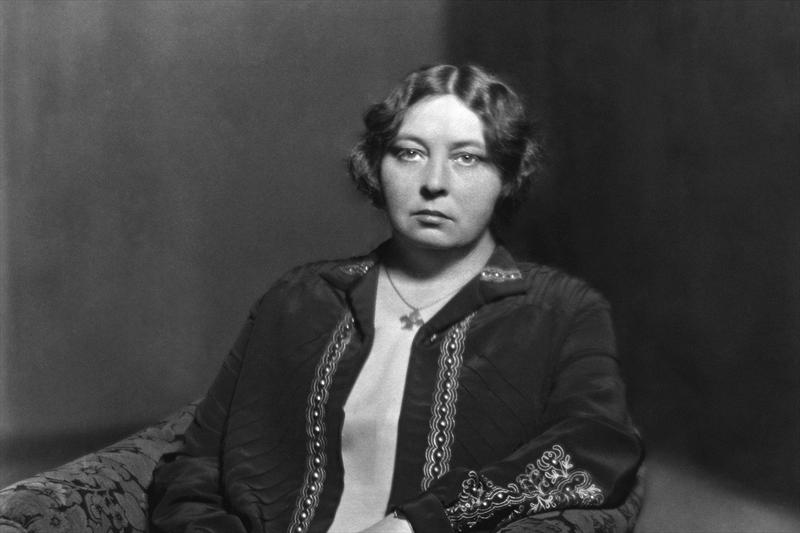


Not sure how old Undset was here, but it’s obviously in middle age.  I particularly like this photo since it shows her proudly displaying her cross pendent.  She was a lovely woman.

 
If you wish to find more on St. Catherine of Siena, these links are most interesting:

I’ve mentioned this all encompassing St. Catherine of Siena site, Drawn By Love.

Here is an article from Crises Magazine proclaiming Catherine “The First Catholic Feminist?” by Christopher Check:

And one of my favorite Catholic bloggers, Jimmy Akin, has just put out a piece, “8 Things to Know About St. Catherine of Siena” just in time for her feast day:

 
Tomorrow, April 29th is St. Catherine’s feast day.  Let us appeal to her for her prayers.


Tuesday, April 23, 2013

Music Tuesday: "The Way You Look Tonite" By Frank Sinatra

I was at a wedding this weekend, and as in most weddings quite a few of Frank Sinatra's music is played.  I love Franky.  He's my all time favorite singer in any music genre, truly the finest American singer that I can think of.  I can listen to Sinatra all night long.  So here's one.


Some day, when I'm awfully low,
When the world is cold,
I will feel a glow just thinking of you...
And the way you look tonight.

Yes you're lovely, with your smile so warm
And your cheeks so soft,
There is nothing for me but to love you,
And the way you look tonight.

With each word your tenderness grows,
Tearing my fear apart...
And that laugh that wrinkles your nose,
It touches my foolish heart.

Lovely ... Never, ever change.
Keep that breathless charm.
Won't you please arrange it ?
'Cause I love you ... Just the way you look tonight.

Mm, Mm, Mm, Mm,
Just the way you look to-night.


Monday, April 22, 2013

Matthew Monday: Matthew Proposes Marriage

We had to go to a wedding in Pittsburgh, and we spent the weekend there.  Wed had two double beds in the room for the three of us, and we expected Matthew and his mother to sleep in one and I would get the other.  After all my wife makes a snide comment to Matthew that he wouldn't be able to sleep with Daddy's snoring.  Nonetheless Matthew chose to sleep with me.  After the lights were out and I had turned over with my back to him, Matthew pulls me over and whispers, "Daddy I want to tell you a secret."  I kind of half turn back and said, "What?"

He climbed over my shoulder to face me.  "I want to tell you that we're friends," he whispered.

"Oh, thank you.  Why did you tell me?"

"Because we're going to have adventures together." 

"OK," I whispered back.  I thought that was a neat male bonding moment.

Next day when he kind of understood what marriage means, he tells his mother rather dramatically that he's "going to marry" her.  "You are?" his mother asks.  "Then you better go out and buy me a ring as soon as you can." 

Pulling out a quarter, Matthew says, "OK.  Is this enough?"


Later that night, the night of the wedding we were there to attend, the baby sitter we arranged to take care of Matthew showed up.  She was a sweet young lady who was a friend of the bride's family, and she apparently had a nice way with children.  Matthew took to her immediately.  She baby sat from four-thirty to ten-thirty at the hotel room.  When we got back to the room, Matthew had gotten Ellen (her name) to sit with him in his "man-cave."  He had taken one of the decorative spreads from the bed and placed it over a table so that it formed a sort of cave (he's done this at home) and placed his stuffed animals in there and invited her in...lol.  They had read nursery rhymes and stories and played with alphabet cards.  He also made her race back and forth up the length of the room with him.  What a little lady's man.  When we asked him if he had a good time, he said, "I'm going to marry Ellen." 

So there you go.  From male bonding to marrying his mother to dumping his parents for a cute chick all within 24 hours.

Friday, April 19, 2013

Faith Filled Friday: Thanksgiving Prayer

Well, my mother had her operation on her finger Wednesday.  You can read about the need here.  All went well.  The only hangup was trying to get one of her earrings off.  She was to take all jewelery off, but no matter how we tried we couldn't unclasp the right one.  The nurse put tape over it, something about it getting too hot during the operation and burning her.  I can't say I understand.  It had no bearing on the operation.

The operation took under an hour.  She went in at 12:25, and I went out to get lunch.  I also took a little walk since it was such a beautiful spring day here.  I got back to the waiting room at 1:20 and the doctor had gone.  He had stuck his head out to look for me and I wasn't there.  Mama was in a recovery bay sipping a cup of coffee and looking like she had slept pleasantly.  I had them call the doctor for me and he said it all went well.  The tendon/ligament (not sure if that's the same thing) had torn and was in need of reconstruction.  I think he used that word, but I'm not sure.  Then he put pins in to hold it together for the next ten days when he will see her again.  We were home an hour later.

Thank you for all those who prayed for her.  The finger will be the finger, but my biggest concern was her going under sedation.  One never knows with that. 

And finally I thank the Lord for this little blessing.  His blessings are too numerous to count.  Special devotion to the Holy Family on this instance.  I'll end with this Thanksgiving Prayer.


Blessed are You, loving Father,
For all your gifts to us.
Blessed are You for giving us family and friends
To be with us in times of joy and sorrow,
To help us in days of need,
And to rejoice with us in moments of celebration..

Father,
We praise You for Your Son Jesus,
Who knew the happiness of family and friends,
And in the love of Your Holy Spirit.
Blessed are you for ever and ever.

Amen.

Prayer source from here.


Wednesday, April 17, 2013

Notable Quote: Walt Whitman

Well, Walt Whitman has been on my mind this week.  He was such a good soul.  He never had an unkind word for people, even those he opposed.  He embraced all people, even those from the South, though he was staunchly against slavery and supported the Union as a nurse to the wounded during the Civil War.  Last year I completely read his Death-Bed edition of Leaves of Grass, all 500 plus pages.  Leaves of Grass, first published in 1855, was his great work that he kept republishing with additional poems.  I think there were up to nine editions of publications, with the concluding edition dubbed "The Death-Bed" edition because it went into publication just prior to Whitman's death.  With each addition Whitman added and revised the poems, but unfortunately not all the revisions were improvements.  Sometimes the original poem is superior.  What I really like about Whitman was how he embraced humanity.  He loved everyone.


The proof of a poet is that his country absorbs him as affectionately as he has absorbed it.


In his life time he was not appreciated.  That really disappointed him.  He loved the United States, and you can see that in many of his poems.  He was consciously the poet of America, embracing the land, the people, the life-style of his day, and most importantly the particular English language we call the American language.  He did for the American language what Shakespeare did for British English and Dante did for Italian.  He became our national poet.  It took a while, but after his death the country did embrace him as he embraced the country.


By the way, he was frequently photographed in his lifetime.  There are lots of great photos of him.  It was hard to pick one.

Sunday, April 14, 2013

Poetry: "When Lilacs Last in the Dooryard Bloom'd" by Walt Whitman

Today April 14th is, if I did my arithmetic correctly, the 148th anniversary of the assassination of Abraham Lincoln.  That factoid, coupled with Jeanette, my fellow blogger at J’s Café Nette, writing  about her lilac in a recent blog  made me think of the poem I always think of this time of year, Walt Whitman’s “When Lilacs Last in the Dooryard Bloom’d.”  Normally the poem would come to me on its own, since I can’t help recall it when I see my mother’s dwarf lilac in bloom.  However this year it seems to be blooming late up here.  It’s been a cool spring and things are behind.  No perfuming blossoms yet, so the poem was out of mind until Jeanette mentioned it.

You may know that the poem was written on the occasion of Lincoln’s assassination .  Whitman had developed a profound love of Lincoln since he caught a glimpse of him in Washington in 1861, totally gave of himself during the Civil War as a nurse to aid the wounded Union soldiers, and when Lincoln was assassinated in 1865 suffered a most profound despair.  He wrote this poem as an elegy for the fallen leader.

 The poem is nearly nine pages long in my Leaves of Grass (Whitman’s opus of all his poetry) edition, so I’m not going to quote the entire piece.  I’ll highlight the major moments and try to give you an appreciation of its greatness.  But you can read the entire poem at my favorite poetry site, PoetryFoundation. 

 Whitman is not a difficult poet to comprehend.  For the most part he tells you exactly what he means to convey.  His symbols are usually not multifaceted.  His genius is in his language, rhythm, and imagery.  The poem is divided into 16 stanzas with the usual Whitman free verse of irregular meter and irregular line length.  Whitman is not big on formality.  Let’s start with the first stanza.


1

WHEN lilacs last in the dooryard bloom’d,

And the great star early droop’d in the western sky in the night,
I mourn’d, and yet shall mourn with ever-returning spring.
 

Ever-returning spring, trinity sure to me you bring,
Lilac blooming perennial and drooping star in the west, 5
And thought of him I love.
An elegy is a poem of a fallen hero with an appeal for eternal remembrance.  Lincoln is the great star Whitman is quite explicit about it in the second stanza, and lilacs will be eternally returning at the same time of year in remembrance.  Throughout the poem there is a religious undertone that suggests Lincoln to be a Christ-figure whose sacrificial death brings new life to the nation.  And so Whitman collects the bloom, the star, and his love into a “trinity.” 


Let’s look at the next three stanzas:


2

O powerful western fallen star!

O shades of night—O moody, tearful night!
O great star disappear’d—O the black murk that hides the star!
O cruel hands that hold me powerless—O helpless soul of me! 10
O harsh surrounding cloud that will not free my soul.
3

In the dooryard fronting an old farm-house near the white-wash’d palings,

Stands the lilac-bush tall-growing with heart-shaped leaves of rich green,
With many a pointed blossom rising delicate, with the perfume strong I love,
With every leaf a miracle—and from this bush in the dooryard, 15
With delicate-color’d blossoms and heart-shaped leaves of rich green,
A sprig with its flower I break.
4

In the swamp in secluded recesses,

A shy and hidden bird is warbling a song.
Solitary the thrush, 20
The hermit withdrawn to himself, avoiding the settlements,
Sings by himself a song.
Song of the bleeding throat,
Death’s outlet song of life (for well dear brother I know,
If thou wast not granted to sing thou would’st surely die).


In the second stanza, Whitman connects Lincoln to the star and his emotional connection.  In the third he fleshes out the lilac bush, pointing out the heart-shaped leaf, suggesting love, and ending with a very suggestive broken sprig.  In the fourth stanza he introduces a new character, a shy little bird singing.  From other Whitman poems, the little thrush is a stand-in for the poet himself, and even here it’s not so subtle.  The bird “sings by himself a song,” which echoes Whitman’s famous poem “Song of Myself.”

 
Stanzas five and six dramatizes the journey of Lincoln’s coffin from Washington to Lincoln’s home town of Springfield, Illinois, a procession across the nation which actually happened.  Whitman ends the procession with offering that sprig of lilac he broke to the coffin as people tend to throw flowers into an open grave.  In stanzas seven and eight Whitman consecrates the death as a sacred death, that Lincoln’s life and now death was connected to something beyond earth, divine providence.  That is why Whitman chooses the falling star to symbolize Lincoln.
 

Stanzas nine and ten he returns to the singing bird, wondering how he shall sing for the fallen man.  What Whitman decides on is to let the bird sing of the nation, all it’s varied elements.  In stanzas 11, 12, and 13 he sings of farms and hills and a flowing river, then to Manhattan with its spires, and then to swamps and prairies.  The song—the death song—is knitting the nation together, as the tragic death of a president can do. 

And then we come to what I think is the climatic stanza, fourteen.  Let me cite it all.


14

Now while I sat in the day and look’d forth,

In the close of the day with its light and the fields of spring, and the farmers preparing their crops, 110
In the large unconscious scenery of my land with its lakes and forests,
In the heavenly aerial beauty (after the perturb’d winds and the storms),
Under the arching heavens of the afternoon swift passing, and the voices of children and women,
The many-moving sea-tides, and I saw the ships how they sail’d,
And the summer approaching with richness, and the fields all busy with labor, 115
And the infinite separate houses, how they all went on, each with its meals and minutia of daily usages,
And the streets how their throbbings throbb’d, and the cities pent—lo, then and there,
Falling upon them all and among them all, enveloping me with the rest,
Appear’d the cloud, appear’d the long black trail,
And I knew death, its thought, and the sacred knowledge of death. 120

Then with the knowledge of death as walking one side of me,

And the thought of death close-walking the other side of me,
And I in the middle as with companions, and as holding the hands of companions,
I fled forth to the hiding receiving night that talks not,
Down to the shores of the water, the path by the swamp in the dimness, 125
To the solemn shadowy cedars and ghostly pines so still.

And the singer so shy to the rest receiv’d me,

The gray-brown bird I know receiv’d us comrades three,
And he sang the carol of death, and a verse for him I love.
From deep secluded recesses, 130
From the fragrant cedars and the ghostly pines so still,
Came the carol of the bird.

And the charm of the carol rapt me,

As I held as if by their hands my comrades in the night,
And the voice of my spirit tallied the song of the bird. 135

Come lovely and soothing death,

Undulate round the world, serenely arriving, arriving,
In the day, in the night, to all, to each,
Sooner or later delicate death.

Prais’d be the fathomless universe,
140
For life and joy, and for objects and knowledge curious,
And for love, sweet love—but praise! praise!
For the sure-enwinding arms of cool-enfolding death.
Dark mother always gliding near with soft feet,
Have none chanted for thee a chant of fullest welcome? 145
Then I chant it for thee, I glorify thee above all,
I bring thee a song that when thou must indeed come, come unfalteringly.

Approach strong deliveress,

When it is so, when thou hast taken them I joyously sing the dead,
Lost in the loving floating ocean of thee, 150
Laved in the flood of thy bliss O death.

From me to thee glad serenades,

Dances for thee I propose saluting thee, adornments and feastings for thee,
And the sights of the open landscape and the high-spread sky are fitting,
And life and the fields, and the huge and thoughtful night. 155

The night in silence under many a star,

The ocean shore and the husky whispering wave whose voice I know,
And the soul turning to thee O vast and well-veil’d death,
And the body gratefully nestling close to thee.

Over the tree-tops I float thee a song,
160
Over the rising and sinking waves, over the myriad fields and the prairies wide,
Over the dense-pack’d cities all and the teeming wharves and ways,
I float this carol with joy, with joy to thee O death.


Here the land, the houses, the streets, the sea all come into the song of death, into “the sacred knowledge of death.”  Here while holding hands with his companions Whitman meets “the receiving night that talks not,” or in different words, the universal providence.  The word “companion” is nicely chosen too.  It was originally a religious word, its Latin origin “com pane,” with bread, or members of the Christian union of Christ’s breaking of bread.  The italics in the poem are the bird’s actual voice, and it’s a prayer almost in the form of St. Francis of Assisi’s “Canticle of Brother Sun.”  This little section is so beautiful: “Prais’d be the fathomless universe,/For life and joy, and for objects and knowledge curious,/And for love, sweet love—but praise! praise! praise!
 

In stanza 15 the song alludes to the nation’s recent history of strife and war.  And finally let’s end with stanza 16 where by Lincoln’s death and through the rising birdsong the poet, and by implication, the nation now goes forward with heaven’s blessing.

 
16

Passing the visions, passing the night,

Passing, unloosing the hold of my comrades’ hands,
Passing the song of the hermit bird and the tallying song of my soul,
Victorious song, death’s outlet song, yet varying ever-altering song,
As low and wailing, yet clear the notes, rising and falling, flooding the night, 190
Sadly sinking and fainting, as warning and warning, and yet again bursting with joy,
Covering the earth and filling the spread of the heaven,
As that powerful psalm in the night I heard from recesses,
Passing, I leave thee lilac with heart-shaped leaves,
I leave thee there in the door-yard, blooming, returning with spring. 195

I cease from my song for thee,

From my gaze on thee in the west, fronting the west, communing with thee,
O comrade lustrous with silver face in the night.

Yet each to keep and all, retrievements out of the night,

The song, the wondrous chant of the gray-brown bird, 200
And the tallying chant, the echo arous’d in my soul,
With the lustrous and drooping star with the countenance full of woe,
With the holders holding my hand nearing the call of the bird,
Comrades mine and I in the midst, and their memory ever to keep, for the dead I loved so well,
For the sweetest, wisest soul of all my days and lands—and this for his dear sake, 205
Lilac and star and bird twined with the chant of my soul,
There in the fragrant pines and the cedars dusk and dim.

 
Whitman ends it with lilac, star, and bird, forever caught within his soul.  A truly inspired poem.

Saturday, April 13, 2013

Personal Story: Mama’s Finger


Let’s start with my mother being seventy-nine.  She’s a strong seventy-nine, but still she’s actually closer to her eightieth birthday than the one she just passed.  She has slowed down since her hip replacement from four years ago, but still she gardens and walks, and now that my brother has been away she’s living alone.  Living alone actually gives her less to do because when my brother and his wife are at her house, she cooks and cleans for them as if she was forty years old and they were teenagers.  She’s one of those tireless Italian ladies that just need to be doing something.

She lives about a half mile from my house.  I stop there every day on my way home from work, just for five or ten minutes to make sure everything is OK.  In the spring and summer she’s usually in the back gardening, and sometimes digging trenches and moving buckets of dirt.  Half the time I shake my head and ask her why.  She just does.  Sometimes after digging a trench where rain puddles up, she’ll redo it if she doesn’t feel like it came out right.  Some of our biggest arguments are over what I see as meaningless heavy labor.  She’s incorrigible.  She’ll tell me this will be the last time and I find out she did it again any way.  Or I just catch her at it.

I stopped there last Thursday and no one answered the door.  I knocked and rang the bell for ten minutes.  The side of the house was nicely raked with dirt turned over.  I used my cell phone to call.  I heard her phone ring.  Still there was no answer.  I keep her keys, and so decided to open the door.  I did and called inside.  No answer.  At her age I worry about her collapsing and either being unconscious or incapacitated.  I went through each room and she wasn’t anywhere to be found.  I sighed. 

The next possibility is she walked about a mile away to where the commercial street resides.  There she could have gone to several stores.  Under typical conditions she would have planned walking there and being home at the time I normally get home from work.  But there have been a few times where she didn’t plan that well and was out.  Those times I drove toward that commercial boulevard and found her walking along the way.  She would be grateful for the ride home.  So I drove and didn’t come across her.  I drove back and didn’t see her.  I stopped back in her house—nothing.  I drove back toward the boulevard again and this time I stopped at the little supermarket where she might be.  I walked through every aisle—nothing.  I gave up.  I called my wife (at this point I was late for home) and told her what had happened and that I was on my way home.  I got about a block when my cell phone rang. 

“Are you Maria _____’s son?” asked the voice.

“Yes.  Where is she?”

“The Emergency Room at Staten Island University Hospital.”

 
“What?  What happened? ”

“Don’t worry.  No need to get worried.  She fell.”

“How is she?”

“Don’t get alarmed.  It’s scratches and bruises and a dislocated finger.  When can you get here?”

“I’ll be right there.  Ten, fifteen minutes.”

I called my wife and told her I was headed straight there, raced over.   The Emergency Room was packed and they had beds in the aisles, and I found her in a bed in an aisle.  She looked rather comfortable laying there.  Her right hand was wrapped and she held it up.  The doctor was happy to see me.  My mother doesn’t speak enough English to really understand everything.  I guess they understood her since communication of pain is rather easy.  She had been there at least three hours.

So what happened?  She had been raking the backyard and needed to put down grass seed.  She had walked to that commercial boulevard to the hardware store and bought grass seed.  When she was just a few blocks from home she just fell.  She’s not sure why, but she fell forward catching herself with her hands and apparently also taking the blow with her chest.  A couple living nearby saw her fall, tried to help her up, but decided to call an ambulance.  They even checked up on her at the hospital. 

Her chest hurt all the way around.  They did an EKG and chest x-rays.  Her heart was fine and no ribs were broken.  She had scratches and bruises on her hands and legs.  The tips of several of her exposed fingers had band-aids.  She was grateful (with a weird sort of pride) that she did not scratch or hurt her face.  Her right hand had a splint with bloody bandages.  The doctor said she dislocated at the mid knuckle.  She came in with the finger bent in the middle literally at a right angle outward.  Yikes.  They had straightened it, and now they were going to stick it back into the knuckle.  When they unwrapped it I squirmed, especially my face.  The finger was swollen double the size, the color of the skin looked pale grey, and there was a slit down the inside that you could see into the finger.  The doctor shoved the front half of the finger into the back half.  It wasn’t going in right, so they needed to do it several times.  Finally they got it in, then x-rayed again, and then when they were happy, stitched the gaping wound. 

They finally let her out around eight o’clock with a follow up with a hand surgeon.  As I helped her with her coat, which had been lying on the hospital bed beside her, I noticed a plastic shopping bag that was underneath the coat.  I looked in the bag and it was a big bag of grass seed.  LOL!  She still had the bag all this time, ambulance ride and all.  The white plastic was smeared with blood. 

You would think that would be the end of the story, but no.  I checked in on her the next day, and there she was in the backyard, smeared with dirt, her right hand full of bandages and inside a plastic bag to prevent it from getting dirty.  “What the hell are you doing?” I screamed.  “I can’t believe you’re doing this.”  “I had to get the seed down,” she explained.  “It’s going to rain tomorrow.”  And then she asked me to help her with her ice pack.  We walked inside and she sat down.  I assumed she had an ice pack inside the bag around her hand.  But she lifted her pants leg up and had a wrap with ice around her calf. 

“Is it swollen?” she asked. 

It was slightly swollen.  “What happened here?”

“A dog bit me.”

“What?” 

“A little dog.  It bit me.”  She extended her arm and with her other hand showed the length of the dog to be from her fingertips to the mid forearm.  “A little dog.  No bigger than a rat.  It bit me?”

“Where was this?  In front of the house?”

“No.”

So here’s what happened.  She walked back to the spot where she had fallen the day before.  For what reason, God knows.  To see if her blood was still there?  To see if there was something in the sidewalk that caused her to fall?  She really didn’t have an answer.  While she was looking at the concrete floor at the very spot she fell this little dog on a leash, possibly on one of those extendable leashes, squirted up around her leg and bit her calf.  At the very spot she fell…LOL. 


The dog’s owner was apologetic and what-not.  But here she was now with a swollen leg and two little fang piercings.  My first thought was, do I need to take her to the hospital?  I was pretty sure she had a tetanus shot in the last ten years, but could the dog possibly be rabid?  Given the dog was with the owner and on a leash, I figured it was fairly unlikely it was rabid.  I did not want to go to the hospital again.  I put an antiseptic on the bite marks, put a band-aid on that, and wrapped the ice pack again.  I looked at her.  “What is going on with you?”  I had my hands up, almost appealing to God.  She had an embarrassed smirk on her face.  “I don’t know.”

So in the last week we met with the hand surgeon and she will need an operation on the finger.  The front part of the finger won’t stay correctly.  He will have to put pins in and reconstruct (I think) the tendons.  The operation will be on the 17th.  But since then we’ve had pre-op testing, medical clearences from her general doctor and from a cardiologist.  Oy vey.

 Here's a picture of my mother in her garden from several years ago.  As you can see, she's into her gardening.