
Day
1 was actually a Lenten Retreat with St. Catherine, but since Lent is over
and today is St. Catherine’s Feast Day (April 29th), I am going to
call these future posts as Retreats with St. Catherine.
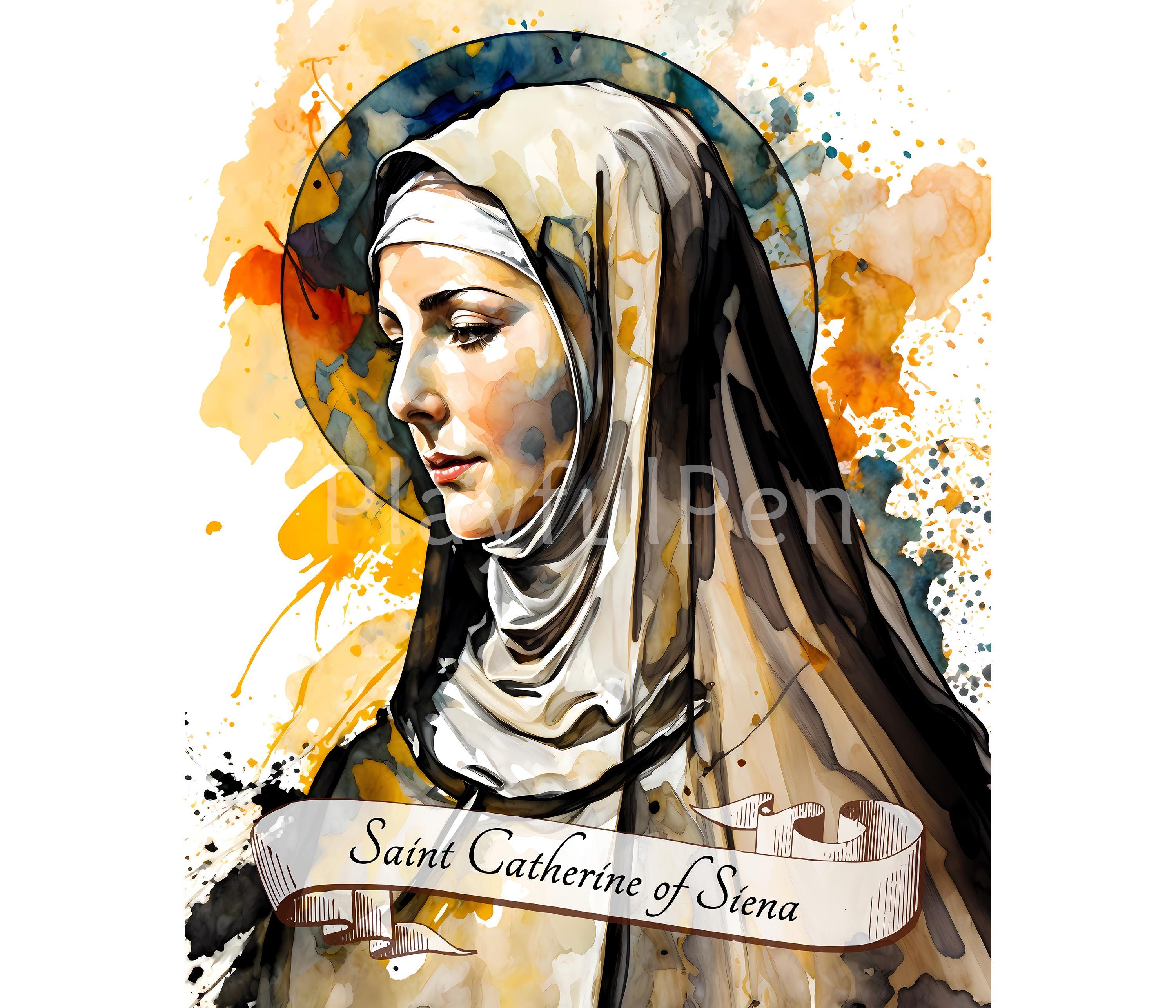
What is self-knowledge? From Marriam-Webster’s Dictionary:
“knowledge or understanding of one's own capabilities, character, feelings, or motivations : self-understanding”
To reach self-knowledge, one needs a fair amount of introspection.
What exactly are you striving for spiritually when you are seeking self-knowledge? Knowing one’s capability in shooting basketball foul shots will not exactly lead you to understand your relationship with God.
Also, related to self-knowledge, but in an inverse way, is self-absorption. When does meditating on one’s self-understanding cross over into self-absorption?
St. Catherine of Siena has a lot to say on these questions. From Elizabeth A. Dreyer’s, Living the
Truth in Love: A Retreat with Catherine of Siena.
From the Introduction:
[Catherine] was certainly no stranger to the lure of selfishness. She cautions her readers over and over again that the great enemy of the spiritual life is self-preoccupation. She writes, “Every scandal, hatred, cruelty, and everything unbecoming springs from the root of selfish love” (The Dialogue, Trans. Suzzane Noffke, New York: Paulist Press, p.35). Terms like “selfish self-centeredness,” “selfish sensuality,” “self-complacency” and “self-opinionatedness” pepper her texts. (p. 34)
On this second day of retreat, we reflect on the human condition as the great contrast with the reality of God. We delve into a most basic truth about ourselves—that we are creatures, not the Creator; sinners, not the sinless One. (p. 34)
Opening Prayer:
Ineffable Creator
…
You are proclaimed
The true font of light and wisdom
And the primal origin
Raised beyond all things.
Pour forth a ray of Your brightness
into the darkened places of my
mind;
disperse from my soul
the twofold darkness
into which i was born:
sin and ignorance.
[The Prayers of Catherine of Siena, Ed.
Suzanne Noffke, New York: Pualist Press, 1983, p.82]
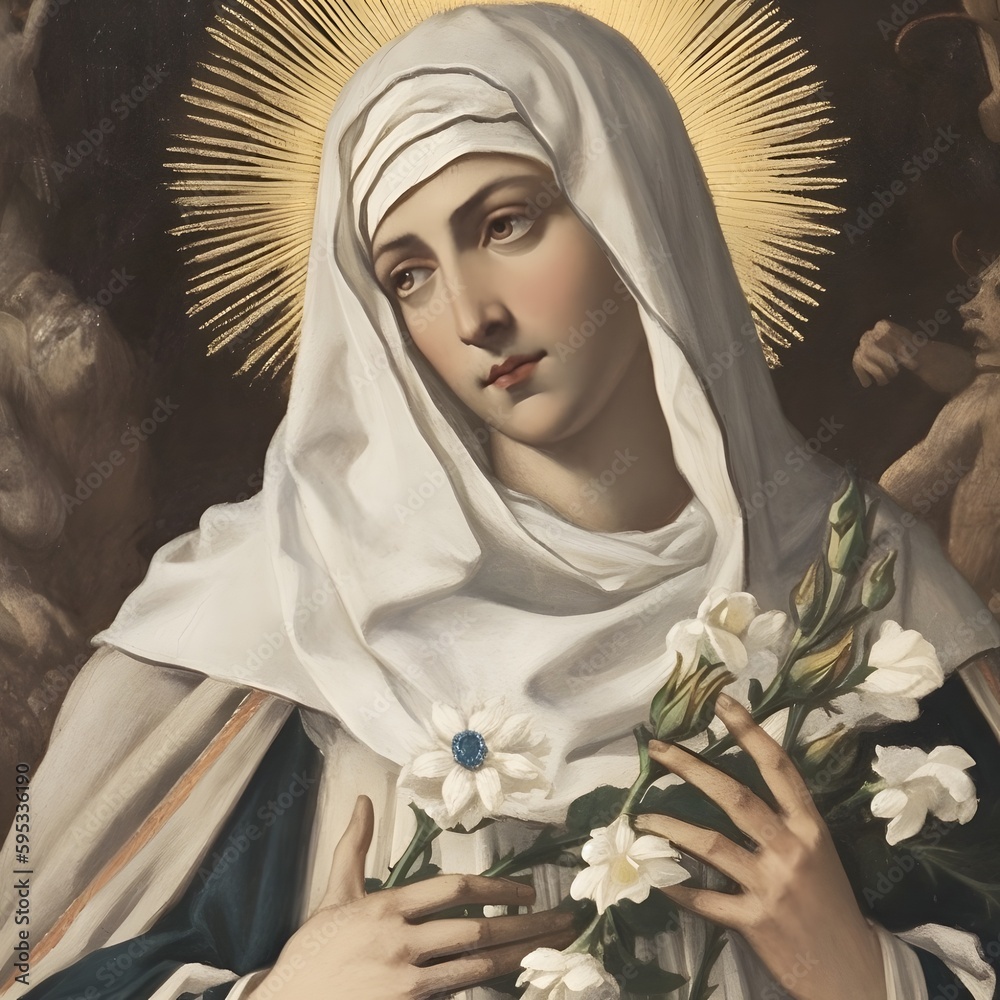
Spiritual Talk:
Three quotes out of the retreat talk.
Catherine’s works are full of references to self-knowledge and knowledge of God. Often she places both phrases in the same sentence, since she sees them intimately related to each other. Perhaps because she spent three years in solitary prayer in her room in her parent’s home, she often refers to the “cell” or the “house” of self-knowledge. She may also have felt compelled to emphasize the “cell within” to counter her critics, who would have preferred to have her in her cell than traveling about Europe, conversing with popes and princes. In a letter to her first spiritual director, Tommaso della Fonte, she describes the “cell of the soul” as a well in which there is both earth [our poverty] and living water [the very core of the knowledge of God’s will that we be made holy] (The Letters of St. Catherine of Siena. Vol 1, Trans. Suzzane Noffke, p. 44). One comes to know oneself by turning inward in quiet reflection. She encourages us to enter into the depths of this well, into loving transformation. (p. 36)
In order to force us to confront our sinfulness with honesty and courage, [Catherine] employs a rather dramatic metaphor. She compares sin to leprosy (Dialogue, p.180). Adam’s sin, she says, oozed with deadly pus, until the incarnation effected a cure, draining the pus out of Adam’s sin, leaving only its scar (Dialogue, p.52). No doubt this imagery was impressed on Catherine’s mind as she went about nursing those who suffered from plague and other diseases. (p.37)
Catherine’s insistence on self-knowledge bears the mark of her intense personality. Nowhere is this more visible than in her awareness of her own sinfulness. In her Prayers, she is constantly juxtaposing her sinfulness and the sinfulness of the world with God’s loving mercy. The phrase, “I have sinned against the Lord; have mercy on me!” runs like a leitmotif throughout. In a letter to two of her friends, Catherine writes, “I, Caterina, a useless servant, am in agony with desire as I searched the depths of my soul; I grieve and weep when I see and really understand our foolish apathy, our failure to give our love to God after God has given us such great graces with so much love” (The Letters of St. Catherine of Siena. Vol 1, Trans. Suzzane Noffke, p. 80). (p.40-1)
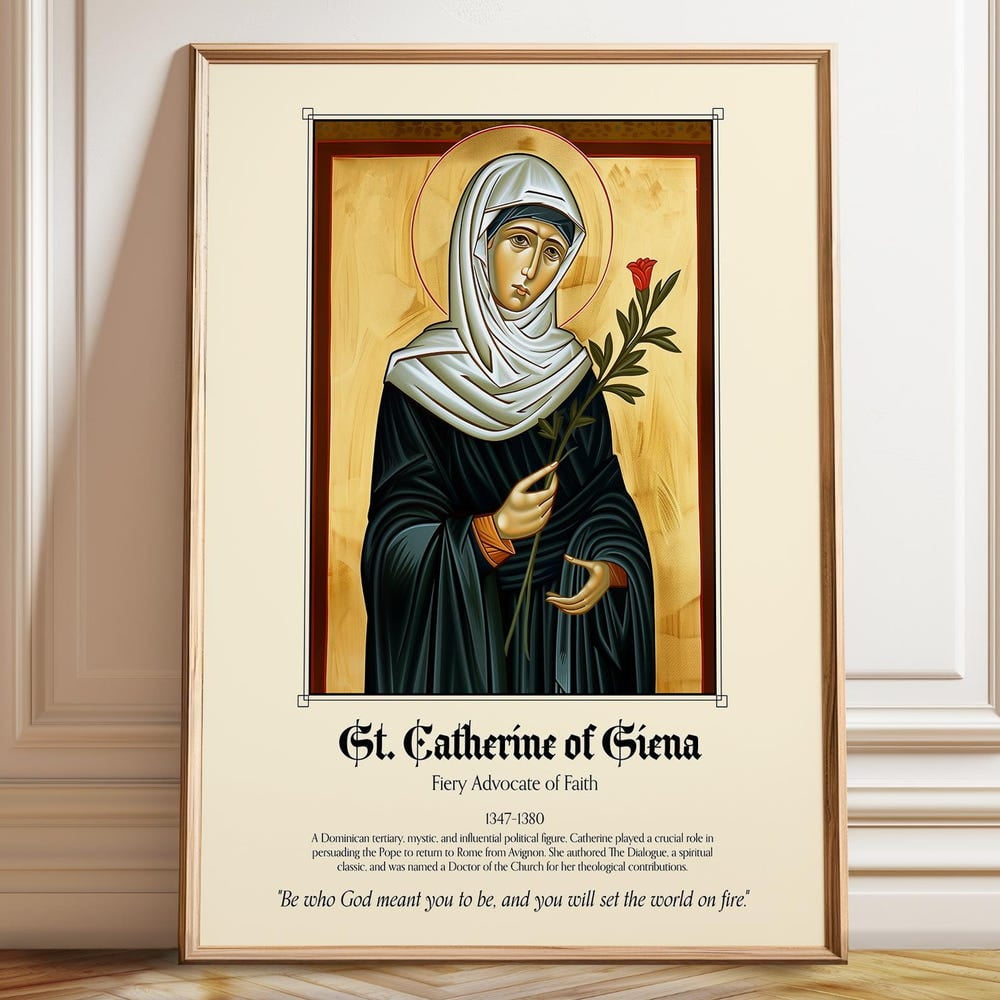
Catherine’s self-knowledge—her sinfulness, her smallness in the face of the Creator, and her sinfulness with respect to God’s purity—leads her to write from the mouth of God the eternal Father spoken to Catherine: "Do you know, daughter, who you are and who I am? If you know these two things you will have beatitude within your grasp. You are she who is not, and I AM HE WHO IS." (Raymond of Capua, Life of Catherine of Siena, 92). Knowledge of self for Catherine requires the awareness that one is not God and that God is many things she is not.
For Reflection:
Throughout her Prayers, Catherine repeats over and over again: “I have sinned against the Lord. Have mercy on me! Do not look at our sins, all-powerful, compassionate, merciful God.”
Closing Prayer:
“Cancel out our sin today, then,
O true God,
and wash our soul’s face
with your only begotten Son’s
blood,
poured out for us,
so that dead to ourselves
and living for him
we may offer him a return for his
suffering
with bright face and undivided
soul.”
(Prayers,
p. 65)

Beautiful! I love Catherine's devotion to the Blood of Christ.
ReplyDelete(This is Kelly, btw, I wasn't able to sign in to my Google account, who knows?)
I also love the first painting of her at the top of the post. I have a similar one of Padre Pio. Just radiant. I have heard she was an extremely beautiful woman.
Thanks Kelly. I don't know about extremely beautiful but she was supposedly pretty as a young lady. She did fast to the point of starvation for her adult life, something she regretted later in life, so that in time she became extraordinarily skinny and feeble. I don't know what she could have looked like as she aged. She died at 33.
ReplyDelete