"Love follows knowledge."
"Beauty above all beauty!"
– St. Catherine of Siena

Tuesday, June 10, 2014

Music Tuesday: Summertime Songs and "Sunny Afternoon" by The Kinks

With summer coming on us—especially after this past week’s hot and sunny weather beckoning a full summer glory—I was recently asked what the perfect summer song is.  So as in all things, I gave it some thought.  What would be the criteria for such a song?  I would say it would have to be bright, perhaps energetic, youthful, dramatize a summer activity.  I would say it would have to capture that feeling of getting out of school for at least two months and running out onto a sandy beach.  It would have to be rock and roll.  After all, summer exuberance means young, and nothing is eternally, and perhaps pathetically, young as rock and roll.  Mick Jagger famously said, “I’d rather be dead than singing ‘Satisfaction’ when I’m forty-five.  I think he was in his late twenties when he said it.  Of course, he’s seventy years old today, turning seventy-one this summer, and still singing “Satisfaction’ on their current tour.  As wrinkled as the Stones have become, they are still enslaved by youth. 

Can one do any better than Alice Cooper’s “School’sOut” for a summer song?  Great guitar riff, high energy, and in your face burst of childhood snootiness.  "No more pencils, no more books, no more teachers' dirty looks"    By the way you can hear this and all the songs I’ll mention on youtube.  The Wikipedia entry quotes Cooper on how the song came to him: "What's the greatest three minutes of your life?"  Cooper said: "There's two times during the year. One is Christmas morning, when you're just getting ready to open the presents. The greed factor is right there. The next one is the last three minutes of the last day of school when you're sitting there and it's like a slow fuse burning. I said, 'If we can catch that three minutes in a song, it's going to be so big.'"

Nothing smells of summer as a Beach Boy song.  Goodness gracious, I wouldn’t even know how to choose.  “Surfin Safari,” Surfin USA,” “Surfer Girl,” but if I had to pick the best Beach Boys summer song, I would go with “Fun, Fun, Fun.” 

Well she got her daddy's car
And she cruised through the hamburger stand now
Seems she forgot all about the library
Like she told her old man now
And with the radio blasting
Goes cruising just as fast as she can now 

And she'll have fun, fun, fun
Till her daddy takes the t-bird away
(Fun, fun, fun till her daddy takes the t-bird away 

Oh how can you have a summer and not be out cruising in a car, stopping at hamburger stands, radio blasting, and looking for fun.  Ah and memories of Ford Thunderbirds.  Do they still make T-Birds?  I think I saw one not too long ago and it looked disgustingly contemporary.   

Then there is Mungo Jerry’s, “In the Summertime,” a one hit wonder with a cool hook for a riff.   I think the lyrics makes this one: “In the summertime when the weather is hot/You can stretch right up and touch the sky/When the weather's fine/You got women, you got women on your mind/Have a drink, have a drive/Go out and see what you can find.”  Whoa, what did he just say, have a drink and a drive?  Boy did that come from a different era.  And then there are those misogynistic lyrics: “If her daddy's rich take her out for a meal/If her daddy's poor just do what you feel.”  The song might be carefree perhaps, but that’s a bit too uncaring for my taste.  Still it’s on the airwaves every summer.  

And how about Eddie Cochran’s “Summertime Blues.”  Cool riff, and love that boss’s contrasting bossy voice, “no dice, son, you gotta work late.”  Yeah, I worked most of my summers when in school, and Cochran captures that feeling. 

Of course one has to mention, The Lovin’ Spoonfuls, “Summer in the City.”  No one captures that hot July—and around here we usually get a few days above 100F (39C) in July—day like this: “Hot town, summer in the city/Back of my neck getting dirty and gritty/Been down, isn't it a pity/Doesn't seem to be a shadow in the city.”  I don’t know what city they’re talking about, but I can swear it’s New York City. 

And when thinking of summer songs, one has to consider the one I mentioned above, The Rolling Stones’ “Satisfaction.”  I believe it stood at number one on the charts for four straight weeks in the summer of 1965.  It’s a bit more sophisticated than the other songs, but it still captures that raw youthful, summer energy with a great guitar riff—one of the greatest guitar riffs ever—over a hard driving rhythm.  And those lyrics of defiance, frustrated, rude, and adolescently brazen.  Here too there’s driving in a car, and some advertisement “that’s supposed to fire my imagination.”  "Supposed to" is teen snootiness.  There’s also the pretentiousness of a youth saying that the man on the TV “can’t be a man because he doesn’t smoke/the same cigarettes as me.”  Oh can’t you just see that high school kid smoking cigarettes around the corner thinking he’s now so ADULT.  And there’s that grandiose statement that’s at the heart of the song, “Hey hey hey, that's what I say.”  That really is a great summer song. 

Now if I were to have picked a song twenty years ago, I most definitely would have gone with the Stones’ “Satisfaction.”  Lord knows I had—and still have—a rebellious streak.  But now I’m over fifty, and perhaps I have to tone down my summer songs.  I don't strut and sneer like I used to.  So I’ve gone with this little classic, “Sunny Afternoon” by The Kinks as the perfect summer song.    Here’s a youtube clip.


Nothing I like to do better on a summer afternoon—actually more toward evening—than lay on a recliner on my deck, listen to the birds flying and chirping about through the trees in the backyards, with a cool beer or nice glass of red wine, and reading a good book. That is close to heaven. And how about these opening lyrics for a Conservative: “The tax man's taken all my dough/And left me in this stately home/Lazing on a sunny afternoon/And I can't sail my yacht/He's taken everything I got/All I've got's this sunny afternoon.” Bah, rebellion is over rated. Just give me limited government these days. ;)

What summer songs do you like?

Sunday, June 8, 2014

Poetry: “Pentecost” by Annette von Droste-Hülshoff

A German friend of mine—who occasionally clicks on my blog—uses for an avatar a painting of a woman, and in passing I asked who that woman was.   To quote our correspondence, she said, “Her name is Annette von Droste-Hülshoff and she was a poet who was born not far away from my town. I found some information about her in English - if you're interested,” and then she sent me the Wikipedia in English entry.   

I have to admit, my knowledge of writers from other than English speaking countries is limited to the great ones, the ones who wrote the classics, but I was surprised to learn of von Droste-Hülshoff.  I had never heard of her.  Wikipedia says, “She was one of the most important German poets and author of the novella Die Judenbuche.”  Elsewhere I believe I read she is the most important female German poet ever.  How could I not have heard of her name at least?  I don’t know.   


And then to my surprise, von Droste-Hülshoff was catholic and had written religious poems, most notably a cycle of poems, titled “The Spiritual Year” on each Sunday and the all the feast days of the church calendar.  Well, that certainly piqued my interest.  I search Amazon for a good edition of her work in English, and unfortunately did not find much.  I found only one book, The Wild Muse, and I put in into my cart, a dual language collection that has biographical commentary to go along with the poems.  

However, I did find a few of her poems in English translation on the internet.  Since today is Pentecost Sunday, the day the Holy Spirit came upon the apostles, I’m going to provide her poem of this feast day.    First, here is the English translation:     

Pentecost
by Annette Von Droste-Hulshoff 

The day was still, the sun's bright glare
   Fell sheer upon the Temple's beauteous wall
   Withered by tropic heat, the air
   Let, like a bird, its listless pinions fall.
   Behold a group, young men and gray,
   And women, kneeling; silence holds them all;
   They mutely pray!

  Where is the faithful Comforter
   Whom, parting, Thou didst promise to Thine own?
   They trust Thy word which cannot err,
   But sad and full of fear the time has grown.
   The hour draws nigh; for forty days
   And forty wakeful nights toward Thee we've thrown
   Our weeping gaze. 

  Where is He? Hour on hour doth steal,
   And minute after minute swells the doubt.
   Where doth He bide? And though a seal
   Be on the mouth, the soul must yet speak out.
   Hot winds blow, in the sandy lake
   The panting tiger moans and rolls about,
   Parched is the snake. 

  But hark! a murmur rises now,
   Swelling and swelling like a storm's advance,
   Yet standing grass-blades do not bow,
   And the still palm-tree listens in a trance.
   Why seem these men to quake with fear
   While each on other casts a wondering glance?
   Behold! 'Tis here! 

  'Tis here, 'tis here! the quivering light
   Rests on each head; what floods of ecstasy
   Throng in our veins with wondrous might!
   The future dawns; the flood-gates open free;
   Resistless pours the mighty Word;
   Now as a herald's call, now whisperingly,
   Its tone is heard. 

  Oh Light, oh Comforter, but there
   Alas! and but to them art Thou revealed
   And not to us, not everywhere
   Where drooping souls for comfort have appealed!
   I yearn for day that never breaks;
   Oh shine, before this eye is wholly sealed,
   Which weeps and wakes.
 

All poetry loses something in translation.  Poetry relies to a greater extent than prose on the sound and rhythm of the language, and so it can never be reproduced in a different language with the same effect and beauty.  As you can see there is a rhyme scheme, and so the English translator felt the need to try to reproduce a rhyme scheme in the English.  That always causes a red flag for me as a reader.  The more one tries to use the nuances in the translation of the translated language, the more one drifts from the original meaning.  Still this is not a complex poem; it tries to dramatize an historical event.  I can’t speak for the accuracy of the translation.  Here is the original German.    
 

Pfingstsonntag

Still war der Tag, die Sonne stand
So klar an unbefleckten Domeshallen;
Die Luft, von Orientes Brand
Wie ausgedörrt, ließ matt die Flügel fallen.
Ein Häuflein sieh, so Mann als Greis,
Auch Frauen knieend; keine Worte hallen,
Sie beten leis! 

Wo bleibt der Tröster, treuer Hort,
Den scheidend doch verheißen du den Deinen?
Nicht zagen sie, fest steht dein Wort,
Doch bang und trübe muß die Zeit uns scheinen.
Die Stunde schleicht; schon vierzig Tag
Und Nächte harrten wir in stillem Weinen
Und sahn dir nach. 

Wo bleibt er nur, wo? Stund' an Stund',
Minute will sich reihen an Minuten.
Wo bleibt er denn? Und schweigt der Mund,
Die Seele spricht es unter leisem Bluten.
Der Wirbel stäubt, der Tiger ächzt
Und wälzt sich keuchend durch die sand'gen Fluten,
Die Schlange lechzt. 

Da, horch, ein Säuseln hebt sich leicht!
Es schwillt und schwillt und steigt zu Sturmes Rauschen.
Die Gräser stehen ungebeugt;
Die Palme starr und staunend scheint zu lauschen.
Was zittert durch die fromme Schar,
Was läßt sie bang' und glühe Blicke tauschen?
Schaut auf! Nehmt wahr! 

Er ist's, er ist's; die Flamme zuckt
Ob jedem Haupt; welch wunderbares Kreisen,
Was durch die Adern quillt und ruckt!
Die Zukunft bricht; es öffnen sich die Schleusen,
Und unaufhaltsam strömt das Wort
Bald Heroldsruf und bald im flehend leisen
Geflüster fort. 

O Licht, o Tröster, bist du, ach,
Nur jener Zeit, nur jener Schar verkündet?
Nicht uns, nicht überall, wo wach
Und Trostes bar sich eine Seele findet?
Ich schmachte in der schwülen Nacht;
O leuchte, eh' das Auge ganz erblindet!
Es weint und wacht. 

Annette von Droste-Hülshoff
 

Other than trying to fast learn some basic German back in September when I had a business trip over to the country, I don’t know German.  However, I can sound out the words, and I can see the alliteration and assonance and rhetorical repetitions, and even pick up a lyrical musicality in the lines.  At least I think so.  I would love to hear the poem spoken out loud, and while youtube had some audio of von Droste-Hülshoff poems, it unfortunately did not have this one.  Perhaps I’ll revisit her poetry when I get the book from Amazon.  Until then, I hope you enjoyed this one.


And happy feast of Pentecost!


Friday, June 6, 2014

Faith Filled Friday: FDR's Prayer Before D-Day

On the evening of the D-Day invasion of Normandy, President Franklyn Delano Roosevelt read the following on the radio.

My Fellow Americans:  
Last night, when I spoke with you about the fall of Rome, I knew at that moment that troops of the United States and our Allies were crossing the Channel in another and greater operation. It has come to pass with success thus far. 
And so, in this poignant hour, I ask you to join with me in prayer: 
Almighty God: Our sons, pride of our nation, this day have set upon a mighty endeavor, a struggle to preserve our Republic, our religion, and our civilization, and to set free a suffering humanity.
Lead them straight and true; give strength to their arms, stoutness to their hearts, steadfastness in their faith. 
They will need Thy blessings. Their road will be long and hard. For the enemy is strong. He may hurl back our forces. Success may not come with rushing speed, but we shall return again and again; and we know that by Thy grace, and by the righteousness of our cause, our sons will triumph. 
They will be sore tried, by night and by day, without rest -- until the victory is won. The darkness will be rent by noise and flame. Men's souls will be shaken with the violences of war. 
For these men are lately drawn from the ways of peace. They fight not for the lust of conquest. They fight to end conquest. They fight to liberate. They fight to let justice arise, and tolerance and goodwill among all Thy people. They yearn but for the end of battle, for their return to the haven of home. 
Some will never return. Embrace these, Father, and receive them, Thy heroic servants, into Thy kingdom. 
And for us at home -- fathers, mothers, children, wives, sisters, and brothers of brave men overseas, whose thoughts and prayers are ever with them -- help us, Almighty God, to rededicate ourselves in renewed faith in Thee in this hour of great sacrifice. 
Many people have urged that I call the nation into a single day of special prayer. But because the road is long and the desire is great, I ask that our people devote themselves in a continuance of prayer. As we rise to each new day, and again when each day is spent, let words of prayer be on our lips, invoking Thy help to our efforts. 
Give us strength, too -- strength in our daily tasks, to redouble the contributions we make in the physical and the material support of our armed forces. 
And let our hearts be stout, to wait out the long travail, to bear sorrows that may come, to impart our courage unto our sons wheresoever they may be. 
And, O Lord, give us faith. Give us faith in Thee; faith in our sons; faith in each other; faith in our united crusade. Let not the keeness of our spirit ever be dulled. Let not the impacts of temporary events, of temporal matters of but fleeting moment -- let not these deter us in our unconquerable purpose. 
With Thy blessing, we shall prevail over the unholy forces of our enemy. Help us to conquer the apostles of greed and racial arrogances. Lead us to the saving of our country, and with our sister nations into a world unity that will spell a sure peace -- a peace invulnerable to the schemings of unworthy men. And a peace that will let all of men live in freedom, reaping the just rewards of their honest toil. 
Thy will be done, Almighty God. 
Amen. 
President Franklin D. Roosevelt - June 6, 1944

 May the Almighty bless those boys who served, and especially those who died. 

Thursday, June 5, 2014

Lines I Wished I’d Written: From “Fifty Grand” by Ernest Hemingway

This is not one of Hemingway’s great short stories, but it’s damn good.  The whole story revolves around money and the business of boxing.  The story is 90 percent dialogue, and what fine dialogue.  I’ll present this extended passage.  Jack Brennan is an aging boxing champion faced with what will be his last fight, and he knows he’s going to lose.  He can’t sleep for a week, and so decides to get drunk the night before the fight, just so it can relax him and put him to sleep.   I don’t know what year this story was written, except that it was around the 1930’s.  $50,000 in 1935 would be worth $674,000 in 2013 dollars according to an economic inflation calculator.  That’s just so you get a feel for how much money is being discussed.   

One thing that’s curious is that Hemingway sometimes transcribes the dialogue in the present tense, especially for Jack.  Notice how for the most part it’s “I said” or “Jack said,” but every so often it’s “Jacks says.”  It’s certainly not a slip up.  It’s consciously done.  I just can’t figure out what Hemingway means or suggests by it.  The story is told in first person from a friend of Jack’s named Jerry Doyle.  They are at Hogan’s training camp. 

We put on our coats and started out.  It was quite a way down to the main road and then we walked along the main road about a mile and a half.  Cars kept going by and we would pull out to the side until they were past.  Jack didn’t say anything.  After we had stepped out into the bushes to let a big car go by Jack said, “To hell with this walking.  Come on back to Hogan’s.   

We went along a side road that cut up over the hill and cut across the fields back to Hogan’s.  We could see the lights of the house up on the hill.  We came around to the front of the house and there standing in the doorway was Hogan.   

“Have a good walk?” Hogan asked. 

“Oh, fine,” Jack said.  “Listen, Hogan.  Have you got any liquor?” 

“Sure,” says Hogan.  “What’s the idea?” 

“Send it up to the room,” Jack says.  “I’m going to sleep tonight.” 

“You’re the doctor,” Hogan says. 

“Come on up to the room, Jerry,” Jack says. 

Upstairs Jack sat on the bed with his head in his hands. 

“Ain’t it a life?” Jack says. 

Hogan brought in a quart of liquor and two glasses. 

“Want some ginger ale?” 

“What do you think I want to do, get sick?” 

“I just asked you,” said Hogan. 

“Have a drink?” said Jack. 

“No, thanks,” said Hogan.  He went out. 

“How about you, Jerry?” 

“I’ll have one with you,” I said. 

Jack poured out a couple of drinks.  “Now,” he said, “I want to take it slow and easy.” 

“Put some water in it,” I said. 

“Yes,” jack said.  “I guess that’s better.” 

We had a couple of drinks without saying anything.  Jack started to pour me another. 

“No,” I said, “that’s all I want.” 

“All right,” Jack said.  He poured himself another big shot and put water in it.  He was lighting up a little. 

“That was a fine bunch out here this afternoon,” he said.  “They don’t take any chances, those two.” 

Then a little later, “Well,” he says, they’re right.  What the hell’s the good of taking chances?” 

“Don’t you want another, Jerry?” he said.  “Come on, drink along with me.” 

“I don’t need it, Jack,” I said.  “I feel alright.” 

“Just have one more,” Jack said.  It was softening him up. 

“All right,” I said. 

Jack poured one for me and another big one for himself. 

“You know,” he said, “I like liquor pretty well.  If I hadn’t been boxing I would have drunk quite a lot.” 

“Sure,” I said. 

“You know,” he said, “I missed a lot, boxing.” 

“You made plenty of money.” 

“Sure, that’s what I’m after.  You know I miss a lot, Jerry.” 

“How do you mean?” 

“Well,” he says, “like about my wife.  And being away from home so much.  It don’t do my girls any good.  ‘Who’s your old man?’ some of these society kids ‘ll say to them.  ‘My old man’s Jack Brennan.’  That don’t do them any good.” 

‘Hell,” I said, “all that makes a difference is if they got dough.”   

“Well,” says Jack, “I got the dough for them all right.” 

He poured out another drink.  The bottle was about empty.   

“Put some water in it,” I said.  Jack poured in some water. 

“You know,” he says, “You ain’t got any idea how I miss the wife.” 

“Sure.” 

“You ain’t got any idea.  You can’t have an idea what it’s like.” 

“It ought to be better out in the country than in town.” 

“With me now,” jack said, “it don’t make any difference where I am.  You can’t have any idea what it’s like.” 

“Have another drink.” 

“Am I getting soused?  Do I talk funny?” 

“You’re coming on all right.” 

“You can’t have any idea what it’s like.  They ain’t anybody can have an idea what it’s like.” 

“Except the wife,” I said. 

“She knows,” Jack said.  “She knows all right.  She knows.  You bet she knows.” 

“Put some water in that,” I said. 

“Jerry,” says Jack, “you can’t have an idea what it gets to be like.” 

He was good and drunk.  He was looking at me steady.  His eyes were sort of too steady. 

“You’ll sleep all right,” I said. 

“Listen, Jerry,” Jack says.  “You want to make some money?  Get some money down on Walcott.”
 
“Yes?” 

“Listen, Jerry,” Jack put down the glass.  “I’m not drunk now, see?  You know what I’m betting on him?  Fifty grand.” 

“That’s a lot of dough.” 

“Fifty grand,” Jack says, “at two to one.  I’ll get twenty-five thousand bucks.  Get some money on him, Jerry.” 

“It sounds good,” I said. 

“How can I beat him?” Jack says.  “It ain’t crooked.  How can I beat him?  Why not make money on it?” 

“Put some water in that,” I said. 

“I’m through after this fight,” Jack says.  “I’m through with it.  I got to take a beating.  Why shouldn’t I make money on it?” 

“Sure.” 

“I ain’t slept for a week,” Jack says.  “All night I lay awake and worry my can off.  I can’t sleep, Jerry.  You ain’t got an idea what it’s like when you can’t sleep.” 

“Sure.” 

“I can’t sleep.  That’s all.  I just can’t sleep.  What’s the use of taking care of yourself all these years when you can’t sleep?” 

“It’s bad.” 

“You ain’t got an idea what it’s like, Jerry, when you can’t sleep.” 

“Put some water in that,” I said. 

Well, about eleven o’clock Jack passes out and I put him to bed.  Finally he’s so he can’t keep from sleeping.  I help him get his clothes off and got him to bed. 

“You’ll sleep all right, Jack,” I said. 

“Sure,” Jack says, “I’ll sleep now.” 

“Good night, Jack,” I said. 

“Good night, Jerry,” Jack says.  “You’re the only friend I got.” 

“Oh, hell,” I said. 

“You’re the only friend I got,” Jack says, “the only friend I got.” 

“Go to sleep,” I said. 

“I’ll sleep, “Jack says.
 

Now these aren’t intellectuals speaking.  The dialogue is so true; it’s as sharp as a dramatist.  It reminds me very much of my Brooklyn upbringing, only Hemingway’s characters are bit more taciturn than the people I grew up around.  Read the story to find out how it turns out.  It’s not quite what one expects, but very much concludes the theme.

Tuesday, June 3, 2014

Notable Quotes: No More Parades by Ford Madox Ford

I’ve been reading Ford Madox Ford’s Parade’s End, a tetralogy (a sequence of four books)set during and after the first world war.  It’s as good as any novel in the high modernist period, which means it is difficult, but transcending.  Perhaps it’s me, but I love the literature from between the world wars.  That’s what I specialized in college.  Let  me also say that Ford may be the best prose writer in English of his era.  And when you consider that’s including James Joyce, Virginia Woolf, D. H. Lawrence, F. Scott Fitzgerald, William Faulkner, Ernest Hemingway that is saying a lot.  A heck of a lot. 

I’m going to quote this wonderful gem from the second novel of the tetralogy, No More Parades.  It has nothing to do with writing, as a lot of my notable quotes do though Ford had lots to say on writing, but more on how dejected I’ve been the last two days over some current events.  I’m not going to get into it.  Politicians should be barred from making any military decisions.  Or get better politicians. 
Ford, by the way, volenteered and served in the first world war at the age of forty-one.  The picture I provide below is Ford in uniform, a picture I've never seen before.  He looks rather exhausted and beaten. 
 
No more Hope, no more Glory, no more parades for you and me any more. Nor for the country... nor for the world, I dare say... None... Gone.
        -Ford Madox Ford
 

Sunday, June 1, 2014

Personal Essay: Raising the Bayonne Bridge

New York City has lots of bridges, 2000 according toWikipedia,  but they must be counting fallen trees across flooded side streets because that’s way more than even I imagined.  2000?  Well, there are many and some of them are some of the most impressive spans in the world.  We are composed of islands, and we are over 8 million in population in the city with another 25 million in the suburbs, depending how you count suburbs.   A lot of people have to move about and cross lots of water: the Hudson River, the East River, the New York Harbor, the Long Island Sound, and the Kill van Kull.   


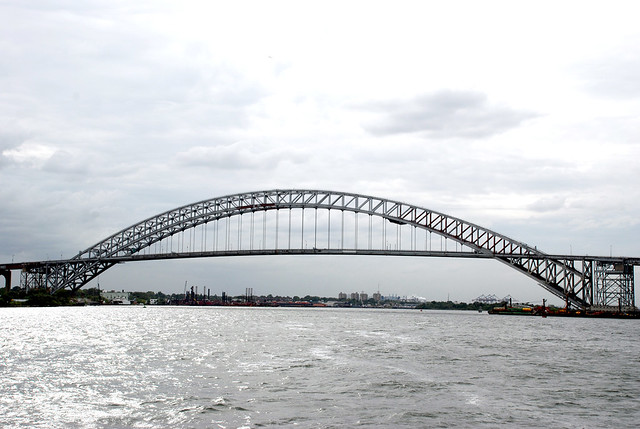
I live on Staten Island the most remote of the five boroughs of New York City, and we have four major bridges that connect us to the outside world, three bridges that connect us to New Jersey, and one that connects us to Brooklyn.  The Kill Van Kull is a channel that separates us from Bayonne, New Jersey, and as you can imagine a lot of shipping goes through that channel.  Spanning the channel is the Bayonne Bridge (they never name anything after Staten Island), which on certain times of the year I can see the top from my bedroom window.  I think it’s in the winter time that the trusses of the arch becomes visible, when the leaves are off the trees and I have an unobstructed view.  I’ve never considered the Bayonne Bridge to be aesthetically beautiful, so I’ve never thought much of being able to see it.  Houses on Staten Island that have views of the Verrazano-Narrows Bridge are very expensive; view of the Bayonne Bridge does nothing for my home value.
Apparently they will be building cargo ships well beyond current size.  They are currently huge, so what they will be building is like the largest mammal set side by side to a dinosaur.  Super container ships will be the transport vehicle of choice, as soon as they can build them.  This has caused ports around the world to modify their ports to accommodate these super vessels.  Dredging bottoms, widening harbors, building accommodating structures for loading and unloading are some of the projects going on for the sake of improving logistics.  You can read about that here. 

They have dredged parts of New York Harbor, either for this reason or just for some sort of maintenance.  But to really accommodate these super container ships, they will have to raise the roadway of the Bayonne Bridge.  The current clearance must interfere with the tops of these super containers.  So instead of tearing down the bridge, they will build the roadway above the current roadway, and then take down the old roadway, so that in the end there will be more clearance for the super ships.  
Does that sound interesting?  Absolutely!  As an engineer, that really piques my interest.  Building on top of an existing bridge is way more complicated and difficult than building one from scratch, or at least intuitively it would seem that way.  Here’s a video of the project plan.  It’s breathtaking.   


I wonder what the cost savings are for building on top rather than building from scratch.  That’s some heck of a project.  I’m a mechanical engineer, but projects like that might have swayed me back in college into being a civil engineer.  I would love to manage that project.  When they are into it, I’ll be sure to go by the bridge and take some pictures.  
Now one thing I don’t understand is how tall are these super ships?  From the movie clip it looks like there is plenty of vertical clearance.  However when I looked up the dimensions of the bridge, it claims there is only 14 ft (4.3m) clearance.  Fourteen feet to the water level?  That’s not even two stories.  It’s got to be higher than that.  It looks way higher than two stories when I’m driving on it.  
One last thing.  I work in New Jersey and though we (my carpool) don’t regularly take the Bayonne Bridge, we might switch to it on occasion when traffic at the Goethals Bridge is jammed.  We’ve decided that while this project is going on, we’ll suffer with the traffic and avoid the Bayonne.  A project that complex has got to have something go awry.  It will be a miracle if they execute the entire project flawlessly.  I hate to be the car under the beam that falls.