
Today is the Feast of the Holy Family of
Jesus, Mary, and Joseph, and in Year A we hear of Joseph’s swift, fatherly
action of taking his family away from danger.
Once again Joseph follows the will of God when asked to do something. He travels eastward to Egypt. I have never heard this comparison made, but
Joseph is in analogy here with Abraham who travels eastward when God asks him
in Genesis. What is most interesting is that Joseph ultimately
settles in Nazareth, an obscure little town in the north. Matthew quotes some prophesy that the Messiah
“shall be called a Nazorean.” But where
exactly is this prophesy? It’s no where
in the Old Testament. Just read on.
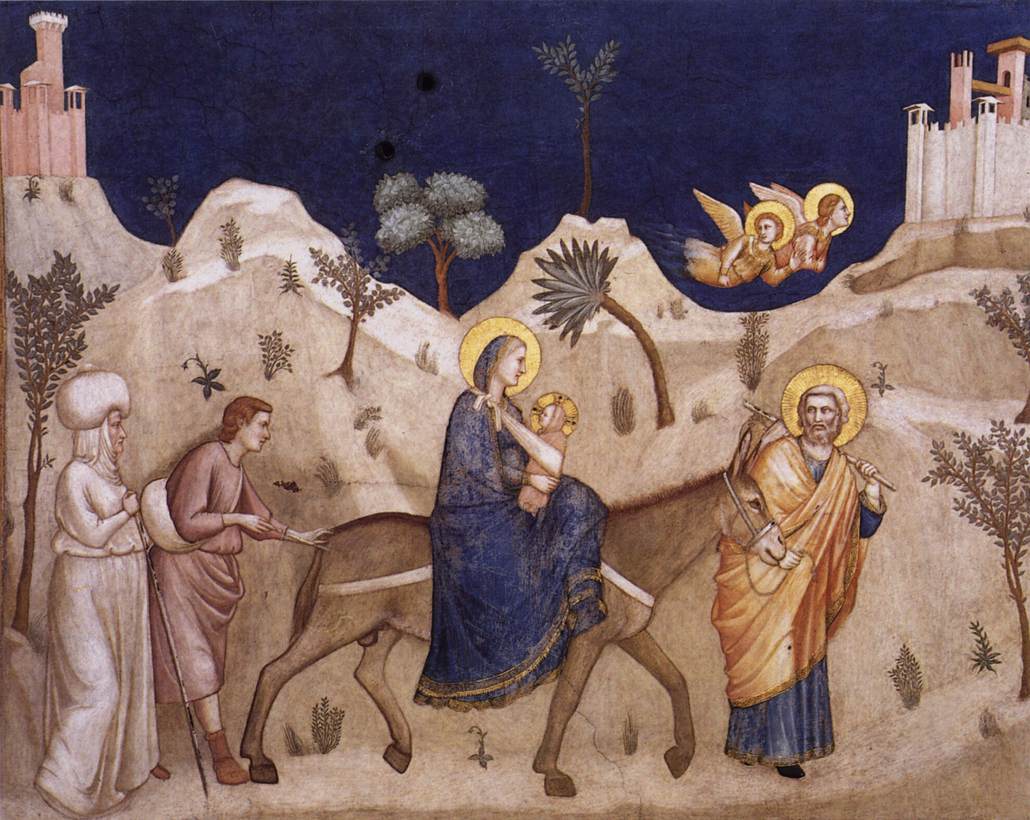
First, here is the Gospel passage.
When the magi had departed, behold,
the angel of the Lord appeared to Joseph in a dream and said,
“Rise, take the child and his mother, flee to Egypt,
and stay there until I tell you.
Herod is going to search for the child to destroy him.”
Joseph rose and took the child and his mother by night
and departed for Egypt.
He stayed there until the death of Herod,
that what the Lord had said through the prophet might be fulfilled,
Out of Egypt I called my son.
When Herod had died, behold,
the angel of the Lord appeared in a dream
to Joseph in Egypt and said,
“Rise, take the child and his mother and go to the land of Israel,
for those who sought the child’s life are dead.”
He rose, took the child and his mother,
and went to the land of Israel.
But when he heard that Archelaus was ruling over Judea
in place of his father Herod,
he was afraid to go back there.
And because he had been warned in a dream,
he departed for the region of Galilee.
He went and dwelt in a town called Nazareth,
so that what had been spoken through the prophets
might be fulfilled,
He shall be called a Nazorean.
~Mt 2:13-15, 19-23
Goodness, Fr.
Geoffrey Plant does an amazing job explaining this passage.
Some fantastic quotes
from Fr, Geoffrey:
“Jesus gathers up the
whole story of Israel, fulfills it, and brings it to its true purpose.”
“By shaping Jesus’
early life to mirror Israel’s journey, Matthew is saying that in Jesus the
whole drama of salvation is being lived again but this time brought to its
fulfillment.”
“The royal tree will
be cut down...and a future king from David’s line would arise like a shoot from
the stump of Jesse.”
But how does Matthew get the prophesy that the Messiah will be a Nazorean? As Fr. Geoffrey points out, Nazareth puns on the Hebrew word for shoot, and that’s where Matthew derives the prophesy that Jesus will be called a “Nazorean.” That is something I had never heard before. Now you know too.
For the pastoral
homily, I am going back to the USCCB homily of the day, today given by Fr. Greg
Friedman, OFM from The Franciscan Province of Our Lady of Guadalupe in Albuquerque,
NM. I have never seen Fr. Greg
before. Obviously he is a Franciscan
friar.
Fr. Greg provides the
Catholic connection g of the Holy Family’s flight to Egypt with the plight of
migrants. He mentions Pope Francis’s
characterization of this flight as an archetype of refugees but actually as I
explained in my analysis of the Flannery O’Connor short story, “The Displaced
Person,” the characterization of that archetype goes back Pope Pius XII Apostolic
Constitution, Exsul Familia. Pope Pius XII:
The émigré Holy Family of Nazareth, fleeing into Egypt, is the archetype of every refugee family. Jesus, Mary and Joseph, living in exile in Egypt to escape the fury of an evil king, are, for all times and all places, the models and protectors of every migrant, alien and refugee of whatever kind who, whether compelled by fear of persecution or by want, is forced to leave his native land, his beloved parents and relatives, his close friends, and to seek a foreign soil.
The Feast of the Holy
Family of Year A is a reminder of the Catholic understanding of migrants and
their fair treatment.
Sunday Meditation: "Joseph rose and took the child and his mother by night and departed for Egypt.”
Not a hymn today but
sacred oratorio, “The Flight Into Egypt” composed by John Harbison and
performed by the Los Angeles Philharmonic, Cantata Singers and Ensemble,
Sanford Sylvan and Roberta Anderson.
This piece is rather modern and I have no
idea how lasting it will be. You can
read its Wikipedia entry. I rather like it.

No comments:
Post a Comment