"Love follows knowledge."
"Beauty above all beauty!"
– St. Catherine of Siena

Friday, May 10, 2013

Book Excerpt: The Cossacks by Leo Tolstoy, Part 2

You can read Part 1 of Book Excerpt: The Cossacks by Leo Tolstoy here. Excerpts taken from etext from Wikisource Library through Classic Literature By Great Authors ; translation by Louise and Aylmer Maude.
 
Olenin, the novel's central character, is contrasted with a young Cossack who couldn’t be more different, a youth named Lukashka with the nickname, “the snatcher” because of his hunting skills.  While Olenin is introduced in the city setting, Lukashka is quite distinctly introduced with the wilderness as background. 

The male population of the village spend their time on military expeditions and in the cordon--or 'at their posts', as the Cossacks say. Towards evening, that same Lukashka the Snatcher, about whom the old women had been talking, was standing on a watch-tower of the Nizhni-Prototsk post situated on the very banks of the Terek. Leaning on the railing of the tower and screwing up his eyes, he looked now far into the distance beyond the Terek, now down at his fellow Cossacks, and occasionally he addressed the latter. The sun was already approaching the snowy range that gleamed white above the fleecy clouds. The clouds undulating at the base of the mountains grew darker and darker. The clearness of evening was noticeable in the air. A sense of freshness came from the woods, though round the post it was still hot. The voices of the talking Cossacks vibrated more sonorously than before. The moving mass of the Terek's rapid brown waters contrasted more vividly with its motionless banks. The waters were beginning to subside and here and there the wet sands gleamed drab on the banks and in the shallows. The other side of the river, just opposite the cordon, was deserted; only an immense waste of low-growing reeds stretched far away to the very foot of the mountains. On the low bank, a little to one side, could be seen the flat-roofed clay houses and the funnel-shaped chimneys of a Chechen village. The sharp eyes of the Cossack who stood on the watch-tower followed, through the evening smoke of the pro-Russian village, the tiny moving figures of the Chechen women visible in the distance in their red and blue garments.  [Chpt 6]

Yes, that’s the same Chechen people who have been in the news here in the United States lately.  The Cossacks and the Chechens are neighboring people with the Terek River dividing them, but they are at war with each other, a sort of feud of cultures.  They are on guard against each other, and it seems like the goal of the men of both is to prove their manhood through soldierly exploits.  Lukashka is now old enough to participate, and he’s a natural at it. 

Lukashka, who stood on the watch-tower, was a tall handsome lad about twenty years old and very like his mother. His face and whole build, in spite of the angularity of youth, indicated great strength, both physical and moral. Though he had only lately joined the Cossacks at the front, it was evident from the expression of his face and the calm assurance of his attitude that he had already acquired the somewhat proud and warlike bearing peculiar to Cossacks and to men generally who continually carry arms, and that he felt he was a Cossack and fully knew his own value. His ample Circassian coat was torn in some places, his cap was on the back of his head Chechen fashion, and his leggings had slipped below his knees. His clothing was not rich, but he wore it with that peculiar Cossack foppishness which consists in imitating the Chechen brave. Everything on a real brave is ample, ragged, and neglected, only his weapons are costly. But these ragged clothes and these weapons are belted and worn with a certain air and matched in a certain manner, neither of which can be acquired by everybody and which at once strike the eye of a Cossack or a hillsman. Lukashka had this resemblance to a brave. With his hands folded under his sword, and his eyes nearly closed, he kept looking at the distant Tartar village. Taken separately his features were not beautiful, but anyone who saw his stately carriage and his dark-browed intelligent face would involuntarily say, 'What a fine fellow!'  [Chpt 6]

In almost complete contrast to the Olenin scene with his friends, we get a scene with Lukashka and his friends, but instead of the Moscow scene where the dialogue is over a lame philosophic conversation on whether love exists, Lukashka’s scene is very much different.  Here it is at length; it’s worth reading the whole thing. 

Nazarka, with a live pheasant under his arm, forced his way through the brambles and emerged on the footpath.

'Oh!' said Lukashka, breaking off in his song, 'where did you get that cock pheasant? I suppose it was in my trap?'

Nazarka was of the same age as Lukashka and had also only been at the front since the previous spring.

He was plain, thin and puny, with a shrill voice that rang in one's ears. They were neighbours and comrades. Lukashka was sitting on the grass crosslegged like a Tartar, adjusting his nets.

'I don't know whose it was--yours, I expect.'

'Was it beyond the pit by the plane tree? Then it is mine! I set the nets last night.'

Lukashka rose and examined the captured pheasant. After stroking the dark burnished head of the bird, which rolled its eyes and stretched out its neck in terror, Lukashka took the pheasant in his hands.

'We'll have it in a pilau tonight. You go and kill and pluck it.'

'And shall we eat it ourselves or give it to the corporal?'

'He has plenty!'

'I don't like killing them,' said Nazarka.

'Give it here!'

Lukashka drew a little knife from under his dagger and gave it a swift jerk. The bird fluttered, but before it could spread its wings the bleeding head bent and quivered.

'That's how one should do it!' said Lukashka, throwing down the pheasant. 'It will make a fat pilau.'

Nazarka shuddered as he looked at the bird.

'I say, Lukashka, that fiend will be sending us to the ambush again tonight,' he said, taking up the bird. (He was alluding to the corporal.) 'He has sent Fomushkin to get wine, and it ought to be his turn. He always puts it on us.'

Lukashka went whistling along the cordon.

'Take the string with you,' he shouted.

Nazirka obeyed.

'I'll give him a bit of my mind today, I really will,' continued Nazarka. 'Let's say we won't go; we're tired out and there's an end of it! No, really, you tell him, he'll listen to you. It's too bad!'

'Get along with you! What a thing to make a fuss about!' said Lukashka, evidently thinking of something else. 'What bosh! If he made us turn out of the village at night now, that would be annoying: there one can have some fun, but here what is there? It's all one whether we're in the cordon or in ambush. What a fellow you are!'

'And are you going to the village?'

'I'll go for the holidays.'

'Gurka says your Dunayka is carrying on with Fomushkin,' said Nazarka suddenly.

'Well, let her go to the devil,' said Lukashka, showing his regular white teeth, though he did not laugh. 'As if I couldn't find another!'

'Gurka says he went to her house. Her husband was out and there was Fomushkin sitting and eating pie. Gurka stopped awhile and then went away, and passing by the window he heard her say, "He's gone, the fiend.... Why don't you eat your pie, my own? You needn't go home for the night," she says. And Gurka under the window says to himself, "That's fine!"'

'You're making it up.'

'No, quite true, by Heaven!'

'Well, if she's found another let her go to the devil,' said Lukashka, after a pause. 'There's no lack of girls and I was sick of her anyway.'

'Well, see what a devil you are!' said Nazarka. 'You should make up to the cornet's girl, Maryanka. Why doesn't she walk out with any one?'

Lukashka frowned. 'What of Maryanka? They're all alike,' said he.

'Well, you just try... '

'What do you think? Are girls so scarce in the village?'

And Lukashka recommenced whistling, and went along the cordon pulling leaves and branches from the bushes as he went. Suddenly, catching sight of a smooth sapling, he drew the knife from the handle of his dagger and cut it down. 'What a ramrod it will make,' he said, swinging the sapling till it whistled through the air.

The Cossacks were sitting round a low Tartar table on the earthen floor of the clay-plastered outer room of the hut, when the question of whose turn it was to lie in ambush was raised. 'Who is to go tonight?' shouted one of the Cossacks through the open door to the corporal in the next room.

'Who is to go?' the corporal shouted back. 'Uncle Burlak has been and Fomushkin too,' said he, not quite confidently. 'You two had better go, you and Nazarka,' he went on, addressing Lukashka. 'And Ergushov must go too; surely he has slept it off?'

'You don't sleep it off yourself so why should he?' said Nazarka in a subdued voice.

The Cossacks laughed.

Ergushov was the Cossack who had been lying drunk and asleep near the hut. He had only that moment staggered into the room rubbing his eyes.

Lukashka had already risen and was getting his gun ready.

'Be quick and go! Finish your supper and go!' said the corporal; and without waiting for an expression of consent he shut the door, evidently not expecting the Cossack to obey. 'Of course,' thought he, 'if I hadn't been ordered to I wouldn't send anyone, but an officer might turn up at any moment. As it is, they say eight abreks have crossed over.'

'Well, I suppose I must go,' remarked Ergushov, 'it's the regulation. Can't be helped! The times are such. I say, we must go.'

Meanwhile Lukashka, holding a big piece of pheasant to his mouth with both hands and glancing now at Nazarka, now at Ergushov, seemed quite indifferent to what passed and only laughed at them both. Before the Cossacks were ready to go into ambush. Uncle Eroshka, who had been vainly waiting under the plane tree till night fell, entered the dark outer room.

'Well, lads,' his loud bass resounded through the low-roofed room drowning all the other voices, 'I'm going with you. You'll watch for Chechens and I for boars!'  [Chpt 7]

That scene just oozes with masculinity: the hunting and killing of the pheasant, Lukashka not concerned if his girlfriend leaves him (he’ll find another), cutting a tree down with his knife, male rivalry and banter, getting drunk, going on ambush, guns, and so on.  A couple of notes that may clarify.  Abreks are a type of Chechen and Maryanka is a girl Lukashka has had his eye on and who his family has been trying to arrange a marriage for him.  The ultimate accomplishment of the Cossack warrior is to kill an invading Chechen, and Lukashka does just that while ambush that night. 

The greater part of the night was past. The black cloud that had moved westward revealed the clear starry sky from under its torn edge, and the golden upturned crescent of the moon shone above the mountains with a reddish light. The cold began to be penetrating. Nazarka awoke, spoke a little, and fell asleep again. Lukashka feeling bored got up, drew the knife from his dagger-handle and began to fashion his stick into a ramrod. His head was full of the Chechens who lived over there in the mountains, and of how their brave lads came across and were not afraid of the Cossacks, and might even now be crossing the river at some other spot. He thrust himself out of his hiding-place and looked along the river but could see nothing. And as he continued looking out at intervals upon the river and at the opposite bank, now dimly distinguishable from the water in the faint moonlight, he no longer thought about the Chechens but only of when it would be time to wake his comrades, and of going home to the village. In the village he imagined Dunayka, his 'little soul', as the Cossacks call a man's mistress, and thought of her with vexation. Silvery mists, a sign of coming morning, glittered white above the water, and not far from him young eagles were whistling and flapping their wings. At last the crowing of a cock reached him from the distant village, followed by the long-sustained note of another, which was again answered by yet other voices.

'Time to wake them,' thought Lukashka, who had finished his ramrod and felt his eyes growing heavy. Turning to his comrades he managed to make out which pair of legs belonged to whom, when it suddenly seemed to him that he heard something splash on the other side of the Terek. He turned again towards the horizon beyond the hills, where day was breaking under the upturned crescent, glanced at the outline of the opposite bank, at the Terek, and at the now distinctly visible driftwood upon it. For one instant it seemed to him that he was moving and that the Terek with the drifting wood remained stationary. Again he peered out. One large black log with a branch particularly attracted his attention. The tree was floating in a strange way right down the middle of the stream, neither rocking nor whirling. It even appeared not to be floating altogether with the current, but to be crossing it in the direction of the shallows. Lukashka stretching out his neck watched it intently. The tree floated to the shallows, stopped, and shifted in a peculiar manner. Lukashka thought he saw an arm stretched out from beneath the tree. 'Supposing I killed an abrek all by myself!' he thought, and seized his gun with a swift, unhurried movement, putting up his gun-rest, placing the gun upon it, and holding it noiselessly in position. Cocking the trigger, with bated breath he took aim, still peering out intently. 'I won't wake them,' he thought. But his heart began beating so fast that he remained motionless, listening. Suddenly the trunk gave a plunge and again began to float across the stream towards our bank. 'Only not to miss ...' thought he, and now by the faint light of the moon he caught a glimpse of a Tartar's head in front of the floating wood. He aimed straight at the head which appeared to be quite near--just at the end of his rifle's barrel. He glanced cross. 'Right enough it is an abrek! he thought joyfully, and suddenly rising to his knees he again took aim. Having found the sight, barely visible at the end of the long gun, he said: 'In the name of the Father and of the Son,' in the Cossack way learnt in his childhood, and pulled the trigger. A flash of lightning lit up for an instant the reeds and the water, and the sharp, abrupt report of the shot was carried across the river, changing into a prolonged roll somewhere in the far distance. The piece of driftwood now floated not across, but with the current, rocking and whirling.  [Chpt 8]

The shot hits its mark and the kill is confirmed in the subsequent chapter as the young soldiers find the body.  Lukashka becomes a young hero to his village.  The Cossack/Chechen feud, which culminates in a major battle at the end of the story, has the feel of a Cowboys and Indians dime novel, or at least a Russian version of it.  The young Tolstoy was fond of reading the novels of the backwoods frontier of the 19th century American novelist James Fenimore Cooper. 
 
I leave you with three images of first the Terek River and second two of the Caucasus Mountains and wilderness, so you can get a feel of the terrain. 


Faith Filled Friday: The Ascension of Christ

It's wonderful to be able to go to mass on a weekday.  I don't get the opportunity unless it's a holy day of obligation, as was Thursday, The Ascension of the Lord.  I found a church not too far from where I work and went to the early mass and got to work only an hour late, which I made up by staying an extra hour.  The pastor had a wonderful, inspiring homily about how the Ascension should cause us to shine and be Christ-like.  Oh I forgot already how he made that connection.  Homilies seem to float right through my mind, even ones that inspire me, but he did make that connection artfully.

Now can you guess what the name of the church I found?  It's named after my newly found favorite saint, The Church of St. Catherine of Siena!  Is God telling me something or what?  I'm going to try to get there on occasions when I can.  Thank you St. Catherine!

I also found this photo of what looks like a metal relief of the Ascension.  I don't know where it's from, but it's very lovely.

Wednesday, May 8, 2013

Notable Quote: Leo Tolstoy

Tolstoy had some very particular views on art.  I'm not sure he held these all his life, but it does seem everything I've read by Tolstoy had these elements.  So if his aesthetic theory came to him at mid life or later, he certainly intuitively applied it throughout most of his works.  What is his theory?  First it should have simplicity.  Don't overly complicate it.   Second it should get to the core of humanity, especially of a specific central character.  Third, art must embrace humanity, so that the art binds people together.  Fourth, it must have a moral, a lesson that teaches something noble.  Fifth, it must reflect God in some way.  Those are the elements that I can remember.  There may be more.  So with that context, here is a pithy quote that condenses it down to a statement, coming from his book on the subject, "What is Art?" 

 
"Art lifts man from his personal life into the universal life."
by Leo Tolstoy


Tuesday, May 7, 2013

Music Tuesday: Emotional Rescue by The Rolling Stones


The big news from the new Rolling Stones tour is that they have included the song “Emotional Rescue” into their set list.  You may wonder why that is such big news, especially since the song reached number three on the US charts when it came out as a single back in 1980.  It’s certainly not every song that breaks the top ten.  The album, also called “Emotional Rescue” broke to number one.  Not bad for an album where the band doesn’t follow it up with a tour.  I remember that summer it came out.  I loved the song the moment I heard it. 

The reason it’s news is because in the thirty-three years since the song was written the Stones have never played it live.  Well why not if the song was fairly successful?  Well there was no immediate tour.  It would have been natural to play your top song off the current album.  But if I remember correctly Mick Jagger and Keith Richards had one of their famous spats, and according to Wikipedia Jagger just refused:

“The recording of the album was reportedly plagued by turmoil, with Jagger and Richards' relationship reaching a new low. Richards, though still using heroin according to former keyboardist of The Small Faces, Ian McLagan, wanted to tour in summer or autumn of 1980 to promote the new album, which Jagger declined.”

So why didn’t they play the song on subsequent tours?  Well first off, the song did and still does divide a lot of Stones fans who at the time felt that the band had turned disco.  It’s got a dance beat, and in the late 70’s and early 80’s there was this rivalry between traditional rock and dance music.  A real rocker had to remain pure. But more important than that Keith Richards has always detested the song.  Yes, he was more the pure rocker and Jagger has always experimented with dance music.  But I have to say that “Emotional Rescue” is a very quirky song (more on that further down), and I can see how Keith (and others) just don’t get it.  Keith once famously punned on the title, calling it “Emotional Doo-Doo.”  Yes, he’s got writing credit for the song, but that’s because Jagger/Richards is a contractual (not sure if that’s the correct term) song writing team, and anything either writes for the Stones is a shared credit, whether one contributed or not.  But if you check out the studio credits, he’s got no part in playing on the song, no guitar or bass or even backing vocal, except for a quick mention of a backing vocal at “song’s close.”  That was probably something desperately needed to polish off the song at album mixing, since he’s always intimately involved with the final production.  He has not ever wanted to have anything to do with it, and I'm sure he's squashed any suggestion of playing it live.

I can understand why some don’t like the song.  It doesn’t have a big sound, either in dynamics or range (except for the vocal).  It’s minimalist.  It’s really hard to categorize.  It’s got a disco beat but no big disco drum sound, and guitar phrasing sounds more like reggae.  Even the drums seem to alternate between a disco beat and a reggae rhythm.  The melody is driven by the bass, as is the musical “hook.”  Listen to the song.


The most apparent musical interest is Jagger’s vocals.  He starts with a falsetto, part way moves to his natural voice, and concludes with a echo inflated, lowered register, which gives his tone a peculiar pomposity.  I love the way the drums shift rhythms and the sax imbues the chorus section with so much suggestion.  Jagger has said the song is about "a girl who's in some sort of manhood problems", not that she was going crazy but she's "just a little bit screwed up and he wants to be the one to help her out.”  Perhaps that’s part of it, but really the person who is mentally off is the male narrator persona as he fluctuates between “you could be mine,” “you should be mine,” and “you will be mine.”  He’s the emotionally disturbed one, going from fantasy ("knight in shining armour") to breaking down into tears “like a child.”  The irony is that the person who is here to bring the girl emotional rescue is the one in most need of emotional rescue.  That sax just drives home the disturbed inner nature, and the changing vocal register fragments the verse sections, further suggesting a fragmented, disturbed mind.  All the elements of this song work masterfully together.  I love it!
 
The lyrics are just so supple and dexterous. It’s not easy writing a song around a four syllabic word, “emotional,” and who would think the word “Pekinese” could fit into a rhythmic phrase. I just love this verse, “I come to you, so silent in the night /So stealthy, so animal quiet /I'll be your savior, steadfast and true /I'll come to your emotional rescue.” This song is Jagger the lyricist at his best.

Here are the song’s lyrics, taken from Keno’s Rolling Stones Website.
 
EMOTIONAL RESCUE
(M. Jagger/K. Richards)
Is there nothing I can say
Nothing I can do
To change your mind
I'm so in love with you
You're too deep in
You can't get out
You're just a poor girl in a rich man's house
Yeah, baby, I'm crying over you
Don't you know promises were never made to keep?
Just like the night, dissolve in sleep
I'll be your savior, steadfast and true
I'll come to your emotional rescue
Yeah, the other night, crying
Crying baby, yeah I'm crying
Yeah I'm like a child baby
I'm like a child baby
Child yeah, I'm like a child, like a child
Like a child
You think you're one of a special breed
You think that you're his pet Pekinese
I'll be your savior, steadfast and true
I'll come to your emotional rescue
I was dreaming last night
Last night I was dreaming
How you'd be mine, but I was crying
Like a child, yeah, I was crying
Crying like a child
You will be mine, mine, mine, mine, mine, all mine
You could be mine, could be mine
Be mine, all mine
I come to you, so silent in the night
So stealthy, so animal quiet
I'll be your savior, steadfast and true
I'll come to your emotional rescue
Yeah, you should be mine, mine, whew
Yes, you could be mine
Tonight and every night
I will be your knight in shining armour
Coming to your emotional rescue
You will be mine, you will be mine, all mine
I will be your knight in shining armour
Riding across the desert with a fine Arab charger

So here’s a bootleg video of the live song from a couple of days ago someone uploaded to Youtube.  There are several versions, but I think the sound quality is best on this one, though you can find other videos who had a better angle.


They better produce a live album out of this tour because I want a live version in my collection.  Fantastic!

Monday, May 6, 2013

Matthew Monday: Our Trip to Photo the Freedom Tower

We've had beautiful weather lately.  Spring is my favorite season, and when we get that perfect week of 68 degree sunshiny weather, then it's an occasion to get out of the house.  My wife had plans to have lunch with her friend, a sort of girl's afternoon out.  I got Matthew all day, and so we embarked on an afternoon boy's adventure. 

Last week, the Freedom Tower (replacing the collapsed Twin Towers) that has slowly been going up this past year had it's spire put on, reaching it's final height.  I wanted to get some photos of it.  So on such a beautiful spring day I took my little buddy on a bus ride to the Staten Island Ferry, a ferry ride over to lower Manhattan, and a walk through Battery Park to the Freedom Tower. 

So how about a couple of pictures of the Freedom Tower, spire on top but still incomplete, and some pictures of Matthew.


This one is from the ferry as it approaches Manhattan.

.
 
This one is from a few blocks down, where you can get an angle of the entire building from ground to peak. You can still see a couple of cranes at the top


And here's what Matthew really wanted from the adventure, an ice cream cone. 


And he wanted to chase the pigeons around...lol.

 
And a nice photo with the Statue of Liberty in the background.  He was also fascinated with the fishing pole there on the side.
 
Finally Daddy and son.

Saturday, May 4, 2013

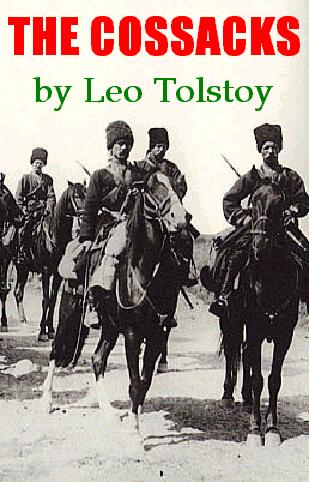
Book Excerpt: The Cossacks by Leo Tolstoy

This is not one of the famous novels that Leo Tolstoy produced, but it’s a fine novel nonetheless.  The novel centers around the character Dmitri Olenin, a young Russian from Moscow, as he enters the exotic world of the rough and rugged people from the Caucuses part of Russia called Cossacks.  Supposedly the novel has an element of the biographical, though it’s hard to say what exactly is autobiographical.   Apparently Tolstoy spent some time in the Caucuses, but Olenin is not exactly the type of hero that would reflect well on the author.  The novel was published in 1863, when Tolstoy was thirty-five years old, but Tolstoy had started writing the novel in 1852.  The novel underwent several revisions, including a substantial one.  Perhaps Olenin’s naiveté and lack of courage was Tolstoy looking back at himself as a younger man, or perhaps the novel started from a more direct biographical stance but under revision Tolstoy felt the central character required a more stark contrast to the Cossack men.  Whatever the autobiography might be, the Olenin character as a sort of green, spoiled, insecure, and immature youth contrasted to the confident, assertive, and natural Cossack men and woman is a stroke of genius. 


Let’s spend some time understanding Olenin’s character since it’s at the crux of the story.  The novel starts in Moscow with Olenin having made the dramatic decision to enter the military and go off to the Caucuses.  That is like a New Yorker from the early 19th century deciding to enter the cavalry and live among the Apache Indians.  It’s not only of another culture, another world, but it’s going from a life of comfort and sophistication to one of living elementary.  Here Olenin, referred to here as “the traveler” is traveling with a few of his companions to a departure point.

'Now I can speak out fully,' said the traveller. 'I don't want to defend myself, but I should like you at least to understand me as I understand myself, and not look at the matter superficially. You say I have treated her badly,' he continued, addressing the man with the kindly eyes who was watching him.

'Yes, you are to blame,' said the latter, and his look seemed to express still more kindliness and weariness.

'I know why you say that,' rejoined the one who was leaving. 'To be loved is in your opinion as great a happiness as to love, and if a man obtains it, it is enough for his whole life.'

'Yes, quite enough, my dear fellow, more than enough!' confirmed the plain little man, opening and shutting his eyes.

'But why shouldn't the man love too?' said the traveller thoughtfully, looking at his friend with something like pity. 'Why shouldn't one love? Because love doesn't come ... No, to be beloved is a misfortune. It is a misfortune to feel guilty because you do not give something you cannot give. O my God!' he added, with a gesture of his arm. 'If it all happened reasonably, and not all topsy-turvy--not in our way but in a way of its own! Why, it's as if I had stolen that love! You think so too, don't deny it. You must think so. But will you believe it, of all the horrid and stupid things I have found time to do in my life--and there are many--this is one I do not and cannot repent of. Neither at the beginning nor afterwards did I lie to myself or to her. It seemed to me that I had at last fallen in love, but then I saw that it was an involuntary falsehood, and that that was not the way to love, and I could not go on, but she did. Am I to blame that I couldn't? What was I to do?'

'Well, it's ended now!' said his friend, lighting a cigar to master his sleepiness. 'The fact is that you have not yet loved and do not know what love is.'

The man in the fur-lined coat was going to speak again, and put his hands to his head, but could not express what he wanted to say. [Chpt 1]

Excerpts taken from etext from Wikisource Library through Classic Literature By Great Authors ; translation by Louise and Aylmer Maude.

We see he has broken up with a woman, an affair that seems to have ended badly.  He thought he was in love, but came to the awareness that he wasn’t.  Well, that’s sort of adolescent.  That he concludes love isn’t even important reveals a sort of an overly intellectual childishness.  His friend points out that Olenin doesn’t even know what love is.  What is also striking on how Tolstoy ends that exchange is that Olinen, hands somewhat flailing up, “could not express what he wanted to say.”  On the surface that’s again suggestive of his adolescence, but it’s also symbolic.  What we’ll see in the novel is that Olenin fails to complete goals, fails to consummate actions, and remains a vicarious standby as the rugged men live life.

Olenin was a youth who had never completed his university course, never served anywhere (having only a nominal post in some government office or other), who had squandered half his fortune and had reached the age of twenty-four without having done anything or even chosen a career. He was what in Moscow society is termed un jeune homme.

At the age of eighteen he was free--as only rich young Russians in the 'forties who had lost their parents at an early age could be. Neither physical nor moral fetters of any kind existed for him; he could do as he liked, lacking nothing and bound by nothing. Neither relatives, nor fatherland, nor religion, nor wants, existed for him. He believed in nothing and admitted nothing. But although he believed in nothing he was not a morose or blase young man, nor self-opinionated, but on the contrary continually let himself be carried away. He had come to the conclusion that there is no such thing as love, yet his heart always overflowed in the presence of any young and attractive woman. He had long been aware that honours and position were nonsense, yet involuntarily he felt pleased when at a ball Prince Sergius came up and spoke to him affably. But he yielded to his impulses only in so far as they did not limit his freedom. As soon as he had yielded to any influence and became conscious of its leading on to labour and struggle, he instinctively hastened to free himself from the feeling or activity into which he was being drawn and to regain his freedom. In this way he experimented with society-life, the civil service, farming, music--to which at one time he intended to devote his life--and even with the love of women in which he did not believe. He meditated on the use to which he should devote that power of youth which is granted to man only once in a lifetime: that force which gives a man the power of making himself, or even--as it seemed to him--of making the universe, into anything he wishes: should it be to art, to science, to love of woman, or to practical activities? It is true that some people are devoid of this impulse, and on entering life at once place their necks under the first yoke that offers itself and honestly labour under it for the rest of their lives. But Olenin was too strongly conscious of the presence of that all-powerful God of Youth--of that capacity to be entirely transformed into an aspiration or idea--the capacity to wish and to do--to throw oneself headlong into a bottomless abyss without knowing why or wherefore. He bore this consciousness within himself, was proud of it and, without knowing it, was happy in that consciousness. Up to that time he had loved only himself, and could not help loving himself, for he expected nothing but good of himself and had not yet had time to be disillusioned. On leaving Moscow he was in that happy state of mind in which a young man, conscious of past mistakes, suddenly says to himself, 'That was not the real thing.' All that had gone before was accidental and unimportant. Till then he had not really tried to live, but now with his departure from Moscow a new life was beginning--a life in which there would be no mistakes, no remorse, and certainly nothing but happiness.  [Chpt 2]


What is clear in that expository passage is that Olenin has lots of wishes, attempts many things, but never finishes anything, never accomplishes anything.  Every activity will be a new beginning, every new endeavor will bring certain happiness.  My goodness, he expects a life of no mistakes or remorse. 

Olenin’s journey to the Caucuses is important.  An author makes many choices as he tells the story, especially the framing of the story.  Tolstoy could have started the story with Olenin already immersed in the Cossack culture.  But Tolstoy shows Olenin departing, breaking away from his friends, and physically being transferred into a different world.  This is a tale imbued with values of the Romantic movement, the idealization of the primitive over the civilized.  Little by little Olenin notices the increasing wildness of the places he passes by, so that he is moving toward the heart of the elemental. 

The farther Olenin travelled from Central Russia the farther he left his memories behind, and the nearer he drew to the Caucasus the lighter his heart became. "I'll stay away for good and never return to show myself in society," was a thought that sometimes occurred to him. "These people whom I see here are NOT people. None of them know me and none of them can ever enter the Moscow society I was in or find out about my past. And no one in that society will ever know what I am doing, living among these people." And quite a new feeling of freedom from his whole past came over him among the rough beings he met on the road whom he did not consider to be PEOPLE in the sense that his Moscow acquaintances were. The rougher the people and the fewer the signs of civilization the freer he felt. Stavropol, through which he had to pass, irked him. The signboards, some of them even in French, ladies in carriages, cabs in the marketplace, and a gentleman wearing a fur cloak and tall hat who was walking along the boulevard and staring at the passersby, quite upset him. "Perhaps these people know some of my acquaintances," he thought; and the club, his tailor, cards, society ... came back to his mind. But after Stavropol everything was satisfactory--wild and also beautiful and warlike, and Olenin felt happier and happier. All the Cossacks, post-boys, and post-station masters seemed to him simple folk with whom he could jest and converse simply, without having to consider to what class they belonged. They all belonged to the human race which, without his thinking about it, all appeared dear to Olenin, and they all treated him in a friendly way.  [Chpt 3]

And finally Olenin reaches his destination, the very heart of Cossackdom, where life is composed of farming, fishing, hunting, and war. 

Novomlinsk village was considered the very heart of Grebensk Cossackdom. In it more than elsewhere the customs of the old Grebensk population have been preserved, and its women have from time immemorial been renowned all over the Caucasus for their beauty. A Cossack's livelihood is derived from vineyards, fruit- gardens, water melon and pumpkin plantations, from fishing, hunting, maize and millet growing, and from war plunder. Novomlinsk village lies about two and a half miles away from the Terek, from which it is separated by a dense forest. On one side of the road which runs through the village is the river; on the other, green vineyards and orchards, beyond which are seen the driftsands of the Nogay Steppe. The village is surrounded by earth-banks and prickly bramble hedges, and is entered by tall gates hung between posts and covered with little reed-thatched roofs. Beside them on a wooden gun-carriage stands an unwieldy cannon captured by the Cossacks at some time or other, and which has not been fired for a hundred years. A uniformed Cossack sentinel with dagger and gun sometimes stands, and sometimes does not stand, on guard beside the gates, and sometimes presents arms to a passing officer and sometimes does not. Below the roof of the gateway is written in black letters on a white board: 'Houses 266: male inhabitants 897: female 1012.' The Cossacks' houses are all raised on pillars two and a half feet from the ground. They are carefully thatched with reeds and have large carved gables. If not new they are at least all straight and clean, with high porches of different shapes; and they are not built close together but have ample space around them, and are all picturesquely placed along broad streets and lanes. In front of the large bright windows of many of the houses, beyond the kitchen gardens, dark green poplars and acacias with their delicate pale verdure and scented white blossoms overtop the houses, and beside them grow flaunting yellow sunflowers, creepers, and grape vines. In the broad open square are three shops where drapery, sunflower and pumpkin seeds, locust beans and gingerbreads are sold; and surrounded by a tall fence, loftier and larger than the other houses, stands the Regimental Commander's dwelling with its casement windows, behind a row of tall poplars. Few people are to be seen in the streets of the village on weekdays, especially in summer. The young men are on duty in the cordons or on military expeditions; the old ones are fishing or helping the women in the orchards and gardens. Only the very old, the sick, and the children, remain at home.  [Chpt 4]

The perspective in that passage, which is Olenin’s perspective, is that of an anthropologist meeting the aborigines.  Finally I want to present this wonderful passage of one of Olenin’s first evenings situated in the Cossack village.

It was one of those wonderful evenings that occur only in the Caucasus. The sun had sunk behind the mountains but it was still light. The evening glow had spread over a third of the sky, and against its brilliancy the dull white immensity of the mountains was sharply defined. The air was rarefied, motionless, and full of sound. The shadow of the mountains reached for several miles over the steppe. The steppe, the opposite side of the river, and the roads, were all deserted. If very occasionally mounted men appeared, the Cossacks in the cordon and the Chechens in their aouls (villages) watched them with surprised curiosity and tried to guess who those questionable men could be. At nightfall people from fear of one another flock to their dwellings, and only birds and beasts fearless of man prowl in those deserted spaces. Talking merrily, the women who have been tying up the vines hurry away from the gardens before sunset. The vineyards, like all the surrounding district, are deserted, but the villages become very animated at that time of the evening. From all sides, walking, riding, or driving in their creaking carts, people move towards the village. Girls with their smocks tucked up and twigs in their hands run chatting merrily to the village gates to meet the cattle that are crowding together in a cloud of dust and mosquitoes which they bring with them from the steppe. The well-fed cows and buffaloes disperse at a run all over the streets and Cossack women in coloured beshmets go to and fro among them. You can hear their merry laughter and shrieks mingling with the lowing of the cattle. There an armed and mounted Cossack, on leave from the cordon, rides up to a hut and, leaning towards the window, knocks. In answer to the knock the handsome head of a young woman appears at the window and you can hear caressing, laughing voices. There a tattered Nogay labourer, with prominent cheekbones, brings a load of reeds from the steppes, turns his creaking cart into the Cossack captain's broad and clean courtyard, and lifts the yoke off the oxen that stand tossing their heads while he and his master shout to one another in Tartar. Past a puddle that reaches nearly across the street, a barefooted Cossack woman with a bundle of firewood on her back makes her laborious way by clinging to the fences, holding her smock high and exposing her white legs. A Cossack returning from shooting calls out in jest: 'Lift it higher, shameless thing!' and points his gun at her. The woman lets down her smock and drops the wood. An old Cossack, returning home from fishing with his trousers tucked up and his hairy grey chest uncovered, has a net across his shoulder containing silvery fish that are still struggling; and to take a short cut climbs over his neighbour's broken fence and gives a tug to his coat which has caught on the fence. There a woman is dragging a dry branch along and from round the corner comes the sound of an axe. Cossack children, spinning their tops wherever there is a smooth place in the street, are shrieking; women are climbing over fences to avoid going round. From every chimney rises the odorous kisyak smoke. From every homestead comes the sound of increased bustle, precursor to the stillness of night.  [Chpt 5]

That is Tolstoy’s prose at his best, simple, filled with rich, meaningful detail, and with a sense of movement. 

Friday, May 3, 2013

Faith Filled Friday: The Rosary For The Unborn

St. Michael the Archangel Organization is coordinating this weekend (May 3rd through May 5th) to gather one million people praying the rosary for the unborn.  This is a worldwide event.  You can read about it here.


You will need to register so they can tally your prayers. You can do that here.

Here is their poster.


Now I have to admit I'm not great at the rosary.  So for all those novices like me, here is a little video to refresh your memory on how to do it.  It's not hard.  Let's pray for those unborn children.