"Love follows knowledge."
"Beauty above all beauty!"
– St. Catherine of Siena

Showing posts with label "Greenleaf". Show all posts

Sunday, October 26, 2014

Short Story Analysis: “Greenleaf” by Flannery O’Connor, Part 2

In Part 1 I discussed the backstory and context of O’Connor’s “Greanleaf.”  Please read Part 1 if you haven’t already.  I apologized for taking so long to post the second part.  Life doesn’t always allow me to ponder and write as much as I would like.  But the interim delay has let the story settle and allow me to really think it through.  Now I’ll get to the story’s main narrative, the finding of a loose bull on Mrs. May’s property, and the attempts to get it off and then finally kill it.


The first four paragraphs of the story capture all the themes, motifs, and symbolism that the bull carries throughout.  So it’s worth reproducing those paragraphs here.

Mrs. May’s bedroom window was low and faced on the east and the bull, silvered in the moonlight, stood under it, his head raised as if he listened—like some patient god come down to woo her—for a stir inside the room.  The window was dark and the sound of her breathing too light to be carried outside.  Clouds crossing the moon blackened him and in the dark he began to tear at the hedge.  Presently they passed and he appeared again in the same spot, chewing steadily, with a hedge-wreath that he had ripped loose for himself caught in the tips of his horns.  When the moon drifted into retirement again, there was nothing to mark his place but the sound of steady chewing.  Then abruptly a pink glow filled the window.  Bars of light slid across him as the venetian blind was slit.  He took a step backward and lowered his head as if to show the wreath across his horns.

For almost a minute there was no sound from inside, then as he raised his crowned head again, a woman’s voice, guttural as if addressed to a dog, said, “Get away from here, Sir!” and in a second muttered, “Some nigger’s scrub bull.”

The animal pawed the ground and Mrs. May, standing bent forward behind the blind, closed it quickly lest the light make him charge into the shrubbery.  For a second she waited, still bent forward, her nightgown hanging loosely from her narrow shoulders.  Green rubber curlers sprouted neatly over her forehead and her face beneath them was smooth as concrete with an egg-white paste that drew the wrinkles out while she slept.

She had been conscious in her sleep of a steady rhythmic chewing as if something were eating one wall of the house.  She had been aware that whatever it was had been eating as long as she had had the place and had eaten everything from the beginning of her fence line up to the house and now was eating the house and calmly with the same steady rhythm would continue through the house, eating her and the boys, and then on, eating everything but the Greanleafs, on and on, eating everything until nothing was left but the Greanleafs on a little island all their own in the middle of whatever had been her place.  When the munching reached her elbow, she jumped up and found herself, fully awake, standing in the middle of her room.  She identified the sound at once: a cow was tearing at the shrubbery under her window.  Mr. Greanleaf had left the lane gate open and she didn’t doubt that the entire herd was on her lawn.  She turned on the dim pink table lamp and then went to the window and slit the blind.  The bull, gaunt and long-legged, was standing about four feet from her, chewing calmly like an uncouth country suitor.

Here we already see two of the same themes that were in the backstory: the lower classes encroaching upon Mrs. May, and her paranoid belief the lower classes are plundering her belongings.  The bull is referred to as “some nigger’s scrub bull,” meaning it’s associated not with pure breed bovines but with the contaminated and lowbred, as she views the lower classes.  And Mrs. May dreaming that the bull is eating away at her property signals the reader toward her perception of the Greanleaf’s rise at her expense.  That there is so much sexual suggestion (the bull “coming to woo her” “like an uncouth country suitor” for a “stir inside her room” and she “hanging loosely” in her nightgown) calls forth the fertility motif, and her rejection of the wooing establishes her sterility, symbolized oddly by the “egg-white paste” upon her face. 

But the bull doesn’t just symbolize some scrub lower class such as Mr. Greanleaf.  The bull is “like some patient god” and is identified with light and has a wreath crown across his head.  A bull deity wooing a woman alludes to the classical myth of Europa, where Zeus, disguised as a white bull, seduces the nymph Europa and carries her away to Crete where their progeny become the three judges of the underworld.  The whole main narrative of the bull culminating with a sexual embrace at the story’s climax constructs a story of a modernized retelling of an ancient myth.  James Joyce made this famous with his novel Ulysses, a modern retelling of the Odyssey.  In such a retelling, while there are parallel events and details, there is usually an inversion of some kind that makes the modern character an anti hero.  While Leopold Bloom parallels Odysseus in Ulysses, he is hardly heroic.  Joyce has inverted a key element while maintaining the parallel.  Another example of a modern retelling is how Joe Christmas of William Faulkner’s Light in August is an inversion of Jesus Christ, though the events of his life parallel Christ’s.  Here Mrs. May is an inversion of a fertility goddess, and clearly the inversion of fertility is sterility.

But the Bull stands for more than a pagan deity.  The wreath across his head is a kingly crown, and a few paragraphs further we are told it’s a “prickly crown.”  And given the “light” and the glow that comes off the bull into Mrs. May’s room and the connotation of the prickly crown to a crown of thorns, we can easily make the association that he also represents Christ.   Notice too how in the first paragraph quoted above the bull bows before her, beckoning.  O’Connor is suggesting through this pantomimed allegory Christ calling Mrs. May.  In fact the whole main narrative of the bull showing up and the attempt to drive him away is an analogue of Christ calling upon the woman and her driving Him away.  Notice her first interjection to the bull: “Get away from here, Sir!”  The use of “Sir” as an honorific address is very natural to southern articulation, though here used cynically.  But “sir” is just a shade away from “lord” and what O’Connor wants the reader to hear once the analogy is identified is, “Get away from me, Lord.”  And to pursue this a bit further, “get away from me” is an inversion of what Virgin Mary says at the embrace of God at the Annunciation “Let it be done unto me.”  And May is Mary’s month, as I pointed out inmy reading of Hopkins’ poem, “The May Magnificant.”  O’Connor is working on several planes simultaneously. 

One can also see the attempt to get the bull off her property as a sort of liturgy.  In fact there are implied liturgies throughout, almost as a sort of bass rhythm that modulates the story.  We see the repetitive return of the bull calling as a ceremony; we see Mrs. May’s reaction to the bull as a ritual; we see Mrs. May sitting at table with her sons as a rite, the broken table from the son’s fighting as a sort of black ceremony.  O’Connor portrays liturgies as gratifying or disdained.  We see Wesley’s ritual of his commute and teaching at school as sort of a bitter observance.  But the most important ritual presented is Mrs. Greenleaf’s healing ritual.  The first time Mrs. May saw her perform this ritual, she was taken aback.  It was in the field, by the woods, the about the same place the bull would later gore Mrs. May.

Out of nowhere a guttural agonized voice groaned, “Jesus!  Jesus!”  In a second it came again with a terrible urgency.  “Jesus!  Jesus!”

Mrs. May stopped still, one hand lifted to her throat.  The sound was so piercing that she felt as if some violent unleashed force had broken out of the ground and was charging toward her.  Her second thought was more reasonable: somebody had been hurt on the place and would sue her for everything she had.  She had no insurance.  She rushed forward and turning a bend in the path, she saw Mrs. Greenleaf sprawled on her hands and knees off the side of the road, her head down.

The “violent unleashed force charging” is an allusion to the bull which would later come toward her, which is also clearly an allusion to Christ.   Throughout the story you can find several instances of things charging toward Mrs. May, setting up the climatic ending.  Mrs. Greenleaf’s embrace of ritual and Mrs. May’s rejection of it (she winces at the scene before her, but especially at the articulation of Jesus’ name) furthers the theme of fertility in the numinous sense as opposed to the sterility of a secular world view.  It is significant that Mrs. May is the cause for breaking the ritual. 

“What is the matter with you?” she asked sharply.

“You broken my healing,” Mrs. Greenleaf said, waving her aside.  “I can’t talk to you until I’m finished.”

And then Mrs. Greenleaf goes on in her charismatic state of mind to call out, “Oh Jesus, stab me in the heart!  Jesus, stab me in the heart.”  That is foreshadowing, yes, since it is Mrs. May that gets literally stabbed in the heart by Jesus, but more than foreshadowing.   O’Connor is suggesting that the avoidance of numinous ritual is impossible.  Mrs. May will eventually meet Jesus, will be stabbed in the heart, and the broken ceremony will be completed.  You can avoid and reject Jesus, but Jesus through life’s rituals and rhythms of life is still going to call on you.

And the overarching rhythms of life are suggested in a number of places.  The story flows with intervals of day and night.  The interweaving of past and present and future (the future through Mrs. May’s projection of her son’s futures and her death) as the story unfolds, and then emphasized when Mrs. May lays back on the hood of her car waiting for Greenleaf to kill the bull: “With her eyes closed, she didn’t think of time as divided into days and nights but into past and future.”  There is also the bull’s “rhythmic chewing.”  There are the frequent images of round configurations, the circle of the wreath around the bull’s horns, “the rim of the pasture” with the bull in the center, the circle of the trees on Mrs. May’s property.  The circle is a loop back to itself, and so associated with rhythm.  There are the seasons of the year, especially spring, the season of return.  That is the significance of the names Greenleaf and May, and Mrs. May even exclaims, “Spring is here!” on the morning of going out to kill the bull.  And there are the rhythmic allusions to light and the sun throughout the story.  The rhythms and rituals connect the story to a sacramental fabric that O’Connor sees woven into the world.

And finally the climatic event ties together all the elements of the story.  She is waiting on the hood of her car for Mr. Greenleaf to have killed the bull.

In a few minutes something emerged from the tree line, a black heavy shadow that tossed its head several times and then bounded forward.  After a second she saw it was the bull.  He was crossing the pasture toward her at a slow gallop, a gay almost rocking gait as if it were overjoyed to find her again.  She looked beyond him to see if Mr. Greenleaf was coming out of the woods too but he was not.  “Here he is, Mr. Greenleaf!” she called and looked on the other side of the pasture to see if he could be seen coming out there but he was not in sight.  She looked back and saw that the bull, his head lowered, was racing toward her.  She remained perfectly still, not in fright, but in freezing unbelief.  She stared at the violent black streak bounding toward her as if she had no sense of distance, as if she could not decide at once what his intention was, and the bull had buried his head in her lap, like a wild tormented lover, before her expression changed.  One of his horns sank until it pierced her heart and the other curved around her side and held her in an unbreakable grip.  She continued to stare straight ahead but the entire scene in front of her had changed—the tree line was a dark wound in a world that was nothing but sky—and she had the look of a person whose sight has been suddenly restored but who finds the light unbearable.

Mr. Greenleaf was running toward her from the side with his gun raised and she saw him coming though she was not looking in his direction.  She saw him approaching on the outside of some invisible circle, the tree line gaping behind him and nothing under his feet.  He shot the bull four times through the eye.  She did not hear the shots but she felt the quake in the huge body as it sank, pulling her forward on its head, so that she seemed, when Mr. Greenleaf reached her, to be bent over whispering some last discovery into the animal’s ear.

In the first post on this story, I started this analysis by questioning the worthiness of the ending, and now that I’ve gone through the story in micro detail, I conclude the ending is most definitely fitting.  My qualms on the initial read had to do with whether the reader was prepared for such an ending.  Her death from the bull seemed to come out of the blue.  But most definitely the climaxed was foreshadowed.  It was foreshadowed from the subtle allusions in the story to Mrs. May’s future death, all in a hypothetical context, and from the various things that are metaphorically “charging” toward Mrs. May.  The other complaint that might get placed on this ending is that it’s rather awkward, if not contorted.  O’Connor does revel in the gothic, and she is identified as an author of Southern Gothic, and the American Southern Gothic Movement.   Such a grotesque situation is at the essence of the gothic, so one shouldn’t be surprised.

But more importantly the ending pulls all the themes together.  We can see the ending as the sexual union with the pagan deity, culminating the Europa myth.  We can see the ending as a final answering to Christ’s call.  No matter how she tried to reject Jesus, ultimately you cannot avoid Him.  We can see the ending as enlightenment, an epiphany: her “sight has been suddenly restored.”  We can see that the gradations of humanity that she was so concerned about in life are in the end unimportant: she consummates with a “scrub bull.”  We can see the sterility of her life ended and transformed into a new fertility.  Christ through His sacrifice is an agent of fertility.  We can even see the climatic death as a crucifixion, pinned and suffering, her life now transfigured.  We can see the ending as the closing of the circle, the return to the bull beckoning outside the window.  We can see the ending as a healing, perhaps inspired by Mrs. Greenleaf’s prayer.  All the hurts, the paranoia, the concerns, the burdens are now relieved.  And finally the culminating act can be seen as acceptance of fate and God’s will.  Here Mrs. May finally transforms into the Blessed Virgin at the Annunciation and has God’s will be done unto her.  I would like to think that the whispering in the bull’s ear contains the word “yes.”


It is astounding how rich and deep this story is, as rich and deep as any ever written.  A masterpiece.

Saturday, October 4, 2014

Poetry: “The May Magnificant” by Gerard Manly Hopkins


Another Hopkins poem, and I post this not because it’s so overwhelming a poem—it’s a nice poem, but not great—but because it gave me insight into the Flannery O’Connor short story, “Greanleaf” which I’ve been analyzing.

First the poem.


The May Magnificat
by Gerard Manly Hopkins

MAY is Mary’s month, and I
Muse at that and wonder why:
    Her feasts follow reason,
    Dated due to season—

Candlemas, Lady Day;                      5
But the Lady Month, May,
    Why fasten that upon her,
    With a feasting in her honour?

Is it only its being brighter
Than the most are must delight her?   10
    Is it opportunest
    And flowers finds soonest?

Ask of her, the mighty mother:
Her reply puts this other
    Question: What is Spring?—           15
    Growth in every thing—

Flesh and fleece, fur and feather,
Grass and greenworld all together;
    Star-eyed strawberry-breasted
    Throstle above her nested                 20

Cluster of bugle blue eggs thin
Forms and warms the life within;
    And bird and blossom swell
    In sod or sheath or shell.

All things rising, all things sizing           25
Mary sees, sympathising
    With that world of good,
    Nature’s motherhood.

Their magnifying of each its kind
With delight calls to mind                       30
    How she did in her stored
    Magnify the Lord.

Well but there was more than this:
Spring’s universal bliss
    Much, had much to say                        35
    To offering Mary May.

When drop-of-blood-and-foam-dapple
Bloom lights the orchard-apple
    And thicket and thorp are merry
    With silver-surfèd cherry                     40

 And azuring-over greybell makes
Wood banks and brakes wash wet like lakes
    And magic cuckoocall
    Caps, clears, and clinches all—

This ecstasy all through mothering earth     45
Tells Mary her mirth till Christ’s birth
    To remember and exultation
    In God who was her salvation.

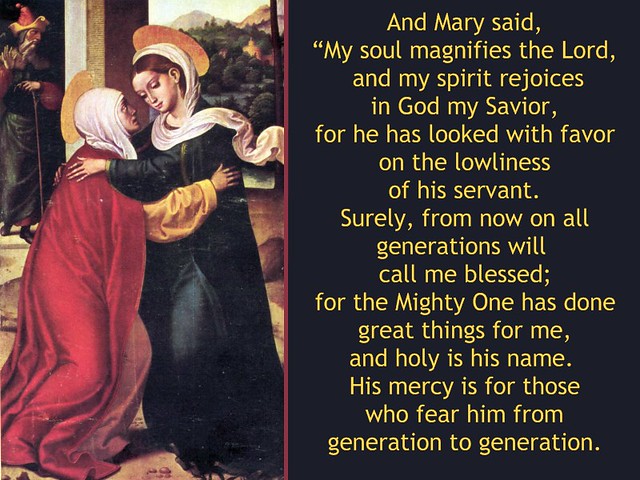
For those that may not know, “The Magnificant” refers to the Canticle of Mary that our blessed mother sings (or speaks) on her visit to her cousin Elizabeth in Luke’s Gospel, 1:46-55.  The poem also refers to the Liturgical Calendar’s dedication of the month of May to the Blessed Virgin.  As you can read, Hopkins starts the poem as a meditation.

If read the first part of my of my analysis of O’Connor’s short story, “Greanleaf,” I wondered why O’Connor named the central character “Mrs. May.”  I don’t know if O’Connor read this poem—it’s quite likely—but the fertility that Hopkins associates with Mary here (she is pregnant with Jesus) is clearly alluded to in the O’Connor short story.  That Mrs. May stands for sterility in the story makes her name ironic and paradoxical.  The word “greenworld” in the 18th line of the poem echoes the name of the family that stands in contradistinction to Mrs. May, the Greanleafs.


I’ll flesh this out in my part two post of the “Greanleaf” analysis but for now just enjoy this wonderful poem.


Wednesday, September 10, 2014

Short Story Analysis: “Greenleaf” by Flannery O’Connor, Part 1

The best way I think to approach an analysis of Flannery O’Connor’s short story “Greenleaf” is to initially disengage the surface narrative (the present time sequence of events) from the back story.  The total story comprises the surface narrative and the backfilled events, details, and personalities that give context to the surface narrative.  The surface narrative here comprises of finding a stray bull on Mrs. May’s property, trying to get the bull off the property, and then finally killing the bull in the story’s dramatic and contorted climax.  (I personally never feel anguish from spoiling endings, so, beware, I will eventually divulge it.)  The back story is a study of contrasts, a contrast between families, that of Mrs. May and her boys against Mr. Greanleaf and his family and a contrast in values.  Let’s start with the back story and understand the context, and then move to the surface narrative, and its relationship to the back story, and then finally understand and assess the climax, which I can’t quite make up my mind as to its worthiness.  Perhaps as I write this, I will reach a decision.

The most distinguishing difference between the May’s and the Greenleaf’s is notion of class.  Mrs. May considers herself to have come from a higher class.  Her husband was a businessman, which in the milieu of the south during the first half of the twentieth century carried the implication of someone more well-to-do than your average Southern white laborer.  And given the South’s consciousness toward gentility, the May’s were probably gentry if not quite patrician, since her husband still worked for a living.  That is, until her husband died, and if I do the timeline, he died premature, since Scofield, the eldest son, would have been twenty-one.  If May’s are gentry then the Greenleaf’s are lower class, “scrub-human” as Mrs. May refers to them.  Mr. Greenleaf is a hired hand, and not particularly an ambitious person.  When the bull first woke her up in the middle of the night, she was tempted to get dressed and go to the Greenleaf’s house to get Mr. Greenleaf.

Weighing it, she decided not to bother Mr. Greenleaf.  She returned to bed thinking that if the Greenleaf boys had risen in the world it was because she had given their father employment when no one would have had him.  She had had Mr. Greenleaf fifteen years but no one else would have had him five minutes.  Just the way he approached an object was enough to tell anybody with eyes what kind of a worker he was.  He walked with a high shouldered creep and he never appeared to come directly forward.  He walked on the perimeter of some invisible circle and if you wanted to look him in the face, you had to move and get in front of him.  She had not fired him because she always doubted she could do better.  He was too shiftless to go out and look for another job; he didn’t have the initiative to steal, and after she had told him three or four times to do a thing, he did it; but he never told her about a sick cow until it was too late to call the veterinarian and if her barn had caught on fire, he would have called his wife to see the flames before he began to put them out.  And of the wife, she didn’t even like to think.  Beside the wife, Mr. Greenleaf was an aristocrat.

If there is anyone who is the complete contrast to Mrs. May, it’s Mrs. Greenleaf, a “large and loose woman” who’s “yard around her house looked like a dump and her five girls were always filthy; even the youngest one dipped snuff.”  Contrast that to Mrs. May’s skinny, wiry frame and obsession to keeping her property cultivated and proper.  The contrast is acute, a country gentlewoman versus a junkyard mongrel, prim versus unwashed.    

Not only is there a class distinction, but Mrs. May has an obsession with the rising of the under classes to supersede her station.  As it turns out Mr. Greenleaf’s twin sons, E.T. and O.T, have risen in life.  Yes, they have their parent’s lower class idiom, but through work and good luck they have built up a farm that has surpassed Mrs. May’s. 

The Greenleaf boys were two or three years younger than the May boys.  They were twins and you never knew when you spoke to one of them whether you were speaking to O.T. or E.T, and they never had the politeness to enlighten you.  They were long-legged and red-skinned, with bright grasping fox-colored eyes like their father’s.  Mr. Greenleaf’s pride in them began with the fact that they were twins.  He acted, Mrs. May said, as if this were something smart they had thought up themselves.  They were energetic and hard-working and she would admit to anyone they had come a long way—and that the Second World War was responsible for it.

They had joined the service and, disguised in their uniforms, they could not be told from other people’s children.  You could tell, of course, when they opened their mouths but they did that seldom.  The smartest thing they had done was to get sent overseas and there marry French wives.  They hadn’t married French trash either.  They had married nice girls who naturally couldn’t tell that they murdered the King’s English or that the Greenleaf’s were who they were….They had both managed to get wounded and now they both had pensions.  Further, as soon as they were released from the army, they took advantage of all the benefits and went to the school of agriculture at the university—the taxpayers meanwhile supporting the French wives.  The two of them were living now about two miles down the highway on a piece of land the government had helped them buy and in a brick duplex bungalow that the government had helped them build and pay for.  If the war had made anyone, Mrs. may said, it had made the Greenleaf boys.  They each had three little children apiece, who spoke Greenleaf English and French, and who, on account of their mother’s background, would be sent to the convent school and brought up with manners.  “And in twenty years,” Mrs. May asked Scofield and Wesley, “do you know what those people will be?”

“Society,” she said blackly.

One has to take with a grain of salt all of the apparent gratuities the government has provided the Greenleaf boys.  This was all told from Mrs. May’s point of view, and you can tell she feels a certain anxiety to events stacked against her life and stacked for others.  Obviously the French wives found something attractive in the men.  It’s also hard to imagine the government giving all those benefits.  The point is that Mrs. May feels a suspicion—a conspiracy—that fate is working against her and for them.  But the Greenleaf boys both ended their military service as “some kind of sergeants” while Schofield, Mrs. May’s eldest son ended as a Private First Class, and Wesley didn’t serve at all due to his poor health.  Those facts aren’t part of any conspiracy.

If the Greenleaf boys flourish, there is something stunted about the May boys.  Both are in their thirties—Scofield thirty-six and presumably Wesley a few years younger—unmarried, and lead somewhat dysfunctional lives.  Scofield is a business man similar to his father, but one reduced to selling insurance of the kind “that only Negroes buy.”  It must be an inexpensive type, but what’s significant about it is he’s fallen a rung on the ladder of society when compared to his father.   What concerns his mother is that “nice girls” are just not interested in him.  We don’t quite understand why.  He is personable and has a broad smile, but there is just something creepy enough about him that must turn nice girls off.  On a number of occasions we see a sense of humor that cuts to the bone, a mean spiritedness. 

If Scofield is creepy, Wesley is downright macabre.  He is “an intellectual,” teaching at the local university.  He had rheumatic fever as a child, and this apparently had altered his personality, at least according to his mother.  He too has problems with women.

Scofield only exasperated her [Mrs. May] beyond endurance but Wesley caused her real anxiety.  He was thin and nervous and bald and being an intellectual was a terrible strain on his disposition.  She doubted if he would marry until she died but she was certain that then the wrong woman would get him.  Nice girls didn’t like Scofield but Wesley didn’t like nice girls.  He didn’t like anything.  He drove twenty miles every day to the university where he taught and twenty miles back every night, but he said he hated the twenty-mile drive and he hated the second-rate university and he hated the morons who attended it.  He hated the country and he hated the life he lived; he hated living with his mother and his idiot brother and he hated hearing about the damn dairy and the damn help and the damn broken machinery.  But in spite of it all he said, he never made any move to leave.  He talked about Paris and Rome but he never went even to Atlanta.

I think the undercurrent to the May boy’s personalities can be summed up with the word, sterility.  They are a dead end.  There is no fruitfulness to their lives.  Their jobs are monotonous; their love lives are perverse; their happiness is nonexistent.  Compare that with the Greenleaf boys who prosper at their farm, marry interesting women, and each have a flock of children. 

But the contrast of families goes even further.  Despite the initial poverty and the lower class outlook habits which cause derision, the Greenleaf family is a harmonious one.  Mr. Greenleaf is always ready to express pride in his sons, and even his wife, who is rather odd, and of which I’ll get to in a moment.  O’Connor suggests this by making the two boys twins, and they work together as a harmonious unit.  Even their names E.T. and O.T are just a blur of a letter.  They are indistinguishable.  What is suggested is a brotherhood of men who help each to form one family.  In contrast, the May family is dysfunctional.  The two boys are “as different…as night and day.  The only thing they had in common was that neither of them cared what happened on the place.”  Not caring what happens on the place is the same as not caring for their family.  At one point the two boys torment their mother by jesting they are not really her sons.  At another point, in response to Mrs. May claiming she prevented the boys from getting up early and milking cows for the household, Wesley turns to her and says, “I wouldn’t milk a cow to save your soul from hell.”  If the Greenleaf’s represent a brotherhood of men, the May’s represent a family at war.  The jokes between them are not harmless fun.  They aim to cut and to hurt.  The family doesn’t bond; it pulls apart.  The scene where Scofield and Wesley physically altercate indicates a division of brothers.

 What these individual contrasts lead to is a more general contrast of approaches to life.  Mrs. May has tried to control her life, at least since her husband died, but probably before that too.  As a widow who was not left good finances, she put her situation in order and built the farm.  “Her city friends,” we are told, “said she was the most remarkable person they knew, to go, practically penniless and with no experience, out to a rundown farm and make a success of it.”  She’s the one who controls Mr. Greenleaf; she’s the one who arranged for her sons to not have to work the farm; she’s the one who fights the elements, fights the “conspiracies,” and, more importantly, fights fate itself.

“Everything is against you,” she would say, “the weather is against you and the dirt is against you and the help is against you.  They’re all in league against you.  There’s nothing for it but an iron hand.”

Her life is lived by that “iron hand,” which is to say she lives by force of will.  Scofield loves to ridicule her “iron hand.”

“Look at Mamma’s iron hand!” Scofield would yell and grab her arm and hold it up so that her delicate blue-veined little hand would dangle from her wrist like the head of a broken lily.”

Notice the difference between the reality of her little delicate hand versus her metaphoric iron hand.  The reality is that she’s not in as control as she thinks she is.  Then in a moment when her sons ridicule her for thinking about their future when she’s dead, her will tightens.

For some time she sat where she was, looking straight ahead through the window across the room into a scene of indistinct grays and greens.  She stretched her face and her neck muscles and drew in a long breath but the scene in front of her flowed together anyway into a watery grey mass.  “They needn’t think I’m going to die any time soon,” she muttered, and some more defiant voice in her added: I’ll die when I’m good and ready.

Not only is she trying to control her sons’ lives after she dies, but she thinks she can control her own fate, which is ironic given her unexpected death at the story’s conclusion. 

The Greenleafs on the other hand “lived like lilies of the field.”  The phrasing is striking.  Mrs. May’s hand is like “broken lily” while the Greenleafs are compared to flourishing lilies.  That’s actually a biblical allusion and worth quoting since it characterizes both the May’s and the Greenleafs, albeit in opposite directions.  From the Gospel of Matthew (6:25-34, NASB), my emphasis in bold, Christ says,

“For this reason I say to you, do not be worried about your life, as to what you will eat or what you will drink; nor for your body, as to what you will put on. Is not life more than food, and the body more than clothing? Look at the birds of the air, that they do not sow, nor reap nor gather into barns, and yet your heavenly Father feeds them. Are you not worth much more than they? And who of you by being worried can add a single hour to his life? And why are you worried about clothing? Observe how the lilies of the field grow; they do not toil nor do they spin, yet I say to you that not even Solomon in all his glory clothed himself like one of these. But if God so clothes the grass of the field, which is alive today and tomorrow is thrown into the furnace, will He not much more clothe you? You of little faith! Do not worry then, saying, ‘What will we eat?’ or ‘What will we drink?’ or ‘What will we wear for clothing?’ For the Gentiles eagerly seek all these things; for your heavenly Father knows that you need all these things. But seek first His kingdom and His righteousness, and all these things will be added to you.  So do not worry about tomorrow; for tomorrow will care for itself. Each day has enough trouble of its own.”

In contrast to Mrs. May putting her trust in her will, the Greenleafs put their trust in God.  They have setbacks; they’re not rich.  Yes they prosper, through work as seen with the two sons, but they don’t obsess over things and fate has a way of working out.  None of the Greenleafs ever show anxiety, even with an escaped bull on the loose.  They don’t try to control.  And they thank God for their good fortune.  “I thank Gawd for ever-thang,” Mr. Greenleaf “drawled” once to Mrs. May, and he meant it.  On the other hand Mrs. May is a “good Christian woman with a large respect for religion, though she did not, of course, believe any of it was true.”   The Greenleafs, poor as they are, have seven children, which suggests lack of forethought; Mrs. May has two, which suggests regulation.

And then there is Mrs. Greenleaf, a woman completely antithetical to Mrs. May.  Unlike Mrs. May’s controlled bearing, Mrs. Greenleaf goes through daily charismatic prayer, and by charismatic one means a complete emotional loss of oneself into the divine.  She performs daily prayer healing.

Every day she cut out all the morbid stories out of the newspaper—the accounts of women who had been raped and criminals who had escaped and children who had been burned and of train wrecks and plane crashes and the divorces of movie stars.  She took these to the woods and dug a hole and buried them and then she fell on the ground over them and mumbled and groaned for an hour or so moving her huge arms back and forth under her and out again and finally just lying down flat and Mrs. May suspected, going to sleep in the dirt.


And later, apparently waking up, “out of nowhere a guttural agonized voice groaned, ‘Jesus!  Jesus!’  In a second it came again with a terrible urgency.  ‘Jesus!  Jesus!’”  And later we see Mrs. Greenleaf fall “back flat in the dirt, a huge human mound, her legs and arms spread out as if trying to wrap them around the earth,” an embrace of the supernatural.  Later Mrs. May would tell Mr. Greenleaf that his wife “has let religion warp her.”  And Mr. Greenleaf responded, “She cured a man oncet that half his gut was eaten out with worms.”  O’Connor’s point isn’t that this sort of simplistic understanding of religion is fact but that such faith is beneficial as it permeates the Greenleaf’s lives.  Such trust in God washes away class distinction, builds a brotherhood of men, nourishes lives, and flourishes with fertility.  The Mays are arid and barren.  One of the most significant moments in the story comes when Wesley who, after being lectured by his mother on being practical, turns to her and says, “Well, why don’t you do something practical, Woman?  Why don’t you pray for me like Mrs. Greenleaf would?”  


Saturday, September 6, 2014

Lines I Wished I’d Written: The Greenleaf’s Farm from “Greenleaf” by Flannery O’Connor

I’ve been putting my thoughts together to analyze Flannery O’Connor’s short story “Greenleaf,” but in the meantime I’d thought I post a particular passage that struck me.  The story centers around an older woman, Mrs. May and her hired help, Mr. Greenleaf.  Mrs. May is very class conscious and has this angst of the lower classes rising above her station.  In the passage below O.T. and E.T. are Mr. Greenleaf’s sons, who have been rising in the world.  A bull has gotten loose and has been on Mrs. May’s property for days now, and she has recently learned that the bull belongs to O.T. and E.T.  The story takes place in the deep South, probably O’Connor’s home state of Georgia, and the two Greenleaf sons both married French women who they met during their service in WWII.  Here Mrs. May has driven over to tell the Greenleaf sons to get their bull back.

It was mid-morning when she turned into O.T. and E.T.’s driveway.  The house, a new red-brick, low-to-the-ground building that looked like a warehouse with windows, was on top of a treeless hill.  The sun was beating down directly on the white roof of it.  It was the kind of house that everybody built now and nothing marked it as belonging to Greenleaf’s except three dogs, part hound and part spitz, that rushed as soon as she stopped her car.  She reminded herself that you could always tell the class of people by the class of dog, and honked her horn.  While she sat waiting for someone to come, she continued to study the house.  All the windows were down and she wondered if the government could have air-conditioned the thing.  No one came and she honked again.  Presently the door opened and several children appeared in it and stood looking at her, making no move to come forward.  She recognized this as a true Greenleaf trait—they could hang in a door, looking at you for hours.

“Can’t one of you children come here?” she called. 

After a minute they all began to move forward, slowly.  They had on overalls and were barefooted but they were not as dirty as she might have expected.  There were two or three that looked distinctly like Greenleafs; the other not so much so.  The smallest child was a girl with untidy black hair.  They stopped about six feet from the automobile and stood looking at her. 

“You’re mighty pretty,” Mrs. May said, addressing herself to the smallest girl.

There was no answer.  They appeared to share one dispassionate expression between them.

“Where’s your Mamma?” she asked.

There was no answer to this for some time.  Then one of them said something in French.  Mrs. May did not speak French. 

“Where’s your daddy?”  she asked.

After a while, one of the boys said, “He ain’t hyar neither.”

“Ahhhh,” May said as if something had been proven.  “Where’s the colored man?”

She waited and decided no one was going to answer.  “The cat has six little tongues,” she said.  “How would you like to come home with me and let me teach you how to talk?”  She laughed and her laugh died on the silent air.  She felt as if she were on trial for her life, facing a jury of Greenleafs.  “I’ll go down and see if I can find the colored man,” she said.

“You can go if you want to,” one of the boys said.

“Well, thank you,” she murmured and drove off.

The barn was down the lane from her house.  She had not seen it before but Mr. Greenleaf had described it in detail for it had been built according to the latest specifications.  It was a milking parlor arrangement where the cows were milked from below.  The milk ran in pipes from the machines to the milk house and was never carried in a bucket, Mr. Greenleaf said, by no human hand.  “When you gonter get one?” he had asked.

“Mr. Greenleaf,” she had said, “I have to do for myself.  I am not assisted hand and foot by the government.  It would cost me $20,000 to install a milking parlor.  I barely make ends meet as it is.”

“My boys done it,” Mr. Greenleaf had murmured, and then—“but all boys ain’t alike.”

“No indeed!” she had said.  “I thank God for that.”

“I thank Gawd for every-thang,” Mr. Greenleaf had drawled. 

You might as well, she had thought in the fierce silence that followed; you’ve never done anything for yourself.

She stopped by the side of the barn and honked but no one appeared.  For several minutes she sat in the car, observing the various machines parked around, wondering how many of them were paid for.  They had a forage harvester and a rotary hay baler.  She had those too.  She decided that since no one was here, she would get out and have a look at the milking parlor and see if they kept it clean.

She opened the milking room door and stuck her head in and for the first second she felt as if she were going to lose her breath.  The spotless white concrete room was filled with sunlight that came from a row of windows head-high along both walls.  The metal stanchions gleamed ferociously and she had to squint to be able to look at all.  She drew her head out of the room quickly and closed the door and leaned against it, frowning.  the light outside was not so bright but she was conscious that the sun was directly on top of her head, like a silver bullet ready to drop into her brain.


I find that to be a min-climax to the story.  Here is her epiphany, a burst of light before her as she sticks her head into the room, that the Greenleafs have made something of themselves and have risen above her in station.  There is so much more to the story though, and the climax comes with the killing of the bull.  I’ll get into an analysis in the coming week.