"Love follows knowledge."
"Beauty above all beauty!"
– St. Catherine of Siena

Showing posts with label Sunday Meditation. Show all posts

Sunday, October 18, 2026

Sunday Meditation: Testing a Truthful Man

For the Twenty-Nineth Sunday in Ordinary Time of Year A, we are still in what  Dr. Nina Heereman calls the “Temple Discourse,”  as I explained last week.  At the Temple during Christ’s last week leading to His passion, He comes in direct confrontation with the Jewish leaders.  In today’s passage the Jewish groups of the Pharisees and the Herodians try to lay a trap for Jesus. 

This passage is well-known for Christ’s saying of giving unto Caesar what is Caesar’s and onto God what is God’s, but what I find fascinating, and perhaps less mentioned is how the Pharisees deviously egg Jesus into being as frank as possible.   They tell Him He is a “truthful man.”  The irony is Jesus is the Truth, the Truth with a capital “T.”  Buttering Him up is a means of getting Him to answer their question. 

And He will answer their question, and He will answer it with Truth but it is not as the Pharisee’s expected.  Jesus will have none of it.  He calls them hypocrites to their face.

The key to this passage is not so much the implied division of church and state from Jesus’s answer, but the play on the word “image”: the image of Caesar versus the image of God in which humanity was made in. 


Today’s Gospel:


The Pharisees went off

and plotted how they might entrap Jesus in speech.

They sent their disciples to him, with the Herodians, saying,

"Teacher, we know that you are a truthful man

and that you teach the way of God in accordance with the truth.

And you are not concerned with anyone's opinion,

for you do not regard a person's status.

Tell us, then, what is your opinion:

Is it lawful to pay the census tax to Caesar or not?"

Knowing their malice, Jesus said,

"Why are you testing me, you hypocrites?

Show me the coin that pays the census tax."

Then they handed him the Roman coin.

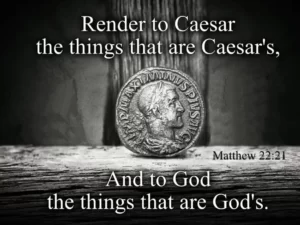
He said to them, "Whose image is this and whose inscription?"

They replied, "Caesar's."

At that he said to them,

"Then repay to Caesar what belongs to Caesar

and to God what belongs to God."

~Mt: 22:15-21


I’m returning to Archbishop Edward J. Weisenburger from the diocese of Detroit for the exegetical homily.


Archbishop Weisenburger:

Now, recall that there were three taxes for the Jews of Jesus' day. First, an income tax, about 1% of your annual income. Second, a 10% tax on grain and grapes used for wine, but then a third tax that was the same for every adult Jewish citizen, roughly the equivalent of a day's wage. That third tax historically began as a way to rebuild the Great Temple in Jerusalem, but when the Roman armies overtook and occupied Palestine during Jesus' era, the Romans shifted this sacred temple tax to pay for the upkeep of their own temple to the pagan gods in Rome. And thus, you can see the crisis. Many faithful Jews saw the payment of that tax as an evil cooperation in reusing a tax meant for the holiest of purposes instead for something blasphemous. Notably, the Herodians quietly had no problem with it. They were actually the ones cooperating with King Herod and the Roman occupiers, and their cooperation with them brought them wonderful privilege.  The Pharisees, for their part, were less open about it, but they also pretty much had free movement in the culture, and so they may quietly have grumbled about paying that blasphemous tax, but few took a public stance, knowing it easily could lead to their being disappeared.  And so now in the temple precincts, these two groups try to force Jesus to either one, be a sellout with the Romans, with overtones of blasphemy, or two, the other option, publicly place a target on his back with the Romans.


Okay, it's at this point that Jesus, standing on sacred temple ground, asks them to show him a Roman coin, which of course was imprinted with the emperor's face.  It also bore an inscription we know for a fact indicating Caesar was God's "high priest."  A blasphemous statement. And two, most biblical scholars note that for a faithful Jew to simply have that coin on his person while on holy temple ground was itself blasphemous.  Which perhaps explains the reason why Jesus had to ask someone to "show me the coin,"   not having one on him himself. And revealing the Pharisees' own hypocrisy.  Okay, with that background in mind, Jesus takes the dilemma of them trying to trap him, and as we so often see, flips it right back on their heads. The coin itself is a blasphemous thing. Money in Jesus' day, much like our own day, technically belonged to the government, with citizens being able to use it for commerce.  Technically, in the law, it did belong to Caesar.  So, it seems Jesus says: give that horrible thing back to a horrible person. But if that's really more context or background, then I think there's still a deeper meaning of the encounter. A deeper meaning for those with the ears to hear and the eyes to see.  And that real or deeper meaning of the encounter was the remainder of what Jesus said to them.  "Give to God what belongs to God." And to the extent that we focus too much on what the coin meant might be the extent to which we too missed the point. Rather, Jesus' intent was the teaching. Give to God what belongs to God.


Brothers and sisters, just as a coin in Jesus' day was stamped with an image, you and I have been created, stamped if you will, in God's image. And you and I are no investment of which he wants simply a part. He really, really wants all of us. And he wants all of you. Moreover, God calls us to recognize and reverence that image of him imprinted on every human being.  And to be sure, the image has little or nothing to do with physical appearance.   Being in the image of God is to reflect God's love in creative and redemptive ways…. Brothers and sisters, I pray that you will have what Jesus would call  "the ears to hear, and the eyes to see."  Be not like the Pharisees or Herodians, twisting religion into something self-serving with a hefty benefit of status and stature. Rather, in recognizing first and foremost in whose image you have been created, and from there recognizing that same divine imprint on every human being, your task is to find ways in life to give to God what belongs to God. Trust me, the Caesars of today can take care of themselves.

And what belongs to God?  Your worship and your service.


For the pastoral sermon (not a homily) I’m going to turn to someone new, Susan Breton of U. S. Catholic Magazine.


Ms. Breton:

Have you ever lost something? How did you get it back?  Maybe it was your purse, your wallet, your phone, your keys, something of sentimental value.  When someone found it, they knew it belonged to you because there was something on it that identified it as being yours. Your name, your picture, something that said, "This belongs to someone." And maybe that's what we are being asked today.  What Jesus is asking us, who do we belong to?


So Jesus asks for a coin. He asks whose image is this and whose inscription? And they answer Caesar. And Jesus says, then repay to Caesar what belongs to Caesar and to God what belongs to God. The word Jesus uses for image is the Greek word eikōn which means icon, image and likeness. The coin bears the icon, the image and likeness of Caesar. So Jesus is acknowledging that the coin belongs to Caesar. But Jesus's answer goes much deeper than taxes. In another place in scripture, we hear this word image. In Genesis, we hear God created human beings in his image and likeness. And in the Greek translation of Genesis, that same word icon is used, icon.  The coin bear Caesar's image or icon. We bear God's image, his icon.  Maybe that's the deeper question that Jesus is putting before us today.  If the coin bears Caesar's image and therefore belongs to Caesar, then if we bear God's image, to whom do we belong?  We belong to God.

There’s an interesting perspective.  Your image stamped by God identifies you as God’s possession!


Sunday Meditation: “Teacher, we know that you are a truthful man."


One of my son Matthew’s favorite hymns as a child, “We Are the Light of the World.”  Here is Chris Brunelle performing.


Chorus: We Are the light of the world, may our light shine before all, that they may see the good that we do, and give glory to God


Vs.1

Blessed are they who are poor in spirit, theirs is the kingdom of God. Bless us, O Lord, make us poor in spirit


Vs. 2

Blessed are they who are meek and humble, they will inherit the earth. Bless us, O Lord, make us meek and humble; bless us, O Lord, our God


Vs. 3

Blessed are they who will mourn in sorrow, they will be comforted. Bless us, O Lord, when we share their sorrow; bless us, O Lord, our God


Vs. 4

Bless those who hunger and thirst for justice, they will be satisfied. Bless us, O Lord, hear our cry for justice; bless us, O Lord, our God


We, whose image is of God, are the light of the world!


Monday, October 5, 2026

Sunday Meditation: The Confrontation Parable

In the Twenty-Seventh Sunday in Ordinary Time of Year A, Jesus comes to what amounts to a final confrontation with the temple elders.  He has entered Jerusalem as a messiah, He has taught as a prophet, He has violently cleansed the Temple with one of authority, He has made claims of hypocrisy against the elders, He has told them a parable of their disobedience, and now He will tell them a parable of their wickedness and God’s condemnation.  This will be the final straw for the religious hierarchy. 

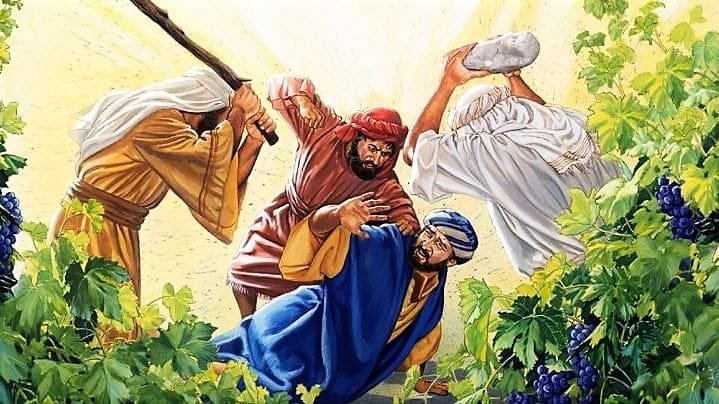
The Parable of the Wicked Tenants is not opaque.  The reference to Isaiah would have been widely known, especially to religious authorities.  The allegorical identifications are obvious.  The vineyard stands for Israel, the tenants in the parable stand for the religious leaders, the servants who are sent before the son are the ancient prophets, and the son who will be killed is the Son of God.  The parable becomes a clear indictment of the religious leaders.  Three years ago I embedded Dr. Brant Pitre’s explanation of the parable and it’s still worth going back to. 

Above I referred to this as Jesus’s final confrontation with the religious leaders, but perhaps the best characterization would be as “a decisive confrontation.  When asked by Jesus what the owner of the vineyard will do, one (or several) of the religious leaders heedlessly says the owner will put the tenants “to a wretched death.”  At that point Jesus has raised the stakes to an existential level, and the only way for the elders to win would be to put Jesus to death.  Or so they think.  Jesus concludes His exchange with “the kingdom of God will be taken away from you.”  Though it’s not in today’s lectionary passage, Matthew includes this coda to this section:


When the chief priests and the Pharisees heard his parables, they knew that he was speaking about them.  And although they were attempting to arrest him, they feared the crowds, for they regarded him as a prophet (45-46). 

That is the exegesis of this Gospel reading.  I’ve noticed in my survey of homilies on this passage, the homilists may explain the rudiments of the exegesis, but the better homilies will tend toward the pastoral application for the congregation.  Are you like the religious leaders not bearing fruit?  Will you be put to a wretched end after your time has run out?


Today’s Gospel:


Jesus said to the chief priests and the elders of the people:

"Hear another parable.

There was a landowner who planted a vineyard,

put a hedge around it, dug a wine press in it, and built a tower.

Then he leased it to tenants and went on a journey.

When vintage time drew near,

he sent his servants to the tenants to obtain his produce.

But the tenants seized the servants and one they beat,

another they killed, and a third they stoned.

Again he sent other servants, more numerous than the first ones,

but they treated them in the same way.

Finally, he sent his son to them, thinking,

'They will respect my son.'

But when the tenants saw the son, they said to one another,

'This is the heir.

Come, let us kill him and acquire his inheritance.'

They seized him, threw him out of the vineyard, and killed him.

What will the owner of the vineyard do to those tenants when he comes?"

They answered him,

"He will put those wretched men to a wretched death

and lease his vineyard to other tenants

who will give him the produce at the proper times."

Jesus said to them, "Did you never read in the Scriptures:

The stone that the builders rejected

has become the cornerstone;

by the Lord has this been done,

and it is wonderful in our eyes?

Therefore, I say to you,

the kingdom of God will be taken away from you

and given to a people that will produce its fruit."

~Mt: 21:33-43


Dr. Matthew Patrick Barber, a Catholic theologian with the Augustine Institute who I have heard speak elsewhere but only now discovered has a YouTube channel, finds a theological wrinkle that I did not hear elsewhere.


Dr. Barber:

And let's talk about the end of the parable. We read, "The kingdom of God will be taken away from you and given to a people that will produce its fruit." Now, this has often been read in terms of what is called replacement theology, and that is the idea that God is rejecting the Jewish people and now replacing Israel with a gentile church.  There are lots of problems with that reading. For one thing, it imagines that the early believers in Jesus, the early followers of Jesus, stopped seeing themselves as Israelites, as Jewish.  That's incorrect. When you read the New Testament, you see Paul, for example, is emphatic on this point. And in the Gospel according to Matthew, Jesus speaks of how the disciples will be punished in the synagogues. This is really important. For example, in Matthew 23, Jesus is condemning Pharisees for various things. And he says that he will send prophets and wise men and scribes. And says, "And some of them you will flog in your synagogues." That's Matthew 23:34.  Now, some will seize on the language there of their synagogues as evidence that the readers of the Gospel of Matthew no longer see themselves as Jewish. These approaches take their synagogues to imply the Jewish synagogues, right?


So what does it mean then when Jesus says the kingdom of God will be taken away from you and given to others? Who is the you Jesus is speaking to there? Well, it's important. Matthew makes it clear at the end of the scene, the end of the

Chapter 4: Leadership replacement story. Jesus tells the parable. We read, "Now the chief priests and the Pharisees heard this parable and they knew that he was speaking about them." So the point is not that the kingdom is being taken away from the Jews in general and given to non-Jewish people. The point is that the leaders are being replaced and they know the story is being told about them.  So the question is who are the new leaders? And I think it's clear the new leaders are the apostles. This is already suggested by a close reading of the gospel Matthew and other places. In Matthew 19 Jesus says that the 12 the 12 apostles will sit on 12 thrones and judge the 12 tribes. They are the eschatological judges, the eschatological leaders of Israel. Moreover, there are some fascinating parallels. I don't have time to get into all of this, but in Matthew 16, Jesus is talking to Peter and in Matthew 23, Jesus condemns the the Pharisees. There's some interesting connections here. Jesus gives to Peter the keys of the kingdom.  In Matthew 16, and Matthew 23, we read that the Pharisees literally key shut the kingdom. They lock people out of the kingdom. In Matthew uh 16, Jesus gives to Peter the authority to bind and loose. And in Matthew 23, the Pharisees bind heavy burdens. So there's a parallel there between Matthew 16, Matthew 23, I think the larger point is that the kingdom is being taken away from these leaders and given to new leaders that Jesus has appointed.

I have to admit, I was under the impression it was replacement theology.  That is brilliant. 


For the pastoral homily I’m going to turn to a Franciscan given that today happens to also be the Feast of St. Francis of Assisi on the 800th anniversary of his passing.  Let’s turn to Fr. Jonathon St. André, TOR of Franciscan University, who combines this homily with St. Francis.


Fr. Jonathon:

So I think I hit the jackpot today. I get to share reflection with you not only on the 27th Sunday in ordinary time but also on October 4th which is the feast of our holy father St. Francis of Assisi in the Jubilee year of St. Francis.  Last night in many places throughout the world was celebrated the transitus a beautiful prayer service where we commemorate Francis's death and passing into eternal life. And this is not just a celebration for Franciscan friars or sisters, but it's for everyone for the gift of St. Francis to the church and the gift of the gospel. And the gospel today for the 27th Sunday in ordinary time is the parable of the landowner.  And we hear about this land owner and he has builds a vineyard, puts a hedge around it, uh builds a well within it, then goes away on a journey and as it says he leased it to tenants and went on a journey.  Then he sends his servants as we know in the parable to come back and to reclaim the produce from the tenants. And of course the story goes that the tenants reject the servants who come and reject the overtures of the master to claim what is rightly his own.  There's a lot of ways we could go into this parable, but one of them that really strikes me today is to recognize that we are tenants of the Lord's vineyard. That we everything we have been given is from the Lord. Our bodies, our minds, our souls, it is all his. It belongs to him. In fact, St. Francis himself would say, "You only possess one thing, your sins.  That's the only thing that's our own.  Everything else is God's." And so, it makes sense that everything we do in our life would return, give an abundant return to the Lord…


Interestingly one of the main themes of the life of St. Francis was living penance. And we hear that word penance and sometimes we can think of that as what we say or do after our confession or we can think of it as a penitential practice in our life or what the attitude we should have during Lent and all those are true but a deeper fuller scriptural sense of penance means a love of God and a love of neighbor. It means an openness to conversion from our sins. It means a closeness to the Eucharist. And interestingly St. Francis says penance is about producing fruits.  So it matches the parable here. What are the fruits? The fruits of the Holy Spirit. The fruits of the Holy Spirit should be visible in our life. Love, joy, peace, patience, kindness, gentleness, self-control.  That people should see that we are living our lives in such a way that the kingdom of God is bearing fruit in us, that we the tenants of the vineyard are helping and cultivating the vines so that the new wine of the Holy Spirit is pouring out of us is pouring out upon people is pouring out upon the church.  So on this feast of St. Francis of Assisi. And at this occasion when we hear the parable of the landowner and in this time when we're called to recognize how am I a good tenant of what the Lord has given me in my life, we should ask ourself, how am I showing forth the fruits of the Holy Spirit?


That is excellent.  I hope to have a blog post during the week on the 800th anniversary of St. Francis’ passing into new life.


Sunday Meditation: “Therefore, I say to you, the kingdom of God will be taken away from you and given to a people that will produce its fruit."


For the hymn, how could we not have the “Prayer of St. Francis”?


Make me a channel of Your peace

Where there is hatred, let me bring Your love

Where there is injury, Your pardon Lord

And where there's doubt, true faith in You


Make me a channel of Your peace

Where there's despair in life, let me bring hope

Where there is darkness, only light

And where there's sadness, ever joy


Oh Master, grant that I may never seek

So much to be consoled as to console

To be understood as to understand

To be loved as to love with all my soul


Make me a channel of Your peace

It is pardoning that we are pardoned

In giving to all men that we receive

And in dying that we're born to eternal life


And in dying we are born to eternal life

Eternal life


I love this hymn, and St. Francis of Assisi is one of the greatest saints ever. 


Sunday, September 27, 2026

Sunday Meditation: A Change of Mind

In the Twenty-Sixth Sunday in Ordinary Time of Year A, we have to understand that the lectionary has jumped.  Last Sunday Jesus was in journey toward Jerusalem.  Today we jump into Holy Week.  Because the preceding passages were provided at or around Palm Sunday—the entry into Jerusalem on donkey, the cursing of the fig tree, the cleansing of the Temple—we may find the context of today’s reading dislocated.  So, refresh yourself on the context.  Today’s reading locates Jesus on the Tuesday of Holy Week.

Given that Jesus has violently overturn the tables at the Temple, the elders confront Jesus and demand by what authority has he done this.  Here he brings up John the Baptist and whether the Jewish religious leaders had accepted John.  This is critical because Jesus cites John the Baptist again in today’s passage.

As a parable, the Parable of the Two Sons, as I said three years ago, is not difficult.  The first son, at first disobedient, repents and responds to what he was asked to.  The second son, openly agreeable but shamefully reprehensible, had no intention of doing what he promised.  Jesus makes clear—something he doesn’t always do in His other parables—that the first son stands for the sinners who listened to John the Baptist and the second the religious authorities who agreed but didn’t obey John the Baptist.

I also find it interesting that Jesus asks the elders for their opinion.  Jesus asks lots of questions throughout the Gospels, 339 by one count, but opinion type questions are not that common, and opinion on moral scenarios are even less so.  “Who do you say that I am?” (Mt 16:15) may be asking for their opinion, but it’s not over ethics.  The question of which of the two sons was righteous echoes the question at the end of the Parable of the Good Samaritan, “Which of the three do you think was a neighbor to the man who fell into the hands of the robbers?” (Lk 10:36-37) with the slight difference that the one of the Good Samaritan was to instill a sense of repentance while the one of the two sons was to implicate sin.


Today’s Gospel:


Jesus said to the chief priests and elders of the people:

"What is your opinion?

A man had two sons.

He came to the first and said,

'Son, go out and work in the vineyard today.'

He said in reply, 'I will not,'

but afterwards changed his mind and went.

The man came to the other son and gave the same order.

He said in reply, 'Yes, sir, 'but did not go.

Which of the two did his father's will?"

They answered, "The first."

Jesus said to them, "Amen, I say to you,

tax collectors and prostitutes

are entering the kingdom of God before you.

When John came to you in the way of righteousness,

you did not believe him;

but tax collectors and prostitutes did.

Yet even when you saw that,

you did not later change your minds and believe him."

~Mt: 21:28-32


Here is someone new to my embedded homilies, Dr. Nina Heereman.  This is not a homily but an exegesis since she is not at and cannot deliver from a pulpit, but still well explained.  She is a professor of Sacred Scripture at St. Patrick’s Seminary and University in Menlo Park, California.  I quoted Dr. Heereman last Sunday, but this is the first time I’m providing a link.  Her explanations do run longer than most I embed but well worth listening to.


Dr. Heereman:

Here comes Jesus question. The baptism of John, where was it from? From heaven or from men?  Was John's baptism something he did commissioned by God in the name of God or just on his own human account?  So they argued with one another and said, "If we say from heaven, she will say to us, then why did you not believe him?" This is the important point. If we say it was from heaven, he's going to say to us, "Why did you not believe him?" What would believing have meant? Believing John the Baptist would have meant believing what John was saying. Number one, repent. Receive the baptism of repentance and prepare yourself for the reception of the Messiah from believing in John would also follow recognizing the one that John announced which is Jesus… Had they believed in John the Baptist, had they had eyes to see, they would have already known in which authority Jesus was doing these things. Because if they   understood who John was, namely as the Lord  said earlier, Elijah, who is to come just before the Messiah, they would have understood Jesus' messianic pedigree, right? He's the son of David.  He's done all all through the gospel, we saw him working all these signs that hint to him being the promised son of David. And one of the foundational things that the son of David, the Messiah, was expected to do was precisely to cleanse the temple. So had they just observed him, they had enough indications that Jesus was the Messiah. But in refusing to listen to Baptist, they implicitly already rejected Jesus.

So Jesus has essentially told the elders by what authority, His divine authority.  Dr. Heereman continues.


Typical Jesus puts out the parable and then he lays out a trap for the high priests and they fall straight into it and by doing so they condemn themselves. They said the first, what's the first?  The first is the guy who first said to the father, "No, I don't care to work in the vineyard." But then he repented. Important word in the Gospel   of Matthew and he went. So the first son is very clearly an image for the sinner who doesn't care about God's commandments. Who doesn't even who doesn't care about serving God at all in his   life. But then the moment of repentance comes and he gives his life to serve the Lord. And so the so Jesus says to them truly amen which means what I'm going to say is as solid as a rock. You can build your life on this truth. I say to you the tax collectors and the harlots go into the kingdom of God before you. The before doesn't mean the tax collectors and the harlots precede the high priests.  It means they go and the high  priest don't because they are the second son who said yes sir but they didn't go be Jesus explains.  So why are the tax collectors entering heaven and they don't? Because John came to you to you high  priests everyone by the way of righteousness and you did not believe him. That's when they refused salvation. But the tax collectors and the harlots believed him and they converted and changed their lives and went to work in the vineyard. And even when you saw the tax collectors and the harlots repenting, you did not afterward repent and believe in him. The most powerful sign that John the Baptist was preaching and acting with divine authority was the fact that the most um that the worst sinners in the understanding of the first century, meaning the tax collectors, the one who collaborated with the Romans and the harlots, which were the epitome of sinful women in the  first century, those two heard the word of John the Baptist and converted.

John the Baptist is not just a throw in within this passage but critical to understanding it.  I bet not too many homilies pointed that out.


For the pastoral homily, I turn once again to Cardinal Blase Cupich.


Cardinal Cupich:

We have this parable of Jesus of the two sons and they differ not only in terms of how they ultimately respond to the father's demand to go into the vineyard.  But we also see that there are other aspects that differentiate them from each other.  The first and the oldest says no.  But the words of the father continue to ring in his ears moving him to change his mind.  It is that sense of continually listening to where God is calling us that is so important for a virtuous life.  We have a lot to learn I think from our Jewish brothers and sisters who pray what they call the Shemma here. O Israel Shemma Israel.  And it is listening to the voice of God that he alone is the Lord of all.  That regular kind of listening, allowing the voice of the Lord to be in our hearts is so important.  But it's also important for us to attend to the voices of people who have made a difference in our lives.  Especially parents, elders, teachers, coaches, people who have left us with a legacy of learning that shapes our lives.

It is so important to listen to the voice of God.  And how do we find the voice of God?  We read the Gospels.  St. Jerome famously said, “Ignorance of scripture is ignorance of Christ.”  Cardinal Cupich continues.


The second son also teaches us something for words don't seem to mean anything.  Not only does he listen, but his word means nothing as well. He says, "Yes, I'll go in." But doesn't and that of course is a very dangerous kind of life to have where the words of God, the words of others, the advice of others is just easily dismissed and we live in our own bubble.  You know, they tell us that the word sincere comes from two Latin words sin and cherus, without wax.  It referred to artists who carved marble statues and sometimes they made a mistake or maybe they didn't put in the work of shining the marble and so they would put wax over it either to cover the mistakes or to brighten up the statue.  But a person or who was an artist who did not use wax was sincere.  That I think also says a lot to us about sincerity in life. We are sincere not when we're waxing over things and polishing things just to make ourselves look good, but that we are true to our words.  Words make a difference. Keeping our word is something that defines our integrity.


Yes, like the parables of Jesus, we have much to learn from these two sons.  To listen to the voice of others and to count the importance of speaking words with sincerity.

A life of integrity is a life of sincerity.  Stay true to your word.


Sunday Meditation: “Yet even when you saw that, you did not later change your minds and believe him."


For the hymn, let’s listen to, “Lord Accept The Gifts We Offer.”


  1. Lord accept the gifts we offer;
    At this Eucharistic feast.
    Bread and wine to be transformed now
    Through the action of your priest (Priests)
    Take us too, O Lord, transform us
    By your grace in us increased.


  1. May our souls be pure and spotless.
    As the host of wheat so fine,
    May all stain of sin be crushed out,
    Like the grape that forms the wine,
    As we, too, become partakers
    In this sacrifice divine.


  1. Take our gifts, almighty Father
    Living God eternal true
    Which we give through Christ our Saviour
    Pleading here for us anew.
    Grant salvation to all present.
    And our faith and love renew.


Take us too, O Lord, transform us!