"Love follows knowledge."
"Beauty above all beauty!"
– St. Catherine of Siena

Showing posts with label Paradisio. Show all posts

Thursday, March 7, 2019

Dante's Paradiso Cantos VI - IX, Summary

Canto VI

The soul who addressed Dante on arriving to Mercury delivers a monologue that lasts the entire canto.  This soul identifies himself as heir to the line of Caesars that governed the Roman Empire.  He is Justinian, the last of the Roman Emperors that tried to reconstitute the empire after the western half collapsed.  He answers to why he is under the sphere of Mercury with a long extended recapitulation of Roman history.  He cites Rome’s mythic founding, it’s early monarchy, it’s subsequent overthrow to establish the Republic, the defeat of foreign enemies, the collapse of the Republic, the establishment of the empire through the Caesars which created the conditions for the birth of Christ, the destruction of the Jewish Temple, and ultimately the establishment of the Holy Roman Empire under Charlemagne.  Justinian then explains how the political parties of Dante’s day, the Ghibellines and the Guelphs, are poor successors to the Roman past.  He explains how the souls under the sphere of Mercury worked for justice during their lifetime but fell short of charity.  Justinian’s reign was known for synthesizing and perfecting Roman law.  Finally Justinian introduces a neighboring spirit, Romeo di Villanove, a man who during his later years was cast into exile. 

Canto VII

Justinian still speaking breaks into a bilingual song intertwining Hebrew and Latin.  He recedes into the group of dancing spirits, leaving Dante (the character) unanswered two questions he was about to ask.  Beatrice, glowing with a radiant smile, answers them.  The first question pertains to the double nature of Christ’s crucifixion in that it was both blasphemy to kill God and redemptive for mankind.  The second question pertains to why God in all His possibilities chose the death of His son as the means to redemption.  Since the Edenic fall was the result of a man’s act (Adam), it was most fitting that the redemption should come through the act of another man.  But since mankind lacked the ability to pay this exorbitant debt, God in His generosity would pay it but would pay it through the sacrificial death of His incarnate son, and thereby satisfy the fitting redemption through mankind.  Beatrice, anticipating a third question, answers why what God creates degenerate and die, even though God Himself is eternal and perfect.  It is because God creates things both directly and indirectly.  Those that are created directly do not die and those indirectly do.  Man’s soul, which is eternal, is a direct creation of God breathing into each individual.

Canto VIII

Without any sense of awareness, Dante is transported to the next sphere, Venus.  This is the planet associated with the pagan goddess of love.  Once within the sphere Dante sees that Beatrice glows brighter and even more beautiful than before.  A group of dancing lights come before them singing “Hosanna,” and one light steps up to speak.  He, Charles Martel, describes himself as having died young, a man who Dante once knew and had affection for.  In his short life, Charles was the ruler of Hungary and other parts of southern Europe.  He contrasts his good rule against that of his brother, Robert, King of Naples, who was a greedy ruler and a collaborator with the Pope against the Holy Roman Emperor.  Dante asks how such a good father—that of Charles and Robert—produce such a bad son?  Charles answers that God created and guides the universe to influence the people on earth but also created diverse people with free will.  Children would be the same as their parents but because God shapes their lives differently and because they respond differently to stimuli, men become different than their parents, and so yield different fruit.  Not all take up professions that fit one’s talents.  It behooves a person, then, to find a profession or state that fits their natural gifts.

Canto IX

Still on Venus, Dante (the character) speaks to Clemenza, Charles’ wife or daughter (it’s unclear) and says that time will bring retribution for those that did her family wrong.  Another splendor moves forward to tell Dante she was from a “degenerate” part of Italy in the northeast where her brother, Ezzelino da Romano scourged the region.  She is Cunniza da Romano who had a long list of love affairs and marriages and who ultimately found contrition and made up for her indiscretions.  She goes on to provide three prophecies: the battle of Vicenza, the death of Riccardo de Camino, and the betrayal of the Forrarese brothers by the bishop of Feltre.  As she fades back, another spirit moves forward to speak, Folquet de Marseilles, known as Folco.  A onetime love poet and perhaps a playboy who renounced his worldly life to first become a friar, then an abbott, and finally a bishop, he was deeply involved in the Albigensian crusade.  He speaks of the brightest splendor who resides under the influence of Venus, that is, the Old Testament prostitute, Rahab, who aided Joshua in his conquest of the Holy Land.  Folco goes on to lament the sad state of Florence where churchmen all seek to enrich themselves.  He goes on to prophesy that the Vatican will soon be free of this sin.


Wednesday, June 10, 2015

Literature in the News: Dante Alighieri’s 750th Birthday

In my last post I mentioned I wanted to celebrate the 750th anniversary of Dante Alighieri’s birth.    I also mentioned there that the exact day of Dante’s birth is unknown, but from a reference in The Divine Comedy we know he was born under the sign of Gemini, and therefore we can bracket from May 11th to June 11th. 

The celebrations in Italy for the occasion must have been stunning.  Both a the actor Robert Begnini and an emissary for the Pope spoke in honor of the great Italian poet in the Italian parliament.  From the English version of the Italian news, ANSA. 

(ANSA) - Rome, May 4 - Oscar-winning actor Roberto Benigni received a standing ovation Monday as he read from Dante in the Italian Senate and Pope Francis praised the medieval poet as a "prophet of hope" as the nation marked the 750th anniversary of his birth.
    Benigni received a standing ovation after his reading from Dante's Divine Comedy in the Upper House of parliament, which was attended by President Sergio Mattarella and broadcast live to the nation by state-run RAI radio.
    The program also included a new musical homage to the poet by renowned composer Nicola Piovani.
    The pope's message said that Dante's works announced the "possibility of redemption and liberation" for humanity with his works that affirmed the love of God and the hope for a new life.
    Cardinal Gianfranco Ravasi delivered the pope's message that described Dante as "one of the most illustrious figures of all humanity".
    The pope's message added the Florentine was an "artist of the highest universal values who still has much to say and to give through his works (to those who are) willing to follow the way of true knowledge, the discovery of self and the world".
    Benigni, who read from the XXIII canto of Dante's Paradiso, said: "The Divine Comedy is a miracle, a work whose beauty takes your breath away".

The article goes on to say that 187 events will occur across Italy in commemoration of his birth, and another 173 outside of Italy by Italian cultural institutes.  I wonder if any will occur here in New York City since we have such a large Italian-American population. 

So how should I commemorate the occasion?  Let’s start with the first 39 lines of that Paradisio Canto XXIII that Benigni read.  This is the spectacular moment that Dante the character sees Christ, the light of the world.  I’ll copy over from the Princeton Dante Project  which includes the Hollander and Hollander translation.  I’ll post the Italian and the English side by side.

Come l'augello, intra l'amate fronde,  1          As the bird among the leafy branches that she loves,
                                                                         
posato al nido de' suoi dolci nati        2          perched on the nest with her sweet brood
                                                                         
la notte che le cose ci nasconde,         3          all through the night, which keeps things veiled from us,
                                                                         
    che, per veder li aspetti disïati        4          who in her longing to look upon their eyes and beaks
                                                                         
e per trovar lo cibo onde li pasca,       5          and to find the food to nourish them --
                                                                         
in che gravi labor li sono aggrati,        6          a task, though difficult, that gives her joy --
                                                                         
    previene il tempo in su aperta frasca,          7          now, on an open bough, anticipates that time
                                                                         
e con ardente affetto il sole aspetta,   8          and, in her ardent expectation of the sun,
                                                                         
fiso guardando pur che l'alba nasca;   9          watches intently for the dawn to break,
                                                                         
    così la donna mïa stava eretta         10        so was my lady, erect and vigilant,
                                                                         
e attenta, rivolta inver' la plaga           11        seeking out the region of the sky
                                                                         
sotto la quale il sol mostra men fretta:            12        in which the sun reveals less haste.
                                                                         
    sì che, veggendola io sospesa e vaga,         13        I, therefore, seeing her suspended, wistful,
                                                                         
fecimi qual è quei che disïando           14        became as one who, filled with longing,
                                                                         
altro vorria, e sperando s'appaga.        15        finds satisfaction in his hope.
                                                                         
    Ma poco fu tra uno e altro quando, 16        But time was short between one moment and the next,
                                                                         
del mio attender, dico, e del vedere   17        I mean between my expectation and the sight
                                                                         
lo ciel venir più e più rischiarando;     18        of the sky turned more and more resplendent.
                                                                         
    e Bëatrice disse: "Ecco le schiere    19        And Beatrice said: 'Behold the hosts
                                                                         
del trïunfo di Cristo e tutto 'l frutto    20        of Christ in triumph and all the fruit
                                                                         
ricolto del girar di queste spere!"        21        gathered from the wheeling of these spheres!'
                                                                         
    Pariemi che 'l suo viso ardesse tutto,          22        It seemed to me her face was all aflame,
                                                                         
e li occhi avea di letizia sì pieni,          23        her eyes so full of gladness
                                                                         
che passarmen convien sanza costrutto.          24        that I must leave that moment undescribed.
                                                                         
    Quale ne' plenilunïi sereni   25        As, on clear nights when the moon is full,
                                                                         
Trivïa ride tra le ninfe etterne 26        Trivia smiles among the eternal nymphs
                                                                         
che dipingon lo ciel per tutti i seni,     27        that deck the sky through all its depths,
                                                                         
    vid' i' sopra migliaia di lucerne        28        I saw, above the many thousand lamps,
                                                                         
un sol che tutte quante l'accendea,     29        a Sun that kindled each and every one
                                                                         
come fa 'l nostro le viste superne;       30        as ours lights up the sights we see above us,
                                                                         
    e per la viva luce trasparea  31        and through that living light poured down
                                                                         
la lucente sustanza tanto chiara           32        a shining substance. It blazed so bright
                                                                         
nel viso mio, che non la sostenea.       33        into my eyes that I could not sustain it.
                                                                         
    Oh Bëatrice, dolce guida e cara!     34        O Beatrice, my sweet belovèd guide!
                                                                         
Ella mi disse: "Quel che ti sobranza    35        To me she said: 'What overwhelms you
                                                                         
è virtù da cui nulla si ripara.    36        is a force against which there is no defense.
                                                                         
    Quivi è la sapïenza e la possanza    37        'Here is the Wisdom and the Power that repaired
                                                                         
ch'aprì le strade tra 'l cielo e la terra,   38        the roads connecting Heaven and the earth
                                                                         
onde fu già sì lunga disïanza."            39        that had so long been yearned for and desired.'

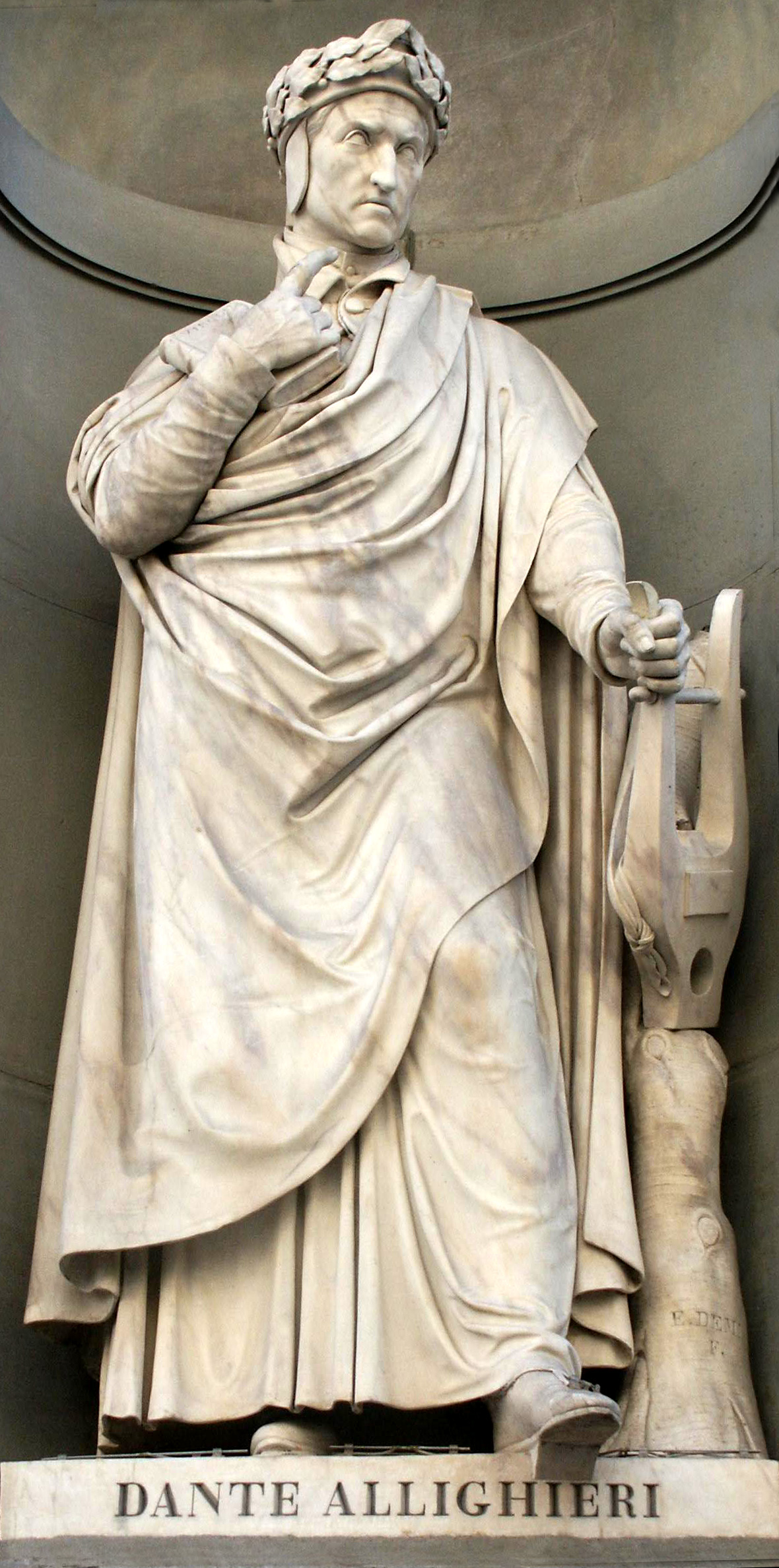
How about a post some statues of Dante from across the world.  Here is the most famous I think, from the UffiziMuseum in Florence, Italy, the city that banished Dante during his lifetime.


This also in Florence at the wonderful Santa Croce Basilica.  


I’ve been there but I can’t remember the statue.  I do remember the one at the Uffizi.

Here is one in Verona, Italy.


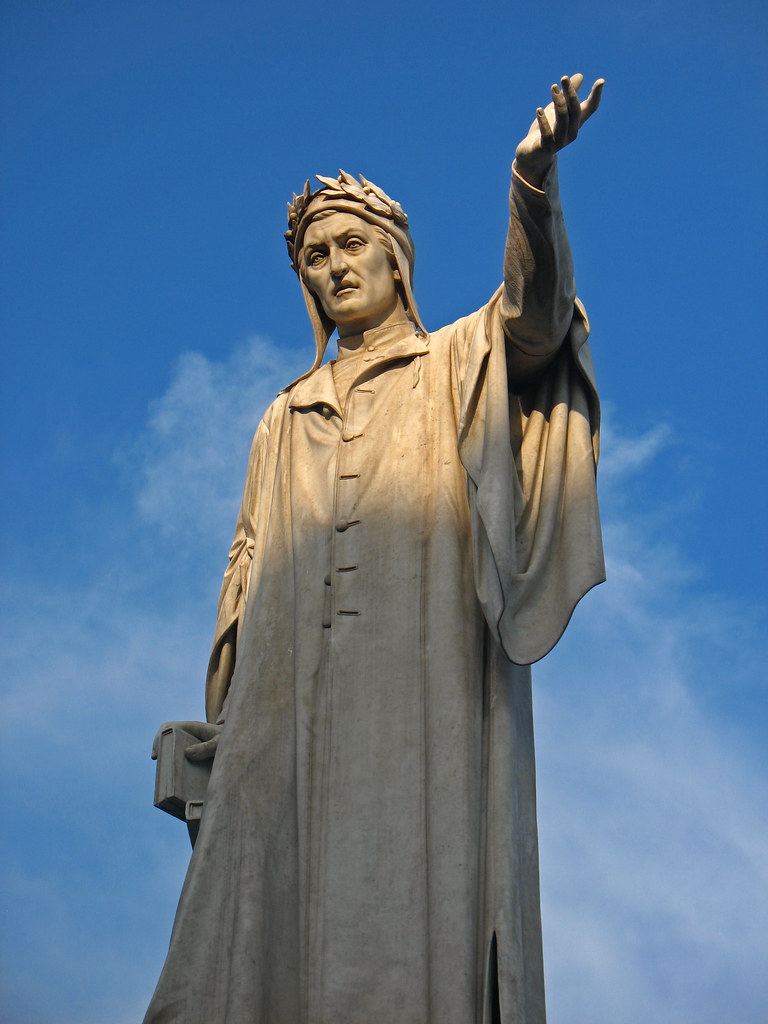
And then one in Naples, Italy. 


I wonder if every city in Italy has a statue of Dante.  Let’s come over to the United States and there is this one in Washington, DC.


And then there is this one in New York City.  This is off my personal camera.  I took it on Memorial Day when Matthew and I were on a bus.  Unfortunately I couldn’t get a good angle, and the bus was moving.


OK, that didn’t really capture it.  Sorry it was the best I could do from the bus.  Here’s an image of it off the internet.


Actually it looks exactly the same as the one in Washington.  So which do I like the best?  I’d go with the one at the Uffizi.

Happy Birthday Dante!