"Love follows knowledge."
"Beauty above all beauty!"
– St. Catherine of Siena

Showing posts with label Confessional Poetry. Show all posts

Wednesday, January 6, 2016

Poetry: “North Haven” by Elizabeth Bishop

I ended 2015 with a poem from Robert Lowell, “Water,” a tribute to the Platonic friendship he had with fellow poet, Elizabeth Bishop.  I want to start 2016 with a complementary poem from Bishop to Lowell, only this is in commemoration to Lowell passing. Lowell’s poem was about their mutual appreciation for a “Maine Lobster town,” which Lowell used as a conceit for their relationship; the place where their “two souls” found mutual tenderness.  As I said in the other post, Bishop was Lesbian.  North Haven is just such a town in Maine, and could be the very one Lowell was referring to.  As a biographical note, North Haven was a place where Bishop spent many of her summers, and apparently Lowell spent many of his summers in Maine, and, as suggested in Bishop’s poem, this same town. 

I didn’t explicate Lowell’s poem in post on his poem, so let me point out a few things here.  The poem presents a dichotomy between the hard realities of ocean shore and the dreamy imagination of Romance.  Lowell uses the word “rock” five times and if you include “granite” in the third line, that’s six times he refers to a stone in the 32 line poem.  Contrasted with that is what “seems” to be “the color of iris” (l. 15-6), the dream of being a mermaid in seventh stanza, and the wish for their “two souls” to return in the final stanza.  Lowell’s theme here then is that hard reality prevents a true fulfillment of their relationship, and so they will have to settle for what they have.  “In the end” the poem concludes, “the water was too cold for us” (l. 31-2).

The timeline between Lowell’s poem and Bishop’s poem is also interesting.  According to this article by Colm Tóibín in the London Review of Books, Lowell first wrote a draft of the poem in 1948 and published it in his 1964 collection, For the Union Dead.  He sent the draft to Bishop in 1962, whereby she suggested some changes, which I guess influenced the final version.  So this poem of their relationship was fully acknowledged between the two of them.  Lowell dies in in September of 1977, Bishop writes her commemorative poem in 1978, and Bishop herself dies in October of 1979.  Here is Bishop’s poem.

North Haven
In Memoriam: Robert Lowell
By Elizabeth Bishop

I can make out the rigging of a schooner
a mile off; I can count
the new cones on the spruce. It is so still
the pale bay wears a milky skin; the sky
no clouds except for one long, carded horse¹s tail.

The islands haven’t shifted since last summer,
even if I like to pretend they have—
drifting, in a dreamy sort of way,
a little north, a little south, or sidewise—
and that they¹re free within the blue frontiers of bay.

This month our favorite one is full of flowers:
buttercups, red clover, purple vetch,
hackweed still burning, daisies pied, eyebright,
the fragrant bedstraw’s incandescent stars,
and more, returned, to paint the meadows with delight.

The goldfinches are back, or others like them,
and the white—throated sparrow’s five—note song,
pleading and pleading, brings tears to the eyes.
Nature repeats herself, or almost does:
repeat, repeat, repeat; revise, revise, revise.

Years ago, you told me it was here
(in 1932?) you first “discovered girls”
and learned to sail, and learned to kiss.
You had “such fun,” you said, that classic summer.
("Fun"—it always seemed to leave you at a loss...)

You left North Haven, anchored in its rock,
afloat in mystic blue... And now—you’ve left
for good. You can’t derange, or rearrange,
your poems again. (But the sparrows can their song.)
The words won’t change again. Sad friend, you cannot change.

Interesting how Bishop connects the third and fifth lines with either an ending rhyme or consonance such as kiss/loss.  But more interesting is that the poem seems to me to be in the Lowell style—confessional, simple free verse, short line lengths, casual tone—rather than Bishop’s more formal mode of expression.  Compare the voice in this poem with Bishop’s masterpiece poem, “At the Fishhouses,” also a poem set at the shore.  


Bishop in “North Haven” as in Lowell’s “Water” presents a dichotomy between a hard reality and the dreamy imagination of Romance.  Bishop’s poem really alludes to Lowell’s.  It’s the same setting with nearly the same action.  The hard reality of the shore—“the islands haven’t shifted” (l. 6) and Lowell left New Haven “anchored in its rock” (l. 26)—is present.  But while Lowell’s poem seems to rest its emphasis on the hard reality, Bishop rests her emphasis on the dreamy Romance.  The ratio between rock and Romance seem to reverse in Bishop’s poem.  The islands may not have shifted, but she likes “to pretend” they have, “drifting in a dreamy sort of way’ (l. 8); Lowell may have been “anchored,” but he was also “afloat in mystic blue” (l. 27); the goldfinches sing a mutable song, and Bishop brings up Lowell’s long, beloved memories on the Maine shore.  In the end, though, the hard reality wins out: “Sad friend, you cannot change.”


Both “Water” and “North Haven” are very lovely poems by fine poets.


Thursday, December 31, 2015

Poetry: “Water” by Robert Lowell [UPDATED]

I’ve fallen down on my poetry read of Robert Lowell (this year’s annual poetry read), as I’ve fallen down on my overall reading.  I’ll get to that when I get to my 2015 summary which I’ll post in a few days.  Nonetheless I want to end the year with this really pretty poem from Lowell.  It’s rather straight forward, without any obscure, unexplained biographical detail that usually typifies Lowell’s great confessional poems.  The only thing you need to know is that the poem is addressed to the poet Elizabeth Bishop.  Lowell and Bishop formed one of the great friendships of American Letters, and from what I know it was purely Platonic.  Actually if I remember correctly, Bishop was lesbian, though she did not publicly reveal it.  Their correspondence is on Amazon and it amounts to some 469 letters between them.  You can read the NY Times review of the correspondence if you wish here  and you can sample some of Lowell’s letters to Bishop at this New Yorker article if you wish. 


Water
by Robert Lowell

It was a Maine lobster town—
each morning boatloads of hands
pushed off for granite
quarries on the islands,

and left dozens of bleak
white frame houses stuck
like oyster shells
on a hill of rock,

and below us, the sea lapped
the raw little match-stick
mazes of a weir,
where the fish for bait were trapped.

Remember? We sat on a slab of rock.
From this distance in time
it seems the color
of iris, rotting and turning purpler,

but it was only
the usual gray rock
turning the usual green
when drenched by the sea.

The sea drenched the rock
at our feet all day,
and kept tearing away
flake after flake.

One night you dreamed
you were a mermaid clinging to a wharf-pile,
and trying to pull
off the barnacles with your hands.

We wished our two souls
might return like gulls
to the rock. In the end,
the water was too cold for us.

Yes, the ending signals his unfulfilled longing.  It’s very sweet and has the perfect Lowell touches.  I really admire Lowell’s poetry.  Here is a picture of the two of them on a beach.


Happy New Year.


UPDATE (6 Jan 2016)
I posted a complementary poem to Lowell's "Water," a poem by Elizabeth Bishop in memorial of her friend passing, Bishop's "North Haven."

Wednesday, October 7, 2015

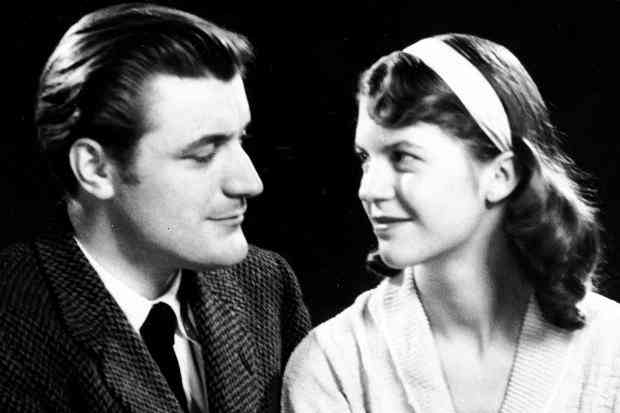
Literature in the News: Sylvia Plath’s Daughter Rebukes Feminists

I found this article interesting.  Frieda Hughes, who is the daughter of poets Sylvia Plath and Ted Hughes, criticized the feminists who idolized her mother’s work but who condemned her father because of their belief that he was responsible for Plath’s suicide.  Here’s a quick background for those who are not familiar.  Plath and Hughes were young poets married to each other from 1956 to her death in 1963.  Sylvia Plath had a history of mental illness and suicide attempts, and finally did kill herself.  It is true Ted Hughes cheated on her and had a mistress, and five months before the suicide had separated from Plath.   With that, here is Frieda Hughes’ claim as published in The Telegraph:

The feminists who exploited Sylvia Plath's death to accuse her husband Ted Hughes of mistreating her committed an "abuse" and a "horrible form of theft", the couple's daughter has said.

Frieda Hughes, the oldest of Plath and Hughes' two children, said she had been "appalled" by the appropriation of her family's tragedy to suit a cause.


Appearing in her first ever television interview, she said she deplored the judgment of "outsiders" who mistakenly believed they had an insight into her family's life.

What I didn’t realize was that the mistress Hughes took up with, also eventually committed suicide.  From the article:

Her father, the former poet laureate Hughes, went on to a relationship with his mistress Assia Wevill, who killed herself and their child in the same way six years later.

The incidents, which left Hughes unable to write his Crow collection, was taken up by furious feminists, who idolised Plath and accused the poet of mistreating both women.

Crow, mentioned above, is perhaps Hughes’ most famous collection of his poems.  I am not knowledgeable enough oh the Plath/Hughes history to know how substantive the feminists’ charge are, but given Plath’s mental illness history I can’t see how Hughes is more than just a bad husband.  And Frieda Hughes is right, who can really know a relationship from the outside.  She is quoted:

Speaking in the documentary, to be broadcast on BBC Two, she said the links made between the two tragedies were a form of "abuse" in themselves.

"I was appalled that something that happened in 1963 could be carried forward," she told programme-makers.

"What an easy way out for somebody to think, yes, we’re right, we have got the real story, we know what really happened, and we are going to punish this complete stranger for something we weren’t around to witness, we know nothing about, but we’re the ones with the answer.

"For outsiders - because that’s what they are, outsiders - to make judgements that affect somebody in their life, for all of their life, is a sort of horrible form of theft.

"It’s an abuse."

The charges against Ted Hughes—he was even accused of outright murdering Plath—colored his entire career.  Plath unfortunately died young, so she never did reach her potential.  Hughes, who was already a more mature poet than Plath, on the other hand, developed into one of the leading British poets of his generation, even titled as the Poet Laureate of Britain, the feminists did all they could to destroy his career. 


Since I’m on the subject of Sylvia Plath and Ted Hughes, let me give an example of their poetry.  First from Plath.  I’ve always thought highly of this poem, though I can’t completing comprehend it all.

Fever 103?

Pure? What does it mean?
 The tongues of hell
 Are dull, dull as the triple

Tongues of dull, fat Cerebus
 Who wheezes at the gate. Incapable
 Of licking clean

The aguey tendon, the sin, the sin.
 The tinder cries.
 The indelible smell

Of a snuffed candle!
 Love, love, the low smokes roll
 From me like Isadora's scarves, I'm in a fright

One scarf will catch and anchor in the wheel.
 Such yellow sullen smokes
 Make their own element. They will not rise,

But trundle round the globe
 Choking the aged and the meek,
 The weak

Hothouse baby in its crib,
 The ghastly orchid
 Hanging its hanging garden in the air,

Devilish leopard!
 Radiation turned it white
 And killed it in an hour.

Greasing the bodies of adulterers
 Like Hiroshima ash and eating in.
 The sin. The sin.

Darling, all night
 I have been flickering, off, on, off, on.
 The sheets grow heavy as a lecher's kiss.

Three days. Three nights.
 Lemon water, chicken
 Water, water make me retch.

I am too pure for you or anyone.
 Your body
 Hurts me as the world hurts God. I am a lantern --

My head a moon
 Of Japanese paper, my gold beaten skin
 Infinitely delicate and infinitely expensive.

Does not my heat astound you. And my light.
 All by myself I am a huge camellia
 Glowing and coming and going, flush on flush.

I think I am going up,
 I think I may rise --
 The beads of hot metal fly, and I, love, I

Am a pure acetylene
 Virgin
 Attended by roses,

By kisses, by cherubim,
 By whatever these pink things mean.
 Not you, nor him.

Not him, nor him
 (My selves dissolving, old whore petticoats) --
 To Paradise.

I’m not going to do a close analysis, but don’t get too hung up on understanding every line.  Bear in mind it’s a confessional poem, and unless you’re a Plath scholar (and I’m not) you probably won’t get the immediate situation.  Plus there are some obscure details which obfuscates the meaning.  For instance that “Isadora’s scarves” in line 12 refers to the dancer Isadora Duncan and her accidental strangling death with one of her scarves.  The poem goes from a sexual desire she considers sinful to being redeemed by it, from hell to paradise, from adulteress to virgin.  I’m not sure, but it could be the poem moves from the sexual sin to a blessed motherhood.

Ted Hughes is quite a different poet.  Here’s one from his Crow collection. 

Crow Communes

"Well," said Crow, "What first?"
God, exhausted with Creation, snored.
"Which way?" said Crow, "Which way first?"
God's shoulder was the mountain on which Crow sat.
"Come," said Crow, "Let's discuss the situation."
God lay, agape, a great carcass.

Crow tore off a mouthful and swallowed.

"Will this cipher divulge itself to digestion
Under hearing beyond understanding?"

(That was the first jest.)

Yet, it's true, he suddenly felt much stronger.

Crow, the hierophant, humped, impenetrable.

Half-illumined. Speechless.

(Appalled.)


The way I read Hughes is to see him as a sort of modern Romantic, idealizing nature and finding some hidden theology behind it.  I’m not overwhelmed by his poetry, despite his reputation.  He seems to me to be a lesser D. H. Lawrence, both in theme and style.  I’d rather read Lawrence.  

Thursday, May 14, 2015

Poetry: “Waking in the Blue” by Robert Lowell

This year’s poetry read is Robert Lowell’s Collected Poems, which I now realize is just too broad a collection.  It’s an astonishing just under 1000 pages worth of poetry, and then a couple of hundred pages of introduction, afterward, notes, and index.  There is no way I’m going to cover this, so I’ll just try to find his most well known poems and then randomly peruse some others.


Robert Lowell might just be the most important post WWII American poet in the canon.  He is arguably the first poet to write in what is called “Confessional Poetry.”  As you can read in the Wikipedia entry, confessional poetry was a movement from the post war through the 1960s where the subject matter were elements of a the author’s life.  Now of course poetry had used biographical details before, but what I think made confessional poetry different is the minutia of detail that poet dwells upon.  It’s not just a mjaor event that frames a lyric, but a developed composition around an obscure detail that many times the poet doesn’t let the reader in on.  It presents a challenge to the reader.  There’s a dislocation; you can’t fully grasp what the poet is referring to, and yet the poem is aesthetically whole.

In addition, the lines in confessional poetry are usually matter-of-fact casual, in free verse, and use very little poetical sound effects.  It tries to capture a conversational tone, as if a friend is speaking to another, all with the lingo and slang and inside knowledge that is particular to them.  When confessional poetry succeeds, it really seems to capture a moment in time like no other poetic form.  However, I will say that in my opinion it fails more often than not, mainly because one ultimately says, so what, and given the lack of poetic device, it becomes a “so what” that lacks craft.  I will also say that I regard Lowell as the best of the confessional poets.  I’ll have more on confessional poetry in subsequent posts, but let’s take a look at a Lowell poem. 

But before we do so, I do need to post some biographical information, otherwise one will be completely lost.  Let me say up front, I am hardly an expert on Lowell’s biography.   I am tempted to pick up a bio on his life (Paul Mariani’s Lost Puritan: Life of Robert Lowell seems like a good one) to help me with his work but I don’t know if I’ll really read it.  Here are some of the pertinent facts of his life that infiltrate his poems.  He came from a Massachusetts family that traced their roots to the Mayflower on his father’s side and a signer of the Declaration of Independence on his mother’s.  He had quite a few distinguished family members (as listed in his Wikipedia entry) in American history.  This historical link to his past would be an important element to his poetry, as would the rebellion he would exhibit to his family and to his family’s religion.  He came from a Puritanical Calvinism of which he rejected and for a good eight years was a Roman Catholic convert.  It’s not clear to me why he left the Catholic Church but it could be related to his several divorces.  Still he took his Christianity seriously but he never did accept his parent’s Calvinism.  During World War II he was a conscientious objector and was imprisoned, even though his father was naval Commander.  He also was a prominent protestor of the Vietnam War.  The other important element to his life was that he suffered from mental illness and was frequently institutionalized.  So if I were to sum up the elements of his biography that frequent his work, it would be the historicism of his family, his rebellion toward it, American history, his Christianity, especially as an outsider, his objection to war, and his mental health issues.

So let’s look at this poem, “Waking in the Blue” which has its own Wikipedia entry.  It’s about waking up on a particular morning while staying at a mental health hospital.


Waking in the Blue
By Robert Lowell

The night attendant, a B.U. sophomore,
rouses from the mare's-nest of his drowsy head
propped on The Meaning of Meaning.
He catwalks down our corridor.
Azure day
makes my agonized blue window bleaker.
Crows maunder on the petrified fairway.
Absence! My hearts grows tense
as though a harpoon were sparring for the kill.
(This is the house for the "mentally ill.")

What use is my sense of humour?
I grin at Stanley, now sunk in his sixties,
once a Harvard all-American fullback,
(if such were possible!)
still hoarding the build of a boy in his twenties,
as he soaks, a ramrod
with a muscle of a seal
in his long tub,
vaguely urinous from the Victorian plumbing.
A kingly granite profile in a crimson gold-cap,
worn all day, all night,
he thinks only of his figure,
of slimming on sherbert and ginger ale--
more cut off from words than a seal.
This is the way day breaks in Bowditch Hall at McLean's;
the hooded night lights bring out "Bobbie,"
Porcellian '29,
a replica of Louis XVI
without the wig--
redolent and roly-poly as a sperm whale,
as he swashbuckles about in his birthday suit
and horses at chairs.

These victorious figures of bravado ossified young.

In between the limits of day,
hours and hours go by under the crew haircuts
and slightly too little nonsensical bachelor twinkle
of the Roman Catholic attendants.
(There are no Mayflower
screwballs in the Catholic Church.)

After a hearty New England breakfast,
I weigh two hundred pounds
this morning. Cock of the walk,
I strut in my turtle-necked French sailor's jersey
before the metal shaving mirrors,
and see the shaky future grow familiar
in the pinched, indigenous faces
of these thoroughbred mental cases,
twice my age and half my weight.
We are all old-timers,
each of us holds a locked razor.

Let’s look at that first stanza.  Notice the conversational tone.  “B. U.” stands for Boston University, and the night attendant fell asleep on a book titled The Meaning of Meaning, a complicated philosophic book of epistemology, which I think in the context of a “house for the ‘mentally ill’” is meant to be ironic.  I’m not exactly sure if the window is actually tinted blue and creates a blue hue from the outside light or Lowell is suggesting the morning light entering the room has a blue hue, but the blueness is critical to the poem.  It creates a tone suggesting a Picasso painting from his “blue” period. 

The poem has the feel of a Picasso painting in that everyone—everyone except perhaps the young night attendant who is the only one in the poem not mentally ill—is askew, a delineation of fragmented faces.  There are three specific mentally ill characters in the poem: Stanley, the “once all-American fullback” taking a bath, Bobbie who is swashbuckling naked, and the narrator, who is clearly Lowell.  There are also the “Roman Catholic attendants”—it must be a Catholic hospital and the “pinched, indigenous faces” of the other patients.  Both Stanley and Bobbie are much older, and poem’s climax is when Lowell standing in front of the mirror shaving sees his “shaky future grow familiar” in the lives of the other mentally ill.  The theme of the poem can be seen in the isolated line, “These victorious figures of bravado ossified young.”  Age plays an important role in this poem.  The poem starts with a young man, who is rather nimble (he “catwalks” down the hall), then transitions to two “ossified” old men and concludes with a middle age man who looks into his future.  Weight and eating play an important role as well.  Stanley is obsessed with his once perfect physique, Bobbie is “roly-poly” fat, and Lowell is getting fat.  Sharp objects are also a motif; the metaphoric harpoon that was threatening Lowell’s heart in the first stanza, the imaginary sword of the swashbuckling Bobbie, and the shaving razor on which the poem concludes.


That last sentence is rather pregnant with meaning: “We are all old-timers,/each of us holds a locked razor.”  Is Lowell referring to a sort of dueling razor fight with that last sentence?  If so, that would seem to come out of nowhere.  Or is he suggesting a sort of suicidal cutting of the wrists?  Or something else?  I don’t really know, but it does provide the poem with a sort of closing coda.  I consider this is a really fine poem that stretches the emotional range from melancholy to humor (“There are no Mayflower/screwballs in the Catholic Church” – a dig at his parents) to contemplative despondency.