This is the fourth post on the second read of Sigrid Unset’s Catherine of Siena.
You can find Post #1 here.
Post #2 here.
Post #3 here.
Summary
Chapter
9
Another transition in her life now occurs, going from corporal works of mercy to spiritual works of mercy. This chapter outlines Catherine’s conversions of men who go from lives of sin and lack of faith, to repentance, conversion, and a death that is in a state of grace. Her extended spiritual family—her devoted followers—continued to grow as she becomes an important part of Sienese life.
Chapter
10
Undset provides the historical background as to why the Popes had moved to Avignon, and the attempts to persuade the Pope to return to Rome by St. Catherine’s predecessor, St. Bridget of Sweden.
Chapter
11
As Catherine’s growing influence makes her more sought after, her band of followers, the “Caterinati” also grows, attracting educated and nobility, religious and secular, and most especially sinners, those who want to be converted and those who convert against their initial wishes. Her charismatic personality and her powerful spiritual insight convert many a sinner.
Chapter
12
By 1372, Catherine’s influence had grown across Italy. Her letters now went to Cardinals and princes of city-states concerning major political issues of the day, including wars between states. And these heads of states sought her advice, not just through letters but by sending ambassadors to Siena to reach her in person. The Seraphic Virgin of Siena even endorsed global policies such as a crusade against Islam, though it was never taken up.
Chapter
13
In 1374 Catherine and her followers went to Florence on one of her missions to bring peace between warring families, and there met her future biographer and most important confessor, Blessed Raimondo of Capua. That year the Bubonic Plague would return with a vengeance and strike down a third of Siena. Catherine worked tirelessly to care for the ill and bury the dead, including performing several miracles. After the plague had subsided, Catherine and her band made a pilgrimage to Montepulciano to venerate the body and relics of St. Agnes of Montepulciano. There a miracle occurred where when Catherine went to kiss the foot of the dead woman, Agnes lifted her foot for Catherine.
###
My
Comment:
This morning in my email
feed I got an inspirational quote that happened to be from St. Catherine. Let
me share it:
"We've had enough of
exhortations to be silent! Cry out with a hundred thousand tongues. I see that
the world is rotten because of silence."
-St. Catherine of Siena
With all the craziness
that is going on in the world, St. Catherine is so on the mark.
My
Reply to Irene:
Irene wrote: "This
section made me curious about St. Birgita. I find it fascinating how often the
lives of saints overlap."
I was thinking similar on Blessed Raimondo of Capua the other night. He’s not a
full saint (canonized) but still a blessed. Other than his relationship to St.
Catherine, I realized I know nothing about him.
My
Reply to Gerri:
Gerri wrote: "I also
like how Undset says the Caterinati were eager to give witness to not only
Catherine's power and piety, but also to her "holy gaiety." I love
that - holy gaiety.
Yes holy gaiety! This was my mission with this book, to get that across.
Because what people remember about Catherine's personality is her severe
asceticism, people assume she was stern and dour. She was stern but definitely
not dour. What people need to realize about her was her bubbly personality. She
was gay (in the old sense of the word) and joyful and playful. She attracted
the huge Caterinati because of her personality. There are lots of devout people
around, but there are few people where you want to be around them all the time.
She made being devout fun!
###
What really puzzles me in these sections is how she went from an obscure little religious woman who did good works about town to being sought after by the highest nobility in Italy. Think about it. She comes out of her cell as a complete unknown, starts doing good works of mercy about town, starts leading people to repentance through spiritual acts of mercy, starts engaging in what I’ll call conflict resolutions about Siena, is then sought after to resolve more conflicts by powerful, and then ultimately goes to Siena’s rival city of Florence to resolve a dispute between the heads of Florence, Siena, Milan, Pisa, and I think the Papacy. That is quite a jump for an unknown woman who is not part of the aristocracy. Here’s how I piece together the timeline for those years.
1347 Birth, age 0
1363-66 Lives in her cell, age 16-19
1366 Becomes Third Order Dominican, age 19
1367 Exits her cell and starts good works, age 20
1368 Her father dies, age 21
1370 Starts Engaging in Conflict Resolution, age 23
1372 Is Sought By the Powerful for Resolutions, age 25
1374 Travels to Florence for a Peace Mission, age 27
How does a young woman go from what we today might classify as a nurse’s aide (not even a nurse) to resolving conflicts between Dukes and Cardinals in four to six years? Undset does her best to show the leap, but details would be fascinating. What were these Dukes and Cardinals thinking? Why her? What specifically did she do to gain that trust? I guess that is lost to the silence of history. But I find that astonishing.
My
Reply to Irene, who did not find it astonishing that
Catherine got so popular:
I can understand that
Irene. Yes, her miracles may have opened people's eyes, but I guess the main
part of my point was the connection between the dots, so to speak, has been
lost to the silence. Why did this particular ruler decide to trust in her over
this particular miracle. The connection between miracle or whatever it was that
was persuasive and powerful figure has been lost.
I did imply a certain
minimizing of her person in my comment. My exact words were "an obscure
little religious woman." I hope you didn't think me sexist for that. I was
merely placing her in the context of medieval society. She was not aristocratic
and she was not educated. She didn't even have a powerful husband. There would
be nothing about her for the powerful of her day to take note.
I'm also skeptical that the miracles could have persuaded many. I'm afraid miracles don't persuade many people. Look at it in our era. Take Padre Pio, a man who was known to bi-locate, read people's souls, and have the visible stigmata. You would think the whole world would be rushing to become Catholic. But even our own Church doubted him for a long time. Blessed Solanus Casey (is he a saint now?) was long associated with miracles, and has the United States rushed to become Catholic? Who was it that said (Dostoyevsky? or is it in the New Testament?) that despite the miracle of parting the Red Sea, the Israelites lost faith in Moses? Anyway it's also in Psalm 106. People will have miracles performed right in front of their eyes and they will not attribute to the divine. Actually look at Fatima and the miracle of the sun. How many hundreds of people witnessed it? You would think because of that the world would be rushing to become Catholic. You would think Catholics would be rushing to be Catholic. No, I'm afraid miracles don't necessarily lead to conversion and discipleship.
My
Reply to Irene who said people like Catherine were the
superstars of the Middle Ages:
Well argued Irene. Yes, it's possible. It's still over a very short time, only four years. Her fame really exploded for her to be sought outside of Siena. And there was no mass communication for word to get around. Perhaps it was through her letters. I'm not sure Undset makes enough of her letters. They span all levels of society. If I remember correctly 380-ish letters survive, which I think she wrote over ten years. They are really remarkable and lend real insight into her person and thought. You can find free editions on the internet, though they were translated over 100 years ago. Perhaps if I can identify the ten or so most interesting we can do them as a short read at some point.
Gerri
Reply to those previous comments:
One more thing that may
have contributed to Catherine's reputation: the political activity of her
brothers. They were highly active and right in the thick of the region's
political feuds. Word of Catherine may have spread via both their supporters
and detractors.
I, too, was surprised at
first when I read that highly placed figures were seeking her out. On page 158:
".. when Bernabo
Visconti sent ambassadors to Siena to see if he could win the goodwill of the
Republic in his dispute with the Pope, he gave them orders to make contact with
the dyer's daughter, and if possible to get her support."
Could a saintly and
beloved Sienese's support influence the local power brokers and her own
immediate family? Something to think about. I think her reputation grew from a
combination of what you both said, Manny and Irene, with perhaps some help from
Italian family culture.
Side note: I'd love to read some of Catherine's letters. I never know where to start, though. Manny, I'd welcome your input but no rush. I've still got half of our book to read.
My
Reply to Gerri:
That is a very good point
Gerri. It's quite possible and as I was saying again lost to history I'm
afraid.
I will pick a couple of
Catherine's letters Gerri and link them here.
Also if you get
Magnificat magazine, almost every month they include an excerpt from one of her
letters as a meditation on a Gospel reading.
###
Oh! I as just looking ahead to EWTN's upcoming programing, and as part of their All Saints Day lineup, they will have an hour long show on St. Catherine of Siena. Here's the brief show description:
"Take a tour through 14th century Italy to experience the life and writings of St. Catherine of Siena in this EWTN original docudrama, filled with incredible interviews and dramatic reenactments."
It's at 2 PM and for 60 minutes. Check your local time. It doesn't mention time zone. So Sunday, November 1st
###
Chapter
14
Catherine is now engaged in diplomatic efforts of a number of Italian City-States, advocating peace among themselves and the papacy and joining together for another crusade against Islam. While in the city of Pisa, where she stayed for quite a while, Catherine experiences the full stigmata. It is at this time in 1374 that Catherine’s letter writing dramatically increases, and while returning home from Pisa she writes her first letter to Pope Gregory XI. As she returned home, Catherine found out that most of the Tuscan City-States aligned together against the papacy.
Chapter
15
Much to Catherine’s dismay, Pope Gregory in his obstinacy entrenches himself further against the Tuscan City-States. Catherine writes several letters to the Holy Father imploring mercy toward the towns, but in his petulancy the Pope sent an army to capture Bologna and Casena, where men were massacred and women raped. In the meanwhile, Catherine resolved a local Sienese conflict where a young man, Stefano Maconi, would become her most devoted “son.” The Florentines, now under a humiliating interdict from the Pope, agreed to Catherine’s offer to act as a mediator in this dispute.
Chapter
16
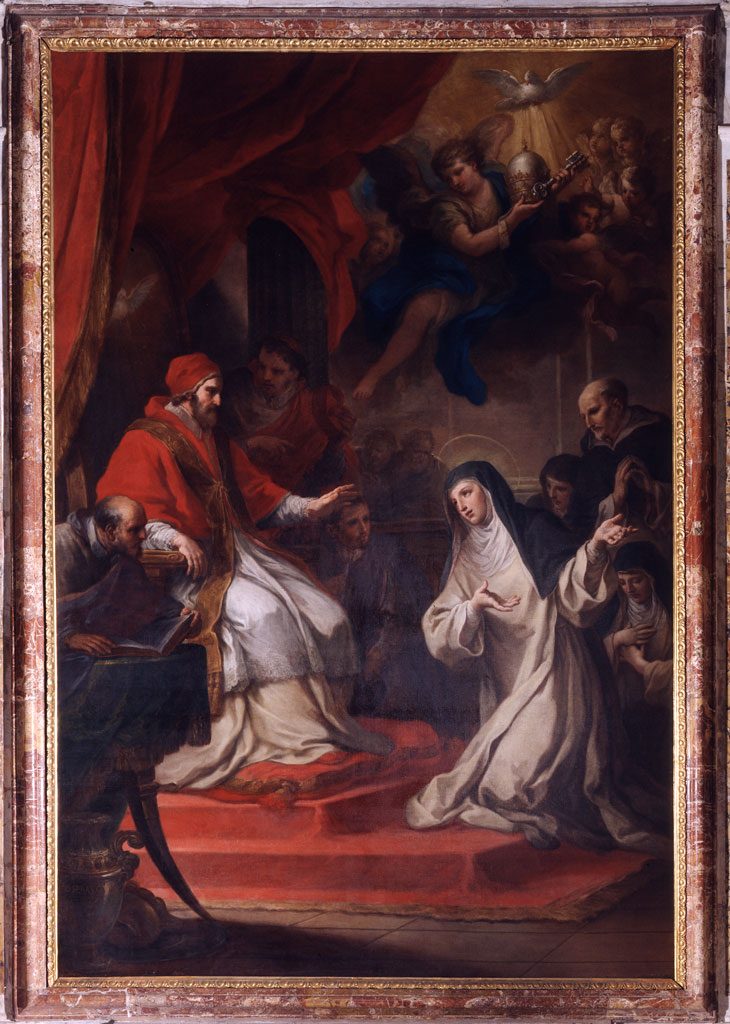
Catherine arrives in Avignon in mid-June and will spend the entire summer there, leaving in mid-September. While there, the Holy Father she has several conversations with the Holy Father, meets the vast papal court and entourage, and wins over most, including the Holy Father himself. The Pope agrees to a peace with Florence, but the Florentines actually reject the offer. By the end of the summer, Pope Gregory XI, so smitten with her holiness, decides to follow Catherine’s advice and return the papacy back to Rome. He takes up the court and moves leaves for Rome two days after Catherine departed.
Chapter
17
Chapter
18
As the Pope in 1377 arrives in Rome, Catherine finally arrives home to Siena. She continues her letter writing especially one imploring prisoners to come to the faith. She meets a particular young man, Niccolò di Toldo who was bitter and unforgiving over his sentence of death. Catherine through her personality go him to repent, take communion, and bravely walk to his execution with her by his side. She knelt by him and caught his head when it was severed.
###
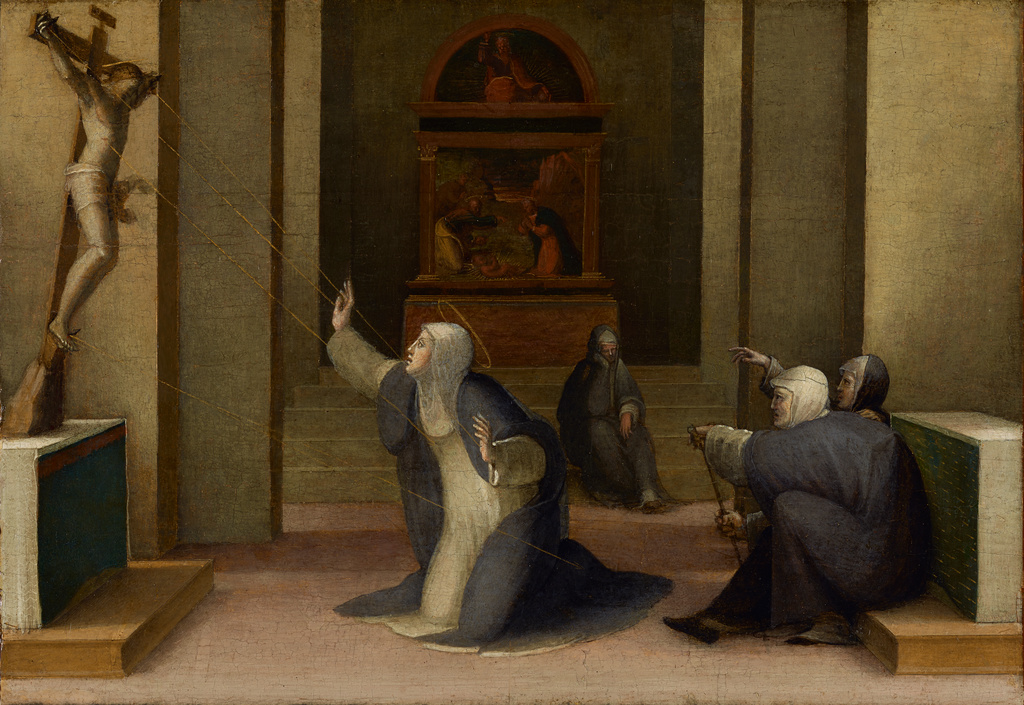
One of those incredible passages is the moment she receives the stigmata. It’s worth transcribing.
But the most overwhelming
event in Catherine’s life while she was in Pisa was that she was marked with
Christ’s stigmata. Raimondo describes
the event as he saw it.
On Laetare
Sunday—mid-Lent Sunday—he celebrated Mass in the church of St. Christina and
had given Catherine Holy Communion. She
lay on her face for a long while afterwards without moving. Raimondo and her friends waited
patiently—they hoped that when she awoke from her ecstasy she would have a
message for them from the lips of her Bridegroom. Suddenly it was as though the outstretched
figure was lifted up; she knelt with closed eyes and her face shining with
supernatural bliss. She stretched out
her arms, with the palms of her hands outward, stiff and still: then she fell
suddenly to the ground as though mortally wounded. A little while after, she recovered
consciousness.
Some time later she
called Raimondo to her and whispered: “Father, know that by the grace of our
lord Jesus I now bear His stigmata in my body.”
Raimondo had guessed by her movements what had happened, but he asked
her to describe the manner in which the gift of grace had been given her. “I saw Our Savior on the cross lean down
toward me in a bright light. And when my
soul tried to hasten to meet its creator, it forced my body to rise. Then I saw how five jets of blood came from
the five wounds and streamed toward my miserable body. I cried out, ‘O my Lord and Savior. I beg You, do not let the wounds on my body be
visible outwardly’—and while I spoke the jets of blood changed to shining
light, and as the rays of light they struck my hands, feet, and heart.” (p.
180)
It is amazing there was a witness at the time and recorded what happened and her understanding of it.
###
My
Reply to Joseph:
Joseph wrote: "It's
also pretty amazing just how active her contemplative life became. We had a
retreat master a couple of years ago emphasize that our work is not our prayer,
our prayer is our work. There's a pretty strong emphasis among our faculty that
we need to be rooted in prayer before we can effectively carry out the active
ministries of priesthood and I think in these chapters St. Catherine models
that relationship brilliantly."
Well, she's Dominican you know.
My Reply to Gerri:
Gerri wrote: "Manny,
I remember you mentioned in an earlier comment about Catherine's support of a
Crusade. Her strong belief in that cause came through clearly to me in these
chapters and surprised me a little. Then I realized how she saw a crusade as a
means to unify the warring Christian factions against a common foe."
Yes, that was the immediate need for the crusade but she also said it would
convert the Muslims for God. I think that was rather naïve on her part.
My
Reply to Gerri:
Gerri wrote: "To
everyone interested in Catherine of Siena: Learn25.com is having a sale on
certain items, including a course on Catherine of Siena. I just ordered the
Audio CD for $6.95. Of course, they got me ..."
Gerri, I have that course. It's presented by Sr. Suzanne Noffke who is probably
the world's leading scholar on St. Catherine of Siena. She has written and
edited many books on St. Catherine. Here is her Goodreads page:
https://www.goodreads.com/author/show...
When I first listened to the course, I didn't at first particularly fall in
love with it. It took several listens over a span of time to warm up to them.
It seemed like Noffke brought in too much of her own life to the lectures for
my taste and it didn't seem like she got to the heart of Catherine's ideas.
This would not be a starter course on St. Catherine, but now that you will have
read this biography I think you might not feel lost.
My
Reply to Gerri:
Gerri wrote: "Oh,
boy, thanks for that insight, Manny. I'm not a big fan of authors bringing
their own life into lectures/biographies. I'm there to learn about the subject,
not the author. Especially with a pers..."
Yes, I know what you mean. Some of those Lear25 courses are disappointing. I
don't want to give the impression that the St. Catherine of Siena course is one
of those disappointing ones. It's not. It's just organized in a manner I did
not expect, and so was a little disconcerting. And Sr. Suzanne is not a dynamic
speaker. But in time I grew to understand her and appreciate her course. I
recommend it. Let me know what you think.
My Comment:
Also, the EWTN
documentary of St. Catherine today was excellent! I enjoyed it and they got to
the heart of her life and thought. The visual images of the locale was great. I
think for those that are mid way through the book, you know enough about her
for the documentary to resonate, I think the book enriched the documentary and the
documentary enriched the book.
###
One
of the often cited instances of Catherine’s life is her giving comfort to
Niccolò di Toldo as he went to his execution.
I had forgotten some of the details.
I had forgotten that Catherine actually narrated this event to Raimondo,
so we have Catherine’s actual take on the whole incident. First I was shocked he was condemned to death
because he had spoken derisively of Siena.
He came from a rival town and was of the nobility of that rival
town. I guess that must have all added
up to a death penalty in those days. And
he was bitter, and refused to reconcile himself with God: “He was wild with
rage and despair over the crazy justice of this wretched government who want to
take his life over such a trifle” (p. 224).
She describes the meeting:
You know I went to visit him, and he gained such great strength and power that he made his confession in the right state of mind. He made me promise for the sake of God’s love I would be with him when the day of execution came, and I promised. The next day before the bells rang for the first time, I went to him, and that consoled him greatly. I went with him to Mass, and he received Holy Communion, which he had always avoided. His will was one with God’s holy will and submitted to it. He was only afraid of one thing—that his courage would fail in the crucial moment. But God’s immeasurable goodness fired such love and longing in him that he could not have enough of God’s presence. He said, Say with me, do not go from me and I will be good, I will die happy. And he leaned his head against my breast. I was filled with joy, for it seemed to me that the perfume of his blood mixed itself with mine which I long to be able to pour out for my beloved Bridegroom Jesus. (p. 225-6)
Three things I would like to highlight in that passage. Catherine’s power to charm is noticeable in all her encounters with people, be they religious people, regular people, Popes, or a young man who is facing execution. We don’t get the details of what she said that caused him to go from a wild and bitter man to one who was willing to “die happy.” This is one of the things that is so memorable about Catherine, her charisma, her charm.
Second, her amazing poetic descriptions: “it seemed to me that the perfume of his blood mixed itself with mine which I long to be able to pour out for my beloved Bridegroom Jesus.” Notice the compact series of images in that one sentence. Blood has a perfumed aroma? What a leap that is. And she envisions the aroma (as a sort of ether) of Niccolò’s blood somehow mixing with the ether of her blood, and the two bloods mixed into one is poured out for Christ. I haven’t been able to highlight much of her language, but this sort of intense imagery runs throughout her writing. She really was a natural poet.
Third,
the blood. Blood is one of her central
symbols: the blood of Christ that washes away sin, and the blood of our
humanity, which is somehow supernaturally connected with the divine. I can’t pin it down—it would take a
systematic study—but for Catherine it’s as if our human blood is our link to
God. And why not? Christ in His incarnation had blood in His
veins, blood that would be shed. That
image of mixing of blood looks ahead to Niccolò’s execution.
Niccolò came, peaceful as
a lamb, and he smiled when he saw that Catherine stood there waiting for
him. He asked her to make the sign of
the cross over him, and she whispered to him: “My dear brother, let us go to
the eternal marriage feast, to enjoy life which shall never end.” She bared his throat, and when he laid his
head on the block she knelt beside him.
He said nothing but “Jesus, Catherine,” and then his head fell into her
hands.
Then I fastened my eyes
upon the Divine Goodness and said: I will.
Immediately I saw, as clearly as one sees the sunshine, Him who is God
and Man. He was there, He received the
blood. In this blood was the fire of
holy desire which grace had put into his soul, and this fire was swallowed up
in the fire of God’s mercy.” She saw
that Niccolò was as though drawn into the treasure chamber of mercy, his
pierced heart into Christ’s breast, so the great truth was made clearly
apparent—that Christ receives a soul entirely because of His mercy, and not
because of any merits of the soul itself.
But as the soul of Niccolò entered the mystery of the Holy Trinity it
turned and looked at her, as the bride does when she has come to the house of
her bridegroom and with bowed head acknowledges those who have accompanied her,
as a last sign of gratitude. (226-7)
Can you imagine the amount of blood that must have splattered on her? And as she held on to the dripping head? What a mess, but that blood is so significant to her. Blood and fire and holy desire and treasure chamber of mercy—there’s a lot of theology there. Too much for here, and I’m not sure I can tie it all up together. But this is why she was made a Doctor of the Church. She connects Catholic doctrine—she never creates or distorts doctrine as some modern theologians—in a way that is original to her and is meaningful to us. I would love to have listened to her preach.
And kudos to Sigrid Undset for a beautiful description and integration of Catherine’s words.
###
My
Reply to Several on Gender Restrictions that St. Catherine
may have faced:
I'm sure there were many
gender restrictions but why would there be one on speaking with a prisoner? I
don't follow that. Plus she may have had one or more of her followers alongside,
so she wouldn't have been alone with him.
As I think of it, I'm surprised they let her stay beside him as the decapitated
him, and not because of her gender. I can't imagine that being common.
My
Reply to Kerstin:
Kerstin wrote: "I
tend to think that women in the Middle Ages had far more freedoms then we give
them credit for. According to history-Prof. Christopher Bellito, who did a few
lecture series on Learn 25/Now You Kn..."
I suspect that is true. The thought has crossed my mind, but I don't have any
expertise to know.