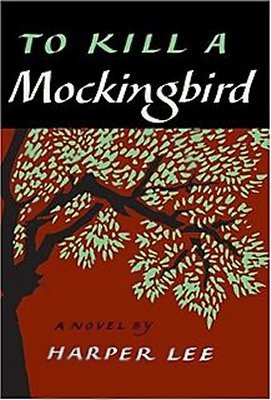
The
author of To Kill a Mockingbird,
Harper Lee, died yesterday. From Associated Press through Yahoo News:
Harper Lee, the elusive
novelist whose child's-eye view of racial injustice in a small Southern town,
"To Kill a Mockingbird," became standard reading for millions of
young people and an Oscar-winning film, has died. She was 89.
Lee died peacefully
Friday, publisher HarperCollins said in a statement. It did not give any other
details about how she died.
"The world knows
Harper Lee was a brilliant writer but what many don't know is that she was an
extraordinary woman of great joyfulness, humility and kindness. She lived her
life the way she wanted to — in private — surrounded by books and the people
who loved her," Michael Morrison, head of HarperCollins U.S. general books
group, said in the statement.
As
I’ve mentioned in the past I had never read To
Kill a Mockingbird, one of the most notable works of American fiction in
the second half of the 20th century.
It was the first book planned to be read in 2016, and I did start
it. I had to stop it to start my Lenten
read, St. Theresa of Avila’s Interior
Castle, which I just finished a few days ago. I’m about a quarter of the way through To Kill a Mockingbird and I was about to
pick it up when I saw the news of Lee’s passing. From the Associated Press article:
"To Kill a
Mockingbird," published in 1960, is the story of a girl nicknamed Scout
growing up in a Depression-era Southern town. A black man has been wrongly
accused of raping a white woman, and Scout's father, the resolute lawyer
Atticus Finch, defends him despite threats and the scorn of many.
The book quickly became a
best-seller, won the Pulitzer Prize and was made into a memorable movie in
1962, with Gregory Peck winning an Oscar for his portrayal of Atticus. As the
civil rights movement grew, the novel inspired a generation of young lawyers,
was assigned in high schools all over the country and was a popular choice for
citywide, or nationwide, reading programs.
By 2015, its sales were
reported by HarperCollins to be more than 40 million worldwide, making it one
of the most widely read American novels of the 20th century. When the Library
of Congress did a survey in 1991 on books that have affected people's lives,
"To Kill a Mockingbird" was second only to the Bible.
It
was just last year, almost to the day, I posted that after 54 years Harper Lee
published a second novel after To Kill a
Mockingbird. The novel, Go Set a Watchman, was actually written before To Kill a Mockingbird, and contained the same characters only set
20 years later. So the To Kill a Mockingbird is actually a
prequel to Go Set a Watchman.
But
the prequel was a learning experience for Lee, and apparently is not of the
same caliber. I won’t go into that since I haven’t read either. I do feel the need to comment, however, on
all the criticism out there for the people who pushed Lee to publish what
critics claim is an unworthy effort.
They do absolve Lee of the critique since she was in her late
eighties. Here’s such criticism from
Ron Charles, the fiction editor at the Washington Post:
The sadness of Harper Lee’s
death on Friday in Monroeville, Ala., is deepened by the painful controversies
that attended the last few years of her life. Long adored as the author of “To
Kill a Mockingbird,” Lee found herself caught in a morass of claims and
counterclaims about her competency to manage her own literary legacy.
“To Kill a Mockingbird”
is still devoured by countless new and repeat readers around the world.
Teenagers study the Depression-era story of Scout and Jem every year. Lawyers
routinely say that Scout’s father, Atticus Finch, inspired them to study law.
But ironically, lawyers and legal ambiguities eventually threatened to
overshadow Lee’s life and work.
What a shame.
And
Charles goes on to utter his disappointment with the recently published work:
When “Go Set a Watchman”
finally appeared in print last summer, it quickly shattered sales records. But
it also shattered something more precious: our admiration for Atticus Finch. In
this old/new story, set two decades after the trial of Tom Robinson, Atticus
has devolved into a racist. Jean Louise (“Scout”) is shocked and disillusioned.
And so are we.
Maybe we should just grow
up; after all, as close readers noticed, Atticus was never really as noble and
uncomplicated as we imagined. But that’s not the point. It wasn’t Atticus’s
reputation that was sullied by this second book, it was Lee’s.
“Go, set a watchman,” the
prophet Isaiah writes. “Let him declare what he seeth.” And what we saw — the
millions of us who bought this new book — was an inferior piece of work, an
early draft of something we love, fascinating perhaps for its embryonic detail,
but not a finished novel to place alongside “To Kill a Mockingbird.”
The tragic story of
Harper Lee — and it is a tragedy — raises the question of who owns our literary
heritage. Not in a legal sense, perhaps, but in a larger, cultural sense. Are
there works of literature so beloved, so foundational to who we are, that they
deserve to be classified as National Historic Landmarks, forever protected from
garish rehab or wholesale demolition?
So
Charles seems to bring up at least four issues there: (1) Should a work that
contradicted the vision of the more renown work have been published? (2) Who
should be responsible for an author’s personal papers and writings? (3) Should a landmark work be protected from
garish rehab? (4) Is an author’s reputation sullied by the publication of
mediocre, if not poor, quality works?
Let’s
take the easiest one to answer first, number 2.
Who should be responsible? The
person the author assigns to be responsible or if no one is assigned, the
natural sequence of heirship. It’s a
legal matter. If the author assigns
poorly or it falls to an unscrupulous person, well, that’s life.
Next,
number 3, protection from rehab. First,
there are copyright laws which apply, and for the most part make sense. Once the time has passed, then if people want
to read some crazy prefabrications of a classic work, I don’t see the
harm. There are all sorts of crazy
rewrites of Jane Austen novels with vampires or zombies complicating the
action. See here if you want to laugh. But this charge itself against Go Tell a Watchman doesn’t make
sense. It was Lee herself who wrote the
work. It’s not a rehab but a
prequel.
As
to number 1, Ron Charles answers it himself when he says above that “we should
grow up.” Yes, complaining that a
character in one work contradicts the nature of that same character in a
different work is is childish, even if both works are by the same author,
perhaps especially so. The works are
separate and distinct. If the author
wants to hold to the same vision in both, then she has the prerogative; if she
wants to have a different vision, then it’s still her prerogative. Take the Renaissance painter Raphael for
example. He painted many versions of the
Madonna, each with a different personality.
The character is the same, but the vision is different.
As
to the harm the people who were responsible for her papers did by publishing Go Set a Watchman, I think it’s a
complete non-issue. I don’t see her reputation sullied. Even if Watchman
turns out to be a disaster – and a lot of people say it’s a disappointment – it
will not hurt her reputation in the long run. Over the course of history, only
a writer’s best work is part of their historical critical evaluation. No one
remembers the few lousy Shakespeare plays. They just don’t count in the long
run. If Harper Lee made some money with Watchman
and handed it over to her heirs, so be it. It’s only a transient thing.
This
is a nice TV news summary of her passing and the issue with the new novel.
By all accounts she was a sweet and good soul. May she rest in peace.