"Love follows knowledge."
"Beauty above all beauty!"
– St. Catherine of Siena

Showing posts with label Book of Signs. Show all posts

Sunday, January 19, 2025

Sunday Meditation: The Bridegroom at Cana

On the Second Sunday in Ordinary Time in Year C we get the Sign of the Wedding Feast at Cana.  I purposely titled this post “The Bridegroom at Cana” because it seems to me that the bridegroom of the actual wedding is transposed by the Eternal Bridegroom.  Here Jesus performs the miracle—called a “sign” by the John Evangelist—of transforming water into wine when at the wedding they are attending in the nearby village of Cana the wine has run out.  Notice how the headwaiter gives credit to the bridegroom for the good wine but in actuality it was the Bridegroom who provided the gift.


There was a wedding at Cana in Galilee,

and the mother of Jesus was there.

Jesus and his disciples were also invited to the wedding.

When the wine ran short,

the mother of Jesus said to him,

“They have no wine.”

And Jesus said to her,

“Woman, how does your concern affect me?

My hour has not yet come.”

His mother said to the servers,

“Do whatever he tells you.”

Now there were six stone water jars there for Jewish ceremonial washings,

each holding twenty to thirty gallons.

Jesus told them,

“Fill the jars with water.”

So they filled them to the brim.

Then he told them,

“Draw some out now and take it to the headwaiter.”

So they took it.

And when the headwaiter tasted the water that had become wine,

without knowing where it came from

— although the servers who had drawn the water knew —,

the headwaiter called the bridegroom and said to him,

“Everyone serves good wine first,

and then when people have drunk freely, an inferior one;

but you have kept the good wine until now.”

Jesus did this as the beginning of his signs at Cana in Galilee

and so revealed his glory,

and his disciples began to believe in him.

~Jn 2:1-11


Fr. Terrance Chartier of the Franciscan Friars of the Immaculate provides a profound homily on the meaning of this miracle.  He gives us observations I never realized here and I will bet you haven’t either. 


I think the world of Fr. Terrance.  Have you ever connected the Wedding Feast at Cana with the Marriage Feast of the Lamb in the Book of Revelation?  I haven’t.  The observation of the imperfect number six of the jars leads one to connect the wine as the fulfillment of water as Jesus is the fulfillment of the Old Testament. 

Fr. Patrick Briscoe O.P. of Our Sunday Visitor gives a wonderful pastoral homily


With confidence, let us turn to our Blessed Mother for the hope we have in Christ, the Bridegroom.


Sunday Meditation: “The headwaiter called the bridegroom and said to him, “Everyone serves good wine first, and then when people have drunk freely, an inferior one.”


No hymn this week, but the video clip from the episode on the Wedding Feast at Cana from The Chosen.


Perhaps not the best exegesis of the Gospel passage, but well done nonetheless.


Sunday, March 19, 2023

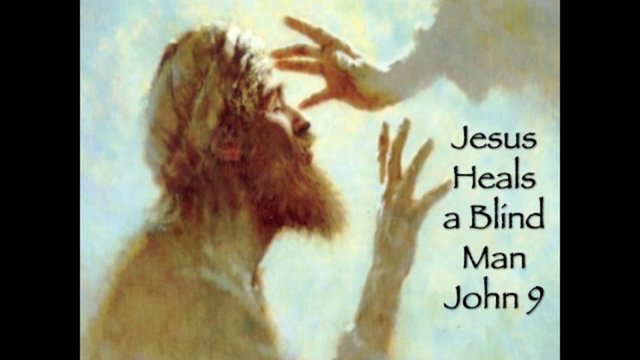
Sunday Meditation: The Healing of the Blind Man

Today Jesus performs another of His miracles, which in the Gospel of John are referred to as “signs.”  The first half of John’s Gospel is actually referred to as “The Book of Signs.”  The seven signs of the Gospel of John are the following:

    1.      Changing water into wine at Cana in John 2:1–11 – "the first of the signs"

    2.      Healing the royal official's son in Capernaum in John 4:46–54

    3.      Healing the paralytic at Bethesda in John 5:1–15

    4.      Feeding the 5000 in John 6:5–14

    5.      Jesus walking on water in John 6:16–24

    6.      Healing the man blind from birth in John 9:1–7

    7.      The raising of Lazarus in John 11:1–45 


    Today’s Gospel reading is of the sixth sign, healing the man born blind.


    As Jesus passed by he saw a man blind from birth.

    His disciples asked him,

    "Rabbi, who sinned, this man or his parents,

    that he was born blind?"

    Jesus answered,

    "Neither he nor his parents sinned;

    it is so that the works of God might be made visible through him.

    We have to do the works of the one who sent me while it is day.

    Night is coming when no one can work.

    While I am in the world, I am the light of the world."

    When he had said this, he spat on the ground

    and made clay with the saliva,

    and smeared the clay on his eyes,

    and said to him,

    "Go wash in the Pool of Siloam" —which means Sent—.

    So he went and washed, and came back able to see.


    His neighbors and those who had seen him earlier as a beggar said,

    "Isn't this the one who used to sit and beg?"

    Some said, "It is, "

    but others said, "No, he just looks like him."

    He said, "I am."

    So they said to him, "How were your eyes opened?"

    He replied,

    "The man called Jesus made clay and anointed my eyes

    and told me, 'Go to Siloam and wash.'

    So I went there and washed and was able to see."

    And they said to him, "Where is he?"

    He said, "I don't know."


    They brought the one who was once blind to the Pharisees.

    Now Jesus had made clay and opened his eyes on a sabbath.

    So then the Pharisees also asked him how he was able to see.

    He said to them,

    "He put clay on my eyes, and I washed, and now I can see."

    So some of the Pharisees said,

    "This man is not from God,

    because he does not keep the sabbath."

    But others said,

    "How can a sinful man do such signs?"

    And there was a division among them.

    So they said to the blind man again,

    "What do you have to say about him,

    since he opened your eyes?"

    He said, "He is a prophet."


    Now the Jews did not believe

    that he had been blind and gained his sight

    until they summoned the parents of the one who had gained his sight.

    They asked them,

    "Is this your son, who you say was born blind?

    How does he now see?"

    His parents answered and said,

    "We know that this is our son and that he was born blind.

    We do not know how he sees now,

    nor do we know who opened his eyes.

    Ask him, he is of age;

    he can speak for himself."

    His parents said this because they were afraid of the Jews,

    for the Jews had already agreed

    that if anyone acknowledged him as the Christ,

    he would be expelled from the synagogue.

    For this reason his parents said,

    "He is of age; question him."


    So a second time they called the man who had been blind

    and said to him, "Give God the praise!

    We know that this man is a sinner."

    He replied,

    "If he is a sinner, I do not know.

    One thing I do know is that I was blind and now I see."

    So they said to him,

    "What did he do to you?

    How did he open your eyes?"

    He answered them,

    "I told you already and you did not listen.

    Why do you want to hear it again?

    Do you want to become his disciples, too?"

    They ridiculed him and said,

    "You are that man's disciple;

    we are disciples of Moses!

    We know that God spoke to Moses,

    but we do not know where this one is from."

    The man answered and said to them,

    "This is what is so amazing,

    that you do not know where he is from, yet he opened my eyes.

    We know that God does not listen to sinners,

    but if one is devout and does his will, he listens to him.

    It is unheard of that anyone ever opened the eyes of a person born blind.

    If this man were not from God,

    he would not be able to do anything."

    They answered and said to him,

    "You were born totally in sin,

    and are you trying to teach us?"

    Then they threw him out.


    When Jesus heard that they had thrown him out,

    he found him and said, "Do you believe in the Son of Man?"

    He answered and said,

    "Who is he, sir, that I may believe in him?"

    Jesus said to him,

    "You have seen him,

    the one speaking with you is he."

    He said,

    "I do believe, Lord," and he worshiped him.

    Then Jesus said,

    "I came into this world for judgment,

    so that those who do not see might see,

    and those who do see might become blind."


    Some of the Pharisees who were with him heard this

    and said to him, "Surely we are not also blind, are we?"

    Jesus said to them,

    "If you were blind, you would have no sin;

    but now you are saying, 'We see,' so your sin remains.

            -Jn 9:1, 6-9, 13-17, 34-38 

    Dr. Brant Pitre gives a wonderful exegesis of this passage. 


    Pitre explains a lot.  I don’t know if I ever had heard that when John in his Gospel refers to “the Jews,” he is referring to the Judeans as opposed to those from other parts of Israel.  That is something I should try to retain.

    But the one point most worth meditating on is the blind man’s transition to the fullness of faith: prophet to man sent from God to Lord.