"Love follows knowledge."
"Beauty above all beauty!"
– St. Catherine of Siena

Showing posts with label Jewishness. Show all posts

Sunday, December 31, 2023

Sunday Meditation: The Presentation

There is a lot packed into this Sunday.  It is the Feast of the Holy Family and for Year B the Gospel takes us to The Presentation of Jesus at the temple. 

When the days were completed for their purification

according to the law of Moses,

They took him up to Jerusalem

to present him to the Lord,

just as it is written in the law of the Lord,

Every male that opens the womb shall be consecrated to the Lord,

and to offer the sacrifice of

a pair of turtledoves or two young pigeons,

in accordance with the dictate in the law of the Lord.


Now there was a man in Jerusalem whose name was Simeon.

This man was righteous and devout,

awaiting the consolation of Israel,

and the Holy Spirit was upon him.

It had been revealed to him by the Holy Spirit

that he should not see death

before he had seen the Christ of the Lord.

He came in the Spirit into the temple;

and when the parents brought in the child Jesus

to perform the custom of the law in regard to him,

He took him into his arms and blessed God, saying:

“Now, Master, you may let your servant go

in peace, according to your word,

for my eyes have seen your salvation,

which you prepared in sight of all the peoples,

a light for revelation to the Gentiles,

and glory for your people Israel.”

The child’s father and mother were amazed at what was said about him;

and Simeon blessed them and said to Mary his mother,

“Behold, this child is destined

for the fall and rise of many in Israel,

and to be a sign that will be contradicted

—and you yourself a sword will pierce—

so that the thoughts of many hearts may be revealed.”

There was also a prophetess, Anna,

the daughter of Phanuel, of the tribe of Asher.

She was advanced in years,

having lived seven years with her husband after her marriage,

and then as a widow until she was eighty-four.

She never left the temple,

but worshiped night and day with fasting and prayer.

And coming forward at that very time,

she gave thanks to God and spoke about the child

to all who were awaiting the redemption of Jerusalem.


When they had fulfilled all the prescriptions

of the law of the Lord,

they returned to Galilee,

to their own town of Nazareth.

The child grew and became strong, filled with wisdom;

and the favor of God was upon him.

~Lk 2:22-40

This is the second week in a row Fr. Geoffrey Plant does an amazing job of explaining today’s readings. 


Fr. Plant’s explanation of a mother’s purification after childbirth as a return to the profane from the sacred is startling.  I had never heard that before.  I questioned it actually.  Most explanations do not reproduce that.  However, at Chabad.org, a religious Jewish question and answer website, we do get this:  


Why the difference in the laws of ritual purity between the birth of males and females?

By Chana Weisberg

Question:


My question is on the subject of cleanness of a mother after the birth of a male or female (Leviticus 12). The woman is unclean for seven days after a male birth, and after the birth of a female the mother is unclean for fourteen days. Why is there a difference between the birth of males and females?


Answer:


You write the word "cleanliness," when really it is "ritual purity." A woman's "impurity," or "tumah" in Hebrew, during her menstruation is a built-in component of her natural monthly cycle. Her status of "impurity" demonstrates her descent from a peak level of holiness, when she had the ability to conceive a precious new life through her union with her husband.


The status of "tumah" is not meant to imply sinfulness, degradation or inferiority. On the contrary, it emphasizes, in particular, the great level of holiness inherent in woman's G‑dly power to create and nurture a new life within her body, and the great holiness of a husband and wife's union, in general. Since a woman possesses this lofty potential, she, also bears the possibility of its void; hence her status as tameh, ritually impure. Since she experienced "the touch of death," so to speak, with the loss of potential life, as reflected by her menstruation, she enters this status of "impure."


After having given birth to a baby boy, a woman must wait a minimum of seven days before beginning her pure days; while after a baby girl is born, she must wait a minimum of fourteen days. Since the female child inherently carries a higher degree of holiness, due to her own biological, life creating capability, a greater void, or tumah, remains after her birth. Thus, the greater tumah after a baby girl's birth reflects her greater capacity for holiness (due to her creative powers) and necessitates the longer wait to remove this ritual impurity.

Now the question is in reference to the difference between a the ritual waiting between a boy and a girl child, but explaining, Chana Weisberg substantiates Fr. Plant’s explanation.


Meditation: “Now, Master, you may let your servant go in peace, according to your word, for my eyes have seen your salvation,”

Wednesday, December 20, 2017

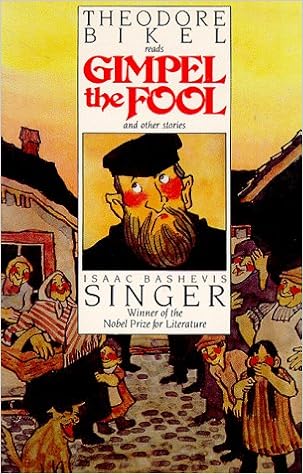
Lines I Wished I’d Written: Gimpel’s Wife from “Gimpel the Fool” by Isaac Bashevis Singer

Gimpel the Fool” is one of those classic short stories that everyone should read by one of the greats in the short story world, Isaac Bashevis Singer.  For the most part, the story is a character study of a person who most people take advantage, Reb Gimpel.  In about ten pages it surveys his life from birth to old age, but it mostly centers on his relation with his wife.  Since the story is not overly complex, I’m not doing an analysis but just provide an extended passage that captures the heart of the story.  This passage opens with Gimpel’s wedding night.  The wedding has ended and Gimpel is going to the bedroom where his wife, Elka, is closed up.  Some background may be warranted.  Singer is Jewish and the story was written in Yiddish and takes place in some small town in one of the old countries, presumably Poland.  A number of Jewish rituals are referenced, especially the post menstrual bathing ritual, the mikveh.  I’m sure you know what a circumcision is.

At night I came where my wife lay, but she wouldn’t let me in.  “Say, look here, is this what they married us for?” I said.  And she said, “My monthly has come.”  “But yesterday they took you to the ritual bath, and that’s afterward, isn’t it supposed to be?”  “Today isn’t yesterday,” said she, “and yesterday’s not today.  You can beat it if you don’t like it.”  In short, I waited.

Not four months later, she was in childbed.  The townsfolk hid their laughter with their knuckles.  But what could I do?  She suffered intolerable pains and clawed at the walls.  “Gimpel,” she cried, “I’m going.  Forgive me!”  The house filled with women.  They were boiling pans of water.  The screams rose to the welkin.

The thing to do was to go to the house of prayer and repeat psalms, and that was what I did.

The townsfolk liked that, all right.  I stood in a corner saying psalms and prayers, and they shook their heads at me.  “Pray, pray!” they told me.  “Prayer never made any woman pregnant.”  One of the congregation put a straw in my mouth and said, “Hay for the cows.”  There was something to that too, by God!

She gave birth to a boy.  Friday at the synagogue the sexton stood up before the Ark, pounded on the reading table, and announced, “The wealthy Reb Gimpel invites the congregation to a feast in honor of the birth of a son.”  The whole house of prayer rang with laughter.  My face was flaming.  But there was nothing I could do.  After all, I was the one responsible for the circumcision honors and rituals.

Half the town came running.  You couldn’t wedge another soul in.  Women brought peppered chick-peas, and there was a keg of beer from the tavern.  I ate and drank as much as anyone, and they all congratulated me.  Then there was a circumcision, and I named the boy after my father, may he rest in peace.  When all were gone and I was left with my wife alone, she thrust her head through the bed-curtain and called me to her.

“Gimpel,” said she, “why are you silent?  Has your ship gone and sunk?”

“What shall I say,” I answered.  “A fine thing you’ve done to me!  If my mother had known of it she’d have died a second time.”

She said, “Are you crazy, or what?”

“How can you make such a fool,” I said, “of one who should be the lord and master?” 

“What’s the matter with you?” she said.  “What have you taken it into your head to imagine?”

I saw that I must speak bluntly and openly.  “Do you think this is the way to use an orphan?” I said.  “You have borne a bastard.”

She answered, “Drive this foolishness out of your head.  The child is yours.”

“How can he be mine?” I argued.  He was born seventeen weeks after the wedding.”

She told me then he was premature.  I said, “Isn’t he a little too premature?”  She said, she had a grandmother who carried just as short a time and she resembled this grandmother of her as one drop of water does another.  She swore to it with such oaths that you would have believed a peasant at the fair if he had used them.  To tell the plain truth, I didn’t believe her; but when I talked it over next day with the schoolmaster, he told me that the very same thing had happened to Adam and Eve.  Two they went up to bed, and four they descended.

“There isn’t a woman in the world who is not the granddaughter of Eve,” he said. 

That was how it was; they argued me dumb.  But then, who really knows how such things are?

I began to forget my sorrow.  I loved the child madly, and he loved me too.  As soon as he saw me he’d wave his little hands and want me to pick him up, and when he was colicky I was the only one who could pacify him.  I bought him a little bone teething ring and a little gilded cap.  He was forever catching the evil eye from someone, and then I had to run to get one of those abracadabras for him that would get him out of it.  I worked like an ox.  You know how expenses go up when there’s an infant in the house.  I don’t want to lie about it; I didn’t dislike Elka either, for that matter.  She swore at me and cursed, and I couldn’t get enough of her.  What strength she had!  One of her looks could rob you of the power of speech.  And her orations!  Pitch and sulphur, that’s what they were full of, and yet somehow also full of charm.  I adored her every word.  She gave me bloody wounds though.

And that is essentially Gimpel’s character, one repeatedly taken for a fool, but one with love in his heart.  He prays, he works, he takes in the children.  He goes on to stay with his wife, and she bears him six children, none of which are naturally his.  At one point Gimpel goes to a rabbi for some advice, and the rabbi delivers the central theme of the story.  He says, “It is written, better to be a fool all your days than for one hour to be evil.  You are not a fool.  They are the fools.  For he who causes his neighbor to feel shame loses Paradise himself.”  Toward the end of the story when Elka has died, and Gimpel is angry at the world, he is tempted to do an evil thing to the entire town, and starts to, but then he stops and doesn’t.  The story ends with Gimpel dreaming of being with his wife in paradise where he contemplates, “there even Gimpel cannot be deceived.” 


If I’ve piqued your interest in the story, it can be found online, here.  Do read it.


Tuesday, August 1, 2017

Short Story Analysis: “The Magic Barrel” by Bernard Malamud

The first short story I read this year, the latest in the year I think I’ve ever done so, way past mid-May, was a good one, “The Magic Barrel” by Bernard Malamud, and I’ve been giving it thought ever since.  Born in New York City or more precisely the borough of Brooklyn, and the son of Jewish immigrants, Malamud is known for his well-crafted short stories about Jewish-American life, but also for several novels, including The Natural.  I have not read any of his novels, but I have been impressed with his short stories.  In fact, one of the most prestigious awards for an American short story, the PEN/Malamud Award for “excellence in the art of the short story", is named in his honor.  

“The Magic Barrel” may be one of his best known, and a really fun read.  You can find it online, here, in PDF if you wish to read it ahead of my post.  

The story begins in New York City with an almost “Once upon a time” opening.

Not long ago there lived in uptown New York, in a sma ll, almost meager room, though crowded with books, Leo Finkle, a rabbinical student in the Yeshivah University. Finkle, after six years of study, was to be ordained in June and had been advised by an acquaintance that he might find it easier to win himself a congregation if he were married. Since he had no present prospects of marriage, after two tormented days of turning it over in his mind, he called in Pinye Salzman, a marriage broker whose two-line advertisement he had read in the Forward.

The matchmaker appeared one night out of the dark fourth-floor hallway of the graystone rooming house where Finkle lived, grasping a black, strapped portfolio that had been worn thin with use. Salzman, who had been long in the business, was of slight but dignified build, wearing an old hat, and an overcoat too short and tight for him. He smelled frankly of fish, which he loved to eat, and although he was missing a few teeth, his presence was not displeasing, because of an amiable manner curiously contrasted with mournful eyes. His voice, his lips, his wisp of beard, his bony fingers were animated, but give him a moment of repose and his mild blue eyes revealed a depth of sadness, a characteristic that put Leo a little at ease although the situation, for him, was inherently tense.

As a New Yorker, I know these characters, know them in the sense that similar people walk in  the neighborhoods I grew up.  The story was written in the 1950’s, in what is sometimes considered the golden era of New York City.  I’m not that old, but similar people were around when I was growing up a couple of decades later.  So we have the rabbinical student and a sort of old world peddler who in this case hawks brides.  It’s is interesting that Salzman smells of fish, and fish is a motif that goes with the matchmaker throughout the story.  But the sadness in his eyes is an interesting detail that contrasts with Finkle’s youthfulness and inexperience.

Next we get some critical information about Finkle. 

 
He at once informed Salzman why he had asked him to come, explaining that his home was in Cleveland, and that but for his parents, who had married comparatively late in life, he was alone in the world. He had for six years devoted himself almost entirely to his studies, as a result of which, understandably, he had found himself without time for a social life and the company of young women. Therefore he thought it the better part of trial and error--of embarrassing fumbling--to call in an experienced person to advise him on these matters. He remarked in passing that the function of the marriage broker was ancient and honorable, highly approved in the Jewish community, because it made practical the necessary without hindering joy. Moreover, his own parents had been brought together by a matchmaker. They had made, if not a financially profitable marriage--since neither had possessed any worldly goods to speak of--at least a successful one in the sense of their everlasting devotion to each other. Salzman listened in embarrassed surprise, sensing a sort of apology. Later, however, he experienced a glow of pride in his work, an emotion that had left him years ago, and he heartily approved of Finkle.

Here we learn of the parallel situation with Finkle’s parents in that they too have met through a marriage broker, and their marriage was a happy one.  But that was an old world relationship and they lived in Cleveland.  Finkle is now in the modern world and lives in the big metropolis. 

Next Salzman takes out a half dozen cards with woman’s information on it.  As Salzman tries to sell Finkle on the women on the cards, what follows is some of the most entertaining dialogue I can remember.  I can’t quote all of it, but here is a sample.

When Leo's eyes fell upon the cards, he counted six spread out in Salzman's hand.

"So few?" he asked in disappointment.

"You wouldn't believe me how much cards I got in my office," Salzman replied. "The drawers are already filled to the top, so I keep them now in a barrel, but is every girl good for a new rabbi?"

Leo blushed at this, regretting all he had revealed of himself in a curriculum vitae he had sent to Salzman. He had thought it best to acquaint him with his strict standards and specifications, but in having done so, felt he had told the marriage broker more than was absolutely necessary.

He hesitantly inquired, "Do you keep photographs of your clients on file?"

"First comes family, amount of dowry, also what kind of promises," Salzman replied, unbuttoning his tight coat and settling himself in the chair. "After comes pictures, rabbi."

"Call me Mr. Finkle. I'm not yet a rabbi."

Salzman said he would, but instead called him doctor, which he changed to rabbi when Leo was not listening too attentively.

Salzman adjusted his horn-rimmed spectacles, gently cleared his throat and read in an eager voice the contents of the top card:

"Sophie P. Twenty-four years. Widow one year. No children. Educated high school and two years college. Father promises eight thousand dollars. Has wonderful wholesale business. Also real estate. On the mother's side comes teachers, also one actor. Well known on Second Avenue."

Leo gazed up in surprise. "Did you say a widow?"

"A widow don't mean spoiled, rabbi. She lived with her husband maybe four months. He was a sick boy she made a mistake to marry him."

"Marrying a widow has never entered my mind."

"This is because you have no experience. A widow, especially if she is young and healthy like this girl, is a wonderful person to marry. She will be thankful to you the rest of her life. Believe me, if I was looking now for a bride, I would marry a widow."

Leo reflected, then shook his head.

Salzman hunched his shoulders in an almost imperceptible gesture of disappointment. He placed the card down on the wooden table and began to read another:

"Lily H. High school teacher. Regular. Not a substitute. Has savings and new Dodge car. Lived in Paris one year. Father is successful dentist thirty-five years. Interested in professional man. Well Americanized family. Wonderful opportunity."

"I know her personally," said Salzman. "I wish you could see this girl. She is a doll. Also very intelligent. All day you could talk to her about books and theyater and whatnot. She also knows current events."

"I don't believe you mentioned her age?"

"Her age?" Salzman said, raising his brows. "Her age is thirty-two years."

"Leo said after a while, "I'm afraid that seems a little too old.

Salzman let out a laugh. "So how old are you, rabbi?"

"Twentyseven."

"So what is the difference, tell me, between twenty-seven and thirty-two? My own wife is seven years older than me. So what did I suffer?--Nothing. If Rothschild's daughter wants to marry you, would you say on account her age, no?"

"Yes," Leo said dryly.

Salzman shook off the no in the eyes. "Five years don't mean a thing. I give you my word that when you will live with her for one week you will forget her age. What does it mean five years--that she lived more and knows more than somebody who is younger? On this girl, God bless her, years are not wasted. Each one that it comes makes better the bargain."

"What subject does she teach in high school?"

"Languages. If you heard the way she speaks French, you will think it is music. I am in the business twenty-five years, and I recommend her with my whole heart. Believe me, I know what I'm talking, rabbi."

"What's on the next card?" Leo said abruptly.

There is a folktale feel to this story, as the rabbi goes through female candidate after female candidate.  Leo, as he goes through the list, can’t be satisfied with any of the women.  But there are some questions that are brought here that drive the story forward.  What is a right fit for a rabbi’s bride and how does Leo’s lack of experience with the opposite sex cause him select or reject potential brides?  The bulk of the story presents the drama inherent in these abstract questions, and it’s quite entertaining. But I want to move toward Leo’s central crises and then finally toward the climax.  He finally accepts going out on a date with the older woman, the one he rejected because of her age, Lily.  And her probing questions, questions natural of people trying to learn of each other, leads him to respond as to why he chose to be a rabbi: "I was always interested in the Law."

"You saw revealed in it the presence of the Highest?" He nodded and changed the subject. "I understand that you spent a little time in Paris, Miss Hirschorn?" "Oh, did Mr. Salzman tell you, Rabbi Finkle?" Leo winced but she went on, "It was ages ago and almost forgotten. I remember I had to return for my sister's wedding." And Lily would not be put off. "When," she asked in a trembly voice, "did you become enamored of God?" 7 He stared at her. Then it came to him that she was talking not about Leo Finkle, but of a total stranger, some mystical figure, perhaps even passionate prophet that Salzman had dreamed up for her--no relation to the living or dead. Leo trembled with rage and weakness. The trickster had obviously sold her a bill of goods, just as he had him, who'd expected to become acquainted with a young lady of twenty-nine, only to behold, the moment he laid eyes upon her strained and anxious face, a woman past thirty-five and aging rapidly. Only his self control had kept him this long in her presence.

Lily probed too deep.  She hit a nerve, and just like she had misrepresented her age, it became apparent that Leo had misrepresented his faith, only not just to her, but to himself.  Salzman had played up his devoutness, which ultimately, days after the date came back to sting Leo into a self-realization.

He was infuriated with the marriage broker and swore he would throw him out of the room the minute he reappeared. But Salzman did not come that night, and when Leo's anger had subsided, an unaccountable despair grew in its place. At first he thought this was caused by his disappointment in Lily, but before long it became evident that he had involved himself with Salzman without a true knowledge of his own intent. He gradually realized--with an emptiness that seized him with six hands--that he had called in the broker to find him a bride because he was incapable of doing it himself. This terrifying insight he had derived as a result of his meeting and conversation with Lily Hirschorn. Her probing questions had somehow irritated him into revealing --to himself more than her--the true nature of his relationship to God, and from that it had come upon him, with shocking force, that apart from his parents, he had never loved anyone. Or perhaps it went the other way, that he did not love God so well as he might, because he had not loved man. It seemed to Leo that his whole life stood starkly revealed and he saw himself for the first time as he truly was--unloved and loveless. This bitter but somehow not fully unexpected revelation brought him to a point to panic, controlled only by extraordinary effort. He covered his face with his hands and cried.

The experience of finding a wife has made him realize his “relationship to God.”  If he didn’t love anyone, he didn’t love God, and of course this brings him to a spiritual crises, questioning his faith and his vocation.

And finally we get to the climax.  Leo falls in love with a girl of a picture Salzman accidently left behind.  He tries to get Salzman to arrange a meeting.  Salzman refuses.  This girl would not be suitable for him.  As it turns out the girl is Salzman’s daughter who he has banish from his house because she is “wild.”  But Leo cannot let go.

Although he soon fell asleep he could not sleep her out of his mind. He woke, beating his breast. Though he prayed to be rid of her, his prayers went unanswered. Through days of torment he endlessly struggled not to love her; fearing success, he escaped it. He then concluded to convert her to goodness, himself to God. The idea alternately nauseated and exalted him.

So he convinces himself he can convert her to goodness.  And so there is an arrangement.

Leo was informed by better that she would meet him on a certain corner, and she was there one spring night, waiting under a street lamp. He appeared carrying a small bouquet of violets and rosebuds. Stella stood by the lamp post, smoking. She wore white with red shoes, which fitted his expectations, although in a troubled moment he had imagined the dress red, and only the shoes white. She waited uneasily and shyly. From afar he saw that her eyes--clearly her father's--were filled with desperate innocence. He pictured, in her, his own redemption. Violins and lit candles revolved in the sky. Leo ran forward with flowers out-thrust.
Around the corner, Salzman, leaning against a wall, chanted prayers for the dead.

It is certainly not a match made in heaven.  Why prayers for the dead?  Leo and Stella are heading toward a fall.  Both their innocence will suffer a death.  They will be very different people, as Leo already is from the beginning of the story.


Tuesday, December 16, 2014

Chanuka, Oh Chanukah

Today is the first night of Chanukah.  What a blessing to have a Jewish side of the family.  Here is the blessing over the candles in English.  You can read it in Hebrew.

Blessed are you, Lord, our God, sovereign of the universe
Who has sanctified us with His commandments and commanded us
to light the lights of Chanukkah. (Amen)


There are so many ways to spell Hanukkah in English that I just don't which to pick.  And now for your listening pleasure, here is a Hanukkah song, "Chanuka, Oh Chanukah, sung by a Theodore Bikel.  I've never heard of him, but he sings this wonderfully.  I've been to synagogue for some family affair, and I have to say the Jewish Cantors out do our Catholic choruses.


May God bless you all.

Friday, February 1, 2013

Faith Filled Friday: Psalm 23, The Lord Is My Shepherd

The windy storm from a few nights ago really affected us.  My cable TV, my land line telephone, and my Internet were all down for several days.  They are finally back on, just in time to post a Faith Filled Friday.  God must be with me! :)

Today my family and I went to a funeral service for the passing of my wife's great uncle, Uncle Marty.  He was 93 and the last few years were a struggle for him.  He's now at peace and with his beloved wife Esther.  May the Lord eternally shine upon them both.

I have mentioned that my wife's side of the family is Jewish.  I really enjoy Jewish religious services.  I've only been to weddings, Bar Mitzvah, and funerals, and unfortunately mostly funerals.  I love the Hebrew prayers.  Of course I have no idea what they are saying, but sometimes a prayer is spoken in both Hebrew and English.  I love wearing a yarmulke. It's a shame we Catholic men are not required to wear head covering before the Lord. 

In honor of Uncle Marty, I'm going to post a video of Psalm 23, sung in Hebrew.  This clip tries to capture the how it might have been sung in ancient Hebrew.  The accompaniment is very simple, as ancient music was assumed to be.  It provides a transliteration of the Hebrew and English translation, of which we are probably all familiar with. 


I also found this fascinating exegesis of this great psalm.  I have no idea who is this Rabbi Zalman Schachter-Shalomi, but he provides penetrating insight that can only be obtained from understanding the subtle connotations of the Hebrew.  We lose some of that in an English translation.


So much of this Rabbi reminds me of what is wonderful about older Jewish men: the gentleness, the humor and wit, and the love of intellect.