

“The joy of the gospel fills the hearts and lives of all who encounter Jesus.”—Pope Francis, Evangelii Gaudium
I’m sure the world knows by now that Pope Francis passed away early Monday morning, April 21st. From Vatican News,” Pope Francis has died on Easter Monday, April 21, 2025, at the age of 88 at his residence in the Vatican's Casa Santa Marta”:
At 9:45 AM, Cardinal
Kevin Farrell, Camerlengo of the Holy Roman Church, announced the death of Pope
Francis from the Casa Santa Marta with these words:
"Dearest brothers and sisters, with deep sorrow I must announce the death of our Holy Father Francis. At 7:35 this morning, the Bishop of Rome, Francis, returned to the house of the Father. His entire life was dedicated to the service of the Lord and of His Church. He taught us to live the values of the Gospel with fidelity, courage, and universal love, especially in favor of the poorest and most marginalized. With immense gratitude for his example as a true disciple of the Lord Jesus, we commend the soul of Pope Francis to the infinite merciful love of the One and Triune God."
It was a sad moment for me as well. When I woke up that Monday morning and looked at my phone, there had been a news bulletin text that stated Pope Francis had died. If he had died 7:35, Rome time; it was 1:35 AM here.
Over the years I have had an evolving reaction to Pope Francis. I was struck with him when he was first elected. The charm, the smile, the self-effacing jokes, the humility, the off-the-cuff comments that no one would say. He was a good humored man with people skills that no pope has had in a long time. I just loved his pastoral touch. At the time he was elected some twelve years ago, I offered this in my blog:
We have these two strands in this pope, the disciplined mind of a scholarly Jesuit with the humility, simplicity, and human engagement of the Franciscan ministry. The implication is that he’s going to challenge the spiritually indifferent trend of western culture, both through rhetorical argumentation and humble example. And in him we see the real deal. He is inherently a humble man, lived in a small apartment, cooked his own meals, rode the subway, embraced the people in the slums. St. Francis embraced and kissed the lepers; Bergoglio washed and kissed the feet of today’s equivalent of the lepers, AIDs patients.
And then after a few days of Pope Francis meeting the world, I posted again on the new Holy Father, with even more glowing terms:
"The last few days have made it apparent that [Pope Benedict XVI’s] strengths were intellectual at the expense of human contact. Given what I’ve seen of Francis’s human contact approach to his ministry, human contact is much more important than intellectual pontificating, pardon the pun. The intellectual underpinnings of Catholicism are there in the magisterium. Whatever updating B16 did to it is marginal, and non-Catholics weren’t listening anyway. I like what I’ve seen Pope Francis. This contact ministry is the human contact that I’ve argued brings Christ to everyone. Through human contact is where Christ is revealed. Pope Francis is a shot in the arm!"
In 2015, Pope Francis traveled to the United States and celebrated a Papal Mass in New York City. I was fortunate to be selected to receive a ticket to the Mass representing my parish. It was such an honor and I had a number of posts leading up to the Papal Mass and then of course the Papal Mass. You can read those posts and see the pictures I took when you go to this link that calls up those Papal Mass posts.
I also posted part of Pope Francis’s homily which focused on the isolation of people living in a big city. I found this part of the homily both moving and penetrating to those who live in a big city such as myself.
But big cities also
conceal the faces of all those people who don’t appear to belong, or are
second-class citizens. In big cities, beneath the roar of traffic, beneath “the
rapid pace of change”, so many faces pass by unnoticed because they have no
“right” to be there, no right to be part of the city. They are the foreigners,
the children who go without schooling, those deprived of medical insurance, the
homeless, the forgotten elderly. These people stand at the edges of our great
avenues, in our streets, in deafening anonymity. They become part of an urban
landscape which is more and more taken for granted, in our eyes, and especially
in our hearts.
Knowing that Jesus still
walks our streets, that he is part of the lives of his people, that he is
involved with us in one vast history of salvation, fills us with hope. A hope
which liberates us from the forces pushing us to isolation and lack of concern
for the lives of others, for the life of our city. A hope which frees us from
empty “connections”, from abstract analyses, or sensationalist routines. A hope
which is unafraid of involvement, which acts as a leaven wherever we happen to
live and work. A hope which makes us see, even in the midst of smog, the
presence of God as he continues to walk the streets of our city. Because God is
in the city.
What is it like, this light travelling through our streets? How do we encounter God, who lives with us amid the smog of our cities? How do we encounter Jesus, alive and at work in the daily life of our multicultural cities?
And
then he implored us to go out and embrace the city and all its inhabitants.
Prince of Peace. Go out
to others and share the good news that God, our Father, walks at our side. He
frees us from anonymity, from a life of emptiness, and brings us to the school
of encounter. He removes us from the fray of competition and self-absorption,
and he opens before us the path of peace. That peace which is born of accepting
others, that peace which fills our hearts whenever we look upon those in need
as our brothers and sisters.
God is living in our
cities. The Church is living in our cities. God and the Church living in our
cities want to be like yeast in the dough, to relate to everyone, to stand at
everyone’s side, proclaiming the marvels of the Wonderful Counselor, the Mighty
God, the Eternal Father, the Prince of Peace.
“The people who walked in darkness have seen a great light”. And we, as Christians, are witnesses to this.
As I look back on those words from his homily, Pope Francis had not changed over the years. The same themes he had at the beginning of his papacy were there at the end. It was a concern for the outcast, the disenfranchised, the overlooked, the weak, the unaccepted, the lepers of our time.
In time I became somewhat dissatisfied with the Holy Father. When it came to articulating church teaching, he was not the clearest, and he, also being on the Liberal side of both politics and the Church, his critics conflated his magisterium with his Liberal tendencies so that it gave the appearance that he was either confused or a heretic. Being conservative myself I succumbed to the worst elements of the conservative’s characterization of Pope Francis. There is an industry out there, especially in the United States, which is built on making money tearing down the Holy Father and anyone who smacks of not being orthodox. The conservative language of these radical traditionalists (rad trads for short) tends to lure political conservatives to their side since so much of the jargon overlap. I too began to conflate Pope Francis’s more Liberal political issues with liberal church teachings. While I was sure Pope Francis had not taught anything heretical, I assumed he was pushing the Church to some liberal climax of his papacy.
And in some point in the last five years I began to see a disconnect between what I actually read and heard Pope Francis say and what the rad trad critics claimed he taught. No, Pachamama was not meant to be a fertility goddess, and Pope St.John Paul II also embraced the symbol. No, Francis never endorsed women priests, never endorsed homosexual lifestyle, and never supported abortion. He may have had a compassionate heart for those outside the graces of the Church, and he pushed to extend God’s grace to them, but he never overturned Church teaching.
What I discovered was that this industry was built on distorting Pope Francis’s Magisterial teaching to make it sound he was teaching heresy. The turning point for me was Fiducia supplicans. No it does not say that a homosexual union can be blessed. It says that a couple can be blessed, and if I and my brother walked up to a priest it would satisfy as a couple. The blessing isn’t even on the couple, it’s on the persons of the couple. Read it carefully. Pope Francis kept the doctrine of the Catholic faith while stretching out as far as he could to include the marginalized. You are supposed to read Papal comments in charity and docility. When I read this and saw the hysterical outrage and distortions, it dawned on me that there were elements in the Church that were fixated at tearing the Papacy for their own vision of what the church should be. Well, they weren’t elected Pope. The Holy Spirit didn’t endow them with anything. That’s when the scales fell from my eyes.
I’m not going to dwell on the negative. The Catholic Church has always had its Protestants and Pharisees, and they can find themselves another religion for all I care. What I care about is Christ going to lepers and healing them. What I care about is Christ refusing to stone the woman caught in adultery, which can be seen as Christ keeping doctrine while stretching out for the marginalized. What I care about is the Good Samaritan caring for the injured man. What I care about is Christ sitting to eat with tax collectors and prostitutes. What I care about is the Prodigal Son being welcomed back. What I care about is Christ washing His subordinates’ feet. What I care about is Christ providing dignity to the Samaritan woman at the well who has had a series of inappropriate relationships. That is the heart of the Gospel message and that is at the heart of Pope Francis’s magisterial teaching.
There are those who say what we needed was a more precise theologian. Who knows? I tend to disagree. Pope Francis was the pope we needed. He showed us how to live in the love of Christ and provide dignity to every human being. What humanity needs is not another theologian—there are tons of those in every Catholic university—but needs someone to show them how to live out Christ. Pope Francis did just that.
That
Pope Francis died after Easter and before Divine Mercy Sunday is most
appropriate, if not Providential. If any
pope can be identified as the Pope of Divine Mercy, it is Pope Francis. One of Pope Francis’s analogies for the
Catholic Church was that of a “field hospital' which helps the suffering and
marginalized through love, mercy, and charity. Well, goodness gracious, the first reading from the Divine Mercy Sunday lectionary in Year C is this from Acts of the
Apostles:
Many signs and wonders
were done among the people
at the hands of the
apostles.
They were all together in
Solomon’s portico.
None of the others dared
to join them, but the people esteemed them.
Yet more than ever,
believers in the Lord,
great numbers of men and
women, were added to them.
Thus they even carried
the sick out into the streets
and laid them on cots and
mats
so that when Peter came
by,
at least his shadow might
fall on one or another of them.
A large number of people
from the towns
in the vicinity of
Jerusalem also gathered,
bringing the sick and
those disturbed by unclean spirits,
and they were all cured. (Acts 5:12-16)
There
is Peter at the head of the “field hospital,” navigating the actions for the
cure of those disturbed by unclean spirits!
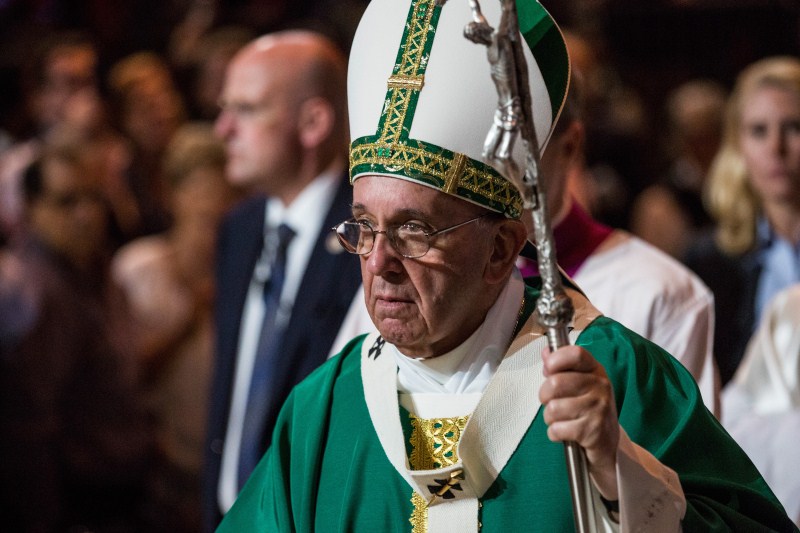
“God is living in our cities. The Church is living in our cities. God and the Church living in our cities want to be like yeast in the dough, to relate to everyone, to stand at everyone’s side, proclaiming the marvels of the Wonderful Counselor, the Mighty God, the Eternal Father, the Prince of Peace.”—Pope Francis, Homily in New York City, 25 September 2015
###
Did I have political disagreements with Pope Francis? Of course. I am a conservative and Pope Francis was I think innately a Liberal. I am a free market capitalist. I support being tough on criminals. I want to restrict immigration to just the essential and minimum. I am skeptical about accommodations with communist regimes. I support the strengthening of the military in a world where power is used for evil reasons. Did it really matter Pope Francis might have a different view on these issues? I don’t think so. He was the Holy Father and I was not, and in time I listened as a good Catholic should, with docility and respect.
I cannot say that for his critics, some of whom would bring up my beloved patroness, St. Catherine of Siena as a critic of the pope in her day. But here is the difference. St. Catherine of Siena chided Pope Gregory XI in private conversations and in direct letters. She never criticized Pope Gregory XI in public.
Have I modified my views in the twelve years of Pope Francis’ papacy? In thinking it over, though I am not sure if I can attribute it all to Pope Francis, I would have say yes. I’ve come to the understanding that there must be some sort of accommodation for the lower economic earners in a free market economy; justice cannot be totally achieved by the harshest retributions; I no longer support the death penalty; human dignity must always be upheld; some immigration is charitable and compassionate, and morally required for those escaping human rights violations; use of the military must be implemented with caution and humility. Over these twelve years I’ve gravitated closer to what President George W. Bush called “compassionate conservatism.” I think the Holy Father had a hand in that evolution.
Perhaps
where Pope Francis influenced me the most was on recognizing the dignity in
every person. Yes, I intellectually,
abstractly knew that before, but did I understand it in my bones? I think in his various papal writings, Pope
Francis shaped me to understand it in the encounter with others.
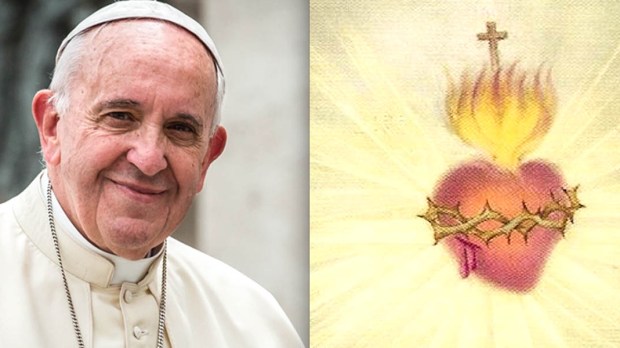
The heart of Christ is ‘ecstasy,’ openness, gift, and encounter. In that heart, we learn to relate to one another in wholesome and happy ways, and to build up in this world God’s kingdom of love and justice. Our hearts, united with the heart of Christ, are capable of working this social miracle”—Pope Francis, Dilexit Nos
###
If there is a single theological doctrine I most associate with Pope Francis, it is his “culture of encounter.” Yes, I raise what appears on the surface to be a simple exhortation to a profound Christocentric idea. Pope Francis spoke often on this culture of encounter, so I don’t know if I’m quoting from the fullest explanation, but these are the ones that came up in my search. He made the first exhortation in his homily at Pentecost shortly after being selected in 2013. From the Address from the Holy Father on 18 May 2013, he exhorts that the Church must be ready to step out:
In this “stepping out” it is important to be ready for encounter. For me this word is very important. Encounter with others. Why? Because faith is an encounter with Jesus, and we must do what Jesus does: encounter others. We live in a culture of conflict, a culture of fragmentation, a culture in which I throw away what is of no use to me, a culture of waste.
Notice the mirrored complexity of that thought: In going out to meet the poor, to use an example, we go out to meet Jesus, and in so meeting Jesus, we, in turn, become Jesus meeting the poor. This is aligned with the homily he gave in NYC I quoted above, going out to the city because Jesus is in the city. Jesus is there in the poor.
There
is also a meditation from the Vatican documents on Pope Francis homily on 13
September 2013
An
invitation to work for “the culture of encounter”, in a simple way, “as Jesus
did”: not just seeing, but looking; not just hearing, but listening; not just
passing people by, but stopping with them; not just saying “what a shame, poor
people!”, but allowing yourself to be moved with compassion; “and then to draw
near, to touch and to say: ‘Do not weep’ and to give at least a drop of life”.
Pope Francis used these words in his homily to describe the message contained
in the liturgical readings of the Mass he celebrated at Santa Marta on Tuesday
morning.
Focusing in particular on the scene of the widow of Nain, from the Gospel of Luke (7:11-17), the Pope highlighted that this passage from “the Word of God” speaks of “an encounter. There is an encounter between people, an encounter between people who were in the street”. And this, he commented, is “something unusual”. In fact, “when we go into the street, every man thinks of himself: he sees, but does not look; he hears, but does not listen”; in short, everyone goes their own way. And consequently “people pass each other, but they do not encounter each other”. Because, Pope Francis clarified, “an encounter is something else” entirely, and this is “what the Gospel today proclaims to us: an encounter between a man and a woman, between an only son who is alive and an only son who is dead; between a happy group of people — happy because they have encountered Jesus and followed him — and a group of people who weep as they accompany the woman”, who is a widow and is on her way to bury her only son.
There
is too much in that meditation to quote, but to further develop Jesus’s
encounter with the widow and her son, Pope Francis points out the typology of
the encounter:
“The only son who is dead resembles Jesus, and he is transformed into an only son who is alive, like Jesus. And Jesus’ action truly shows the tenderness of an encounter, and not only the tenderness, but the fruitfulness of an encounter. ‘The dead man sat up and began to speak, and Jesus returned him to his mother’. He did not say: ‘The miracle has been done’. No, he said: ‘Come, take him, he is yours’”. That is why “every encounter is fruitful. Each encounter returns people and things to their place”.
And thus in so many of Jesus’s encounters in the Gospels—the Good Samaritan, the woman at the well, the woman to be stoned for adultery, the lepers and those possessed by demons—Jesus is moved and does more than just pass by.
Thomas J. Eggleston, writing for the Houston Catholic Worker, I think concisely summarized Pope Francis’s theology of encounter:
With this line of thinking, Christians encounter other people in their imitation of Christ, but on top of that, the disciple encounters other people as a response to having an encounter with Christ in the first place. Francis on a regular basis has spoken of a Culture of Encounter as a goal for human society. A society that espouses a Culture of Encounter facilitates right relationship among humans and involves a spirituality that emphasizes a personal friendship with God who first encounters us in love.
This is not the typical abstract theological thinking of say a Thomas Aquinas nor Pope Benedict XVI. This is a hands on theology of the moment, one that if I had more space to flesh out is one of an existential nature. This is not the theology of Ordo amoris that some politicians conveniently want to quote to justify reductions in aiding the needy, but one that forces you to love those before you. (Pope Leo XIV also weighed in by rebuking such politicians, “Jesus doesn't ask us to rank our love for others.") Pope Francis was a people person, a people Pope, one who saw the dignity in everyone, who as far as I can tell truly cared for everyone.
###
Finally I want to end with I found a very moving tribute, a statement from Dr. David Anders on his EWTN radio show, Called to Communion. Someone had called in with a question on Pope Francis on his April 25th, 2025 show at about the 21:33 minute mark and lasts for three minutes..
I
transcribed what Dr. Anders said, and I present it here, removing some minor
verbal ticks that an ad hoc oral expression will have:
“He [Pope Francis] sounded a very consistent note from start to finish through his entire pontificate, and that was that our attachment to the Gospel of Christ must sensitize us to the dignity of the marginalized, the poor, the migrant, the other, those on the peripheries—and sometimes the peripheries could be conceived of in political terms and other times conceived of the guy or the lady in the parish who can’t receive compassion in the confessional—and he always had a heart for whoever is falling through the cracks of the Church’s ministry, how we’re failing to reach them, and a deep willingness to challenge the Church’s traditional ways of doing things, habits and customs that we might be working to defend to prop up the status quo than challenging the status quo in the interest of the apostolate, and ultimately reaching souls.” -Dr. David Anders, Called to Communion, April 25th, 2025.
That brought a tear to my eye. That stands as the best statement on Pope's Francis the man and his pontificate that I heard anywhere.
May the Holy Father rest in peace.
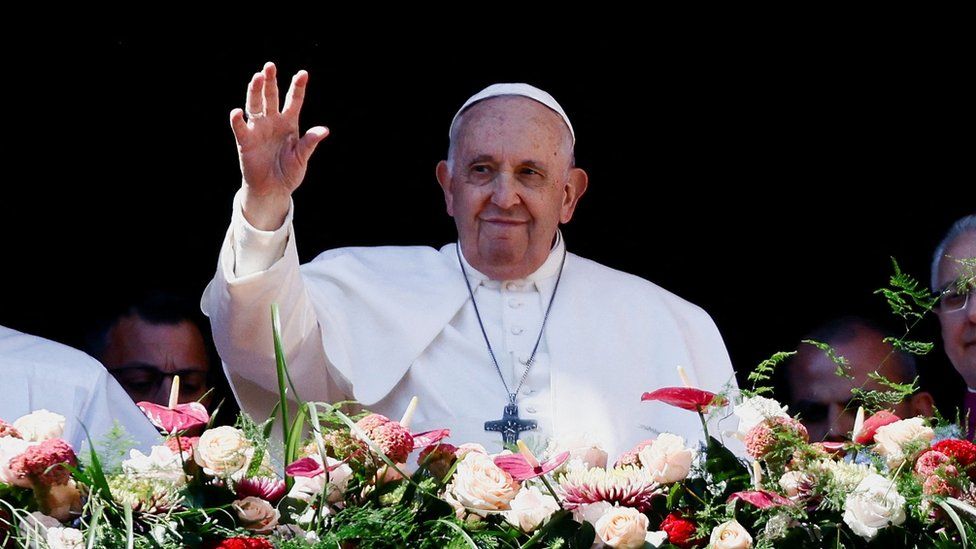
”In the Lord’s Paschal Mystery, death and life contended in a
stupendous struggle, but the Lord now lives forever. He fills us with the
certainty that we too are called to share in the life that knows no end, when
the clash of arms and the rumble of death will be heard no more. Let us entrust
ourselves to him, for he alone can make all things new!”—Pope Francis, Urbi et orbi, Easter 2025


