"Love follows knowledge."
"Beauty above all beauty!"
– St. Catherine of Siena

Showing posts with label Wilfred Owen. Show all posts

Thursday, October 19, 2017

Poetry: “Dulce et Decorum est” by Wilfred Owen

Continuing the ongoing series of World War I poems from the collection titled, Some Desparate Glory: The First World Warthe Poets Knew edited by Max Egremont, I want to post what I consider the finest poem to come out of the First World War.  Before I get to the poem, let me provide links to the previous poems of the series.  Since Egremont organizes his book by year during the war, I have been posting on what I consider the most interesting poem of that year.  Here are the poems and the links.


Now I had intended to only post one poem per poet so we could get a broad diversity of voices, but, since Wilfred Owen in both 1917 and 1918 stands head and shoulders above the other poems written, I really have no choice but to repeat one of his poems.  As I mentioned before, Egremont provides a summary of biographical events for each poet during each year of the war.  In the 1917 post on Wilfred Owen I had mentioned how he had been injured and spent almost a year in hospital at Craiglockhart, where he met Siegfried Sassoon, built up a friendship, and influenced each other’s poetry.  But by the end of August in 1918, Owen was recovered and on his way back to the front.  Ergremont elaborates:

The way to the front went through Etaples, then to Amiens to join his battalion and from Amiens to Vendelles before preparations for an attack.  In France Owen completed “The Sentry”, “Exposure” and “Spring Offensive”.  Of the fighting, he told his mother, “I lost all my earthly faculties, and fought like an angel.”  Doubts about his courage vanished when, with a corporal, he captured a German machine-gun post, writing that “I only shot one man with my revolver (at about 30 yards!).  The rest I took with a smile.”  Wilfred Owen won a Military Cross.

He knew he had a mission now, to care for and to record what his men endured, how “every word, every figure of speech must be matter of experience”, must be conveyed so that any soldier could understand.  “I came out in order to help these boys,” he told his mother, “directly by leading them as well as any officer can; indirectly by watching their sufferings that I might speak of them as a pleader can.  I have done the first.”  What he wrote would fulfill the second.

The end came on 4 November, during an attack across the Sambre-Oise canal when three Victoria Crosses were won.  Owen was last seen trying to cross the canal on a raft under heavy enemy fire.  The engagement was his unit’s last time in action, the heroism perhaps encouraged by a sense that victory was near.  Showing the static nature of the western front, the 2nd Manchesters found themselves on Armistice Day—11 November 1918—in billets to the south of Landrecies, where they’d been on 18 August 1914, on their way to Mons.

The confirmation of Owen’s Military Cross occurred some four days after he had been killed.  One of the myths of the armistice is of the bells of Shrewsbury ringing out in celebration as the telegram boy knocked on the door of the Owen home with the news of Wilfred’s death.  It’s ironic that the last letter to his mother from a poet whose work shows should say, “It is a great life…Of this I am certain, you could not be visited by a band of friends so fine as surround me here.”
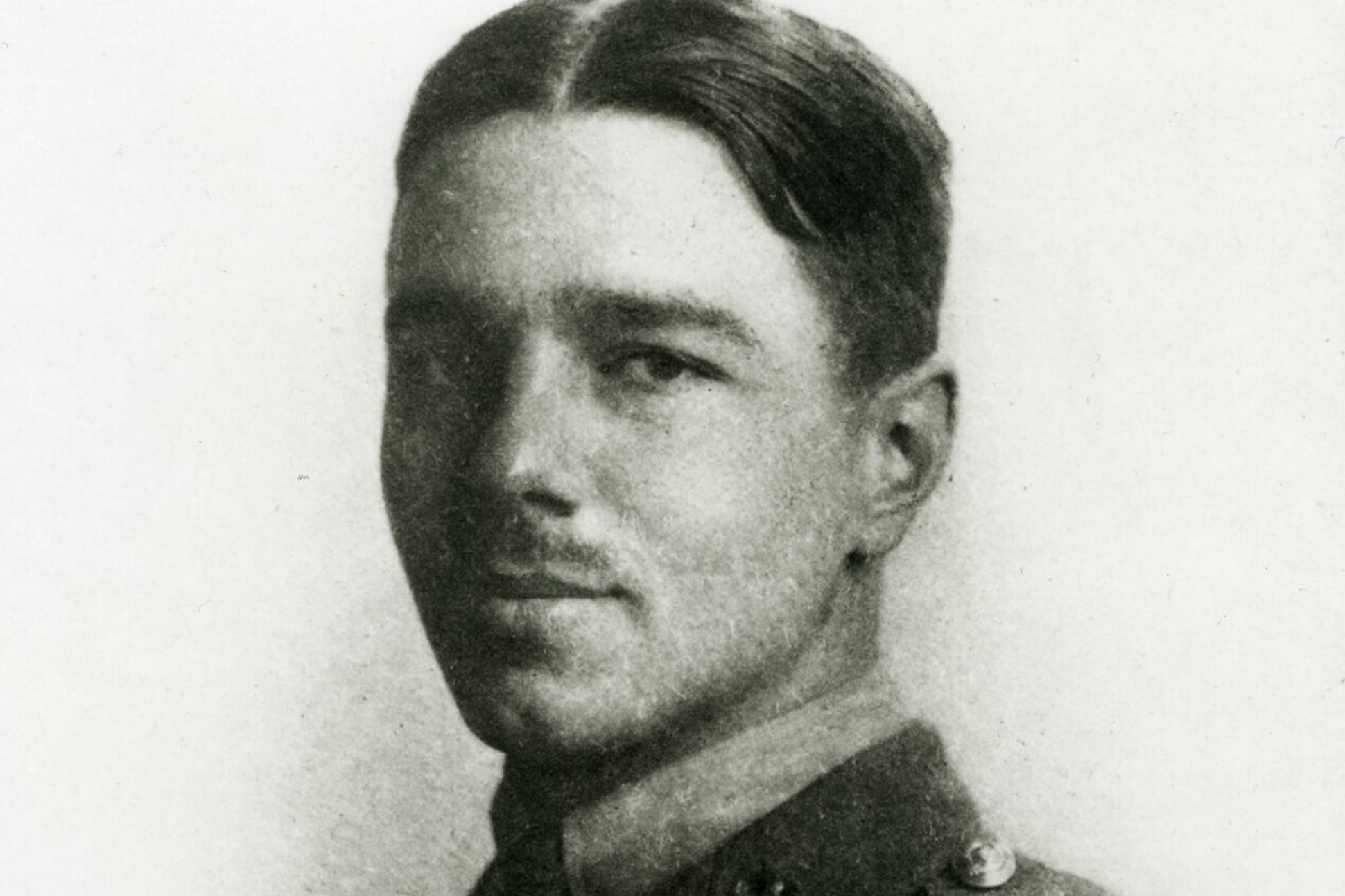
That Wilfred Owen died one week prior to the cessation of hostilities is one of the great tragedies of the war.  Of course there were countless tragedies within the 1,568 days (4 years, 3 months, 15 days) the war spanned.  As far as literature was concerned, Owen's death seems to represent the great human, and creative loss brought forth by the war.

Now to the poem. 

Dulce et Decorum Est
By Wilfred Owen

Bent double, like old beggars under sacks,
Knock-kneed, coughing like hags, we cursed through sludge,
Till on the haunting flares we turned our backs
And towards our distant rest began to trudge.
Men marched asleep. Many had lost their boots
But limped on, blood-shod. All went lame; all blind;
Drunk with fatigue; deaf even to the hoots
Of tired, outstripped Five-Nines that dropped behind.

Gas! Gas! Quick, boys!—An ecstasy of fumbling,
Fitting the clumsy helmets just in time;
But someone still was yelling out and stumbling
And flound’ring like a man in fire or lime...
Dim, through the misty panes and thick green light,
As under a green sea, I saw him drowning.

In all my dreams, before my helpless sight,
He plunges at me, guttering, choking, drowning.

If in some smothering dreams you too could pace
Behind the wagon that we flung him in,
And watch the white eyes writhing in his face,
His hanging face, like a devil’s sick of sin;
If you could hear, at every jolt, the blood
Come gargling from the froth-corrupted lungs,
Obscene as cancer, bitter as the cud
Of vile, incurable sores on innocent tongues,—
My friend, you would not tell with such high zest
To children ardent for some desperate glory,
The old Lie: Dulce et decorum est
Pro patria mori.

As the Wikipedia entry states, the title and the subsequent quote that ends the poem comes from a famous poem by the Roman poet, Horace, “Dulce et decorum est pro patria mori,”  (How sweet and glorious it is to die for one’s country.”)  The Wikipedia entry states that the poem combines two sonnets, which is not true.  A sonnet does have fourteen lines and this poem is twenty-lines long, which would be two sonnets, but neither of the two halves of fourteen lines have any type of sonnet rhyme scheme.  Wikipedia also says that the form is “similar to a French Ballade,” and claims that through the allusion to a French Ballade and through breaking form, Owen is making a modernist statement of disorder, if I may paraphrase.  I’m not familiar with the ballade form to fully understand variation to it, but Owen’s poem doesn’t incorporate a refrain, which I would think is defining to a ballade, nor does it incorporate an interlocking rhyme scheme.   The only similarity to a ballade is that it has roughly eight line stanzas with a quatrain rhyme scheme. 

The poem’s structure follows a progression of thought, and here the rhyme scheme of progressing, alternating rhymes (ABABCDCD and so on) accentuates the forward thrust toward the poem’s conclusion.  The poem is divided into four sections; I’ll call them stanzas.  The first is an eight line stanza of which could be thought of as two quatrains.  It sets the scene of a marching troop, all suffering through the hardships of soldiers on maneuver.  The second stanza is of six lines, and taken with the eight can be seen as a second half of an Italian sonnet as Wikipedia see it.  It is a volta, meaning a turn of thought from the initial motif.  Here the turn is the introduction of a new crises, the realization that the Five-Nines (mortar or artillery shells) contained poison gas, and so the soldiers need to immediately put on their gas masks. 

Both the first and second stanzas are in the past tense, and so this is set in the past.  But notice how the second stanza has a stream of gerunds: “fumbling,” “fitting,” “stumbling,” “flound’ring,” “drowning.”  Though not associated with time, gerunds have a wonderful immediacy that makes the language feel as if it’s present time.  The “I saw him drowning” main clause clearly though situates it in the past. 

The third stanza is only two lines, but it clearly pushes us into the present tense—a simple present tense of general time, “in all my dreams.”  The poor dying man “plunges at [him]” in repeated dreams, again characterized by the immediacy of gerunds: “guttering, choking, drowning.”  “Drowning” gains a tremendous power by being repeated with the repetition falling on a rhymed word slot. 
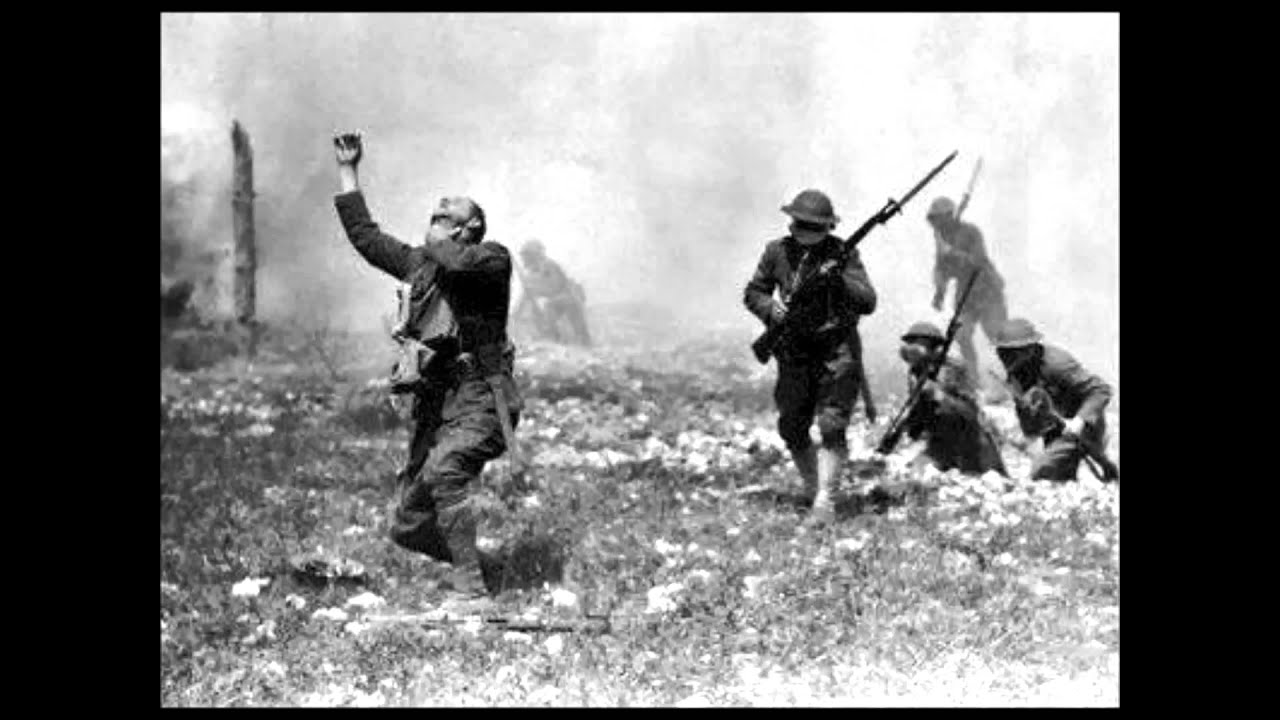
The last stanza is made up of twelve lines with a strong break between the first eight and the last four. The tense shifts again here, this time into a conditional “if-then” construction.  Suddenly there is a person being addressed, “you” and later “my friend.”  Each quatrain of the eight lines has its own “if” construction.  The first “if” puts the person being addressed into the situation watching the dying man, and the second “if” allows the addressee hear the suffering man.  The “then” is a reproach to the addressee for promoting what Owen calls the “old lie,” the quote from Horace promoting a romanticized version of war.  Shortening that last line to three feet makes the ending that much more powerful.  Everything in the poem refutes the claim that there is anything sweet and glorious about war or dying in war for one’s country.  The Wikipedia entry identifies who Owen is addressing in that last stanza, a Jesse Pope who apparently was a propagandist poet for the war.  


There is more one can point out in the poem, such as the alliteration, the diction that accentuates the drudgery and the chaos, and the allusions to Dante’s hell.  Listen for it as you hear the poem being read here overlaid with some WWI video.   


So many great lines and phrases in the poem: “Bent double, like old beggars under sacks,” “deaf even to the hoots/Of tired, outstripped Five-Nines that dropped behind,” “Gas! Gas! Quick, boys!” “As under a green sea, I saw him drowning,” and finally “you would not tell with such high zest/To children ardent for some desperate glory,/The old Lie.”  Egremont titles his book from that line, “some desperate glory.”


Not only the finest poem of the First World War, but truly one of the great poems of the ages.


Monday, May 29, 2017

Poem: Anthem for Doomed Youth by Wilfred Owen

Today is Memorial Day, a holiday to honor the war dead from our history.  This is a perfect opportunity to continue with my poetry read, Some Desperate Glory: The First World War the Poets Knew by Max Ergremont.  I gave a quick little introduction on the book last year when I first discussed it.  Here’s what I said:

My poetry read for this year is a collection poems from poets of WWI, titled Some Desperate Glory: The First World War the Poets Knew, written and edited by Max Egremont.  It’s written by Egremont because it’s more than just a collection of poetry.  The poetry is integrated with the history and poet’s lives.  The book is organized around the year by year history and what the poets were up to in that year, and it provides a sampling of that year’s poetic output.

I’ve been tracking the book by posting a poem from each year of the war.  I am now up to 1917 and the poem I want to highlight is Wilfred Owen’s “Anthem for Doomed Youth.”   I keep making the mistake that the poem is about ‘a doomed youth,” singular, but it’s for “doomed youth,” general and plural.  So when you read the poem, don’t make the mistake I’ve been making.

Some consider Wilfred Owen to be the best of the First World War poets.    He seemed to have grown up from a struggling family, though reasonably well educated.  He began writing poetry at a young age, so when he enlisted in 1915 at the age of twenty-two, he had built up some skill.  He was severely injured in 1917 and went back to home country where he met one of the other great poets of the war Siegfried Sassoon at hospital in Edinburgh.  They built up a friendship and a correspondence.  Owen returned the front in the summer of 1918, and would be killed in action on the 4th of November, exactly one week before Armistice. 

Here is some background from Some Desperate Glory:

In January 1917, Wilfred Owen was with the 2nd Battalion, the Manchester Regiment in the transit camp of Etaples.  Here he was hit, during bombing practice, by a fragment which grazed his thumb, letting him coax out one drop of blood, a glimpse of what it was to be a warrior.  ‘There is a fine heroic feeling about being in France,’ Owen told his mother on New Year’s Day, ‘and I am in perfect spirits.  A tinge of excitement is about me, but excitement is always necessary to my happiness.’  He wrote again ten days later, ‘Have no anxiety.  I cannot do a better thing or be in a righter place…’

He’d been under shellfire in the snow at Bertrancourt by 4 February.  The ugliness of the trenches cut into the crimson aestheticism, nurtured by Tailhade and the reading of Wilde.  ‘I suppose I can endure cold, and fatigue, and face-to-face death, as well as another, but extra for me there is the universal perversion of Ugliness,’ he told his mother.  ‘Hideous landscapes, vile noises, foul language and nothing but foul, even from one’s own mouth (for all are devilridden), everything unnatural, broken, blasted; the distortion of the dead, whose unburiable bodies sit outside the dug-outs all day, all night, the most execrable sights on earth.’  Owen claimed that he’d been too busy to be frightened: ‘I cannot say I felt any fear.’  That day he arrived at Abbeville to take a transport course.  Another offensive was only two months away. 

That offensive was the Battle of Arras, and it would alter Owen’s life significantly and effect his poetry.   

Arras brought humiliation for Wilfred Owen.  He returned to his company in March and, when with a working party, fell into a hole which brought mild concussion and a visit to a casualty clearing station in Gailly on the Somme canal where he passed his twenty-fourth birthday.  Here Owen thought of his future; perhaps after the war he might live in a cottage in southern England with an orchard, or so he told his brother Colin, 'and give my afternoons to the care of pigs.  The hired labour would be very cheap, 2 boys could tend 50 pigs.  And it would be the abruptest change' from the writing that would be 'my moruning work.'

He came into the front line again near Saint Quentin on 3 April where there was still snow, and lay four days and four nights without relief in the open, kept going by brandy and the fear of death.  On 14 April, Owen led his section in an attack on the German trenches under fire and shelling, later telling his brother Colin that 'going over the top' was 'about as exhilarating as going over a precipice', that he'd wish'd for a bugle and drum and had kept chanting 'Keep the line straight!  Not so fast on the left!  Steady on the left' before the 'tornado' of shells. 

The imagery of the 1918 poems goes back to this, and to the horror of a few days later, indelibly marking the literature of war.  Owen's battalion stayed in the line around Savy, lying again in holes where 'for twelve days I did not was my face, nor take off my boots nor sleep a deep sleep...'.  A shell hit a bank , just two yards from his head, and he was blown into the air, ending up in a hole just big enough to shelter him, with the dead body of a comrade near by, covered with earth.  There followed a collapse, then possible imputations of cowardice from his commanding officer who judged that Owen was no longer fit to lead men and ordered him back to the casualty clearing station.  The diagnosis was 'neurasthenia', or shell shock, although he assured his mother that he hadn't had a breakdown.  A medical report stated that on 1 May he was found to be 'shaky and tremulous and his conduct and manner were peculiar and his memory confused.'  By the end of June Owen was in Craiglockhart, a hospital housed in a dark, converted Victorian hydro in Slateford, a suburb of Edinburgh.

It was at Craiglockhart he met Sassoon, and the two discussed the art of poetry.  Nothing like discussion to focus one’s mind and skill. 


Owen had been transformed by Craiglockhart.  Early in November, his poem 'Miners' was accepted by the Nation; later that month he visited his cousin and former literary confidant Leslie Gunston, displaying a new confidence by writing mockingly to Siegfried Sassoon about Gunston's tame verses and sexual innocence.  In November, he rejoined the 5th Battalion, the Manchester Regiment, at Scarborough, still thought capable of light duty. 

Now let’s get to the poem.

Anthem for Doomed Youth
By Wilfred Owen

What passing-bells for these who die as cattle?
Only the monstrous anger of the guns.
Only the stuttering rifles' rapid rattle
Can patter out their hasty orisons.
No mockeries now for them; no prayers nor bells;
Nor any voice of mourning save the choirs, –
The shrill, demented choirs of wailing shells;
And bugles calling for them from sad shires.

What candles may be held to speed them all?
Not in the hands of boys but in their eyes
Shall shine the holy glimmers of goodbyes.
The pallor of girls' brows shall be their pall;
Their flowers the tenderness of patient minds,
And each slow dusk a drawing-down of blinds.

(September - October, 1917)

The first thing that should be mention is that the form is of a sonnet, and despite the break after the eighth line and the grouping of the last six lines together, the sonnet is not an Italian sonnet but a Shakespearean, or sometimes called an English sonnet.  An Italian sonnet has a rhyme scheme of ABAB CDCD EFGEFG.  The way those last six lines are intertwined in the rhyme scheme creates a bulk of lines that if handled properly consolidate into a contrasting thought to the opening eight lines.  Sometimes an Italian sonnet is arranged with the two quatrains grouped together with a line break before the sestet to emphasize the change in thought in that sestet. 

A Shakespearean sonnet, on the other hand, has three quatrains ABAB CDCD EFEF and a closing couplet GG, and is almost never displayed with any line breaks.  The internal logic of a Shakespearean works differently than an Italian.  Typically a Shakespearean builds to a climax within the three different quatrains and then delivers the climatic thrust in the couplet.  So Owen shapes the poem like an Italian sonnet, though it’s actually a Shakespearean, and he varies the rhyme scheme of third quatrain to EFFE

Why does he group the last six into a sort of Italian sonnet sestet?    In the Italian sonnet there is that turn in thought, referred to as the “volta,” going from the octave (the two quatrains) to the sestet.  In Owens poem there isn’t so much a turn in thought but a change in imagery.  I’ll get to that.

The poem is built on a grotesque metaphor that the elements of battle are like that of a funeral.  And so in the octave we get artillery fire described as church bells and the prattle of guns as orisons or prayers.  The sound of whistling shells are choir song and military bugles are local voices.  Bells, bombs, prattle, choirs, and so on are a merging of sounds from two disparate environments, a church and a battle field.  For me the octave is the strongest part of the poem.  Its internal logic is clear.

The turn in the sestet is a shift from sound imagery to visual imagery.  Now we have candles, eyes that shine, glimmers, and the pallor of brows.  I’m confused as to what “speed them all” refers to in the ninth line.  Speed toward death?  Toward their grave?  Toward heaven?  Whatever that is supposed to mean, it doesn’t seem to shift the conceit; it’s still a funeral and a battle field. 

The closing couplet brings in the funeral flowers, and a closing of blinds to indicate a closing of eyes and therefore sight.  I don’t know what Owen means by flowers being “the tenderness of patient minds”—why patient minds?—but intuitively I can understand how we’ve come to flowers. 

So what Owens tried to do is create a hybrid between the Italian and Shakespearean sonnet forms, keeping the Shakespearean three quatrains but grouping the last quatrain and couplet into a sestet-like unit.  Is he successful?  Personally I would say no.  As a sonnet it lacks the intellectual sophistication of an Italian and the power of a Shakespearean.  He’s lost what makes each sonnet work best for no apparent gain.  There are reasons why each sonnet form are the way they are, arrived at through trial and error.  He should have written a clean Italian sonnet, where the last six lines are interlocked in rhyme.

So why did Owen choose to write it this way?  I think the poem came to him in this form, and instead of editing into an Italian sonnet, he felt compelled to keep it this way.  It’s still a good poem, and I can understand how a young poet is reluctant to rejigger what seems adequate. 

The other thing that’s usually mentioned with this poem is the disconnect between the poem being called an “anthem,” which is a celebratory song and the subject of the poem, which is “doomed youth.”  No one celebrates dead youths.  That’s verbal irony and accentuates the irony of the central conceit.

Of course a poem should be listened to as well as read.  Here is Kenneth Branagh reading the poem.


The poem sounds lovely to listen to. It’s a good poem, despite what I think are some internal flaws.  Still, on Memorial Day, keep all those poor doomed youth that have died in the service of our nation in your thoughts, hearts, and prayers.