"Love follows knowledge."
"Beauty above all beauty!"
– St. Catherine of Siena

Showing posts with label Hope. Show all posts

Monday, August 10, 2026

Sunday Meditation: Faith and Hope on the Sea of Galilee

Today, Year A’s Nineteenth Sunday in Ordinary Time, we continue following Jesus and the apostles after the Feeding of the Five Thousand.  Jesus disperses the crowd and sends the apostles off on their boat while he goes up the hillside to pray alone.  The boat encounters a storm, and Jesus heads out to the apostles, walking on the water.  You know the passage.  Peter asks if he could be allowed to walk on the water, and after Jesus acknowledges and Peter does take a few steps, he loses faith and starts to sink.  Jesus then saves him. 

There are a couple of mysterious details in this passage.  Let me bring them out in the form of questions and try to answer them, but rest assured I’m not all that confident in my answers.

Why does Jesus send them off alone to the boat while He goes away from them? 


Prayer is certainly important to Jesus, but the fact He “made them get into a boat” suggests He has orchestrated all the subsequent events.  All details should be filtered with this detail.

Why does He walk on water to go out to them?  Couldn’t He calm the sea and wait for the boat to dock? 


Jesus walking on water is a theophany, a manifestation of His divinity.  He intended to manifest to the apostles.  This appears to be the reason to send them off while He stays back.

Why is the boat on the sea on the fourth watch, which is supposed to be between 3 and 6 AM?  That’s not a particularly safe time to be on water in ancient times. 


It’s obviously overcast and the surroundings would be totally dark.  A natural impulse would be to head back to shore but Jesus wanted them out and so they were obedient.  As Dr. Pitre will explain below, they were fishermen, and so used to going on the sea at night.  Perhaps the bad weather caught them by surprise.

Why did Peter want to walk on the water?


It’s not exactly a natural inclination.  He sees Jesus walking on water, did Peter want to emulate Him?  Was he just looking for a thrill?  Was he trying to show off?  I guess we will never know.
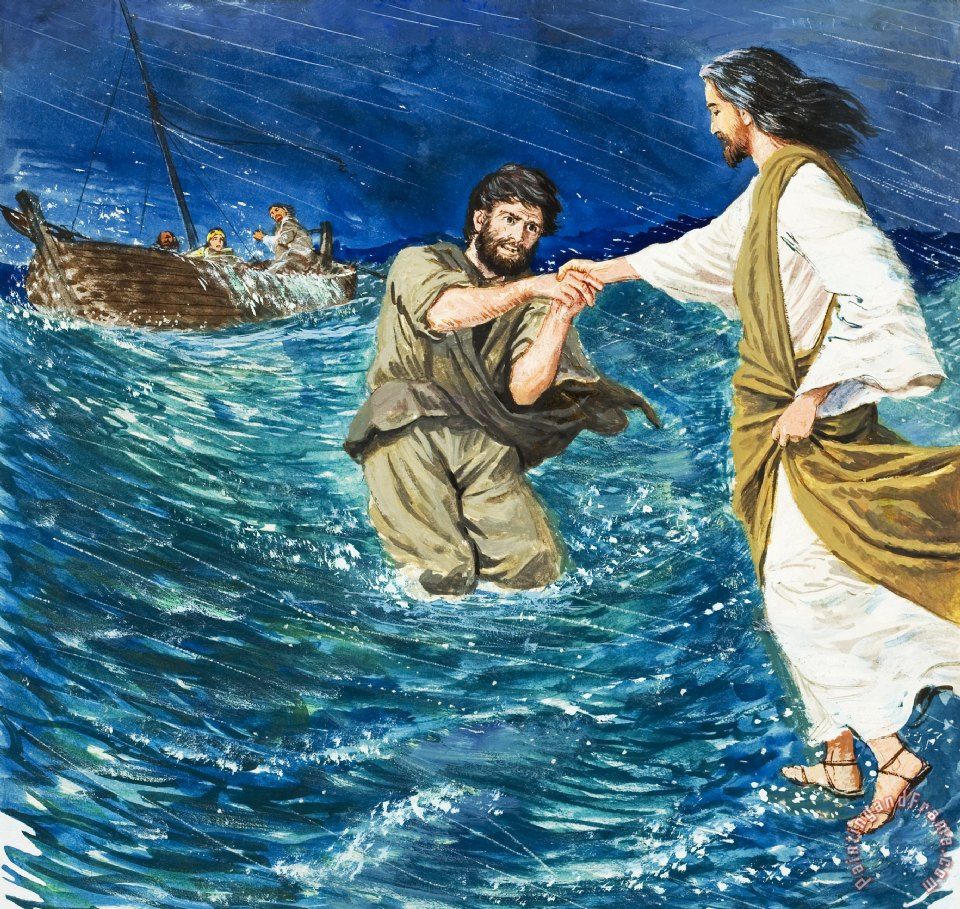


Today’s Gospel:


After he had fed the people, Jesus made the disciples get into a boat

and precede him to the other side,

while he dismissed the crowds.

After doing so, he went up on the mountain by himself to pray.

When it was evening he was there alone.

Meanwhile the boat, already a few miles offshore,

was being tossed about by the waves, for the wind was against it.

During the fourth watch of the night,

he came toward them walking on the sea.

When the disciples saw him walking on the sea they were terrified.

“It is a ghost,” they said, and they cried out in fear.

At once Jesus spoke to them, “Take courage, it is I; do not be afraid.”

Peter said to him in reply,

“Lord, if it is you, command me to come to you on the water.”

He said, “Come.”

Peter got out of the boat and began to walk on the water toward Jesus.

But when he saw how strong the wind was he became frightened;

and, beginning to sink, he cried out, “Lord, save me!”

Immediately Jesus stretched out his hand and caught Peter,

and said to him, “O you of little faith, why did you doubt?”

After they got into the boat, the wind died down.

Those who were in the boat did him homage, saying,

“Truly, you are the Son of God.”

~Mt: 14:22-33


Our old friend, Dr. Brant Pitre, brings out the exegetical main points.


Dr. Pitre:

It's important to recall the setting of this miracle.  It takes place after the famous feeding of the 5,000 in the Gospel of Matthew.  So one of the reasons this is important to highlight is because the same sequence occur in all the Gospels so for example in Matthew and Mark and in John all of those Gospels—three of the four actually—three of the four Gospels have accounts of the walking of Jesus on the water and in all three that that account immediately follows the feeding of the 5,000, so it's like a pair of miracles: Jesus feeds the 5,000 and then he walks on the water, so it's in the wake of him having performing this amazing miracle feeding 5,000 people from five loaves and two fish that Jesus then withdraws and he goes up the mountain to pray right.  So it gets late and then while he is up in the mountain praying the disciples set off across the Sea of Galilee in the boat.  Now a couple elements about the context: where exactly does this take place on the Sea of Galilee?  Well we don't the exact location but we do know the Sea of Galilee to this day is not a very…small lake it's about seven miles wide at its widest point and it was the kind of beating heart of Galilee, and is the place of fishing and industry and disciples knew it well and when they're in their boat [it] is important the first thing you notice is they're not right next to shore; it says there are many furlongs distant from the land now in John's account of this miracle he actually says they're about four miles from the shore.


Also notice the time it's the fourth watch of the night, so this is in the middle of the night sometime between three o'clock and six o'clock in the morning now most of us wouldn't get on a boat and be out in the middle of the night between 3 and 6 a.m.  But for the Apostles they were pretty used to this because as fishermen it was actually customary to fish at night we'll see that in a gospel John that they spend all night fishing and they don't catch anything so they are traveling in the middle of the night and something they're pretty used to.  What they're not used to however is being on the water in the middle of the night in the middle of the lake and seeing a man coming to them walking on the waves of the sea, and that's what Jesus does here in this account, he comes to them walking on the sea.  Now when they experience this their first reaction is fear right and they assume that he's a ghost pretty interesting a point there because it shows us that apparently at least some of the disciples believed in ghosts.


Jesus says something very interesting, he says take heart don't be afraid.  I'll pause there for a second; this is a clue to us that we should characterize this account Jesus walking on the water as a theophany.  A theophany as I've mentioned in other videos is an appearance of God.  It's where God reveals his power and his glory and its presence to his people on earth, and one of the things you'll see over and over again in accounts of theophanies in the Bible is that people are always afraid, like when they see God they're afraid, and God's response to their fear is often to quell it.  Right to say be calm don't be afraid and then to speak to them to give them some message, so in this case Jesus says take heart have no fear and then he says it is I.  Now the Greek, the literal Greek behind that expression which most Bibles render—“it is I”—is “egō eimi,” which literally in Greek means take heart, “I am so,” that's quite the same thing as it is me.  [It] literally just says take heart I now.   On the one hand the expression I am, egō eimi, can be used to identify someone right so if I ask you a question is that you and you say I am it could respond by saying yes it's me.  Right so that can be the sense or the meaning of it, but the literal meaning of the word in context is more than that Jesus isn't just identifying himself; he's also taking the divine name of God.


From the Old Testament and using it as his own, so in other words he's alluding to the most famous theophany in the Bible, the theophany of the appearance of God to Moses on Mount Sinai in the book of Exodus chapter 3.  So in that theophany God comes to Moses and he calls Moses to go to the people of Israel who were slaves in Egypt and to set them free and to bring a message of deliverance, and Moses says well if I go to them whose name shall I give them, what name will I tell them is the name of the God who sent me?  And the Lord says to Moses, “I am Who I am, tell them I am has sent you to them.” Right this is my name for all generations God goes on to say, so the name that the expression, “I am,” is more than just an identification; it's the divine name, so when you take Jesus's use of the term, “I am,” you couple it with the fact that he is walking on water and that he's saying don't be afraid which is standard theophany language from the Old Testament, [all] three things together show to us that Jesus is revealing his divinity.


That’s a pretty clear exegesis.  For the pastoral homily, I’m going to knock you out of your socks with this from Pope Leo XIV.


Pope Leo XIV:

Dear brothers and sisters, happy Sunday. Today's gospel speaks of Jesus approaching his disciples by walking on the waters of the Sea of Galilee in the midst of a storm. Following the miracle of the loaves and fish, the master urges his disciples to get into the boat and set out while he withdraws to the mountain to pray by himself. Once away from the shore, the disciples find themselves at the mercy of the wind and struggle to make headway. After a successful experience in which they had been the protagonists of a miraculous sign, they now find themselves helpless and frightened in the face of the threat of the waves and the headwind. As the night was drawing to a close, Jesus came towards them across the choppy waters, and terrified, they mistook him for a ghost. But he said to them, "Take heart. It is I. Do not be afraid.” The Lord's presence changes everything. Peter even manages to take a few steps across the waves towards him. But then losing his nerve, he begins to sink and Jesus saves him. When the master then steps into the boat, the storm subsides and a profession of faith spontaneously springs out of the disciples hearts.  Truly, you are the son of God. To realize this point, it was not enough for them simply to have witnessed a miracle nor to have succeeded in the eyes of the people. Instead, they had to experience their own weakness and within it recognize God's presence. Only this experience could open their eyes and hearts to his closeness, finding peace even in the midst of the storm. 

Notice the point.  It’s not just witnessing the miracle that changes the apostle’s hearts.  It’s the fear and anxiety they experience that changes them.  They had to experience the terror for their souls to find peace.

Pope Leo XIV:

Sometime later, Jesus would say to them, "If you have faith and do not doubt, if you say to this mountain, be lifted up and thrown into the sea, it will be done." This is similar to what they experienced on the lake. The peace of Christ who had been on the mountain praying reached them in the midst of the raging waters. This miracle then teaches us something important. First, not to get carried away by success and never to be presumptuous. At the same time, not to despair even in moments of darkness when we feel powerless in the face of problems. And despite our efforts, it seems as though we are going backwards rather than forwards. Whatever the circumstances, Jesus does not abandon us. And if we humbly welcome him into the boat of our lives through prayer, the sacraments, and listening to his word, in him we will find peace, light, and strength for our journey. May who is proclaimed blessed for her faith, help us to live in a trusting surrender to God.

Ultimately what I think Pope Leo is getting at is that there is a relationship between faith and hope.  The apostles had a momentary shaking of faith; Peter walking on the water loses faith and begins to drown.  What does he do?  He calls out to Jesus.  The calling is an act of hope.  The apostles did not despair.  One may have a shaking of one’s faith from the tumultuous events in our lives—and that is natural—but keeping hope in Jesus is the key to salvation.


Sunday Meditation: But when he saw how strong the wind was he became frightened; and, beginning to sink, he cried out, “Lord, save me!”


What hymn could be better for this reading than “Take My Hand, Precious Lord,”  Words: Thomas A. Dorsey, 1932.  I played this three years ago for this reading, and I will never miss an opportunity to play my most beloved hymn.  And I absolutely love this version by a not so well known jazz singer named Jimmy Scott.


Precious Lord, take my hand,

Lead me on, let me stand,

I am tired, I am weak, I am worn;

Through the storm, through the night,

Lead me on to the light:


Refrain

Take my hand, precious Lord,

Lead me home.


When my way grows drear,

Precious Lord, linger near,

When my life is almost gone,

Hear my cry, hear my call,

Hold my hand lest I fall:


Refrain


When the darkness appears

And the night draws near,

And the day is past and gone,

At the river I stand,

Guide my feet, hold my hand:


Refrain


I want this song and this version played at my funeral.  I said this on YouTube comments for this song: “I think Jimmy Scott's rendition of this beautiful hymn is my all time favorite.  There is such suffering in his voice.  It feels so honest.” 

Tuesday, November 26, 2024

Mere Christianity by C. S. Lewis, Post #5

This is the fifth of a series of posts on Mere Christianity by C. S. Lewis.

You can find Post #1 here.  

Post #2 here.  

Post #3 here.  

Post #4 here.  


Book 3: Christian Behavior

Summary for Chapters 7 thru 12:

Chapter 7:  Forgiveness

One the most difficult tenets of Christianity is that one must love our neighbor as ourselves, including the forgiveness of our enemies.  We are only forgiven of our sins on the basis that we forgive other’s sins.  This does not entail that one allows evil to stand unchecked.

Chapter 8: The Great Sin

The greatest sin in Christianity, and this differentiates Christianity from almost all other religions, is the sin of pride or self-conceit.  Pride, which is opposite the virtue of humility, is at the heart of all other sins.  Other sins may bring people together, but the sin of pride brings enmity between man and man and man and God.

Chapter 9: Charity

Charity, which means love in a Christian sense, does not mean emotion or sentimentality.  Charity is an act of the will, which makes it irrelevant whether you are fond of other or not.  Once you treat all people with charity you will find that it will lead to affection for all people.

Chapter 10:  Hope

Creatures are not born with desires unless satisfaction for those desires exists. This means that a continual looking forward to the eternal world is not (as some modern people think) a form of escapism or wishful thinking, but one of the things a Christian is meant to do.  We are meant to hope for our final destination that can only be achieved after this life has ended.

Chapter 11: Faith

One sense of the notion of Faith is the art of holding on to things your reason has once accepted, in spite of your changing moods.  This rebellion of your moods against your real self is why Faith is such a necessary virtue: unless you teach your moods “where they get off,” you can never be either a sound Christian or even a sound atheist, but just a creature dithering to and fro, with its beliefs really dependent on the weather and the state of its digestion. Consequently one must train the habit of Faith.

Chapter 12: Faith

Faith in the second sense, the higher sense. arises after a man has tried his level best to practise the Christian virtues, and found that he fails, and seen that even if he could he would only be giving back to God what was already God’s own.  All this trying leads up to the vital moment at which you turn to God and say, “You must do this. I can’t.”  Then you are living by Christian faith.


###

Manny’s Comments:


The chapter on forgiveness was fairly straight forward.  His explanation of the sin of pride and the need for humility seems to come right out of Thomas Aquinas.  Lewis has a great quote on pride that is worthy of memorizing: “For Pride is spiritual cancer: it eats up the very possibility of love, or contentment, or even common sense.”


It is interesting Lewis connects hope with the disparity of the imperfect of the earthly world with the perfect of the heavenly world.  He doesn’t say this in these words but he seems to define hope as the desire to close the gap between the imperfect and the perfect.  That is an interesting way of thinking about it.


My thought on hope jumped to Dante’s Divine Comedy, where Dante the character is questioned by St. James on what is hope in Canto 25 of Paradiso.  Dante’s response is this:


'Hope,' I said, 'is the certain expectation

of future glory, springing

from heavenly grace and merit we have won.


'This light comes down to me from many stars,

but he who first instilled it in my heart

was that exalted singer of our exalted Lord.


'"Let them have hope in you," he declares

in his god-song, "those who know your name."

Among those who share my faith, who does not know it?


'After he had imbued me with his song,

you poured your epistle down on me so that I,

overflowing, now rain your rain on others.' (Par 25:67-78)


To Dante, and this is right out of Medieval scholasticism, hope is the expectation of achieving future glory (beatitude) instilled in him by God through grace.  Hope is not something we do on ourselves, but something given to us.


How does this compare with Lewis?   I think Lewis is much more human centered than Dante or the Medieval scholastics.  On the other hand, Lewis does say that desires are innate and therefore must have their satisfaction somewhere, and that somewhere is heaven.  Hope I can’t help feeling is overly simplified here.  Hope is a virtue that is required.  Despair, the opposite of hope, is a mortal sin, and so hope is not just something that seeks satisfaction but something that is connected to salvation.  I’m not saying Lewis is denying any of this, but that he makes it too mundane.

###

Manny’s Comments:


It is interesting Lewis divides faith into two parts: one that can be summarized as belief and the other that can be summarized as trust.  It was very insightful for me.


The first definition of faith is the belief that the God exists and that the Christian doctrines are true.  Lewis goes on to conclude that faith in this sense is a virtue.  Here is a pertinent passage:


Now Faith, in the sense in which I am here using the word, is the art of holding on to things your reason has once accepted, in spite of your changing moods. For moods will change, whatever view your reason takes. I know that by experience. Now that I am a Christian I do have moods in which the whole thing looks very improbable: but when I was an atheist I had moods in which Christianity looked terribly probable. This rebellion of your moods against your real self is going to come anyway. That is why Faith is such a necessary virtue: unless you teach your moods “where they get off,” you can never be either a sound Christian or even a sound atheist, but just a creature dithering to and fro, with its beliefs really dependent on the weather and the state of its digestion. Consequently one must train the habit of Faith.


In this sense, a Christian must maintain a strength against the fluctuations of doubts.  I love the quote: “Now that I am a Christian I do have moods in which the whole thing looks very improbable: but when I was an atheist I had moods in which Christianity looked terribly probable.”  That is so true.  I occasionally suffer from such a doubt when in a particular mood, and when I was an atheist I had the same occasional intuition.  We are all prone to have moments of doubts and moments of faith as our daily activities cause us to have thoughts.  Lewis is not saying it is wrong to have such moments, or that we shouldn’t evaluate those moments, but he is saying that a person of faith will not find the moments of doubts compelling.


The other type of faith is to live in the trust of God.  We all at some point realize that we don’t have the power to control the plan of our lives.  There are times when a crises or multiple crises hit us that we should step back and “let go and let God” as the saying goes.  That’s not to say we shouldn’t organize our lives and strive for our wellbeing, but at some point things go awry and that is when we need to turn to the Lord.  Perhaps one should think of it as God letting it go awry to test your faith.  Lewis frames it this way: “All this trying leads up to the vital moment at which you turn to God and say, “You must do this. I can’t.”  Lewis in the chapter speaks of this faith when things come to a crises, but I think one should step back at various points of one’s life and ask God to let Him lead you, crises or not. 


Now that I’ve summarized Lewis’s two concepts of faith, I would like to see how that compares to the Biblical definition of faith.  The Letter to the Hebrews has two chapters on faith.  First from chapter eleven.


Now faith is the assurance of things hoped for, the conviction of things not seen. 2 Indeed, by faith our ancestors received approval. 3 By faith we understand that the worlds were prepared by the word of God, so that what is seen was made from things that are not visible. (Heb 11:1-3)


Indeed the rest of the chapter provides Biblical examples of faith.  Then in chapter twelve, there is more.


Therefore, since we are surrounded by so great a cloud of witnesses, let us also lay aside every weight and the sin that clings so closely, and let us run with perseverance the race that is set before us, 2 looking to Jesus the pioneer and perfecter of our faith, who for the sake of the joy that was set before him endured the cross, disregarding its shame, and has taken his seat at the right hand of the throne of God.  (Heb 12:1-2)


Hebrews chapter 12 goes on to give advice on how one should live one’s life, “enduring trials,” being disciplined to bear “the fruit of righteousness,” strengthening feet and hands, and accepting God’s graces without bitterness.  Between the two chapters of Hebrews, I think we can see both sides of Lewis’s definition of faith.  I think Lewis has explained a difficult Biblical definition of faith simply and well. 

###

This section of Mere Christianity is focused on the theological virtues, faith, hope, and charity (sometimes named as “love” but I think that “charity” is the more accurate term in our contemporary English).  I found this video that fills out more of Lewis’s view of the theological virtues insightful.  It’s a philosophical set of lectures from Reflections on Morality, Philosophy, and History called “Faith, Hope, Charity, and Love in CS Lewis’ Mere Christianity: The Theological Virtues.”


Monday, March 21, 2022

Essay: Justification by Faith But Not Alone

On a particular conservative online board I belong to we have a Catholics group where a few non Catholics are in the group.  They are in the group because they have a pull toward Catholicism but have not converted yet.  One such person, Stina, asked about the differences in justification between Protestants and Catholics.  I gave a series of answers which I will post here on the blog.  Mind you, I am not a learned theologian, so I am only speaking here for me and not as any officially trained theologian for the Catholic Church.  I am only presenting this as I understand the Catholic position on justification.  So don’t take this as an official Catholic Church position, but from a layman who has had a passing non-professional interest.

This is Stina’s question:

Hey Catholics… my church just started a new member class so they are going over their statements of faith. I already know I have some issues there, but I’m doing a deep dive into Calvinism and Arminianism just to figure out what it is they say and where I fit… it’s a lot of needle threading and angels on pinheads. I’m not leaning in either direction.


I have some idea on the Catholic view of Ephesians 2:8-10, but can you guys maybe encapsulate your concept of Salvation by grace through faith? I don’t know if it would be better if you know the Protestant theologies or not, so let there be a free for all.

I’m only going to provide my series of responses, and since this was at a board, it’s somewhat disjointed.  I have cleaned up the syntax to make my thoughts clear for the blog post.

###

Response 1:

Stina this is one of the most complicated of questions. I don’t know if I can summarize succinctly but I will try. Two things you first should understand. (1) Protestants and Catholics define justification slightly differently. Jimmy Akin of Catholic Answers does a nice job in explaining. Just google “Jimmy Akin Justification” and you’ll see a number of articles. But when you try to reach a level ground in definitions between the two, you find there is not too much difference. (2) Even with the leveling of definitions, Catholics do not believe in the “alone” part of justification. It’s not justification by faith alone.

That said I’ll try to summarize but this may be a bit scattered. St. Peter Damian, he was the Thomas Aquinas from 200 years before Aquinas, said, paraphrasing here, faith is the foundation of justification. Faith is primary on which you need for salvation. It’s from faith that everything else is built on.

Now if you go through the New Testament, you will find several different things delineated as needed for salvation. In some places you need to “repent.” In some places you need to be baptized. In some places you need to take up your cross and follow Jesus. In some places you need to “serve.” [See washing of the feet passage.] Christ says you need to do what he has done. Finally in sum you need to obey Christ’s commandments, which come down to acts of mercy. So doing works is obeying Christ. All the parables hinge on works but see especially Matt 25. The goats on the left all have faith but they are not saved. 

All of this is a result of grace. As Lois says above grace is infused in you, not just by Christ sacrificial death but by a continuous acceptance of the graces God offers every moment. I think Protestants look at grace as a one time thing but Catholics look at grace as a continuous offering from God and you accept as much as you can. Take an act that some Protestants might consider a work, say feeding the hungry in a soup kitchen. If you’re doing it because you feel it gets you to heaven, that’s works righteousness and it does not get you to heaven. We would agree with Protestants there. But if you’re doing it because the poor are in front of you and your compassion is leading you to do it, then are obeying Christ’s commandment to feed the hungry. You are obeying Christ and receiving graces from it. Such grace strengthens your faith, and so conforms your heart to Christ’s heart. That is ultimately salvation: when your heart becomes Christ’s heart. There is a symbiotic relationship between grace and faith.

Not sure I made it clear. I have to run but I’ll be back for a little more.

Response #2:

So let’s look at that passage in Ephesians:

8 For it is by grace you have been saved, through faith—and this is not from yourselves, it is the gift of God— 9 not by works, so that no one can boast. 10 For we are God’s handiwork, created in Christ Jesus to do good works, which God prepared in advance for us to do.

So you can see how all the elements of the argument are there in the passage: faith, grace, works.  Notice how Protestants zero in on line 9: “not by works” but they don’t really have a good explanation for line 10: “For we are God’s handiwork, created in Christ Jesus to do good works.”  It really ignores St. Paul’s passage in 1 Cor 13.  There he says it’s not faith alone but “faith, hope, and love.”  And by love it’s charitas, charity.  You need all three to shape your heart into Christ’s heart.  In fact, St. Paul even says “If I speak in human and angelic tongues but do not have love (charity), I am a resounding gong or a clashing cymbal.  And if I have the gift of prophecy and comprehend all mysteries and all knowledge; if I have all faith so as to move mountains but do not have love, I am nothing.”  So all the faith in the world without charitas he has nothing, he will sound just like a clashing cymbal.  Sometimes when I hear Protestants argue faith alone it sounds like a clashing cymbal, especially when it leads to “once saved always saved” doctrine.  How ludicrous.  And notice how that dovetails perfectly with Matthew 25: the goats had no charitas and really their argument is just a clashing cymbal.

I recall an argument I had with a Protestant over this, and her comeback to me was “then how much works do you have to do to be saved?”  (paraphrasing).  She thought that was a perfect comeback and that’s because she sees justification as solely “imputed” by Christ’s sacrifice on the cross.  Catholics see justification as infused.  We are always before Christ on the cross receiving or rejecting grace.  Scott Hahn describes the differences in this way.  Protestants think of justification as a legal transaction, so that person I argued with makes perfect sense to her line of thinking since she wants to know the contractual details.  But Catholics, Hahn argues, think in terms of covenant, a marriage.  We try to serve our spouse as best we can but surely it’s not perfectly.  My love for my wife can’t be measured in how many times per week I do the dishes but because I want to do the dishes for her as much as I can.  My love for my wife is “infused” with faith in each other and the “works” we have done for each other.

More to come still. 

Stina Replied:

I’m not quite certain how justification is being defined. I’ve heard it used in a myriad of ways that I don’t know if I use it the same as others do.


I’m justified by grace through faith. But my faith is justified by works. So grace is what saves me, faith is my response to it, and works are evidence of that faith… while the works are also used by the spirit to sanctify me (because grace). It’s a cycle!


If I have no works, my relationship suffers. I become like a dead branch on a tree no longer bearing fruit, As if my faith is dead. Jesus says dead branches are cut off. Hebrews confirms it.

My Reply to Stina:

Simply Stina, justification is the basis on which you are judged for salvation. Protestants like to focus on that because it seems like a court room situation, and the evidence you are presenting to Christ is according to Protestants your faith. But Catholics don’t think of it as a court scene; Catholics think of it as like the prodigal son. He repents and works his way back to his father. Yes, faith compelled him but he had to do other things too. That’s why St. Peter Damian says it’s the foundation of justification but not the totality of salvation. I like to think of it as a resume. You can’t get a job as a mechanical engineer without a degree in mechanical engineering. The degree is a pre-requisite. But that’s not the sole criteria. Your grades are going to play a role in the hiring, your character, your obstacles, the type of school you went to. There are lots of things on that resume. Faith is a pre-requisite but not the sole criteria. You can’t get into heaven without faith but there are other factors too. Ultimately as I said it’s the state of your heart as conformed to Christ.

Another Reply to Stina:

From Stina above:

“If I have no works, my relationship suffers. I become like a dead branch on a tree no longer bearing fruit, As if my faith is dead. Jesus says dead branches are cut off. Hebrews confirms it.”


Yes, that’s what I mean by a symbiotic relationship. 

###

Response #3:

In all of this I haven’t even brought up how sin plays a part in salvation.  Protestants never seem to mention sin.  For them all of this is a one-time event, Christ’s crucifixion redeems all sins, past, present, and future.  I don’t quite get the logic but it seems like there is an automatic implied repentance as you live your life.  I find that ridiculous.  But some Protestants do require an internal private repentance.  That’s good, but that shows you it’s not faith alone.  So Protestants have kind of trapped themselves in this faith alone justification.  If you hold to faith alone, then to be philosophically consistent it leads to “once saved, always saved.”  Which is clearly not in the Gospels.  So they’re either violating sola scriptura or they are violating justification by faith alone.

So let’s look at how sin plays apart in this.  Let’s use that marriage analogy.  If I don’t do the dishes one night, it’s a venial sin.  No one is going to say I’m not a good husband because I left the dishes for my wife to do last night.  But it would be a little sin and some retrospection would be in order.  But if my wife were seriously ill and there were out of pocket costs and I said I didn’t want to pay them, well that’s a pretty lousy husband.  That would be a mortal sin.  That would require a huge repentance if you wanted to keep your marriage intact.  Just because you made a one time marriage vow doesn’t excuse that level of reprehension.  Same thing with our relationship with Christ.  We fail on little and big things, venial and mortal sins.  Sin is a part of justification, and is rooted in the lack of obedience I mentioned up above.  We have to follow Christ’s commandments.  We are not excused from moral law, and it plays into salvation.

Which brings us to the sacraments, as WC mentions.  The sacraments are a direct engagement with God’s grace.  Not only does He offer grace to us on a continuous basis He offers it directly in the sacraments.  Certainly the sacrament of reconciliation is a direct means to resolve our sins and therefore be put in a proper “state of grace.”  See the language there.  Grace is being offered continuously but through sin one rejects that grace, and we need to be that prodigal son and return to our Father’s state of grace.  And the other sacraments bring us either closer to God (conforming our hearts) or satisfy the other aspects of justification, such as baptism and repentance.  All the aspects of the Catholic life brings us into justification with Christ. 

Hope that all helps.  There’s a book called “Grace and Justification: An Evangelical’s Guide to Catholic Beliefs” by Stephan Wood.  I haven’t read it really, just flipped through it.  It’s kind of dry as a subject unless you’re really into the theology.  I have seen Wood interviewed and he makes perfect sense.  That’s why I bought the book.  Wood is a convert to Catholicism.  You might be interested.

Now I need to get back to work!  LOL.

My Response to WC:

From WC:

“There also seems to be confusion about “justification” versus “sanctification.” I admit, I don’t quite understand all the different thoughts on justification”


Yes. The Calvinist branch of Protestantism completely excludes sanctification. Sanctification is part of justification for Catholics. It’s technically what I said as conforming our hearts to Christ’s heart. Our obedience to Christ, especially through acts of mercy, is a process of sanctification. The Protestant movement of Arminianism rejected Calvinism and did a 180 degree on this is a return to Apostolic Christinaity. Look at their Wikipedia entry. It sounds like they returned to Catholicism on sanctification. But sanctification is a work, and that’s why evangelicals don’t accept it. But look at Methodists. They do. Protestants are all over the place.

###

This is a follow up to the above conversation on the question of justification. Marcus Grodi (from The Coming Home Network) has a wonderful article on this subject in an essay, “Salvation Is Nearer Than You Think.”

Marcus is a convert to Catholicism, a former Presbyterian minister, and the founder of The Coming Home Network, an apostolate focused on helping people, especially Protestant ministers, convert to the Catholic faith, and host of The Journey Home program on EWTN, a TV show where Marcus interviews converts to Catholicism.  In “Salvation Is Nearer Than You Think” Marcus creates a parable of a board game to illustrate how salvation works from a Catholic perspective.  It’s rather interesting and involved, so I would advise you to read it.  But from the parable he derives seven things that God will consider when you stand before him at judgement day.  I’m just going to list them. 


1. How we loved God.

2. How we loved.

3. How we indirectly loved.

4. How we grew in grace.

5. How we cared for what we were given.

6. How content we were.

7. How our lives inspired others.

Marcus takes you through the scriptures on how he came to these things.  Yes, they are scripturally based.  Somehow Protestants only seem “to see” the faith dependent passages in the New Testament, but there are a whole host of other passages that show salvation is dependent on more than faith.  He summarizes the overarching content of these things with this paragraph.


As to the relationship between works and righteousness, faith and love, the “instructions inside the lid of the box” state that “faith apart from works is dead” (Jam 2:26), or as a joint Lutheran-Catholic statement put it: “We confess together that good works — a Christian life lived in faith, hope and love — follow justification and are its fruits. When the justified live in Christ and act in the grace they receive, they bring forth, in biblical terms, good fruit. . . . Thus both Jesus and the apostolic Scriptures admonish Christians to bring forth the works of love.”

Finally he comes to the same conclusion that I did above.


On the other hand, the Catechism of the Catholic Church warns that Catholics safely home in the Church can still miss the mark: “Even though incorporated into the Church, one who does not however persevere in charity is not saved” (no. 837). Essentially and succinctly, as put by Thomas Howard:


There is only one agenda for all of us Christians, namely, our growing into conformity to Jesus Christ, that is to say, our being made perfect in Charity. We must all appear before the judgment seat of Christ, and at that tribunal there is not one test for Protestants and another for Catholics. All of us have arrived there by grace, and all of us are “washed in the blood of the Lamb”, and all of us are to have been configured to Christ.


To a very significant extent, all sin is a failure to love; all divisions and schisms are a failure of charity; and all abuse and misuse of God’s Creation is a failure to love Him.

As I tried to describe above, sin, charity, and the sacraments lead the Christian either to conform his heart to that of Jesus’ heart or irrevocably away from it.  That, finally, is justification.

###

Now finally, to give you a third perspective, here is a Catholic theologian explaining it all in a theologian’s way.  This is the amazingly brilliant Fr. Thomas Joseph White, O.P., https://en.wikipedia.org/wiki/Thomas_Joseph_White  here with the Thomistic Institute but he is now rector at the Angelicum, the Pontifical University in Rome, explaining in a YouTube video the relationship between grace and justification. 


How did I do as an amateur theologian?  I probably would not receive a passing grade from Fr. Thomas Joseph.  ;)

###

One more thing.  I’ve given you an uneducated layman’s perspective (me), an educated everyman’s perspective (Marcus), and a theologian’s perspective (Fr. Joseph Thomas).  Now a one line scriptural perspective.  From the Gospel of John:


Whoever believes in the Son has eternal life, but whoever disobeys the Son will not see life, but the wrath of God remains upon him.  (Jn 3:36)