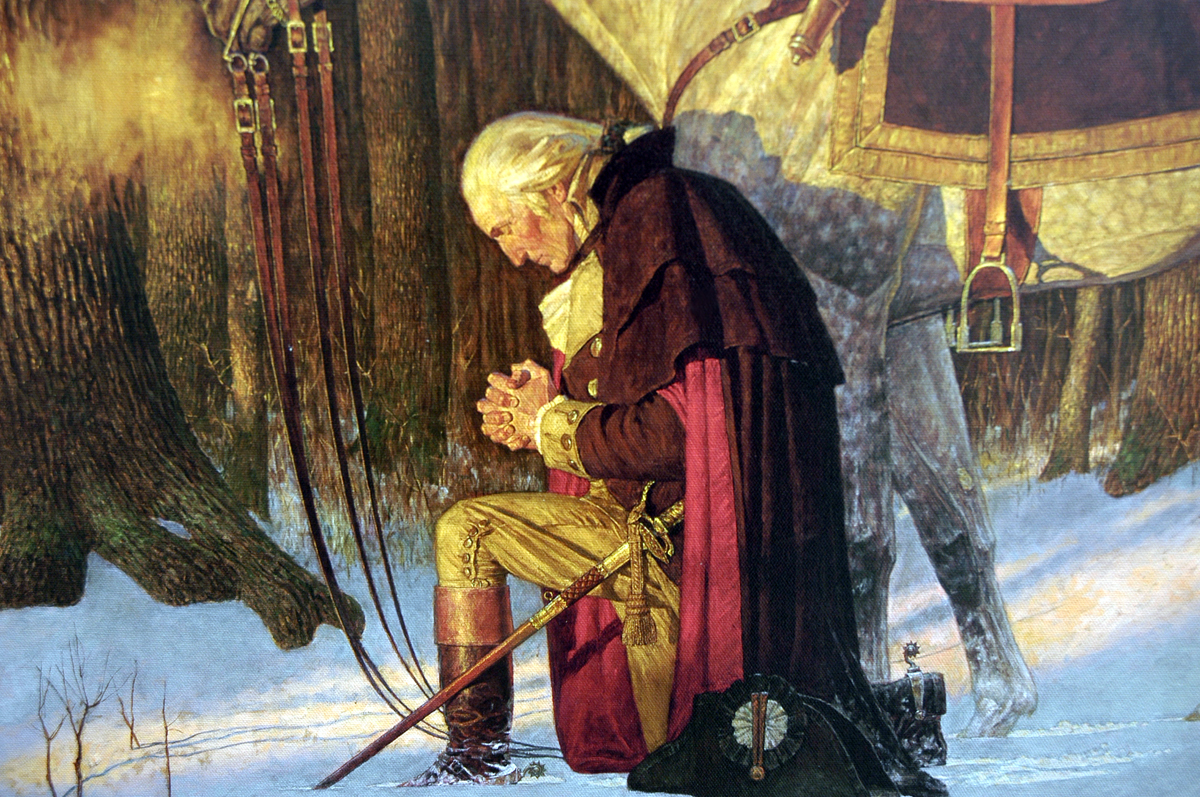
"Love follows knowledge."
"Beauty above all beauty!"
– St. Catherine of Siena

Showing posts with label George Washington. Show all posts

Monday, July 4, 2022

Poetry: For the Fourth of July, “His Excellency General Washington” by Phillis Wheatley

Who was Phyllis Wheatley?  She was an African-American who was a slave but taught to read and write and showed a natural gift toward poetry.  According to Wikipedia, she was born in West Africa, enslaved at about seven or eight, brought to the colonies where she was sold to the Wheatley family in Boston.  This was quite fortunate (not the enslavement, but being sold to the Wheatley family) in that she was taught to read and write, and once showing talent in poetry was encouraged.  Phyllis Wheatley was the first African-American to publish a book, titled, Poems on Various Subjects.  Her masters even took her to London, which must have been a great experience for her.
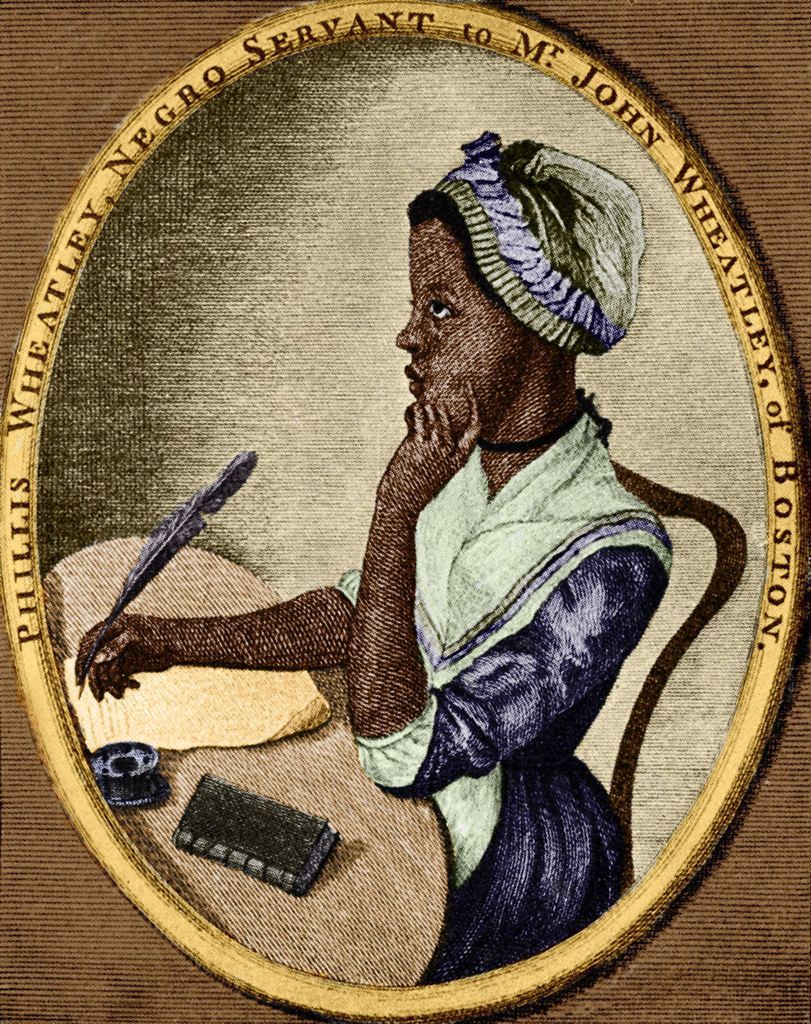


PoetryFoundation also has a fuller biography (read this one if you’re only going to read one) and a brief analysis of her poetic style. 


Poems on Various Subjects revealed that Wheatley’s favorite poetic form was the couplet, both iambic pentameter and heroic. More than one-third of her canon is composed of elegies, poems on the deaths of noted persons, friends, or even strangers whose loved ones employed the poet. The poems that best demonstrate her abilities and are most often questioned by detractors are those that employ classical themes as well as techniques.

Upon publication of her book, she was freed and went on to live a difficult and relatively short life.  But her life did overlap the beginning of the Revolutionary War and she wrote this one poem in praise of George Washington, the Commanding General of the Continental Army.  I think it’s worth reading today on the Fourth of July, 2022.  This poem fits right into Poetry Foundation’s analysis.


His Excellency General Washington

Phillis Wheatley (1753-1784)


   Celestial choir! enthron'd in realms of light,

Columbia's scenes of glorious toils I write.

While freedom's cause her anxious breast alarms,

She flashes dreadful in refulgent arms.

See mother earth her offspring's fate bemoan,

And nations gaze at scenes before unknown!

See the bright beams of heaven's revolving light

Involved in sorrows and the veil of night!


   The Goddess comes, she moves divinely fair,

Olive and laurel binds Her golden hair:

Wherever shines this native of the skies,

Unnumber'd charms and recent graces rise.


   Muse! Bow propitious while my pen relates

How pour her armies through a thousand gates,

As when Eolus heaven's fair face deforms,

Enwrapp'd in tempest and a night of storms;

Astonish'd ocean feels the wild uproar,

The refluent surges beat the sounding shore;

Or think as leaves in Autumn's golden reign,

Such, and so many, moves the warrior's train.

In bright array they seek the work of war,

Where high unfurl'd the ensign waves in air.

Shall I to Washington their praise recite?

Enough thou know'st them in the fields of fight.

Thee, first in peace and honors—we demand

The grace and glory of thy martial band.

Fam'd for thy valour, for thy virtues more,

Hear every tongue thy guardian aid implore!


   One century scarce perform'd its destined round,

When Gallic powers Columbia's fury found;

And so may you, whoever dares disgrace

The land of freedom's heaven-defended race!

Fix'd are the eyes of nations on the scales,

For in their hopes Columbia's arm prevails.

Anon Britannia droops the pensive head,

While round increase the rising hills of dead.

Ah! Cruel blindness to Columbia's state!

Lament thy thirst of boundless power too late.


   Proceed, great chief, with virtue on thy side,

Thy ev'ry action let the Goddess guide.

A crown, a mansion, and a throne that shine,

With gold unfading, WASHINGTON! Be thine.

You can hear the poem read if you prefer here.


I’m not a fan of 18th century poetry but this is as good as most of that era.  Though educated, I can’t imagine she was sent to prominent teachers and had a disciplined education.  She probably read a lot on her own and was self-taught.  She seems like a wonderful woman.  If I had the time I would love to read more about her.  She needs to be better remembered.  God bless her.

This short biographical video captures her story.


Happy Independence Day!

Saturday, July 4, 2015

Great Speeches: Henry Lee Eulogizes George Washington

In my Plans for 2015 Reads, I mentioned I would start a new feature this year where I would present a great speech from history and perform a little analysis on it.  Well, I’ve been trying to find the time to start that off.  So here’s an ideal moment, the fourth of July.

I’m going to start with Henry Lee III’s famous eulogy of George Washington.  Lee, a fellow Virginian, serve with Washington in the Revolutionary War, and at one time was Governor of Virginia.  He was also the father of the Civil War General, Robert E. Lee.

Amazingly I could not find the entire speech on the internet.  You can find that famous first paragraph that is often quoted, but I was at a loss to get a hold of the entire thing.  So, I had to type it out myself.  It’s not a very long speech.  My copy comes from William Safire’s collection, Lend Me Your Ears: Great Speeches in History. 

First in war—first in peace—and first in the hearts of his countrymen, he was second to none in the humble and endearing scenes of private life; pious, humane, temperate, and sincere; uniform, dignified, and commanding, his example was as edifying to all around him as were the effects of that example lasting.

To his equals he was condescending, to his inferiors kind, and to the dear object of his affections exemplarily tender; correct throughout, vice shuddered in his presence, and virtue always felt his fostering hand; the purity of his private character gave effulgence to his public virtues. 

His last scene comported with the whole tenor of his life—although in extreme pain, not a sigh, not a groan escaped him; and with undisturbed serenity he closed his well spent life.  Such was the man America has lost—such was the man for whom our nation mourns.

Methinks I see his august image, and I hear falling from his venerable lips these deep-sinking words:

“Cease, sons of America, lamenting our separation; go on, and confirm by your wisdom the fruits of our joint councils, joint efforts, and common dangers; reverence religion, diffuse knowledge throughout your land, patronize the arts and sciences; let liberty and order be inseparable companions.  Control party spirit, the bane of free governments; observe good faith to, and cultivate peace with, all nations, shut up every avenue to foreign influence, contract rather than extend national connection, rely on ourselves only: be Americans in thought, word, and deed—thus will you give immortality to that union which was the constant object of my terrestrial labors; thus will you preserve undisturbed to the latest posterity the felicity of a people to me most dear, and thus will you supply (if my happiness is now aught to you) the only vacancy in the round of pure bliss high heaven bestows.”

Certainly that is such a memorable beginning using the rhetorical device called anaphora (the sequence of a repeated first word), here constructed in a sequence of three components: “First in war—first in peace—and first in the hearts of his countrymen.”  Writing in elements of threes creates a sense of completeness that twos lack, and greater than threes suggest you can’t fully pin down.  You should try to construct many sentences in elements of threes in writing, but in a speech you should always construct in threes.  The ear picks up on the threes even more so than in writing.  Even as Lee goes on to list an abundance of Washington’s attributes, he divides them into groups of threes.

I also found the conclusion fascinating.  Lee almost brings Washington to life by calling forth “his august image,” and then does something that is brilliant: he allows the image of Washington to speak from the dead in that last paragraph.  Notice also the tone shift (it heightens into a more formal tone) when he has Washington “speak.” 


I hope that brought you back to our founding fathers.  I revere George Washington above all our other founders.  Pious, dignified, ascetic, noble in a natural sense.  Virtue I think is the most precise adjective.


Happy Fourth of July!


Wednesday, November 27, 2013

Faith Filled Friday: George Washington’s Thanksgiving Proclamation

Umm, I know, it’s not Friday.  But I wanted this out for Thanksgiving, which is a Thursday.  I assume many of you have seen this, but I wanted to post it.  This is President George Washington’s Proclamation for a national day of Thanksgiving in the first year of our nation’s history.
 

Whereas it is the duty of all nations to acknowledge the providence of Almighty God, to obey His will, to be grateful for His benefits, and humbly to implore His protection and favor; and Whereas both Houses of Congress have, by their joint committee, requested me to "recommend to the people of the United States a day of public thanksgiving and prayer, to be observed by acknowledging with grateful hearts the many and signal favors of Almighty God, especially by affording them an opportunity peaceably to establish a form of government for their safety and happiness:"

Now, therefore, I do recommend and assign Thursday, the 26th day of November next, to be devoted by the people of these States to the service of that great and glorious Being who is the beneficent author of all the good that was, that is, or that will be; that we may then all unite in rendering unto Him our sincere and humble thanks for His kind care and protection of the people of this country previous to their becoming a nation; for the signal and manifold mercies and the favorable interpositions of His providence in the course and conclusion of the late war; for the great degree of tranquility, union, and plenty which we have since enjoyed; for the peaceable and rational manner in which we have been enable to establish constitutions of government for our safety and happiness, and particularly the national one now lately instituted for the civil and religious liberty with which we are blessed, and the means we have of acquiring and diffusing useful knowledge; and, in general, for all the great and various favors which He has been pleased to confer upon us.

And also that we may then unite in most humbly offering our prayers and supplications to the great Lord and Ruler of Nations and beseech Him to pardon our national and other transgressions; to enable us all, whether in public or private stations, to perform our several and relative duties properly and punctually; to render our National Government a blessing to all the people by constantly being a Government of wise, just, and constitutional laws, discreetly and faithfully executed and obeyed; to protect and guide all sovereigns and nations (especially such as have shown kindness to us), and to bless them with good governments, peace, and concord; to promote the knowledge and practice of true religion and virtue, and the increase of science among them and us; and, generally to grant unto all mankind such a degree of temporal prosperity as He alone knows to be best.

Given under my hand, at the city of New York, the 3d day of October, A.D. 1789.


You can’t say it better than that.  I am thankful for so many things, but especially my family and friends and all those who stop here to comment.  God bless you all.  In a small way you are all part of this blessed life that God has graciously given me.