
In Part 1 of the posts on the Fr. Thomas McGlynn statue, I gave an overview of how he,
a sculptor as well as a Dominican priest, went to Portugal to interview St. Lúcia de Jesus dos Santos, the living child (then grown an adult) from the Fatima
apparitions to create a statue of the Blessed Mother as she appeared to the children. As it turned out, Irmã Dores (Lúcia), as she
was known at her convent, completely rejected Fr. McGlynn’s initial prototype,
and so he decided to collaborate with Lúcia for a new prototype, what would be
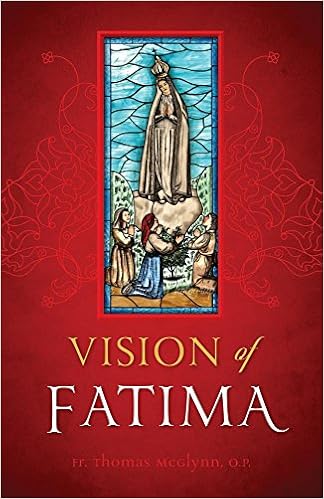
the official statue based on one of the eye witnesses. Fr. McGlynn documented all this in Vision of Fatima, his book on the journey
and the making of the statue.
In
part 1 I also mentioned how I went up to the Church of St. Vincent Ferrer in
Manhattan to photograph an actual marble production of the statue. In that post I spoke about how the statue may
have been the first actual version of the prototype, and now after completing
the book I know for sure it is. In
chapter 20, Fr, McGlynn tells us that the first marble version, a five foot
copy, was placed and dedicated on May 11, 1947 at the Church of St. Vincent
Ferrer in New York City (p. 202). So the
statue I photographed is the first marble production.
In
this post want to look at the statue in detail and bring in the words from Fr.
McGlynn in how the various elements of the statue came about. The words come from two chapters in the book,
chapter 7, “Irmã Dores and the Apparition,” where Fr. McGlynn discusses with Irmã
Dores the details of her vision, and from chapter 11, “Our Statue,” where Fr.
McGlynn tells of the collaborative interaction between the two to create the
prototype. What must be kept in mind is
that creation was completely based on Irmã Dores’s apperception. Fr. McGlynn tells us what creation meant to
the future saint.
She had always wanted to
see a statue of this apparition of the Immaculate Heart. She had wished many times that she could be a
sculptor so as to be able to make it herself, but since she was not, she said,
she believed that God had sent me to make this statue. (p. 98)
In
many respects, Lúcia herself was the artist with the vision, Fr. McGynn the
medium through which the vision was realized: “There was not a detail of
execution that Irmã Dores missed or on which she did not comment with either
approval or correction” (p. 100). So
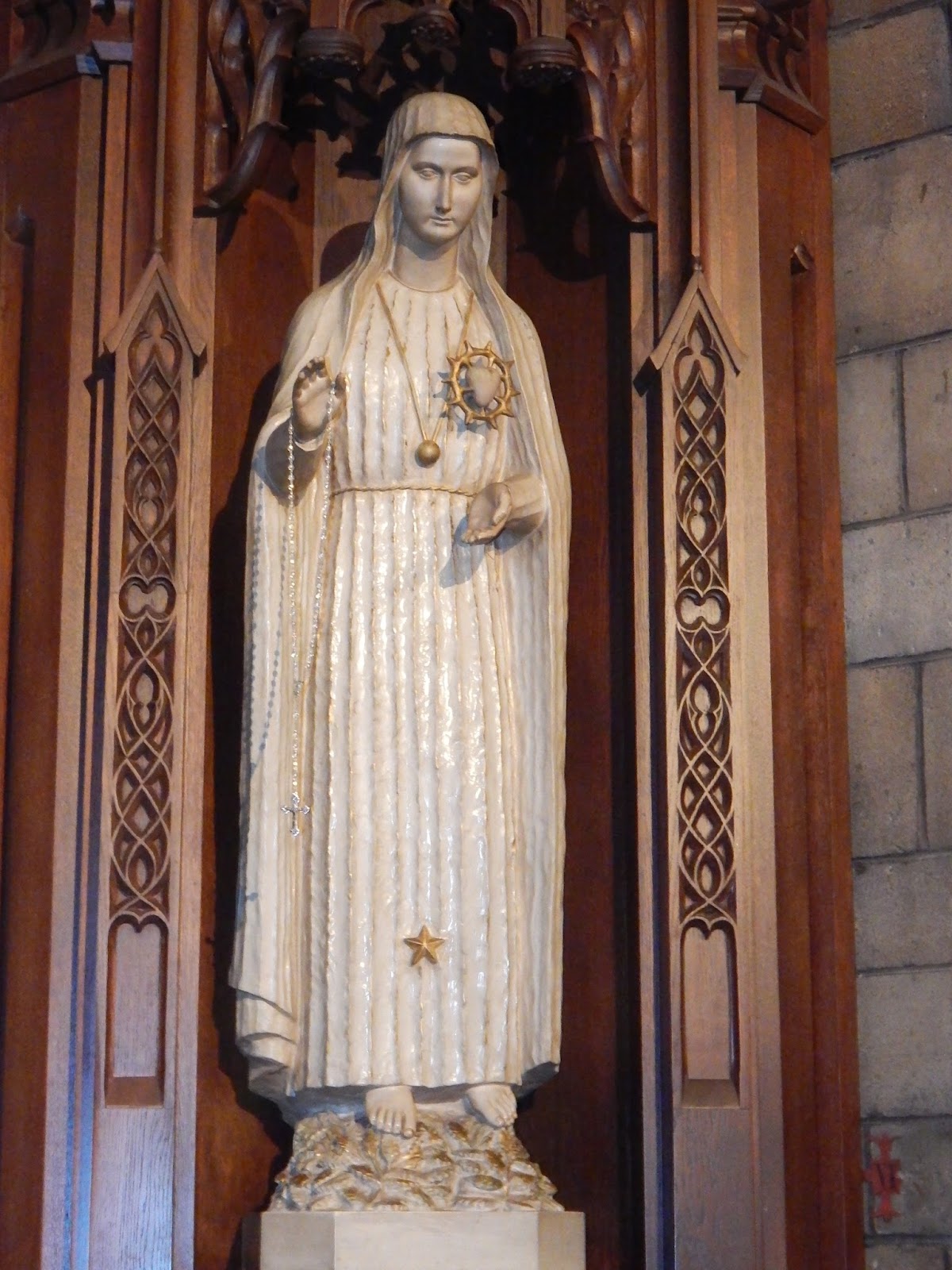
here once more is the statue in total:
 |
| Fr. McGlynn Our Lady of Fatima Statue |
You can enlarge the photos by clicking on them. Let’s
start with the most controversial part of the statue, the statue’s most
defining feature, the Blessed Mother’s hand positions. It was the first thing Irmã Dores rejected
when Fr. McGlynn had presented his vision of the statue.
“Não dá posicão,” she said. That was the first sentence of
Portuguese I learned and one I shall never forget: “It’s not the right
position.”
“The right hand should be
raised and the left lower down,” she continued. I knew she was speaking of the
June apparition and hastened to explain that in the gesture portrayed I was not
intending to be descriptive but symbolic. I was indicating in the position of
the hands the devotional message of Fatima, namely, the Immaculate Heart and
the Rosary.
She smiled at my
apologetic, unable to gather the interest I had in symbolism; nothing could
substitute for the reality with her, it was obvious. She simply repeated her
first comment, “Não dá posicão.” (p. 61)
So
here is a close up of the hands, the right offering a rosary, the left in an
open gesture.
 |
| Fr. McGlynn Our Lady of Fatima Statue, Close Up, Hands |
It
is a most curious positioning. Either of
the position of the hands are natural in themselves but I think what makes it
unusual is the combination together.
It’s hard to imagine how the two occur at the same time. But Irmã Dores tells us:
The statue again reminded
her of the June apparition. “She appeared as the Immaculate Heart in June
only,” she said; then getting her Rosary out of a pocket of her habit, she
draped it over the palm of her right hand and joined her hands in the attitude
of prayer, continuing, “In June she appeared at first as in the other
apparitions, then she opened her hands.” Irmã Dores demonstrated. Her right arm
was extended, the forearm forward of the plane of her waist and elevated only
slightly above the horizontal, the hand gently arched, palm downward. Her left
hand was upturned near the center and close to her body with the fingertips a
little below the waist. After carefully establishing this position (I made her
hold it for a while so that I might study it), Irmã Dores held her right hand
flat about two inches in front of her left breast to indicate the position at
which the Immaculate Heart appeared, surrounded by thorns. I expressed surprise
that the heart appeared out from the body, but she assured me that it was so.
It was not so good for sculpture, I thought, but the consideration did not
disturb me very much. I was too much interested in hearing her complete
description. (p. 64)
On
reflection, as a work of art I really like the hand positioning. It is the one part of the statue that
elevates it to beyond the mundane.
Next
let’s look at the rosary. Irmã Dores
made the rosary herself for the prototype.
Here’s how it came about.
The rosary that Irmã
Dores was working on was intended for the statue, a tiny chaplet of
mother-of-pearl beads, which she linked together with great skill and
speed. She had the beads on a coil of
fine silver wire that she twisted with pliers into hardly visible links as the
rosary grew, bead by bead. She stopped
the work frequently to examine the statue.
The distraction may account for the fact that one of the decades has
only nine beads.
I asked Irmã Dores about
the size of the beads carried by our Lady.
She took hold of a bead of Mother King’s rosary and said they were about
that size. The little beads of the
rosary she was making were therefore in good scale. Irmã Dores could not say definitely that the
rosary carried by our Lady was of five decades, rather than fifteen. But she did assert that the Rosary extended about
to the knees when our Lady’s right hand was in the position of the June
apparition. From this information and Irmã
Dores’s identification of the size of the beads, it is a fair deduction that
our Lady’s rosary must have been of five decades, for one of fifteen decades
with that size bead would have gone far below her feet.
Irmã Dores said that the
rosary was all white, the cross included.
She apologized for having to put on the rosary she was making a cross
that was aluminum and a bit oversized. She
explained she had no other. (p. 99)
 |
| Fr. McGlynn Our Lady of Fatima Statue, Close up, Mid Body |
I
can’t tell if the rosary is missing a bead, but I would imagine that would have
been corrected for the actual statue.
The crucifix is white and not silver.
The
garments in the sculpture presented certain problems. First the apparition glowed brightly of which
the clothes appeared to almost be at the source of the illumination. Second, they were real and they had folds. Third there was a mantle that went over the
tunic and covered the Blessed Mother’s head. While these are things that might
be embraced in a painting, they are more difficult to carry off in a
sculpture. Fr. McGlynn was not met with
approval on his first attempts:
“The garments in the
statue are too smooth,” she said, after we were all seated again and the statue
was resting on the little marble-topped table. The fascination of speaking with
someone who had seen and spoken with our Lady contended with the disappointment
of her not approving the work sufficiently to keep me interested in further
criticism.
Again an apologetic: “I
knew from published descriptions that the vision was very brilliant. Now, it is
impossible to express light in sculpture otherwise than by reflecting light
from simple surfaces. That is why I made the garments so smooth.”
“But the light was in
waves and gave the impression of a garment with folds” (literally an undulated
garment), she said. “She was surrounded by light and she was in the middle of
light,” she went on, confirming the truth of my previous observation about
brilliance. (p. 62)
Irmã
Dores further elaborated, “The light was in waves and gave the impression of a
garment with folds.” Fr. McGlynn then
tried subtle technique to bring out the garment’s folds and approximate an
illuminating quality.
Two things seemed to be
important in interpreting this description: One was that, although there was a
suggestion of folds, the folds could not be realistic; they should not appear
to be actual folds of fabric, but rather in some manner to suggest folds. The second was that the folds should have the
vibrant character of the light that she described. Therefore, in making the lines of the tunic
as I drew the tool down for each line, I moved it from side to side rapidly
with each downward stroke. The action
resulted in a basically straight line that, however, was broken with slightly
scooped and concave forms. I asked Irmã
Dores if this treatment suggested the “waves of light.” She said, “Yes, it does very well.”
But she had a change to
make. I had made the folds, or these
waves, continuous lines, starting from the top of the tunic and ending at the
hem. Irmã Dores insisted that they be
broken at the waist, alternating, so that the ridges of the folds falling from
the waist corresponded with the hollows of the folds above the waist. She explained that this resembled the
apparition in that, while there was no sash or visible cord drawing the waist
in, there definitely was a break of the form at the waist.
She made me add clay at
the right side of the tunic, eliminating the curve that I thought balanced well
with the movement of the left leg. She
insisted that the drapery should fall down straight and that the underlying
shape of the body should not be at all obvious.
Nor could the folds reveal the form of the breasts more than by a slight
curving of the bosom. (p. 101)
And
if the folds weren’t difficult enough, the mantle presented a still more
difficult problem.
Returning to the more
important elements, I asked if there was any difference between the mantle and
the tunic. “The mantle was a wave of light.”
“Wasn’t the tunic?”
“Yes.”
“What then was the
difference?”
“There were two waves of
light, one on top of the other.” Puzzling about the possibility of suggesting
the lucidity of the apparition while making folds in the drapery, I became
rather insistent on the necessity of keeping the drapery simple. I explained
that each fold would create a shadow and that the cumulative effect of many
shadows would be to darken the figure generally. Her reply was, “No matter what
you do, you won’t give the impression of the reality.” (p. 64-65)
This
was true. I don’t believe Fr. McGlynn
solved the problem of two distinctly different illuminations between the tunic
and the mantle, if that is even possible on a sculpture. Still I think it he did a magnificent job
with the garments. Here are a couple of
close ups.
 |
| Fr. McGlynn Our Lady of Fatima Statue, Upper Half |
 |
| Fr. McGlynn Our Lady of Fatima Statue, Lower Half |
There
is a glimmering shininess to the surface.
I don’t know if the folds are gilded with a golden material, but there
is something that highlights each fold and matches in color with the star,
pendent, and the thorny stem of the immaculate heart. I like the way the folds wrap at the bottom
of the statue’s right side.
On
top of the garments there is a star and a hanging pendant as accessories. The star was apparently always known but the
pendant turned out to be a new piece of information concerning the apparitions.
Next, an omission was
observed: “She always had a star on her tunic.” I had thought that was one of
the mistakes in the conventional image. Well, that would easily be remedied.
But then she added another detail, one I had not heard of:
“She always had a cord
with a little ball of light,” she said, indicating an imaginary pendant around
the neck falling to about the waistline. It was this detail that was mistaken
for a cord and tassel after the first investigations in 1917. (p. 62-3)
The
pendant too was altered from Fr. McGlynn’s original conception: “I had placed
the “little ball of light” directly at the waist. Irmã Dores noticed this and made me raise it
about a quarter of an inch to its present position” (p. 101).
Now
the shape of the star was one detail that Irmã Dores lacked vision. She had not noticed how it was shaped in the
apparition.
I had asked Irmã Dores
how many points there were in the star.
He answer was, “I don’t know.
Does it make a difference?” Then
she inquired about the meaning of the different numbers of points on
stars. Not an authority on this subject,
I merely joked about it. I said, “Well,
the Star of Bethlehem has five points; the Star of David, crossed triangles,
has six; and if you want to bring in Saint Dominic, he has a star with eight
points.” She left the decision entirely
up to me by saying, “I don’t know.”
Without consciously
making a decision, I made a five-pointed star.
It later occurred to me that this is the number of points in the Soviet
star. A fitting symbol, I thought, of
the conversion of Russia that the Blessed Virgin had prophesied… (p. 103)
Yes,
how perfect that the star is shaped exactly as in a soviet flag. Compare the star on the tunic with a soviet
star.


When
it came to the formation of the Immaculate Heart, Irmã Dores had a direct hand
in the handiwork.
In order to clarify the
appearance of the heart and thorns Irmã Dores went out into the garden and came
back soon with branches of thorns. She
joined the ends of one them together to show how the thorns encircled the heart
vertically and the approximate number that fastened into the heart. Incidentally, she said that of the entire
apparition only the thorns were not made of light; they were simply burnt-out,
brown, and natural in quality. She
herself placed the heart surrounded by thorns in its right position after I had
put it a little more than she wished toward the center. (p. 102)
Concerning
another element of foliage, it came as a shock to Fr. McGlynn that our Lady’s
feet rested on the branches of the azinheira tree and not on some vaporous
puff. “Her feet rested on the azinheira,”
she said.
This was a shock. Was
there no cloud? Every account and every image had indicated that there was.
The problem of designing the cloud had been especially vexing during the
modeling of this statue — how to make something that would suggest vapor and
still be integrated in a solid composition. I had thought, finally, that I had
solved the problem quite well in the little carpet-like cloud that had emerged
beneath the feet of the figure. Did Irmã Dores now mean that there was no
cloud? I asked her.
“The people spoke of a
cloud, but I saw none. Our Lady’s feet rested lightly on the tops of the
leaves.” I told her I was disappointed because I thought the cloud a very
pretty form. (p. 62)
This
made the billow on which the Blessed Lady’s feet rest more distinct, the azinheira
leaves also gilded.
 |
| Fr. McGlynn Our Lady of Fatima Statue, Close Up, Azinheira |
And
it appears that Fr. McGlynn also gilded her toenails. They must have pedicures up in heaven! Seriously, I can’t imagine how a simple cloud
would have turned out better than that.
Perhaps
the most difficult part of artistic creation was the formation of the face and
hair, or, in this case, the lack of hair.
Irmã Dores was adamant about how the face and the covering of the hair
were embodied.
I came back then to the
problem of showing or concealing the hair. Irmã Dores again declared that the
hair was not visible.
“But,” I argued, “if the
mantle falls from the hairline, it will conceal not only the hair but the profile
as well.”
“Whatever the
difficulties may be in representing our Lady,” Irmã Dores replied, “I never saw
the hair.”
So
Fr. McGlynn capitulated, and he asked, “What was our Lady’s expression?” And Irmã Dores responded with, “Pleasing but sad; sweet but
sad.” (Agradável mas triste; doce mas triste.) But it was clear that sculptor and visionary had
very different ideas about the aesthetics of a face, and it was of critical
importance to Irmã Dores.
The face and hands of the
figure were her chief concern and mine also.
It was not too long before she became satisfied with the position of the
hands and of the figure generally, but for a time I feared that the face would
never satisfy her. Her criticisms were
endless; she kept making me change the forehead, now the cheeks, now the mouth,
chin, and eyes. Mother Cunha-Mattos
scolded her for being too particular.
She warned that I would never finish the statue if she did not finish
her criticisms. Irmã Dores’s answer was,
“I can’t tell him I like it if I don’t.”
After a day that I
devoted almost entirely to the modeling of the face, Mother King wondered if I
would be hurt by her telling me what Irmã Dores had said. I assured her I wanted to know. Then she quoted Irmã Dores as saying, “He has
the position of the hands right but the face is not yet beautiful enough.” This made me concentrate with almost furious
activity on the alteration of the features for a possible improvement before Irmã
Dores arrived. When she came, she
expressed her feeling that the face was better.
But this implied that it was not quite good enough. “Mais
pequena, mais pequenai” (smaller, smaller), she kept saying of the
mouth. I kept obeying against my will
until I thought the mouth too small.
Then she studied it carefully, and I was afraid she was about to say
smaller again when instead, and much worse, she said, “Mais alta” (higher). Well,
one does not just raise up a mouth. That
meant I had to make a new one. There
were times like this when annoyance nearly took the place of reverence in my
feelings, when I could forget that Irmã Dores was Lucy dos Santos of Fatima.
Mother Cunha-Mattos
sympathized with my near desperation and told me not to worry too much about
the criticisms that Irmã Dores made. She
startled me by adding, “Your ideas of beauty may just be as good as hers.” I hastened, with tones of ultimatum, to have
Mother King convey to Irmã Dores the following question:
Are you basing your
criticisms of the face upon your conception of what is beautiful or upon the
apparition?”
Irmã Dores replied, As
far as I am able, I am trying to show you what I saw.”
This gave me patience to
carry on until at last Irmã Dores expressed her satisfaction and ceased firing
corrections. I must admit that, although
it is a face that I would never have made without her direction, I much prefer
the face of this statue to that of the one I had first made. (p. 104-105)
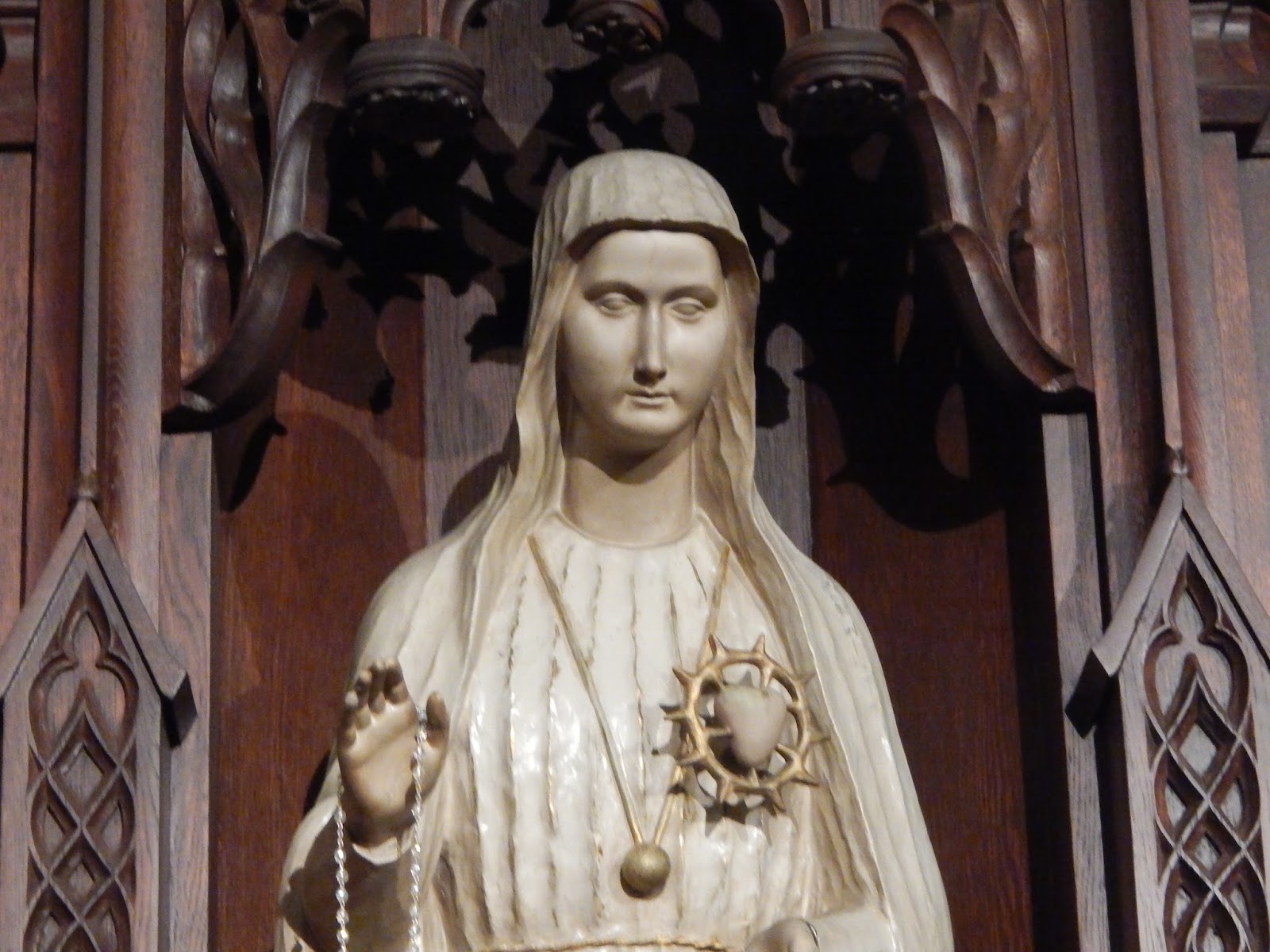
And
so, here is the face, first in the context of her upper body and then up close.
 |
| Fr. McGlynn Our Lady of Fatima Statue, Upper Half |
 |
| Fr. McGlynn Statue, Close Up, Face |
Personally
I adore this face. It looks so real to
me and not some artificially constructed template of a face, as in the one on
the more common statue of Our Lady of Fatima.
And so this comes back to how I started this post. The statue is the vision that a little girl
named Lúcia dos Santos had from witnessing the apparition of our
Blessed Mother at Fatima some thirty years prior and which she kept in her
heart all those years until God could bring about a sculptor that could make
manifest that vision into a physical entity.
When the work had been completed, Fr. McGlynn wanted and sought some acknowledgement
from Irmã Dores.
I had formally accepted
as quite sufficient the expression of satisfaction evident in [Irmã Dores’s]attitude
toward the work and also in her statements made to others concerning the
statue. But now I wanted some word of
final approval from Irmã Dores directly.
An important word I had learned was the verb gostar, which means “to like” or “to be pleased with.” Gosta?
suffices for asking, “Do you like it?” and Gosto
means “I like it.” Now, with
unprecedented daring, I enquired of Irmã Dores: “Gosta?” She replied with a
smile and the greatest compliment ever given to the statue: “Gosto.”
Yes,
me too, Gosto. Eu
gosto muito disso. Nossa Senhora deve estar muito satisfeita. This statue is how I will forever envision
the apparition of Fatima. This is the
defining statue for me.
So
if you have the opportunity to be in New York City, I highly recommend you take
a little pilgrimage to the Church of St. Vincent Ferrer in Manhattan at 869
Lexington Avenue (between 65th and 66th streets) and view this most
beautiful statue of Our Lady of Fatima in person. Read Fr. McGlynn’s book on the making of the
statue. I could not cover everything
here, and his journey is also fascinating.
Both the book and being in the statue’s presence will give you as many
graces as it has given me.




_-_Jul_2008_(cropped).jpg/1200px-Santu%C3%A1rio_de_F%C3%A1tima_(36)_-_Jul_2008_(cropped).jpg)

