"Love follows knowledge."
"Beauty above all beauty!"
– St. Catherine of Siena

Showing posts with label Transfiguration. Show all posts

Sunday, March 1, 2026

Sunday Meditation: Listen to Jesus

On the Second Sunday in Lent of Year A, we have Matthew’s Transfiguration scene.  Three years ago I embedded Dr. Brant Pitre’s explanation of Matthew’s Transfiguration, and it’s well worth going back to watch that.  Dr. Pitre explains the parallels between this scene and that of Moses going up Mt. Sinai in Exodus chapters 24 and 34.  The point of Matthew’s Transfiguration is that Jesus is the new and greater Moses.

But what I find most fascinating that I don’t think I heard any of the homilists I surveyed mention is that this scene at the beginning of chapter 17 comes right after the events of chapter 16.  What are the events of Matthew 16 that resonate here in 17?  At the beginning of Matthew 16 Jesus is asked by the Pharisees and Sadducees to show them a sign.  Jesus refuses and even says, “An evil and unfaithful generation seeks a sign, but no sign will be given it except the sign of Jonah” (Mt 16:4).  Later in the chapter Jesus asks the disciples who they think He is, and Peter gives his famous, “You are the Christ, the Son of the living God” (Mt 16:16).  Still later in the chapter, after Jesus explains He must die and be resurrected, He adds, “For the Son of Man will come with his angels in his Father’s glory” (Mt 16:27).  So in Matthew 16, He tells the Jewish critics that no sign will be given, but He explains exactly to the apostles what will come.  But do they really understand it?  Not if you read carefully.  They need that sign, and in His goodness Jesus gives the three apostles such a sign in the Transfiguration.


Here is today’s Gospel reading.


Jesus took Peter, James, and John his brother,

and led them up a high mountain by themselves.

And he was transfigured before them;

his face shone like the sun

and his clothes became white as light.

And behold, Moses and Elijah appeared to them,

conversing with him.

Then Peter said to Jesus in reply,

“Lord, it is good that we are here.

If you wish, I will make three tents here,

one for you, one for Moses, and one for Elijah.”

While he was still speaking, behold,

a bright cloud cast a shadow over them,

then from the cloud came a voice that said,

“This is my beloved Son, with whom I am well pleased;

listen to him.”

When the disciples heard this, they fell prostrate

and were very much afraid.

But Jesus came and touched them, saying,

“Rise, and do not be afraid.”

And when the disciples raised their eyes,

they saw no one else but Jesus alone.


As they were coming down from the mountain,

Jesus charged them,

“Do not tell the vision to anyone

until the Son of Man has been raised from the dead.”

~Mt: 17: 1-9


Fr. Terrance Chartier of the Franciscan Friars of the Immaculate gives a fine homily where he alludes to the theology taught from Dr. Pitre’s video.


Fr. Terrance:

“The last lesson from Mount Taber today is probably the first and most important lesson. It's the fact that Jesus is the new Moses. He's actually our Moses. Just as Moses led God's people out of slavery to the promised land, so to Jesus, our Moses, leads us out of sin and out of the difficulties of life to bring us to a heavenly promised land…And when Moses went up Mount Sinai, it was said that when he came down, his face shone with the glory of having been in the presence of God. Exodus 32:34:29.  So his face, Moses's face reflected the glory of God when whom he had encountered.  What does it say in the gospel today?  Jesus goes up the mountain. Matthew tells us his face shone like the sun. Matthew 17:2, it shines like the sun with its own light.”


In the Transfiguration, Jesus opened up His humanity to reveal His glory.


The Catholic Truth Society, a British evangelist organization, is providing Lenten retreat talks from St. John Henry Newman’s sermons, and they provide an interesting one on this week’s Gospel reading.


Up above I brought the Transfiguration scene into context with the prior events of Matthew 16.  Fr. George Bowen brings out Newman’s preaching on how the passage following the Transfiguration shows the dichotomy of the transcendence and glory of the Transfiguration up the mountain with the grief, pain, and confusion of the earthly world down the mountain.  That scene is the one with the epileptic boy where the boy’s father asks Jesus, “Lord, have pity on my son, for he is a lunatic and suffers severely; often he falls into fire, and often into water.  I brought him to your disciples, but they could not cure him” (Mt 17:15-16).

The contrast between the two scenes is striking.


Sunday Meditation: “His face shone like the sun and his clothes became white as light.”


Here is a lovely hymn I have never heard of, “Transfiguration,” written by Brian Wren (lyrics) and Ricky Manalo (music).


Praise and glory, praise and glory,

praise and glory to our Lord!

Let us, if we dare to speak,

join the saints and angels praising.


Sunday, March 16, 2025

Sunday Meditation: The Mountain of Transfiguration

Last week, the First Sunday of Lent, the Lord took us with Him to the Desert where we saw Him overcome three temptations from the Devil.  On the Second Sunday, the Lord takes us up a mountain to reveal to us the Glorification of our future bodies.


Jesus took Peter, John, and James

and went up the mountain to pray.

While he was praying his face changed in appearance

and his clothing became dazzling white.

And behold, two men were conversing with him, Moses and Elijah,

who appeared in glory and spoke of his exodus

that he was going to accomplish in Jerusalem.

Peter and his companions had been overcome by sleep,

but becoming fully awake,

they saw his glory and the two men standing with him.

As they were about to part from him, Peter said to Jesus,

“Master, it is good that we are here;

let us make three tents,

one for you, one for Moses, and one for Elijah.”

But he did not know what he was saying.

While he was still speaking,

a cloud came and cast a shadow over them,

and they became frightened when they entered the cloud.

Then from the cloud came a voice that said,

“This is my chosen Son; listen to him.”

After the voice had spoken, Jesus was found alone.

They fell silent and did not at that time

tell anyone what they had seen.

~Lk 9:28-36


Three years ago on that Second Sunday of Lent, I highlighted how Luke is the only Transfiguration account that mentions that Jesus spoke to Moses and Elijah on Jesus’s exodus that was to come.  I had Dr. Brant Pitre’s video embedded to explain it.  You might want to check it out.  


This week Bishop Robert Barron provides the best exegesis of this passage.


 For the pastoral homily I’m going to hand it over to Fr. Sam French from Australia. 


 Fr. Sam calls himself The Average Shepherd.  He's not so average, he's above average.  ;)

One of the details of this passage that neither of the two homilies touched on that caught my eye in this reading is the moment of darkness that comes upon the three apostles.  God in the cloud descends upon them and they are frightened.  Look at the first reading and the darkness that frightens Abraham.


Sunday Meditation: “While he was still speaking, a cloud came and cast a shadow over them, and they became frightened when they entered the cloud.”


For a hymn, let’s turn to John Michael Talbot’s “Sing to the Mountains”


Have a blessed Sunday.

Sunday, February 25, 2024

Sunday Meditation: Onto the Mountaintop with the Prophets

Last week Jesus took us into the desert with the wild beasts, but today on the Second Sunday of Lent in Year B, Jesus goes from the desert to the top of a mountain, and instead of communing with wild beasts Jesus communes with two prophets from the Old Testament.


Jesus took Peter, James, and John

and led them up a high mountain apart by themselves.

And he was transfigured before them,

and his clothes became dazzling white,

such as no fuller on earth could bleach them.

Then Elijah appeared to them along with Moses,

and they were conversing with Jesus.

Then Peter said to Jesus in reply,

"Rabbi, it is good that we are here!

Let us make three tents:

one for you, one for Moses, and one for Elijah."

He hardly knew what to say, they were so terrified.

Then a cloud came, casting a shadow over them;

from the cloud came a voice,

"This is my beloved Son. Listen to him."

Suddenly, looking around, they no longer saw anyone

but Jesus alone with them.


As they were coming down from the mountain,

he charged them not to relate what they had seen to anyone,

except when the Son of Man had risen from the dead.

So they kept the matter to themselves,

questioning what rising from the dead meant.

~Mk 9:2-1

This week I’m going to provide two sermons (I can’t say homilies since neither are priests) on this passage since both are short and to the point.  First will be Jeff Cavins, who has I think the better exegesis.


Jeff rightly points out how the almost sacrifice of Isaac and then replaced by the sacrifice of the lamb projects to the future sacrifice of Christ, the Lamb of God, on still another mountain, Calvary.  The Feast of Booths that he speaks of is called Sukkot, and if you live in a religiously Jewish neighborhood as I do, you will see the booths built for the week long feast in everyone’s backyards or decks.

I know people get hung up on how God could request Abraham the sacrifice of his child, but there is still another way to look at this from what I’ll call the more “Jewish” perspective.  Abraham here at this point is not Jewish; he is a Chaldean, a Semitic people of the region, and like most (if not all) Semitic people of the time practiced child sacrifice.  The most famous perhaps are the Carthaginians of the Punic people who sacrificed infants to the deity Baal.  By leading Abraham to the point of sacrificing his child—and notice Abraham goes along with it as a perfectly normal request—and then stopping it, God stops the practice of child sacrifice in the Jewish people.  Perhaps here with the ending of the child sacrifice, Abraham has now changed from a Chaldean to a Jew.  So do not think of God as a monster here.  There were both contemporaneous and archetypical reasons for God’s request with the intention of ending the horrific practice.  I didn’t mean to dwell so much on the first reading, but I think that needed to be said.

The second sermon will be from John Michael Talbot who I think better captures the spirituality of the passage.    


JMT points out the community that forms between Jesus and the three disciples and the two prophets, and that is very insightful and an element of the transfiguration that I never thought about.  I don’t think JMT goes far enough though.  Notice that there are two trinities on the mountain, trinity with a small “t” but perhaps pointing to the Trinity with a capital “T.”  Jesus, Moses, and Elijah form one trinity, and Peter, James, and John form a second trinity.  And both “trinity” and “Trinity” is a community. 

Could the Trinity be there in the passage as well?  Jesus, God the Father in the voice, and the Holy Spirit as the Glory Cloud?  Possible, but I am not quite that knowledgeable to say definitively.  Perhaps that could be our Sunday meditation.


Meditation: “Then a cloud came, casting a shadow over them; from the cloud came a voice, "This is my beloved Son. Listen to him.”


How can we have a sermon from John Michael Talbot and not play one of his beautiful hymns?  I can’t.  What song would be fitting for the Transfiguration?  How about, “Let Us Kneel Down.”


Sunday, March 5, 2023

Sunday Meditation: Matthew’s Transfiguration

Today Jesus reveals His divine nature.  We have one of the most iconic moments of the New Testament, the Transfiguration.  All three Synoptic Gospels tell of this moment.  In Year A of the lectionary, we have Matthew’s version.


Jesus took Peter, James, and John his brother,

and led them up a high mountain by themselves.

And he was transfigured before them;

his face shone like the sun

and his clothes became white as light.

And behold, Moses and Elijah appeared to them,

conversing with him.

Then Peter said to Jesus in reply,

"Lord, it is good that we are here.

If you wish, I will make three tents here,

one for you, one for Moses, and one for Elijah."

While he was still speaking, behold,

a bright cloud cast a shadow over them,

then from the cloud came a voice that said,

"This is my beloved Son, with whom I am well pleased;

listen to him."

When the disciples heard this, they fell prostrate

and were very much afraid.

But Jesus came and touched them, saying,

"Rise, and do not be afraid."

And when the disciples raised their eyes,

they saw no one else but Jesus alone.


As they were coming down from the mountain,

Jesus charged them,

"Do not tell the vision to anyone

until the Son of Man has been raised from the dead."

~Mt 17:1-9


Last year, I posted Dr. Brant Pitre explaining the transfiguration as told in Luke’s Gospel.  Here he is again explaining it as told in Matthew’s Gospel.


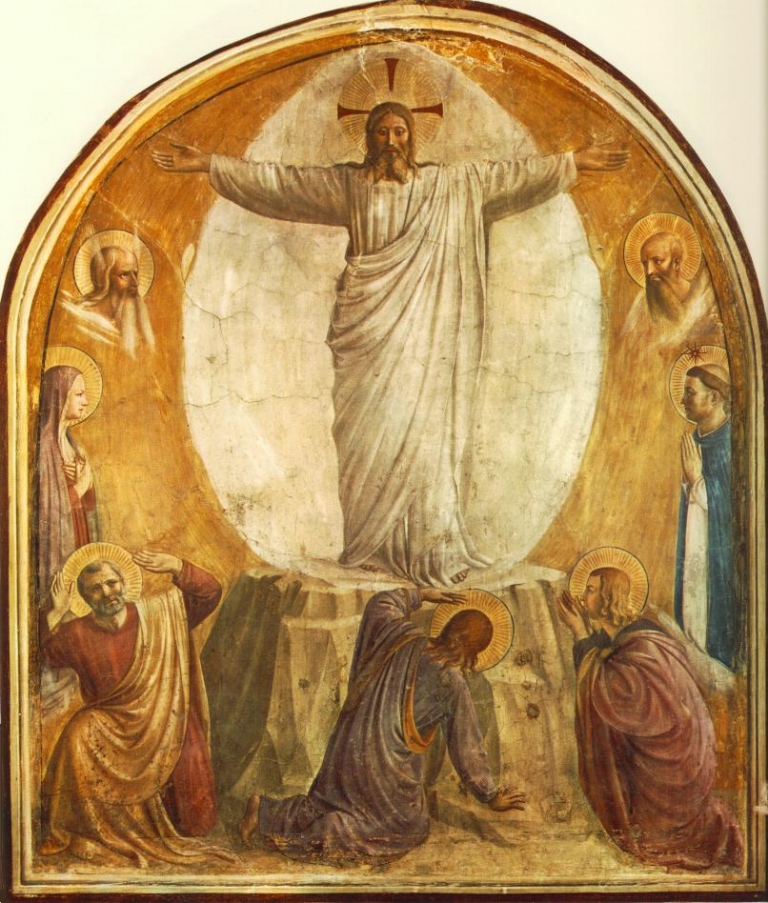
There is a lot there to really sink your teeth into.  But I want to end this with one of the great representations of the event, Fra Angelico’s The Transfiguration.


Notice how Christ is delineated at about twice the size of the three apostles fallen to the ground.  And the blazing white of Christ’s figure is almost blinding.  Christ’s arms are spread out projecting the crucifixion and we see the heads of Moses and Elijah on each side.  I love the delineation of Christ’s face as you can see in this detail.


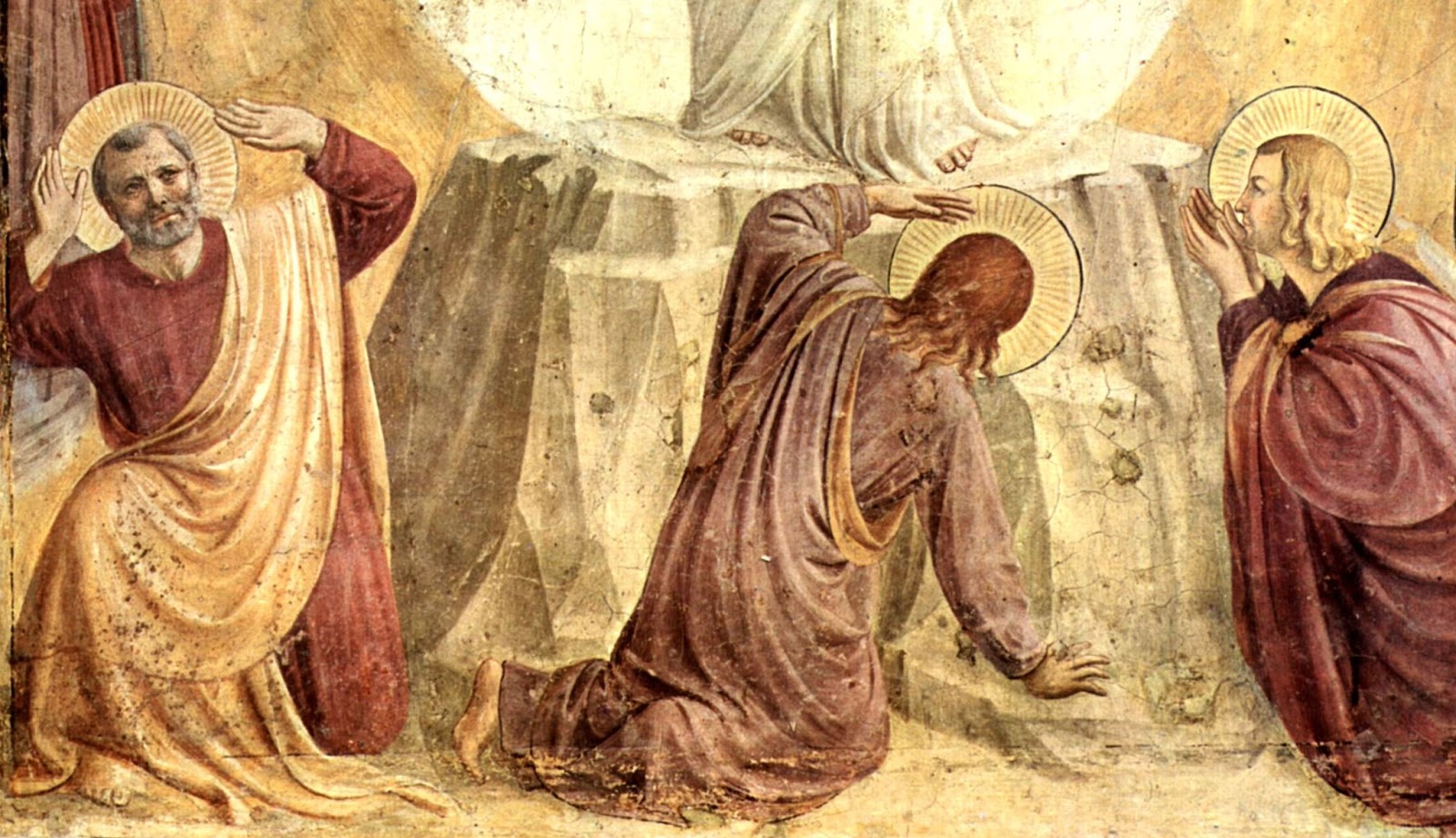
His expression is emotionless and He is thickly bearded, depicted I think as one who has taken “the vow of a Nazirite” (see Numbers, chapter 6).  And consider the detail of the apostles at Jesus’ feet. 


The one facing the viewer would have to be Peter with the sash I think signifying authority.  He is turned away from Christ, projecting Peter’s denial of Jesus.  The apostles are not clothed in white garments.  That is reserved for Jesus, and I would guess that the apostle with the blondish hair is John since the hair makes him look youngish.

Who are those two figures on the sides looking in at Jesus?  On the right is St. Dominic.  Fra Angelico was a Dominican friar.  On the left is said to be the Virgin Mary. 

Sunday, March 13, 2022

Sunday Meditation: Luke’s Transfiguration, Speaking with Jesus

Luke’s version of the Transfiguration has one very important distinction. 


Jesus took Peter, John, and James
and went up the mountain to pray.
While he was praying his face changed in appearance
and his clothing became dazzling white.
And behold, two men were conversing with him, Moses and Elijah,
who appeared in glory
and spoke of his exodus
that he was going to accomplish in Jerusalem.
Peter and his companions had been overcome by sleep,
but becoming fully awake,
they saw his glory and the two men standing with him.
As they were about to part from him, Peter said to Jesus,
“Master, it is good that we are here;
let us make three tents,
one for you, one for Moses, and one for Elijah.”
But he did not know what he was saying.
While he was still speaking,
a cloud came and cast a shadow over them,
and they became frightened when they entered the cloud.
Then from the cloud came a voice that said,
“This is my chosen Son; listen to him.”
After the voice had spoken, Jesus was found alone.
They fell silent and did not at that time
tell anyone what they had seen.

-Lk 9:28-36

Now if you were speaking with Moses and Elijah, what would you be talking about?  Probably not what they talked to Jesus about.  Here is the brilliant Dr. Brant Pitre explaining that conversation.


Friday, December 28, 2018

The Gospel of Luke: Comments and Observations, Part II

Last week I posted my first entry on the Gospel of Luke.  You can find it here.  Allow me to continue.  Susan commented that many of the historians date the three Gospels after 70 AD, after the destruction of the temple.  But that has not always been the understanding, and Susan mentions how theologian Brad Pitre thinks otherwise.  I agreed with her and Pitre.

Manny Comment:
I completely agree Susan. The whole argument of the Gospels being written as late as recent scholars claim is solely based on the belief that they had to have been written after the temple's destruction. (1) Of course if Christ is God He could predict it. I can understand secular scholars relying on that argument, but you get the same nonsense from believing Catholic scholars. They have all bought into that argument. Before recent times, the Catholic Church did not support this argument, as I posted during the Gospel of Mark discussion last year. Thank God for a new generation of scholars like Pitre challenging the conventional wisdom. I think in time, sanity will prevail. (2) If you look at the actual Gospel readings, Jesus isn't even specific in what is being destroyed. He's talking about a general destruction of Jerusalem, an apocalyptic vision. Here are the passages side by side.  

Yes, the Temple is included in the destruction but frankly he's talking almost about an end of times scenario, or perhaps more of an end of the current status quo. If this was written in hindsight as a prophecy, the Gospel writers would have had him be way more specific.

⁑

Manny Comment:
I could highlight so many things in these first eight chapters. But they are probably things you might get from a homily at Mass. Here's something interesting that caught my eye for the first time. In chapter seven, Jesus is speaking about John the Baptist.

24 When the messengers of John had left, Jesus began to speak to the crowds about John. "What did you go out to the desert to see-a reed swayed by the wind?
25 Then what did you go out to see? Someone dressed in fine garments? Those who dress luxuriously and live sumptuously are found in royal palaces.
26 Then what did you go out to see? A prophet? Yes, I tell you, and more than a prophet.
27 This is the one about whom scripture says: 'Behold, I am sending my messenger ahead of you, he will prepare your way before you.'
28 I tell you, among those born of women, no one is greater than John; yet the least in the kingdom of God is greater than he."
29 l (All the people who listened, including the tax collectors, and who were baptized with the baptism of John, acknowledged the righteousness of God;
30 but the Pharisees and scholars of the law, who were not baptized by him, rejected the plan of God for themselves.)
31 "Then to what shall I compare the people of this generation? What are they like?
32 They are like children who sit in the marketplace and call to one another, 'We played the flute for you, but you did not dance. We sang a dirge, but you did not weep.'
33 For John the Baptist came neither eating food nor drinking wine, and you said, 'He is possessed by a demon.'
34 The Son of Man came eating and drinking and you said, 'Look, he is a glutton and a drunkard, a friend of tax collectors and sinners.'
35 But wisdom is vindicated by all her children."


It's interesting that John the Baptist doesn't eat bread nor drink wine, while Jesus does. Some Christian denominations make the claim you're not supposed to drink alcohol, and if you went strictly by John the Baptist, I could understand. But Jesus does eat and drink. Of course bread and wine become extremely important as Christ transforms them into His body and blood. But why does John refrain from them all? I don't have a good answer, other than to say that in preparation for Christ, John represents the strict asceticism as a preparation to holiness.

One other thing, I really like how Christ ends it with saying, "But wisdom is vindicated by all her children." Meaning that wisdom requires asceticism and enjoyment as a achieving the fullness of life. There is a time and place for both.

⁑

Manny Comment:
It's quite amazing how many scenes are in each of Luke's chapters.  Chapter Nine contains (1) Sending the Apostles out to preach and heal, (2) Herod being perplexed about Jesus, (3) the feeding of the five thousand, (4) Peter declaring that Jesus is the Christ, (5) Jesus stating that to follow Him requires denying oneself, (6) the Transfiguration scene, (7) Jesus heals a boy with a demon, (8) Jesus predicts His death, (9) Jesus resolves who is great, (10) Jesus rebukes John for forbidding a man for casting out demons in Jesus' name, (11) a Samaritan village rejects Jesus, (12) Jesus rebukes several men who make excuses about following Him.  A montage of twelve scenes in one chapter, and this is typical of the other chapters.  I put forth this again: does this not appear to be a collation of scenes that were individually documented and dispersed among the Christian communities?  No one puts narrative together in this way from his own understanding of a story, especially not a skilled writer such as Luke.

The transfiguration scene is worth looking at.  Luke's version is probably the most cursory of the three but Luke too chooses to repeat a key bit of language.

34 While he was speaking, a cloud appeared and covered them, and they were afraid as they entered the cloud. 35 A voice came from the cloud, saying, "This is my Son, whom I have chosen; listen to him."

Now turn back to the Annunciation scene (Chapter 1) and let me repeat this:

35 And the angel said to her in reply, "The holy Spirit will come upon you, and the power of the Most High will overshadow you. Therefore the child to be born will be called holy, the Son of God.

"A cloud appeared and covered them" and "The power of the Most High will overshadow you."  Cloud covering and overshadowing are nearly the same thing.  I put to you Mary is undergoing her own transfiguration.  Now where does this notion of shadow and cloud covering come from?  Turn to Exodus Chapter 40.  In this chapter the Lord instructs Moses to create a tabernacle.  Once Moses follows the instructions, God enters the tabernacle.

34 Then the cloud covered the tent of meeting, and the glory of the LORD filled the tabernacle.
35Moses could not enter the tent of meeting, because the cloud settled down upon it and the glory of the LORD filled the tabernacle.
36 Whenever the cloud rose from the tabernacle, the Israelites would set out on their journey.
37 But if the cloud did not lift, they would not go forward; only when it lifted did they go forward.
38 The cloud of the LORD was over the tabernacle by day, and fire in the cloud at night, in the sight of the whole house of Israel in all the stages of their journey.


Remember, the tabernacle is the Holiest of Holies.  Only the holiest priest could enter and under the pain of death if he did not maintain his holiness.  Mary is overshadowed just like at the tabernacle because the Blessed Mother is the new tabernacle, the holiest of holies, which will house Christ.  Is there a distinction between cloud and shadow?  Yes, the cloud causes the shadow.  The cloud is associated with God, and it has cast its shadow over the Blessed Virgin.